airbag off Seat Alhambra 2012 User Guide
[x] Cancel search | Manufacturer: SEAT, Model Year: 2012, Model line: Alhambra, Model: Seat Alhambra 2012Pages: 388, PDF Size: 6.72 MB
Page 56 of 388
54Cockpit
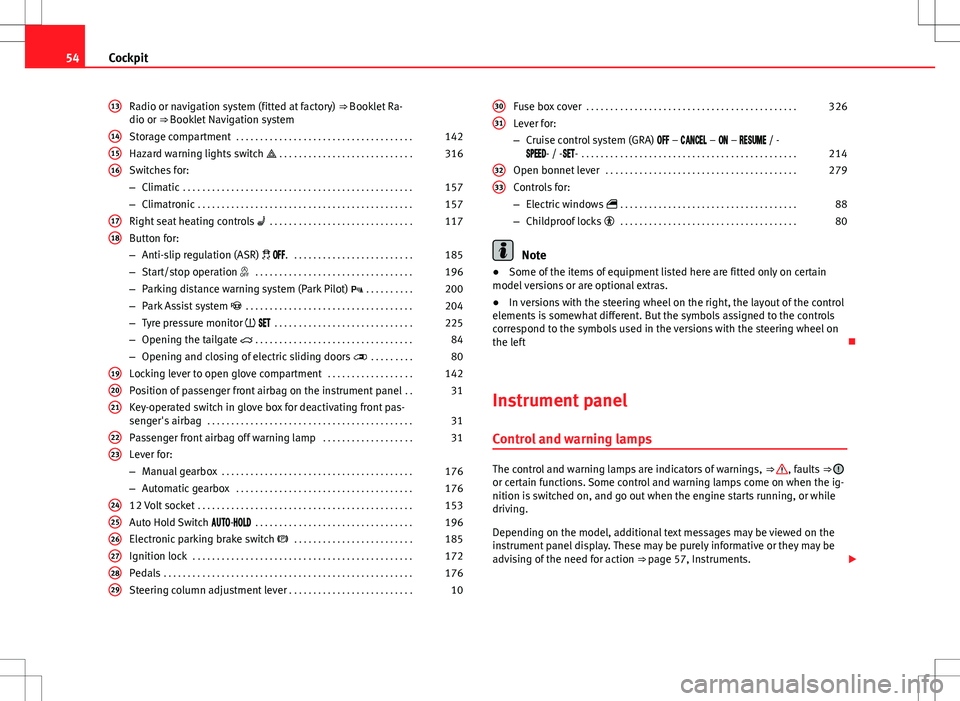
Radio or navigation system (fitted at factory) ⇒ Booklet Ra-
dio or ⇒ Booklet Navigation system
Storage compartment . . . . . . . . . . . . . . . . . . . . . . . . . . . . . . . . . . . . . 142
Hazard warning lights switch . . . . . . . . . . . . . . . . . . . . . . . . . . . . 316
Switches for:
– Climatic . . . . . . . . . . . . . . . . . . . . . . . . . . . . . . . . . . . . . . . . . . . . . . . . 157
– Climatronic . . . . . . . . . . . . . . . . . . . . . . . . . . . . . . . . . . . . . . . . . . . . . 157
Right seat heating controls . . . . . . . . . . . . . . . . . . . . . . . . . . . . . . 117
Button for:
– Anti-slip regulation (ASR) . . . . . . . . . . . . . . . . . . . . . . . . . . 185
– Start/stop operation . . . . . . . . . . . . . . . . . . . . . . . . . . . . . . . . . 196
– Parking distance warning system (Park Pilot) . . . . . . . . . . 200
– Park Assist system . . . . . . . . . . . . . . . . . . . . . . . . . . . . . . . . . . . 204
– Tyre pressure monitor . . . . . . . . . . . . . . . . . . . . . . . . . . . . . 225
– Opening the tailgate . . . . . . . . . . . . . . . . . . . . . . . . . . . . . . . . . 84
– Opening and closing of electric sliding doors . . . . . . . . . 80
Locking lever to open glove compartment . . . . . . . . . . . . . . . . . .142
Position of passenger front airbag on the instrument panel . .31
Key-operated switch in glove box for deactivating front pas-
senger's airbag . . . . . . . . . . . . . . . . . . . . . . . . . . . . . . . . . . . . . . . . . . . 31
Passenger front airbag off warning lamp . . . . . . . . . . . . . . . . . . .31
Lever for:
– Manual gearbox . . . . . . . . . . . . . . . . . . . . . . . . . . . . . . . . . . . . . . . . 176
– Automatic gearbox . . . . . . . . . . . . . . . . . . . . . . . . . . . . . . . . . . . . . 176
12 Volt socket . . . . . . . . . . . . . . . . . . . . . . . . . . . . . . . . . . . . . . . . . . . . . 153
Auto Hold Switch - . . . . . . . . . . . . . . . . . . . . . . . . . . . . . . . . . 196
Electronic parking brake switch . . . . . . . . . . . . . . . . . . . . . . . . . 185
Ignition lock . . . . . . . . . . . . . . . . . . . . . . . . . . . . . . . . . . . . . . . . . . . . . . 172
Pedals . . . . . . . . . . . . . . . . . . . . . . . . . . . . . . . . . . . . . . . . . . . . . . . . . . . . 176
Steering column adjustment lever . . . . . . . . . . . . . . . . . . . . . . . . . . 10
13
141516
1718
192021
2223
242526272829
Fuse box cover
. . . . . . . . . . . . . . . . . . . . . . . . . . . . . . . . . . . . . . . . . . . . 326
Lever for:
– Cruise control system (GRA) – – – / -
- / -- . . . . . . . . . . . . . . . . . . . . . . . . . . . . . . . . . . . . . . . . . . . . . 214
Open bonnet lever . . . . . . . . . . . . . . . . . . . . . . . . . . . . . . . . . . . . . . . . 279
Controls for:
– Electric windows . . . . . . . . . . . . . . . . . . . . . . . . . . . . . . . . . . . . . 88
– Childproof locks . . . . . . . . . . . . . . . . . . . . . . . . . . . . . . . . . . . . . 80
Note
● Some of the items of equipment listed here are fitted only on certain
model versions or are optional extras.
● In versions with the steering wheel on the right, the layout of the control
elements is somewhat different. But the symbols assigned to the controls
correspond to the symbols used in the versions with the steering wheel on
the left
Instrument panel Control and warning lamps
The control and warning lamps are indicators of warnings, ⇒ , faults ⇒ or certain functions. Some control and warning lamps come on when the ig-
nition is switched on, and go out when the engine starts running, or while
driving.
Depending on the model, additional text messages may be viewed on the
instrument panel display. These may be purely informative or they may be
advising of the need for action ⇒ page 57, Instruments.
30
31
3233
Page 58 of 388
56Cockpit
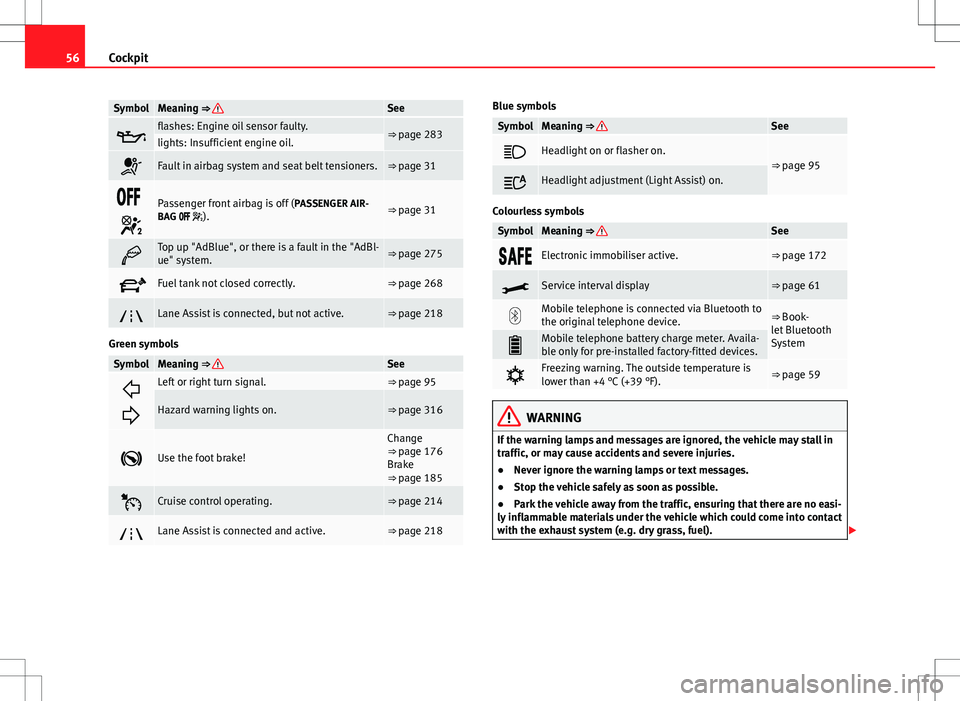
SymbolMeaning ⇒ See
flashes: Engine oil sensor faulty.⇒ page 283lights: Insufficient engine oil.
Fault in airbag system and seat belt tensioners.⇒ page 31
Passenger front airbag is off ( PASSENGER AIR-
BAG ).⇒ page 31
Top up "AdBlue", or there is a fault in the "AdBl-
ue" system.⇒ page 275
Fuel tank not closed correctly.⇒ page 268
Lane Assist is connected, but not active.⇒ page 218
Green symbols
SymbolMeaning ⇒ See
Left or right turn signal.⇒ page 95
Hazard warning lights on.⇒ page 316
Use the foot brake!
Change
⇒ page 176
Brake
⇒ page 185
Cruise control operating.⇒ page 214
Lane Assist is connected and active.⇒ page 218
Blue symbols
SymbolMeaning ⇒ See
Headlight on or flasher on.⇒ page 95
Headlight adjustment (Light Assist) on.
Colourless symbols
SymbolMeaning ⇒ See
Electronic immobiliser active.⇒ page 172
Service interval display⇒ page 61
Mobile telephone is connected via Bluetooth to
the original telephone device.⇒ Book-
let Bluetooth
System
Mobile telephone battery charge meter. Availa-
ble only for pre-installed factory-fitted devices.
Freezing warning. The outside temperature is
lower than +4 °C (+39 °F).⇒ page 59
WARNING
If the warning lamps and messages are ignored, the vehicle may stall in
traffic, or may cause accidents and severe injuries.
● Never ignore the warning lamps or text messages.
● Stop the vehicle safely as soon as possible.
● Park the vehicle away from the traffic, ensuring that there are no easi-
ly inflammable materials under the vehicle which could come into contact
with the exhaust system (e.g. dry grass, fuel).
Page 77 of 388

75
Unlocking and locking
● Electric windows ⇒ page 88
● Panorama sliding sunroof ⇒ page 92
● Towing mode ⇒ page 237
● Emergency locking and unlocking ⇒ page 318
WARNING
The incorrect use of the central locking system may cause serious inju-
ries.
● The central locking system will lock all doors. A vehicle locked from
the inside can prevent any non-authorised individual from opening the
doors and accessing the vehicle. Nevertheless, in case of emergency or
accident, locked doors will complicate access to the passenger compart-
ment to help the passengers.
● Never leave children or disabled people alone in the vehicle. The cen-
tral locking button can be used to lock all the doors from within. There-
fore, passengers will be locked inside the vehicle. Individuals locked in
the vehicle can be exposed to very high or very low temperatures.
● Depending on the time of the year, temperatures inside a locked and
closed vehicle can be extremely high or extremely low resulting in seri-
ous injuries and illness or even death, particularly for young children.
● Never leave individuals locked in a closed and locked vehicle. In case
of emergency, they may not be able to exit the vehicle by themselves or
get help.
Description of the central locking system
The central locking system allows all doors and the tailgate to be locked
and unlocked centrally.
● From outside, using the vehicle key.
● From inside, by pushing the central locking button ⇒ page 77. In the submenu Convenience in the Configuration menu, or by visiting a spe-
cialized workshop, special functions of the central locking system can be
switched on or off ⇒ page 62.
In case of a vehicle key fault or central locking system fault, all doors can be
locked or unlocked manually.
Locking the vehicle after the airbags have been deployed
If the airbags are deployed due to an accident, the vehicle will be automati-
cally and completely unlocked. Depending on the amount of damage, the
vehicle can be locked following an accident in the following ways:
FunctionNecessary operationsLocking the vehicle
from within:– Turn off the ignition and turn it on again.
– Push the central locking button .Locking the vehicle
from the outside:– Turn off the ignition and turn it on again.
OR: – Remove the key from the ignition.
– Open any door just once.
– Lock the vehicle with the key.
Safety FirstOperating instructionsPractical tipsTechnical Specifications
Page 119 of 388

117
Seats and storage compartments
Seat functions Introduction
Additional information and warnings
● Adjust the seat position ⇒ page 10
● Seat belts ⇒ page 21
● Airbag system ⇒ page 31
● Child seats (accessories) ⇒ page 39
● Integrated child seats ⇒ page 45
● Exterior mirrors ⇒ page 110
● Luggage compartment ⇒ page 126
WARNING
Inappropriate use of the seat functions can cause severe injuries.
● Assume the proper sitting position before your trip and remain in it
throughout. This also applies to the other occupants.
● Only adjust the seat position memory when the vehicle is stationary.
● Only switch the lumbar massage function on and off when the vehicle
is stationary.
● Keep hands, fingers, feet and other limbs away from the seat operat-
ing and adjustment radius.
Seat heating*
Fig. 78 Detailed view of
the centre console: front
seat heating controls,
here with the second
temperature level set.
Fig. 79 Detailed view of
the centre console: con-
trols for the front seat
heating in vehicles
equipped with Climatron-
ic.
The seat cushions can be heated electrically when the ignition is switch on.
The backrest is also heated in some versions.
Switch off seat heating if there is nobody in the seat.
Safety FirstOperating instructionsPractical tipsTechnical Specifications
Page 124 of 388
122Seats and storage compartments
The front passenger's frontal airbag must be disconnected ⇒ page 31 if ob-
jects are being transported on the folded front passenger's seat.
Folding the backrest of the front passenger's seat
● Remove any objects from the front passenger's seat cushion ⇒
.
● Adjust the front passenger's seat to its lowest position ⇒ page 10.
● Push the head restraint down as far as it will go ⇒ page 10.
● Unlock the backrest of the front passenger's seat in the direction of the
arrow ⇒ fig. 82 1
.
● Fold the backrest of the front passenger's seat forwards in the direction
of the arrow 2
until it is horizontal.
● The backrest of the front passenger's seat must engage safely in its fol-
ded position.
Lifting the backrest of the front passenger seat
● Check that there are no objects or parts of the body in the hinge area.
● Lift the backrest of the front passenger's seat by first unlocking it again
⇒ fig. 83.
● Lift the backrest of the front passenger seat until it is upright. The back-
rest must be engaged.
● The upright backrest of the front passenger's seat must safely engage.
WARNING
Folding and lifting the backrest of the front passenger's seat uncontrolla-
bly or without paying attention may lead to severe injuries.
● Only fold and lift the backrest of the front passenger's seat when the
vehicle is stationary.
● While the backrest of the front passenger's seat is folded, the frontal
airbag must remain disconnected and the PASSENGER AIRBAG OFF light
on.
WARNING (Continued)
● Keep your hands, fingers, feet and other body parts out of the hinges
and the seat locking mechanism when folding and unfolding.
● Mats or other objects can be caught in the hinges of the backrest of
the front passenger's seat. This could prevent the backrest from locking
safely when positioned upright.
● The upright backrest of the front passenger's seat must engage. If the
backrest of the front passenger's seat is not locked, it may suddenly
move and cause severe injuries.
WARNING
Seat anchors and hinges exposed when the backrest of the front pas-
senger's seat is folded may lead to severe injuries in the event of an acci-
dent or sudden braking.
● Never carry people or children on the front passenger's seat when the
backrest is folded.
● When the backrest of the front passenger's seat is folded, only the
outer seat behind the driver on the second row of seats may be occupied.
This also applies to children sitting in a child seat.
Page 174 of 388
172Driving
Stopping and starting the engine
Introduction
Immobiliser display
When an invalid key is used or in the event of a system fault, or Immo-
biliser on is displayed on the instrument panel. The engine cannot be star- ted.
Pushing or towing
For technical reasons, the vehicle must not be push- or tow-started. Jump
starting is preferable.
Additional information and warnings:
● Vehicle key set ⇒ page 71
● Changing gear ⇒ page 176
● Braking, stopping and parking ⇒ page 185
● Steering ⇒ page 169
● Start assist systems ⇒ page 196
● Refuelling ⇒ page 268
● Fuel ⇒ page 271
● Emergency locking and unlocking ⇒ page 318
● Jump starting ⇒ page 341
● Tow-starting and towing away ⇒ page 344
WARNING
Turning off the engine while driving will make stopping the vehicle diffi-
cult; this could even result in the loss of control causing an accident with
serious consequences.
● The assisted braking and steering systems, the airbag system, safety
belts and certain safety equipment are only active while the engine is
running.
● The engine should only be switched off when the vehicle is at a
standstill.
WARNING
While the engine is running or starting it could help reduce the risk of se-
rious injury.
● Never start or leave the engine running in poorly ventilated or closed
spaces. Exhaust gas contains carbon monoxide, a toxic, colourless and
odourless gas. Carbon monoxide can cause people to lose conscious-
ness. It can also cause death.
● Never leave the vehicle unattended if the engine is running. The vehi-
cle could move off suddenly or something unexpected could happen re-
sulting in damage and serious injury.
● Never use start boosters. Cold start sprays could explode or increase
the engine speed unexpectedly.
Page 177 of 388
175
Driving
WARNING
Cold start sprays could explode or cause a sudden increase in the engine
speed.
● Never use start boosters.
CAUTION
● An attempt to start the engine while driving or starting the engine imme-
diately after turning it off can cause damage to the engine or starter motor.
● When the engine is cold, avoid high revs and heavy acceleration and do
not make the engine work hard.
● Do not push or tow start the engine. Sunburnt fuel could damage the
catalytic converter.
For the sake of the environment
Do not warm the engine at idle speed; start driving immediately if the visi-
bility is OK. This helps the engine reach operating temperature faster and
reduces emissions.
Note
● For example, if the key battery is very worn or flat, the engine cannot be
started with the starter button. In this case, remove the ignition button from
the lock and insert the key.
● Electrical components with a high power consumption are switched off
temporarily when the engine starts.
● When the engine is started cold, there may be strong vibrations for a few
moments for technical reasons. This is quite normal, and no cause for con-
cern.
● At temperatures below +5 °C (+41 °F), smoke may be given off below the
vehicle when the additional heater is connected. Stopping the engine
Complete operations only in the sequence given:
Step 1.Stopping the vehicle completely
⇒ .
2.Press the brake pedal and keep pressed until step 4 has been
completed.
3.In automatic gearboxes, put the selector lever in position P.4.Connect the electronic parking brake ⇒ page 185.5.Turn the key in the ignition lock to position ⇒ fig. 128 0.6.With a manual gearbox, put the vehicle in first or reverse gear.
WARNING
Never switch off the engine while the vehicle is moving. You may lose
control of the vehicle and there is a risk of serious accident.
● The airbags and belt tensioners do not work when the ignition is
switched off.
● The brake servo does not work with the engine off. To stop, the brake
pedal must be pressed with more force.
● As the power steering does not work if the engine is not running, you
will need more strength to steer than normally.
● If the key is removed from the ignition, the steering may lock and it
will not be possible to steer the vehicle.
CAUTION
If the engine has been driven at high speed for a prolonged period of time,
it may overheat when turned off. To avoid engine damage, allow the engine
to run for approximately two minutes in neutral before switching it off.
Safety FirstOperating instructionsPractical tipsTechnical Specifications
Page 218 of 388
216Driving
FunctionControl position,
control operations
⇒ fig. 152Action
Switching the
speed setting
back on.Press RESUME 1
The stored speed is reached again
and maintained. If no speed has
been set then the vehicle will re-
cord and maintain the actual
speed of the vehicle.
Increasing the
stored speed (dur-
ing CCS setting).Hold down
SPEED + +
Short press:
Increases the speed
at intervals of 10 km/h and re-
cords it.
Long press: the vehicle acceler-
ates while the button remains
pressed. Release the button to
store the current speed.
Reducing the stor-
ed speed (during
CCS setting).Press SPEED – –
Short press:
Reduces the speed at
intervals of 10 km/h and records
it.
Long press: while this remains
pressed, speed is reduced inter-
rupting the accelerator without
using the brakes. Release the but-
ton to store the current speed.
Switching off the
cruise control sys-
tem.Click OFF 2The system is switched off. The
stored speed is deleted.
Travelling down hills with the CCS
When travelling down hills the CCS cannot maintain a constant speed. Slow
the vehicle down using the brake pedal and reduce gears if required.
Automatic off
The cruise control system is switched off automatically or temporarily: ●
If the system detects a fault that could affect the working order of the
CCS.
● If you increase the stored speed by using the accelerator for a certain
time.
● if the brake or clutch pedal is depressed.
● If you change gears.
● If the airbag is triggered.
Page 263 of 388
261
Accessories, parts replacement and modifications
Accessories, parts replacement and modifications Accessories, replacement of parts and
modifications
Introduction
WARNING
The use of spare parts and accessories, or incorrectly performed modifi-
cations or repairs may result in damage to the vehicle, accidents and se-
rious injury.
● SEAT strongly recommends you to only use SEAT approved accesso-
ries and SEAT ®
original spare parts. These parts and accessories have
been specially tested by SEAT for suitability, reliability and safety.
● Have any repairs or modifications carried out at a Technical Service.
Qualified workshops have the necessary tools, diagnostics equipment,
repair information and qualified personnel.
● Only mount parts with the same specifications as the parts fitted at
factory.
● Never mount, fasten or fit objects such as drink holders or telephone
cradles over the covers of the airbag modules or within their radius of ac-
tion.
● Only use wheels and tyre combinations which have been approved by
SEAT for your vehicle type.
Accessories and spare parts
SEAT recommends you consult an Official Service before purchasing acces-
sories and spare parts or consumables. For example, when fitting accesso- ries at a later date, or when replacing a component. A Technical Service will
advise you as to the legal requirements and manufacturer's recommenda-
tions regarding accessories, spare parts and other components.
SEAT recommend you use only approved
SEAT accessories and genuine
SEAT spare parts ®
. These parts and accessories have been specially tested
by SEAT for suitability, reliability and safety. In addition the Technical Serv-
ices will guarantee that the assembly is carried out professionally.
Although we continually monitor the market, SEAT cannot guarantee that
products not approved by SEAT are reliable, safe and suitable for the vehi-
cle. Therefore, SEAT cannot accept liability, even in those cases authorised
by an officially recognised technical inspection office or other official body.
Any retro-fitted equipment which has a direct effect on the vehicle and/or
the way it is driven must be approved by SEAT for use in your vehicle and
bear the e mark (the European Union's authorisation symbol). This includes
cruise control systems or electronically controlled suspension.
If any additional electrical components are fitted which do not serve to con-
trol the vehicle itself, these must bear the mark (European Union manu-
facturer conformity declaration). This includes refrigerator boxes, laptops or
ventilator fans.
WARNING
Unprofessional repairs or modifications to the vehicle may affect the per-
formance of the airbags, resulting in operating faults or fatal accident.
● Never mount, fasten or fit objects such as drink holders or telephone
cradles over the covers of the airbag modules or within their radius of ac-
tion.
● Objects placed over the airbag covers, or within their radius of action,
could lead to serious injury or loss of life if the airbags are triggered.
Safety FirstOperating instructionsPractical tipsTechnical Specifications
Page 268 of 388
266Accessories, parts replacement and modifications
electromagnetic radiation transmitted and the risk to human health. It will
also improve the quality of the connection.
If the phone is used inside the vehicle without the hands-free system, it will
not be securely fastened and will not be connected to the exterior aerial of
the vehicle telephone. Nor will the telephone charge if it is not on the sup-
port. In addition, some calls may break off and the quality of the connection
will be affected.
Mobile phones should only be used inside the vehicle if they are connected
to a hands-free system with an exterior aerial.
WARNING
If the mobile phone is not securely fastened in position, it could be sent
flying around the vehicle in the event of sharp braking, sudden manoeu-
vres or accident, causing injury.
● While driving, mobile phones must be securely fastened in position,
outside the radius of action of the airbags, or safely stowed away.
WARNING
When using a mobile phone without a connection to an exterior aerial,
the maximum permitted levels of electromagnetic radiation may be ex-
ceeded. This is also the case if the aerial has not been correctly installed.
● A minimum of 20 centimetres should be kept between mobile phone
aerials and artificial pacemakers, as mobile telephones may affect the
working of pacemakers.
● Do not carry a mobile phone in your breast pocket directly over the
pacemaker when the phone is switched on.
● If you suspect interference, switch the mobile phone off immediately.
Jacking points for raising vehicle
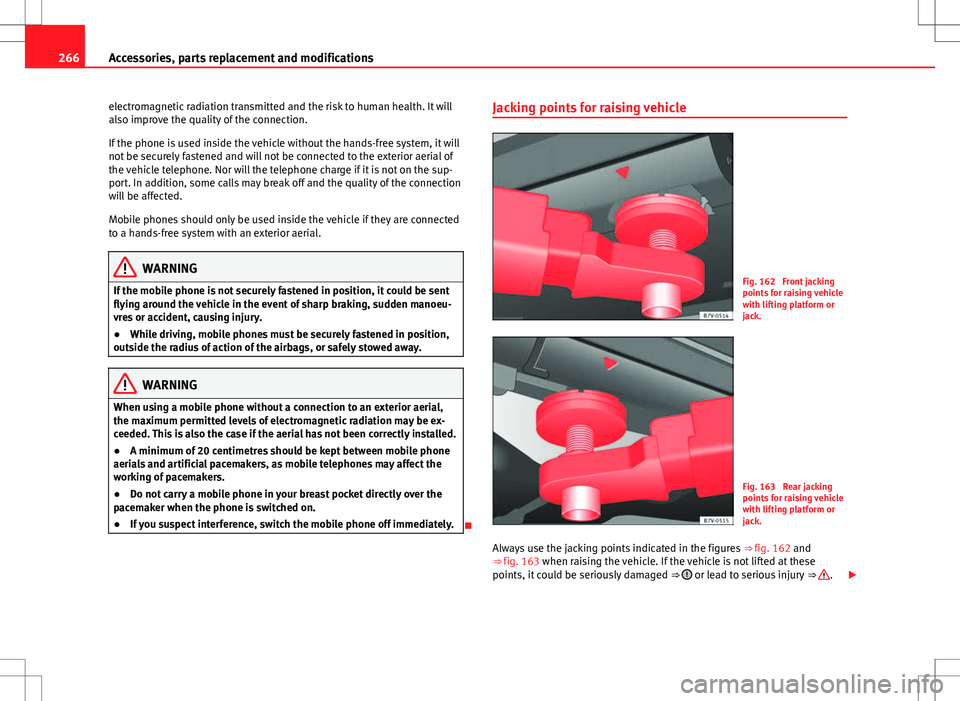
Fig. 162 Front jacking
points for raising vehicle
with lifting platform or
jack.
Fig. 163 Rear jacking
points for raising vehicle
with lifting platform or
jack.
Always use the jacking points indicated in the figures ⇒ fig. 162 and
⇒ fig. 163 when raising the vehicle. If the vehicle is not lifted at these
points, it could be seriously damaged ⇒
or lead to serious injury ⇒ .