fuel type Seat Alhambra 2012 User Guide
[x] Cancel search | Manufacturer: SEAT, Model Year: 2012, Model line: Alhambra, Model: Seat Alhambra 2012Pages: 388, PDF Size: 6.72 MB
Page 274 of 388
272Checking and refilling levels
WARNING
Refuelling or handling fuel carelessly can cause an explosion or fire re-
sulting in serious burns and injuries.
● Fuel is a highly explosive, easily flammable substance.
● Observe current safety instructions and local regulations concerning
the handling of fuel.
Types of fuel
The type of fuel to use when refilling will depend on the vehicle's engine.
You will find a factory-fitted sticker containing information on the type of
fuel for your vehicle on the inside of the fuel tank flap.
SEAT recommends the use of sulphur-free or low sulphur fuel to reduce con-
sumption and prevent engine damage.
Possible types of fuelAlternative namesFurther information
91a)
RONNormal petrol, normal unlea-
ded petrol
⇒ page 27295 a)
RONPremium unleaded petrol (95
RON)
98 a)
RONPremium unleaded petrol (98
RON)
Diesel ⇒ page 273a) RON = Regulation Octane Number Petrol
Petrol types
Vehicles with petrol engines must refuel using unleaded petrol according to
European norm EN 228 ⇒
.
Petrol types are categorised according to their octane number (e.g. 91, 95,
98 or 99 RON (RON = “Research Octane Number”). You may use petrol with
a high octane number than the one recommended for your engine. Howev-
er, this has no advantage in terms of fuel consumption and engine power.
SEAT recommends refuelling with a low sulphur content or sulphur-free pet-
rol to reduce petrol consumption for petrol engines.
Petrol additives
The quality of the fuel influences running behaviour, performance and serv-
ice life of the engine. For this reason, you should use good quality petrol
containing a mixture of additives. These additives will help to prevent corro-
sion, keep the fuel system clean and prevent deposits from building up in
the engine.
If good quality petrol with additives is not available or engine problems
arise, the necessary additives must be added when refuelling.
Not all petrol additives have been shown to be effective. The use of unsuita-
ble petrol additives could damage the engine. These additives are available
from Technical Services, who will inform you of their application.
CAUTION
● Only use fuel with an octane rating that is in line with the norm EN 228,
otherwise significant damage could be caused to the engine and fuel sys-
tem. Furthermore, it could lead to a loss of performance with the conse-
quent engine fault.
● The use of unsuitable petrol additives could damage the engine.
Page 275 of 388
273
Checking and refilling levels
● If, in exceptional circumstances, petrol with a lower octane rating to that
recommended is used, only use moderate engine speeds and a light throt-
tle. Avoid using full throttle and overloading the engine. Otherwise you may
damage the engine. Fill up with fuel of a suitable octane rating as soon as
possible.
● Do not refuel if the filler indicates that the fuel contains metal. LRP (lead
replacement petrol) fuels also contain high concentrations of metal addi-
tives. This could damage the engine!
● Just one full tank of leaded fuel would seriously impair the efficiency of
the catalytic converter and could damage it.
Diesel
Diesel fuel
Diesel fuel must correspond to European standard EN 590 (In Germany,
EN 590 or DIN 51628).
The use of diesel fuel with a high sulphur percentage requires shorter serv-
ice intervals ⇒ Booklet Maintenance Programme ⇒
. Your Technical Serv-
ice will be able to tell you which countries have diesel with a high sulphur
content.
Do not mix fuel additives (thinners, or similar additives) with diesel fuel.
Winter-grade diesel
When using “summer-grade diesel fuel”, difficulties may be experienced at
temperatures below 0 °C (+32 °F) because the fuel thickens due to wax sep-
aration. For this reason, “winter-grade diesel fuel” is available in Germany,
for example, during the cold months. It can be used at temperatures as low
as -20 °C (-4 °F).
In countries with different climatic conditions, other types of diesel fuel are
available that are suitable to local temperatures. Technical Services and fill-
ing stations in the country concerned will inform you on the type of diesel
fuels available. A cold diesel engine makes more noise during winter temperatures than
summer temperatures. Furthermore, the exhaust fumes may turn slightly
bluish while the engine is heating. The quantity of exhaust gases will de-
pend on the outside temperature.
Filter pre-heater
Vehicles with a diesel engine are fitted with a fuel filter pre-heater. This en-
sures that the fuel system remains operational to approx. -24 °C (-11.2 °F),
provided you use winter-grade diesel which is safe to -15 °C (+5 °F).
However, if the fuel has waxed to such an extent that the engine will not
start at temperatures of under -24 °C (-11,2 °F), simply place the vehicle in a
warm garage or workshop for a while to heat up.
Auxiliary heater
Vehicles with a diesel engine may be fitted with an auxiliary heater. The
heater runs off the fuel from the fuel tank. On doing so, smells and steam
may be noticed outside the vehicle for a short period. This is normal and it
is not an indication of a fault in the vehicle.
Whenever there is little fuel in the tank (reserve), the auxiliary heater auto-
matically switches off.
WARNING
Never use start boosters. An aerosol start booster could explode or cause
a sudden rise in engine speed leading to engine damage and serious in-
jury.
Safety FirstOperating instructionsPractical tipsTechnical Specifications
Page 276 of 388
274Checking and refilling levels
CAUTION
● The vehicle is not prepared for the use of biodiesel. Never, under any
circumstances refuel with biodiesel. It could damage the fuel system and
subsequently lead to engine faults!
● The addition of biodiesel to diesel by the diesel producer according to
Standard EN 590 or other equivalent (DIN 51628 in Germany, for example)
is authorised and causes no type of damage to the engine or the fuel
system.
● The diesel engine has been designed for to use diesel fuel exclusively.
Therefore, never use petrol, fuel oil or other unsuitable fuels. The composi-
tion of these fuels may significantly damage the fuel system and the en-
gine.
● The use of diesel fuels with a high sulphur percentage could considera-
bly reduce the service life of the diesel particulate filter. Your Technical Serv-
ice will be able to tell you which countries have diesel with a high sulphur
content.
Information on fuel consumption
The consumption and emission values indicated do not refer to one specific
vehicle. They are only to be used to compare the values of the different ve-
hicle versions. The fuel consumption and CO 2 emissions of a vehicle not on-
ly depend on the effective use of fuel. They also depend on your driving
style and other non-technical factors.
Calculation of fuel consumption
Fuel consumption and emission values are determined according to the cur-
rent version of the 715/2007/EC or 80/1268/EEC regulation and are valid
for the vehicle kerb weight. The specifications do not refer to an individual
vehicle. Two measuring cycles are carried out on a rolling road test bed. The
test criteria are as follows:
Urban cycleMeasurement of the urban cycle starts with an engine cold
start. City driving is then simulated at between 0 and 50 km/
h.
Road cycleIn the road cycle simulation, the car undergoes frequent ac-
celeration and braking in all gears, as in normal everyday
driving. The road speed ranges from 0 to 120 km/h.
CombinedThe average combined consumption is calculated with a
weighting of around 37 % for the urban cycle and 63 % for
the road cycle.
CO 2 emis-
sions of the
combinationThe exhaust gases are collected during both driving cycles
to calculate carbon dioxide emissions (urban and road). The
gas composition is then analysed to evaluate the CO 2 con-
tent and other emissions.
Note
● The kerb weight may vary according to the vehicle equipment. This
could raise consumption and the CO 2 emissions slightly.
● In practice, consumption values could be different to the values calcula-
ted based on the 715/2007/EC or 80/1268/EEC regulations.
Page 280 of 388
278Checking and refilling levels
Opening the tank filling neck
● Open the tailgate.
● Rotate the shut off on the cover clockwise ⇒ fig. 166 and open the cover
forwards.
● Unscrew the tank filler neck cap ⇒ fig. 167 1
anticlockwise.
Refilling AdBlue
Only use AdBlue that is approved by SEAT and that complies with the
ISO 22241-1 Standard. Only use genuine bottles.
● Observe the instructions and information provided by the refill bottle
manufacturer.
● Observe the expiry date.
● Unscrew the cap on the refill bottle.
● Place the refill bottle 2
upside down inside the tank filler neck.
● Press the refill bottle against the filler neck and keep in this position.
● Add at least 10 litres of AdBlue (6 bottles). A lower quantity would be
insufficient.
● Wait until the contents of the refill bottle have been poured into the
AdBlue tank. Do not crush or damage the bottle!
● Unscrew the liquid bottle anticlockwise and remove it carefully ⇒
.
● You can tell when the AdBlue tank is full because the bottle will be emp-
ty.
Closing the tank filling neck
● Screw on the tank filler neck cap 1
clockwise until it is fully inserted.
● Place the cover and turn the shut off anticlockwise to close it.
Operations before driving
● Only switch the ignition on after refilling.
● Keep the ignition switch on for at least 30 seconds so that the system
detects tank refilling.
● Wait 30 seconds before starting the engine!
WARNING
Only keep AdBlue in its original container, tightly shut and in a safe
place.
● Never keep AdBlue in empty food cans, bottles or other containers to
avoid other people mistaking it for something else.
● Keep the AdBlue out of the reach of small children.
CAUTION
● Only refill using AdBlue expressly approved by SEAT. The use of any oth-
er type of AdBlue could cause engine damage!
● AdBlue should never be mixed with water or any other additives. Any
type of damage caused by a mixture will not be covered by the warranty.
● Do not add AdBlue to the diesel fuel tank! Otherwise you may damage
the engine.
● Never leave the refill bottle in the vehicle. It could become permeable
due to temperature changes and bottle damage and the AdBlue could dam-
age the vehicle interior.
For the sake of the environment
Dispose of the refill bottle in an environment-friendly manner.
Note
Suitable AdBlue refill bottles can be purchased from a Technical Service.
Page 301 of 388

299
Wheels and tyres
● Replace damaged or worn tyres as soon as possible ⇒ page 303.
● Regularly check tyres for non-visible damage ⇒ page 303.
● Never exceed the maximum permitted speed or loads specified for the
type of tyre fitted on your vehicle ⇒ page 306.
● Do not allow tyres to come into contact with aggressive substances,
grease, oil, fuel or brake fluid ⇒
.
● Lost valve caps should be replaced immediately.
Tyres with directional tread pattern
Tyres with directional tread pattern have been designed to operate best
when rotating in only one direction. An arrow on the tyre sidewall indicates
the direction of rotation on tyres with directional tread ⇒ page 306. Always
observe the direction of rotation indicated when mounting the wheel. This
guarantees optimum grip and helps to avoid aquaplaning, excessive noise
and wear.
If the tyre is mounted in the opposite direction of rotation, drive with ex-
treme caution, as the tyre is no longer being used correctly. This is of partic-
ular importance when the road surface is wet. Change the tyre as soon as
possible or remount it with the correct direction of rotation.
Interchanging tyres
To ensure that the wear is equal on all tyres the wheels should be changed
round from time to time according to the system ⇒ fig. 177. All the tyres will
then last for about the same time.
SEAT recommends you take the vehicle to a Technical Service to have the
tyres changed.
Tyres that are over 6 years old
Tyres are subject to an ageing process as a result of physical and chemical
processes. This may affect their performance. Tyres which are stored for
long periods of time without being used, harden and become more fragile
than tyres which are in constant use.
SEAT recommends that tyres over six years old are replaced with new tyres.
This also applies to tyres which appear to be in perfect condition on the out- side and which have a tread depth within the values stipulated by the Law
⇒
.
The date of manufacture, part of the tyre identification number (TIN), indi-
cates the age of the tyre ⇒ page 306.
Storing tyres
Mark tyres when you remove them to indicate the direction of rotation (left,
right, forwards, backwards). This ensures you will be able to mount them
correctly when you replace them. When removed, the wheels and/or tyres
should be stored in a cool, dry and preferably dark location. Do not place
tyres mounted on the wheel in a vertical position.
Protect tyres not mounted on wheels from dirt by storing them in suitable
bags and standing them on the ground on their tread.
WARNING
Aggressive fluids or substances could result in visible or invisible dam-
age with the consequent risks.
● Always ensure that tyres do not come into contact with chemical
products, oil, grease, fuel, brake fluid or other aggressive substances.
WARNING
Old tyres, even if they have never been used, may lose air or burst unex-
pectedly while driving, resulting in serious accident or damage.
● If tyres are over six years old, they should only be used in an emer-
gency and with extreme caution.
For the sake of the environment
Old tyres must be disposed of by qualified personnel according to the laws
in the country concerned.
Safety FirstOperating instructionsPractical tipsTechnical Specifications
Page 303 of 388
301
Wheels and tyres
WARNING
New tyres do not give maximum grip and will not have reached their max-
imum braking capacity to start with, and therefore need running in.
● To prevent accidents and major damage, extreme caution should be
taken for the first 600 km (370 miles).
WARNING
There should be adequate space between the tyres and the vehicle in ac-
cordance with the vehicle design. If this is not the case, the tyres may
rub against parts of the running gear, chassis or brake lines, leading to
faults in the brake system or to tread detachment, and the risk of burst
tyres.
● The true tyre dimension should not be greater than the dimensions of
tyres manufactured and approved by SEAT and should not rub against
parts of the vehicle.
Note
● Although tyres may be shown as being the same size, the true dimen-
sions of different types of tyre may vary with respect to the nominal size, or
tread patterns may be different.
● If you use tyres that are approved by SEAT, you can be sure that the true
tyre dimensions will be correct for your vehicle. For other tyre models, the
tyre vendor should provide the manufacturer's certificate with the tyre, indi-
cating that this type of tyre is suitable for your vehicle. This certificate
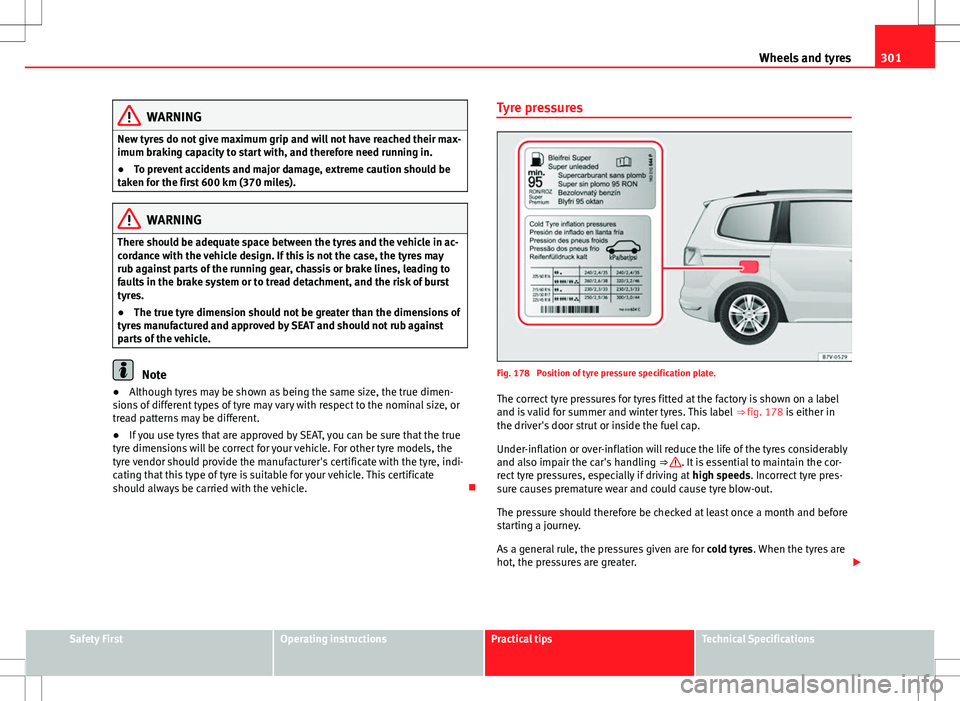
should always be carried with the vehicle. Tyre pressuresFig. 178 Position of tyre pressure specification plate.
The correct tyre pressures for tyres fitted at the factory is shown on a label
and is valid for summer and winter tyres. This label ⇒ fig. 178 is either in
the driver's door strut or inside the fuel cap.
Under-inflation or over-inflation will reduce the life of the tyres considerably
and also impair the car's handling ⇒
. It is essential to maintain the cor-
rect tyre pressures, especially if driving at high speeds. Incorrect tyre pres-
sure causes premature wear and could cause tyre blow-out.
The pressure should therefore be checked at least once a month and before
starting a journey.
As a general rule, the pressures given are for cold tyres. When the tyres are
hot, the pressures are greater.
Safety FirstOperating instructionsPractical tipsTechnical Specifications
Page 307 of 388
305
Wheels and tyres
Please observe all instructions and warnings when using snow chains
⇒ page 305.
WARNING
Although winter tyres help to make driving safer in the winter, you
should not take unnecessary risks.
● Adjust your speed and driving style to visibility, road, traffic and
weather conditions.
● Never exceed the maximum permitted speed or loads specified for the
type of winter tyre fitted on your vehicle.
For the sake of the environment
When winter is over, change back to summer tyres. In temperatures above
+7 °C (+45 °F), performance will be improved if summer tyres are used. Fuel
consumption, wear and noises while driving will all be reduced.
Note
● If the vehicle is fitted with a tyre control system, this should be “reprog-
rammed” whenever a tyre is changed ⇒ page 227.
● Please ask at a Technical Service for information about the permitted
sizes for winter tyres.
Snow chains
When using snow chains, applicable local legislation and maximum permit-
ted speed limits must be observed.
In winter weather, snow chains not only help to improve grip but also im-
prove the braking capacity. Snow chains must only be mounted
on the front wheels, even on all-wheel
drive vehicles, and only with the tyre and rim combinations listed below:
Tyre sizeWheel rim205/60 R166 1/2 J x 16 ET 33
SEAT recommends you ask a Technical Service for further information on
wheel, tyre and chain sizes.
Wherever possible use fine-link chains measuring less than 15 mm (37/64
inch) including the lock.
Remove wheel hub covers and trim rings before fitting snow chains ⇒
.
The wheel bolts should be covered with caps for safety reasons. These are
available from Technical Services.
WARNING
The use of unsuitable or incorrectly fitted chains could lead to serious ac-
cidents and damage.
● Always the appropriate snow chains.
● Observe the fitting instructions provided by the snow chain manufac-
turer.
● Never exceed the maximum permitted speeds when driving with snow
chains.
CAUTION
● Remove the snow chains to drive on roads without snow. Otherwise they
will impair handling, damage the tyres and wear out very quickly.
● Wheel rims may be damaged or scratched if the chains come into direct
contact with them. SEAT recommends the use of covered snow chains.
Note
Snow chains are available in different sizes according to the vehicle type.
Safety FirstOperating instructionsPractical tipsTechnical Specifications
Page 369 of 388

367
Technical specifications
Dimensions and capacities
DimensionsLength, width 4854 mm1904 mmHeight at kerb weight 1720 mmFront and rear projection Wheelbase 2919 mmTurning circle
Track width a)FrontRear1557 – 1569 mm1605 – 1617 mmCapacitiesFuel tank 70 litres. Reserve 8 litres.Windscreen washer fluid container with headlight washer 3.5 l/ 6 lTyre pressureSummer-grade tyres:The correct tyre pressure can be seen on the sticker on the inside of the tank flap.Winter tyres:The pressure of these tyres is the same as the summer tyre pressure plus 0.2 bar.a)
This data will change depending on the type of wheel rim.
CAUTION
● Special care should be taken when parking in areas with high kerbs or
fixed barriers. Objects protruding from the ground may damage the bumper
or other parts of the vehicle during manoeuvres.
● Special attention is required when driving through entrances, over
ramps, kerbs or other objects. The vehicle underbody, bumpers, mudguards
and running gear, and the engine and exhaust system could be damaged as
you drive over these objects.
Safety FirstOperating instructionsPractical tipsTechnical Specifications
Page 377 of 388
G 12 plus-plus . . . . . . . . . . . . . . . . . . . . . . 289
Refilling . . . . . . . . . . . . . . . . . . . . . . . . . . . . 290
Specifications . . . . . . . . . . . . . . . . . . . . . . . 289
Engine fault . . . . . . . . . . . . . . . . . . . . . . . . . . . 232
Engine management . . . . . . . . . . . . . . . . . . . . 232 Warning lamp . . . . . . . . . . . . . . . . . . . . . . . 232
Engine oil . . . . . . . . . . . . . . . . . . . . . . . . . . . . . 283 changing . . . . . . . . . . . . . . . . . . . . . . . . . . . 286
Checking the oil level . . . . . . . . . . . . . . . . . 285
Consumption . . . . . . . . . . . . . . . . . . . . . . . 286
Dipstick . . . . . . . . . . . . . . . . . . . . . . . . . . . . 285
Filler opening . . . . . . . . . . . . . . . . . . . . . . . 285
Indicator . . . . . . . . . . . . . . . . . . . . . . . . . . . 283
Specifications . . . . . . . . . . . . . . . . . . . . . . . 284
Topping up . . . . . . . . . . . . . . . . . . . . . . . . . 285
ESC See "Assisted braking systems" . . . . . . . . 191
Event Data Recorder . . . . . . . . . . . . . . . . . . . . . 265
Exhaust gas purification system . . . . . . . . . . . 232 Warning lamp . . . . . . . . . . . . . . . . . . . . . . . 232
Exterior aerial . . . . . . . . . . . . . . . . . . . . . . . . . . 264
Exterior mirrors . . . . . . . . . . . . . . . . . . . . . . . . . 112 Automatically folding exterior mirrors . . . 112
Controlling function . . . . . . . . . . . . . . . . . . 113
Synchronised mirror adjustment . . . . . . . . 112
Vehicle care . . . . . . . . . . . . . . . . . . . . . . . . 249
Extinguisher Driving with a trailer . . . . . . . . . . . . . . . . . . 238
F
Fastening rings . . . . . . . . . . . . . . . . . . . . . . . . . 134 Fault
Electric windows . . . . . . . . . . . . . . . . . . . . . . 90
Park assist system . . . . . . . . . . . . . . . . . . . 205
Parking sensor system . . . . . . . . . . . . . . . . 201
Rear assist . . . . . . . . . . . . . . . . . . . . . . . . . 211
Fault memory Connector . . . . . . . . . . . . . . . . . . . . . . . . . . 265
Faults Air conditioner . . . . . . . . . . . . . . . . . . . . . . 162
Panorama sliding sunroof . . . . . . . . . . . . . . 92
Filling capacity AdBlue tank . . . . . . . . . . . . . . . . . . . . . . . . 276
Filling the tank . . . . . . . . . . . . . . . . . . . . . . . . . 268 Control lamp . . . . . . . . . . . . . . . . . . . . . . . . 269
Diesel . . . . . . . . . . . . . . . . . . . . . . . . . . . . . 270
Fuel . . . . . . . . . . . . . . . . . . . . . . . . . . . . . . . 270
Fuel gauge . . . . . . . . . . . . . . . . . . . . . . . . . 269
Petrol . . . . . . . . . . . . . . . . . . . . . . . . . . . . . . 270
Refilling precautions . . . . . . . . . . . . . . . . . 271
Filter pre-heater . . . . . . . . . . . . . . . . . . . . . . . . 273
Fire extinguisher . . . . . . . . . . . . . . . . . . . . . . . . 318
Fire extinguishers . . . . . . . . . . . . . . . . . . . . . . . 318
First-aid kit Storage . . . . . . . . . . . . . . . . . . . . . . . . . . . . 318
First aid kit . . . . . . . . . . . . . . . . . . . . . . . . . . . . 318
Fitting Tow hitch . . . . . . . . . . . . . . . . . . . . . . . . . . . 243
Floor mats . . . . . . . . . . . . . . . . . . . . . . . . . . . . . 178
Fluids . . . . . . . . . . . . . . . . . . . . . . . . . . . . . . . . 262
Fog light . . . . . . . . . . . . . . . . . . . . . . . . . . . . . . . 98
Folding down rear seats Load space . . . . . . . . . . . . . . . . . . . . . . . . . 128 Folding in exterior mirrors . . . . . . . . . . . . . . . . 112
Folding table . . . . . . . . . . . . . . . . . . . . . . . . . . . 148
Folding the backrest of the front passenger
seat . . . . . . . . . . . . . . . . . . . . . . . . . . . . . . . . 121
Four-wheel-drive Towing . . . . . . . . . . . . . . . . . . . . . . . . . . . . . 345
Front airbags See "Airbag system" . . . . . . . . . . . . . . . . . . 33
Front passenger airbag Deactivating using the key switch . . . . . . . . 35
See "Airbag system" . . . . . . . . . . . . . . . . . . 31
Fuel . . . . . . . . . . . . . . . . . . . . . . . . . . . . . . . . . . 271 Depending on the engine . . . . . . . . . . . . . 272
Diesel . . . . . . . . . . . . . . . . . . . . . . . . . . . . . 273
Filling the tank . . . . . . . . . . . . . . . . . . . . . . 270
Information on consumption . . . . . . . . . . . 274
Petrol . . . . . . . . . . . . . . . . . . . . . . . . . . . . . . 272
Type of fuel . . . . . . . . . . . . . . . . . . . . . . . . . 272
Fuel consumption Economic driving . . . . . . . . . . . . . . . . . . . . 229
Why does fuel consumption increase? . . . 233
Fuel gauge . . . . . . . . . . . . . . . . . . . . . . . . . . . . 269 Control lamp . . . . . . . . . . . . . . . . . . . . . . . . 269
Fuel tank flap Closure . . . . . . . . . . . . . . . . . . . . . . . . . . . . 270
Opening . . . . . . . . . . . . . . . . . . . . . . . . . . . 270
Function control Tow hitch . . . . . . . . . . . . . . . . . . . . . . . . . . . 240
Fuses . . . . . . . . . . . . . . . . . . . . . . . . . . . . . . . . . 326 Fuse box . . . . . . . . . . . . . . . . . . . . . . . . . . . 327
Identification using colours . . . . . . . . . . . . 327
Identifying blown fuses . . . . . . . . . . . . . . . 328
375
Index
Page 381 of 388
Parking light . . . . . . . . . . . . . . . . . . . . . . . . . . . . 98
Parking sensor system . . . . . . . . . . . . . . . 200, 201Fault . . . . . . . . . . . . . . . . . . . . . . . . . . . . . . 201
Optical parking system . . . . . . . . . . . . . . . 202
With towing bracket . . . . . . . . . . . . . . . . . . 201
Particulate filter . . . . . . . . . . . . . . . . . . . . . . . . 233
Pedals . . . . . . . . . . . . . . . . . . . . . . . . . . . . . 12, 178
Petrol Additives . . . . . . . . . . . . . . . . . . . . . . . . . . . 272
Filling the tank . . . . . . . . . . . . . . . . . . . . . . 270
Fuel . . . . . . . . . . . . . . . . . . . . . . . . . . . . . . . 272
Fuel gauge . . . . . . . . . . . . . . . . . . . . . . . . . 269
Types . . . . . . . . . . . . . . . . . . . . . . . . . . . . . . 272
Plates . . . . . . . . . . . . . . . . . . . . . . . . . . . . . . . . 259
Polishing . . . . . . . . . . . . . . . . . . . . . . . . . . . . . . 251
Portable waste bin . . . . . . . . . . . . . . . . . . . . . . 148
Pre-heating . . . . . . . . . . . . . . . . . . . . . . . . . . . . 174
Preparation Checking the engine coolant level . . . . . . 290
Vehicle battery . . . . . . . . . . . . . . . . . . . . . . 294
Work in the engine compartment . . . . . . . 281
Preparations Changing a wheel . . . . . . . . . . . . . . . . . . . 310
Checking the engine oil level . . . . . . . . . . 285
Topping up the engine oil level . . . . . . . . . 285
Preparing for the journey . . . . . . . . . . . . . . . . . . . 7
Principles of physics regarding a frontal colli- sion . . . . . . . . . . . . . . . . . . . . . . . . . . . . . . . . . 19
Protection of vehicle undercarriage . . . . . . . . 252
Pushing . . . . . . . . . . . . . . . . . . . . . . . . . . . . . . . 172 R
Radio reception Aerial . . . . . . . . . . . . . . . . . . . . . . . . . . . . . . 259
Operating faults . . . . . . . . . . . . . . . . . . . . . 260
Rails and attachment element system Baggage net . . . . . . . . . . . . . . . . . . . . . . . . 136
Rails and attachment system . . . . . . . . . . . . . 135
Rain sensor . . . . . . . . . . . . . . . . . . . . . . . . . . . . 108 Control of function . . . . . . . . . . . . . . . . . . . 108
Raising the vehicle Check list . . . . . . . . . . . . . . . . . . . . . . . . . . 314
Jack . . . . . . . . . . . . . . . . . . . . . . . . . . . . . . . 313
Raising vehicle Lifting platform . . . . . . . . . . . . . . . . . . . . . . 266
With a lifting platform . . . . . . . . . . . . . . . . 266
Reading the Fault memory . . . . . . . . . . . . . . . . . . . . . . . 265
Rear assist Fault . . . . . . . . . . . . . . . . . . . . . . . . . . . . . . 211
Mode 1 . . . . . . . . . . . . . . . . . . . . . . . . . . . . 211
Mode 2 . . . . . . . . . . . . . . . . . . . . . . . . . . . . 212
Screen . . . . . . . . . . . . . . . . . . . . . . . . . . . . . 210
Things to note . . . . . . . . . . . . . . . . . . . . . . . 211
User instructions . . . . . . . . . . . . . . . . . . . . 210
Rear Assist . . . . . . . . . . . . . . . . . . . . . . . . . . . . 209
Rear assist systems . . . . . . . . . . . . . . . . . . . . . 209
Rear seats . . . . . . . . . . . . . . . . . . . . . . . . . . . . . 128
Rear shelf . . . . . . . . . . . . . . . . . . . . . . . . . . . . . 131
Rear vision mirror . . . . . . . . . . . . . . . . . . . 110, 111
Rear vision mirrors . . . . . . . . . . . . . . . . . . . . . . 111
Recommended gear . . . . . . . . . . . . . . . . . . . . . 184 Recycling . . . . . . . . . . . . . . . . . . . . . . . . . . . . . . 260
Refilling precautions . . . . . . . . . . . . . . . . . . . . 271
Reflective vest . . . . . . . . . . . . . . . . . . . . . . . . . 318
Reflective vests . . . . . . . . . . . . . . . . . . . . . . . . . 318
Refuelling
Mistakes . . . . . . . . . . . . . . . . . . . . . . . . . . . 269
Remote control Auxiliary heater . . . . . . . . . . . . . . . . . . . . . 166
See "Keys" . . . . . . . . . . . . . . . . . . . . . . . . . . 71
Removing ice . . . . . . . . . . . . . . . . . . . . . . . . . . 249
Removing snow . . . . . . . . . . . . . . . . . . . . . . . . 249
Removing wax deposits . . . . . . . . . . . . . . . . . . 249
Repairs . . . . . . . . . . . . . . . . . . . . . . . . . . . 261, 262 Airbag system . . . . . . . . . . . . . . . . . . . . . . . 263
Labels . . . . . . . . . . . . . . . . . . . . . . . . . . . . . 259
Lifting platform . . . . . . . . . . . . . . . . . . . . . . 266
Plates . . . . . . . . . . . . . . . . . . . . . . . . . . . . . 259
Replacement of parts . . . . . . . . . . . . . . . . . . . . 261
Reprogramming control units . . . . . . . . . . . . . 265
Retaining hooks . . . . . . . . . . . . . . . . . . . . . . . . 138
Retro-fitting Two-way radios . . . . . . . . . . . . . . . . . . . . . . 264
Vehicle telephone . . . . . . . . . . . . . . . . . . . 264
Rev counter . . . . . . . . . . . . . . . . . . . . . . . . . . . . . 57
Reversing camera . . . . . . . . . . . . . . . . . . . . . . . 209
Rocker switches Tiptronic . . . . . . . . . . . . . . . . . . . . . . . . . . . 182
Rollback anti-trap function Electric sliding doors . . . . . . . . . . . . . . . . . . 82
Roof carrier system . . . . . . . . . . . . . . . . . . . . . . 139
Rubber seals . . . . . . . . . . . . . . . . . . . . . . . . . . . 252
379
Index