seats Seat Alhambra 2012 Owner's Guide
[x] Cancel search | Manufacturer: SEAT, Model Year: 2012, Model line: Alhambra, Model: Seat Alhambra 2012Pages: 388, PDF Size: 6.72 MB
Page 44 of 388
42Child safety
Always secure child seats properly and safely in the vehicle according to the
child seat manufacturer's installation instructions.
Mounted child seats must rest correctly on the vehicle's seat and must not
move or rock more than 2.5 cm (1 inch).
Child seats equipped for a Top Tether strap must also be secured using the
Top Tether retaining strap in the vehicle ⇒ page 45. Only secure the re-
taining belt to the rings fitted for this purpose and identified as Top Tether.
Not all rings can be used with the Top Tether system. Always tighten the Top
Tether retaining strap so that the child seat fits snugly against the corre-
sponding seat in the vehicle.
Specific mounting systems for each country
Europe: ISOFIX retaining rings and upper retaining strap ⇒ page 44
and ⇒ page 45.
Three-point seat belt and upper retaining strap ⇒ page 44.
The systems include the child restraint system mounting with an upper re-
taining strap (Top Tether) and lower anchoring points on the seat.
Use of the child seat on the front passenger seat
Transporting children on the front passenger seat is not permitted in all
countries. Furthermore, not all child seats are approved for use on the front
passenger seat. Your Technical Service has an updated list of all approved
child seats. Only used child seats that are approved for each vehicle.
The frontal airbag on the front passenger side is highly dangerous for a
child. The front passenger seat is life-threatening to a child if he or she is
transported in a rear-facing child seat.
If a rear-facing child seat is secured to the front passenger seat, an inflating
airbag can strike it with such great force that severe or fatal injuries may re-
sult ⇒
. Therefore, rear-facing child seats must never be used on the front
passenger seat when the front passenger airbag is enabled. A
B
Only use a rear-facing child seat on the front passenger seat if the front pas-
senger airbag is disabled. When it is disabled, the yellow
PASSENGER
AIR BAG control lamp on the instrument panel will be lit ⇒ page 31. If
you cannot disable the front passenger airbag and it remains enabled, it is
forbidden to transport children on the front passenger seat ⇒
.
Things to note if using a child seat on the front passenger seat:
● The front passenger airbag must be disabled if using a rear-facing
child seat ⇒ page 35.
● The backrest of the front passenger seat must be upright.
● The front passenger seat must be moved as far back as possible.
● The backrest of the front passenger seat must be upright.
● The seat belt height adjustment must be as high as possible.
Suitable child seats
The child seat must be authorised by the manufacturer especially for use on
a front passenger seat with a frontal or side airbag.
If the front passenger seat is equipped with retaining rings, the child seat
can be secured using the approved retaining system provided it is approved
for this type of vehicle in accordance with current regulations in the country
in question.
Universal seats for children in groups 0, 0+, 1, 2 or 3 according to the ECE-
R 44 regulation.
WARNING
If a child seat is mounted on the front passenger seat, the risk of the
child sustaining severe or fatal injuries in the event of an accident increa-
ses. Rear-facing child seats must never be mounted on the front passen-
ger seat when the front passenger airbag is enabled. This is life-threaten-
ing to the child should the frontal airbag deploy, as the child seat would
be struck by the inflated airbag and thrown against the backrest.
Page 45 of 388
43
Child safety
WARNING
If, in exceptional circumstances, a child must be transported in a rear-fac-
ing child seat on the front passenger seat, strictly observe the following:
● Always disable the front passenger airbag and leave it disabled.
● The child seat must be approved by the manufacturer for use on a
front passenger seat with frontal and side airbag.
● Follow the installation instructions of the child seat manufacturer and
observe the warnings.
● Move the front passenger seat as far back as possible and adjust it to
its highest position to keep as far away as possible from the frontal air-
bag.
● Move the backrest to the upright position.
● The seat belt height adjustment must be as high as possible.
● Children must always be protected with an approved child restraint
system suited to their height and weight.
Use of the child seat on the rear seat
If a child seat is mounted on the rear seat, adapt the position of the front
passenger seat so that the child has enough space. Therefore, adapt the
front passenger seat to the size of the child seat and the height of the child.
Ensure the passenger is in the correct position ⇒ page 10.
Move the second and third row of seats fully back and lock them. Place the
seat backs in a vertical position and fold the armrests down.
ISOFIX child seats approved for rear seats
The rear seats are suitable for child seats with the ISOFIX system specially
designed for this type of vehicle in accordance with regulation ECE-R 44.
ISOFIX child seats are divided into “specific categories for the vehicle”,
“limited” or “semi-universal”. Child seat manufacturers supply a list of vehicles with each ISOFIX seat,
which includes the models for which the ISOFIX child seat in question is ap-
proved. If the vehicle is included in the manufacturer's list and the ISOFIX
child seat belongs to a seat category included in the list, then it can be
used in your vehicle. If necessary, contact the child seat manufacturer for an
updated list of vehicles.
Group (weight
category)ISOFIX child seat cate- gorySeat position on the rear seats
Group 0: chil-
dren up to 10 kgEIUF a)
Group 0+: chil-
dren up to 13 kgEIUF a)DIUFa)CIUFa)
Group 1: 9 to 18
kg
DIUFa)CIUFa)BIUFa)B1IUFa)AIUFa)a)
IUF: suitable for “universal” ISOFIX child seats authorised for use in this group.
WARNING
If child seats are fitted to all the seats in the second row then it is possi-
ble that the seats of this row cannot be folded down from the third row of
seats in case of an accident. In case of an emergency, passengers in the
third row of seats will not be able to leave the vehicle or to help them-
selves.
● Child seats should not occupy all the seats of the second row if other
passengers are to occupy the third row of seats.
Safety FirstOperating instructionsPractical tipsTechnical Specifications
Page 46 of 388
44Child safety
Securing child seats with the seat belt
Securing the child seat using the seat belt
●Please read and observe the child seat manufacturer's handling instruc-
tions.
● Positioning the child seat on the seat according to the manufacturer's
instructions.
● The seat belt height adjustment must be as high as possible.
● Fasten the seat belt or pass it around the child seat structure in the man-
ner described in the manufacturer's instructions.
● Make sure the seat belt is not twisted.
● Insert the latch plate into the buckle for the appropriate seat and push it
down until it is securely locked with an audible click.
● Ensure that the upper belt web lies tightly on the child seat.
● Pull the belt (it must be no longer possible to pull the lower belt web-
bing out).
Removing the child seat
The seat belt must not be unfastened until the vehicle has come to a stand-
still ⇒
.
● Press the red button on the buckle. The latch plate is released from the
buckle.
● Guide the belt back by hand so that it rolls up easily and the trim will not
be damaged.
● Remove the child seat from the vehicle.
WARNING
Unbuckling the seat belt while the vehicle is in motion can cause severe
or fatal injuries in the event of an accident or sudden braking.
● The seat belt must not be unfastened until the vehicle has come to a
standstill.
Securing the child seat using the lower anchor points
(ISOFIX, LATCH*)
Fig. 27 Version 2: identi-
fication of the anchor
points for the child seat
on the vehicle seat.
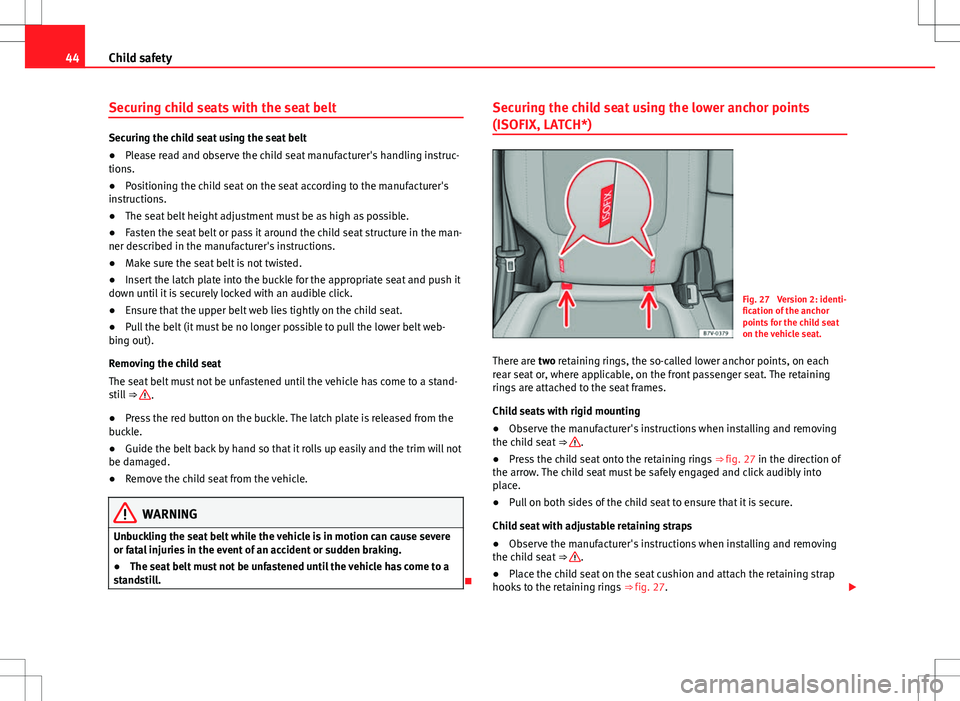
There are two retaining rings, the so-called lower anchor points, on each
rear seat or, where applicable, on the front passenger seat. The retaining
rings are attached to the seat frames.
Child seats with rigid mounting
● Observe the manufacturer's instructions when installing and removing
the child seat ⇒
.
● Press the child seat onto the retaining rings ⇒ fig. 27 in the direction of
the arrow. The child seat must be safely engaged and click audibly into
place.
● Pull on both sides of the child seat to ensure that it is secure.
Child seat with adjustable retaining straps
● Observe the manufacturer's instructions when installing and removing
the child seat ⇒
.
● Place the child seat on the seat cushion and attach the retaining strap
hooks to the retaining rings ⇒ fig. 27.
Page 47 of 388

45
Child safety
● Tighten the straps evenly using the corresponding adjustment device.
The child seat must sit flush against the vehicle seat.
● Pull on both sides of the child seat to ensure that it is secure.
WARNING
The lower anchor points for child seats do not include rings. Only secure
booster seats to lower anchor points.
Securing a child seat using a Top Tether retaining strap
Fig. 28 Upper retaining
strap hooked in the lug-
gage compartment
● Observe the manufacturer's instructions when installing and removing
the child seat ⇒
.
● Raise the head restraint behind the child seat until it engages.
● Secure the child seat to the lower anchor points ⇒ page 44.
● Pull the upper child seat retaining strap back to the backrest of the rear
seat, below or on both sides of the head restraint (depending on the child
seat model). ●
Hook the upper retaining strap to the corresponding retaining ring (for
TOP TETHER) on the back of the backrest on the rear seat ⇒ fig. 28.
● Push the head restraint down as far as it will go. Ensure that it does not
interfere with the seatbelt from the upper attachment.
● Tighten the strap so that the top of the child seat rests on the backrest.
WARNING
Child seats with lower anchor points and with an upper retaining strap
must be installed in line with the manufacturer's instructions. Failure to
comply could result in severe injuries.
● Always secure just one retaining strap from a child seat to a retaining
ring (for TOP TETHER) on backrest on the rear seat in the luggage com-
partment.
● Never secure a child seat to the retaining rings.
● Never secure a child seat to the movable attachment elements for ve-
hicles with an attachment element and rail system .
Integrated child seat Introduction
The integrated child seat is only suitable for children in Group 2 (15-25 kg)
and Group 3 (22-36 kg), according to the ECE-R 44 regulation.
Additional information and warnings:
● Seat belts ⇒ page 21
Safety FirstOperating instructionsPractical tipsTechnical Specifications
Page 49 of 388

47
Child safety
Unfolding the integrated child seat
Fig. 29 Integrated child
seats. lift up the cushion.
Fig. 30 Integrated child seats. position the head re-
straint over the side head restraint A and fit into place
B.
The integrated child seat can be fitted with a side head restraint. SEAT rec-
ommends use of the integrated child seat with the side head restraint fitted
and also that this seat be used only for children above the age of 3.
Safety FirstOperating instructionsPractical tipsTechnical Specifications
Page 50 of 388
48Child safety
Lifting the cushion
● Pull the unlock lever ⇒ fig. 29 A
on the cushion in the direction of the
arrow 1.
● Fold both sides B up in the direction of the arrow 2.
● Push the cushion C back in the direction of the arrow 3 until it engag-
es.
Fitting the side head restraint
● Fold the backrest of the rear seat forwards ⇒ page 117.
● Remove the head restraint.
● Make sure the belt guide handle on the window side is on the side head
restraint ⇒ page 48.
● Insert the guide rods ⇒ fig. 30 1
of the head restraint into the guides
on the side head restraint 2.
● Insert the head restraint and the side head restraint into the guides on
the corresponding backrest B
.
● Push the head restraint down as far as it will go.
● Fold the backrest of the rear seat back.
● Pull the rear seat and the backrest to check whether they are engaged
properly. Seat belt routing on the integrated child seat
Fig. 31 Integrated child
seats. Adjusting the belt
webbing.
Fig. 32 Integrated child
seats. seat belt routing
with guide handle.
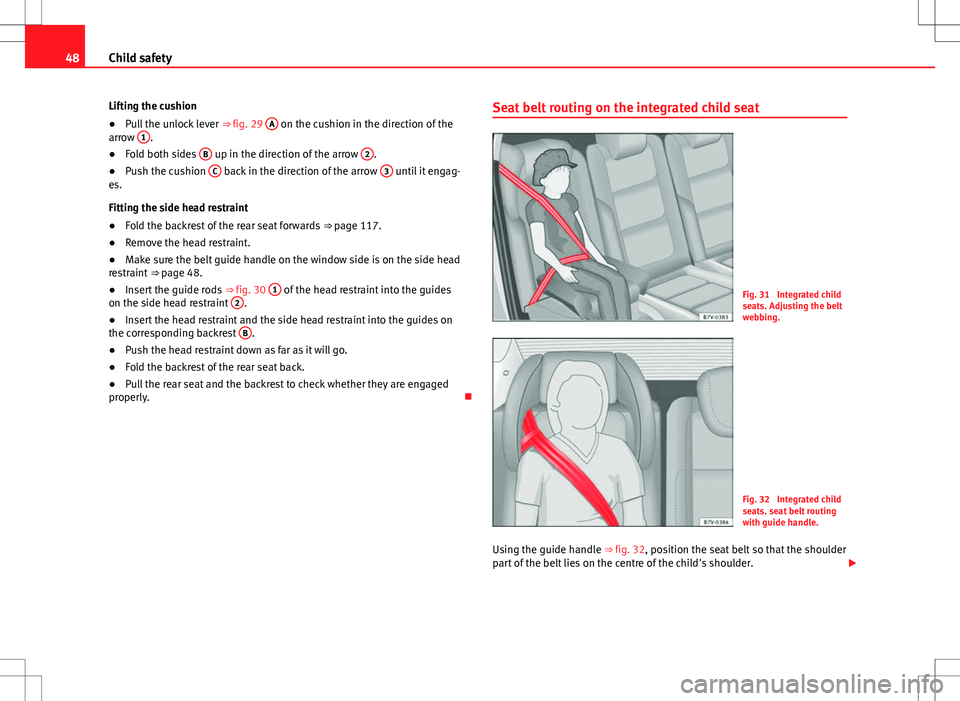
Using the guide handle ⇒ fig. 32, position the seat belt so that the shoulder
part of the belt lies on the centre of the child's shoulder.
Page 51 of 388

49
Child safety
Seat belt guide handle
● Secure the seat belt guide handle to the side head restraint on the win-
dow side. The guide handle is secured by a button.
● Open the upper button on the seat belt guide handle and pass the belt
webbing below the side head restraint and through the guide handle.
● Close the button again.
Adjusting the belt routing
● Guide the automatic three-point seat belt below the side head restraint.
● Pull the latch plate and slowly place the belt webbing across the child's
chest and lap.
● Insert the latch plate into the buckle for the appropriate seat and push it
down until it is securely locked with an audible click.
● Pull the belt to ensure that the latch plate is securely engaged in the
buckle.
WARNING
The seat belt only offers maximum protection from severe or fatal injuries
when it is correctly positioned.
● Children must assume the proper sitting position and be properly bel-
ted in while travelling.
● The shoulder belt must be positioned against the middle of the
shoulder.
● The seat belt must lie flat and fit comfortably.
● Allow the belt to retract until it fits tightly over the child's seat.
● The lap part of the seat belt must lie across the pelvis, never across
the stomach.
● Only one child may occupy a child seat.
Removing the seat belt
Fig. 33 Integrated
child seats. lowering
the cushion.
Lowering the cushion
● Pull the unlock lever ⇒ fig. 33 A
on the cushion in the direction of the
arrow 1.
● Push the cushion down through the central area B in the direction of
the arrow 2 until it safely engages
⇒ . The side supports fold away auto-
matically.
Removing the side head restraint
● Open the seat belt guide handle.
● Guide the seat belt by hand to pull the belt back in more easily and not
damage the trim.
● Push the head restraint up as far as it will go.
● Fold the backrest of the rear seat forwards ⇒ page 117.
● Remove the head restraint along with the side head restraint.
● Remove the head restraint and side head restraint by pulling on it.
● Fitting the head restraint.
Safety FirstOperating instructionsPractical tipsTechnical Specifications
Page 91 of 388

89
Unlocking and locking
WARNING (Continued)
● Always take all the keys with you whenever you leave the vehicle. Af-
ter turning off the ignition, the windows can be opened and closed for a
short time using the buttons on the door as long as the driver's door or
passenger side door is not open.
● When transporting children in the rear seats, always deactivate the
rear electric windows with the child safety lock so that they cannot be
opened and closed.
Opening and closing the electric windows
Fig. 56 In the driver
door: Buttons for front
and rear electric windows
and child safety lock.
Buttons on the driver door
Legend for the fig. 56: For the front electric windows.
For the sliding door electric windows.
To lock the sliding doors and their windows.
1
23
Opening and closing the windows
FunctionNecessary operationsOpening:Press button
.Closing:Push the button .To stop the one
touch function:Press or pull on the corresponding window button.
Press the button for the electronic child safety
lock to deactivate the controls for the windows on
the sliding doors and to lock these doors ⇒ page 80.
The button will light up.
After turning off the ignition, the windows can be opened and closed for a
short time using the buttons on the door as long as the driver's door or pas-
senger side door is not open. When the key is removed from the ignition
and the driver's door is open, all of the electric windows can be opened or
closed using the corresponding button on the driver's door. After a few sec-
onds, the convenience opening or closing function will begin ⇒ page 90.
Electric windows: functions
One-touch opening and closing
The one-touch automatic opening and closing is used to open or close the
windows completely. It will not be necessary to hold the button of the corre-
sponding electric window.
For the one-touch closing function: pull up on the button for the window to
the second position.
For the one-touch opening function: Push down the button for the window
to the second position.
To stop the one touch function: Push or pull on the button of the corre-
sponding window.
Safety FirstOperating instructionsPractical tipsTechnical Specifications
Page 92 of 388
90Unlocking and locking
Restoring one-touch opening and closing
The one-touch opening and closing function is not active after the vehicle
battery has been disconnected or is flat and will have to be reset.
● Close all windows and doors.
● Pull the button of the corresponding window and hold it for one second
in this position.
● Release the button and pull upwards and hold again. The one-touch
function is now ready for operation.
The automatic one-touch electric windows can be reinitialised individually
or several at a time.
Convenience opening and closing function
The electric windows can be opened or closed from outside using the vehi-
cle key:
● Hold in the unlocking for locking button for the vehicle. All windows
which function electrically will be either opened or closed.
● To interrupt the function, release the locking or unlocking button.
During convenience closing, first the windows and then the sliding sunroof
will be closed.
In the Configuration - convenience menu, there are different settings for oper- ating the windows ⇒ page 62.
WARNING
Careless use of the electric windows can cause serious injury.
● Only operate the electric windows when nobody is in the way.
● Never leave children or disabled people alone in the vehicle if the
doors are to be locked. The windows cannot be opened in case of an
emergency.
WARNING (Continued)
● Always take all the keys with you whenever you leave the vehicle. Af-
ter turning off the ignition, the windows can be opened and closed for a
short time using the buttons on the door as long as the driver's door or
passenger side door is not open.
● When transporting children in the rear seats, always deactivate the
rear electric windows with the child safety lock so that they cannot be
opened and closed.
Note
The one-touch function and roll-back function will not work if there is a mal-
function in the electric windows. Visit a specialised workshop.
Electric Windows anti-trap function
The anti-trap function of the electric windows can reduce the risk of injury
when opening and closing the electric windows ⇒ . If a window is not
able to close because it is stiff or because of an obstruction, it will automati-
cally open again.
● Check why the window does not close.
● Attempt to close the window again.
● If you try within the following 10 seconds and the window closes with
difficulty or there is an obstruction once again, the one-touch closing will
stop working for 10 seconds.
● If the window is still obstructed, it will stop at the corresponding posi-
tion. When the button is operated within 10 seconds, the window will close
without the anti-trap function ⇒
.
Page 104 of 388
102Lights and visibility
1
Instrument and switch lighting
When the headlights are switched on, the brightness of the instruments
and switch lighting can be regulated to suit your requirements by turning
the switch ⇒ fig. 62 1
.
2
Headlight range control
The headlight range control 2 is modified according to the value of the
headlight beam and the vehicle load status. This offers the driver optimum
visibility and the headlights do not dazzle oncoming drivers ⇒
.
The headlights can only be adjusted when the dipped beam is switched on.
To reset, turn switch 2
:
ValueVehicle load statusa)–Two front occupants, luggage compartment empty1All seats occupied, luggage compartment empty
2All seats occupied, luggage compartment full. With trailer
and minimum support load
3Driver only, luggage compartment full. With trailer and
maximum support load
a)
If the vehicle load does not correspond to those shown in the table, it is possible to select
intermediary positions.
Dynamic headlight range control
The control 2
is not mounted in vehicles with dynamic headlight range
control. The headlight range is automatically adjusted according to the ve-
hicle load status when the headlights are switched on.
WARNING
Heavy objects in the vehicle may mean that the headlights dazzle and
distract other drivers. This could result in serious accident.
● Adjust the light beam to the vehicle load status so that it does not
blind other drivers.
Interior and reading lights
Button /
SwitchFunction
Switches interior lights off.
Switches interior lights on.
Switches door contact control on (central position).
The interior lights come on automatically when the vehicle is
unlocked, a door is opened or the key is removed from the ig-
nition.
The lights go off a few seconds after all the doors are closed,
the vehicle is locked or the ignition is switched on.
Turning the reading light on and off
Storage and luggage compartment lighting
When the glove box and the tailgate are opened and closed, a light auto-
matically switches on or off.
Ambient lighting
The background lighting in the front covering of the ceiling lights up the
controls on the centre console from above when the side or dipped lights
are on.
In addition, the lever on the door moulding can also be illuminated.
Note
The reading lights go out when the vehicle is locked, or a few minutes after
the key is removed from the ignition. This prevents the battery from dis-
charging.