fuel Seat Alhambra 2012 Workshop Manual
[x] Cancel search | Manufacturer: SEAT, Model Year: 2012, Model line: Alhambra, Model: Seat Alhambra 2012Pages: 388, PDF Size: 6.72 MB
Page 280 of 388
278Checking and refilling levels
Opening the tank filling neck
● Open the tailgate.
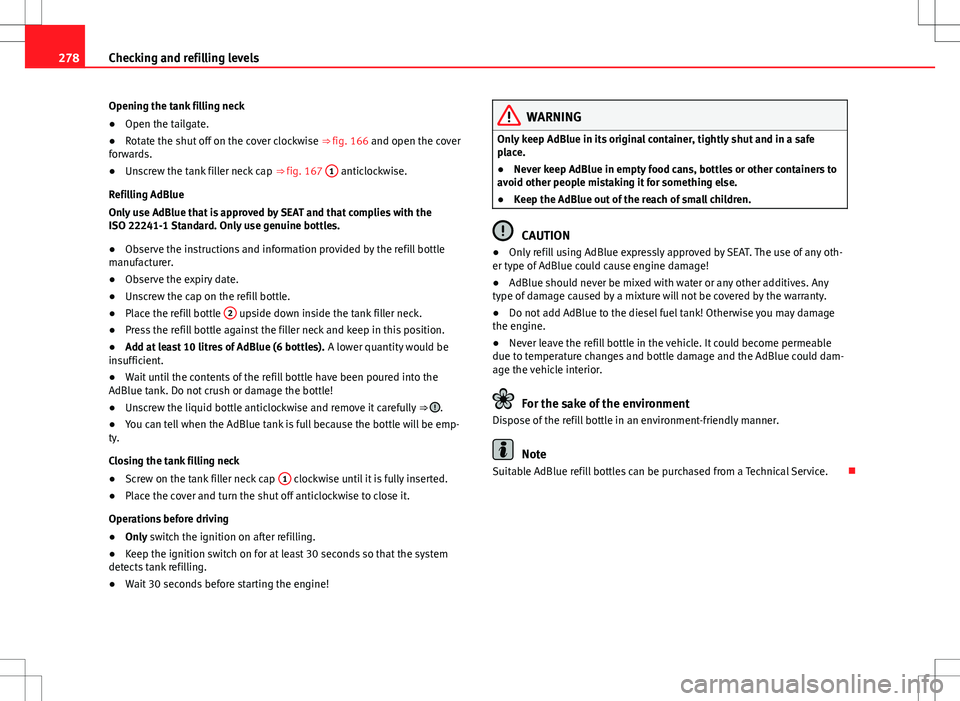
● Rotate the shut off on the cover clockwise ⇒ fig. 166 and open the cover
forwards.
● Unscrew the tank filler neck cap ⇒ fig. 167 1
anticlockwise.
Refilling AdBlue
Only use AdBlue that is approved by SEAT and that complies with the
ISO 22241-1 Standard. Only use genuine bottles.
● Observe the instructions and information provided by the refill bottle
manufacturer.
● Observe the expiry date.
● Unscrew the cap on the refill bottle.
● Place the refill bottle 2
upside down inside the tank filler neck.
● Press the refill bottle against the filler neck and keep in this position.
● Add at least 10 litres of AdBlue (6 bottles). A lower quantity would be
insufficient.
● Wait until the contents of the refill bottle have been poured into the
AdBlue tank. Do not crush or damage the bottle!
● Unscrew the liquid bottle anticlockwise and remove it carefully ⇒
.
● You can tell when the AdBlue tank is full because the bottle will be emp-
ty.
Closing the tank filling neck
● Screw on the tank filler neck cap 1
clockwise until it is fully inserted.
● Place the cover and turn the shut off anticlockwise to close it.
Operations before driving
● Only switch the ignition on after refilling.
● Keep the ignition switch on for at least 30 seconds so that the system
detects tank refilling.
● Wait 30 seconds before starting the engine!
WARNING
Only keep AdBlue in its original container, tightly shut and in a safe
place.
● Never keep AdBlue in empty food cans, bottles or other containers to
avoid other people mistaking it for something else.
● Keep the AdBlue out of the reach of small children.
CAUTION
● Only refill using AdBlue expressly approved by SEAT. The use of any oth-
er type of AdBlue could cause engine damage!
● AdBlue should never be mixed with water or any other additives. Any
type of damage caused by a mixture will not be covered by the warranty.
● Do not add AdBlue to the diesel fuel tank! Otherwise you may damage
the engine.
● Never leave the refill bottle in the vehicle. It could become permeable
due to temperature changes and bottle damage and the AdBlue could dam-
age the vehicle interior.
For the sake of the environment
Dispose of the refill bottle in an environment-friendly manner.
Note
Suitable AdBlue refill bottles can be purchased from a Technical Service.
Page 283 of 388
281
Checking and refilling levels
WARNING (Continued)
● Never pour service fluids over the engine. These fluid may ignite hot
engine parts and cause injuries.
● If it is necessary to work on the fuel system or the electrical system,
please follow the instructions below:
–Always disconnect the vehicle battery. When disconnecting the
battery, ensure that the vehicle is unlocked otherwise the anti-theft
alarm will be triggered.
– Never work close to heaters, heat sources or places exposed to
flames or sparks.
● Always keep a recently serviced and perfectly working fire extin-
guisher close by.
CAUTION
When refilling or changing service liquids, ensure that you put the liquids
into the right tank. Making a mistake when refilling could cause serious
malfunctions and damage the engine!
For the sake of the environment
Service fluids leaks are harmful to the environment. For this reason you
should make regular checks on the ground underneath your vehicle. Take
the vehicle to a specialised workshop to be checked if you see stains, oil or
other fluids on the ground. Collect any spilt service fluids and allow a pro-
fessional to dispose of them.
Preparing the vehicle for work in the engine compartment
Checklist
Carry out the operations below in the order indicated before starting work in
the engine compartment ⇒
: ●
Park the vehicle on an even and solid surface.
● Press and hold the brake pedal until the vehicle comes to a standstill.
● Connect the electronic parking brake ⇒ page 185.
● Move the selector lever to its intermediate position or to P ⇒ page 176.
● Stop the engine and remove the key from the ignition ⇒ page 172.
● Wait for the engine to cool down.
● Always keep children and other people far from the engine compart-
ment.
● Ensure that the vehicle can not move off unexpectedly.
WARNING
Ignoring this checklist, drawn up for your own safety, could result in seri-
ous injury.
● Always complete the operations given in the checklist and observe
the general rules of safety.
Safety FirstOperating instructionsPractical tipsTechnical Specifications
Page 301 of 388

299
Wheels and tyres
● Replace damaged or worn tyres as soon as possible ⇒ page 303.
● Regularly check tyres for non-visible damage ⇒ page 303.
● Never exceed the maximum permitted speed or loads specified for the
type of tyre fitted on your vehicle ⇒ page 306.
● Do not allow tyres to come into contact with aggressive substances,
grease, oil, fuel or brake fluid ⇒
.
● Lost valve caps should be replaced immediately.
Tyres with directional tread pattern
Tyres with directional tread pattern have been designed to operate best
when rotating in only one direction. An arrow on the tyre sidewall indicates
the direction of rotation on tyres with directional tread ⇒ page 306. Always
observe the direction of rotation indicated when mounting the wheel. This
guarantees optimum grip and helps to avoid aquaplaning, excessive noise
and wear.
If the tyre is mounted in the opposite direction of rotation, drive with ex-
treme caution, as the tyre is no longer being used correctly. This is of partic-
ular importance when the road surface is wet. Change the tyre as soon as
possible or remount it with the correct direction of rotation.
Interchanging tyres
To ensure that the wear is equal on all tyres the wheels should be changed
round from time to time according to the system ⇒ fig. 177. All the tyres will
then last for about the same time.
SEAT recommends you take the vehicle to a Technical Service to have the
tyres changed.
Tyres that are over 6 years old
Tyres are subject to an ageing process as a result of physical and chemical
processes. This may affect their performance. Tyres which are stored for
long periods of time without being used, harden and become more fragile
than tyres which are in constant use.
SEAT recommends that tyres over six years old are replaced with new tyres.
This also applies to tyres which appear to be in perfect condition on the out- side and which have a tread depth within the values stipulated by the Law
⇒
.
The date of manufacture, part of the tyre identification number (TIN), indi-
cates the age of the tyre ⇒ page 306.
Storing tyres
Mark tyres when you remove them to indicate the direction of rotation (left,
right, forwards, backwards). This ensures you will be able to mount them
correctly when you replace them. When removed, the wheels and/or tyres
should be stored in a cool, dry and preferably dark location. Do not place
tyres mounted on the wheel in a vertical position.
Protect tyres not mounted on wheels from dirt by storing them in suitable
bags and standing them on the ground on their tread.
WARNING
Aggressive fluids or substances could result in visible or invisible dam-
age with the consequent risks.
● Always ensure that tyres do not come into contact with chemical
products, oil, grease, fuel, brake fluid or other aggressive substances.
WARNING
Old tyres, even if they have never been used, may lose air or burst unex-
pectedly while driving, resulting in serious accident or damage.
● If tyres are over six years old, they should only be used in an emer-
gency and with extreme caution.
For the sake of the environment
Old tyres must be disposed of by qualified personnel according to the laws
in the country concerned.
Safety FirstOperating instructionsPractical tipsTechnical Specifications
Page 303 of 388
301
Wheels and tyres
WARNING
New tyres do not give maximum grip and will not have reached their max-
imum braking capacity to start with, and therefore need running in.
● To prevent accidents and major damage, extreme caution should be
taken for the first 600 km (370 miles).
WARNING
There should be adequate space between the tyres and the vehicle in ac-
cordance with the vehicle design. If this is not the case, the tyres may
rub against parts of the running gear, chassis or brake lines, leading to
faults in the brake system or to tread detachment, and the risk of burst
tyres.
● The true tyre dimension should not be greater than the dimensions of
tyres manufactured and approved by SEAT and should not rub against
parts of the vehicle.
Note
● Although tyres may be shown as being the same size, the true dimen-
sions of different types of tyre may vary with respect to the nominal size, or
tread patterns may be different.
● If you use tyres that are approved by SEAT, you can be sure that the true
tyre dimensions will be correct for your vehicle. For other tyre models, the
tyre vendor should provide the manufacturer's certificate with the tyre, indi-
cating that this type of tyre is suitable for your vehicle. This certificate
should always be carried with the vehicle. Tyre pressuresFig. 178 Position of tyre pressure specification plate.
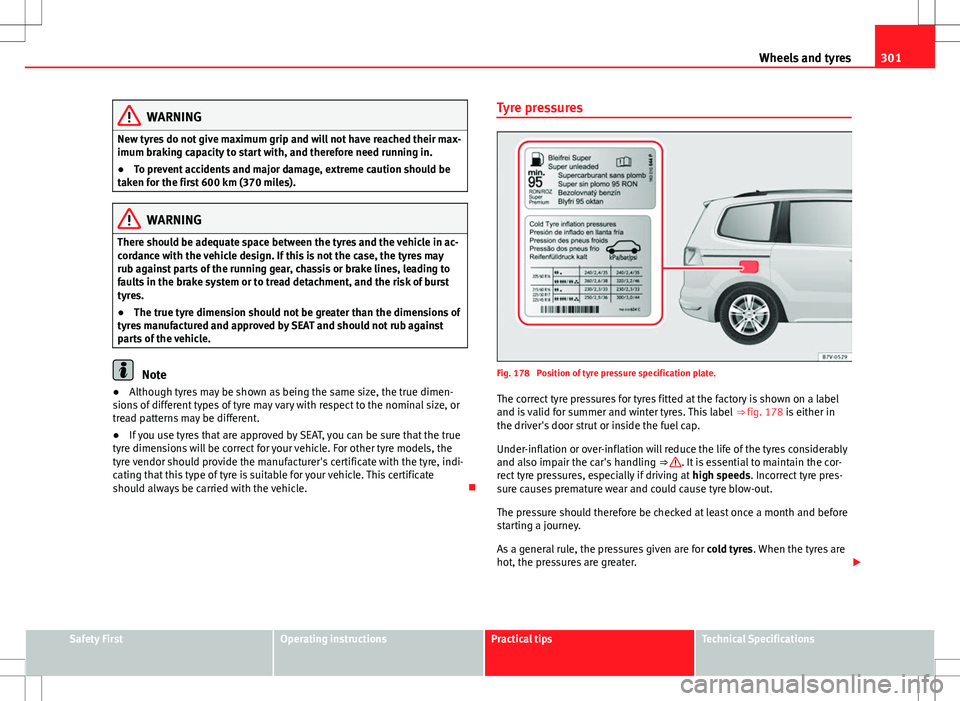
The correct tyre pressures for tyres fitted at the factory is shown on a label
and is valid for summer and winter tyres. This label ⇒ fig. 178 is either in
the driver's door strut or inside the fuel cap.
Under-inflation or over-inflation will reduce the life of the tyres considerably
and also impair the car's handling ⇒
. It is essential to maintain the cor-
rect tyre pressures, especially if driving at high speeds. Incorrect tyre pres-
sure causes premature wear and could cause tyre blow-out.
The pressure should therefore be checked at least once a month and before
starting a journey.
As a general rule, the pressures given are for cold tyres. When the tyres are
hot, the pressures are greater.
Safety FirstOperating instructionsPractical tipsTechnical Specifications
Page 304 of 388
302Wheels and tyres
Never deflate a hot tyre in order to obtain the required pressure. This could
result in very low tyre pressures which may lead to sudden blow-outs.
Checking tyre pressures
Tyre pressures should only be checked when the vehicle has not been driv-
en for more than a few kilometres (miles) at low speeds in the past three
hours.
● The tyre pressures should be checked regularly, and only when the tyres
are cold. Always check all the tyres. Tyre pressures should be checked more
often in colder regions, and only when the vehicle has not been driven re-
cently. Always use a correctly-operating tyre gauge.
● Adjust tyre pressures to the loads carried in the vehicle.
● After checking the pressure, always replace the valve caps, and where
applicable, observe the instructions given for adjusting the tyre control sys-
tem ⇒ page 225.
WARNING
If tyre pressures are too high or too low, the tyre may deflate or burst
suddenly while driving. This could result in serious accident.
● If the tyre pressure is too low, the tyres could overheat, resulting in
tread detachment or even burst tyres.
● When driving at high speeds and/or fully loaded, the tyre could sud-
denly overheat, burst or be subject to tread detachment, with the resul-
tant loss of control of the vehicle.
● Tyre pressures which are too high or too low reduce the service life of
the tyre, affecting the vehicle's performance.
● Tyre pressures should be checked regularly, at least once a month
and before long journeys.
● Adjust the pressures of all the tyres to the vehicle load.
● Never deflate excess pressure from hot tyres.
CAUTION
● Take care not to tilt the manometer when placing it on the valve. Other-
wise, the valve may be damaged.
● To avoid damage to the valves, always replace valve caps correctly.
Check that the caps are identical to the standard caps and have been cor-
rectly tightened.
For the sake of the environment
Under-inflated tyres will increase the fuel consumption.
Note
When checking tyre pressures, please observe the instructions for the tyre
control system ⇒ page 225.
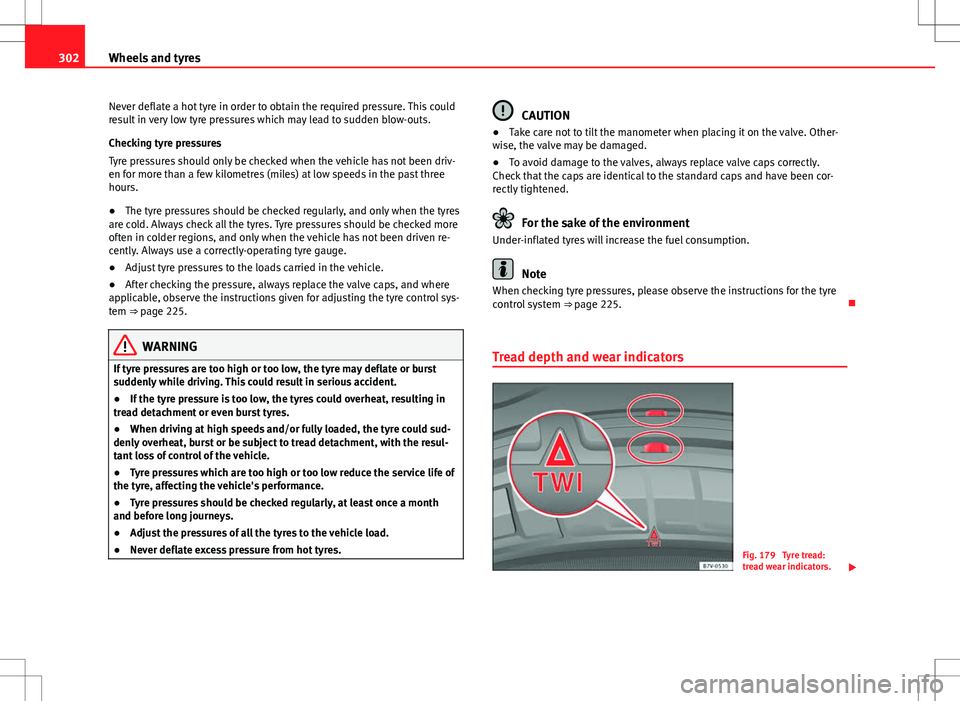
Tread depth and wear indicators
Fig. 179 Tyre tread:
tread wear indicators.
Page 307 of 388
305
Wheels and tyres
Please observe all instructions and warnings when using snow chains
⇒ page 305.
WARNING
Although winter tyres help to make driving safer in the winter, you
should not take unnecessary risks.
● Adjust your speed and driving style to visibility, road, traffic and
weather conditions.
● Never exceed the maximum permitted speed or loads specified for the
type of winter tyre fitted on your vehicle.
For the sake of the environment
When winter is over, change back to summer tyres. In temperatures above
+7 °C (+45 °F), performance will be improved if summer tyres are used. Fuel
consumption, wear and noises while driving will all be reduced.
Note
● If the vehicle is fitted with a tyre control system, this should be “reprog-
rammed” whenever a tyre is changed ⇒ page 227.
● Please ask at a Technical Service for information about the permitted
sizes for winter tyres.
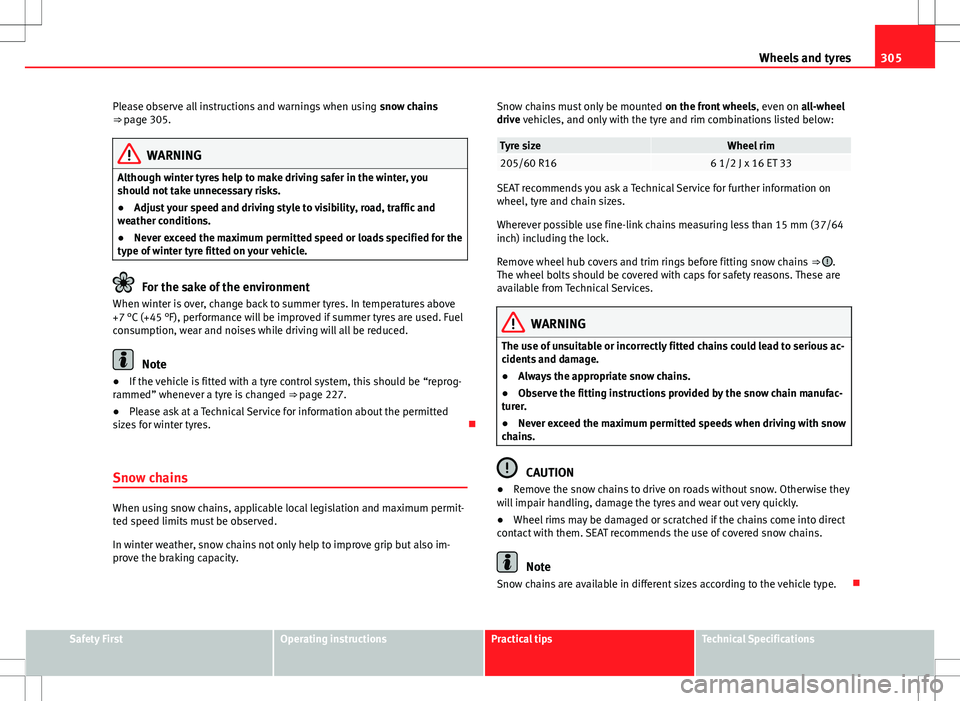
Snow chains
When using snow chains, applicable local legislation and maximum permit-
ted speed limits must be observed.
In winter weather, snow chains not only help to improve grip but also im-
prove the braking capacity. Snow chains must only be mounted
on the front wheels, even on all-wheel
drive vehicles, and only with the tyre and rim combinations listed below:
Tyre sizeWheel rim205/60 R166 1/2 J x 16 ET 33
SEAT recommends you ask a Technical Service for further information on
wheel, tyre and chain sizes.
Wherever possible use fine-link chains measuring less than 15 mm (37/64
inch) including the lock.
Remove wheel hub covers and trim rings before fitting snow chains ⇒
.
The wheel bolts should be covered with caps for safety reasons. These are
available from Technical Services.
WARNING
The use of unsuitable or incorrectly fitted chains could lead to serious ac-
cidents and damage.
● Always the appropriate snow chains.
● Observe the fitting instructions provided by the snow chain manufac-
turer.
● Never exceed the maximum permitted speeds when driving with snow
chains.
CAUTION
● Remove the snow chains to drive on roads without snow. Otherwise they
will impair handling, damage the tyres and wear out very quickly.
● Wheel rims may be damaged or scratched if the chains come into direct
contact with them. SEAT recommends the use of covered snow chains.
Note
Snow chains are available in different sizes according to the vehicle type.
Safety FirstOperating instructionsPractical tipsTechnical Specifications
Page 319 of 388

317
If and when
Move the selector lever to its intermediate position or to P ⇒ page 176.
Stop the engine and remove the key from the ignition ⇒ page 172.
Have all occupants leave the vehicle and move to safety, for example
behind a guard rail.
When leaving the vehicle, take all keys with you.
Place an emergency warning triangle to indicate the position of your ve-
hicle to other road users.
Allow the engine to cool and check if a specialist is required.
Examples of when to use the hazard warning lights:
● If the vehicles ahead suddenly slow down or reach the end of a traffic
jam, to warn the vehicles behind.
● In case of an emergency.
● If the vehicle breaks down.
● When being towed.
Always comply with the applicable laws regarding the use of hazard warn-
ing lights.
If the hazard warning lights are not working, you must use an alternative
method of drawing attention to your vehicle. This method must comply with
traffic legislation.
WARNING
Failure to follow the checklist prepared for your own safety could lead to
accidents and severe injuries.
● Always complete the operations given in the checklist and observe
the general rules of safety.
4.
5.
6.
7.
8.
9.WARNING
The components of the exhaust system reach very high temperatures.
This could cause a fire and considerable damage.
● Always park your vehicle so that no part of the exhaust system can
come in contact with flammable materials (such as dried grass or fuel).
Note
● The vehicle battery will discharge and run down if the hazard warning
lights remain on for too much time (even with the ignition turned off).
● For some vehicles, the brake lights will blink when braking suddenly at
speeds of approximately 80 km/h to warn vehicles behind. If braking con-
tinues, then the hazard warning lights will automatically be turned on at the
speed of less than approximately 10 km an hour. The brake lights remain lit.
Upon accelerating, the hazard warning lights will be automatically turned
off.
Safety FirstOperating instructionsPractical tipsTechnical Specifications
Page 346 of 388
344If and when
WARNING (Continued)
● Do not attach the negative cable to parts of the fuel system or to the
brake hose/pipe.
● The non-insulated parts of the battery clamps must not be allowed to
touch. Also, the cable connected to the positive pole of the battery
should never enter into contact with electrically conductive parts of the
vehicle.
● Check the magic eye on the battery; use a lamp if necessary. If it is
clear yellow or clear, do not start the vehicle: seek specialised technical
assistance.
● Avoid static electricity discharges in the area around the battery. In
the event of sparks, explosive gases coming from the battery could ig-
nite.
● Never use starting assistance if the vehicle battery is damaged, fro-
zen or has been frozen.
Towing and tow starting Introduction
When towing, always respect legal requirements.
For technical reasons, it is not possible to tow a vehicle if the battery is flat.
Additional information and warnings:
● Electronic power control and exhaust gases purification system
⇒ page 232
WARNING
A vehicle with a flat battery should never be towed.
● Never remove the key from the ignition lock. The electronic steering
lock could engage. Then the vehicle will be uncontrollable. You may lose
control of the vehicle and there is a risk of serious accident.
WARNING
When towing the vehicle, the handling and braking efficiency change
considerably. Please observe the following instructions to minimise the
risk of serious accidents and injury:
● As the driver of the vehicle being towed:
– The brake must be depressed must harder as the brake servo does
not operate. Always remain aware to avoid collision with the towing
vehicle.
– More strength is required at the steering wheel as the power steer-
ing does not operate when the engine is switched off.
● As the driver of the towing vehicle:
– Accelerate gently and carefully.
– Avoid sudden braking and manoeuvres.
– Brake well in advance than usual and brake gently.
CAUTION
● Carefully fit and remove the towing ring and its cover to avoid damage to
the vehicle (for example, paintwork).
● When towing, fuel could enter the catalytic converter and cause dam-
age!
Page 347 of 388
345
If and when
Instructions for tow starting
In general, the vehicle should not be started by towing. Jump-starting is
much more preferable ⇒ page 341.
For technical reasons, the following vehicles can not be tow started:
● Vehicles with an automatic gearbox.
● Vehicles with an electronic parking brake, given that it is possible that
the brake will not be disengaged.
● If the vehicle battery is flat, it is possible that the engine control units do
not operate correctly.
However, if your vehicle must absolutely be tow-started (manual gearbox):
● Engage the 2nd or 3rd gear.
● Keep the clutch pressed down.
● Switch on the ignition and the hazard warning lights.
● Release the clutch when both vehicles are moving.
● As soon as the engine starts, press the clutch and move the gear lever
into neutral. This helps to prevent a collision with the towing vehicle.
CAUTION
When tow-starting, fuel could enter the catalytic converter and damage it.
Towing instructions
Tow-rope or tow-bar
When towing, the tow bar is the safest and vehicle friendly way. You should
only use a tow-rope if you do not have a tow-bar. A tow-rope should be slightly elastic to avoid damage to both vehicles. It is
advisable to use a tow-rope made of synthetic fibre or similarly elastic mate-
rial.
Only secure the tow rope or tow bar to the tow ring or specially designed
fitting.
Vehicles with a
factory fitted towing device , can only be used for towing
with a tow-bar, specially designed to fit on a tow hitch ball ⇒ page 237.
Towing vehicles with an automatic gearbox
Note the following for a towed vehicle:
● Make sure the gear selector lever is in the N position.
● Do not drive faster than 50 km/h (30 mph) when towing a vehicle.
● Do not tow further than 50 km (30 miles).
● If a breakdown truck is used, the vehicle must be towed with the front
wheels raised. Note the following instructions for towing four wheel drive
vehicles.
Instructions for towing four-wheel-drive vehicles
Four wheel drive vehicles can be towed using a toolbar or tow rope. If the
vehicle is towed with the front or rear axle raised, the engine must be turned
off to avoid transmission damage.
For vehicles with a double clutched DSG ®
(direct shift gearbox) the instruc-
tions for towing vehicles with an automatic gearbox apply ⇒ page 345.
Situations in which the vehicle should not be towed
In the following cases, the vehicle should not be towed but transported on a
trailer or special vehicle:
● If the vehicle gearbox does not contain lubricant due to a fault.
● If the vehicle battery is flat and, as a result, the electronic steering lock
and electronic parking brake cannot be disengaged if applied.
● If the vehicle to be towed has an automatic gearbox and the distance to
be covered is greater than 50 km (30 miles).
Safety FirstOperating instructionsPractical tipsTechnical Specifications
Page 350 of 388
348Description of specifications
Technical Specifications
Description of specifications
Important information
Important
The information in the vehicle documentation always has
precedence. All technical specifications provided in this manual are valid for the stand-
ard model in Spain. The vehicle data card included in the Inspection and
Maintenance Plan in the vehicle documents shows which engine is installed
in the vehicle.
The figures may be different depending on if additional equipment is fitted,
for different models, for special vehicles and for other countries.
Additional information and warnings:
● Transporting ⇒ page 13
● Ecological driving ⇒ page 229
● Fuel ⇒ page 271
● Engine oil ⇒ page 283
● Engine coolant ⇒ page 287
● Wheels and tyres ⇒ page 297
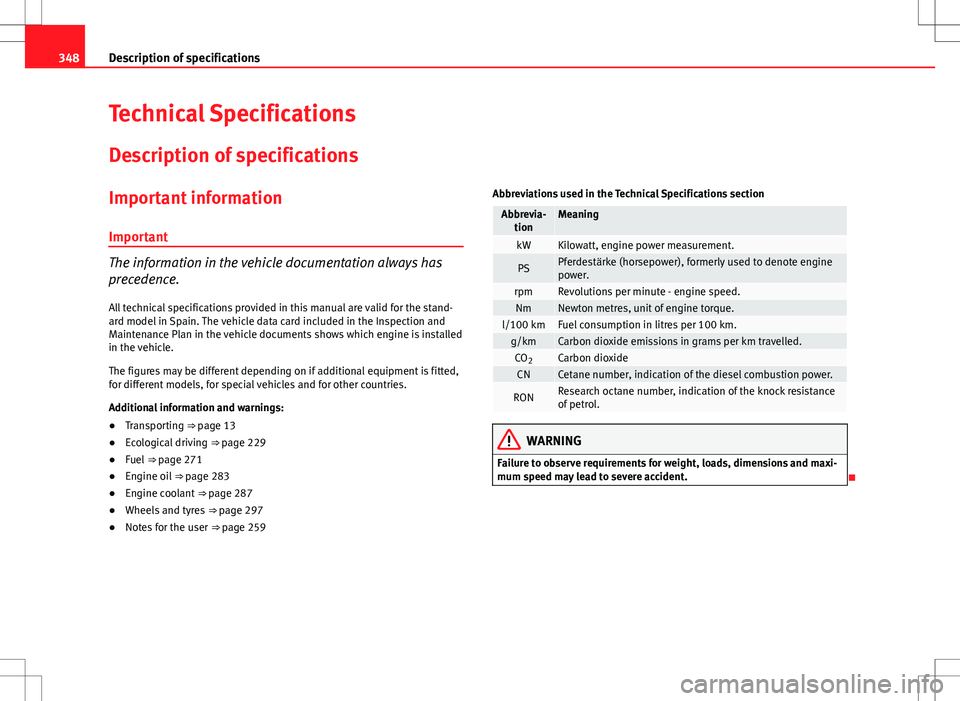
● Notes for the user ⇒ page 259 Abbreviations used in the Technical Specifications section
Abbrevia-
tionMeaning
kWKilowatt, engine power measurement.
PSPferdestärke (horsepower), formerly used to denote engine
power.
rpmRevolutions per minute - engine speed.NmNewton metres, unit of engine torque.l/100 kmFuel consumption in litres per 100 km.g/kmCarbon dioxide emissions in grams per km travelled.CO2Carbon dioxideCNCetane number, indication of the diesel combustion power.
RONResearch octane number, indication of the knock resistance
of petrol.
WARNING
Failure to observe requirements for weight, loads, dimensions and maxi-
mum speed may lead to severe accident.