brake Seat Alhambra 2012 Manual PDF
[x] Cancel search | Manufacturer: SEAT, Model Year: 2012, Model line: Alhambra, Model: Seat Alhambra 2012Pages: 388, PDF Size: 6.72 MB
Page 347 of 388
345
If and when
Instructions for tow starting
In general, the vehicle should not be started by towing. Jump-starting is
much more preferable ⇒ page 341.
For technical reasons, the following vehicles can not be tow started:
● Vehicles with an automatic gearbox.
● Vehicles with an electronic parking brake, given that it is possible that
the brake will not be disengaged.
● If the vehicle battery is flat, it is possible that the engine control units do
not operate correctly.
However, if your vehicle must absolutely be tow-started (manual gearbox):
● Engage the 2nd or 3rd gear.
● Keep the clutch pressed down.
● Switch on the ignition and the hazard warning lights.
● Release the clutch when both vehicles are moving.
● As soon as the engine starts, press the clutch and move the gear lever
into neutral. This helps to prevent a collision with the towing vehicle.
CAUTION
When tow-starting, fuel could enter the catalytic converter and damage it.
Towing instructions
Tow-rope or tow-bar
When towing, the tow bar is the safest and vehicle friendly way. You should
only use a tow-rope if you do not have a tow-bar. A tow-rope should be slightly elastic to avoid damage to both vehicles. It is
advisable to use a tow-rope made of synthetic fibre or similarly elastic mate-
rial.
Only secure the tow rope or tow bar to the tow ring or specially designed
fitting.
Vehicles with a
factory fitted towing device , can only be used for towing
with a tow-bar, specially designed to fit on a tow hitch ball ⇒ page 237.
Towing vehicles with an automatic gearbox
Note the following for a towed vehicle:
● Make sure the gear selector lever is in the N position.
● Do not drive faster than 50 km/h (30 mph) when towing a vehicle.
● Do not tow further than 50 km (30 miles).
● If a breakdown truck is used, the vehicle must be towed with the front
wheels raised. Note the following instructions for towing four wheel drive
vehicles.
Instructions for towing four-wheel-drive vehicles
Four wheel drive vehicles can be towed using a toolbar or tow rope. If the
vehicle is towed with the front or rear axle raised, the engine must be turned
off to avoid transmission damage.
For vehicles with a double clutched DSG ®
(direct shift gearbox) the instruc-
tions for towing vehicles with an automatic gearbox apply ⇒ page 345.
Situations in which the vehicle should not be towed
In the following cases, the vehicle should not be towed but transported on a
trailer or special vehicle:
● If the vehicle gearbox does not contain lubricant due to a fault.
● If the vehicle battery is flat and, as a result, the electronic steering lock
and electronic parking brake cannot be disengaged if applied.
● If the vehicle to be towed has an automatic gearbox and the distance to
be covered is greater than 50 km (30 miles).
Safety FirstOperating instructionsPractical tipsTechnical Specifications
Page 348 of 388
346If and when
Note
The vehicle can only be towed if the electronic parking brake and steering
lock are deactivated. If the vehicle has no power supply or there is an elec-
tric system fault, the engine must be started using jump leads to deactivate
the electronic parking brake and electronic steering lock.
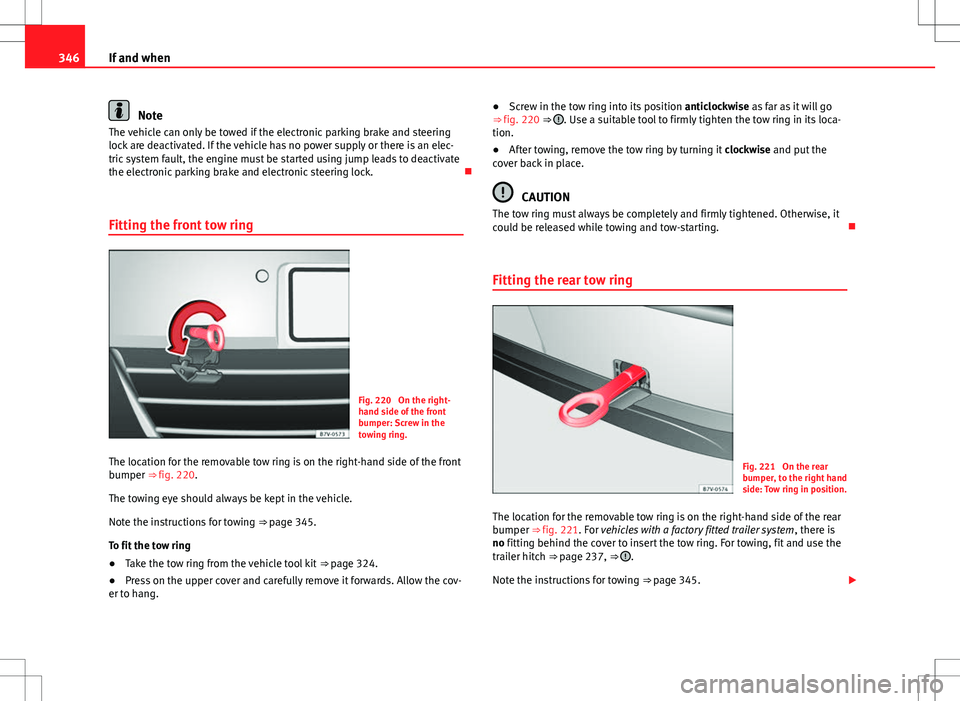
Fitting the front tow ring
Fig. 220 On the right-
hand side of the front
bumper: Screw in the
towing ring.
The location for the removable tow ring is on the right-hand side of the front
bumper ⇒ fig. 220. The towing eye should always be kept in the vehicle.
Note the instructions for towing ⇒ page 345.
To fit the tow ring
● Take the tow ring from the vehicle tool kit ⇒ page 324.
● Press on the upper cover and carefully remove it forwards. Allow the cov-
er to hang. ●
Screw in the tow ring into its position anticlockwise as far as it will go
⇒ fig. 220 ⇒
. Use a suitable tool to firmly tighten the tow ring in its loca-
tion.
● After towing, remove the tow ring by turning it clockwise and put the
cover back in place.
CAUTION
The tow ring must always be completely and firmly tightened. Otherwise, it
could be released while towing and tow-starting.
Fitting the rear tow ring
Fig. 221 On the rear
bumper, to the right hand
side: Tow ring in position.
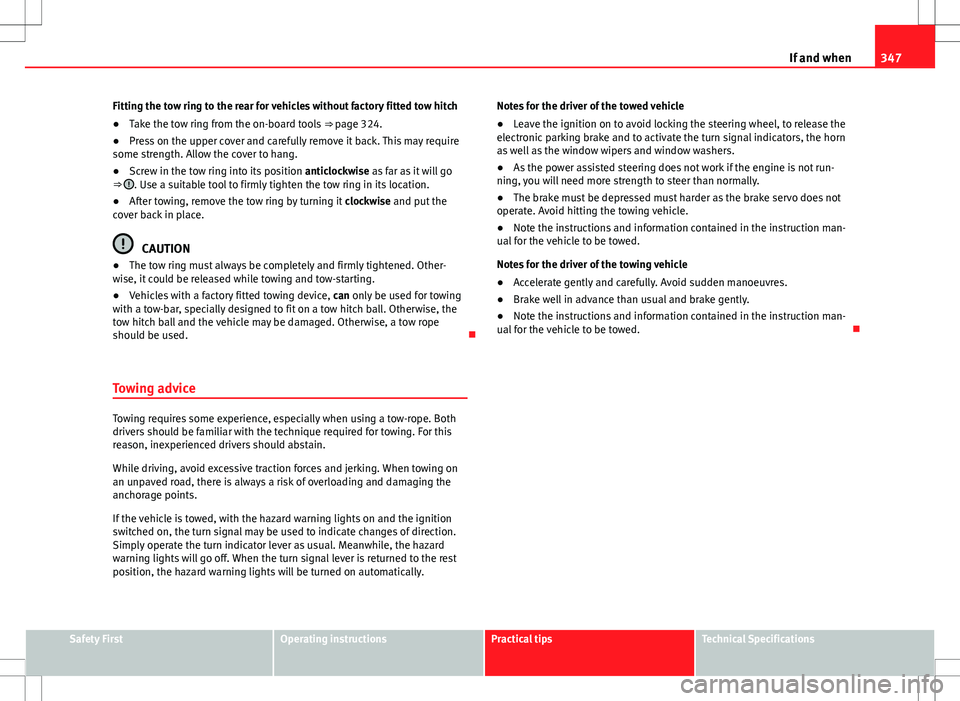
The location for the removable tow ring is on the right-hand side of the rear
bumper ⇒ fig. 221. For vehicles with a factory fitted trailer system , there is
no fitting behind the cover to insert the tow ring. For towing, fit and use the
trailer hitch ⇒ page 237, ⇒
.
Note the instructions for towing ⇒ page 345.
Page 349 of 388
347
If and when
Fitting the tow ring to the rear for vehicles without factory fitted tow hitch
● Take the tow ring from the on-board tools ⇒ page 324.
● Press on the upper cover and carefully remove it back. This may require
some strength. Allow the cover to hang.
● Screw in the tow ring into its position anticlockwise as far as it will go
⇒
. Use a suitable tool to firmly tighten the tow ring in its location.
● After towing, remove the tow ring by turning it clockwise and put the
cover back in place.
CAUTION
● The tow ring must always be completely and firmly tightened. Other-
wise, it could be released while towing and tow-starting.
● Vehicles with a factory fitted towing device, can only be used for towing
with a tow-bar, specially designed to fit on a tow hitch ball. Otherwise, the
tow hitch ball and the vehicle may be damaged. Otherwise, a tow rope
should be used.
Towing advice
Towing requires some experience, especially when using a tow-rope. Both
drivers should be familiar with the technique required for towing. For this
reason, inexperienced drivers should abstain.
While driving, avoid excessive traction forces and jerking. When towing on
an unpaved road, there is always a risk of overloading and damaging the
anchorage points.
If the vehicle is towed, with the hazard warning lights on and the ignition
switched on, the turn signal may be used to indicate changes of direction.
Simply operate the turn indicator lever as usual. Meanwhile, the hazard
warning lights will go off. When the turn signal lever is returned to the rest
position, the hazard warning lights will be turned on automatically. Notes for the driver of the towed vehicle
●
Leave the ignition on to avoid locking the steering wheel, to release the
electronic parking brake and to activate the turn signal indicators, the horn
as well as the window wipers and window washers.
● As the power assisted steering does not work if the engine is not run-
ning, you will need more strength to steer than normally.
● The brake must be depressed must harder as the brake servo does not
operate. Avoid hitting the towing vehicle.
● Note the instructions and information contained in the instruction man-
ual for the vehicle to be towed.
Notes for the driver of the towing vehicle
● Accelerate gently and carefully. Avoid sudden manoeuvres.
● Brake well in advance than usual and brake gently.
● Note the instructions and information contained in the instruction man-
ual for the vehicle to be towed.
Safety FirstOperating instructionsPractical tipsTechnical Specifications
Page 352 of 388
350Description of specifications
Information on fuel consumption
Fuel consumption
The consumption and emission details shown on the vehicle
data sticker differ from one vehicle to another.
The fuel consumption, CO 2 emissions and actual kerb weight of the vehicle
are noted on the vehicle data sticker.
The fuel consumption and emissions figures given are based on the vehicle
weight category, which is determined according to the engine/gearbox
combination and the equipment fitted.
The consumption and emission figures are calculated in accordance with
the EC test requirements 1999/100/EC. These test requirements specify a
realistic test method based on normal everyday driving.
The following test conditions are applied:
Urban cycleThe urban cycle starts with an engine cold start. City driving
is then simulated.
Extra urban
cycleIn the extra urban cycle simulation the vehicle frequently ac-
celerates and brakes in all gears, as in normal everyday driv-
ing. The road speed ranges from 0 to 120 km/h.
Total con-
sumptionThe average total consumption is calculated with a weight-
ing of around 37% for the urban cycle and 63% for the extra
urban cycle.
CO 2 emis-
sionsThe exhaust gases are collected during both driving cycles
to calculate carbon dioxide emissions. The gas composition
is then analysed to evaluate the CO 2 content and other
emissions.
Note
● Actual consumption may vary from quoted test values, depending on
personal driving style, road and traffic conditions, the weather and the vehi-
cle condition.
Weights
Kerb weight refers to the basic model with a fuel tank filled to 90% capacity
and without optional extras. The figure quoted includes 75 kg to allow for
the weight of the driver.
For special versions and optional equipment fittings or for the addition of
accessories, the weight of the vehicle will increase ⇒
.
WARNING
● Please note that the centre of gravity may shift when transporting
heavy objects; this may affect the vehicle's handling and lead to an acci-
dent. Always adjust your speed and driving style to suit road conditions
and requirements.
● Never exceed the gross axle weight rating or the gross vehicle weight
rating. If the allowed axle load or the allowed total weight is exceeded,
the driving characteristics of the vehicle may change, leading to acci-
dents, injuries and damage to the vehicle.
Page 354 of 388

352Technical specifications
Technical specifications
Checking fluid levels
From time to time, the levels of the different fluids in the ve-
hicle must be checked. Never fill with incorrect fluids, other-
wise serious damage to the engine may be caused.
Fig. 223 Diagram for the location of the various elements Coolant fluid deposit
Engine oil dipstick
Oil filler neck
Brake fluid reservoir
Vehicle battery (underneath a cover)
Windscreen washer fluid reservoir
The checking and refilling of service fluids are carried out on the compo-
nents mentioned above. These operations are described in ⇒ page 279.
Overview
Further explanations, instructions and restrictions on the technical data are
contained as of ⇒ page 348
1
23456
Page 356 of 388

354Technical specifications
Trailer weight Trailer without brakes 750
Trailer with brakes, gradients up to 8% 1800
Trailer with brakes, gradients up to 12% 1800
Engine oil capacity
Approximate engine oil capacity with oil filter change 3,6
Petrol engine 1.4 110 kW (150 PS) Automatic
Engine specifications Power output in kW (PS) rpm 110 (150)/ 5800
Maximum torque in Nm at rpm 240/ 1500-4000
No. of cylinders/capacity in cm3
4/ 1390
Fuel Super 95 RON a)
a)
Research Octane Number = Anti-detonation rating of the petrol.
Performance Maximum speed in km/h 197
Acceleration from 0-80 km/h in sec. 6,6
Acceleration from 0-100 km/h in sec. 9,9
Consumption (litres/100 km)/ CO
2 (g/km)
Urban cycle 9,4/218
Extra-urban cycle 6,6/154
Combined 7,6/178
Page 357 of 388

355
Technical specifications
Weights 5 seats 7 seats
Gross vehicle weight in kg 2310 2500
Weight in running order (with driver) in kg 1742 1790
Gross front axle weight in kg 1190/1240 1190/1240
Gross rear axle weight in kg 1070/1120 1260/1310
Permitted roof load in kg 100 100
Trailer weight
Trailer without brakes 750
Trailer with brakes, gradients up to 8% 1800
Trailer with brakes, gradients up to 12% 1800
Engine oil capacity
Approximate engine oil capacity with oil filter change 3,6
Petrol engine 2.0 147 kW (200 PS) Automatic
Engine specifications Power output in kW (PS) rpm 147 (200)/ 5100
Maximum torque in Nm at rpm 280/ 1700-5000
No. of cylinders/capacity in cm3
4,6/ 1984
Fuel Super 95 RON a)
a)
Research Octane Number = Anti-detonation rating of the petrol.
Performance Maximum speed in km/h 221
Acceleration from 0-80 km/h in sec. 5,8
Acceleration from 0-100 km/h in sec. 8,3
Safety FirstOperating instructionsPractical tipsTechnical Specifications
Page 358 of 388

356Technical specifications
Consumption (litres/100 km)/ CO 2 (g/km)
5 seats 7 seats
Urban cycle 11,5/268 11,6/270
Extra-urban cycle 6,6/155 6,7/156
Combined 8,4/196 8,5/198
Weights
5 seats 7 seats
Gross vehicle weight in kg 2360 2530
Weight in running order (with driver) in kg 1790 1838
Gross front axle weight in kg 1100/1150 1220/1270
Gross rear axle weight in kg 1100/1150 1260/1310
Permitted roof load in kg 100 100
Trailer weight
Trailer without brakes 750
Trailer with brakes, gradients up to 8% 2000
Trailer with brakes, gradients up to 12% 2000
Engine oil capacity
Approximate engine oil capacity with oil filter change 4,6
Page 360 of 388

358Technical specifications
Trailer weight Trailer without brakes 750
Trailer with brakes, gradients up to 8% 2000
Trailer with brakes, gradients up to 12% 2000
Engine oil capacity
Approximate engine oil capacity with oil filter change 4,0
Diesel engine 2.0 TDI CR 100 kW (136 PS)
Engine specifications Power output in kW (PS) rpm 100 (136)/ 4200
Maximum torque in Nm at rpm 320/1750-2500
No. of cylinders/capacity in cm3
4/1968
Fuel Min. 51 CN a)
a)
Cetane Number (cetane index) = Measure of the combustion power of the diesel
Performance Maximum speed in km/h 192
Acceleration from 0-80 km/h in sec. 7,8
Acceleration from 0-100 km/h in sec. 11,1
Consumption (litres/100 km)/ CO
2 (g/km)
5 seats 7 seats
Urban cycle 6,8/179 6,9/182
Extra-urban cycle 4,8/127 4,9/130
Combined 5,5/143 5,6/146
Page 361 of 388

359
Technical specifications
Weights 5 seats 7 seats
Gross vehicle weight in kg 2340 2510
Weight in running order (with driver) in kg 1174 1822
Gross front axle weight in kg 1190/1240 1200/1250
Gross rear axle weight in kg 1100/1150 1260/1310
Permitted roof load in kg 100 100
Trailer weight
Trailer without brakes 750
Trailer with brakes, gradients up to 8% 2200
Trailer with brakes, gradients up to 12% 2200
Engine oil capacity
Approximate engine oil capacity with oil filter change 4,0
Diesel engine 2.0 TDI CR 100 kW (136 PS) Automatic
Engine specifications Power output in kW (PS) rpm 100 (136)/ 4200
Maximum torque in Nm at rpm 320/1750-2500
No. of cylinders/capacity in cm3
4/1968
Fuel Min. 51 CN a)
a)
Cetane Number (cetane index) = Measure of the combustion power of the diesel
Performance Maximum speed in km/h 189
Acceleration from 0-80 km/h in sec. 7,8
Acceleration from 0-100 km/h in sec. 11,1
Safety FirstOperating instructionsPractical tipsTechnical Specifications