seats Seat Alhambra 2012 Manual PDF
[x] Cancel search | Manufacturer: SEAT, Model Year: 2012, Model line: Alhambra, Model: Seat Alhambra 2012Pages: 388, PDF Size: 6.72 MB
Page 156 of 388
154Seats and storage compartments
Note
● Using electrical appliances with the engine stopped and the ignition
switched on will drain the battery.
● Unshielded equipment can cause interference on the radio equipment
and the vehicle's electrical system.
● Interference can occur on the radio's AM waveband if electrical applian-
ces are used near the rear window aerial.
Vehicle sockets
Depending on your vehicle's version, you may have a 12-
volt socket and/or a 230 volt socket.
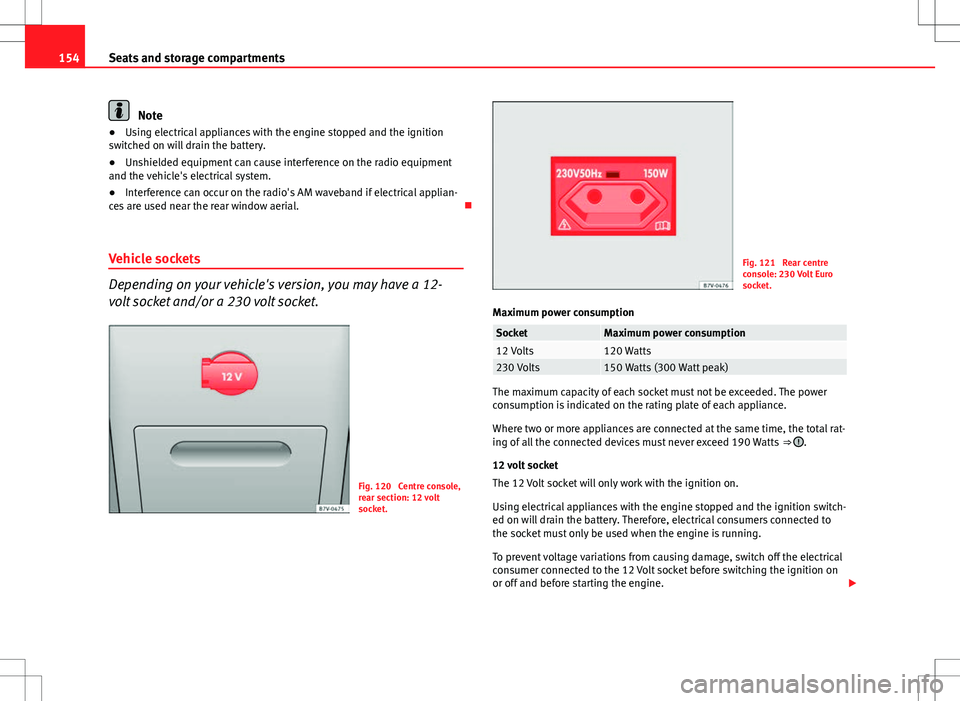
Fig. 120 Centre console,
rear section: 12 volt
socket.
Fig. 121 Rear centre
console: 230 Volt Euro
socket.
Maximum power consumption
SocketMaximum power consumption12 Volts120 Watts230 Volts150 Watts (300 Watt peak)
The maximum capacity of each socket must not be exceeded. The power
consumption is indicated on the rating plate of each appliance.
Where two or more appliances are connected at the same time, the total rat-
ing of all the connected devices must never exceed 190 Watts ⇒
.
12 volt socket
The 12 Volt socket will only work with the ignition on.
Using electrical appliances with the engine stopped and the ignition switch-
ed on will drain the battery. Therefore, electrical consumers connected to
the socket must only be used when the engine is running.
To prevent voltage variations from causing damage, switch off the electrical
consumer connected to the 12 Volt socket before switching the ignition on
or off and before starting the engine.
Page 157 of 388

155
Seats and storage compartments
12 Volt sockets can be found in the following locations in the vehicle:
● Compartment in the centre of the centre console.
● Compartment in the front centre console.
● Storage compartment in the front central armrest.
● Rear centre console ⇒ fig. 120.
● At the rear right of the luggage compartment.
230 Volt Euro socket*
The socket only works when the engine is running ⇒
.
Connecting an electrical appliance: Plug the appliance into the socket as far
as possible to unlock the built-in child safety device. The current only flows
when the child safety device is unlocked.
LED on the socket ⇒ fig. 121Steady green light:The child safety device is unlocked. The
socket can now be used.
Flashing red light:There is some kind of fault (e.g. discon-
nection due to excess current or tempera-
ture).
Heat protection
The 230 Volt Euro power connector converter switches off automatically
when a certain temperature is exceeded. This disconnect prevents overheat-
ing in the event of an increase in power consumption of the connected ap-
pliance and where the atmospheric temperature is too high. The inverter
will switch on again automatically after it has cooled down. Appliances that
are switched on and connected to the socket will start up again. Therefore,
switch off all electrical appliances connected to the socket when the current
converter switches off due to overheating.
WARNING
High voltage in the electrical installation!
● Liquids must not be spilt over the socket.
● Do not plug adapters or extension cords into the 230 Volt Euro power
connector. Otherwise, the built-in child safety device will switch off and
the connector will become live.
● Do not plug current conductors such as a knitting needle into the 230
Volt Euro power connector.
CAUTION
● Always follow the operating instructions for the appliances to be con-
nected!
● Never exceed the maximum power rating as this could damage the vehi-
cle's general electrical system.
● 12 volt socket:
– Only use accessories with approved electromagnetic compatibility ac-
cording to current regulations.
– Never power the socket.
● 230 Volt Euro socket:
– Do not hang appliances or plugs that are too heavy (e.g. a transform-
er) from the socket.
– Do not connect lamps which contain a neon tube.
– Only plug appliances with a voltage that matches the socket voltage
into the socket.
– In the event of consumers with a high start-up current, surge protec-
tion prevents them from switching on. In this case, unplug the consumer
and try plugging it back in after around 10 seconds.
Safety FirstOperating instructionsPractical tipsTechnical Specifications
Page 158 of 388
156Seats and storage compartments
Note
● Some appliances may not work properly in the 230 Volt Euro power con-
nector due to a lack of power (Watts).
● The 230 Watt Euro power connector can be modified for 115 Watt appli-
ances and vice versa. Consult a specialist shop for advice on accessories to
adapt the connector. SEAT recommends visiting a Technical Service.
Page 162 of 388
160Air conditioning
Some Climatronic controls may also be on the climate control system con-
trol panel located in the rear centre console. These controls are used to
make the appropriate settings for the rear seats.
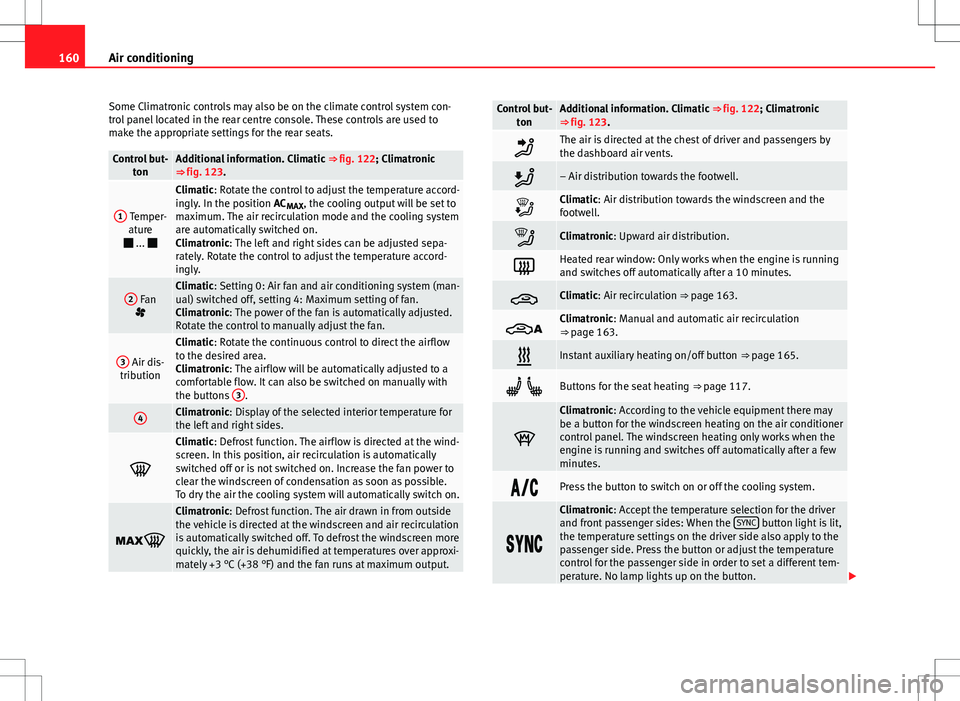
Control but- tonAdditional information. Climatic ⇒ fig. 122; Climatronic
⇒ fig. 123.
1 Temper- ature
...
Climatic: Rotate the control to adjust the temperature accord-
ingly. In the position AC MAX, the cooling output will be set to
maximum. The air recirculation mode and the cooling system
are automatically switched on.
Climatronic: The left and right sides can be adjusted sepa-
rately. Rotate the control to adjust the temperature accord-
ingly.
2 Fan
Climatic: Setting 0: Air fan and air conditioning system (man-
ual) switched off, setting 4: Maximum setting of fan.
Climatronic: The power of the fan is automatically adjusted.
Rotate the control to manually adjust the fan.
3 Air dis-
tribution
Climatic: Rotate the continuous control to direct the airflow
to the desired area.
Climatronic: The airflow will be automatically adjusted to a
comfortable flow. It can also be switched on manually with
the buttons 3
.
4Climatronic: Display of the selected interior temperature for
the left and right sides.
Climatic: Defrost function. The airflow is directed at the wind-
screen. In this position, air recirculation is automatically
switched off or is not switched on. Increase the fan power to
clear the windscreen of condensation as soon as possible.
To dry the air the cooling system will automatically switch on.
Climatronic: Defrost function. The air drawn in from outside
the vehicle is directed at the windscreen and air recirculation
is automatically switched off. To defrost the windscreen more
quickly, the air is dehumidified at temperatures over approxi-
mately +3 °C (+38 °F) and the fan runs at maximum output.
Control but-
tonAdditional information. Climatic ⇒ fig. 122; Climatronic
⇒ fig. 123.
The air is directed at the chest of driver and passengers by
the dashboard air vents.
– Air distribution towards the footwell.
Climatic: Air distribution towards the windscreen and the
footwell.
Climatronic: Upward air distribution.
Heated rear window: Only works when the engine is running
and switches off automatically after a 10 minutes.
Climatic: Air recirculation ⇒ page 163.
Climatronic: Manual and automatic air recirculation
⇒ page 163.
Instant auxiliary heating on/off button ⇒ page 165.
Buttons for the seat heating ⇒ page 117.
Climatronic: According to the vehicle equipment there may
be a button for the windscreen heating on the air conditioner
control panel. The windscreen heating only works when the
engine is running and switches off automatically after a few
minutes.
Press the button to switch on or off the cooling system.
Climatronic: Accept the temperature selection for the driver
and front passenger sides: When the SYNC button light is lit,
the temperature settings on the driver side also apply to the
passenger side. Press the button or adjust the temperature
control for the passenger side in order to set a different tem-
perature. No lamp lights up on the button.
Page 163 of 388
161
Air conditioning
Control but-
tonAdditional information. Climatic ⇒ fig. 122; Climatronic
⇒ fig. 123.
Climatronic: Automatic temperature, fan, and air distribution
control. Press the button to switch on the function. The con-
trol lamp lights up on the AUTO
button.
Climatronic: Press the button REAR to adjust the air condi-
tioner for the rear seats from the front seats. A lamp is lit in
the REAR
button if the function is activated. The settings for
the rear seats will be displayed. Press the button again to
switch the function off or do not touch any other button for
around 10 seconds.
Climatronic: Press the button REST to use the heat that the
engine radiates. When the engine is still warm but the igni-
tion switched off, the heat given off by the engine can be
used to keep the passenger compartment warm. The REST
button will light up when the function is switched on. The
function will switch off after around 30 minutes and if the
battery level is low.
a)
Turn off.
Climatic: Turn the fan switch to setting 0.
Climatronic: Press the button OFF
or manually set the fan to
0. When the device is switched off the OFF button will light
up.
a) Depending on the version of the model.
WARNING
Never turn off the air fan for a long time or the air in the passenger com-
partment will not be refreshed.
● Stuffy or used air will increase fatigue and reduce driver and passen-
ger concentration possibly resulting in a serious accident.
Note
● Not all Climatronic buttons are operational in REAR mode.
● The REAR
button is locked in defrost mode.
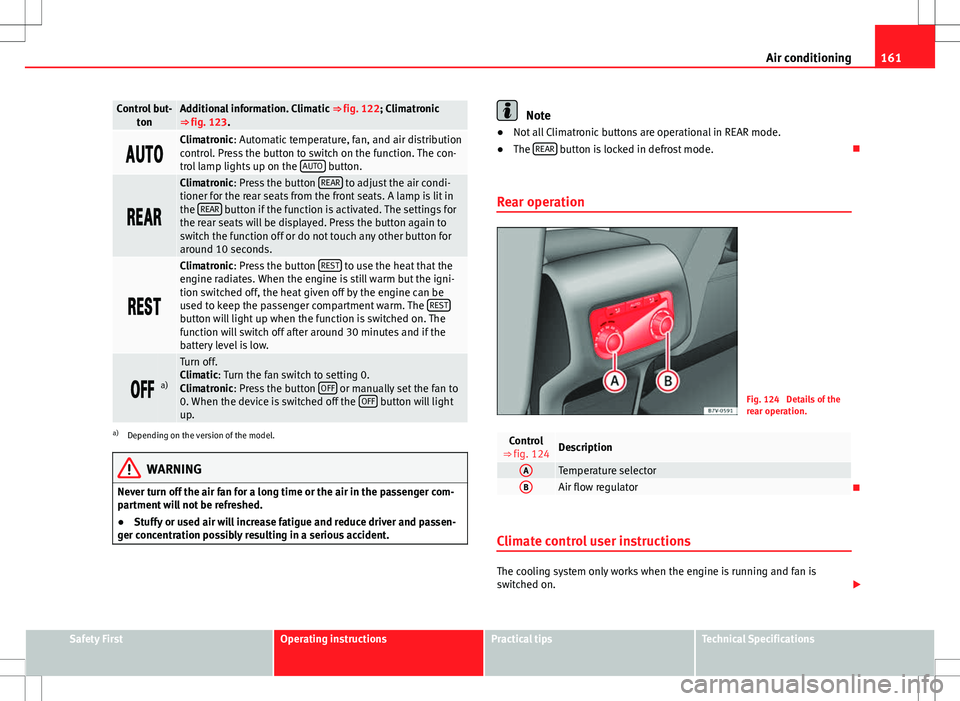
Rear operation
Fig. 124 Details of the
rear operation.
Control
⇒ fig. 124Description
ATemperature selectorBAir flow regulator
Climate control user instructions
The cooling system only works when the engine is running and fan is
switched on.
Safety FirstOperating instructionsPractical tipsTechnical Specifications
Page 232 of 388
230Driving and the environment
Economic driving style
Changing gear early
General instructions: The highest gear is always the most economical gear.
As a guideline, for the majority of vehicles: At a speed of 30 km/h, drive in
third gear, at 40 km/h in fourth gear and at 50 km/h in fifth gear.
In addition, skipping gears when shifting up helps to save fuel, weather and
traffic conditions permitting.
Do not wait until the last moment before changing gear. Only use first gear
when you move off and change to second gear quickly. Avoid the kick-down
function in vehicles with automatic gearbox.
Vehicles with a gear display help to achieve an economical driving style as
the display indicates the best moment to change gear.
Let the vehicle roll
If you take your foot off the accelerator, the fuel supply is stopped and con-
sumption is reduced.
Allow the vehicle to roll without accelerating, for example when approach-
ing a red traffic light. However, if the vehicle is rolling too slowly or the dis-
tance is too long, the clutch pedal should be pressed to declutch. The en-
gine will then operate at idle speed.
If the vehicle is going to be at a standstill for a period of time, switch off the
engine; for example, while waiting at a level crossing. In vehicles which
have the Start-Stop function on, the engine switches off automatically when
the vehicle is not moving.
Think ahead and “flow” with the traffic
Frequent acceleration and braking considerably increase fuel consumption.
If you think ahead as you drive and keep a safe distance from the vehicle in
front, it is possible to slow down by simply lifting your foot off the accelera-
tor. This eliminates the need for constant braking and acceleration. Calm and steady driving
Constancy is more important than speed: The more you drive at a constant
speed, the lower the fuel consumption.
When driving on the motorway, it is more efficient to drive at a constant and
more moderate speed than to be continuously accelerating and braking. As
a general rule, you will reach your destination just as quickly when you drive
at a constant speed.
The cruise control function helps you to achieve a constant style of driving.
Moderate use of additional electrical appliances
It is important to travel in comfort, but convenience systems should be used
in an ecological manner.
Some equipment, when connected, increase fuel consumption considera-
bly, for example:
●
Air conditioning cooling system: If the air conditioning system is re-
quired to cool to significantly lower temperatures than the true outside tem-
perature, it will require a large quantity of energy from the engine. There-
fore, we recommend that the selected temperature for the vehicle is not too
different to the outside temperature. It is a good idea to open all the win-
dows of the car before starting your journey, and to drive a short distance
with all the windows open to allow the vehicle to cool down slightly. Only
then should you close all the windows and switch on the air conditioning.
Keep windows closed when travelling at high speeds. Driving with the win-
dows open increases fuel consumption.
● Switch off the seat heating when the seats have warmed up.
● Switch off the heated rear window and the windscreen heating when the
windows have demisted and are free of ice.
● Do not leave the auxiliary heater switched on when the vehicle is mov-
ing ⇒ page 165.
Page 256 of 388
254Vehicle maintenance and cleaning
The longer stains or dirt remain on the vehicle surfaces, especially the fab-
rics covering the padded upholstery, the more difficult it becomes to clean
and maintain them. If stains and dirt are left for a long time, it may be that
they are impossible to remove.
WARNING
Car care products may be toxic and hazardous. Using unsuitable car-care
products or, using them in the wrong way, may cause accidents, serious
injury, burns or intoxication.
● Keep your car-care products in their original containers.
● Read the instructions.
● Never keep car-care products in empty food containers, bottles or
other similar containers, other people may confuse them.
● Keep all car-care products out of the reach of children.
● Some products may give off harmful vapours during use. Therefore,
they should be used outdoors in well-ventilated places.
● Never use fuel, turpentine, engine oil, nail-varnish remover or any
other volatile product for washing, maintenance or cleaning. These are
toxic and highly flammable.
WARNING
Unsuitable maintenance and cleaning of vehicle components may impair
proper operation of safety equipment and cause serious injury.
● Maintain and clean vehicle components according to the manufactur-
er's instructions.
● Only use approved or recommended cleaning products.
CAUTION
● Cleaning products which contain solvents have a corrosive effect and
may damage the material irreparably.
● Stains and dirt containing aggressive substances or solvents attack the
material and may damage it irreparably, even when they are cleaned quick-
ly.
● Dirt and stains should not be allowed to dry and should be cleaned as
quickly as possible.
● In the case of stubborn stains, take the vehicle to a specialised work-
shop to avoid damage.
Treating your upholstery
Checklist
To treat and maintain your seat upholstery, keep the following in mind ⇒
:
¥ Before entering the vehicle, close any Velcro fasteners that might
snag on the upholstery or trim fabric. Any open Velcro fasteners may
damage the trim or upholstery fabrics.
¥ To prevent damage, avoid direct contact between sharp decorative
objects and the upholstery and trim fabrics. Decorative objects in-
clude zips, rivets and rhinestones on clothing and belts.
¥ From time to time, clean the dust that gathers in the perforations,
folds and seams so that the surfaces of the seats are not damaged
by its abrasive effect.
¥ Make sure clothes are colour-fast to avoid them running and staining
the upholstery. This is especially important if the upholstery is light
in colour.
Page 257 of 388
255
Vehicle maintenance and cleaning
CAUTION
If you ignore this checklist, which is important for maintaining your seat up-
holstery, the fabric may be damaged or stained.
● Consult the checklist and carry out the operations it describes.
Note
SEAT recommends you take the vehicle to a specialised workshop to treat
any stains on the upholstery caused by the discolouration of clothing.
How to clean the upholstery, trim fabrics and Alcantara ®
Cleaning the fabric on heated seats and electrically adjustable seats or
seats with airbag components
It is possible that there are important airbag components and electrical con-
nections inside the driver seat, passenger seat and possibly the outer rear
seats. If these seats and backrests are damaged, or are cleaned and are
treated incorrectly, or if they get wet, the vehicle electric system may be de-
stroyed and the airbag system damaged
⇒
.
Electric and heated seats contain components and electrical connections
that may be damaged if the seats are cleaned or incorrectly treated ⇒
.
Similarly, damage might be caused at other points in the vehicle's electric
system.
For this reason, bear the following indications in mind for cleaning:
● Do not use high-pressure or steam cleaning equipment or cold aerosols.
● Do not use cream detergents or detergent-based solutions for delicate
garments.
● Prevent the fabric from getting wet at all times.
● Only use cleaning products approved by SEAT.
● If in doubt, take the vehicle to a professional cleaning company. Cleaning the fabric on unheated seats, non-electrically adjustable seats
and seats without airbag components
●
Before using any cleaning products, consult and keep in mind the in-
structions of use, indications and warnings on the container.
● Use a vacuum cleaner (with the brush attachment) on the trim and seat
fabrics, the Alcantara ®
upholstery of the seats and the carpet.
● Do not use high-pressure or steam cleaning equipment or cold aerosols.
● For general cleaning, use a soft sponge or an ordinary lint-free microfi-
bre cloth ⇒
.
● Clean Alcantara ®
surfaces with a slightly damp cotton or woollen cloth,
or a standard lint-free microfibre cloth ⇒
.
If the dirt on the trim and upholstery fabrics is only superficial, you can use
a standard foam cleaner.
If the upholstery and trim are very dirty, before cleaning them we recom-
mend you find out about the most suitable cleaning options from a profes-
sional cleaning company. If necessary, the cleaning should be carried out
by a specialised company.
Stain removal
When removing stains, it may be necessary to clean the whole surface and
not just the stain itself. Especially if the surface has been dirtied through
normal use. If you only clean the stained area, that part may then look light-
er than the rest. If in doubt, take the vehicle to a professional cleaning com-
pany.
WARNING
If there is a fault in the airbag system, it is likely that the airbag will not
deploy correctly, not deploy at all, or do so unexpectedly, which could
cause serious or fatal injuries.
● Have the system checked immediately by a specialised workshop.
Safety FirstOperating instructionsPractical tipsTechnical Specifications
Page 258 of 388
256Vehicle maintenance and cleaning
CAUTION
If the upholstery on electrically operated seats or seats with airbag compo-
nents gets soaked, the vehicle's electric system and certain other compo-
nents may be damaged.
● If the seat gets soaked, take the vehicle immediately to a specialised
workshop to be dried and for the system components to be inspected.
● Do not use steam cleaning equipment as the dirt becomes more encrus-
ted and fixed in the material.
● High-pressure cleaning equipment and cold aerosols may damage the
upholstery.
CAUTION
● Brushes should only be used to clean the carpet and floor mats! Other
fabrics may be damaged if cleaned with a brush.
● If cream detergents or detergents for delicate garments are applied with
a damp cloth or sponge, they may, for example, leave rings when dry be-
cause of the tensioactive components they contain. Generally, such rings
are very difficult or almost impossible to remove.
CAUTION
● Do not let water soak into Alcantara ®
under any circumstances.
● Do not use leather cleaning products, solvents, wax polish, shoe cream,
stain removers or similar products on Alcantara ®
.
● Never use brushes for cleaning damp material as they could damage the
surface.
Cleaning and maintenance of natural leather upholstery
Consult a professional cleaning workshop if you have any doubts on clean-
ing and maintaining the leather equipment in your car. Maintenance and treatment
Nappa natural leather is delicate because it has no additional protective
layer.
●
After cleaning, regularly apply a conditioner with sun-screen and im-
pregnating action. These products nourish the leather, soften it and make it
more breathable, as well as re-hydrating it. They also provide it with a pro-
tective film.
● Clean the leather every two or three months and remove stains as they
appear.
● Treat the leather regularly (about twice a year) with a suitable mainte-
nance product.
● Apply as few cleaning and maintenance products as possible, always
using a dry, lint-free cotton or woollen cloth. Do not apply cleaning and
maintenance products directly to the leather.
● Remove recent ball-point pen and ink stains, lipstick, shoe cream and
similar stains as soon as possible.
● Maintain the colour of the leather. To do this, use a special cream espe-
cially coloured for leather to achieve the same overall colour, if necessary.
● Afterwards, go over it with a soft cloth.
Cleaning the vehicle
SEAT recommends using a slightly damp cotton or woollen cloth for general
cleaning purposes.
Generally, the leather should never be soaked at any point, nor should wa-
ter penetrate the seams.
Before cleaning the leather upholstery, bear in mind the following recom-
mendations ⇒ page 255, Cleaning the fabric on heated seats and electrical-
ly adjustable seats or seats with airbag components.
Page 259 of 388
257
Vehicle maintenance and cleaning
CAUTION
● On no account use solvents, wax polish, shoe cream, stain removers or
similar materials on leather.
● If the stain remains on the leather for long, it will soak in and be impos-
sible to remove.
● In the event of spilt liquids, dry immediately with an absorbent cloth to
prevent the liquid penetrating through the leather or seams.
● If the car is left standing in the sun for long periods, the leather should
be protected against direct sunlight to prevent it from fading.
Note
The leather will usually change colour slightly with use.
Cleaning synthetic leather upholstery
Before cleaning the synthetic leather upholstery, bear in mind the following
recommendations ⇒ page 255, Cleaning the fabric on heated seats and
electrically adjustable seats or seats with airbag components
Only use water and neutral cleaning products to clean synthetic leather up-
holstery.
CAUTION
Do not use solvents, floor wax, shoe cream, stain removers or similar prod-
ucts on synthetic leather. These will stiffen the material, causing it to crack
prematurely. Cleaning storage compartments, drinks holders and
ashtray
Cleaning storage compartments and drinks holders
Some storage compartments and drinks holders have a removable rubber
mat.
●
Use a clean, damp, lint-free cloth to clean parts.
● If this does not provide satisfactory results, we recommend using a spe-
cial solvent-free plastic cleaning product.
Cleaning the ashtray
● Extract the ashtray and empty it.
● Clean the ashtray with a dishcloth.
Use a toothpick or similar to remove ash from the area where cigarettes are
stubbed out.
Care and cleaning of plastic parts, wooden trim and the
instrument panel
● Use a clean, damp, lint-free cloth to clean parts.
● Clean plastic parts (inside and outside the vehicle) and the instrument
panel with a special solvent-free product for the care and cleaning of plas-
tic, approved by SEAT ⇒
.
● Wash wooden trims with a mild soap and water solution.
Safety FirstOperating instructionsPractical tipsTechnical Specifications