ABS Seat Alhambra 2012 Owner's Manual
[x] Cancel search | Manufacturer: SEAT, Model Year: 2012, Model line: Alhambra, Model: Seat Alhambra 2012Pages: 388, PDF Size: 6.72 MB
Page 21 of 388

19
Seat belts
Why wear seat belts? Frontal collisions and the laws of physics
Fig. 5 Vehicle about to
hit a wall: the occupants
are not wearing seat
belts.
Fig. 6 The vehicle hits
the wall: the occupants
are not wearing seat
belts. It is easy to explain how the laws of physics work in the case of a head-on
collision: when a vehicle starts moving
⇒ fig. 5, this is a certain amount of
energy known as kinetic energy both in the vehicle and in the occupants.
The higher the speed and the greater the weight of the vehicle, the more
energy there is to be absorbed in an accident.
The most significant factor, however, is the speed of the vehicle. If the
speed doubles from 25 km/h to 50 km/h, for example, the kinetic energy is
multiplied by four.
The amount of kinetic energy depends on the speed of the vehicle and the
weight of the vehicle and its passengers. The higher the speed and the
greater the weight of the vehicle and the occupants, the more energy there
is to be absorbed in an accident.
Passengers not wearing seat belts are not “attached” to the vehicle. As a
result, in a frontal collision they will continue to move forward at the speed
their vehicle was travelling just before the impact until something stops
them! Because the passengers in our example are not restrained by seat
belts, all of the passengers' kinetic energy has to be absorbed at the point
of impact ⇒ fig. 6.
At speeds of 30 km/h to 50 km/h, the forces acting on bodies in a collision
can easily exceed one tonne (1000 kg). At greater speed these forces are
even higher.
This example applies not only to head-on collisions, but to all accidents and
collisions.
Safety FirstOperating instructionsPractical tipsTechnical Specifications
Page 23 of 388
21
Seat belts
Seat belt protection
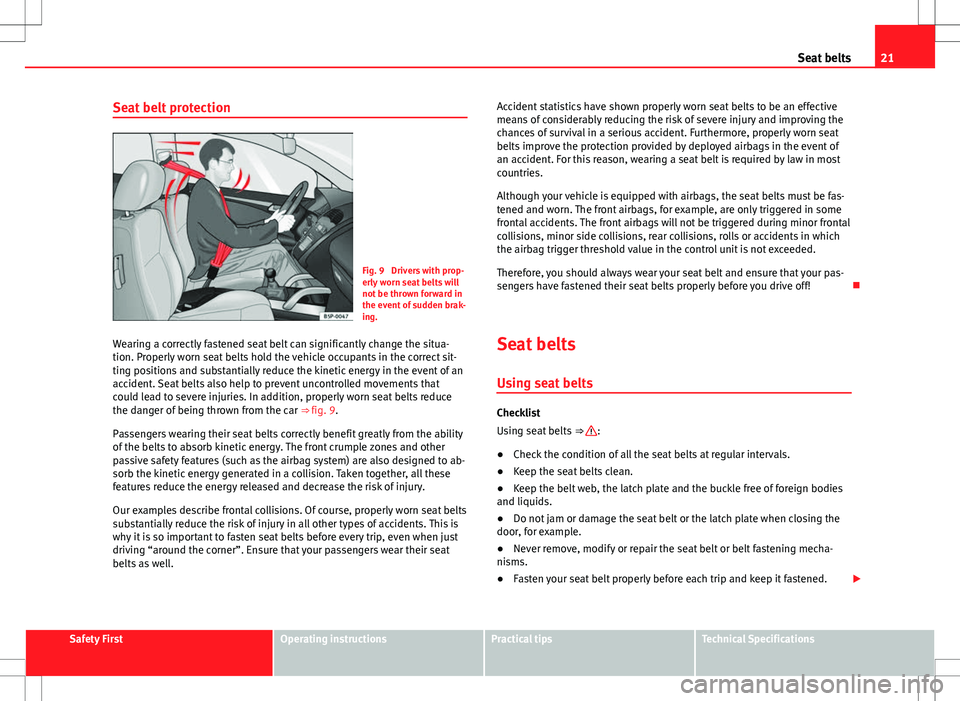
Fig. 9 Drivers with prop-
erly worn seat belts will
not be thrown forward in
the event of sudden brak-
ing.
Wearing a correctly fastened seat belt can significantly change the situa-
tion. Properly worn seat belts hold the vehicle occupants in the correct sit-
ting positions and substantially reduce the kinetic energy in the event of an
accident. Seat belts also help to prevent uncontrolled movements that
could lead to severe injuries. In addition, properly worn seat belts reduce
the danger of being thrown from the car ⇒ fig. 9.
Passengers wearing their seat belts correctly benefit greatly from the ability
of the belts to absorb kinetic energy. The front crumple zones and other
passive safety features (such as the airbag system) are also designed to ab-
sorb the kinetic energy generated in a collision. Taken together, all these
features reduce the energy released and decrease the risk of injury.
Our examples describe frontal collisions. Of course, properly worn seat belts
substantially reduce the risk of injury in all other types of accidents. This is
why it is so important to fasten seat belts before every trip, even when just
driving “around the corner”. Ensure that your passengers wear their seat
belts as well. Accident statistics have shown properly worn seat belts to be an effective
means of considerably reducing the risk of severe injury and improving the
chances of survival in a serious accident. Furthermore, properly worn seat
belts improve the protection provided by deployed airbags in the event of
an accident. For this reason, wearing a seat belt is required by law in most
countries.
Although your vehicle is equipped with airbags, the seat belts must be fas-
tened and worn. The front airbags, for example, are only triggered in some
frontal accidents. The front airbags will not be triggered during minor frontal
collisions, minor side collisions, rear collisions, rolls or accidents in which
the airbag trigger threshold value in the control unit is not exceeded.
Therefore, you should always wear your seat belt and ensure that your pas-
sengers have fastened their seat belts properly before you drive off!
Seat belts Using seat belts
Checklist
Using seat belts ⇒ :
● Check the condition of all the seat belts at regular intervals.
● Keep the seat belts clean.
● Keep the belt web, the latch plate and the buckle free of foreign bodies
and liquids.
● Do not jam or damage the seat belt or the latch plate when closing the
door, for example.
● Never remove, modify or repair the seat belt or belt fastening mecha-
nisms.
● Fasten your seat belt properly before each trip and keep it fastened.
Safety FirstOperating instructionsPractical tipsTechnical Specifications
Page 33 of 388
31
Airbag system
CAUTION
Always pay attention to any lit lamps and to the corresponding descriptions
and instructions to avoid damage to the vehicle.
Airbag system Description and function of the airbag
The airbag can protect vehicle occupants in the event of an accidents, cush-
ioning the movement of the occupants in the direction of the collision in
frontal and side accidents.
Deployed airbags fill with a propellant gas. This causes the airbag covers to
break and the airbags to deploy extremely quickly in their entire deploy-
ment space within fractions of a second. When an occupant with the seat
belt properly fastened puts pressure on the inflated airbag, the propellant
gas escapes to absorb the force of the impact and slow the movement. This
reduces the risk of severe or fatal injuries. Airbag deployment does not
mean that other types of injury such as swelling, bruising, burns and skin
injuries can be ruled out.
Airbags do not protect the arms or the lower part of the body.
The most important factors for triggering the airbag are the type of accident,
the angle of impact, the vehicle speed and the characteristics of the object
the vehicle hits. Therefore, airbags are not triggered every time the vehicle
is visibly damaged.
The airbag system is designed to be triggered in collisions with a severe im-
pact. The front, curtain, side and knee airbags may be triggered under spe-
cial circumstances. The scope of any visible damage to the vehicle is not an
indication of airbag deployment. Airbags act in conjunction with three-point seat belts in the event of certain
accidents, when the vehicle deceleration rate is severe enough to trigger
the airbags. Airbags only deploy once and only under certain circumstan-
ces. Seat belts remain present to offer protection in situations where air-
bags are not triggered or where they have already deployed. For example,
when a vehicle hits another after an initial collision or is hit by another vehi-
cle.
The airbag system is an integral part of the car's passive safety system. The
airbag system can only work effectively when the occupants are wearing
their seat belts correctly and have adjusted the head restraints properly
⇒ page 10.
Vehicle safety components
The following safety equipment makes up the vehicle safety design to re-
duce the risk of severe and fatal injuries. Depending on the vehicle equip-
ment, some equipment may not be fitted in the vehicle or may not be avail-
able in some markets.
● Optimised seat belts for all seats.
● Belt tension devices for the driver and front passenger and, where appli-
cable, on the outer seats of the second row of seats in combination with the
side airbags.
● Furthermore, belt tension limiters for the driver's and front passenger's
seat belt.
● Belt height adjustment for the front seats and, where applicable, the
outer seats of the second row of seats.
● Seat belt warning lamp
● Frontal airbags for driver and passenger.
● Side airbags for the driver, front passenger and, where applicable, the
outer seats of the second row of seats.
● Left and right curtain airbags.
● One airbag for the driver's knees.
● Airbag control lamp .
● PASSENGER AIR BAG control lamp.
Safety FirstOperating instructionsPractical tipsTechnical Specifications
Page 57 of 388
55
Cockpit
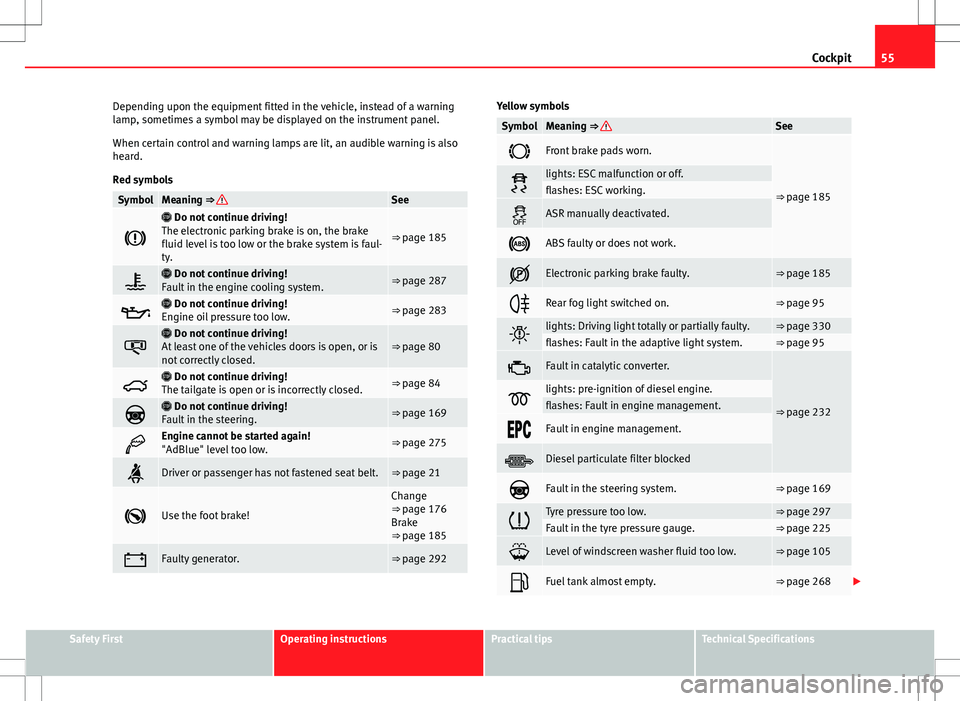
Depending upon the equipment fitted in the vehicle, instead of a warning
lamp, sometimes a symbol may be displayed on the instrument panel.
When certain control and warning lamps are lit, an audible warning is also
heard.
Red symbols
SymbolMeaning ⇒ See
Do not continue driving!
The electronic parking brake is on, the brake
fluid level is too low or the brake system is faul-
ty.
⇒ page 185
Do not continue driving!
Fault in the engine cooling system.⇒ page 287
Do not continue driving!
Engine oil pressure too low.⇒ page 283
Do not continue driving!
At least one of the vehicles doors is open, or is
not correctly closed.⇒ page 80
Do not continue driving!
The tailgate is open or is incorrectly closed.⇒ page 84
Do not continue driving!
Fault in the steering.⇒ page 169
Engine cannot be started again!
"AdBlue" level too low.⇒ page 275
Driver or passenger has not fastened seat belt.⇒ page 21
Use the foot brake!
Change
⇒ page 176
Brake
⇒ page 185
Faulty generator.⇒ page 292
Yellow symbols
SymbolMeaning ⇒ See
Front brake pads worn.
⇒ page 185lights: ESC malfunction or off.flashes: ESC working.
ASR manually deactivated.
ABS faulty or does not work.
Electronic parking brake faulty.⇒ page 185
Rear fog light switched on.⇒ page 95
lights: Driving light totally or partially faulty.⇒ page 330flashes: Fault in the adaptive light system.⇒ page 95
Fault in catalytic converter.
⇒ page 232lights: pre-ignition of diesel engine.flashes: Fault in engine management.
Fault in engine management.
Diesel particulate filter blocked
Fault in the steering system.⇒ page 169
Tyre pressure too low.⇒ page 297Fault in the tyre pressure gauge.⇒ page 225
Level of windscreen washer fluid too low.⇒ page 105
Fuel tank almost empty.⇒ page 268
Safety FirstOperating instructionsPractical tipsTechnical Specifications
Page 112 of 388
110Lights and visibility
WARNING
Never mix an unsuitable antifreeze or other similar products with the
windscreen washer water. A greasy layer may be formed on the wind-
screen which will impair visibility.
● Use clean water with a window cleaner recommended by SEAT.
● If necessary, add a suitable antifreeze to the water bottle.
CAUTION
● Do not mix cleaning products recommended by SEAT with other prod-
ucts. This could lead to flocculation and may block the windscreen washer
jets.
● When topping up service fluids, make absolutely certain that you fill the
fluids into the correct reservoirs. Using the wrong fluids could cause serious
malfunctions and engine damage!
Rear vision mirror
Introduction
Additional information and warnings:
● Personal convenience settings in the SEAT information system
⇒ page 62
● Seat memory
⇒ page 117
● Changing gear
⇒ page 176
● Braking, stopping and parking
⇒ page 185
WARNING
The automatic anti-dazzle rear vision mirror contains an electrolytic fluid
which may leak if the mirror is broken. This fluid can cause irritation to
the skin, eyes and respiratory organs.
● The electrolytic fluid may cause irritation to the skin, eyes and respi-
ratory organs, particularly in individuals suffering from asthma or other
illnesses. Make sure that adequate quantities of fresh air enter and leave
the vehicle if it is not possible to open all the doors and windows.
● If the electrolytic fluid comes into contact with eyes or skin, wash the
area for at least 15 minutes with plenty of water, and seek medical ad-
vice.
● If the electrolytic fluid comes into contact with shoes or clothing,
wash the area for at least 15 minutes with plenty of water. Wash shoes
and clothing before wearing them again.
● If the electrolytic fluid is swallowed, wash the mouth with plenty of
water for at least 15 minutes. Do not try to provoke vomiting unless rec-
ommended by a Doctor. Seek medical advice immediately.
CAUTION
If an automatic anti-dazzle rear vision mirror is broken, the electrolytic fluid
may leak out. This fluid attacks plastic surfaces. Therefore, it should be
cleaned as fast as possible with a damp sponge or similar.
Page 155 of 388

153
Seats and storage compartments
WARNING
Undue use of the cigarette lighter may cause a fire or burns and other se-
rious injuries.
● The cigarette lighter must only be used to light cigarettes or similar.
● Never leave children unsupervised in the vehicle. The cigarette lighter
can be used when the ignition is switched on.
Note
The cigarette lighter can also be used with the 12 Volt socket ⇒ page 153.
Electrical sockets
Introduction
Electrical equipment can be connected to the sockets in the vehicle.
All connected appliances should be in perfect working order without any
faults.
Additional information and warnings:
● Cigarette lighter
⇒ page 151
● Accessories, parts replacement, repairs and modifications
⇒ page 261
WARNING
Improper use of the sockets or electrical devices could lead to a fire and
cause serious injuries.
● Never leave children unsupervised in the vehicle. The sockets and
equipment connected to them can be used when the ignition is switched
on.
● Should a connected electrical device overheat, switch it off and un-
plug it immediately.
CAUTION
● To avoid damage to the vehicle's electrical system, never connect equip-
ment that generates electrical current, such as solar panels or battery charg-
ers, to the 12 Volt sockets in order to charge the vehicle's battery.
● Only use accessories with approved electromagnetic compatibility ac-
cording to current regulations.
● To avoid damage due to voltage variations, switch off all appliances con-
nected to the 12 V sockets before switching the ignition on or off and before
starting the engine.
● Never connect an appliance to the 12 Volt socket that consumes more
than the power indicated in watts. Exceeding the maximum power absorp-
tion could damage the vehicle's electrical system.
For the sake of the environment
Do not leave the engine running when the vehicle is at a standstill.
Safety FirstOperating instructionsPractical tipsTechnical Specifications
Page 187 of 388
185
Driving
Braking, stopping and parking
Introduction
The assisted braking systems include the anti-lock braking system (ABS),
the brake assist system (BAS), the electronic differential lock (EDL), the trac-
tion control system (ASR) and the electronic stability control (ESC).
Additional information and warnings:
● Towing mode ⇒ page 237
● Start assist systems ⇒ page 196
● Wheels and tyres ⇒ page 297
● Accessories, parts replacement, repairs and modifications ⇒ page 261
WARNING
Driving with worn brake pads or a faulty brake system may lead to seri-
ous accident.
● If lights, alone or accompanied by a warning message on the in-
strument panel, please go immediately to a specialised workshop to
check the brake pads and to replace them if they are worn.
WARNING
Careless parking can cause serious injury.
● Never remove the key from the ignition if the vehicle is in motion. The
steering lock may engage and locked the steering wheel making the vehi-
cle impossible to control.
● Always park your vehicle so that no part of the exhaust system can
come in contact with flammable materials (such as wood, leaves, spilled
fuel, dried grass, etc).
WARNING (Continued)
● Always apply the electronic parking brake when you leave your vehi-
cle and when you park.
● Never leave children or disabled people alone in the vehicle. They
could release the electronic parking brake, activate the selector lever or
gear stick and start the vehicle moving. This could result in serious acci-
dent.
● Always take all the keys with you whenever you leave the vehicle. The
engine could accidentally be started and electrical equipment such as
the windows could accidentally be operated resulting in serious injury.
● Never leave children or disabled people alone in the car. They could
be trapped in the car in an emergency and will not be able to get them-
selves to safety. For example, depending on the time of the year, temper-
atures inside a locked and closed vehicle can be extremely high or ex-
tremely low resulting in serious injuries and illness or even death, partic-
ularly for young children.
CAUTION
● Special care should be taken when parking in areas with high kerbs or
fixed barriers. Objects protruding from the ground may damage the bumper
or other parts of the vehicle during manoeuvres. To avoid damage, stop be-
fore the wheels touched the barrier or kerb.
● Special attention is required when driving through entrances, over
ramps, kerbs or other objects. The vehicle underbody, bumpers, mudguards
and running gear, and the engine and exhaust system could be damaged as
you drive over these objects.
Safety FirstOperating instructionsPractical tipsTechnical Specifications
Page 188 of 388
186Driving
Warning and control lamps
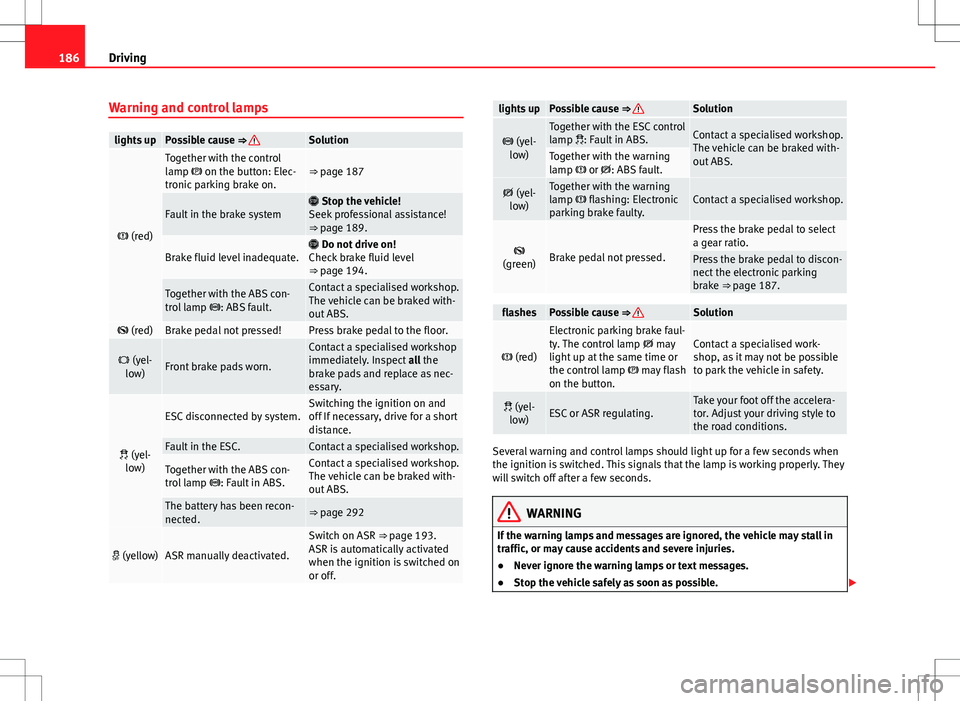
lights upPossible cause ⇒ Solution
(red)
Together with the control
lamp on the button: Elec-
tronic parking brake on.⇒ page 187
Fault in the brake system Stop the vehicle!
Seek professional assistance!
⇒ page 189.
Brake fluid level inadequate. Do not drive on!
Check brake fluid level
⇒ page 194.
Together with the ABS con-
trol lamp : ABS fault.Contact a specialised workshop.
The vehicle can be braked with-
out ABS.
(red)Brake pedal not pressed!Press brake pedal to the floor.
(yel-
low)Front brake pads worn.
Contact a specialised workshop
immediately. Inspect all the
brake pads and replace as nec-
essary.
(yel-
low)
ESC disconnected by system.Switching the ignition on and
off If necessary, drive for a short
distance.
Fault in the ESC.Contact a specialised workshop.
Together with the ABS con-
trol lamp : Fault in ABS.Contact a specialised workshop.
The vehicle can be braked with-
out ABS.
The battery has been recon-
nected.⇒ page 292
(yellow)ASR manually deactivated.
Switch on ASR ⇒ page 193.
ASR is automatically activated
when the ignition is switched on
or off.
lights upPossible cause ⇒ Solution
(yel-
low)Together with the ESC control
lamp : Fault in ABS.Contact a specialised workshop.
The vehicle can be braked with-
out ABS.
Together with the warning
lamp or : ABS fault.
(yel-
low)Together with the warning
lamp flashing: Electronic
parking brake faulty.Contact a specialised workshop.
(green)Brake pedal not pressed.
Press the brake pedal to select
a gear ratio.
Press the brake pedal to discon-
nect the electronic parking
brake ⇒ page 187.
flashesPossible cause ⇒ Solution
(red)
Electronic parking brake faul-
ty. The control lamp may
light up at the same time or
the control lamp may flash
on the button.Contact a specialised work-
shop, as it may not be possible
to park the vehicle in safety.
(yel- low)ESC or ASR regulating.Take your foot off the accelera-
tor. Adjust your driving style to
the road conditions.
Several warning and control lamps should light up for a few seconds when
the ignition is switched. This signals that the lamp is working properly. They
will switch off after a few seconds.
WARNING
If the warning lamps and messages are ignored, the vehicle may stall in
traffic, or may cause accidents and severe injuries.
● Never ignore the warning lamps or text messages.
● Stop the vehicle safely as soon as possible.
Page 189 of 388
187
Driving
WARNING
Driving with brakes in bad condition could result in a serious accident.
● If the brake warning lamp does not go out, or if it lights up when
driving, the brake fluid level in the reservoir is too low or there is a fault
in the brake system. Obtain professional assistance immediately
⇒ page 193, Brake fluid.
● If the brake warning lamp lights up together with the ABS warning
lamp , the regulation function of the ABS could be malfunctioning. As a
result, the rear wheels can lock relatively easily when braking. If the rear
wheels lock this could result in loss of vehicle control! If possible, reduce
your speed and drive carefully to a specialised workshop close by to
check the brake system. During the following journey, avoid sudden brak-
ing and manoeuvres.
● If the ABS warning lamp does not go out or if it lights while driv-
ing, the ABS is malfunctioning. The vehicle can only be stopped using
normal braking without ABS. The protection provided by the ABS is not
available. Visit a specialised workshop as soon as possible.
● If lights, alone or accompanied by a warning message on the in-
strument panel screen, please go immediately to a specialised workshop
to check the brake pads and to replace them if they are worn.
CAUTION
Failure to heed the warning lamps and text messages when they appear
may result in faults in the vehicle. Electronic parking brake
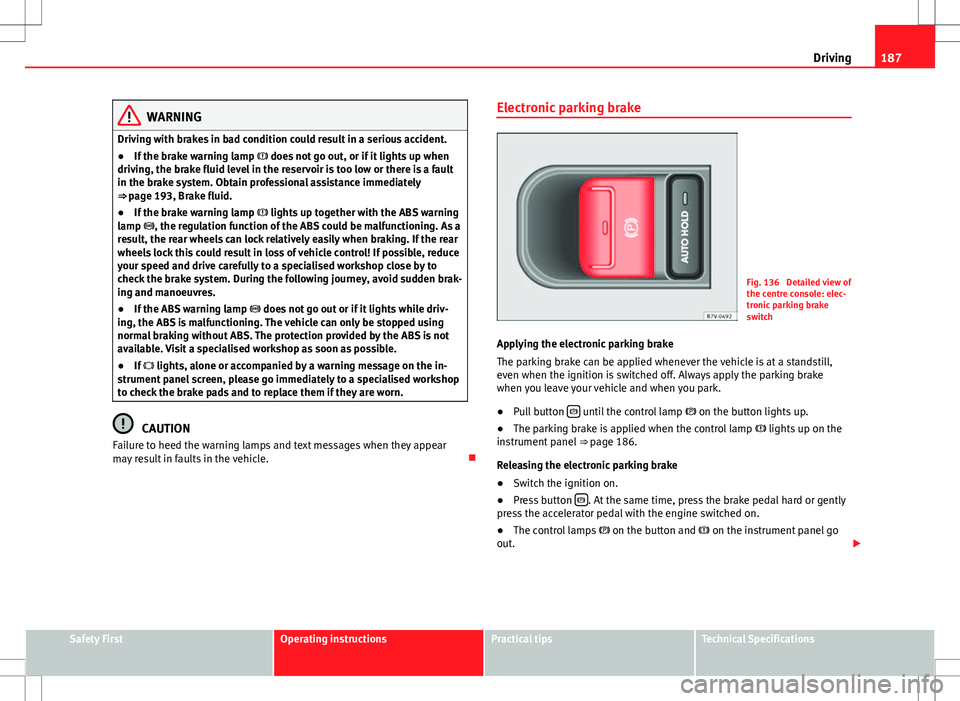
Fig. 136 Detailed view of
the centre console: elec-
tronic parking brake
switch
Applying the electronic parking brake
The parking brake can be applied whenever the vehicle is at a standstill,
even when the ignition is switched off. Always apply the parking brake
when you leave your vehicle and when you park.
● Pull button
until the control lamp
on the button lights up.
● The parking brake is applied when the control lamp lights up on the
instrument panel ⇒ page 186.
Releasing the electronic parking brake
● Switch the ignition on.
● Press button
. At the same time, press the brake pedal hard or gently
press the accelerator pedal with the engine switched on.
● The control lamps on the button and on the instrument panel go
out.
Safety FirstOperating instructionsPractical tipsTechnical Specifications
Page 193 of 388
191
Driving
Note
When checking the front brake pads, take the time to also check the rear
brake pads. The thickness of the brake pads should be checked visually and
regularly, by looking through the openings in the wheel rims or from under-
neath the vehicle. If necessary, remove the wheels to check them thorough-
ly. SEAT recommends visiting a Technical Service.
Brake assist systems
The brake assist systems ESC, ABS, BAS, ASR and EDL only operate when
the ignition is switched on. They contribute significantly to increasing active
safety.
Electronic Stability Control (ESC)
ESC reduces the risk of skidding and increases the vehicle stability by brak-
ing individual wheels under specific driving conditions. ESC detects critical
handling situations, such as understeer, oversteer and wheelspin on the
driven wheels. The system stabilises the vehicle by braking individual
wheels or by reducing the engine torque.
The ESC has limits. It is important to realise that the ESC is also subject to
the laws of physics. ESC will not be able to deal with all situations with
which drivers may be faced. For example, if the road surface changes sud-
denly then ESC will not be useful in all cases. If the vehicle suddenly enters
a section covered by water, mud or snow then ESC will not provide assis-
tance in the same way as on dry ground. If the vehicle loses its grip on the
ground and moves on a film of water (aquaplaning), the ESC will not be able
to assist the driver to control the vehicle due to the loss of adherence with
the road surface preventing braking and steering. If the vehicle is driven
through series of bends at high speed, the ESC will not always be as effec-
tive: the vehicle reaction to aggressive driving is not the same as at reduced
speeds. When driving with a trailer, ESC does not provide the same amount
of vehicle control as without a trailer. Adjust your speed and driving style to road, traffic and weather conditions.
ESC cannot push the limits of the laws of physics; improve the transmission
available or maintain the vehicle on the road if a lack of driver attention cre-
ates an inevitable situation. Otherwise, ESC assists in maintaining vehicle
control in extreme situations and uses the movements of the steering made
by the driver to maintain the vehicle moving in the desired direction. If the
vehicle is driven at such a speed that it will leave the road before ESC can
intervene then the system cannot provide assistance.
The ABS, BAS, ASR and EDL systems are incorporated into the ESC. The ESC
is always on. The ESC should only be turned off using the ASR button
⇒
fig. 137 when traction is insufficient. Always remember to turn on the ASR
once more when the vehicle has traction again.
Anti-lock brake system (ABS)
ABS can prevent the wheels from locking during braking until just before
the vehicle stops thus helping the driver to steer the vehicle and maintain
control. This means that, even during full braking, the risk of skidding is re-
duced:
● Press and hold the brake pedal fully. Do not remove your foot from the
brake pedal or reduce braking force!
● Do not “pump” the brake pedal, or reduce braking force!
● Maintain vehicle direction when braking fully.
● When the brake pedal is released or when the brake force is reduced,
ABS is turned off.
ABS control can be observed by vibration of the brake pedal and noise. You
should never expect the ABS to reduce the braking distance under any cir-
cumstances. Braking distances will increase when driving on gravel, recent
snow or on icy and slippery ground.
When driving on loose ground, the all-terrain configuration of the ABS is au-
tomatically turned on. When ABS is activated, the front wheels may lock
briefly. This shortens the braking distance in off-road situations as the
wheels are prevented from digging into loose surfaces. All-terrain ABS only
Safety FirstOperating instructionsPractical tipsTechnical Specifications