belt Seat Alhambra 2013 Owner's Guide
[x] Cancel search | Manufacturer: SEAT, Model Year: 2013, Model line: Alhambra, Model: Seat Alhambra 2013Pages: 387, PDF Size: 6.13 MB
Page 49 of 387
47
Child safety
WARNING
Child travelling without their seat belt fastened or not secured using a
suitable restraint system may sustain fatal injuries if the airbag is de-
ployed.
● Children up to 12 years old should always travel on the rear seat.
● Always disable the front passenger front airbag if, in exceptional ca-
ses, you have no alternative but to transport a child in a rear-facing child
safety seat on the front passenger seat.
● Children must always be protected with a child restraint system suit-
ed to their height and weight.
● Always fasten children's seat belts correctly.
WARNING
Children must travel in a child seat appropriate to their weight and
height while the vehicle is in motion.
● Children must always be protected with a child restraint system suit-
ed to their height and weight.
● Children must assume the proper sitting position and be properly bel-
ted in while travelling.
● The shoulder part of the seat belt must lie approximately on the cen-
tre of the shoulder, never across the neck or the arm.
● The seat belt must lie close to the upper part of the body.
WARNING (Continued)
● The lap belt part must lie across the pelvis, not across the stomach,
and always fit closely.
● Allow the belt to retract until it fits tightly over the child's seat.
● Never hold children or babies on your lap.
● Always use a child seat and the seat belt for children who are less
than 1.5 metres tall. The normal seat belt could cause injuries to the ab-
dominal and neck areas.
● Only one child may occupy a child seat.
● Read and follow the information and warnings provided by the child
seat manufacturer.
● Never leave an unsupervised child alone on a child seat or in the vehi-
cle.
● All modifications to the integrated child seat must be carried out by a
specialised workshop.
● Replace the child seat or any seat components damaged or involved
in an accident.
WARNING
Loose objects could fly uncontrollably around the vehicle interior and
cause injuries in the event of an accident or sudden braking.
● Do not leave toys or other hard, loose objects on the child seat or on
the seat while the vehicle is in motion.
Safety FirstOperating instructionsPractical tipsTechnical Specifications
Page 51 of 387
49
Child safety
Lifting the cushion
● Pull the unlock lever ⇒ Fig. 29 A
on the cushion in the direction of the
arrow 1.
● Fold both sides B up in the direction of the arrow 2.
● Push the cushion C back in the direction of the arrow 3 until it engag-
es.
Fitting the side head restraint
● Fold the seat backrest of the rear seat forwards ⇒ page 117.
● Remove the head restraint.
● Make sure the belt guide handle on the window side is on the side head
restraint ⇒ page 49.
● Insert the guide rods ⇒ Fig. 30 1
of the head restraint into the guides
on the side head restraint 2.
● Insert the head restraint and the side head restraint into the guides on
the corresponding seat backrest B
.
● Push the head restraint down as far as it will go.
● Fold the seat backrest of the rear seat back.
● Pull the rear seat and the seat backrest to check whether they are en-
gaged properly. Seat belt routing on the integrated child seat
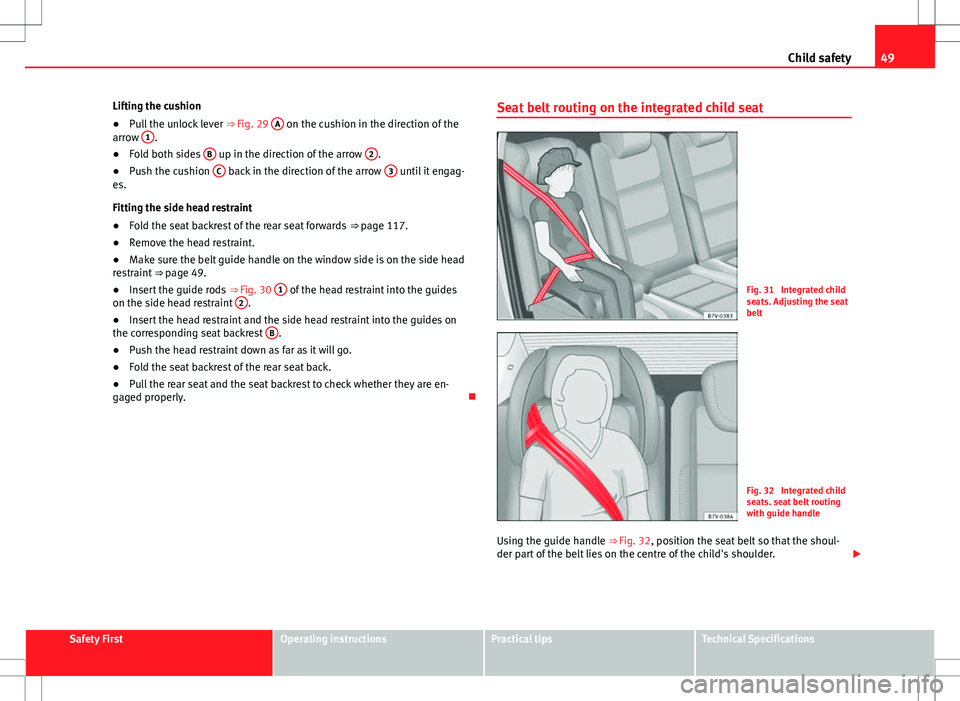
Fig. 31 Integrated child
seats. Adjusting the seat
belt
Fig. 32 Integrated child
seats. seat belt routing
with guide handle
Using the guide handle ⇒ Fig. 32, position the seat belt so that the shoul-
der part of the belt lies on the centre of the child's shoulder.
Safety FirstOperating instructionsPractical tipsTechnical Specifications
Page 52 of 387
50Child safety
Seat belt guide handle
● Secure the seat belt guide handle to the side head restraint on the win-
dow side. The guide handle is secured by a button.
● Open the upper button on the seat belt guide handle and pass the belt
webbing below the side head restraint and through the guide handle.
● Close the button again.
Adjusting the seat belt
● Guide the automatic three-point seat belt below the side head restraint.
● Pull the latch plate and slowly place the belt webbing across the child's
chest and lap.
● Insert the latch plate into the buckle for the appropriate seat and push it
down until it is securely locked with an audible click.
● Pull the belt to ensure that the latch plate is securely engaged in the
buckle.
WARNING
The seat belt only offers maximum protection from severe or fatal injuries
when it is correctly positioned.
● Children must assume the proper sitting position and be properly bel-
ted in while travelling.
● The shoulder belt must be positioned against the middle of the
shoulder.
● The seat belt must lie flat and fit comfortably.
● Allow the belt to retract until it fits tightly over the child's seat.
● The lap part of the seat belt must lie across the pelvis, never across
the stomach.
● Only one child may occupy a child seat.
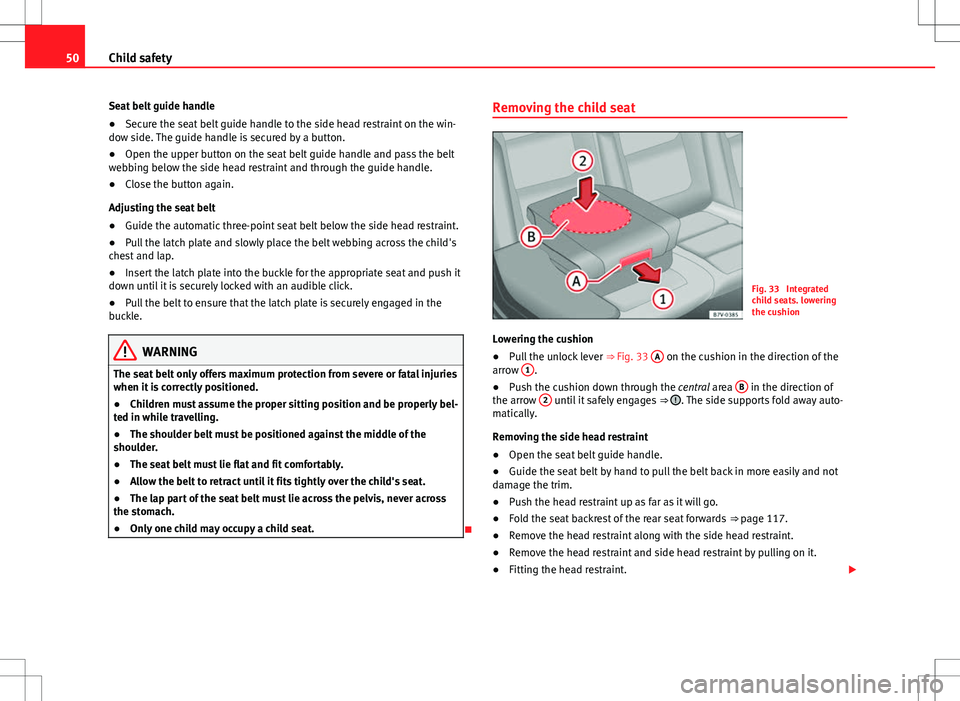
Removing the child seat
Fig. 33 Integrated
child seats. lowering
the cushion
Lowering the cushion
● Pull the unlock lever
⇒ Fig. 33 A
on the cushion in the direction of the
arrow 1.
● Push the cushion down through the central area B in the direction of
the arrow 2 until it safely engages
⇒ . The side supports fold away auto-
matically.
Removing the side head restraint
● Open the seat belt guide handle.
● Guide the seat belt by hand to pull the belt back in more easily and not
damage the trim.
● Push the head restraint up as far as it will go.
● Fold the seat backrest of the rear seat forwards
⇒ page 117.
● Remove the head restraint along with the side head restraint.
● Remove the head restraint and side head restraint by pulling on it.
● Fitting the head restraint.
Page 57 of 387
55
Cockpit
Depending upon the equipment fitted in the vehicle, instead of a warning
lamp, sometimes a symbol may be displayed on the instrument panel.
When certain control and warning lamps are lit, an audible warning is also
heard.
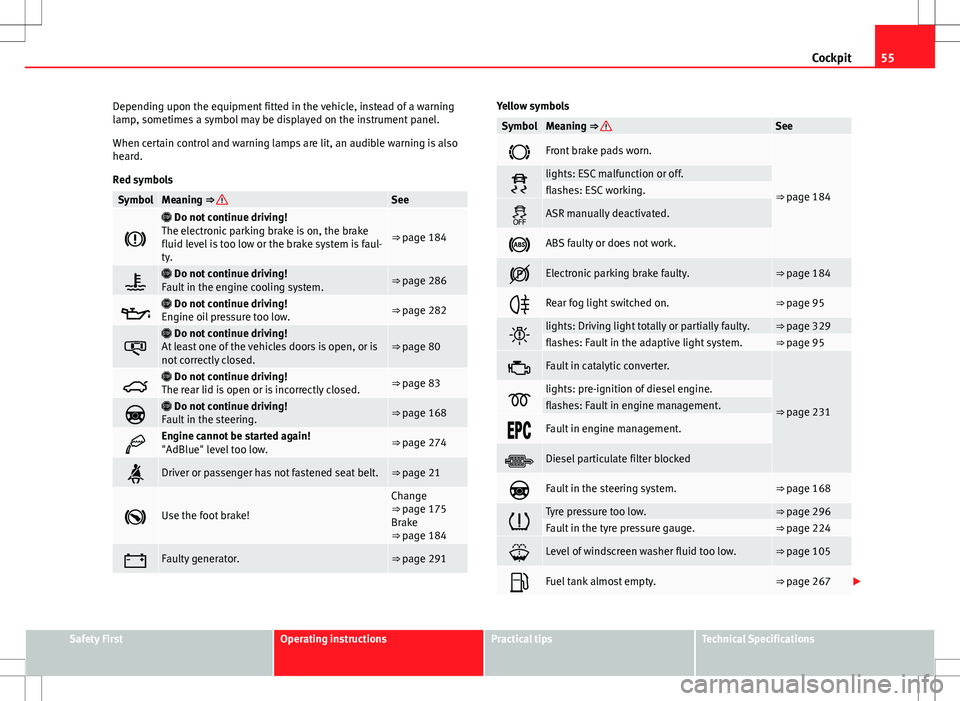
Red symbols
SymbolMeaning ⇒ See
Do not continue driving!
The electronic parking brake is on, the brake
fluid level is too low or the brake system is faul-
ty.
⇒ page 184
Do not continue driving!
Fault in the engine cooling system.⇒ page 286
Do not continue driving!
Engine oil pressure too low.⇒ page 282
Do not continue driving!
At least one of the vehicles doors is open, or is
not correctly closed.⇒ page 80
Do not continue driving!
The rear lid is open or is incorrectly closed.⇒ page 83
Do not continue driving!
Fault in the steering.⇒ page 168
Engine cannot be started again!
"AdBlue" level too low.⇒ page 274
Driver or passenger has not fastened seat belt.⇒ page 21
Use the foot brake!
Change
⇒ page 175
Brake
⇒ page 184
Faulty generator.⇒ page 291
Yellow symbols
SymbolMeaning ⇒ See
Front brake pads worn.
⇒ page 184lights: ESC malfunction or off.flashes: ESC working.
ASR manually deactivated.
ABS faulty or does not work.
Electronic parking brake faulty.⇒ page 184
Rear fog light switched on.⇒ page 95
lights: Driving light totally or partially faulty.⇒ page 329flashes: Fault in the adaptive light system.⇒ page 95
Fault in catalytic converter.
⇒ page 231lights: pre-ignition of diesel engine.flashes: Fault in engine management.
Fault in engine management.
Diesel particulate filter blocked
Fault in the steering system.⇒ page 168
Tyre pressure too low.⇒ page 296Fault in the tyre pressure gauge.⇒ page 224
Level of windscreen washer fluid too low.⇒ page 105
Fuel tank almost empty.⇒ page 267
Safety FirstOperating instructionsPractical tipsTechnical Specifications
Page 58 of 387
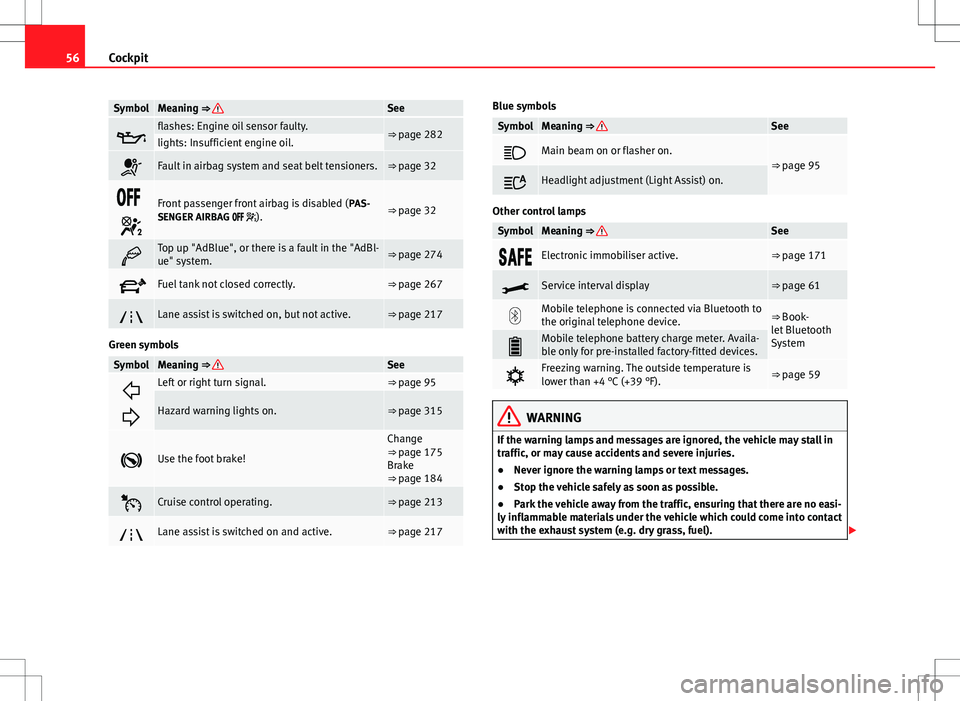
56Cockpit
SymbolMeaning ⇒ See
flashes: Engine oil sensor faulty.⇒ page 282lights: Insufficient engine oil.
Fault in airbag system and seat belt tensioners.⇒ page 32
Front passenger front airbag is disabled ( PAS-
SENGER AIRBAG ).⇒ page 32
Top up "AdBlue", or there is a fault in the "AdBl-
ue" system.⇒ page 274
Fuel tank not closed correctly.⇒ page 267
Lane assist is switched on, but not active.⇒ page 217
Green symbols
SymbolMeaning ⇒ See
Left or right turn signal.⇒ page 95
Hazard warning lights on.⇒ page 315
Use the foot brake!
Change
⇒ page 175
Brake
⇒ page 184
Cruise control operating.⇒ page 213
Lane assist is switched on and active.⇒ page 217
Blue symbols
SymbolMeaning ⇒ See
Main beam on or flasher on.⇒ page 95
Headlight adjustment (Light Assist) on.
Other control lamps
SymbolMeaning ⇒ See
Electronic immobiliser active.⇒ page 171
Service interval display⇒ page 61
Mobile telephone is connected via Bluetooth to
the original telephone device.⇒ Book-
let Bluetooth
System
Mobile telephone battery charge meter. Availa-
ble only for pre-installed factory-fitted devices.
Freezing warning. The outside temperature is
lower than +4 °C (+39 °F).⇒ page 59
WARNING
If the warning lamps and messages are ignored, the vehicle may stall in
traffic, or may cause accidents and severe injuries.
● Never ignore the warning lamps or text messages.
● Stop the vehicle safely as soon as possible.
● Park the vehicle away from the traffic, ensuring that there are no easi-
ly inflammable materials under the vehicle which could come into contact
with the exhaust system (e.g. dry grass, fuel).
Page 119 of 387
117
Seats and storage
Seat functions Introduction
Additional information and warnings
● Adjust the seat position ⇒ page 10
● Seat belts ⇒ page 21
● Airbag system ⇒ page 32
● Child seats (accessories) ⇒ page 40
● Integrated child seats ⇒ page 46
● Exterior mirrors ⇒ page 110
● Luggage compartment ⇒ page 126
WARNING
Inappropriate use of the seat functions can cause severe injuries.
● Assume the proper sitting position before your trip and remain in it
throughout. This also applies to the other vehicle occupants.
● Only adjust the seat position memory when the vehicle is stationary.
● Only switch the lumbar massage function on and off when the vehicle
is stationary.
● Keep hands, fingers, feet and other limbs away from the seat operat-
ing and adjustment radius.
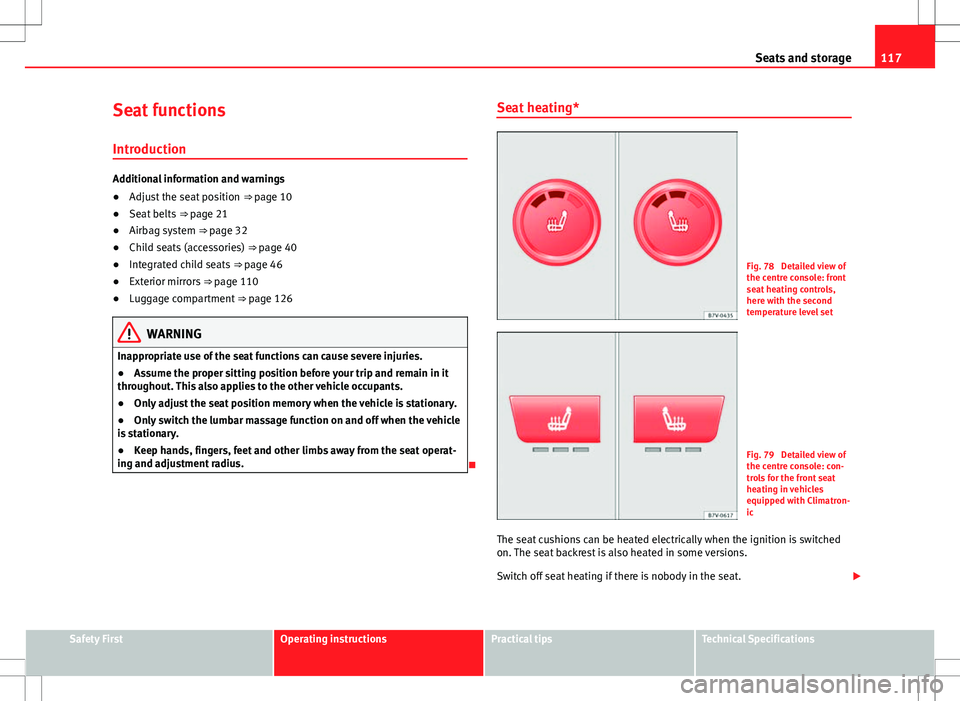
Seat heating*
Fig. 78 Detailed view of
the centre console: front
seat heating controls,
here with the second
temperature level set
Fig. 79 Detailed view of
the centre console: con-
trols for the front seat
heating in vehicles
equipped with Climatron-
ic
The seat cushions can be heated electrically when the ignition is switched
on. The seat backrest is also heated in some versions.
Switch off seat heating if there is nobody in the seat.
Safety FirstOperating instructionsPractical tipsTechnical Specifications
Page 122 of 387
120Seats and storage
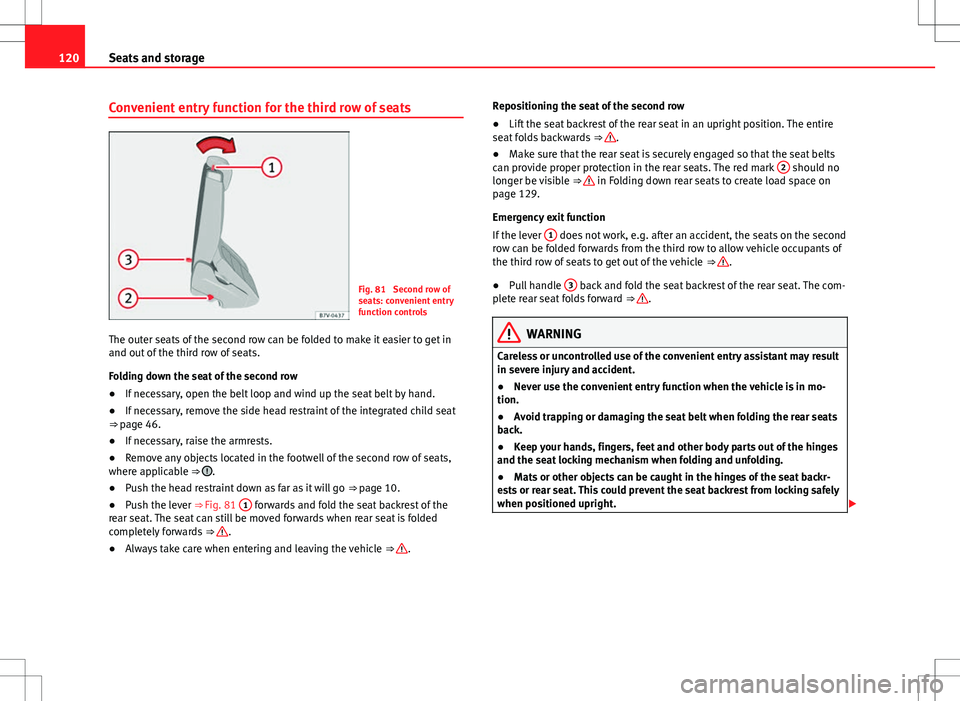
Convenient entry function for the third row of seats
Fig. 81 Second row of
seats: convenient entry
function controls
The outer seats of the second row can be folded to make it easier to get in
and out of the third row of seats.
Folding down the seat of the second row
● If necessary, open the belt loop and wind up the seat belt by hand.
● If necessary, remove the side head restraint of the integrated child seat
⇒ page 46.
● If necessary, raise the armrests.
● Remove any objects located in the footwell of the second row of seats,
where applicable ⇒
.
● Push the head restraint down as far as it will go ⇒ page 10.
● Push the lever ⇒ Fig. 81 1
forwards and fold the seat backrest of the
rear seat. The seat can still be moved forwards when rear seat is folded
completely forwards ⇒
.
● Always take care when entering and leaving the vehicle ⇒ .Repositioning the seat of the second row
●
Lift the seat backrest of the rear seat in an upright position. The entire
seat folds backwards ⇒
.
● Make sure that the rear seat is securely engaged so that the seat belts
can provide proper protection in the rear seats. The red mark 2
should no
longer be visible ⇒ in Folding down rear seats to create load space on
page 129.
Emergency exit function
If the lever 1
does not work, e.g. after an accident, the seats on the second
row can be folded forwards from the third row to allow vehicle occupants of
the third row of seats to get out of the vehicle ⇒
.
● Pull handle 3
back and fold the seat backrest of the rear seat. The com-
plete rear seat folds forward ⇒ .
WARNING
Careless or uncontrolled use of the convenient entry assistant may result
in severe injury and accident.
● Never use the convenient entry function when the vehicle is in mo-
tion.
● Avoid trapping or damaging the seat belt when folding the rear seats
back.
● Keep your hands, fingers, feet and other body parts out of the hinges
and the seat locking mechanism when folding and unfolding.
● Mats or other objects can be caught in the hinges of the seat backr-
ests or rear seat. This could prevent the seat backrest from locking safely
when positioned upright.
Page 123 of 387
121
Seats and storage
WARNING (Continued)
● All seat backrests must engage correctly for the seat belts on the rear
seats to work properly. When the seat backrest of an occupied seat is not
correctly locked in place, the passenger can be thrust forward with the
seat backrest in case of sudden braking, sudden manoeuvres or an acci-
dent.
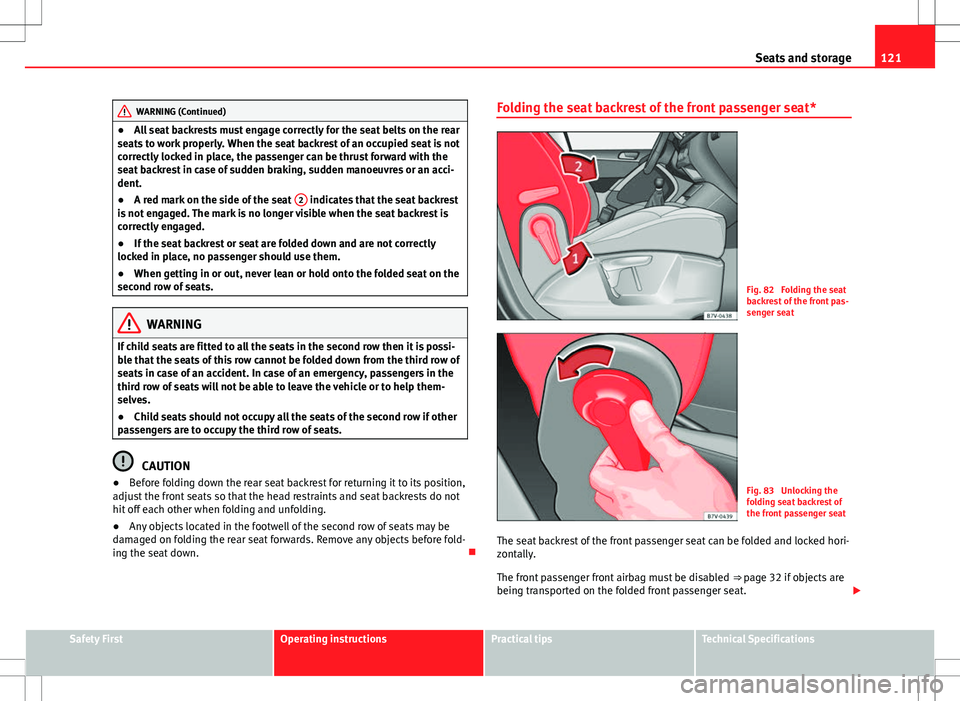
● A red mark on the side of the seat 2
indicates that the seat backrest
is not engaged. The mark is no longer visible when the seat backrest is
correctly engaged.
● If the seat backrest or seat are folded down and are not correctly
locked in place, no passenger should use them.
● When getting in or out, never lean or hold onto the folded seat on the
second row of seats.
WARNING
If child seats are fitted to all the seats in the second row then it is possi-
ble that the seats of this row cannot be folded down from the third row of
seats in case of an accident. In case of an emergency, passengers in the
third row of seats will not be able to leave the vehicle or to help them-
selves.
● Child seats should not occupy all the seats of the second row if other
passengers are to occupy the third row of seats.
CAUTION
● Before folding down the rear seat backrest for returning it to its position,
adjust the front seats so that the head restraints and seat backrests do not
hit off each other when folding and unfolding.
● Any objects located in the footwell of the second row of seats may be
damaged on folding the rear seat forwards. Remove any objects before fold-
ing the seat down. Folding the seat backrest of the front passenger seat*
Fig. 82 Folding the seat
backrest of the front pas-
senger seat
Fig. 83 Unlocking the
folding seat backrest of
the front passenger seat
The seat backrest of the front passenger seat can be folded and locked hori-
zontally.
The front passenger front airbag must be disabled ⇒ page 32 if objects are
being transported on the folded front passenger seat.
Safety FirstOperating instructionsPractical tipsTechnical Specifications
Page 130 of 387
128Seats and storage
Folding down rear seats to create load space
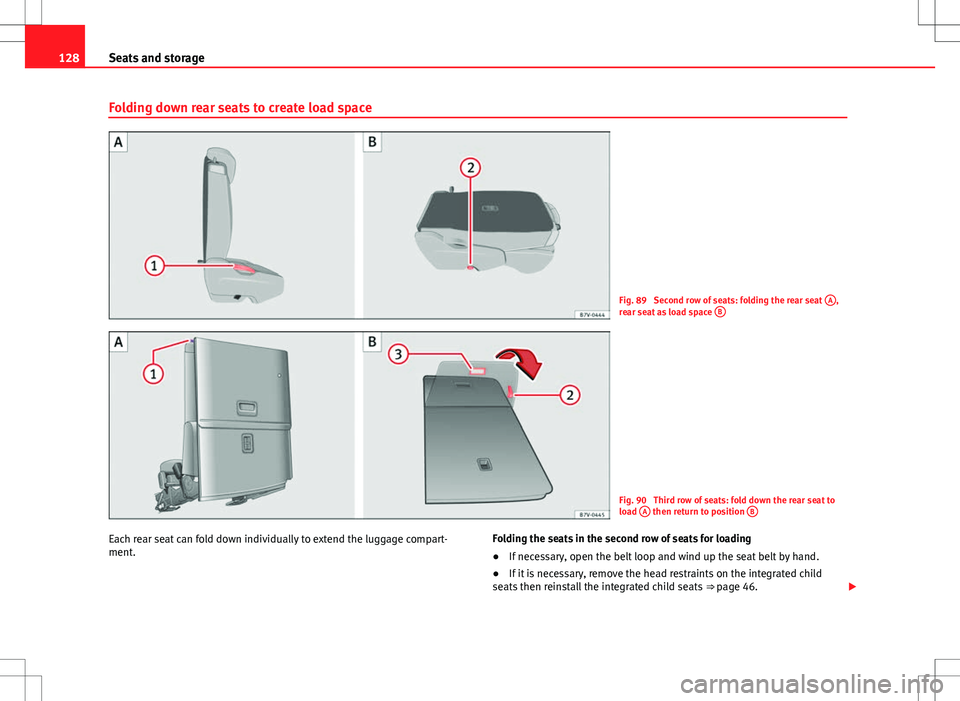
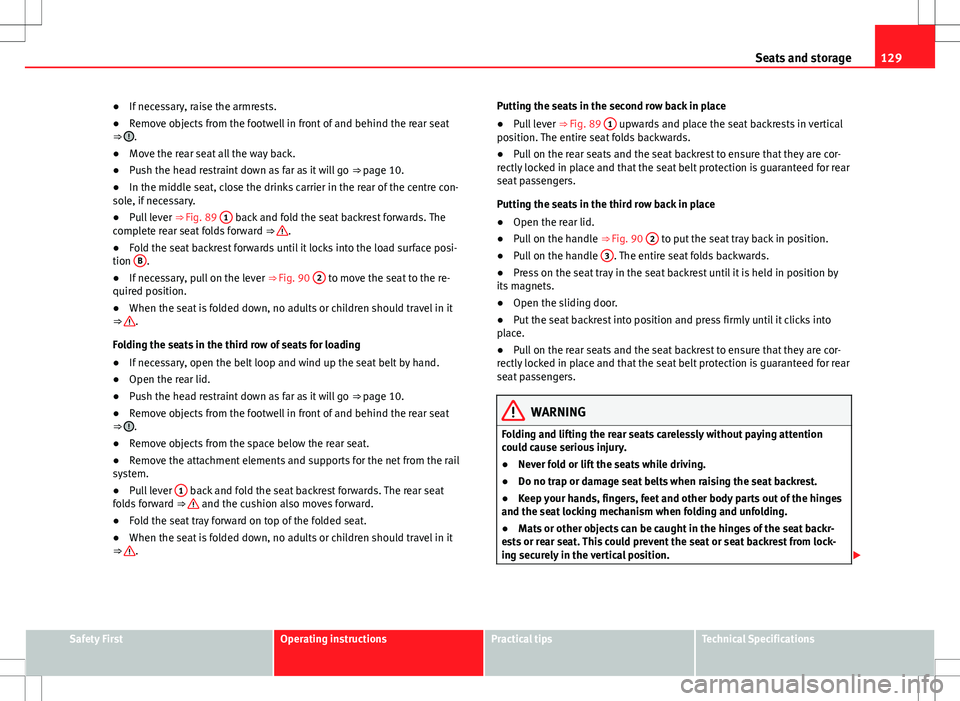
Fig. 89 Second row of seats: folding the rear seat A,
rear seat as load space B
Fig. 90 Third row of seats: fold down the rear seat to
load A then return to position B
Each rear seat can fold down individually to extend the luggage compart-
ment. Folding the seats in the second row of seats for loading
●
If necessary, open the belt loop and wind up the seat belt by hand.
● If it is necessary, remove the head restraints on the integrated child
seats then reinstall the integrated child seats ⇒ page 46.
Page 131 of 387
129
Seats and storage
● If necessary, raise the armrests.
● Remove objects from the footwell in front of and behind the rear seat
⇒
.
● Move the rear seat all the way back.
● Push the head restraint down as far as it will go ⇒ page 10.
● In the middle seat, close the drinks carrier in the rear of the centre con-
sole, if necessary.
● Pull lever ⇒ Fig. 89 1
back and fold the seat backrest forwards. The
complete rear seat folds forward ⇒ .
● Fold the seat backrest forwards until it locks into the load surface posi-
tion B
.
● If necessary, pull on the lever ⇒ Fig. 90 2 to move the seat to the re-
quired position.
● When the seat is folded down, no adults or children should travel in it
⇒
.
Folding the seats in the third row of seats for loading
● If necessary, open the belt loop and wind up the seat belt by hand.
● Open the rear lid.
● Push the head restraint down as far as it will go ⇒ page 10.
● Remove objects from the footwell in front of and behind the rear seat
⇒
.
● Remove objects from the space below the rear seat.
● Remove the attachment elements and supports for the net from the rail
system.
● Pull lever 1
back and fold the seat backrest forwards. The rear seat
folds forward ⇒ and the cushion also moves forward.
● Fold the seat tray forward on top of the folded seat.
● When the seat is folded down, no adults or children should travel in it
⇒
. Putting the seats in the second row back in place
●
Pull lever ⇒ Fig. 89 1
upwards and place the seat backrests in vertical
position. The entire seat folds backwards.
● Pull on the rear seats and the seat backrest to ensure that they are cor-
rectly locked in place and that the seat belt protection is guaranteed for rear
seat passengers.
Putting the seats in the third row back in place
● Open the rear lid.
● Pull on the handle ⇒ Fig. 90 2
to put the seat tray back in position.
● Pull on the handle 3. The entire seat folds backwards.
● Press on the seat tray in the seat backrest until it is held in position by
its magnets.
● Open the sliding door.
● Put the seat backrest into position and press firmly until it clicks into
place.
● Pull on the rear seats and the seat backrest to ensure that they are cor-
rectly locked in place and that the seat belt protection is guaranteed for rear
seat passengers.
WARNING
Folding and lifting the rear seats carelessly without paying attention
could cause serious injury.
● Never fold or lift the seats while driving.
● Do no trap or damage seat belts when raising the seat backrest.
● Keep your hands, fingers, feet and other body parts out of the hinges
and the seat locking mechanism when folding and unfolding.
● Mats or other objects can be caught in the hinges of the seat backr-
ests or rear seat. This could prevent the seat or seat backrest from lock-
ing securely in the vertical position.
Safety FirstOperating instructionsPractical tipsTechnical Specifications