steering Seat Alhambra 2013 Service Manual
[x] Cancel search | Manufacturer: SEAT, Model Year: 2013, Model line: Alhambra, Model: Seat Alhambra 2013Pages: 387, PDF Size: 6.13 MB
Page 219 of 387
217
Driving
Control lamps
Blinks or
lights upPossible causeSolution
(yellow)Lane assist system connec-
ted but inactive.
The system cannot clearly de-
tect the lane. See and
page 218, The lane assist sys-
tem is inactive (control lamp lit
in yellow).
(green)Lane assist system connec-
ted and active.–
Several warning and control lamps should light up for a few seconds when
the ignition is switched on, signalling that the function is being verified.
They will switch off after a few seconds.
WARNING
If the warning lamps and messages are ignored, the vehicle may stall in
traffic, or may cause accidents and severe injuries.
● Never ignore the warning lamps or text messages.
● Stop the vehicle safely as soon as possible.
CAUTION
Failure to heed the control lamps and text messages when they appear may
result in faults in the vehicle. Operation mode
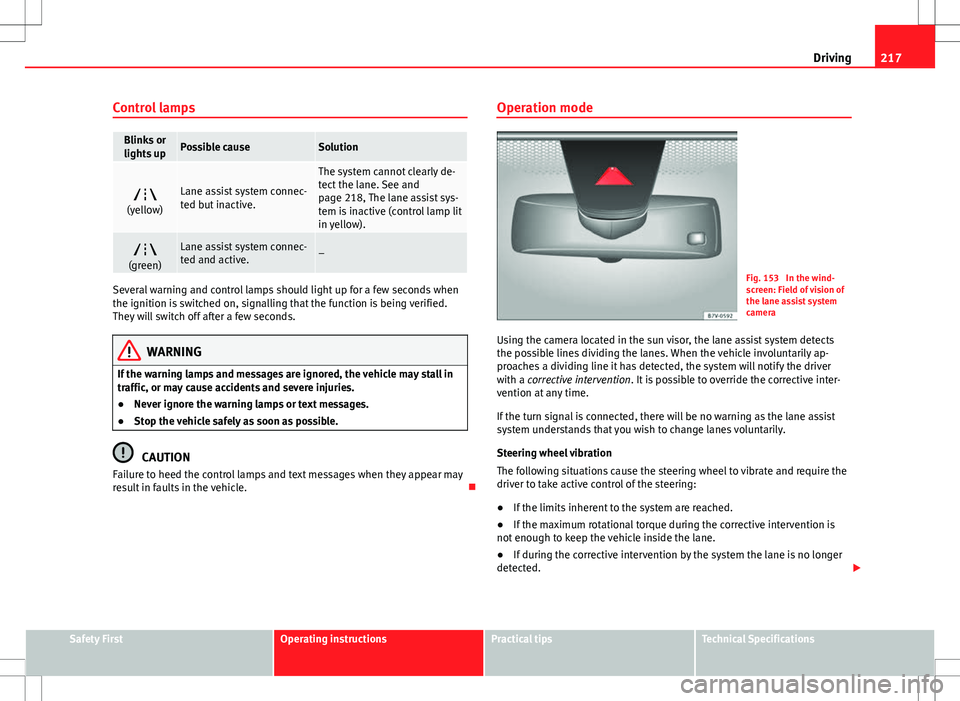
Fig. 153 In the wind-
screen: Field of vision of
the lane assist system
camera
Using the camera located in the sun visor, the lane assist system detects
the possible lines dividing the lanes. When the vehicle involuntarily ap-
proaches a dividing line it has detected, the system will notify the driver
with a corrective intervention. It is possible to override the corrective inter-
vention at any time.
If the turn signal is connected, there will be no warning as the lane assist
system understands that you wish to change lanes voluntarily.
Steering wheel vibration
The following situations cause the steering wheel to vibrate and require the
driver to take active control of the steering:
● If the limits inherent to the system are reached.
● If the maximum rotational torque during the corrective intervention is
not enough to keep the vehicle inside the lane.
● If during the corrective intervention by the system the lane is no longer
detected.
Safety FirstOperating instructionsPractical tipsTechnical Specifications
Page 220 of 387
218Driving
Switching the lane assist system on or off
● Select the corresponding menu option using the button for the driver as-
sist systems ⇒ page 62.
● OR: Activate or deactivate the system in the menu Settings, sub-menu
Assist systems , menu Lane Assist ⇒ page 62. The “confirmation sign” indi-
cates that the driver assist system is switched on.
Automatic deactivation: the lane assist system can be deactivated automat-
ically if there is a system malfunction. Control lamp switches off.
The lane assist system is inactive (control lamp lit in yellow)
● When the speed of travel drops to below approx. 65 km/h (40 mph).
● When the lane assist system does not detect the dividing lines of the
road. For example, in the event of road works, and snow, dirt, moisture or
reflections.
● When the radius of a curve is too small.
● When there is no dividing line.
● When the distance to the next dividing line is excessive.
● When there are more than two lane markings per lane.
● When the ASR is switched off.
● When the system does not detect any active rotation of the steering
wheel by the driver during a prolonged period.
● Temporarily, in the event of very dynamic driving.
● When the turn signal is connected.
Note
Before starting travel, verify that the camera's field of vision is not covered
⇒ Fig. 153.
Note
Keep the camera window clean. Disconnect the lane assist system in the following
situations
Due to the limits of the lane assist system, disconnect it in the following sit-
uations:
●
When more attention is required of the driver
● For very sporty driving
● In very unfavourable weather conditions
● In very unfavourable road conditions
● In areas of road works
Page 224 of 387
222Driving
Tiredness detection (recommendation to
take a break)
Introduction
Additional information and warnings:
● SEAT information system ⇒ page 62
● Accessories, parts replacement, repairs and modifications ⇒ page 260
WARNING
Do not let the extra convenience afforded by the tiredness detection func-
tion tempt you into taking any risks when driving. When making long
trips, conveniently long breaks must be taken.
● The driver is responsible for determining their capacity to drive.
● Never drive when tired.
● The system does not always detect the tiredness of the driver. Please
read the information provided in the section ⇒ page 223, Limited opera-
tion.
● In some situations the system may incorrectly interpret an intended
manoeuvre as a sign of tiredness of the driver.
● In the event of the an episode called “microsleep” at the wheel, a
strong warning is not in place!
● Observe the indications on the display of the instrument panel and
act in accordance with them.
Note
● The tiredness detection function has only been conceived for driving on
motorways and wide roads.
● If there is a fault in the system, refer to a Specialised workshop to have
the system inspected. Function and operation
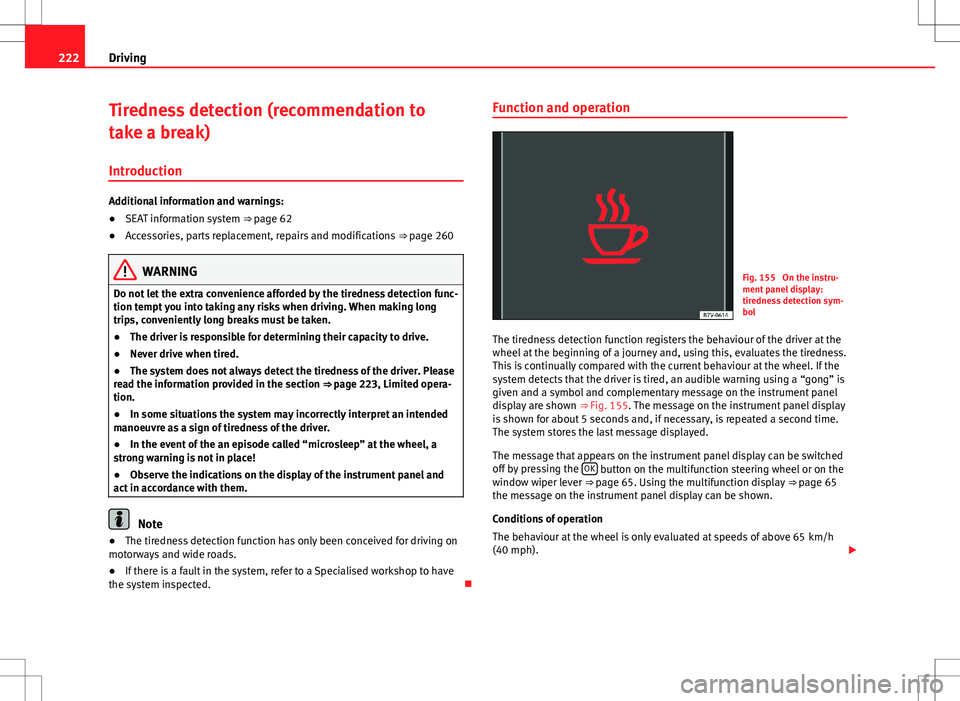
Fig. 155 On the instru-
ment panel display:
tiredness detection sym-
bol
The tiredness detection function registers the behaviour of the driver at the
wheel at the beginning of a journey and, using this, evaluates the tiredness.
This is continually compared with the current behaviour at the wheel. If the
system detects that the driver is tired, an audible warning using a “gong” is
given and a symbol and complementary message on the instrument panel
display are shown ⇒ Fig. 155. The message on the instrument panel display
is shown for about 5 seconds and, if necessary, is repeated a second time.
The system stores the last message displayed.
The message that appears on the instrument panel display can be switched
off by pressing the OK
button on the multifunction steering wheel or on the
window wiper lever ⇒ page 65. Using the multifunction display ⇒ page 65
the message on the instrument panel display can be shown.
Conditions of operation
The behaviour at the wheel is only evaluated at speeds of above 65 km/h
(40 mph).
Page 271 of 387
269
Checking and refilling levels
WARNING
Driving with insufficient fuel reserve could result in the vehicle breaking
down in traffic and a serious accident.
● If the fuel level is too low then the fuel supply to the engine can be-
come irregular especially on slopes.
● If the engine “is choked” or stalls due to lack of or irregularity of the
fuel supply, the power steering as well as all of the driver assistance sys-
tems including braking assistance will stop working.
● Always refuel when there is only one quarter of the fuel tank left to
avoid running out of fuel.
CAUTION
● Always pay attention to any lit control lamps and to the corresponding
descriptions and instructions to avoid damage to the vehicle.
● Never run the fuel tank completely dry. An irregular fuel supply may lead
to ignition faults and unburnt fuel could enter the exhaust system. This
could damage the catalytic converter filter or the diesel particulate filter!
Note
The arrow next to the fuel pump symbol on the instrument panel ⇒ Fig. 164
indicates the side of the vehicle on which the tank flap is located. Filling the tank with petrol or diesel
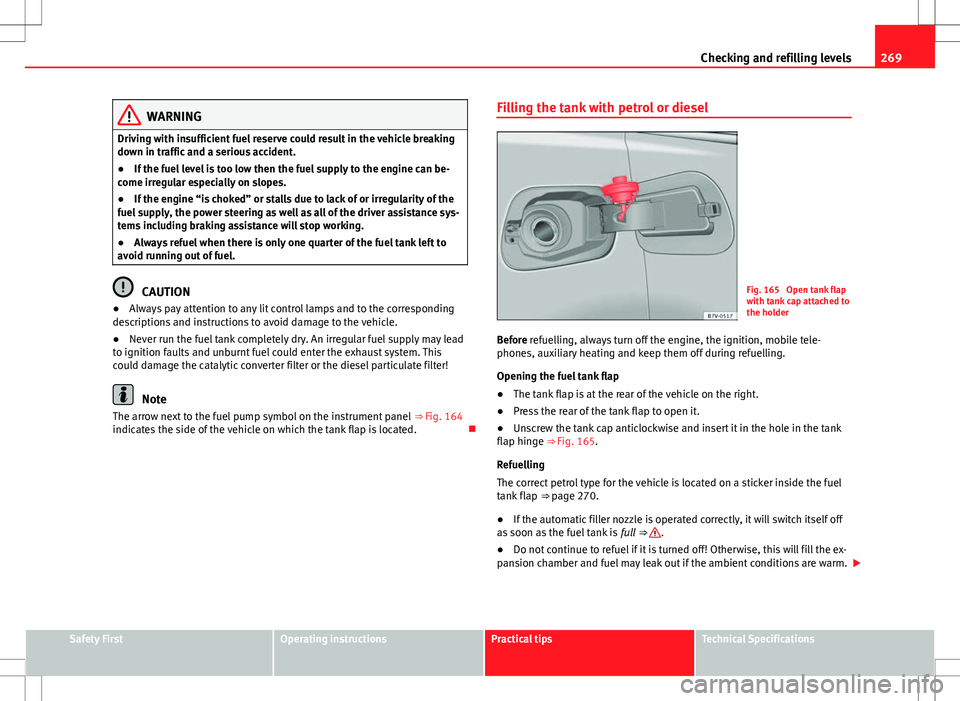
Fig. 165 Open tank flap
with tank cap attached to
the holder
Before refuelling, always turn off the engine, the ignition, mobile tele-
phones, auxiliary heating and keep them off during refuelling.
Opening the fuel tank flap
● The tank flap is at the rear of the vehicle on the right.
● Press the rear of the tank flap to open it.
● Unscrew the tank cap anticlockwise and insert it in the hole in the tank
flap hinge ⇒ Fig. 165.
Refuelling
The correct petrol type for the vehicle is located on a sticker inside the fuel
tank flap ⇒ page 270.
● If the automatic filler nozzle is operated correctly, it will switch itself off
as soon as the fuel tank is full
⇒
.
● Do not continue to refuel if it is turned off! Otherwise, this will fill the ex-
pansion chamber and fuel may leak out if the ambient conditions are warm.
Safety FirstOperating instructionsPractical tipsTechnical Specifications
Page 305 of 387
303
Wheels and tyres
Foreign bodies in the tyre
● Do not remove foreign bodies if they have penetrated through the tyre
wall!
● You should obtain professional assistance immediately.
The sealant at the lower part of the tyre tread wraps around the foreign body
and provisionally seals the tyre.
Wear of tyres
The wear of tyres depends on a number of factors, for example:
● Driving style.
● Unbalanced wheels.
● Running gear settings.
Driving style : driving round bends fast or sudden acceleration or braking
speed up the wear of tyres. When the driving style is normal, if the tyres
wear too quickly, have the running gear settings checked at a specialised
workshop.
Wheel run-out: The wheels on new vehicles are balanced. However, certain
circumstances may lead to imbalance (run-out), which is detected as vibra-
tions in the steering wheel. Run-out leads to wear of the steering and sus-
pension. In the event of run out, the wheels should be balanced again.
When a new wheel is fitted, it should be balanced again.
Running gear settings : an incorrectly positioned running gear increases the
wear of tyres and affects your safety while driving. If tyres wear too quickly,
have the wheel alignment checked at a specialised workshop.
WARNING
If you notice unusual vibration or the car pulls to one side while driving,
this may indicate that one of the tyres is damaged.
● Reduce speed immediately and stop, while observing the highway
code.
● Check the wheels and tyres for damage.
● Never carry on driving on worn tyres or wheels. Request qualified as-
sistance immediately.
● If there is no visible exterior damage, drive slowly and carefully to the
nearest specialised workshop and have the vehicle checked.
Winter tyres*
In winter conditions winter tyres will considerably improve the vehicle's han-
dling. The design of summer tyres (width, rubber compound, tread pattern)
gives less grip on ice and snow. Winter tyres also improve the vehicle brak-
ing performance, reducing the braking distance in winter weather. SEAT rec-
ommend that winter tyres be fitted to the vehicle at temperatures below
+7 °C (+45 °F).
The performance of winter tyres is much reduced if the tyre tread is worn be-
low 4 mm (1/16 inch). The age of the tyre is another factor affecting per-
formance, regardless of the depth of the tyre tread.
Please observe the following when using winter tyres:
● Observe legal requirements in each country.
● Winter tyres must be fitted on all four wheels.
● Only use winter tyres in wintery weather conditions.
● Only use winter tyres of the size authorised for the vehicle.
Safety FirstOperating instructionsPractical tipsTechnical Specifications
Page 345 of 387
343
If and when
WARNING (Continued)
● Observe the instructions provided by the manufacturer of the jump
leads.
● Do not connect the negative cable from the other vehicle directly to
the negative terminal of the flat battery. The gas emitted from the battery
could be ignited by sparks. Danger of explosion.
● Do not attach the negative cable from the other vehicle to parts of the
fuel system or to the brake line.
● The non-insulated parts of the battery clamps must not be allowed to
touch. The jump lead attached to the positive battery terminal must not
touch metal parts of the vehicle, this can cause a short circuit.
● Position the leads in such a way that they cannot come into contact
with any moving parts in the engine compartment.
● Do not lean on the batteries. This could result in chemical burns.
Note
The vehicles must not touch each other, otherwise electricity could flow as
soon as the positive terminals are connected.
Towing and tow starting Introduction
When towing, always respect legal requirements.
For technical reasons, it is not possible to tow a vehicle if the battery is flat.
Additional information and warnings:
● Electronic power control and exhaust gases purification system
⇒ page 231
WARNING
A vehicle with a flat battery should never be towed.
● Never remove the key from the ignition lock. The electronic steering
lock could engage. Then the vehicle will be uncontrollable. You may lose
control of the vehicle and there is a risk of serious accident.
WARNING
When towing the vehicle, the handling and braking efficiency change
considerably. Please observe the following instructions to minimise the
risk of serious accidents and injury:
● As the driver of the vehicle being towed:
– The brake must be depressed must harder as the brake servo does
not operate. Always remain aware to avoid collision with the towing
vehicle.
– More strength is required at the steering wheel as the power steer-
ing does not operate when the engine is switched off.
● As the driver of the towing vehicle:
– Accelerate gently and carefully.
– Avoid sudden braking and manoeuvres.
– Brake well in advance than usual and brake gently.
CAUTION
● Carefully fit and remove the towline anchorage and its cover to avoid
damage to the vehicle (for example, paintwork).
● When towing, fuel could enter the catalytic converter and cause dam-
age!
Safety FirstOperating instructionsPractical tipsTechnical Specifications
Page 346 of 387
344If and when
Instructions for tow starting
In general, the vehicle should not be started by towing. Jump-starting is
much more preferable ⇒ page 340.
For technical reasons, the following vehicles can not be tow started:
● Vehicles with an automatic gearbox.
● Vehicles with an electronic parking brake, given that it is possible that
the brake will not be disengaged.
● If the vehicle battery is flat, it is possible that the engine control units do
not operate correctly.
However, if your vehicle must absolutely be tow-started (manual gearbox):
● Engage the 2nd or 3rd gear.
● Keep the clutch pressed down.
● Switch on the ignition and the hazard warning lights.
● Release the clutch when both vehicles are moving.
● As soon as the engine starts, press the clutch and move the gear lever
into neutral. This helps to prevent a collision with the towing vehicle.
CAUTION
When tow-starting, fuel could enter the catalytic converter and damage it.
Towing instructions
Tow rope or tow bar
When towing, the tow bar is the safest and vehicle friendly way. You should
only use a tow rope if you do not have a tow bar. A tow rope should be slightly elastic to avoid damage to both vehicles. It is
advisable to use a tow rope made of synthetic fibre or similarly elastic mate-
rial.
Only secure the tow rope or tow bar to the towline anchorage or specially
designed fitting.
Vehicles with a
factory fitted towing device , can only be used for towing
with a tow bar, specially designed to fit on a tow hitch ball ⇒ page 236.
Towing vehicles with an automatic gearbox
Note the following for a towed vehicle:
● Make sure the gear selector lever is in the N position.
● Do not drive faster than 50 km/h (30 mph) when towing a vehicle.
● Do not tow further than 50 km (30 miles).
● If a breakdown truck is used, the vehicle must be towed with the front
wheels raised. Note the following instructions for towing four all-wheel drive
vehicles.
Instructions for towing all-wheel drive vehicles
All-wheel drive vehicles can be towed using a toolbar or tow rope. If the ve-
hicle is towed with the front or rear axle raised, the engine must be turned
off to avoid transmission damage.
For vehicles with a double clutched DSG ®
(direct shift gearbox) the instruc-
tions for towing vehicles with an automatic gearbox apply ⇒ page 344.
Situations in which the vehicle should not be towed
In the following cases, the vehicle should not be towed but transported on a
trailer or special vehicle:
● If the vehicle gearbox does not contain lubricant due to a fault.
● If the vehicle battery is flat and, as a result, the electronic steering lock
and electronic parking brake cannot be disengaged if applied.
● If the vehicle to be towed has an automatic gearbox and the distance to
be covered is greater than 50 km (30 miles).
Page 347 of 387
345
If and when
Note
The vehicle can only be towed if the electronic parking brake and steering
lock are deactivated. If the vehicle has no power supply or there is an elec-
tric system fault, the engine must be started using jump leads to deactivate
the electronic parking brake and electronic steering lock.
Fitting the front towline anchorage
Fig. 220 On the right-
hand side of the front
bumper: Screw in the
towline anchorage
The location for the removable towline anchorage is on the right-hand side
of the front bumper ⇒ Fig. 220.
The towline anchorage should always be kept in the vehicle.
Note the instructions for towing ⇒ page 344.
To fit the towline anchorage
● Take the towline anchorage from the vehicle tool kit
⇒ page 323.
● Press on the upper cover and carefully remove it forwards. Allow the cov-
er to hang. ●
Screw in the towline anchorage into its position anticlockwise as far as
it will go ⇒ Fig. 220 ⇒
. Use a suitable tool to firmly tighten the towline
anchorage in its location.
● After towing, remove the towline anchorage by turning it clockwise and
put the cover back in place.
CAUTION
The towline anchorage must always be completely and firmly tightened.
Otherwise, it could be released while towing and tow-starting.
Fitting the rear towline anchorage
Fig. 221 On the rear
bumper, to the right hand
side: Tow ring in position
The location for the removable towline anchorage is on the right-hand side
of the rear bumper ⇒ Fig. 221. For vehicles with a factory fitted towing brack-
et, there is no fitting behind the cover to insert the towline anchorage. For
towing, fit and use the tow hitch ⇒ page 236, ⇒
.
Note the instructions for towing ⇒ page 344.
Safety FirstOperating instructionsPractical tipsTechnical Specifications
Page 348 of 387
346If and when
Fitting the towline anchorage to the rear for vehicles without factory fitted
tow hitch
● Take the towline anchorage from the vehicle tool kit in the luggage com-
partment ⇒ page 323.
● Press on the upper cover and carefully remove it back. This may require
some strength. Allow the cover to hang.
● Screw in the towline anchorage into its position anticlockwise as far as
it will go ⇒
. Use a suitable tool to firmly tighten the towline anchorage in
its location.
● After towing, remove the towline anchorage by turning it clockwise and
put the cover back in place.
CAUTION
● The towline anchorage must always be completely and firmly tightened.
Otherwise, it could be released while towing and tow-starting.
● Vehicles with a factory fitted towing bracket, can only be used for towing
with a tow bar, specially designed to fit on a tow hitch ball. Otherwise, the
tow hitch ball and the vehicle may be damaged. Otherwise, a tow rope
should be used.
Towing advice
Towing requires some experience, especially when using a tow rope. Both
drivers should be familiar with the technique required for towing. For this
reason, inexperienced drivers should abstain.
While driving, avoid excessive traction forces and jerking. When towing on
an unpaved road, there is always a risk of overloading and damaging the
anchorage points.
If the vehicle is towed, with the hazard warning lights on and the ignition
switched on, the turn signal may be used to indicate changes of direction.
Simply operate the turn signal lever as usual. Meanwhile, the hazard warn- ing lights will go off. When the turn signal lever is returned to the rest posi-
tion, the hazard warning lights will be turned on automatically.
Notes for the driver of the towed vehicle
●
Leave the ignition on to avoid locking the steering wheel, to release the
electronic parking brake and to activate the turn signals, the horn as well as
the window wipers and window washers.
● As the power assisted steering does not work if the engine is not run-
ning, you will need more strength to steer than normally.
● The brake must be depressed must harder as the brake servo does not
operate. Avoid hitting the towing vehicle.
● Note the instructions and information contained in the Instruction Man-
ual for the vehicle to be towed.
Notes for the driver of the towing vehicle
● Accelerate gently and carefully. Avoid sudden manoeuvres.
● Brake well in advance than usual and brake gently.
● Note the instructions and information contained in the Instruction Man-
ual for the vehicle to be towed.
Page 369 of 387
Index
A
AbroadExtended stay abroad with your vehicle . . 258
Sale of vehicle . . . . . . . . . . . . . . . . . . . . . . 258
ABS See "Brake assist systems" . . . . . . . . . . . . 190
Accessories . . . . . . . . . . . . . . . . . . . . . . . . . . . . 260
Acoustic warnings Headlights . . . . . . . . . . . . . . . . . . . . . . . . . . 97
Adaptive headlights Dynamic . . . . . . . . . . . . . . . . . . . . . . . . . . . . 99
AdBlue Control lamp . . . . . . . . . . . . . . . . . . . . . . . . 274
Information . . . . . . . . . . . . . . . . . . . . . . . . . 275
Minimum quantity for a refill . . . . . . . . . . . 275
Refilling . . . . . . . . . . . . . . . . . . . . . . . . . . . . 276
Specifications . . . . . . . . . . . . . . . . . . . . . . . 277
Tank filling capacity . . . . . . . . . . . . . . . . . . 275
Warning lamp . . . . . . . . . . . . . . . . . . . . . . . 274
Additional equipment . . . . . . . . . . . . . . . . . . . 261
Additional heater See "Auxiliary heater" . . . . . . . . . . . . . . . . 164
Adjusting passenger exterior mirror . . . . . . . . 112
Adjustment Correct sitting position . . . . . . . . . . . . . . . . 12
Electric front seat . . . . . . . . . . . . . . . . . . . . 115
Head restraints . . . . . . . . . . . . . . . . . . . . . . 123
Mechanical front seat . . . . . . . . . . . . . . . . 114
Rear seats . . . . . . . . . . . . . . . . . . . . . . . . . . 116 Seat with position memory . . . . . . . . . . . . 118
Steering wheel . . . . . . . . . . . . . . . . . . . . . . 170
Adjustments Folding the seat backrest of the front pas-senger seat . . . . . . . . . . . . . . . . . . . . . . . 121
Headlight range . . . . . . . . . . . . . . . . . . . . . 101
Aerial . . . . . . . . . . . . . . . . . . . . . . . . . . . . . . . . . 258
Aerial built into the window . . . . . . . . . . . . . . . 258
AFS . . . . . . . . . . . . . . . . . . . . . . . . . . . . . . . . . . . 99
Airbag system . . . . . . . . . . . . . . . . . . . . . . . . 29, 32 Cleaning dash panel . . . . . . . . . . . . . . . . . 256
Control lamp . . . . . . . . . . . . . . . . . . . . . . . . . 31
Curtain airbags . . . . . . . . . . . . . . . . . . . . . . . 38
Deactivating the front passenger front air-bag . . . . . . . . . . . . . . . . . . . . . . . . . . . . . . . 36
Deactivating using the key switch . . . . . . . . 36
Description . . . . . . . . . . . . . . . . . . . . . . . . . . 32
Differences between front passenger front airbag systems . . . . . . . . . . . . . . . . . . . . . 35
Faults . . . . . . . . . . . . . . . . . . . . . . . . . . . . . 262
Front airbags . . . . . . . . . . . . . . . . . . . . . . . . 34
Function . . . . . . . . . . . . . . . . . . . . . . . . . . . . 32
Knee airbag . . . . . . . . . . . . . . . . . . . . . . . . . 39
Locking the vehicle after airbag deploy- ment . . . . . . . . . . . . . . . . . . . . . . . . . . . . . . 75
Repairs . . . . . . . . . . . . . . . . . . . . . . . . . . . . 262
Side airbags . . . . . . . . . . . . . . . . . . . . . . . . . 37
Use of child seats . . . . . . . . . . . . . . . . . . . . . 36
Vehicle care . . . . . . . . . . . . . . . . . . . . . . . . 256 Air conditioner . . . . . . . . . . . . . . . . . . . . . . . . . 156
Air recirculation mode . . . . . . . . . . . . . . . . 162
Air vents . . . . . . . . . . . . . . . . . . . . . . . . . . . 162
Climatronic . . . . . . . . . . . . . . . . . . . . . . . . . 158
Controls . . . . . . . . . . . . . . . . . . . . . . . . . . . . 158
Electronic manual air conditioning . . . . . . 158
Faults . . . . . . . . . . . . . . . . . . . . . . . . . . . . . 161
Indirect ventilation . . . . . . . . . . . . . . . . . . . 162
Things to note . . . . . . . . . . . . . . . . . . . . . . . 161
User instructions . . . . . . . . . . . . . . . . . . . . 161
Air conditioning see "Air conditioner" . . . . . . . . . . . . . . . . . 156
Air recirculation mode . . . . . . . . . . . . . . . . . . . 162
Air vents . . . . . . . . . . . . . . . . . . . . . . . . . . . . . . 162
Alarm system . . . . . . . . . . . . . . . . . . . . . . . . . . . 78
Alcantara . . . . . . . . . . . . . . . . . . . . . . . . . . . . . . 254
All-wheel drive Snow chains . . . . . . . . . . . . . . . . . . . . . . . . 304
Towing . . . . . . . . . . . . . . . . . . . . . . . . . . . . . 344
Winter tyres . . . . . . . . . . . . . . . . . . . . . . . . . 304
Alternator . . . . . . . . . . . . . . . . . . . . . . . . . . . . . 292
Ambient lighting . . . . . . . . . . . . . . . . . . . . . . . 102
Anodized surfaces . . . . . . . . . . . . . . . . . . . . . . 250
Anti-lock brake system (ABS) . . . . . . . . . . . . . 190
Anti-theft alarm . . . . . . . . . . . . . . . . . . . . . . . . . 78 Trailer . . . . . . . . . . . . . . . . . . . . . . . . . . . . . 239
Anti-theft alarm system Anti-tow system . . . . . . . . . . . . . . . . . . . . . . 79
False alarms . . . . . . . . . . . . . . . . . . . . . . . . . 79
Interior monitoring . . . . . . . . . . . . . . . . . . . . 79
367
Index