lock Seat Alhambra 2013 Workshop Manual
[x] Cancel search | Manufacturer: SEAT, Model Year: 2013, Model line: Alhambra, Model: Seat Alhambra 2013Pages: 387, PDF Size: 6.13 MB
Page 129 of 387
127
Seats and storage
WARNING
When the vehicle is not in use or being watched, always lock the doors
and the rear lid to reduce the risk of serious injury or death.
● Do not leave children unwatched, especially when the rear lid is open.
Children could climb into the luggage compartment, close the rear lid
from inside and be unable to escape themselves. This could lead to seri-
ous injury or death.
● Never allow children to play in or around the vehicle.
● Never transport people in the luggage compartment.
WARNING
Unsecured or incorrectly secured objects can cause serious injury in case
of a sudden manoeuvring or breaking or in case of an accident. This is es-
pecially true when objects are struck by a detonating airbag and fired
through the vehicle interior. To reduce the risks, please note the follow-
ing:
● Secure all objects in the vehicle. Always keep equipment and heavy
objects in the luggage compartment.
● Always secure objects with suitable rope or straps so that they can-
not enter the areas around the front or side airbags in case of sudden
braking or an accident.
● While driving, always keep object compartments closed.
WARNING (Continued)
● Do not place hard, heavy or sharp objects inside the vehicle interior,
in open storage compartments, the rear shelf or on the dash panel.
● Remove hard, heavy and sharp objects from clothes and pockets in-
side the vehicle and store securely.
WARNING
The transport of heavy object changes vehicle handling and increases
braking distance. Heavy loads that have not been stored or secured cor-
rectly could cause loss of control and result in serious injury.
● The vehicle handling changes when transporting heavy objects due
to a change in the centre of gravity.
● Distribute the load as uniformly and as low down on the vehicle as
possible.
● Store heavy objects in the luggage compartment as far from the rear
axle as possible.
CAUTION
● Hard objects on the rear shelf could chafe the wires of the heating ele-
ment and antenna of the rear window and cause damage.
● The side window antenna could be damaged due to chafing from ob-
jects.
Note
The ventilating slits between the heated rear window and the shelf must not
be covered so that used air can escape from the vehicle.
Safety FirstOperating instructionsPractical tipsTechnical Specifications
Page 131 of 387
129
Seats and storage
● If necessary, raise the armrests.
● Remove objects from the footwell in front of and behind the rear seat
⇒
.
● Move the rear seat all the way back.
● Push the head restraint down as far as it will go ⇒ page 10.
● In the middle seat, close the drinks carrier in the rear of the centre con-
sole, if necessary.
● Pull lever ⇒ Fig. 89 1
back and fold the seat backrest forwards. The
complete rear seat folds forward ⇒ .
● Fold the seat backrest forwards until it locks into the load surface posi-
tion B
.
● If necessary, pull on the lever ⇒ Fig. 90 2 to move the seat to the re-
quired position.
● When the seat is folded down, no adults or children should travel in it
⇒
.
Folding the seats in the third row of seats for loading
● If necessary, open the belt loop and wind up the seat belt by hand.
● Open the rear lid.
● Push the head restraint down as far as it will go ⇒ page 10.
● Remove objects from the footwell in front of and behind the rear seat
⇒
.
● Remove objects from the space below the rear seat.
● Remove the attachment elements and supports for the net from the rail
system.
● Pull lever 1
back and fold the seat backrest forwards. The rear seat
folds forward ⇒ and the cushion also moves forward.
● Fold the seat tray forward on top of the folded seat.
● When the seat is folded down, no adults or children should travel in it
⇒
. Putting the seats in the second row back in place
●
Pull lever ⇒ Fig. 89 1
upwards and place the seat backrests in vertical
position. The entire seat folds backwards.
● Pull on the rear seats and the seat backrest to ensure that they are cor-
rectly locked in place and that the seat belt protection is guaranteed for rear
seat passengers.
Putting the seats in the third row back in place
● Open the rear lid.
● Pull on the handle ⇒ Fig. 90 2
to put the seat tray back in position.
● Pull on the handle 3. The entire seat folds backwards.
● Press on the seat tray in the seat backrest until it is held in position by
its magnets.
● Open the sliding door.
● Put the seat backrest into position and press firmly until it clicks into
place.
● Pull on the rear seats and the seat backrest to ensure that they are cor-
rectly locked in place and that the seat belt protection is guaranteed for rear
seat passengers.
WARNING
Folding and lifting the rear seats carelessly without paying attention
could cause serious injury.
● Never fold or lift the seats while driving.
● Do no trap or damage seat belts when raising the seat backrest.
● Keep your hands, fingers, feet and other body parts out of the hinges
and the seat locking mechanism when folding and unfolding.
● Mats or other objects can be caught in the hinges of the seat backr-
ests or rear seat. This could prevent the seat or seat backrest from lock-
ing securely in the vertical position.
Safety FirstOperating instructionsPractical tipsTechnical Specifications
Page 132 of 387
130Seats and storage
WARNING (Continued)
● All seat backrests must engage correctly for the seat belts on the rear
seats to work properly. When the seat backrest of an occupied seat is not
correctly locked in place, the passenger can be thrust forward with the
seat backrest in case of sudden braking, sudden manoeuvres or an acci-
dent.
● No seat must be occupied if the seat backrest or seat is folded or not
correctly engaged.
CAUTION
● Before folding the seat backrest of the rear seat, adjust the front seats
so that the head restraint or seat backrest do not hit them when it is folded.
● Objects placed in the footrest area in front of and behind the rear seats
can be damaged when seats are folded down or put back into position. Re-
move any objects in the way before folding seats down or repositioning
them. ●
Objects placed in the moulding on the back of the third row of seats can
be damaged when folding down the seats or putting them back into posi-
tion. Remove any objects in the way before folding seats down or reposi-
tioning them.
● The attachment elements and supports for the net partition placed on
the rail system can be damaged when folding down seats from the third row
or putting them back into position and these can also damage the seats
themselves. Before folding down or repositioning the seats, remove the at-
tachment elements and supports for the net from the rail system.
Page 136 of 387
134Seats and storage
Installing the net partition behind the front seats
● Hook in the net partition on the left-hand side roof support C
. To do
this, guide the rod from up to down.
● Hook in the net partition on the rear right-hand side roof support by
pressing on the rod.
● Secure the hooks of the net partition to the attachment rings in the left
and right hand side footwells on the second row of seats then tighten the
straps.
Removing the net partition
● Loosen the net partition straps.
● Release the net partition hooks from the rings B
.
● Release the net partition from the right and left roof supports A or Cby pressing on the rod.
●
Unhook the net partition from the left-hand side roof support.
Folding in the net partition
● Press on the release button ⇒ Fig. 93 2
and bend the rod A in the di-
rection of the arrow with the release o button pressed.
● Press on the release button 3
and bend the rod B in the direction of
the arrow with the release button pressed.
● Store the net partition securely in the vehicle.
WARNING
Loose objects in the vehicle interior can be violently thrown in case of a
sudden manoeuvre or braking and especially in accidents causing seri-
ous injury.
● Ensure that the rods are correctly locked in place.
● Even when net partition is correctly fitted, objects must be secured.
● When driving with the net partition, no passengers should be behind
it.
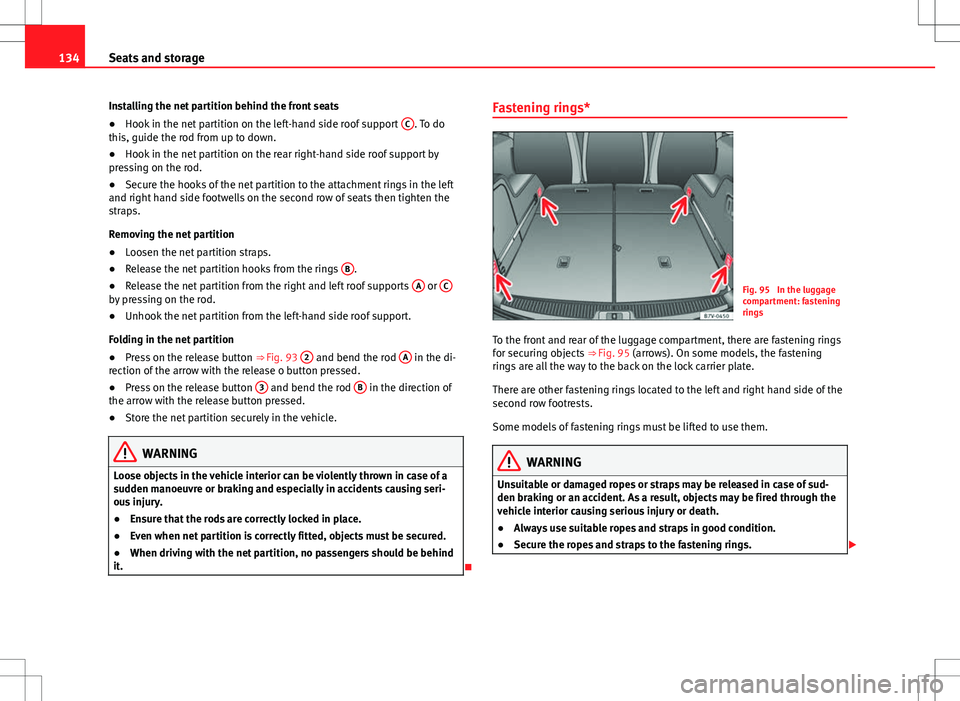
Fastening rings*
Fig. 95 In the luggage
compartment: fastening
rings
To the front and rear of the luggage compartment, there are fastening rings
for securing objects ⇒ Fig. 95 (arrows). On some models, the fastening
rings are all the way to the back on the lock carrier plate.
There are other fastening rings located to the left and right hand side of the
second row footrests.
Some models of fastening rings must be lifted to use them.
WARNING
Unsuitable or damaged ropes or straps may be released in case of sud-
den braking or an accident. As a result, objects may be fired through the
vehicle interior causing serious injury or death.
● Always use suitable ropes and straps in good condition.
● Secure the ropes and straps to the fastening rings.
Page 144 of 387
142Seats and storage
WARNING
In the event of sudden braking movements or turns, loose objects may be
thrown around the vehicle interior. This could cause serious injuries to
passengers and cause the driver to lose control of the vehicle.
● Do not transport animals or place hard, heavy or sharp objects inside
the vehicle in: open storage compartments, dash panel, rear shelf, items
of clothing or bags.
● While driving, always keep object compartments closed.
WARNING
Objects falling into the driver's footwell could prevent use of the pedals.
This could lead the driver to lose control of the vehicle, increasing the
risk of a serious accident.
● Make sure the pedals can be used at all times, with no objects rolling
underneath them.
● The floor mat should always be secured to the floor.
● Never place other mats or rugs on top of the original mat supplied by
the factory.
● Make sure that no objects can fall into the driver's footwell while the
vehicle is in motion.
CAUTION
● Objects on the shelf could chafe against the wires of the heating ele-
ment in the heated rear window and cause damage.
● Do not keep heat-sensitive objects, food or medicines inside the vehi-
cle. Heat and cold could damage them or render them useless.
● Light-transparent objects placed inside the vehicle, such as lenses,
magnifying glasses or transparent suction caps on the windows, could con-
centrate the sun's rays and cause damage to the vehicle.
Note
The ventilating slits between the heated rear window and the shelf must not
be covered so that used air can escape from the vehicle.
Spectacle case in the roof console
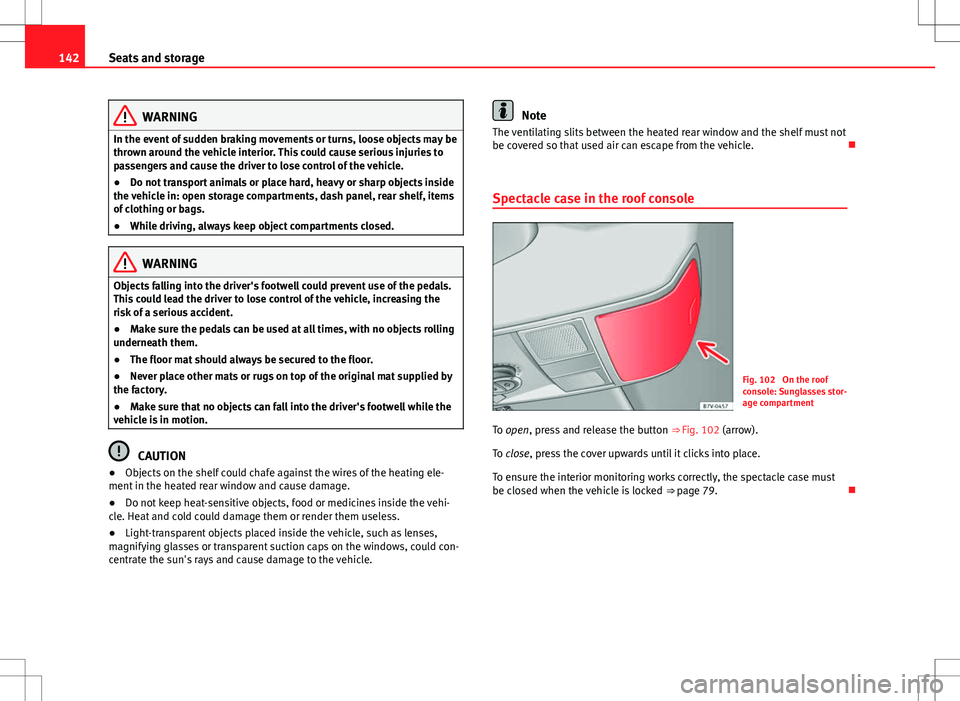
Fig. 102 On the roof
console: Sunglasses stor-
age compartment
To open, press and release the button ⇒ Fig. 102 (arrow).
To close, press the cover upwards until it clicks into place.
To ensure the interior monitoring works correctly, the spectacle case must
be closed when the vehicle is locked ⇒ page 79.
Page 145 of 387
143
Seats and storage
Storage compartment on the roof console
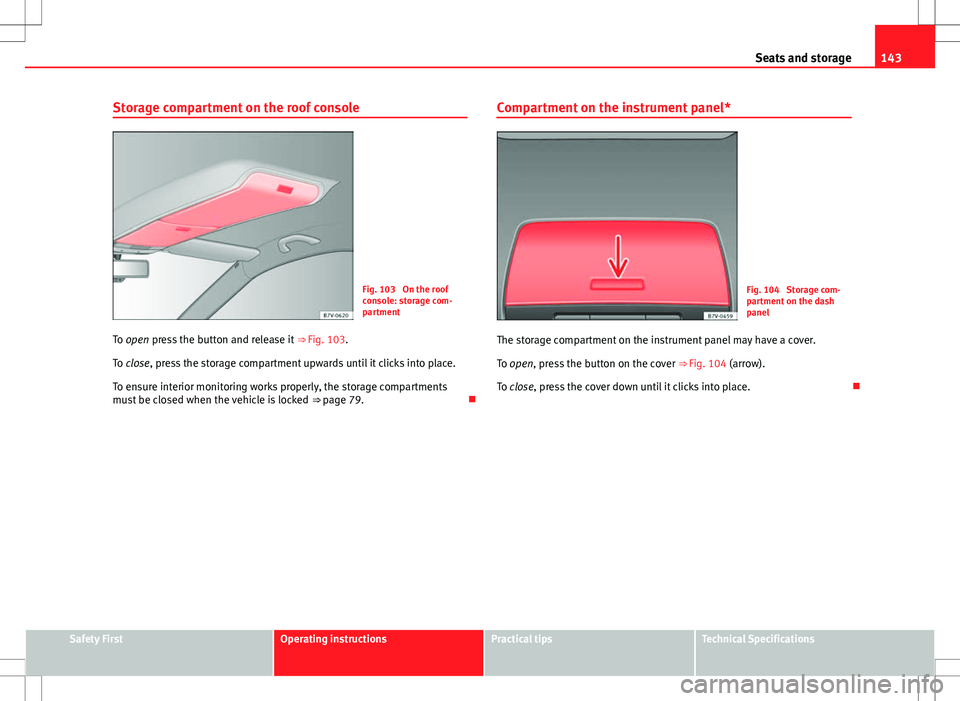
Fig. 103 On the roof
console: storage com-
partment
To open press the button and release it ⇒ Fig. 103.
To close, press the storage compartment upwards until it clicks into place.
To ensure interior monitoring works properly, the storage compartments
must be closed when the vehicle is locked ⇒ page 79.Compartment on the instrument panel*Fig. 104 Storage com-
partment on the dash
panel
The storage compartment on the instrument panel may have a cover.
To open, press the button on the cover ⇒ Fig. 104 (arrow).
To close, press the cover down until it clicks into place.
Safety FirstOperating instructionsPractical tipsTechnical Specifications
Page 147 of 387
145
Seats and storage
Card compartments*
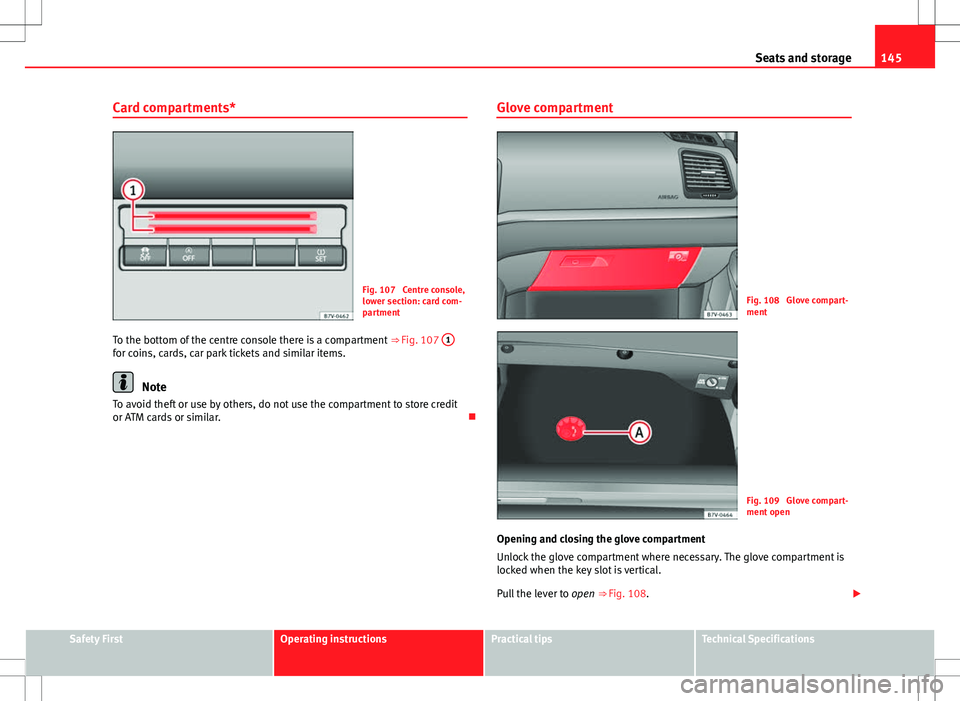
Fig. 107 Centre console,
lower section: card com-
partment
To the bottom of the centre console there is a compartment ⇒ Fig. 107 1
for coins, cards, car park tickets and similar items.
Note
To avoid theft or use by others, do not use the compartment to store credit
or ATM cards or similar. Glove compartment
Fig. 108 Glove compart-
ment
Fig. 109 Glove compart-
ment open
Opening and closing the glove compartment
Unlock the glove compartment where necessary. The glove compartment is
locked when the key slot is vertical.
Pull the lever to open ⇒ Fig. 108.
Safety FirstOperating instructionsPractical tipsTechnical Specifications
Page 150 of 387
148Seats and storage
WARNING
The folding table must not be folded down while the vehicle is in motion
to avoid the risk of injuries.
Portable waste bin*
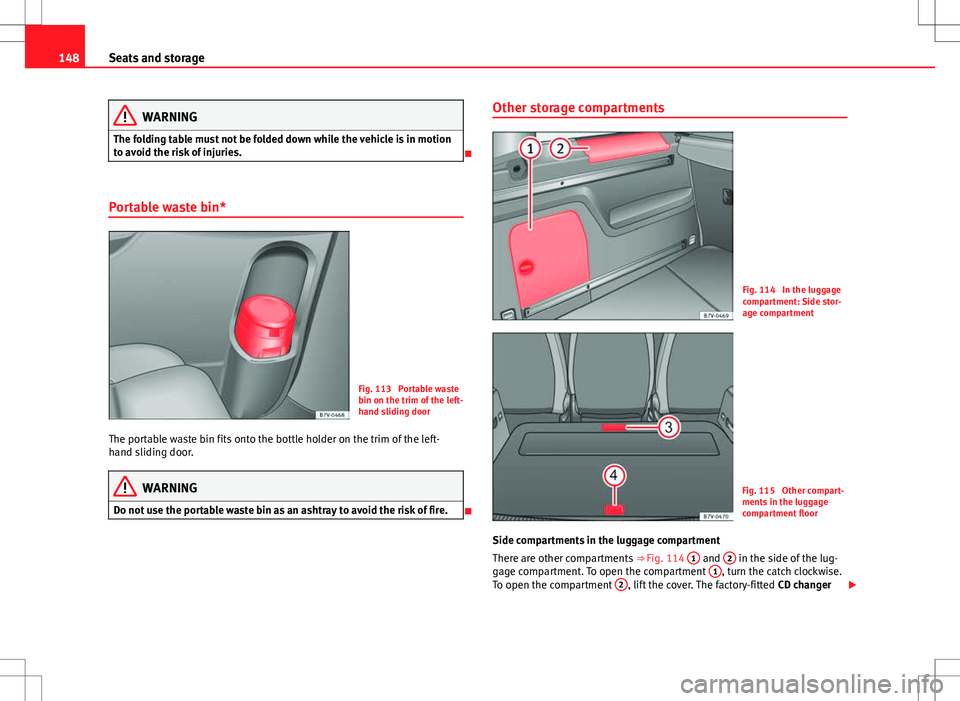
Fig. 113 Portable waste
bin on the trim of the left-
hand sliding door
The portable waste bin fits onto the bottle holder on the trim of the left-
hand sliding door.
WARNING
Do not use the portable waste bin as an ashtray to avoid the risk of fire.
Other storage compartments
Fig. 114 In the luggage
compartment: Side stor-
age compartment
Fig. 115 Other compart-
ments in the luggage
compartment floor
Side compartments in the luggage compartment
There are other compartments ⇒ Fig. 114 1
and 2 in the side of the lug-
gage compartment. To open the compartment 1, turn the catch clockwise.
To open the compartment 2, lift the cover. The factory-fitted
CD changer
Page 156 of 387
154Seats and storage
Vehicle power sockets
Depending on your vehicle's version, you may have a 12-
volt power socket and/or a 230 volt power socket.
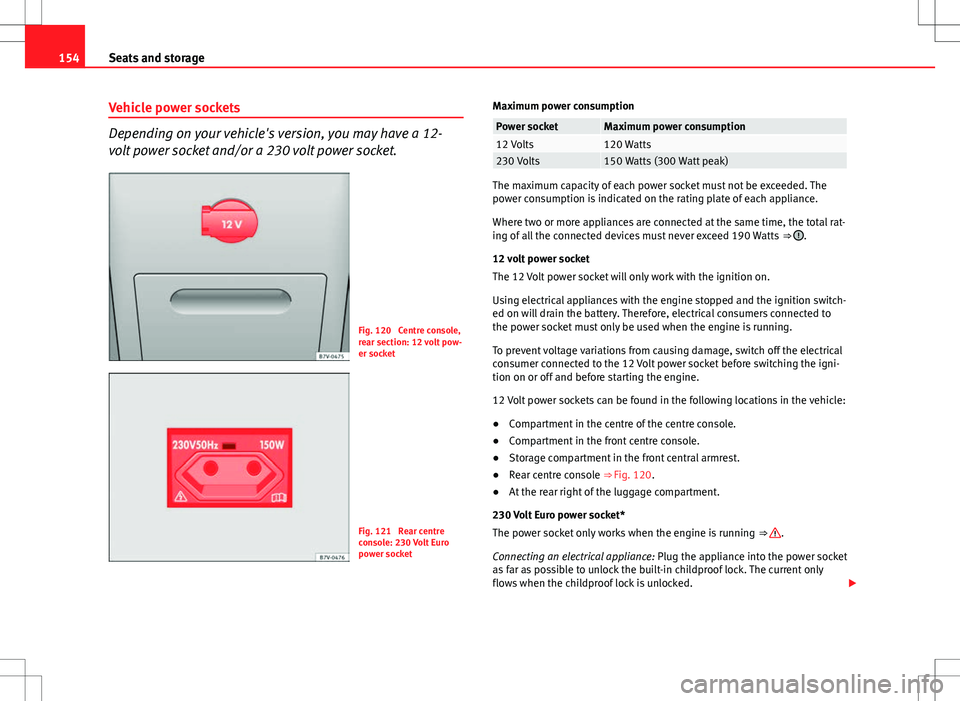
Fig. 120 Centre console,
rear section: 12 volt pow-
er socket
Fig. 121 Rear centre
console: 230 Volt Euro
power socket Maximum power consumption
Power socketMaximum power consumption12 Volts120 Watts230 Volts150 Watts (300 Watt peak)
The maximum capacity of each power socket must not be exceeded. The
power consumption is indicated on the rating plate of each appliance.
Where two or more appliances are connected at the same time, the total rat-
ing of all the connected devices must never exceed 190 Watts
⇒
.
12 volt power socket
The 12 Volt power socket will only work with the ignition on.
Using electrical appliances with the engine stopped and the ignition switch-
ed on will drain the battery. Therefore, electrical consumers connected to
the power socket must only be used when the engine is running.
To prevent voltage variations from causing damage, switch off the electrical
consumer connected to the 12 Volt power socket before switching the igni-
tion on or off and before starting the engine.
12 Volt power sockets can be found in the following locations in the vehicle:
● Compartment in the centre of the centre console.
● Compartment in the front centre console.
● Storage compartment in the front central armrest.
● Rear centre console ⇒ Fig. 120.
● At the rear right of the luggage compartment.
230 Volt Euro power socket*
The power socket only works when the engine is running ⇒
.
Connecting an electrical appliance: Plug the appliance into the power socket
as far as possible to unlock the built-in childproof lock. The current only
flows when the childproof lock is unlocked.
Page 157 of 387
155
Seats and storage
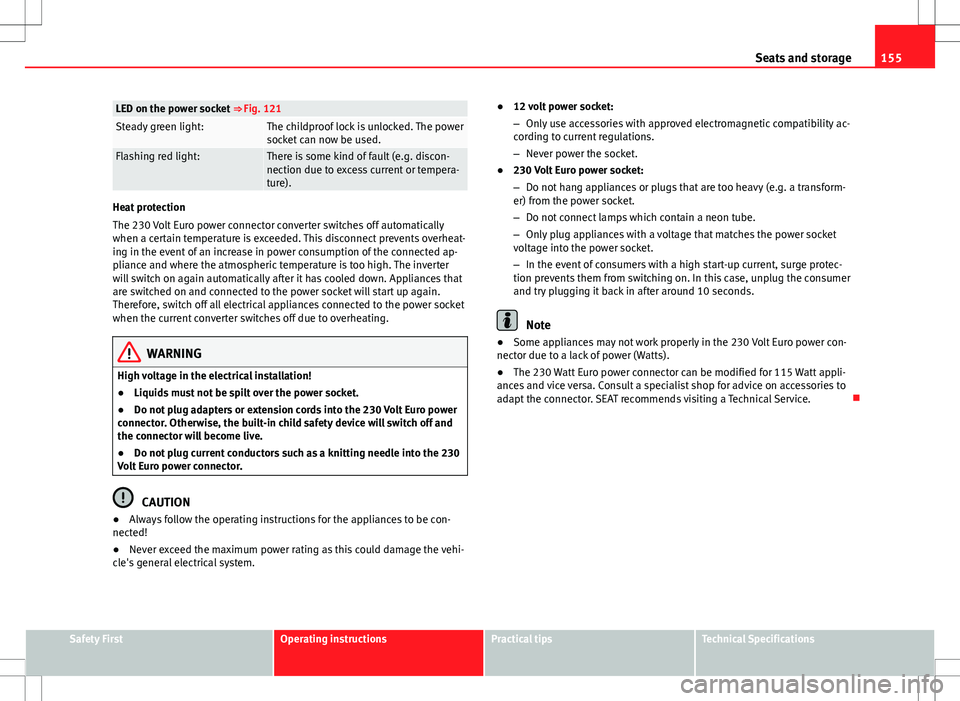
LED on the power socket ⇒ Fig. 121Steady green light:The childproof lock is unlocked. The power
socket can now be used.
Flashing red light:There is some kind of fault (e.g. discon-
nection due to excess current or tempera-
ture).
Heat protection
The 230 Volt Euro power connector converter switches off automatically
when a certain temperature is exceeded. This disconnect prevents overheat-
ing in the event of an increase in power consumption of the connected ap-
pliance and where the atmospheric temperature is too high. The inverter
will switch on again automatically after it has cooled down. Appliances that
are switched on and connected to the power socket will start up again.
Therefore, switch off all electrical appliances connected to the power socket
when the current converter switches off due to overheating.
WARNING
High voltage in the electrical installation!
● Liquids must not be spilt over the power socket.
● Do not plug adapters or extension cords into the 230 Volt Euro power
connector. Otherwise, the built-in child safety device will switch off and
the connector will become live.
● Do not plug current conductors such as a knitting needle into the 230
Volt Euro power connector.
CAUTION
● Always follow the operating instructions for the appliances to be con-
nected!
● Never exceed the maximum power rating as this could damage the vehi-
cle's general electrical system. ●
12 volt power socket:
– Only use accessories with approved electromagnetic compatibility ac-
cording to current regulations.
– Never power the socket.
● 230 Volt Euro power socket:
– Do not hang appliances or plugs that are too heavy (e.g. a transform-
er) from the power socket.
– Do not connect lamps which contain a neon tube.
– Only plug appliances with a voltage that matches the power socket
voltage into the power socket.
– In the event of consumers with a high start-up current, surge protec-
tion prevents them from switching on. In this case, unplug the consumer
and try plugging it back in after around 10 seconds.
Note
● Some appliances may not work properly in the 230 Volt Euro power con-
nector due to a lack of power (Watts).
● The 230 Watt Euro power connector can be modified for 115 Watt appli-
ances and vice versa. Consult a specialist shop for advice on accessories to
adapt the connector. SEAT recommends visiting a Technical Service.
Safety FirstOperating instructionsPractical tipsTechnical Specifications