fuel cap Seat Alhambra 2014 User Guide
[x] Cancel search | Manufacturer: SEAT, Model Year: 2014, Model line: Alhambra, Model: Seat Alhambra 2014Pages: 381, PDF Size: 5.75 MB
Page 304 of 381
302Wheels and tyres
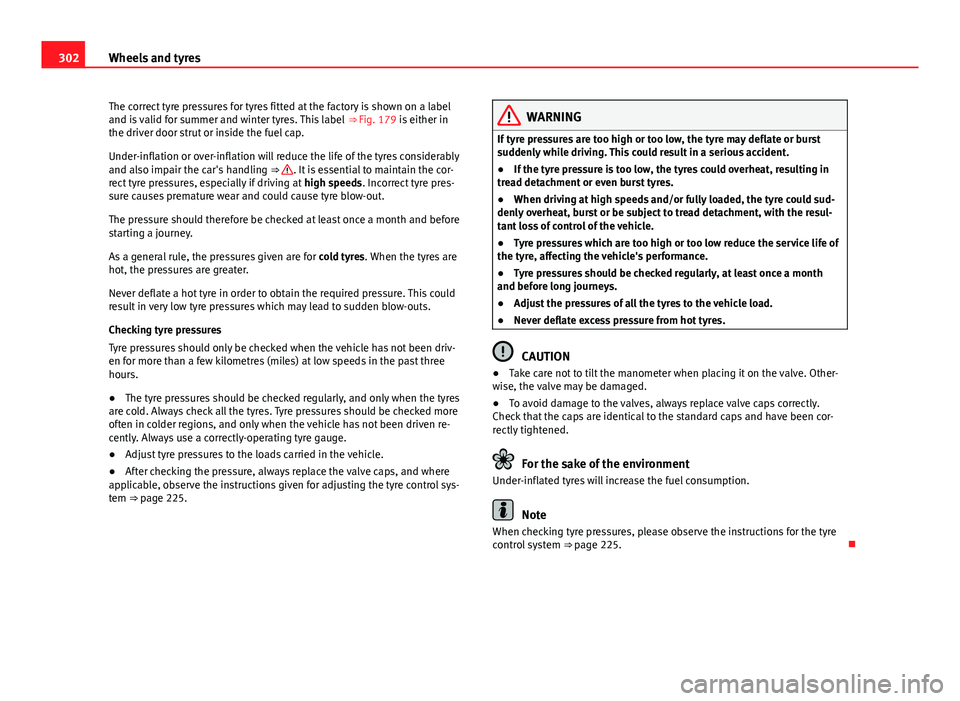
The correct tyre pressures for tyres fitted at the factory is shown on a label
and is valid for summer and winter tyres. This label ⇒ Fig. 179 is either in
the driver door strut or inside the fuel cap.
Under-inflation or over-inflation will reduce the life of the tyres considerably
and also impair the car's handling ⇒
. It is essential to maintain the cor-
rect tyre pressures, especially if driving at high speeds. Incorrect tyre pres-
sure causes premature wear and could cause tyre blow-out.
The pressure should therefore be checked at least once a month and before
starting a journey.
As a general rule, the pressures given are for cold tyres. When the tyres are
hot, the pressures are greater.
Never deflate a hot tyre in order to obtain the required pressure. This could
result in very low tyre pressures which may lead to sudden blow-outs.
Checking tyre pressures
Tyre pressures should only be checked when the vehicle has not been driv-
en for more than a few kilometres (miles) at low speeds in the past three
hours.
● The tyre pressures should be checked regularly, and only when the tyres
are cold. Always check all the tyres. Tyre pressures should be checked more
often in colder regions, and only when the vehicle has not been driven re-
cently. Always use a correctly-operating tyre gauge.
● Adjust tyre pressures to the loads carried in the vehicle.
● After checking the pressure, always replace the valve caps, and where
applicable, observe the instructions given for adjusting the tyre control sys-
tem ⇒ page 225.
WARNING
If tyre pressures are too high or too low, the tyre may deflate or burst
suddenly while driving. This could result in a serious accident.
● If the tyre pressure is too low, the tyres could overheat, resulting in
tread detachment or even burst tyres.
● When driving at high speeds and/or fully loaded, the tyre could sud-
denly overheat, burst or be subject to tread detachment, with the resul-
tant loss of control of the vehicle.
● Tyre pressures which are too high or too low reduce the service life of
the tyre, affecting the vehicle's performance.
● Tyre pressures should be checked regularly, at least once a month
and before long journeys.
● Adjust the pressures of all the tyres to the vehicle load.
● Never deflate excess pressure from hot tyres.
CAUTION
● Take care not to tilt the manometer when placing it on the valve. Other-
wise, the valve may be damaged.
● To avoid damage to the valves, always replace valve caps correctly.
Check that the caps are identical to the standard caps and have been cor-
rectly tightened.
For the sake of the environment
Under-inflated tyres will increase the fuel consumption.
Note
When checking tyre pressures, please observe the instructions for the tyre
control system ⇒ page 225.
Page 307 of 381

305
Wheels and tyres
● Only use radial winter tyres of the same type, size (rolling circumference)
and tread pattern.
● Adjust speeds to within the limits indicated (code letter on tyre) ⇒
.
Speed limit
A code letter indicating the speed limit is stamped on all winter tyres
⇒ page 308.
In some vehicles, it is possible to set a speed warning in the MFA (multifunc-
tion display) menu on the instrument panel ⇒ page 62.
If you use V-rated tyres the speed limits and tyre pressure will be deter-
mined by engine size. Please ask your Technical Service for further informa-
tion on the maximum permitted speed and the required pressures for the tyres.
All-wheel drive*
Thanks to its all-wheel drive, your car will have plenty of traction in winter
conditions, even with the standard tyres. Nevertheless, SEAT still recom-
mend that winter tyres or all-season tyres should be fitted on all four wheels
when winter road conditions are expected, mainly because this will give a
better braking response.
Please observe all instructions and warnings when using snow chains
⇒ page 305.
WARNING
Although winter tyres help to make driving safer in the winter, you
should not take unnecessary risks.
● Adjust your speed and driving style to visibility, road, traffic and
weather conditions.
● Never exceed the maximum permitted speed or loads specified for the
type of winter tyre fitted on your vehicle.
For the sake of the environment
When winter is over, change back to summer tyres. In temperatures above
+7 °C (+45 °F), performance will be improved if summer tyres are used. Fuel
consumption, wear and noises while driving will all be reduced.
Note
● If the vehicle is fitted with a tyre control system, this should be “reprog-
rammed” whenever a tyre is changed ⇒ page 227.
● Please ask at a Technical Service for information about the permitted
sizes for winter tyres.
Snow chains
When using snow chains, applicable local legislation and maximum permit-
ted speed limits must be observed.
In winter weather, snow chains not only help to improve grip but also im-
prove the braking capacity.
Snow chains must only be mounted on the front wheels, even on all-wheel
drive vehicles, and only with the tyre and rim combinations listed below:
Tyre sizeWheel rim205/60 R166 1/2 J x 16 ET 33
SEAT recommends you ask a Technical Service for further information on
wheel, tyre and chain sizes.
Wherever possible use fine-link chains measuring less than 15 mm
(37/64 inch) including the lock.
Remove wheel hub covers and trim rings before fitting snow chains ⇒
.
The wheel bolts should be covered with caps for safety reasons. These are
available from Technical Services.
Safety FirstOperating instructionsPractical TipsTechnical Specifications
Page 345 of 381
343
If and when
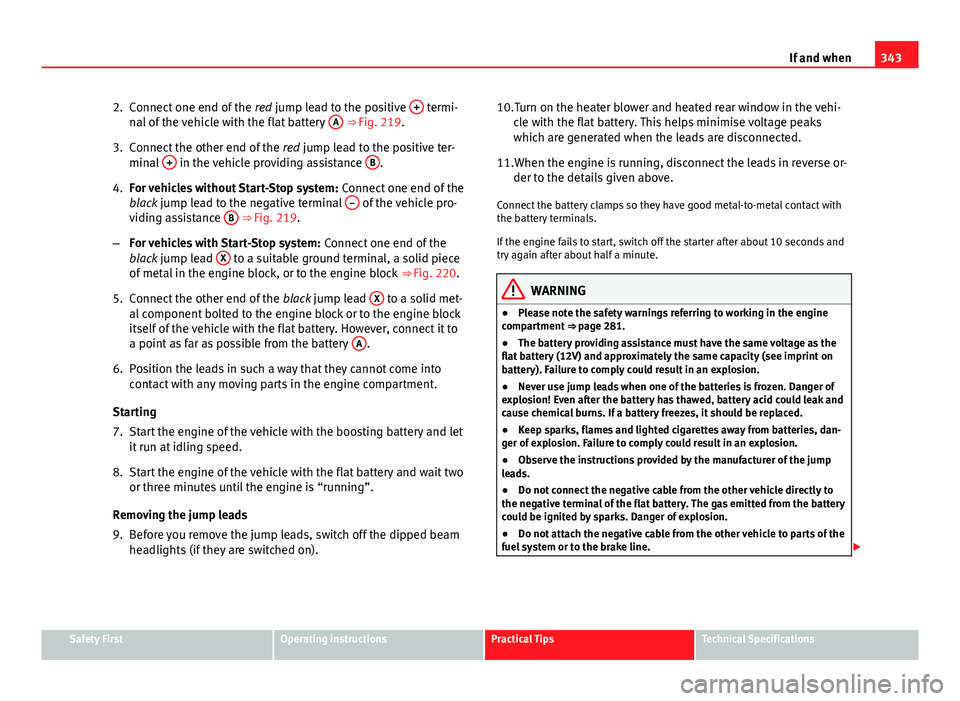
2. Connect one end of the red jump lead to the positive +
termi-
nal of the vehicle with the flat battery A ⇒ Fig. 219.
3. Connect the other end of the red jump lead to the positive ter-
minal +
in the vehicle providing assistance B.
4. For vehicles without Start-Stop system: Connect one end of the
black jump lead to the negative terminal –
of the vehicle pro-
viding assistance B ⇒ Fig. 219.
– For vehicles with Start-Stop system: Connect one end of the
black jump lead X
to a suitable ground terminal, a solid piece
of metal in the engine block, or to the engine block ⇒ Fig. 220.
5. Connect the other end of the black jump lead X
to a solid met-
al component bolted to the engine block or to the engine block
itself of the vehicle with the flat battery. However, connect it to
a point as far as possible from the battery A
.
6. Position the leads in such a way that they cannot come into contact with any moving parts in the engine compartment.
Starting
7. Start the engine of the vehicle with the boosting battery and let it run at idling speed.
8. Start the engine of the vehicle with the flat battery and wait two or three minutes until the engine is “running”.
Removing the jump leads
9. Before you remove the jump leads, switch off the dipped beam headlights (if they are switched on). 10.Turn on the heater blower and heated rear window in the vehi-
cle with the flat battery. This helps minimise voltage peaks
which are generated when the leads are disconnected.
11.When the engine is running, disconnect the leads in reverse or- der to the details given above.
Connect the battery clamps so they have good metal-to-metal contact with
the battery terminals.
If the engine fails to start, switch off the starter after about 10 seconds and
try again after about half a minute.
WARNING
● Please note the safety warnings referring to working in the engine
compartment ⇒ page 281.
● The battery providing assistance must have the same voltage as the
flat battery (12V) and approximately the same capacity (see imprint on
battery). Failure to comply could result in an explosion.
● Never use jump leads when one of the batteries is frozen. Danger of
explosion! Even after the battery has thawed, battery acid could leak and
cause chemical burns. If a battery freezes, it should be replaced.
● Keep sparks, flames and lighted cigarettes away from batteries, dan-
ger of explosion. Failure to comply could result in an explosion.
● Observe the instructions provided by the manufacturer of the jump
leads.
● Do not connect the negative cable from the other vehicle directly to
the negative terminal of the flat battery. The gas emitted from the battery
could be ignited by sparks. Danger of explosion.
● Do not attach the negative cable from the other vehicle to parts of the
fuel system or to the brake line.
Safety FirstOperating instructionsPractical TipsTechnical Specifications
Page 352 of 381
350Description of specifications
Information on fuel consumption
Fuel consumption
The consumption and emission details shown on the vehicle
data sticker differ from one vehicle to another.
The fuel consumption, CO 2 emissions and actual kerb weight of the vehicle
are noted on the vehicle data sticker.
The fuel consumption and emissions figures given are based on the vehicle
weight category, which is determined according to the engine/gearbox
combination and the equipment fitted.
The consumption and emission figures are calculated in accordance with
the EC test requirements 1999/100/EC. These test requirements specify a
realistic test method based on normal everyday driving.
The following test conditions are applied:
Urban cycleThe urban cycle starts with an engine cold start. City driving
is then simulated.
Extra urban
cycleIn the extra urban cycle simulation the vehicle frequently ac-
celerates and brakes in all gears, as in normal everyday driv-
ing. The road speed ranges from 0 to 120 km/h (75 mph).
Total con-
sumptionThe average total consumption is calculated with a weight-
ing of around 37% for the urban cycle and 63% for the extra
urban cycle.
CO 2 emis-
sionsThe exhaust gases are collected during both driving cycles
to calculate carbon dioxide emissions. The gas composition
is then analysed to evaluate the CO 2 content and other
emissions.
Note
● Actual consumption may vary from quoted test values, depending on
personal driving style, road and traffic conditions, the weather and the vehi-
cle condition.
Weights
Kerb weight refers to the basic model with a fuel tank filled to 90% capacity
and without optional extras. The figure quoted includes 75 kg to allow for
the weight of the driver.
For special versions and optional equipment fittings or for the addition of
accessories, the weight of the vehicle will increase ⇒
.
WARNING
● Please note that the centre of gravity may shift when transporting
heavy objects; this may affect vehicle handling and lead to an accident.
Always adjust your speed and driving style to suit road conditions and re-
quirements.
● Never exceed the gross axle weight rating or the gross vehicle weight
rating. If the allowed axle load or the allowed total weight is exceeded,
the driving characteristics of the vehicle may change, leading to acci-
dents, injuries and damage to the vehicle.
Page 355 of 381
353
Technical specifications
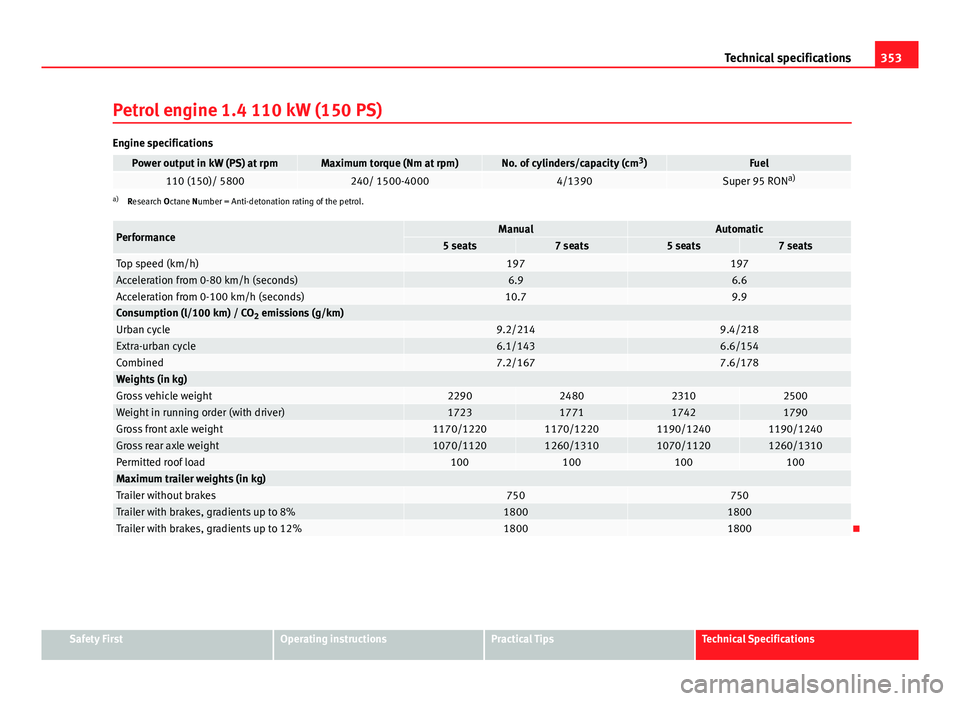
Petrol engine 1.4 110 kW (150 PS)
Engine specifications
Power output in kW (PS) at rpmMaximum torque (Nm at rpm)No. of cylinders/capacity (cm 3
)Fuel110 (150)/ 5800240/ 1500-40004/1390Super 95 RON a)a)
Research Octane Number = Anti-detonation rating of the petrol.
PerformanceManualAutomatic5 seats7 seats5 seats7 seatsTop speed (km/h)197197Acceleration from 0-80 km/h (seconds)6.96.6Acceleration from 0-100 km/h (seconds)10.79.9Consumption (l/100 km) / CO 2 emissions (g/km)Urban cycle9.2/2149.4/218Extra-urban cycle6.1/1436.6/154Combined7.2/1677.6/178Weights (in kg)Gross vehicle weight2290248023102500Weight in running order (with driver)1723177117421790Gross front axle weight1170/12201170/12201190/12401190/1240Gross rear axle weight1070/11201260/13101070/11201260/1310Permitted roof load100100100100Maximum trailer weights (in kg)Trailer without brakes750750Trailer with brakes, gradients up to 8%18001800Trailer with brakes, gradients up to 12%18001800
Safety FirstOperating instructionsPractical TipsTechnical Specifications
Page 356 of 381
354Technical specifications
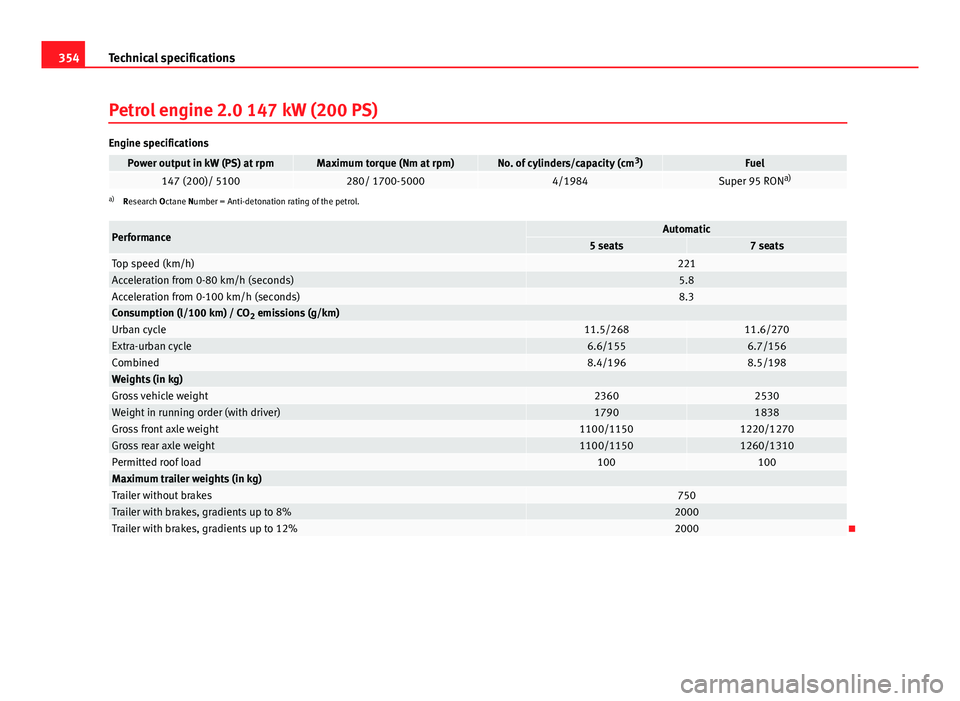
Petrol engine 2.0 147 kW (200 PS)
Engine specifications
Power output in kW (PS) at rpmMaximum torque (Nm at rpm)No. of cylinders/capacity (cm 3
)Fuel147 (200)/ 5100280/ 1700-50004/1984Super 95 RON a)a)
Research Octane Number = Anti-detonation rating of the petrol.
PerformanceAutomatic5 seats7 seatsTop speed (km/h)221Acceleration from 0-80 km/h (seconds)5.8Acceleration from 0-100 km/h (seconds)8.3Consumption (l/100 km) / CO 2 emissions (g/km)Urban cycle11.5/26811.6/270Extra-urban cycle6.6/1556.7/156Combined8.4/1968.5/198Weights (in kg)Gross vehicle weight23602530Weight in running order (with driver)17901838Gross front axle weight1100/11501220/1270Gross rear axle weight1100/11501260/1310Permitted roof load100100Maximum trailer weights (in kg)Trailer without brakes750Trailer with brakes, gradients up to 8%2000Trailer with brakes, gradients up to 12%2000
Page 357 of 381
355
Technical specifications
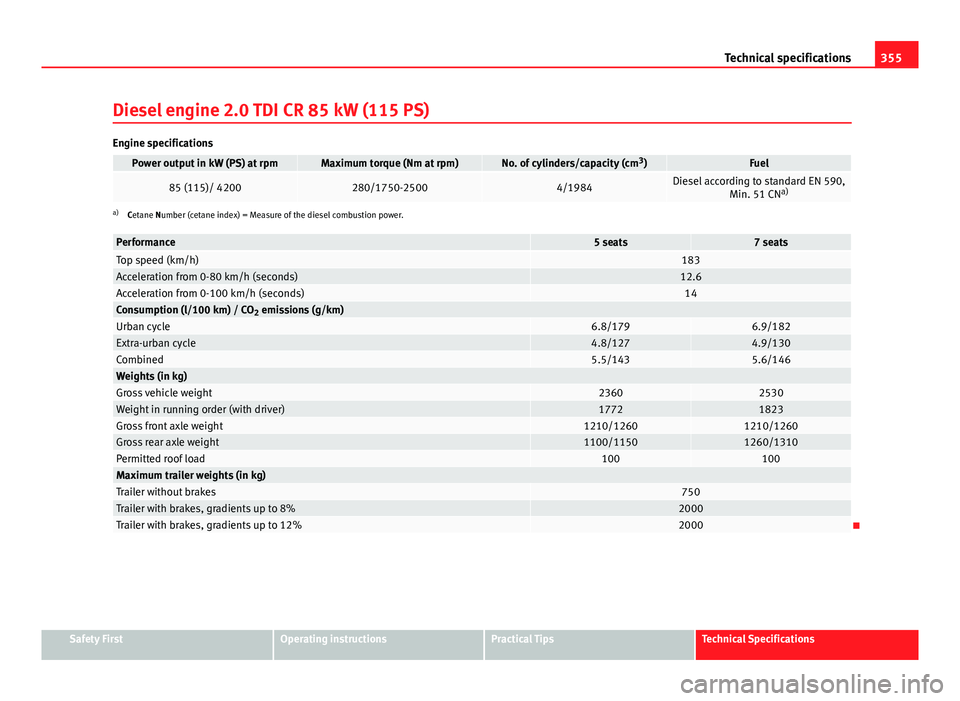
Diesel engine 2.0 TDI CR 85 kW (115 PS)
Engine specifications
Power output in kW (PS) at rpmMaximum torque (Nm at rpm)No. of cylinders/capacity (cm 3
)Fuel
85 (115)/ 4200280/1750-25004/1984Diesel according to standard EN 590,
Min. 51 CNa)
a)
Cetane Number (cetane index) = Measure of the diesel combustion power.
Performance5 seats7 seatsTop speed (km/h)183Acceleration from 0-80 km/h (seconds)12.6Acceleration from 0-100 km/h (seconds)14Consumption (l/100 km) / CO 2 emissions (g/km)Urban cycle6.8/1796.9/182Extra-urban cycle4.8/1274.9/130Combined5.5/1435.6/146Weights (in kg)Gross vehicle weight23602530Weight in running order (with driver)17721823Gross front axle weight1210/12601210/1260Gross rear axle weight1100/11501260/1310Permitted roof load100100Maximum trailer weights (in kg)Trailer without brakes750Trailer with brakes, gradients up to 8%2000Trailer with brakes, gradients up to 12%2000
Safety FirstOperating instructionsPractical TipsTechnical Specifications
Page 358 of 381
356Technical specifications
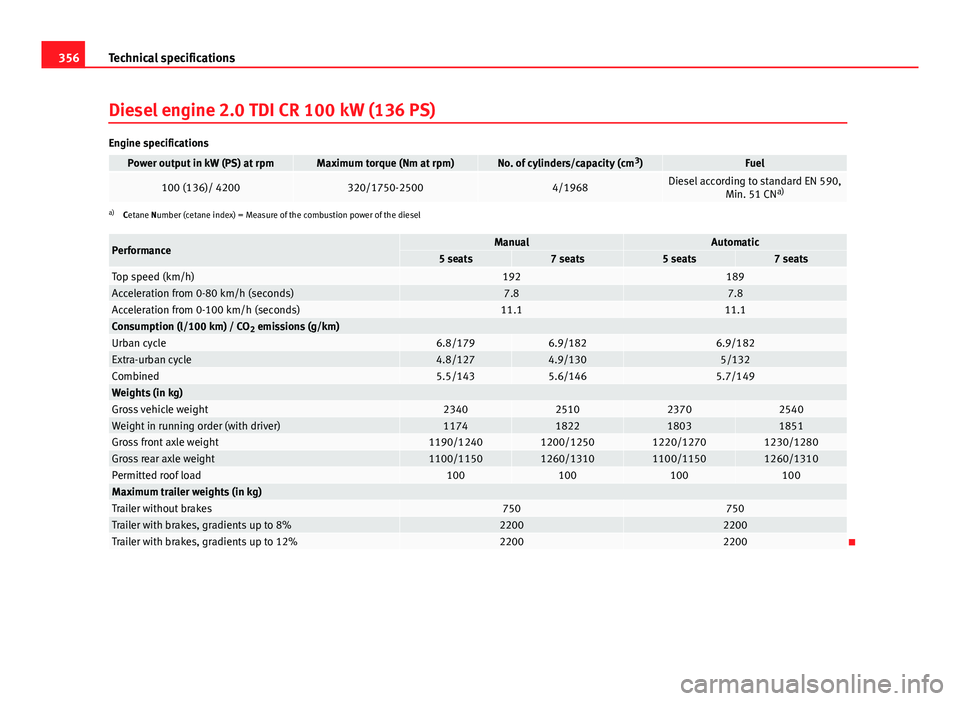
Diesel engine 2.0 TDI CR 100 kW (136 PS)
Engine specifications
Power output in kW (PS) at rpmMaximum torque (Nm at rpm)No. of cylinders/capacity (cm 3
)Fuel
100 (136)/ 4200320/1750-25004/1968Diesel according to standard EN 590,
Min. 51 CNa)
a)
Cetane Number (cetane index) = Measure of the combustion power of the diesel
PerformanceManualAutomatic5 seats7 seats5 seats7 seatsTop speed (km/h)192189Acceleration from 0-80 km/h (seconds)7.87.8Acceleration from 0-100 km/h (seconds)11.111.1Consumption (l/100 km) / CO 2 emissions (g/km)Urban cycle6.8/1796.9/1826.9/182Extra-urban cycle4.8/1274.9/1305/132Combined5.5/1435.6/1465.7/149Weights (in kg)Gross vehicle weight2340251023702540Weight in running order (with driver)1174182218031851Gross front axle weight1190/12401200/12501220/12701230/1280Gross rear axle weight1100/11501260/13101100/11501260/1310Permitted roof load100100100100Maximum trailer weights (in kg)Trailer without brakes750750Trailer with brakes, gradients up to 8%22002200Trailer with brakes, gradients up to 12%22002200
Page 359 of 381
357
Technical specifications
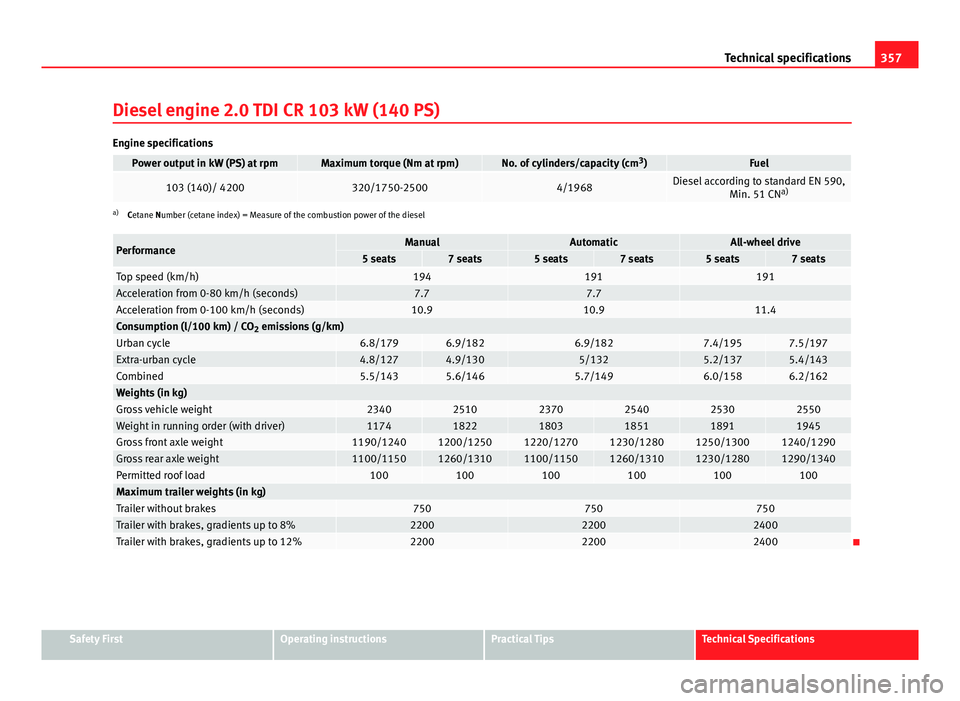
Diesel engine 2.0 TDI CR 103 kW (140 PS)
Engine specifications
Power output in kW (PS) at rpmMaximum torque (Nm at rpm)No. of cylinders/capacity (cm 3
)Fuel
103 (140)/ 4200320/1750-25004/1968Diesel according to standard EN 590,
Min. 51 CNa)
a)
Cetane Number (cetane index) = Measure of the combustion power of the diesel
PerformanceManualAutomaticAll-wheel drive5 seats7 seats5 seats7 seats5 seats7 seatsTop speed (km/h)194191191Acceleration from 0-80 km/h (seconds)7.77.7 Acceleration from 0-100 km/h (seconds)10.910.911.4Consumption (l/100 km) / CO 2 emissions (g/km)Urban cycle6.8/1796.9/1826.9/1827.4/1957.5/197Extra-urban cycle4.8/1274.9/1305/1325.2/1375.4/143Combined5.5/1435.6/1465.7/1496.0/1586.2/162Weights (in kg)Gross vehicle weight234025102370254025302550Weight in running order (with driver)117418221803185118911945Gross front axle weight1190/12401200/12501220/12701230/12801250/13001240/1290Gross rear axle weight1100/11501260/13101100/11501260/13101230/12801290/1340Permitted roof load100100100100100100Maximum trailer weights (in kg)Trailer without brakes750750750Trailer with brakes, gradients up to 8%220022002400Trailer with brakes, gradients up to 12%220022002400
Safety FirstOperating instructionsPractical TipsTechnical Specifications
Page 360 of 381
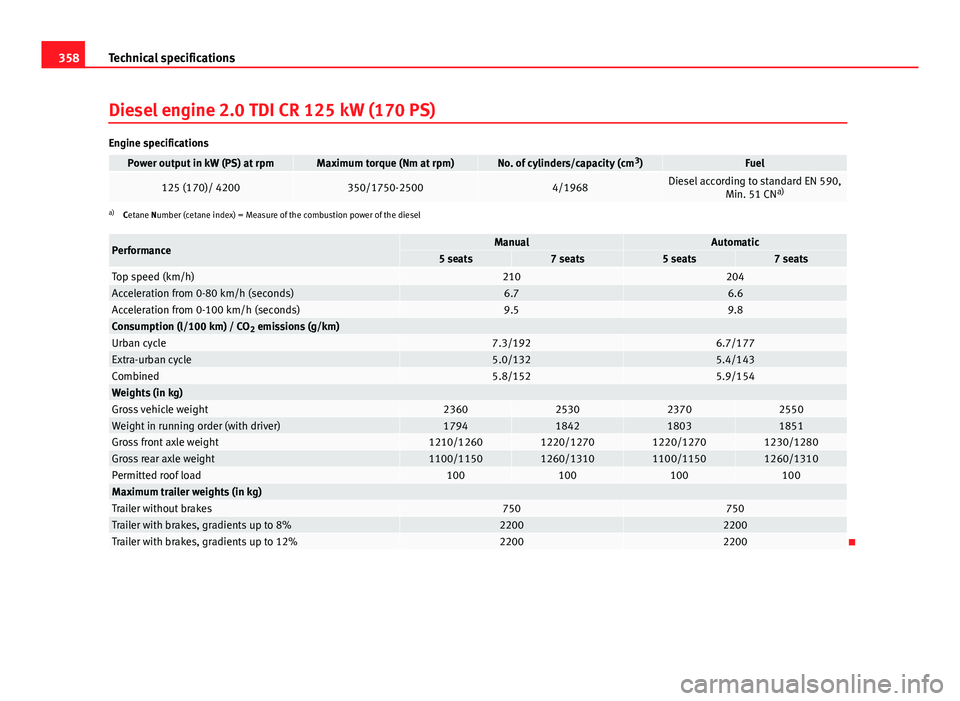
358Technical specifications
Diesel engine 2.0 TDI CR 125 kW (170 PS)
Engine specifications
Power output in kW (PS) at rpmMaximum torque (Nm at rpm)No. of cylinders/capacity (cm 3
)Fuel
125 (170)/ 4200350/1750-25004/1968Diesel according to standard EN 590,
Min. 51 CNa)
a)
Cetane Number (cetane index) = Measure of the combustion power of the diesel
PerformanceManualAutomatic5 seats7 seats5 seats7 seatsTop speed (km/h)210204Acceleration from 0-80 km/h (seconds)6.76.6Acceleration from 0-100 km/h (seconds)9.59.8Consumption (l/100 km) / CO 2 emissions (g/km)Urban cycle7.3/1926.7/177Extra-urban cycle5.0/1325.4/143Combined5.8/1525.9/154Weights (in kg)Gross vehicle weight2360253023702550Weight in running order (with driver)1794184218031851Gross front axle weight1210/12601220/12701220/12701230/1280Gross rear axle weight1100/11501260/13101100/11501260/1310Permitted roof load100100100100Maximum trailer weights (in kg)Trailer without brakes750750Trailer with brakes, gradients up to 8%22002200Trailer with brakes, gradients up to 12%22002200