height Seat Alhambra 2014 Owner's Guide
[x] Cancel search | Manufacturer: SEAT, Model Year: 2014, Model line: Alhambra, Model: Seat Alhambra 2014Pages: 381, PDF Size: 5.75 MB
Page 142 of 381

140Seats and storage
Hooking the baggage net into the luggage compartment floor
● Hook the baggage net into the fastening rings ⇒ Fig. 101 1
and 2.
Releasing the baggage net
The secured baggage net is taut ⇒
.
● Carefully unhook the baggage net hooks from the fastening rings
⇒ Fig. 101 1
.
● Carefully unhook the baggage net hooks from the fastening rings
⇒ Fig. 101 2
.
WARNING
The elastic baggage net stretches when it is secured to the luggage com-
partment fastening rings. The secured baggage net is taut. The hooks on
the baggage net can cause injury if the net is incorrectly hooked or un-
hooked.
● Always ensure that the hooks do not suddenly release from the fas-
tening rings when hooking or un-hooking.
● Always keep your face and eyes protected at a safe distance to avoid
injury should a hook slip while hooking or unhooking.
● Always engage the hooks in the order given. If a baggage net hook
springs back this can cause injury.
Roof carrier system* Introduction
The vehicle roof has been designed to optimise aerodynamics. For this rea-
son, conventional roof carrier systems cannot be secured to the roof rails. Given that the water drains have been incorporated into the roof for aerody-
namic reasons, only the SEAT approved basic supports and roof carrier sys-
tems can be used.
When should the roof carrier system be removed?
●
When it is not being used.
● When the vehicle is being washed in a car wash.
● When the vehicle height exceeds the maximum height (for example, in a
garage).
Additional information and warnings:
● Light ⇒ page 96
● Transporting ⇒ page 13
● Ecological driving ⇒ page 229
● Wheels and tyres ⇒ page 297
● Accessories, parts replacement, repairs and modifications ⇒ page 261
WARNING
The risk of an accident is increased by transporting heavy or bulky loads
on the roof, which affects the car's handling by shifting the centre of
gravity and increasing susceptibility to cross winds.
● Always secure loads correctly with suitable and undamaged attach-
ment rope or straps.
● Large, heavy, wide and flat loads negatively affect the vehicle aerody-
namics, centre of gravity and handling.
● Avoid brusque manoeuvres and sudden braking.
● Adjust your speed and driving style to visibility, road, traffic and
weather conditions.
Page 143 of 381
141
Seats and storage
CAUTION
● Always remove the roof carrier system from the roof before entering a car
wash.
● The height of your vehicle is changed by the installation of the roof carri-
er and the load secured on it. Compare the vehicle height with the passage
height, for example in underground car parks or entering garage doors.
● The roof antenna, the range of the panoramic sliding sunroof and the
rear lid should not be affected by the roof carrier system and the load being
transported.
● Take extra care not to let the rear lid strike the roof load when opening.
For the sake of the environment
The vehicle uses more fuel when the roof carrier system is fitted.
Securing the base supports and roof carrier system
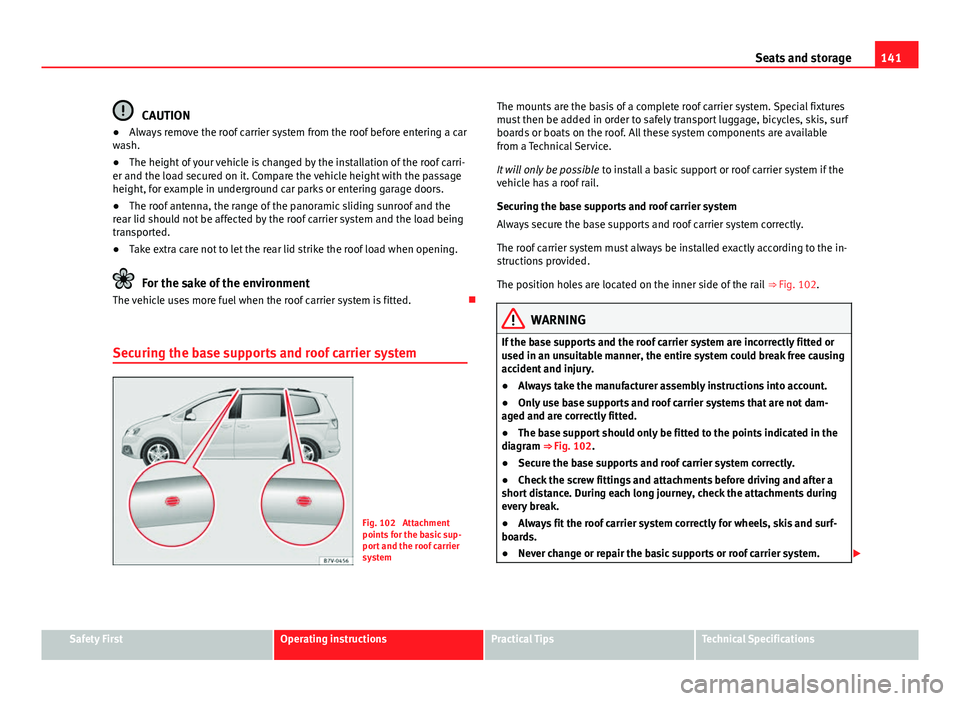
Fig. 102 Attachment
points for the basic sup-
port and the roof carrier
system The mounts are the basis of a complete roof carrier system. Special fixtures
must then be added in order to safely transport luggage, bicycles, skis, surf
boards or boats on the roof. All these system components are available
from a Technical Service.
It will only be possible
to install a basic support or roof carrier system if the
vehicle has a roof rail.
Securing the base supports and roof carrier system
Always secure the base supports and roof carrier system correctly.
The roof carrier system must always be installed exactly according to the in-
structions provided.
The position holes are located on the inner side of the rail ⇒ Fig. 102.
WARNING
If the base supports and the roof carrier system are incorrectly fitted or
used in an unsuitable manner, the entire system could break free causing
accident and injury.
● Always take the manufacturer assembly instructions into account.
● Only use base supports and roof carrier systems that are not dam-
aged and are correctly fitted.
● The base support should only be fitted to the points indicated in the
diagram ⇒ Fig. 102.
● Secure the base supports and roof carrier system correctly.
● Check the screw fittings and attachments before driving and after a
short distance. During each long journey, check the attachments during
every break.
● Always fit the roof carrier system correctly for wheels, skis and surf-
boards.
● Never change or repair the basic supports or roof carrier system.
Safety FirstOperating instructionsPractical TipsTechnical Specifications
Page 250 of 381
248Vehicle maintenance and cleaning
● Switch off the rain sensor and the Auto Hold function before entering a
car wash.
● Compare the height and width of your vehicle with the available height
and width when entering and driving through the car wash.
● Fold in exterior mirrors Electrically retractable exterior mirrors must not
be folded in or out by hand. Always use the electrical power control.
● To avoid damaging the bonnet paintwork, rest the wipers on the wind-
screen after drying them. Do not let them fall!
● Lock the rear lid to prevent it from opening unexpectedly while inside
the car wash.
Washing the vehicle with high pressure cleaning
equipment
When cleaning the vehicle with a high-pressure cleaner, always follow the
operating instructions for the equipment. Pay special attention to the re-
quired pressure of the jet and the distance between the jet and the vehicle
⇒
.
Keep a suitable distance from soft materials, such as rubber hoses or insu-
lating material, and from the parking distance warning system sensors. The
parking distance sensors are fitted in the rear bumpers and, where applica-
ble, in the front bumpers ⇒
.
Do not use a nozzle that sprays the water out in a direct stream or one that
has a rotating jet for forcing off dirt ⇒
.
WARNING
The incorrect use of high pressure cleaning equipment could result in
permanent damage, visible or invisible, to the tyres or other materials.
This could result in a serious accident.
● Ensure there is a suitable distance between the nozzle and the tyres.
● Never wash tyres with a concentrated jet or so-called “dirt blasters”.
Even at large spraying distances and short cleaning times, you may dam-
age the tyres.
WARNING
After the vehicle has been washed, the braking effect will be reduced
(and the braking distance increased) due to moisture (and ice in winter)
on the brakes.
● Dry the brakes and remove ice by braking carefully. Ensure that you
are not endangering other road-users or breaking traffic regulations in
the process.
CAUTION
● The temperature of the water must not be above +60 °C (+140 °F).
● To avoid damage to the paintwork, do not wash the vehicle in full sun.
● The sensors on the bumpers should be kept clean and free of ice at all
times to ensure the parking distance warning system and the parking aid
system operate correctly. When cleaning with pressure hoses and steam
cleaners, the sensors should be sprayed only briefly. A distance of 10 cm
between the sensors and the steam / hose nozzle must be observed.
● Do not use a high pressure cleaner to remove ice or snow from windows
● Washing the vehicle in low temperatures: When washing the vehicle
with a hose, do not direct water into the lock cylinders or the gaps around
the doors, rear lid, or sunroof. Locks and seals could freeze!
Page 265 of 381
263
Accessories, replacement of parts and modifications
The vehicle owner should keep the documentation for the additional equip-
ment safely and hand it over to the scrap yard at the end of the vehicle's
service life. This ensures that any additional equipment mounted in end-of-
life vehicles is correctly disposed of with respect for the environment.
WARNING
Repairs or modifications which are not performed correctly may result in
damage or errors in the vehicle operation, affecting the effectiveness of
the driver assist systems. This could result in serious accident.
● All repairs and modifications to the vehicle should only be performed
by a specialised workshop.
Repair and faults in the airbag system
When performing repairs and technical modifications, SEAT's directives
must be observed! ⇒
Modifications and repairs to the front bumper, doors, front seats, and re-
pairs to the roof or chassis should only be carried out in a specialised work-
shop. These components may contain parts or sensors belonging to the air-
bag system.
If work is carried out on the airbag system or parts have to be removed and
fitted on the system when performing other repair work, parts of the airbag
system may be damaged. The consequence may be that, in the event of an
accident, the airbag inflates incorrectly or does not inflate at all.
So that the effectiveness of the airbag is not reduced and that removed
parts do not cause any injuries or environmental pollution, regulations must
be observed. These requirements are known to specialised workshops.
Modifications to the vehicle suspension may affect the operation of the air-
bag system in the event of collision. For example, if wheel and tyre combi-
nations not approved by SEAT are used, or if the vehicle height is lowered, the suspension is stiffened or the suspension springs, telescopic arms,
dampers, etc., are modified, the results received by the airbag sensors and
sent to the control unit may not be accurate. For example, some modifica-
tions to the suspension could increase the force measured by the sensors
and result in the triggering of the airbag systems in collisions. Under normal
conditions, the measured values would be lower and the airbag would not
have been triggered. Other modifications may reduce the forces measured
by the sensors and therefore the airbags are not triggered in situations
when they should have triggered.
WARNING
Repairs or modifications which are not performed correctly may result in
damage or errors in the vehicle operation, affecting the effectiveness of
the airbag systems. This could result in serious or fatal accident.
● All repairs and modifications to the vehicle should only be performed
by a specialised workshop.
● Airbag modules must never be repaired: if damaged, they must be re-
placed.
● Never fit recycled or reused airbag components in your vehicle.
WARNING
Modifications to the vehicle suspension, including the use of unauthor-
ised wheel and tyre combinations, may affect the performance of the air-
bags and increase the risk of serious or fatal injury in the event of acci-
dent.
● Never fit suspension components which are not identical to the origi-
nal parts mounted in the vehicle.
● Never use wheel and tyre combinations not approved by SEAT.
Safety FirstOperating instructionsPractical TipsTechnical Specifications
Page 308 of 381

306Wheels and tyres
WARNING
The use of unsuitable or incorrectly fitted chains could lead to serious ac-
cidents and damage.
● Always the appropriate snow chains.
● Observe the fitting instructions provided by the snow chain manufac-
turer.
● Never exceed the maximum permitted speeds when driving with snow
chains.
CAUTION
● Remove the snow chains to drive on roads without snow. Otherwise they
will impair handling, damage the tyres and wear out very quickly.
● Wheel rims may be damaged or scratched if the chains come into direct
contact with them. SEAT recommends the use of covered snow chains.
Note
Snow chains are available in different sizes according to the vehicle type. Tyre codeFig. 181 Universal code on tyres
Radial
Rim diameter code
Load index & speed rating
DOT tyre identification number
Severe snow conditions
Tyre ply composition and materials used
Max. load rating
Treadwear, traction and temperature grades
Max. permissible inflation pressure
Passenger car tyre
Nominal width of tyre in millimetres
Ratio of height to width (aspect ratio)
1
23456789101112
Page 309 of 381

307
Wheels and tyres
Tyre code (example)MeaningMake, logotypeManufacturerProduct nameName of tyre assigned by manufacturer.P215 / 55 R 16Size:PPassenger vehicle code.215Nominal width between walls, in mm.55Height/width ratio in %RTyre type (R indicates "radial").16Rim diameter in inches91 VLoad index ⇒ page 308 and speed rating
⇒ page 308.
XLReinforced tyres.M+S or M/SWinter tyres (mud and snow tyres) ⇒ page 304.SSR or DSST, Eufonia,
RFT, ROF, RSC, ZP,
Conti-SealSpecific manufacturer codes for run-flat tyres.
RADIAL TUBELESSRadial tyre without inner tube.E4 ...E-mark certifying tyre complies with internation-
al legislation followed by a number denoting the
country granting the authorisation. The authori-
sation number ( several digits) is shown below.
DOT BT RA TY5 1709Tyre identification number (TINa)
, may be only on
interior wall of wheel) and date of manufacture:
DOTThe tyre complies with the legal require-
ments of the US Department of Trans-
port, responsible for tyre safety regula-
tions.
BTPlace of manufacture code.RAInformation about manufacturer and tyre
size.
TY5Manufacturer's tyre specifications.1709Date of manufacture: Week 17 of 2009.
Tyre code (example)MeaningTWIThis identifies the position of the Tread Wear In-
dicator ⇒ page 303.
MAX LOAD 615 KG
(1356 LBS)US load rating, indicating maximum permitted
load per tyre.
MAX INFLATION 350 KPA
(51 PSI)US limit, indicating maximum permitted tyre
pressure.
SIDEWALL 1 PLY RAYONInformation about tyre wall components:
1 layer of rayon (artificial silk).
TREAD 4 PLIES
1 RAYON + 2 STEEL +
1 NYLONInformation about tread components:
In the example, there are 4 layers below the
tread: 1 layer of rayon (artificial silk), 2 layers of
steel reinforcement and 1 layer of nylon.
Information for the end consumer concerning the comparative values of
the established base tyres (standardised test procedures) :
TREADWEAR 280Relative service life of the tyre, with respect to
specific US standard test.
TRACTION AABraking capacity of tyre on wet surface (AA, A, B
or C).
TEMPERATURE ATyre temperature resistance at higher test
speeds (A, B or C).
If there are different letters, they are specific codes of the tyre manufac-
turer or specific national codes.
a)
The letters TIN refer to the tyre serial number.
Tyres with directional tread pattern
Tyres with directional tread pattern have been designed to operate best
when rotating in only one direction. An arrow on the tyre sidewall indicates
the direction of rotation on tyres with directional tread. Always observe the
direction of rotation indicated when mounting the wheel. This guarantees
optimum grip and helps to avoid aquaplaning, excessive noise and wear.
Safety FirstOperating instructionsPractical TipsTechnical Specifications
Page 361 of 381
359
Technical specifications
Dimensions
Length / Width (mm)4,854/1,904Height at kerb weight (mm)1,720Wheelbase (mm)2,919Turning circle diameter (m)11.9
Front/rear a)
track width (mm)1,557 / 1,569
1,605 / 1,617
a) This data will change depending on the type of wheel rim.
Capacities
CapacitiesFuel tank 70 litres. Reserve 8 litres.Windscreen washer fluid container /
with headlight washer 3.5 l/ 6 l
Tyre pressureSummer tyres:
Correct tyre pressure can be seen on the sticker on the inside of the tank
flap.
Winter typres:
The pressure of these tyres is 0.2 bar higher than that of summer tyres
(2.9 psi / 20 kPa).
CAUTION
● Special care should be taken when parking in areas with high kerbs or
fixed barriers. Objects protruding from the ground may damage the bumper
or other parts of the vehicle during manoeuvres.
● Special attention is required when driving through entrances, over
ramps, kerbs or other objects. The vehicle underbody, bumpers, mudguards
and running gear, and the engine and exhaust system could be damaged as
you drive over these objects.
Safety FirstOperating instructionsPractical TipsTechnical Specifications
Page 364 of 381
Anti-theft bolts . . . . . . . . . . . . . . . . . . . . . . . . . 325
Anti-theft locking bolts . . . . . . . . . . . . . . . . . . 310
Anti-theft wheel locking bolts . . . . . . . . . . . . . 311
Anti-tow system . . . . . . . . . . . . . . . . . . . . . . . . . 80
Anti-trap functionElectric windows . . . . . . . . . . . . . . . . . . . . . . 91
Panoramic sliding sunroof . . . . . . . . . . . . . . 95
Sun blind . . . . . . . . . . . . . . . . . . . . . . . . . . . 95
Antifreeze . . . . . . . . . . . . . . . . . . . . . . . . . . . . . 289
Armrests . . . . . . . . . . . . . . . . . . . . . . . . . . . . . . 127
Ashtray . . . . . . . . . . . . . . . . . . . . . . . . . . . . . . . 152
ASR See "Brake assist systems" . . . . . . . . . . . . 193
See "Brake assist" . . . . . . . . . . . . . . . . . . . 192
Turning on and off . . . . . . . . . . . . . . . . . . . 193
Assistance systems . . . . . . . . . . . . . . . . . . . . . 214 Cruise control . . . . . . . . . . . . . . . . . . . . . . . 214
Electronic differential lock system (EDL andXDS) . . . . . . . . . . . . . . . . . . . . . . . . . . . . . 192
Electronic Stability Control (ESC) . . . . . . . 191
Assist systems Anti-lock brake system (ABS) . . . . . . . . . . 191
Auto Hold . . . . . . . . . . . . . . . . . . . . . . . . . . 196
Braking assist . . . . . . . . . . . . . . . . . . . . . . . 191
Lane Assist . . . . . . . . . . . . . . . . . . . . . . . . . 217
Lane Assist system . . . . . . . . . . . . . . . . . . . 217
Optical parking system . . . . . . . . . . . . . . . 202
Park Assist . . . . . . . . . . . . . . . . . . . . . . . . . 204
Park Assist system . . . . . . . . . . . . . . . . . . . 204
Parking aid . . . . . . . . . . . . . . . . . . . . . . . . . 201
Parking sensor system . . . . . . . . . . . . . . . . 201
Rear Assist . . . . . . . . . . . . . . . . . . . . . . . . . 209 Rear assist system . . . . . . . . . . . . . . . . . . . 209
Sign Assist . . . . . . . . . . . . . . . . . . . . . . . . . 220
Start-Stop . . . . . . . . . . . . . . . . . . . . . . . . . . 198
Start assist . . . . . . . . . . . . . . . . . . . . . . . . . 196
Traction control system (ASR) . . . . . . . . . . 193
Traction control when accelerating (ASR) . 192
Tyre monitoring indicator . . . . . . . . . . . . . . 227
Auto Hold . . . . . . . . . . . . . . . . . . . . . . . . . . . . . 196
Automatic belt retainer . . . . . . . . . . . . . . . . . . . 27
Automatic car wash . . . . . . . . . . . . . . . . . . . . . 247 Switching Auto Hold off . . . . . . . . . . . . . . . 197
Switching the start assist off . . . . . . . . . . . 197
Automatic consumer disconnection . . . . . . . . 295
Automatic dipped beam control . . . . . . . . . . . . 99
Automatic gearbox . . . . . . . . . . . . . . . . . . . . . . 176 Changing gear . . . . . . . . . . . . . . . . . . . . . . 180
Driving . . . . . . . . . . . . . . . . . . . . . . . . . . . . . 182
DSG automatic gearbox . . . . . . . . . . . . . . . 182
Kickdown system . . . . . . . . . . . . . . . . . . . . 182
Launch-Control programme . . . . . . . . . . . . 182
Malfunction . . . . . . . . . . . . . . . . . . . . . . . . 183
Manually unlocking the gear selector lever . .323
Please also see "Changing gears" . . . . . . 176
Safety interlock for ignition key . . . . . . . . . 174
See "Automatic gearbox" . . . . . . . . . . . . . . 176
Towing . . . . . . . . . . . . . . . . . . . . . . . . . . . . . 345
AUX-IN connection . . . . . . . . . . . . . . . . . . . . . . 142
Auxiliary heater . . . . . . . . . . . . . . . . . . . . 165, 273 Automatic off . . . . . . . . . . . . . . . . . . . . . . . 269
Operating instructions . . . . . . . . . . . . . . . . 168
Programming . . . . . . . . . . . . . . . . . . . . . . . 167
Remote control . . . . . . . . . . . . . . . . . . . . . . 166
Remote control range . . . . . . . . . . . . . . . . . 167 Remote control: Replacing the battery . . . 166
Switching off . . . . . . . . . . . . . . . . . . . . . . . . 165
Switching on . . . . . . . . . . . . . . . . . . . . . . . . 165
Things to note . . . . . . . . . . . . . . . . . . . 165, 168
Auxiliary heater remote control Replacing the battery . . . . . . . . . . . . . . . . . 166
Axle loads . . . . . . . . . . . . . . . . . . . . . . . . . . . . . . 15
B
BAS See "Brake assist systems" . . . . . . . . . . . . 191
Battery Discharge . . . . . . . . . . . . . . . . . . . . . . . . . . 168
Discharging . . . . . . . . . . . . . . . . . . . . . . . . 317
See Vehicle battery . . . . . . . . . . . . . . . . . . 292
Battery acid . . . . . . . . . . . . . . . . . . . . . . . . . . . . 294
Before starting out . . . . . . . . . . . . . . . . . . . . . . . . 7
Belt height adjustment . . . . . . . . . . . . . . . . . . . 26
Belt tensioner . . . . . . . . . . . . . . . . . . . . . . . . . . . 27 Disposal . . . . . . . . . . . . . . . . . . . . . . . . . . . . 27
Service and disposal . . . . . . . . . . . . . . . . . . 27
Belt tension limiter . . . . . . . . . . . . . . . . . . . . . . . 27
Bicycle carrier Installing a bicycle carrier . . . . . . . . . . . . . 239
Maximum load . . . . . . . . . . . . . . . . . . . . . . 239
Biodiesel . . . . . . . . . . . . . . . . . . . . . . . . . . . . . . 274
Bonnet Closing . . . . . . . . . . . . . . . . . . . . . . . . . . . . 282
Opening . . . . . . . . . . . . . . . . . . . . . . . . . . . 282
Bottle holders . . . . . . . . . . . . . . . . . . . . . . . . . . 150
362 Index
Page 374 of 381
Roof carrier system . . . . . . . . . . . . . . . . . . . . . . 140
Rubber seals . . . . . . . . . . . . . . . . . . . . . . . . . . . 252
Run-flat tyresCodes . . . . . . . . . . . . . . . . . . . . . . . . . . . . . 307
Running-in Brake pads . . . . . . . . . . . . . . . . . . . . . . . . . 189
First trips . . . . . . . . . . . . . . . . . . . . . . . . . . . 229
Running-in brake pads Please also see "Brakes" . . . . . . . . . . . . . . 189
Running in Engine . . . . . . . . . . . . . . . . . . . . . . . . . . . . . 229
Tyres . . . . . . . . . . . . . . . . . . . . . . . . . . . . . . 300
Wheels and tyres . . . . . . . . . . . . . . . . . . . . 300
S SAFE . . . . . . . . . . . . . . . . . . . . . . . . . . . . . . 78, 176
Safe driving . . . . . . . . . . . . . . . . . . . . . . . . . . . . . 7 Check list . . . . . . . . . . . . . . . . . . . . . . . . . . . . 7
Safety equipment . . . . . . . . . . . . . . . . . . . . . . . . 32
Sale of vehicle In other countries / continents . . . . . . . . . 259
Salt water . . . . . . . . . . . . . . . . . . . . . . . . . . . . . . . 9
Scrapping . . . . . . . . . . . . . . . . . . . . . . . . . . . . . 260
Seat adjustment Front seats . . . . . . . . . . . . . . . . . . . . . . . . . 115
Seat belt position . . . . . . . . . . . . . . . . . . . . . . . . 25
Seat belt protection . . . . . . . . . . . . . . . . . . . . . . 21
Seat belts . . . . . . . . . . . . . . . . . . . . . . . . . . . 16, 21 Automatic belt retainer . . . . . . . . . . . . . . . . 27
Belt height adjustments . . . . . . . . . . . . . . . 26
Belt tensioner . . . . . . . . . . . . . . . . . . . . . . . . 27 Belt tension limiter . . . . . . . . . . . . . . . . . . . . 27
Checklist . . . . . . . . . . . . . . . . . . . . . . . . . . . . 21
Fastening . . . . . . . . . . . . . . . . . . . . . . . . . . . 22
Seat belt position . . . . . . . . . . . . . . . . . . . . . 25
Seat belt status display . . . . . . . . . . . . . . . . 17
Twisted belt . . . . . . . . . . . . . . . . . . . . . . . . . 22
Unfastened . . . . . . . . . . . . . . . . . . . . . . . . . . 20
Unfastening . . . . . . . . . . . . . . . . . . . . . . . . . 22
Use . . . . . . . . . . . . . . . . . . . . . . . . . . . . . . . . 21
Warning lamp . . . . . . . . . . . . . . . . . . . . . . . . 17
With two buckles . . . . . . . . . . . . . . . . . . . . . 23
Seat belt warning lamp . . . . . . . . . . . . . . . . . . . 17
Seat belt with two buckles Fastening . . . . . . . . . . . . . . . . . . . . . . . . . . . 23
Twisting . . . . . . . . . . . . . . . . . . . . . . . . . . . . . 23
Unfastening . . . . . . . . . . . . . . . . . . . . . . . . . 23
Seat functions . . . . . . . . . . . . . . . . . . . . . . . . . 118 Convenient entry function for the third rowof seats . . . . . . . . . . . . . . . . . . . . . . . . . . 121
Folding the seat backrest of the front pas- senger seat . . . . . . . . . . . . . . . . . . . . . . . 122
Seat heating . . . . . . . . . . . . . . . . . . . . . . . . . . . 118
SEAT information system . . . . . . . . . . . . . . . . . . 62
Seats . . . . . . . . . . . . . . . . . . . . . . . . . . . . . . . . . . 10 Adjusting the head restraints . . . . . . . . . . 124
Adjusting the steering wheel position . . . 171
Convenient entry function for the third rowof seats . . . . . . . . . . . . . . . . . . . . . . . . . . 121
Correct position . . . . . . . . . . . . . . . . . . . . . . 12
Electric front seat . . . . . . . . . . . . . . . . . . . . 116
Fitting the head restraints . . . . . . . . . . . . . 125
Folding the seat backrest of the front pas- senger seat . . . . . . . . . . . . . . . . . . . . . . . 122 Heated seats . . . . . . . . . . . . . . . . . . . . . . . . 118
Mechanical front seat . . . . . . . . . . . . . . . . 115
Number of seats . . . . . . . . . . . . . . . . . . . . . . 10
Rear seats . . . . . . . . . . . . . . . . . . . . . . . . . . 117
Removing the head restraints . . . . . . . . . . 125
Seat with position memory . . . . . . . . . . . . 119
Seat upholstery Alcantara . . . . . . . . . . . . . . . . . . . . . . . . . . . 255
Checklist . . . . . . . . . . . . . . . . . . . . . . . . . . . 254
cleaning Alcantara . . . . . . . . . . . . . . . . . . . 255
Cleaning and maintenance of natural leath-er . . . . . . . . . . . . . . . . . . . . . . . . . . . . . . . 256
cleaning the trim fabric . . . . . . . . . . . . . . . 255
synthetic leather . . . . . . . . . . . . . . . . . . . . 257
Seat with position memory . . . . . . . . . . . . . . . 119
Selective Catalytic Reduction . . . . . . . . . . . . . 275
Selector lever locking . . . . . . . . . . . . . . . . . . . . 180
Service interval display . . . . . . . . . . . . . . . . . . . 61
Service notification: read . . . . . . . . . . . . . . . . . . 61
Side airbags See "Airbag system" . . . . . . . . . . . . . . . . . . 36
Side light . . . . . . . . . . . . . . . . . . . . . . . . . . . . . . 98
Sign Assist . . . . . . . . . . . . . . . . . . . . . . . . 220, 221 Connection . . . . . . . . . . . . . . . . . . . . . . . . . 222
Disconnection . . . . . . . . . . . . . . . . . . . . . . . 222
Indication on display . . . . . . . . . . . . . . . . . 221
Operation mode . . . . . . . . . . . . . . . . . . . . . 221
Trailer . . . . . . . . . . . . . . . . . . . . . . . . . . . . . 222
Sitting position Incorrect position . . . . . . . . . . . . . . . . . . . . . 11
Sliding door Manually opening and closing . . . . . . . . . . 82
372 Index