remove seats Seat Alhambra 2014 Owner's Guide
[x] Cancel search | Manufacturer: SEAT, Model Year: 2014, Model line: Alhambra, Model: Seat Alhambra 2014Pages: 381, PDF Size: 5.75 MB
Page 138 of 381
136Seats and storage
WARNING (Continued)
● Loose objects in the luggage compartment can suddenly slide and
change the way the vehicle handles.
● Secure all objects, little and large.
● Never secure a load that is too heavy for the fastening rings.
● Never secure a child seat to the fastening rings.
Note
● The maximum load of the fastening rings is approximately 3.5 Kn (3.57
Kp).
● You can find suitable transport straps and load securing systems at a
specialised workshop. SEAT recommends visiting a Technical Service.
Rails and attachment system*
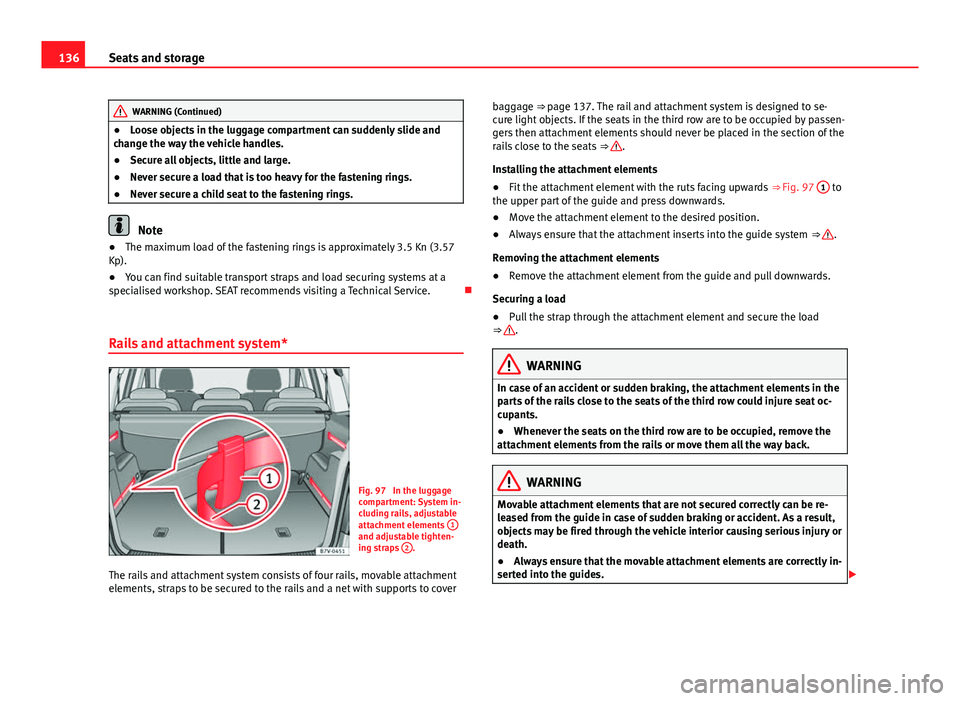
Fig. 97 In the luggage
compartment: System in-
cluding rails, adjustable
attachment elements 1
and adjustable tighten-
ing straps 2.
The rails and attachment system consists of four rails, movable attachment
elements, straps to be secured to the rails and a net with supports to cover baggage ⇒ page 137. The rail and attachment system is designed to se-
cure light objects. If the seats in the third row are to be occupied by passen-
gers then attachment elements should never be placed in the section of the
rails close to the seats
⇒
.
Installing the attachment elements
● Fit the attachment element with the ruts facing upwards ⇒ Fig. 97 1
to
the upper part of the guide and press downwards.
● Move the attachment element to the desired position.
● Always ensure that the attachment inserts into the guide system ⇒
.
Removing the attachment elements
● Remove the attachment element from the guide and pull downwards.
Securing a load
● Pull the strap through the attachment element and secure the load
⇒
.
WARNING
In case of an accident or sudden braking, the attachment elements in the
parts of the rails close to the seats of the third row could injure seat oc-
cupants.
● Whenever the seats on the third row are to be occupied, remove the
attachment elements from the rails or move them all the way back.
WARNING
Movable attachment elements that are not secured correctly can be re-
leased from the guide in case of sudden braking or accident. As a result,
objects may be fired through the vehicle interior causing serious injury or
death.
● Always ensure that the movable attachment elements are correctly in-
serted into the guides.
Page 139 of 381
137
Seats and storage
WARNING
Unsuitable or damaged ropes or straps may be released in case of sud-
den braking or an accident. As a result, objects may be fired through the
vehicle interior causing serious injury or death.
● Always use the attachment straps of the rail and attachment system.
● Secure the attachment straps firmly to the attachment elements.
● Loose objects in the luggage compartment can suddenly slide and
change the way the vehicle handles.WARNING (Continued)
● Secure all objects, little and large.
● Never secure a child seat to the attachment elements.
CAUTION
● The attachment elements placed on the rail system can be damaged
when folding down seats from the third row or putting them back into posi-
tion and these can also damage the seats themselves. Before folding down
or repositioning the seats, remove the attachment elements and supports
for the net from the rail system.
Baggage net*
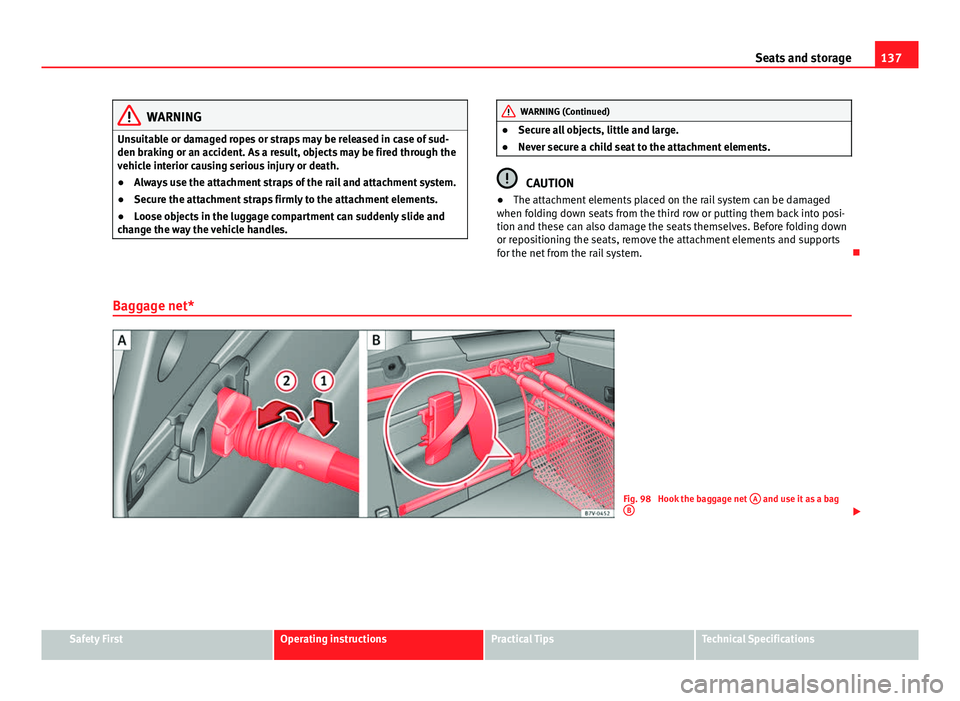
Fig. 98 Hook the baggage net A and use it as a bag
B
Safety FirstOperating instructionsPractical TipsTechnical Specifications
Page 140 of 381
138Seats and storage
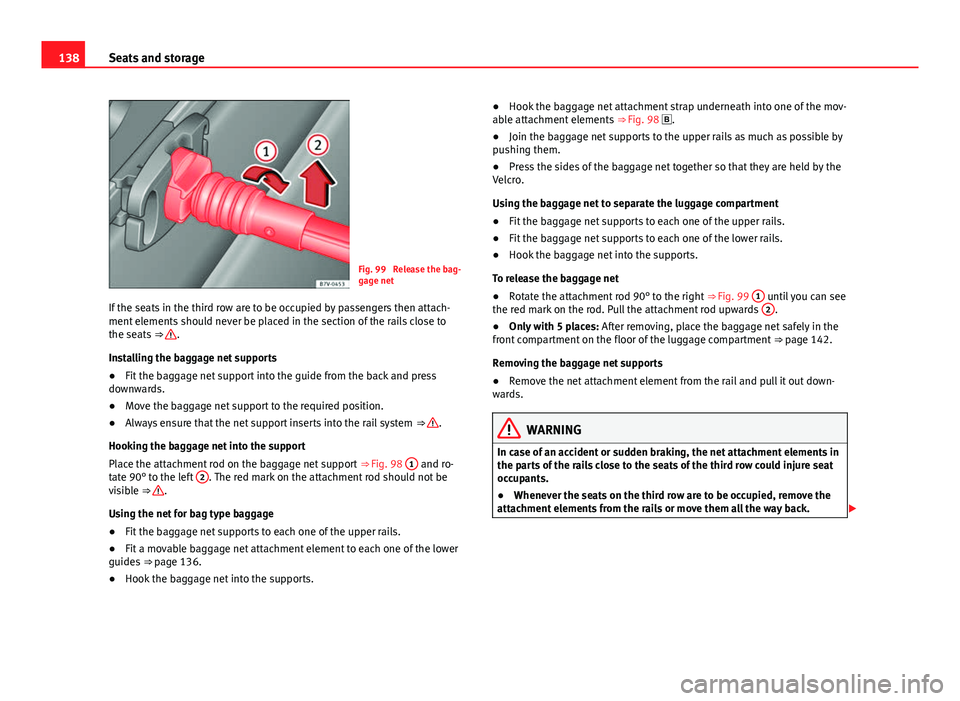
Fig. 99 Release the bag-
gage net
If the seats in the third row are to be occupied by passengers then attach-
ment elements should never be placed in the section of the rails close to
the seats ⇒
.
Installing the baggage net supports
● Fit the baggage net support into the guide from the back and press
downwards.
● Move the baggage net support to the required position.
● Always ensure that the net support inserts into the rail system ⇒
.
Hooking the baggage net into the support
Place the attachment rod on the baggage net support ⇒ Fig. 98 1
and ro-
tate 90° to the left 2. The red mark on the attachment rod should not be
visible ⇒ .
Using the net for bag type baggage
● Fit the baggage net supports to each one of the upper rails.
● Fit a movable baggage net attachment element to each one of the lower
guides ⇒ page 136.
● Hook the baggage net into the supports. ●
Hook the baggage net attachment strap underneath into one of the mov-
able attachment elements ⇒ Fig. 98 .
● Join the baggage net supports to the upper rails as much as possible by
pushing them.
● Press the sides of the baggage net together so that they are held by the
Velcro.
Using the baggage net to separate the luggage compartment
● Fit the baggage net supports to each one of the upper rails.
● Fit the baggage net supports to each one of the lower rails.
● Hook the baggage net into the supports.
To release the baggage net
● Rotate the attachment rod 90° to the right ⇒ Fig. 99 1
until you can see
the red mark on the rod. Pull the attachment rod upwards 2.
● Only with 5 places: After removing, place the baggage net safely in the
front compartment on the floor of the luggage compartment ⇒ page 142.
Removing the baggage net supports
● Remove the net attachment element from the rail and pull it out down-
wards.
WARNING
In case of an accident or sudden braking, the net attachment elements in
the parts of the rails close to the seats of the third row could injure seat
occupants.
● Whenever the seats on the third row are to be occupied, remove the
attachment elements from the rails or move them all the way back.
Page 141 of 381

139
Seats and storage
WARNING
Baggage net supports that are not secured correctly can be released from
the guide in case of the sudden braking or accident. As a result, objects
may be fired through the vehicle interior causing serious injury or death.
● Always ensure that the baggage net supports are correctly inserted
into the rails; the red mark should not be visible.
● Never secure a child seat to the baggage net supports.
CAUTION
● The baggage net supports placed on the rail system can be damaged
when folding down seats from the third row or putting them back into posi-
tion and these can also damage the seats themselves. Before folding down
or repositioning the seats, remove the baggage net supports from the rail
system.
Retaining hooks
Fig. 100 In the luggage
compartment: retaining
hooks On the right-hand side of the luggage compartment, there are folding re-
taining hooks
⇒ Fig. 100 that can be used to secure light shopping bags.
● Press the retaining hooks down ⇒ Fig. 100 (arrow) and fold them.
● Hook the bags in place.
● After use, raise the hooks again.
WARNING
Never use these hooks to secure objects. In case of sudden braking or an
accident, the hooks could rupture.
CAUTION
The hooks can support a maximum of 2.5 kg (about 5 lbs).
Luggage net*
Fig. 101 In the luggage
compartment: net used
on secured baggage
The baggage net can be used to secure lighter items.
Safety FirstOperating instructionsPractical TipsTechnical Specifications
Page 142 of 381

140Seats and storage
Hooking the baggage net into the luggage compartment floor
● Hook the baggage net into the fastening rings ⇒ Fig. 101 1
and 2.
Releasing the baggage net
The secured baggage net is taut ⇒
.
● Carefully unhook the baggage net hooks from the fastening rings
⇒ Fig. 101 1
.
● Carefully unhook the baggage net hooks from the fastening rings
⇒ Fig. 101 2
.
WARNING
The elastic baggage net stretches when it is secured to the luggage com-
partment fastening rings. The secured baggage net is taut. The hooks on
the baggage net can cause injury if the net is incorrectly hooked or un-
hooked.
● Always ensure that the hooks do not suddenly release from the fas-
tening rings when hooking or un-hooking.
● Always keep your face and eyes protected at a safe distance to avoid
injury should a hook slip while hooking or unhooking.
● Always engage the hooks in the order given. If a baggage net hook
springs back this can cause injury.
Roof carrier system* Introduction
The vehicle roof has been designed to optimise aerodynamics. For this rea-
son, conventional roof carrier systems cannot be secured to the roof rails. Given that the water drains have been incorporated into the roof for aerody-
namic reasons, only the SEAT approved basic supports and roof carrier sys-
tems can be used.
When should the roof carrier system be removed?
●
When it is not being used.
● When the vehicle is being washed in a car wash.
● When the vehicle height exceeds the maximum height (for example, in a
garage).
Additional information and warnings:
● Light ⇒ page 96
● Transporting ⇒ page 13
● Ecological driving ⇒ page 229
● Wheels and tyres ⇒ page 297
● Accessories, parts replacement, repairs and modifications ⇒ page 261
WARNING
The risk of an accident is increased by transporting heavy or bulky loads
on the roof, which affects the car's handling by shifting the centre of
gravity and increasing susceptibility to cross winds.
● Always secure loads correctly with suitable and undamaged attach-
ment rope or straps.
● Large, heavy, wide and flat loads negatively affect the vehicle aerody-
namics, centre of gravity and handling.
● Avoid brusque manoeuvres and sudden braking.
● Adjust your speed and driving style to visibility, road, traffic and
weather conditions.
Page 143 of 381
141
Seats and storage
CAUTION
● Always remove the roof carrier system from the roof before entering a car
wash.
● The height of your vehicle is changed by the installation of the roof carri-
er and the load secured on it. Compare the vehicle height with the passage
height, for example in underground car parks or entering garage doors.
● The roof antenna, the range of the panoramic sliding sunroof and the
rear lid should not be affected by the roof carrier system and the load being
transported.
● Take extra care not to let the rear lid strike the roof load when opening.
For the sake of the environment
The vehicle uses more fuel when the roof carrier system is fitted.
Securing the base supports and roof carrier system
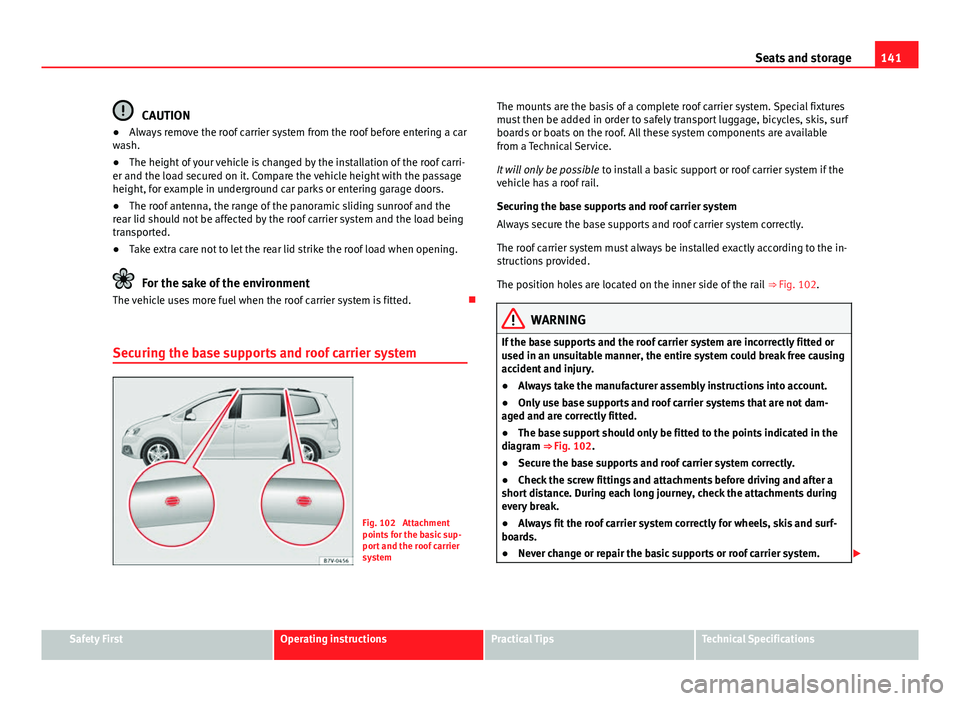
Fig. 102 Attachment
points for the basic sup-
port and the roof carrier
system The mounts are the basis of a complete roof carrier system. Special fixtures
must then be added in order to safely transport luggage, bicycles, skis, surf
boards or boats on the roof. All these system components are available
from a Technical Service.
It will only be possible
to install a basic support or roof carrier system if the
vehicle has a roof rail.
Securing the base supports and roof carrier system
Always secure the base supports and roof carrier system correctly.
The roof carrier system must always be installed exactly according to the in-
structions provided.
The position holes are located on the inner side of the rail ⇒ Fig. 102.
WARNING
If the base supports and the roof carrier system are incorrectly fitted or
used in an unsuitable manner, the entire system could break free causing
accident and injury.
● Always take the manufacturer assembly instructions into account.
● Only use base supports and roof carrier systems that are not dam-
aged and are correctly fitted.
● The base support should only be fitted to the points indicated in the
diagram ⇒ Fig. 102.
● Secure the base supports and roof carrier system correctly.
● Check the screw fittings and attachments before driving and after a
short distance. During each long journey, check the attachments during
every break.
● Always fit the roof carrier system correctly for wheels, skis and surf-
boards.
● Never change or repair the basic supports or roof carrier system.
Safety FirstOperating instructionsPractical TipsTechnical Specifications
Page 153 of 381
151
Seats and storage
WARNING
Improper use of the drink holders can cause injury.
● Never place hot drinks in the drink holders. During sudden braking or
driving manoeuvres, the hot drink could be spilled and lead to scalding.
● Ensure that bottles and other object is dropped in the driver footwell,
as it could get under the pedals and obstruct their working.
● Never place heavy containers, food or other heavy objects in the drink
holder. In the event of an accident, these heavy objects could be thrown
around the vehicle interior and cause serious injuries.
WARNING
Closed bottles inside the vehicle could explode or crack due to the heat
or the cold.
● Never leave a closed bottle in the vehicle if the inside temperature is
too high or too low.
CAUTION
Do not leave open cans in the drink holders when the vehicle is in motion.
They could spill during braking, for example, and cause damage to the vehi-
cle and the electrical system.
Note
The drink holders can be removed for cleaning. Drink holders in front centre console
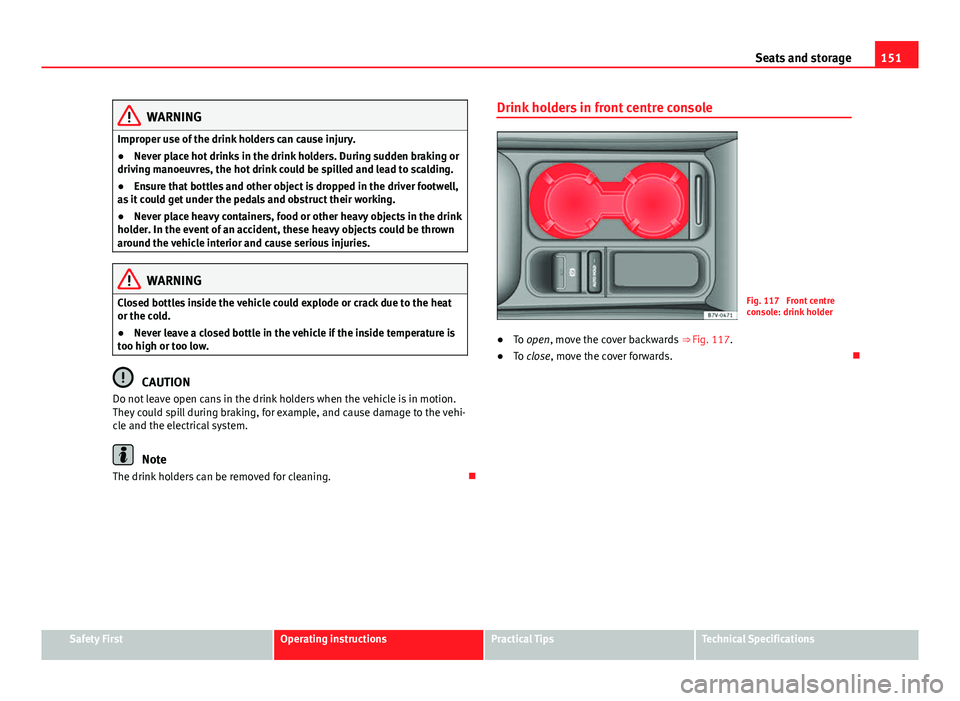
Fig. 117 Front centre
console: drink holder
● To open, move the cover backwards ⇒ Fig. 117.
● To close, move the cover forwards.
Safety FirstOperating instructionsPractical TipsTechnical Specifications
Page 155 of 381
153
Seats and storage
Emptying the ashtray
● Remove the ashtray from the drink holder or lining of the door by pulling
it upwards.
● After emptying the ashtray, insert it from above into the drink holder or
door lining.
Cigarette lighter
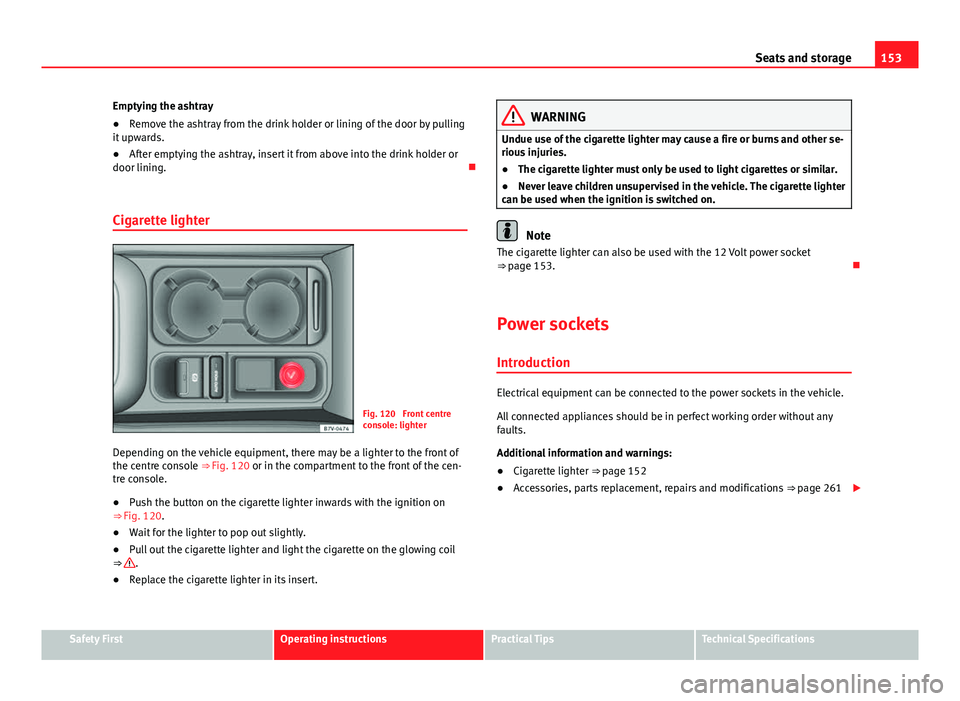
Fig. 120 Front centre
console: lighter
Depending on the vehicle equipment, there may be a lighter to the front of
the centre console ⇒ Fig. 120 or in the compartment to the front of the cen-
tre console.
● Push the button on the cigarette lighter inwards with the ignition on
⇒ Fig. 120.
● Wait for the lighter to pop out slightly.
● Pull out the cigarette lighter and light the cigarette on the glowing coil
⇒
.
● Replace the cigarette lighter in its insert.
WARNING
Undue use of the cigarette lighter may cause a fire or burns and other se-
rious injuries.
● The cigarette lighter must only be used to light cigarettes or similar.
● Never leave children unsupervised in the vehicle. The cigarette lighter
can be used when the ignition is switched on.
Note
The cigarette lighter can also be used with the 12 Volt power socket
⇒ page 153.
Power sockets Introduction
Electrical equipment can be connected to the power sockets in the vehicle.
All connected appliances should be in perfect working order without any
faults.
Additional information and warnings:
● Cigarette lighter
⇒ page 152
● Accessories, parts replacement, repairs and modifications
⇒ page 261
Safety FirstOperating instructionsPractical TipsTechnical Specifications
Page 256 of 381
254Vehicle maintenance and cleaning
The longer stains or dirt remain on the vehicle surfaces, especially the fab-
rics covering the padded upholstery, the more difficult it becomes to clean
and maintain them. If stains and dirt are left for a long time, it may be that
they are impossible to remove.
WARNING
Car-care products may be toxic and hazardous. Using unsuitable car-care
products or, using them in the wrong way, may cause accidents, serious
injury, burns or intoxication.
● Keep your car-care products in their original containers.
● Read the instructions.
● Never keep car-care products in empty food containers, bottles or
other similar containers. Other people may confuse them.
● Keep all car-care products out of the reach of children.
● Some products may give off harmful vapours during use. Therefore,
they should be used outdoors in well-ventilated places.
● Never use fuel, turpentine, engine oil, nail-varnish remover or any
other volatile product for washing, maintenance or cleaning. These are
toxic and highly flammable.
WARNING
Unsuitable maintenance and cleaning of vehicle components may impair
proper operation of safety equipment and cause serious injury.
● Maintain and clean vehicle components according to the manufactur-
er's instructions.
● Only use approved or recommended cleaning products.
CAUTION
● Cleaning products which contain solvents have a corrosive effect and
may damage the material irreparably.
● Stains and dirt containing aggressive substances or solvents attack the
material and may damage it irreparably, even when they are cleaned quick-
ly.
● Dirt and stains should not be allowed to dry and should be cleaned as
quickly as possible.
● In the case of stubborn stains, take the vehicle to a specialised work-
shop to avoid damage.
Treating your upholstery
Checklist
To treat and maintain your seat upholstery, keep the following in mind ⇒
:
Before entering the vehicle, close any Velcro fasteners that might
snag on the upholstery or trim fabric. Any open Velcro fasteners may
damage the trim or upholstery fabrics.
To prevent damage, avoid direct contact between sharp decorative
objects and the upholstery and trim fabrics. Decorative objects in-
clude zips, rivets and rhinestones on clothing and belts.
From time to time, clean the dust that gathers in the perforations,
folds and seams so that the surfaces of the seats are not damaged
by its abrasive effect.
Make sure clothes are colour-fast to avoid them running and staining
the upholstery. This is especially important if the upholstery is light
in colour.
Page 258 of 381
256Vehicle maintenance and cleaning
CAUTION
If the upholstery on electrically operated seats or seats with airbag compo-
nents gets soaked, the vehicle's electric system and certain other compo-
nents may be damaged.
● If the seat gets soaked, take the vehicle immediately to a specialised
workshop to be dried and for the system components to be inspected.
● Do not use steam cleaning equipment as the dirt becomes more encrus-
ted and fixed in the material.
● High-pressure cleaning equipment and cold aerosols may damage the
upholstery.
CAUTION
● Brushes should only be used to clean the carpet and floor mats! Other
fabrics may be damaged if cleaned with a brush.
● If cream detergents or detergents for delicate garments are applied with
a damp cloth or sponge, they may, for example, leave rings when dry be-
cause of the surfactant components they contain. Generally, such rings are
very difficult or almost impossible to remove.
CAUTION
● Do not let water soak into Alcantara ®
under any circumstances.
● Do not use leather cleaning products, solvents, wax polish, shoe cream,
stain removers or similar products on Alcantara ®
.
● Never use brushes for cleaning damp material as they could damage the
surface.
Cleaning and maintenance of natural leather upholstery
Consult a professional cleaning workshop if you have any doubts on clean-
ing and maintaining the leather equipment in your vehicle. Maintenance and treatment
Nappa natural leather is delicate because it has no additional protective
layer.
●
After cleaning, regularly apply a conditioner with sun-screen and im-
pregnating action. These products nourish the leather, soften it and make it
more breathable, as well as re-hydrating it. They also provide it with a pro-
tective film.
● Clean the leather every two or three months and remove stains as they
appear.
● Treat the leather regularly (about twice a year) with a suitable mainte-
nance product.
● Apply as few cleaning and maintenance products as possible, always
using a dry, lint-free cotton or woollen cloth. Do not apply cleaning and
maintenance products directly to the leather.
● Remove recent ball-point pen and ink stains, lipstick, shoe cream and
similar stains as soon as possible.
● Maintain the colour of the leather. To do this, use a special cream espe-
cially coloured for leather to achieve the same overall colour, if necessary.
● Afterwards, go over it with a soft cloth.
Cleaning the vehicle
SEAT recommends using a slightly damp cotton or woollen cloth for general
cleaning purposes.
Generally, the leather should never be soaked at any point, nor should wa-
ter penetrate the seams.
Before cleaning the leather upholstery, bear in mind the following recom-
mendations ⇒ page 255, Cleaning the fabric on heated seats and electrical-
ly adjustable seats or seats with airbag components.