stop start Seat Alhambra 2014 Workshop Manual
[x] Cancel search | Manufacturer: SEAT, Model Year: 2014, Model line: Alhambra, Model: Seat Alhambra 2014Pages: 381, PDF Size: 5.75 MB
Page 294 of 381

292Checking and refilling levels
Vehicle battery
Introduction
The battery is a component of the vehicle's electrical system.
Never work on the electrical system without fully understanding the opera-
tions required, the applicable safety standards and without the correct tools
⇒
! Have the work carried out by a specialised workshop if you are uncer-
tain. SEAT recommends visiting a Technical Service. Negligent work can
cause serious injury.
Location and number of batteries in the vehicle
The battery is located in the engine compartment.
Explanation of the warning indications on the vehicle's battery
SymbolMeaning
Wear eye protection!
Battery acid is very corrosive and caustic. Always wear
protective gloves and eye protection!
Fires, sparks, open flames and smoking are prohibited.
A highly explosive mixture of gases is released when
the battery is under charge.
Keep children away from acid and batteries!
Additional information and warnings:
● ⇒ Booklet Maintenance Programme
● Starter assist systems (Start-Stop function) ⇒ page 196
● Working in the engine compartment ⇒ page 279
● Accessories, parts replacement, repairs and modifications ⇒ page 261
WARNING
Working on the vehicle battery and the electrical system can cause corro-
sion, fire and electric shocks. Always read and take into account the fol-
lowing warnings and safety standards before carrying out any work:
● Before working on the battery, switch off the engine, the ignition and
all electrical devices then disconnect the negative connection on the bat-
tery.
● Keep children away from acid and the battery itself!
● Wear eye protection.
● Battery acid is very corrosive and caustic. It can burn skin and cause
blindness. When handling the battery, protect yourself from splashes of
acids, above all your hands, arms and face.
● Do not smoke and never work close to places exposed to flames or
sparks.
● Avoid sparks and electrostatic discharges when working with cables
and electrical devices.
● Never short the battery terminals.
● Never use a damaged battery. It can explode. Replace a damaged bat-
tery immediately.
● Replaced damaged or frozen batteries as soon as possible. A flat bat-
tery can also freeze at temperatures close to 0 °C (+32 °F).
● For vehicles with the battery in the luggage compartment: Check that
the battery gas ventilation hose is securely attached.
Page 296 of 381
294Checking and refilling levels
Checking the electrolyte level of the vehicle battery
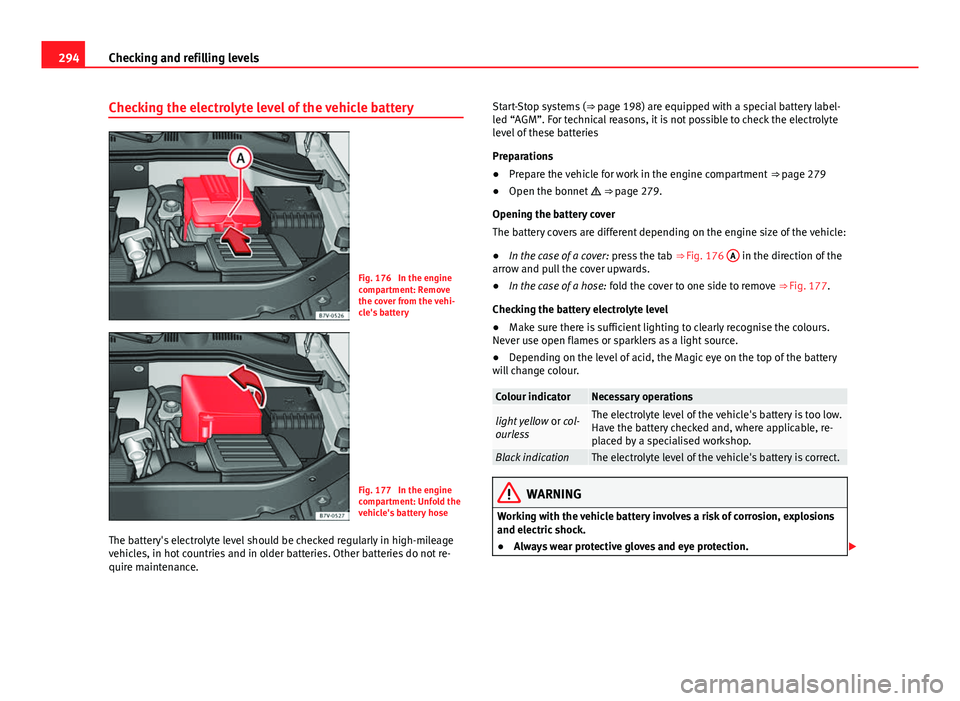
Fig. 176 In the engine
compartment: Remove
the cover from the vehi-
cle's battery
Fig. 177 In the engine
compartment: Unfold the
vehicle's battery hose
The battery's electrolyte level should be checked regularly in high-mileage
vehicles, in hot countries and in older batteries. Other batteries do not re-
quire maintenance. Start-Stop systems (
⇒ page 198) are equipped with a special battery label-
led “AGM”. For technical reasons, it is not possible to check the electrolyte
level of these batteries
Preparations
● Prepare the vehicle for work in the engine compartment ⇒ page 279
● Open the bonnet ⇒ page 279.
Opening the battery cover
The battery covers are different depending on the engine size of the vehicle:
● In the case of a cover: press the tab ⇒ Fig. 176 A
in the direction of the
arrow and pull the cover upwards.
● In the case of a hose: fold the cover to one side to remove ⇒ Fig. 177.
Checking the battery electrolyte level
● Make sure there is sufficient lighting to clearly recognise the colours.
Never use open flames or sparklers as a light source.
● Depending on the level of acid, the Magic eye on the top of the battery
will change colour.
Colour indicatorNecessary operations
light yellow or col-
ourlessThe electrolyte level of the vehicle's battery is too low.
Have the battery checked and, where applicable, re-
placed by a specialised workshop.
Black indicationThe electrolyte level of the vehicle's battery is correct.
WARNING
Working with the vehicle battery involves a risk of corrosion, explosions
and electric shock.
● Always wear protective gloves and eye protection.
Page 297 of 381
295
Checking and refilling levels
WARNING (Continued)
● Battery acid is very corrosive and caustic. It can burn skin and cause
blindness. When handling the battery, protect yourself from splashes of
acids, above all your hands, arms and face.
● Never tilt the vehicle battery. Battery acid could spill out of the open-
ings to release gases and cause corrosion damage.
● Never open the vehicle battery.
● If battery acid splashes on you, immediately rinse your eyes and skin
abundantly with water for several minutes. Then seek medical care imme-
diately.
● If acid is swallowed by mistake, consult a doctor immediately.
Charging, replacing and connecting or disconnecting the
battery
Charging the battery
The vehicle battery should be charged by a specialised workshop only, as
batteries using special technology have been installed and they must be
charged in a controlled environment ⇒
. SEAT recommends visiting a
Technical Service.
Replacing a vehicle battery
The battery has been developed to suit the conditions of its location and
has special safety features. If the battery must be replaced, consult a Tech-
nical Service for information on electromagnetic compatibility, the size and
maintenance, performance and safety requirements of the new battery in
your vehicle before you purchase one. SEAT recommends you have the bat-
tery replaced by a Technical Service.
Use only maintenance-free genuine batteries conforming to TL 825 06 and
VW 7 50 73 Standards. These standards must be dated April 2008 or later. Start-Stop systems (
⇒ page 198) are equipped with a special battery. There-
fore, it must only be replaced with a battery of the same specifications.
Disconnecting the vehicle's battery
If you must disconnect the battery from the electrical system, please note
the following:
● Switch off the ignition and all electrical equipment.
● The vehicle must be unlocked before disconnecting the battery, other-
wise the alarm will be triggered.
● First disconnect the negative cable and then the positive ⇒
.
Connecting the vehicle's battery
● Before reconnecting the battery, switch off the engine, the ignition and
electric devices.
● First reconnect the positive cable and then the negative ⇒
.
Different control lamps may light up after connecting the battery and switch-
ing the ignition on. They will be turned off after a short trip at a speed of
between 15-20 km/h (10-12 mph). If the warning indicators remain lit,
please visit a specialised workshop to have the vehicle checked.
If the battery has been disconnected for a long time, it is possible that the
next service date is not displayed or calculated correctly ⇒ page 57. Respect
the maximum service intervals permitted ⇒ Booklet Maintenance Pro-
gramme.
Automatic consumer disconnection
The intelligent vehicle electrical system automatically implements a range
of measures to prevent the battery from discharging when high demands
are made on it:
Safety FirstOperating instructionsPractical TipsTechnical Specifications
Page 299 of 381

297
Wheels and tyres
Wheels and tyres
Wheels
Introduction
The SEAT Alhambra is equipped as standard with anti-puncture technology
tyres (Conti-Seal). In the event of a puncture or air leak of up to 5 mm, the
tyre seals the hole with a protective layer inside the tread.
The inclusion of such technology means that there is no type of spare
wheel, nor puncture repair kit included in the vehicle's inventory.
SEAT recommend that all work on tyres and wheels is carried out by a speci-
alised workshop. They have the necessary special tools and replacement
parts, trained personnel and facilities for disposing of the old tyres. SEAT
recommends visiting a Technical Service.
Additional information and warnings:
● Transporting ⇒ page 13
● Towing mode ⇒ page 237
● Braking, stopping and parking ⇒ page 185
● Park assist system ⇒ page 204
● Tyre control systems ⇒ page 225
● Caring for and cleaning the vehicle exterior ⇒ page 246
● Wheel trims ⇒ page 308
● Change wheel ⇒ page 310
● Notes for the user ⇒ page 259
WARNING
The vehicle cannot be totally controlled or braked if the tyres (new or
used) are worn or damaged.
● Incorrect use of wheels and tyres could make driving more dangerous
and result in serious accidents and damage.
● All four wheels must be fitted with radial tyres of the same type, size
(rolling circumference) and the same tread pattern.
● New tyres do not give maximum grip and will not have reached their
maximum braking capacity to start with, and therefore need running in.
To prevent accidents and major damage, extreme caution should be tak-
en for the first 600 km (370 miles).
● Check tyre pressures regularly and ensure they are maintained at the
pressures indicated. If the tyre pressure is too low, the tyres could over-
heat, resulting in tread detachment or even burst tyres.
● Never drive on damaged (punctured, cut, cracked or dented) or worn
tyres. Driving on damaged or worn tyres could result in burst tyres, seri-
ous accidents or damage. Worn or damaged tyres must be replaced im-
mediately.
● Never exceed the maximum permitted speed or loads specified for the
type of tyre fitted on your vehicle.
● The effectiveness of driver and brake assist systems also depends on
the grip of the tyres.
● If you notice unusual vibration or if the vehicle pulls to one side when
driving, stop the car immediately and check the tyres and wheels for
damage.
● To minimise the risk of losing control of the vehicle or causing a seri-
ous accident, never undo the bolted joints of beadlock wheels.
Safety FirstOperating instructionsPractical TipsTechnical Specifications
Page 303 of 381
301
Wheels and tyres
Replacing tyres
● Where possible, always replace both wheels on an axle (both wheels on
the front axle or both wheels on the rear axle) ⇒
.
● Old tyres should only be replaced by SEAT approved tyres for the vehicle
in question, and in accordance with the maximum permitted size, diameter,
load and speed capacity.
● Never use tyres which are larger than SEAT approved tyres. If the tyres
are too big, they may knock or rub against the chassis or other components,
resulting in damage.
WARNING
New tyres do not give maximum grip and will not have reached their max-
imum braking capacity to start with, and therefore need running in.
● To prevent accidents and major damage, extreme caution should be
taken for the first 600 km (370 miles).
WARNING
There should be adequate space between the tyres and the vehicle in ac-
cordance with the vehicle design. If this is not the case, the tyres may
rub against parts of the running gear, chassis or brake lines, leading to
faults in the brake system or to tread detachment, and the risk of burst
tyres.
● The true tyre dimension should not be greater than the dimensions of
tyres manufactured and approved by SEAT and should not rub against
parts of the vehicle.
Note
● Although tyres may be shown as being the same size, the true dimen-
sions of different types of tyre may vary with respect to the nominal size, or
tread patterns may be different.
● If you use tyres that are approved by SEAT, you can be sure that the true
tyre dimensions will be correct for your vehicle. For other tyre models, the
tyre vendor should provide the manufacturer's certificate with the tyre, indi-
cating that this type of tyre is suitable for your vehicle. This certificate
should always be carried with the vehicle.
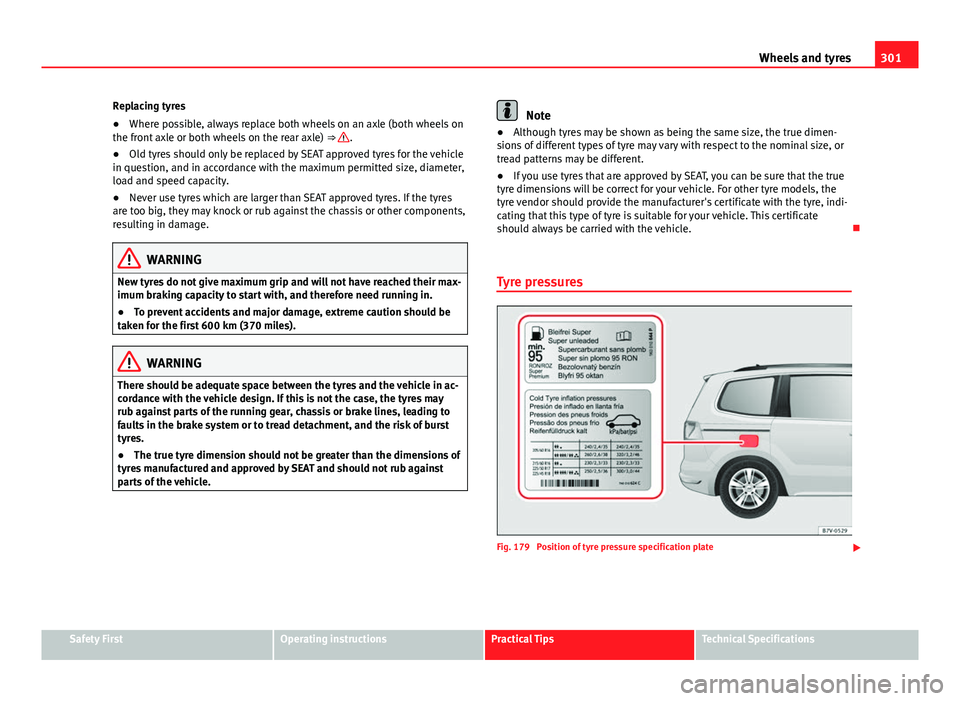
Tyre pressures
Fig. 179 Position of tyre pressure specification plate
Safety FirstOperating instructionsPractical TipsTechnical Specifications
Page 343 of 381
341
If and when
Starting assistance
Introduction
If the engine fails to start because of a discharged battery, the battery of an-
other vehicle can be used to start the engine. Before starting, check the
magic eye on the battery ⇒ page 292.
For starting assistance, jump lead cables conforming to the standard
DIN 72553 are required (see the cable manufacturer instructions). The jump
lead cable must be at least 25 mm 2
in section (0.038 inches 2
) for petrol en-
gines, and 35 mm 2
(0.054 inches 2
) for diesel engines.
For vehicles whose battery is not in the engine compartment, the jump
leads should only be connected to the starting assistance connection
points in the engine compartment.
Additional information and warnings:
● Starter assist systems (Start-Stop function) ⇒ page 196
● Working in the engine compartment ⇒ page 279
● Selective Catalytic Reduction (AdBlue) ⇒ page 275
● Vehicle battery ⇒ page 292
WARNING
Incorrect use of jump leads and incorrectly jump starting could cause the
battery to explode resulting in serious injury. Please observe the follow-
ing rules to minimise the risk of a battery explosion:
● All work involving the vehicle battery and electrical system can cause
corrosion, fire and serious electric shocks. Always read and take into ac-
count the safety warnings and standards before beginning work on the
battery ⇒ page 292, Vehicle battery.
WARNING (Continued)
● The battery providing current must have the same voltage (12V) and
approximately the same capacity (see markings on battery) as the flat
battery.
● Never charge a frozen or recently thawed battery. A flat battery can al-
so freeze at temperatures close to 0 °C (+32 °F).
● If a battery is frozen and/or has been frozen then it must be replaced.
● A highly explosive mixture of gases is released when the battery is
being charged. Always keep lit cigarettes, open flames, sparks and fire
far from the battery. Never use a mobile telephone when connecting and
removing the jump leads.
● Charge the battery only in well ventilated areas given that when the
battery is charged by outside assistance, it creates a mix of highly explo-
sive gases.
● Jump leads should never enter into contact with moving parts in the
engine compartment.
● Never switch the positive and negative poles or connect the jump
leads incorrectly.
● Note the instruction manual provided by the manufacturer of the jump
leads.
CAUTION
To avoid considerable damage to the vehicle electrical system, note the fol-
lowing carefully:
● If the jump leads are incorrectly connected, this could result in a short
circuit.
● The vehicles must not touch each other, otherwise electricity could flow
as soon as the positive terminals are connected.
Safety FirstOperating instructionsPractical TipsTechnical Specifications
Page 344 of 381
342If and when
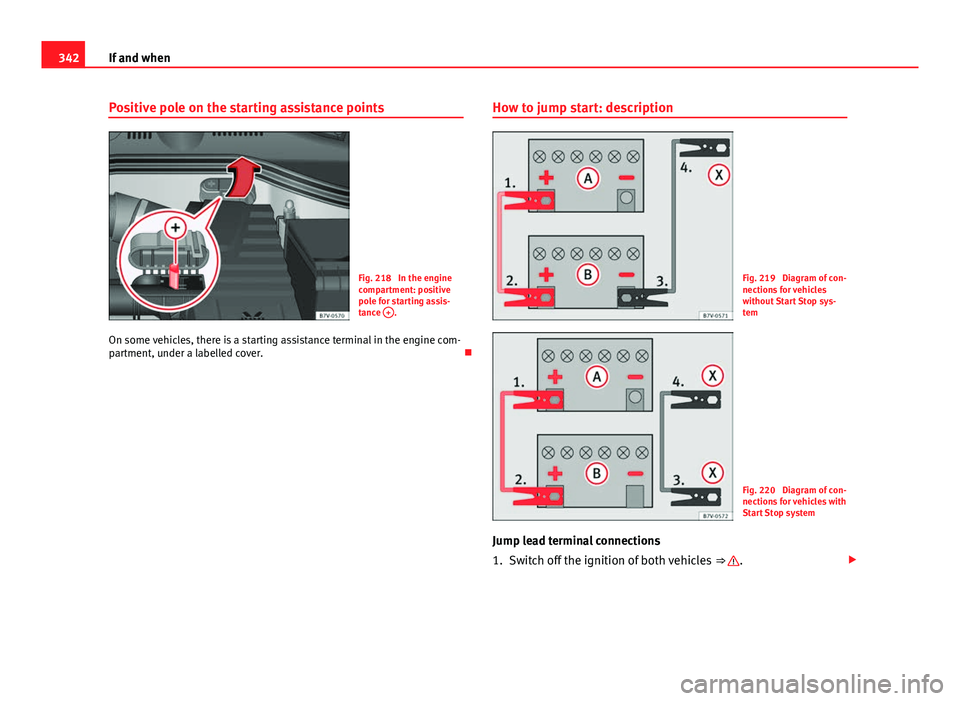
Positive pole on the starting assistance points
Fig. 218 In the engine
compartment: positive
pole for starting assis-
tance +
.
On some vehicles, there is a starting assistance terminal in the engine com-
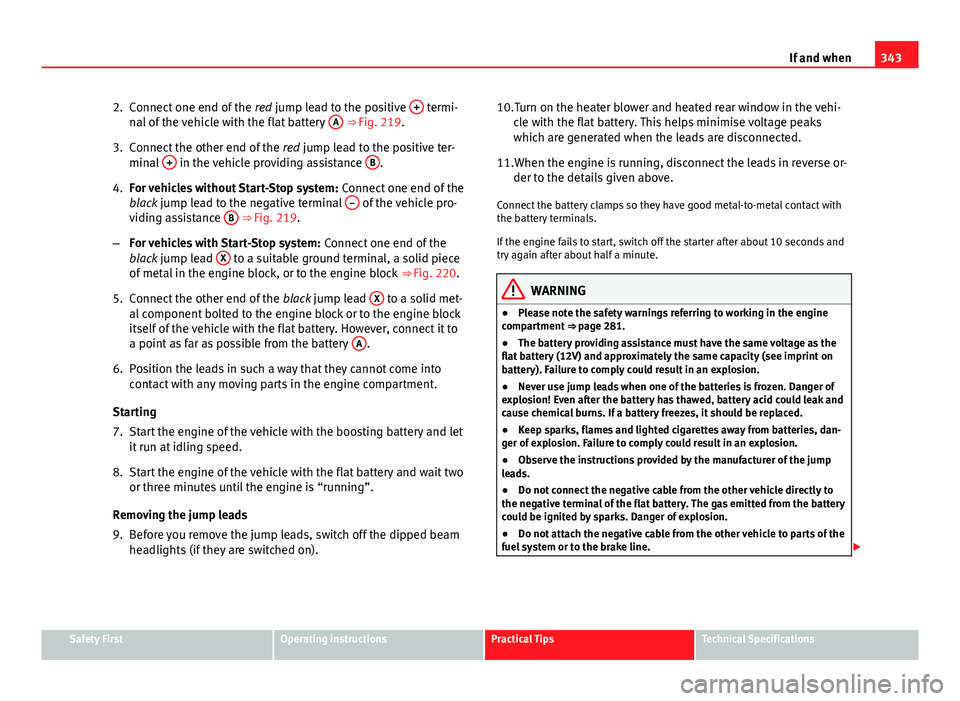
partment, under a labelled cover. How to jump start: description
Fig. 219 Diagram of con-
nections for vehicles
without Start Stop sys-
tem
Fig. 220 Diagram of con-
nections for vehicles with
Start Stop system
Jump lead terminal connections
1. Switch off the ignition of both vehicles ⇒
.
Page 345 of 381
343
If and when
2. Connect one end of the red jump lead to the positive +
termi-
nal of the vehicle with the flat battery A ⇒ Fig. 219.
3. Connect the other end of the red jump lead to the positive ter-
minal +
in the vehicle providing assistance B.
4. For vehicles without Start-Stop system: Connect one end of the
black jump lead to the negative terminal –
of the vehicle pro-
viding assistance B ⇒ Fig. 219.
– For vehicles with Start-Stop system: Connect one end of the
black jump lead X
to a suitable ground terminal, a solid piece
of metal in the engine block, or to the engine block ⇒ Fig. 220.
5. Connect the other end of the black jump lead X
to a solid met-
al component bolted to the engine block or to the engine block
itself of the vehicle with the flat battery. However, connect it to
a point as far as possible from the battery A
.
6. Position the leads in such a way that they cannot come into contact with any moving parts in the engine compartment.
Starting
7. Start the engine of the vehicle with the boosting battery and let it run at idling speed.
8. Start the engine of the vehicle with the flat battery and wait two or three minutes until the engine is “running”.
Removing the jump leads
9. Before you remove the jump leads, switch off the dipped beam headlights (if they are switched on). 10.Turn on the heater blower and heated rear window in the vehi-
cle with the flat battery. This helps minimise voltage peaks
which are generated when the leads are disconnected.
11.When the engine is running, disconnect the leads in reverse or- der to the details given above.
Connect the battery clamps so they have good metal-to-metal contact with
the battery terminals.
If the engine fails to start, switch off the starter after about 10 seconds and
try again after about half a minute.
WARNING
● Please note the safety warnings referring to working in the engine
compartment ⇒ page 281.
● The battery providing assistance must have the same voltage as the
flat battery (12V) and approximately the same capacity (see imprint on
battery). Failure to comply could result in an explosion.
● Never use jump leads when one of the batteries is frozen. Danger of
explosion! Even after the battery has thawed, battery acid could leak and
cause chemical burns. If a battery freezes, it should be replaced.
● Keep sparks, flames and lighted cigarettes away from batteries, dan-
ger of explosion. Failure to comply could result in an explosion.
● Observe the instructions provided by the manufacturer of the jump
leads.
● Do not connect the negative cable from the other vehicle directly to
the negative terminal of the flat battery. The gas emitted from the battery
could be ignited by sparks. Danger of explosion.
● Do not attach the negative cable from the other vehicle to parts of the
fuel system or to the brake line.
Safety FirstOperating instructionsPractical TipsTechnical Specifications
Page 347 of 381
345
If and when
● Vehicles with an automatic gearbox.
● Vehicles with an electronic parking brake, given that it is possible that
the brake will not be disengaged.
● If the vehicle battery is flat, it is possible that the engine control units do
not operate correctly.
However, if your vehicle must absolutely be tow-started (manual gearbox):
● Engage the 2nd or 3rd gear.
● Keep the clutch pressed down.
● Switch on the ignition and the hazard warning lights.
● Release the clutch when both vehicles are moving.
● As soon as the engine starts, press the clutch and move the gear lever
into neutral. This helps to prevent a collision with the towing vehicle.
CAUTION
When tow-starting, fuel could enter the catalytic converter and damage it.
Towing instructions
Tow rope or tow bar
When towing, the tow bar is the safest and vehicle friendly way. You should
only use a tow rope if you do not have a tow bar.
A tow rope should be slightly elastic to avoid damage to both vehicles. It is
advisable to use a tow rope made of synthetic fibre or similarly elastic mate-
rial.
Only secure the tow rope or tow bar to the towline anchorage or specially
designed fitting.
Vehicles with a factory fitted towing device , can only be used for towing
with a tow bar, specially designed to fit on a tow hitch ball ⇒ page 237.Towing vehicles with an automatic gearbox
Note the following for a towed vehicle:
●
Make sure the gear selector lever is in the N position.
● Do not drive faster than 50 km/h (30 mph).
● Do not tow further than 50 km (30 miles).
● If a breakdown truck is used, the vehicle must be towed with the front
wheels raised. Note the following instructions for towing four all-wheel drive
vehicles.
Instructions for towing all-wheel drive vehicles
All-wheel drive vehicles can be towed using a toolbar or tow rope. If the ve-
hicle is towed with the front or rear axle raised, the engine must be turned
off to avoid transmission damage.
For vehicles with a double clutched DSG ®
(direct shift gearbox) the instruc-
tions for towing vehicles with an automatic gearbox apply ⇒ page 345.
Situations in which the vehicle should not be towed
In the following cases, the vehicle should not be towed but transported on a
trailer or special vehicle:
● If the vehicle gearbox does not contain lubricant due to a fault.
● If the vehicle battery is flat and, as a result, the electronic steering lock
and electronic parking brake cannot be disengaged if applied.
● If the vehicle to be towed has an automatic gearbox and the distance to
be covered is greater than 50 km (30 miles).
Note
The vehicle can only be towed if the electronic parking brake and steering
lock are deactivated. If the vehicle has no power supply or there is an elec-
tric system fault, the engine must be started using jump leads to deactivate
the electronic parking brake and electronic steering lock.
Safety FirstOperating instructionsPractical TipsTechnical Specifications
Page 349 of 381
347
If and when
● Screw in the towline anchorage into its position anticlockwise as far as
it will go ⇒
. Use a suitable tool to firmly tighten the towline anchorage in
its location.
● After towing, remove the towline anchorage by turning it clockwise and
put the cover back in place.
CAUTION
● The towline anchorage must always be completely and firmly tightened.
Otherwise, it could be released while towing and tow-starting.
● Vehicles with a factory fitted towing bracket, can only be used for towing
with a tow bar, specially designed to fit on a tow hitch ball. Otherwise, the
tow hitch ball and the vehicle may be damaged. Otherwise, a tow rope
should be used.
Towing advice
Towing requires some experience, especially when using a tow rope. Both
drivers should be familiar with the technique required for towing. For this
reason, inexperienced drivers should abstain.
While driving, avoid excessive traction forces and jerking. When towing on
an unpaved road, there is always a risk of overloading and damaging the
anchorage points.
If the vehicle is towed, with the hazard warning lights on and the ignition
switched on, the turn signal may be used to indicate changes of direction.
Simply operate the turn signal lever as usual. Meanwhile, the hazard warn-
ing lights will go off. When the turn signal lever is returned to the rest posi-
tion, the hazard warning lights will be turned on automatically. Notes for the driver of the towed vehicle
●
Leave the ignition on to avoid locking the steering wheel, to release the
electronic parking brake and to activate the turn signals, the horn as well as
the window wipers and window washers.
● As the power assisted steering does not work if the engine is not run-
ning, you will need more strength to steer than normally.
● The brake must be depressed must harder as the brake servo does not
operate. Avoid hitting the towing vehicle.
● Note the instructions and information contained in the Instruction Man-
ual for the vehicle to be towed.
Notes for the driver of the towing vehicle
● Accelerate gently and carefully. Avoid sudden manoeuvres.
● Brake well in advance than usual and brake gently.
● Note the instructions and information contained in the Instruction Man-
ual for the vehicle to be towed.
Safety FirstOperating instructionsPractical TipsTechnical Specifications