check oil Seat Alhambra 2014 Owner's Manual
[x] Cancel search | Manufacturer: SEAT, Model Year: 2014, Model line: Alhambra, Model: Seat Alhambra 2014Pages: 381, PDF Size: 5.75 MB
Page 5 of 381
Table of Contents
About this manual . . . . . . . . . . . . . . . . . . . 5
Content . . . . . . . . . . . . . . . . . . . . . . . . . . . . . . . . 6
Safety First . . . . . . . . . . . . . . . . . . . . . . . . . . . . 7
Safe driving . . . . . . . . . . . . . . . . . . . . . . . . . . . . . . . 7
Dear SEAT Driver . . . . . . . . . . . . . . . . . . . . . . . . . . 7
Tips for driving . . . . . . . . . . . . . . . . . . . . . . . . . . . 7
Adjusting the seat position . . . . . . . . . . . . . . . . . 10
Transporting objects . . . . . . . . . . . . . . . . . . . . . . . 13
Seat belts . . . . . . . . . . . . . . . . . . . . . . . . . . . . . . . . . 16
Brief introduction . . . . . . . . . . . . . . . . . . . . . . . . . 16
Why wear seat belts? . . . . . . . . . . . . . . . . . . . . . . 19
Seat belts . . . . . . . . . . . . . . . . . . . . . . . . . . . . . . . 21
Seat belt tensioners . . . . . . . . . . . . . . . . . . . . . . . 27
Airbag system . . . . . . . . . . . . . . . . . . . . . . . . . . . . . 29
Brief introduction . . . . . . . . . . . . . . . . . . . . . . . . . 29
Airbag system . . . . . . . . . . . . . . . . . . . . . . . . . . . . 31
Child safety . . . . . . . . . . . . . . . . . . . . . . . . . . . . . . . 39
Child seats (accessories) . . . . . . . . . . . . . . . . . . . 39
Integrated child seat . . . . . . . . . . . . . . . . . . . . . . . 45
Operating instructions . . . . . . . . . . . . . 53
Cockpit . . . . . . . . . . . . . . . . . . . . . . . . . . . . . . . . . . . 53
Overview . . . . . . . . . . . . . . . . . . . . . . . . . . . . . . . . 53
Instrument panel . . . . . . . . . . . . . . . . . . . . . . . . . . 54
Instruments . . . . . . . . . . . . . . . . . . . . . . . . . . . . . . 57
SEAT information system . . . . . . . . . . . . . . . . . . . 62
Three button unit in headliner . . . . . . . . . . . . . . . 70 Opening and closing
. . . . . . . . . . . . . . . . . . . . . . 72
Vehicle key set . . . . . . . . . . . . . . . . . . . . . . . . . . . 72
Central locking and locking system . . . . . . . . . . . 75
Doors . . . . . . . . . . . . . . . . . . . . . . . . . . . . . . . . . . . 81
Sliding doors . . . . . . . . . . . . . . . . . . . . . . . . . . . . . 81
Rear lid . . . . . . . . . . . . . . . . . . . . . . . . . . . . . . . . . . 84
Electric windows . . . . . . . . . . . . . . . . . . . . . . . . . . 89
Panoramic sliding sunroof* . . . . . . . . . . . . . . . . . 93
Lights and visibility . . . . . . . . . . . . . . . . . . . . . . . . 96
Lights . . . . . . . . . . . . . . . . . . . . . . . . . . . . . . . . . . . 96
Sun blind . . . . . . . . . . . . . . . . . . . . . . . . . . . . . . . . 104
Windscreen wiper and washer . . . . . . . . . . . . . . . 106
Rear vision mirror . . . . . . . . . . . . . . . . . . . . . . . . . 111
Seats and storage . . . . . . . . . . . . . . . . . . . . . . . . . 115
Seat adjustment . . . . . . . . . . . . . . . . . . . . . . . . . . 115
Seat functions . . . . . . . . . . . . . . . . . . . . . . . . . . . . 118
Head restraints . . . . . . . . . . . . . . . . . . . . . . . . . . . 124
Centre armrest . . . . . . . . . . . . . . . . . . . . . . . . . . . . 127
Loading luggage compartment . . . . . . . . . . . . . . 127
Roof carrier system* . . . . . . . . . . . . . . . . . . . . . . . 140
Storage compartments . . . . . . . . . . . . . . . . . . . . . 142
Drink holders . . . . . . . . . . . . . . . . . . . . . . . . . . . . . 150
Ashtray and cigarette lighter* . . . . . . . . . . . . . . . 152
Power sockets . . . . . . . . . . . . . . . . . . . . . . . . . . . . 153
Air conditioning . . . . . . . . . . . . . . . . . . . . . . . . . . . 157
Air conditioner . . . . . . . . . . . . . . . . . . . . . . . . . . . . 157
Auxiliary heater* (additional heater) . . . . . . . . . . 165
Driving . . . . . . . . . . . . . . . . . . . . . . . . . . . . . . . . . . . . 169
Steering . . . . . . . . . . . . . . . . . . . . . . . . . . . . . . . . . 169
Stopping and starting the engine . . . . . . . . . . . . 172
Changing gear . . . . . . . . . . . . . . . . . . . . . . . . . . . . 176
Braking, stopping and parking . . . . . . . . . . . . . . 185
Start assist systems . . . . . . . . . . . . . . . . . . . . . . . 196
Parking sensor system* . . . . . . . . . . . . . . . . . . . . 200 Park Assist system* . . . . . . . . . . . . . . . . . . . . . . . 204
Rear Assist system* . . . . . . . . . . . . . . . . . . . . . . . 209
Cruise control system* . . . . . . . . . . . . . . . . . . . . . 214
Lane Assist system* . . . . . . . . . . . . . . . . . . . . . . . 217
Sign Assist* . . . . . . . . . . . . . . . . . . . . . . . . . . . . . . 220
Tiredness detection (recommendation to take a
break) . . . . . . . . . . . . . . . . . . . . . . . . . . . . . . . . . . . 223
Tyre monitoring systems . . . . . . . . . . . . . . . . . . . . 225
Practical Tips . . . . . . . . . . . . . . . . . . . . . . . . . 229
Driving and the environment . . . . . . . . . . . . . . . 229
Running-in . . . . . . . . . . . . . . . . . . . . . . . . . . . . . . . 229
Ecological driving . . . . . . . . . . . . . . . . . . . . . . . . . 229
Engine management and exhaust gas
purification system . . . . . . . . . . . . . . . . . . . . . . . . 232
Trailer towing . . . . . . . . . . . . . . . . . . . . . . . . . . . . . . 235
Introduction . . . . . . . . . . . . . . . . . . . . . . . . . . . . . . 235
Driving with a trailer . . . . . . . . . . . . . . . . . . . . . . . 237
Vehicle maintenance and cleaning . . . . . . . . . 246
Care and cleaning the vehicle exterior . . . . . . . . 246
Caring for and cleaning the vehicle interior . . . . 253
Notes for the user . . . . . . . . . . . . . . . . . . . . . . . . . 259
Accessories, replacement of parts and
modifications . . . . . . . . . . . . . . . . . . . . . . . . . . . . . 261
Accessories, replacement of parts and
modifications . . . . . . . . . . . . . . . . . . . . . . . . . . . . 261
Checking and refilling levels . . . . . . . . . . . . . . . 268
Filling the tank . . . . . . . . . . . . . . . . . . . . . . . . . . . . 268
Fuel . . . . . . . . . . . . . . . . . . . . . . . . . . . . . . . . . . . . 271
Selective Catalytic Reduction* (AdBlue) . . . . . . . 275
Working in the engine compartment . . . . . . . . . . 279
Engine oil . . . . . . . . . . . . . . . . . . . . . . . . . . . . . . . . 283
3
Table of Contents
Page 9 of 381
7
Safe driving
Safety First
Safe driving
Dear SEAT Driver
Safety first!This chapter contains important information, tips, suggestions and
warnings that you should read and consider for both your own
safety and for your passengers' safety.
WARNING
● This manual contains important information about the operation of
the vehicle, both for the driver and the passengers. The other sections of
the on-board documentation also contain further information that you
should be aware of for your own safety and for the safety of your passen-
gers.
● Ensure that the onboard documentation is kept in the vehicle at all
times. This is especially important when lending or selling the vehicle to
another person.
Tips for driving Introduction
Depending upon how you expect to use your vehicle, it may a good idea to
protect the engine from below. A guard underneath the engine may help to reduce the risk of damage to the lower part of the vehicle and the oil sump
when driving over kerbs, or along dirt tracks or rough roads... SEAT recom-
mends you have the guard fitted by a Technical Service.
Additional information and warnings:
●
Ensure you are correctly seated ⇒ page 10
● Transporting ⇒ page 13
● Starting, changing gears, parking ⇒ page 172
● Ecological driving ⇒ page 229
● Notes for the user ⇒ page 259
WARNING
Driving under the influence of alcohol, drugs, medication or narcotics
may result in severe accidents and even loss of life.
● Alcohol, drugs, medication and narcotics may significantly alter per-
ception, affect reaction times and safety while driving, which could result
in the loss of control of the vehicle.
Preparing for the journey and safe driving
Check list
For your own safety, for the safety of passengers in the car, and for that of
other road users, the following should be checked before and during each
journey ⇒
:
Safety FirstOperating instructionsPractical TipsTechnical Specifications
Page 11 of 381
9
Safe driving
● Are there any SEAT dealers in the destination country?
● For petrol vehicles: Is unleaded petrol available at the right octane rat-
ing?
● For diesel engines: Is diesel fuel available with a low sulphur content?
● Are a suitable engine oil ( ⇒ page 283) and other engine fluids comply-
ing with SEAT specifications available in the destination country?
● Will the navigation system fitted at the factory operate correctly in the
destination country with the available navigation data?
● Are special tyres required in the destination country?
CAUTION
SEAT does not accept liability for any damage to the vehicle due to the use
of a lower quality fuel, an inadequate service or the non-availability of genu-
ine spare parts.
Driving along flooded roadways
To prevent damage to the vehicle when driving through water, for example,
along a flooded road, please observe the following:
● Check the depth of the water before entering the flooded zone. The wa-
ter should never come above the lower edge of the bodywork ⇒
.
● Do not drive faster than a pedestrian.
● Do not stop in the water, use reverse gear or switch off the engine.
● Oncoming traffic will cause waves which raise the level of the water,
making it difficult to cross the water.
WARNING
When driving through water, mud, melted snow, etc., please remember
that due to damp or frozen brake discs and shoes in winter, the braking
effect may be delayed, therefore the required braking distance is greater.
● Dry the brakes and remove ice by braking carefully. Ensure that you
are not endangering other road-users or breaking traffic regulations in
the process.
● After driving through water, avoid sudden sharp manoeuvres.
CAUTION
● Driving through flooded areas may severely damage vehicle compo-
nents such as the engine, transmission, running gear or electrical system.
● Never drive through salt water as salt causes corrosion. Always rinse any
parts of the vehicle which have been in contact with salt water.
Safety FirstOperating instructionsPractical TipsTechnical Specifications
Page 171 of 381
169
Driving
Driving SteeringIntroduction
The power steering is not hydraulic but electromechanical. The advantage
of this steering system is that it disposes of hydraulic tubes, hydraulic oil,
the pump, filter and other components. The electromechanical system
saves fuel. While a hydraulic system requires oil pressure to be maintained,
electromechanical steering only requires energy when the steering wheel is
turned.
With the power steering system, the assisted steering function automatical-
ly adjusts according to the vehicle speed, the steering torque and the wheel
turning angle. The power steering only works when the engine is running.
Additional information and warnings:
● Start and stop the engine ⇒ page 172
● Vehicle battery ⇒ page 292
● Tow starting and towing away ⇒ page 344
WARNING
If the power steering is not working then the steering wheel is much
more difficult to turn and the vehicle more difficult to control.
● The power steering only works when the engine is running.
● Never allow the vehicle to move when the engine is switched off.
● Never remove the key from the ignition if the vehicle is in motion. The
steering may lock and it will not be possible to turn the steering wheel.
Control and warning lamps
lights upPossible causeSolution
(red)Power steering faulty.The steering system should be
checked by a specialised work-
shop as soon as possible.
(yellow)
Power steering operation re-
duced.
The steering system should be
checked by a specialised work-
shop as soon as possible.
If, after restarting the engine
and driving for a short distance,
the yellow warning lamp no lon-
ger comes on, it will not be nec-
essary to take the vehicle to a
specialised workshop.
The vehicle battery was dis-
connected and has been re-
connected.Travel a short distance at about
15-20 km/h (9-12 mph).
Safety FirstOperating instructionsPractical TipsTechnical Specifications
Page 192 of 381
190Driving
WARNING
New brake pads do not brake to full efficiency.
● For the first 320 km (200 miles), new brake pads have not yet reached
their maximum braking capacity, and need to be run in first. For this, to
compensate for reduced braking efficiency the brake pedal will have to
be pressed with more force.
● To avoid losing control of the vehicle and causing serious accidents,
always take great care when driving with new brake pads.
● When running in new brake pads, always respect the safety distances
between you and other vehicles and do not cause situations requiring ex-
treme braking performance.
WARNING
When brakes overheat, braking is less efficient and braking distances in-
crease.
● When driving on slopes, brakes can be overloaded and overheat
quickly.
● Reduce speed, move down a gear or select a shorter range of gears
before long steep slopes. This allows you to use the engine braking ef-
fect and to reduce the strain on the brake system.
● Non-standard or damaged front spoilers could restrict the airflow to
the brakes and cause them to overheat.
WARNING
Wet, frozen or salt-covered brakes take time to brake and this increases
braking distances.
● Test the brakes carefully.
● Dry the brakes, free them of ice and salt by braking gently several
times, when weather, road and traffic conditions permit.
WARNING
Driving without the brake servo may significantly increase the braking
distance and result in a severe accident.
● Never allow the vehicle to move forwards when the engine is switched
off.
● If the brake servo does not operate or the vehicle must be towed,
then the brake pedal will have to be pressed with more force given that
the braking distance will be increased when the brake servo does not op-
erate.
CAUTION
● Never make the brakes slip by pressing the pedal gently, if it is not really
necessary to brake. Continuously pressing on the brake pedal will heat the
brakes. This could significantly reduce braking power, increase braking dis-
tance or even result in the total failure of the brake system.
● Reduce speed, move down a gear or select a shorter range of gears be-
fore long steep slopes. This allows you to use the engine braking effect and
to reduce the strain on the brake system. Otherwise, the brakes may over-
heat and fail. Only use the brakes to reduce speed or to stop.
Note
When checking the front brake pads, take the time to also check the rear
brake pads. The thickness of the brake pads should be checked visually and
regularly, by looking through the openings in the wheel rims or from under-
neath the vehicle. If necessary, remove the wheels to check them thorough-
ly. SEAT recommends visiting a Technical Service.
Page 233 of 381
231
Driving and the environment
Other factors which increase fuel consumption (examples):
● Fault in engine management.
● Driving on hills.
● Trailer towing.
Saving fuel while driving
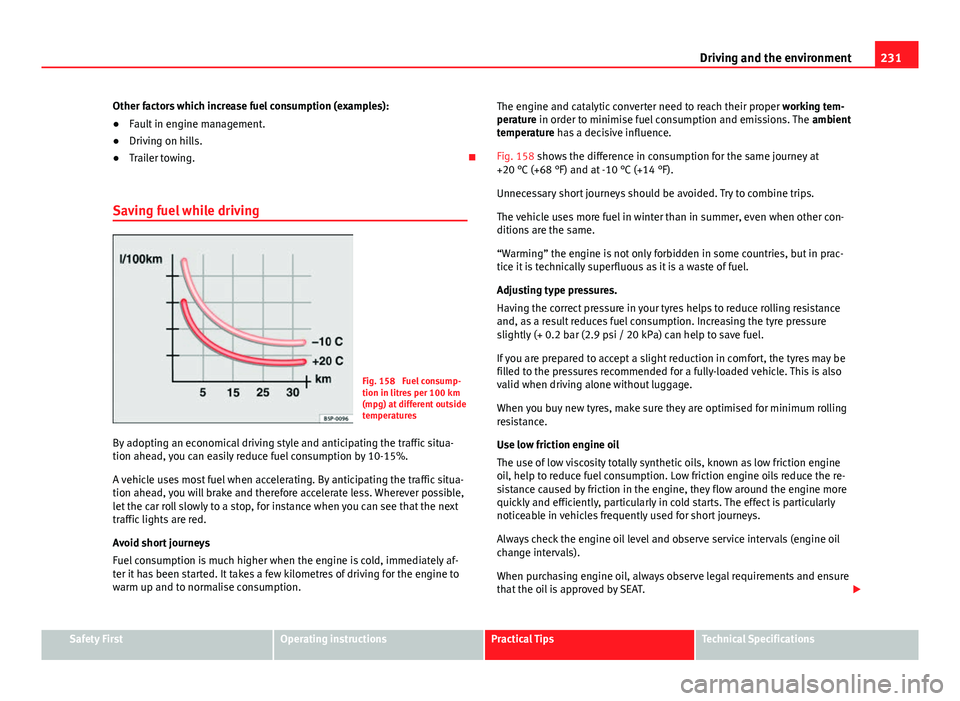
Fig. 158 Fuel consump-
tion in litres per 100 km
(mpg) at different outside
temperatures
By adopting an economical driving style and anticipating the traffic situa-
tion ahead, you can easily reduce fuel consumption by 10-15%.
A vehicle uses most fuel when accelerating. By anticipating the traffic situa-
tion ahead, you will brake and therefore accelerate less. Wherever possible,
let the car roll slowly to a stop, for instance when you can see that the next
traffic lights are red.
Avoid short journeys
Fuel consumption is much higher when the engine is cold, immediately af-
ter it has been started. It takes a few kilometres of driving for the engine to
warm up and to normalise consumption. The engine and catalytic converter need to reach their proper
working tem-
perature in order to minimise fuel consumption and emissions. The ambient
temperature has a decisive influence.
Fig. 158 shows the difference in consumption for the same journey at
+20 °C (+68 °F) and at -10 °C (+14 °F).
Unnecessary short journeys should be avoided. Try to combine trips.
The vehicle uses more fuel in winter than in summer, even when other con-
ditions are the same.
“Warming” the engine is not only forbidden in some countries, but in prac-
tice it is technically superfluous as it is a waste of fuel.
Adjusting type pressures.
Having the correct pressure in your tyres helps to reduce rolling resistance
and, as a result reduces fuel consumption. Increasing the tyre pressure
slightly (+ 0.2 bar (2.9 psi / 20 kPa) can help to save fuel.
If you are prepared to accept a slight reduction in comfort, the tyres may be
filled to the pressures recommended for a fully-loaded vehicle. This is also
valid when driving alone without luggage.
When you buy new tyres, make sure they are optimised for minimum rolling
resistance.
Use low friction engine oil
The use of low viscosity totally synthetic oils, known as low friction engine
oil, help to reduce fuel consumption. Low friction engine oils reduce the re-
sistance caused by friction in the engine, they flow around the engine more
quickly and efficiently, particularly in cold starts. The effect is particularly
noticeable in vehicles frequently used for short journeys.
Always check the engine oil level and observe service intervals (engine oil
change intervals).
When purchasing engine oil, always observe legal requirements and ensure
that the oil is approved by SEAT.
Safety FirstOperating instructionsPractical TipsTechnical Specifications
Page 249 of 381
247
Vehicle maintenance and cleaning
Washing the vehicle
The longer substances such as insects, bird droppings, resinous tree sap,
road dirt, industrial deposits, tar, soot or road salt and other aggressive ma-
terials remain on the vehicle, the more damage they do to the paintwork.
High temperatures (for instance due to strong sunlight) further intensify the
corrosive effect. The vehicle undercarriage should also be thoroughly wash-
ed at regular intervals.
Automatic car washes
Always observe the instructions provided at the automatic car wash. The
standard precautionary measures prior to entering the car wash should be
taken to avoid damage to the vehicle (close all windows, fold in exterior mir-
rors). If the vehicle is fitted with additional components (spoiler, roof-rack,
aerial...), check with the car wash supervisor whether these can enter the
car wash ⇒
.
The vehicle paintwork is so durable that the vehicle can normally be washed
without problems in an automatic car wash tunnel. However, wear and dam-
age to the paintwork will depend on the type of car wash used. SEAT recom-
mends the use of car washed without brushes.
To remove traces of wax on windows and to prevent wiper blades from
scratching, please observe the following ⇒ page 249, Cleaning windows
and exterior mirrors.
Washing the car by hand
When washing the car by hand, use plenty of water to soften the dirt first,
and rinse off as well as possible.
Then clean the vehicle with a soft sponge, glove or brush using only slight
pressure. Start at the roof and work downwards. Special car shampoo
should only be used for very persistent dirt.
Rinse the sponge or glove thoroughly and often.
Wheels, sills and similar should be cleaned last. Use a second sponge for
this.
WARNING
Sharp components on the vehicle may cause injury.
● Protect arms and hands from sharp edges when cleaning the vehicle
undercarriage or the interior of the wheel hubs.
WARNING
After the vehicle has been washed, the braking effect will be reduced
(and the braking distance increased) due to moisture (and ice in winter)
on the brakes.
● Dry the brakes and remove ice by braking carefully. Ensure that you
are not endangering other road-users or breaking traffic regulations in
the process.
CAUTION
● The temperature of the water must not exceed +60 °C (+140 °F).
● To avoid damage to the paintwork, do not wash the vehicle in full sun.
● Do not use rough sponges or similar which could damage the surface to
clean away the traces of insects.
● Never wipe the headlights with a dry cloth or sponge, always moisten
first. It is best to use soapy water.
● Washing the vehicle in low temperatures: When washing the vehicle
with a hose, do not direct water into the lock cylinders or the gaps around
the doors, rear lid, or sunroof. Locks and seals could freeze!
CAUTION
To prevent damage to the vehicle, please observe the following before en-
tering an automatic car wash :
● Compare the distance between the vehicle wheels and the distance be-
tween the guide-rails of the car wash to prevent damage to the wheels and
tyres!
Safety FirstOperating instructionsPractical TipsTechnical Specifications
Page 256 of 381
254Vehicle maintenance and cleaning
The longer stains or dirt remain on the vehicle surfaces, especially the fab-
rics covering the padded upholstery, the more difficult it becomes to clean
and maintain them. If stains and dirt are left for a long time, it may be that
they are impossible to remove.
WARNING
Car-care products may be toxic and hazardous. Using unsuitable car-care
products or, using them in the wrong way, may cause accidents, serious
injury, burns or intoxication.
● Keep your car-care products in their original containers.
● Read the instructions.
● Never keep car-care products in empty food containers, bottles or
other similar containers. Other people may confuse them.
● Keep all car-care products out of the reach of children.
● Some products may give off harmful vapours during use. Therefore,
they should be used outdoors in well-ventilated places.
● Never use fuel, turpentine, engine oil, nail-varnish remover or any
other volatile product for washing, maintenance or cleaning. These are
toxic and highly flammable.
WARNING
Unsuitable maintenance and cleaning of vehicle components may impair
proper operation of safety equipment and cause serious injury.
● Maintain and clean vehicle components according to the manufactur-
er's instructions.
● Only use approved or recommended cleaning products.
CAUTION
● Cleaning products which contain solvents have a corrosive effect and
may damage the material irreparably.
● Stains and dirt containing aggressive substances or solvents attack the
material and may damage it irreparably, even when they are cleaned quick-
ly.
● Dirt and stains should not be allowed to dry and should be cleaned as
quickly as possible.
● In the case of stubborn stains, take the vehicle to a specialised work-
shop to avoid damage.
Treating your upholstery
Checklist
To treat and maintain your seat upholstery, keep the following in mind ⇒
:
Before entering the vehicle, close any Velcro fasteners that might
snag on the upholstery or trim fabric. Any open Velcro fasteners may
damage the trim or upholstery fabrics.
To prevent damage, avoid direct contact between sharp decorative
objects and the upholstery and trim fabrics. Decorative objects in-
clude zips, rivets and rhinestones on clothing and belts.
From time to time, clean the dust that gathers in the perforations,
folds and seams so that the surfaces of the seats are not damaged
by its abrasive effect.
Make sure clothes are colour-fast to avoid them running and staining
the upholstery. This is especially important if the upholstery is light
in colour.
Page 269 of 381

267
Accessories, replacement of parts and modifications
The vehicle should not be lifted using lifting platforms with lift pads con-
taining fluid.
When raising a vehicle using a platform or jack, a series of precautionary
measures are required. Never raise the vehicle with a lifting platform or jack
unless you have received training in how to do so and know how to lift the
vehicle safely.
Notes on raising the vehicle with a jack ⇒ page 313.
WARNING
The improper use of the lifting platform or the jack when raising the vehi-
cle may result in accidents or serious injury.
● Before raising the vehicle, please observe the manufacturer's instruc-
tions for the platform or jack, and the legal requirements, where applica-
ble.
● There should not be anyone inside the vehicle when it is being raised
or once it is in the air.
● Only use the jacking points indicated in the figures ⇒ Fig. 163 and
⇒ Fig. 164 when raising the vehicle. If the vehicle is not lifted at the indi-
cated points, it may fall from the platform while the engine or gearbox is
being dismounted, for example.
● The jacking points should be centrally aligned and firmly positioned
on the platform support plates.
● Never start the engine when the vehicle is raised! The vehicle may fall
from the platform due to the engine vibrations.
● If it is necessary to work underneath the vehicle while it is raised, you
should check that the supporting stands have an adequate load capacity.
● Never climb onto the lifting platform.
● Always make sure that the weight of the vehicle does not exceed the
lifting platform load capacity.
CAUTION
● Never raise the vehicle at the engine oil sump, the gearbox or the rear or
front axles.
● Always use an intermediate rubber support to prevent damage to the
vehicle underbody. Check that the arms of the lifting platform are able to
move with obstruction.
● The arms should not come into contact with the side running boards or
other parts of the vehicle.
Safety FirstOperating instructionsPractical TipsTechnical Specifications
Page 271 of 381
269
Checking and refilling levels
WARNING (Continued)
– If you are using a metal fuel canister, the nozzle must always touch
the canister while it is being filled to avoid static electricity.
– Follow the legal requirements for the use, storage and transport of
spare fuel canisters.
– Insure that the fuel container complies with manufacturing stand-
ards, for example, ANSI or ASTM F852-86.
CAUTION
● Always remove any fuel spilled on the vehicle paintwork immediately to
avoid damage to the wheel housing, the tyre and vehicle paintwork.
● Refuelling a petrol engine with diesel or a diesel engine with petrol can
cause serious engine and fuel system damage; the resulting malfunctions
are not covered by the SEAT warranty. If you refuel with the wrong type of
fuel, never start the engine. This applies to even the smallest amount of the
wrong fuel. Seek specialist assistance. With the engine running, the compo-
sition of the wrong fuel could significantly damage the fuel system and the
engine itself.
● In vehicles with a diesel engine, under no circumstances should you re-
fuel or drive with petrol, kerosene, heating oil or any other type of different
fuel. Other types of fuels could cause serious damage to the engine and to
the fuel supply system and the resulting problems are not covered by the
SEAT warranty.
For the sake of the environment
Fuels can contaminate the environment. Collect any spilt service fluids and
allow a professional to dispose of them.
Note
There is no emergency mechanism for the manual release of the tank flap. If
necessary, request assistance from specialised personnel. Control lamps and fuel gauge
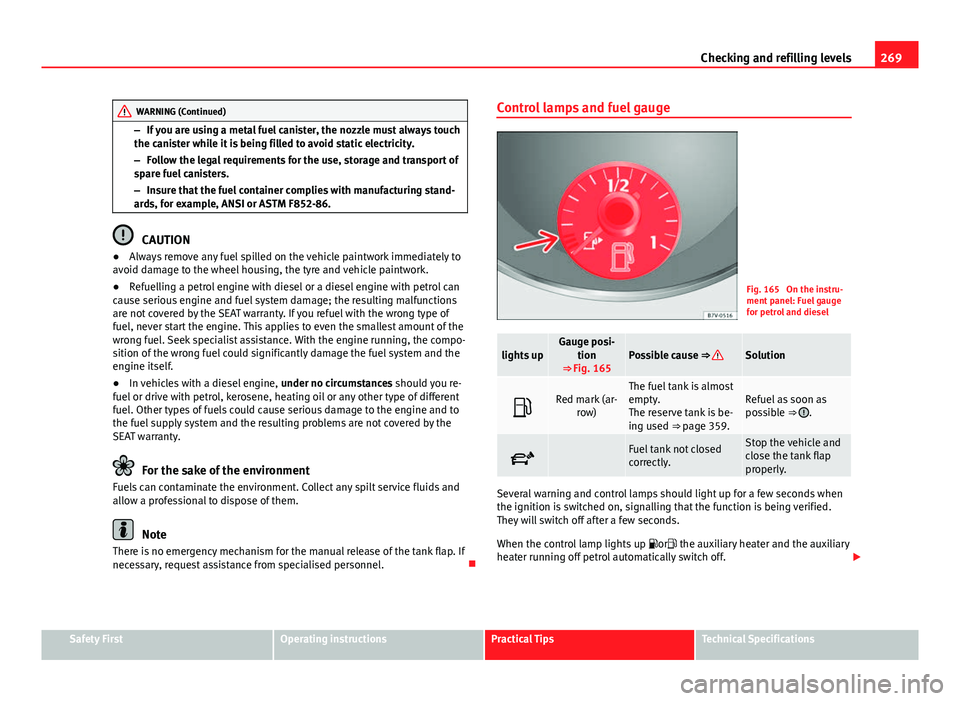
Fig. 165 On the instru-
ment panel: Fuel gauge
for petrol and diesel
lights upGauge posi-
tion
⇒ Fig. 165Possible cause ⇒ Solution
Red mark (ar- row)The fuel tank is almost
empty.
The reserve tank is be-
ing used ⇒ page 359.Refuel as soon as
possible ⇒ .
Fuel tank not closed
correctly.Stop the vehicle and
close the tank flap
properly.
Several warning and control lamps should light up for a few seconds when
the ignition is switched on, signalling that the function is being verified.
They will switch off after a few seconds.
When the control lamp lights up or the auxiliary heater and the auxiliary
heater running off petrol automatically switch off.
Safety FirstOperating instructionsPractical TipsTechnical Specifications