high beam Seat Alhambra 2014 Owner's Manual
[x] Cancel search | Manufacturer: SEAT, Model Year: 2014, Model line: Alhambra, Model: Seat Alhambra 2014Pages: 381, PDF Size: 5.75 MB
Page 98 of 381
96Lights and visibility
Lights and visibility
Lights Introduction
The legal requirements regarding the use of vehicle lights in each country
must be observed.
The driver is personally responsible for the correct use and adjustment of
the lights in all situations.
Additional information and warnings:
● SEAT information system ⇒ page 62
● Changing bulbs ⇒ page 330
WARNING
If the headlights are set too high and the main beam is not used correct-
ly, there is a risk of dazzling or distracting other road users. This could
result in a serious accident.
● Always make sure that the headlights are correctly adjusted.
● Never use the main beam or flashed headlamps as this could dazzle
other drivers.
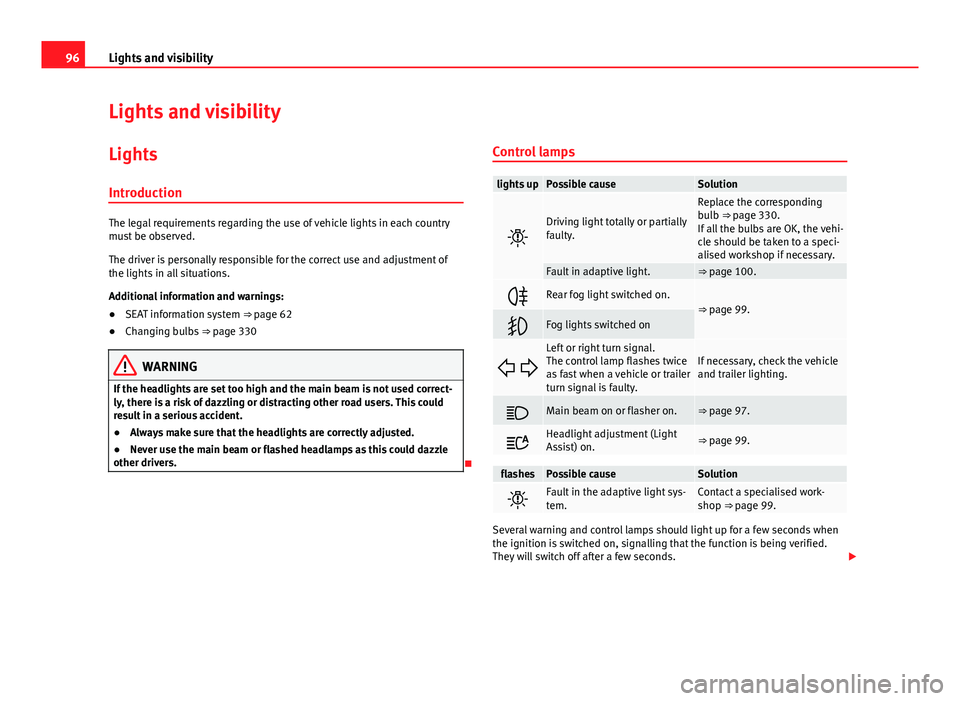
Control lamps
lights upPossible causeSolution
Driving light totally or partially
faulty.
Replace the corresponding
bulb ⇒ page 330.
If all the bulbs are OK, the vehi-
cle should be taken to a speci-
alised workshop if necessary.
Fault in adaptive light.⇒ page 100.
Rear fog light switched on.⇒ page 99.
Fog lights switched on
Left or right turn signal.
The control lamp flashes twice
as fast when a vehicle or trailer
turn signal is faulty.If necessary, check the vehicle
and trailer lighting.
Main beam on or flasher on.⇒ page 97.
Headlight adjustment (Light
Assist) on.⇒ page 99.
flashesPossible causeSolution
Fault in the adaptive light sys-
tem.Contact a specialised work-
shop ⇒ page 99.
Several warning and control lamps should light up for a few seconds when
the ignition is switched on, signalling that the function is being verified.
They will switch off after a few seconds.
Page 110 of 381
108Lights and visibility
Windscreen wiper functions
Windscreen wiper performance in different situations:If the vehicle is at a stand-
still:The activated position provisionally changes
to the previous position.
During the automatic wipe:
The air conditioner comes on for approxi-
mately 30 seconds in air recirculation mode
to prevent the smell of the windscreen wash-
er fluid entering the inside the vehicle.
For the interval wipe:The intervals between wipes vary according
to the speed of the vehicle. The higher the
vehicle speed the shorter the intervals.
Heated windscreen washer jets
The heating only thaws the frozen jets, it does not thaw the water in the
washer hoses. The heated windscreen washer jets automatically adjust the
heat depending on the ambient temperature, when the ignition is switched
on.
Headlight wash/wipe system
The headlight washers/wipers clean the headlight lenses.
After the ignition is switched on, the first and every fifth time the wind-
screen washer is switched on, the headlights are also washed. Therefore,
the windscreen wiper lever should be pulled towards the steering wheel
when the dipped beam or main beam are on. Any incrusted dirt (such as in-
sects) should be cleaned regularly (e.g. when refuelling).
To ensure the headlight washers work correctly in winter, any snow which
has got into the bumper jet supports should be cleaned away. If necessary,
remove snow with an anti-icing spray.
Note
The wiper will try to wipe away any obstacles that are on the windscreen.
The wiper will stop moving if the obstacle blocks its path. Remove the ob-
stacle and switch the wiper back on again.
Windscreen wipers service position
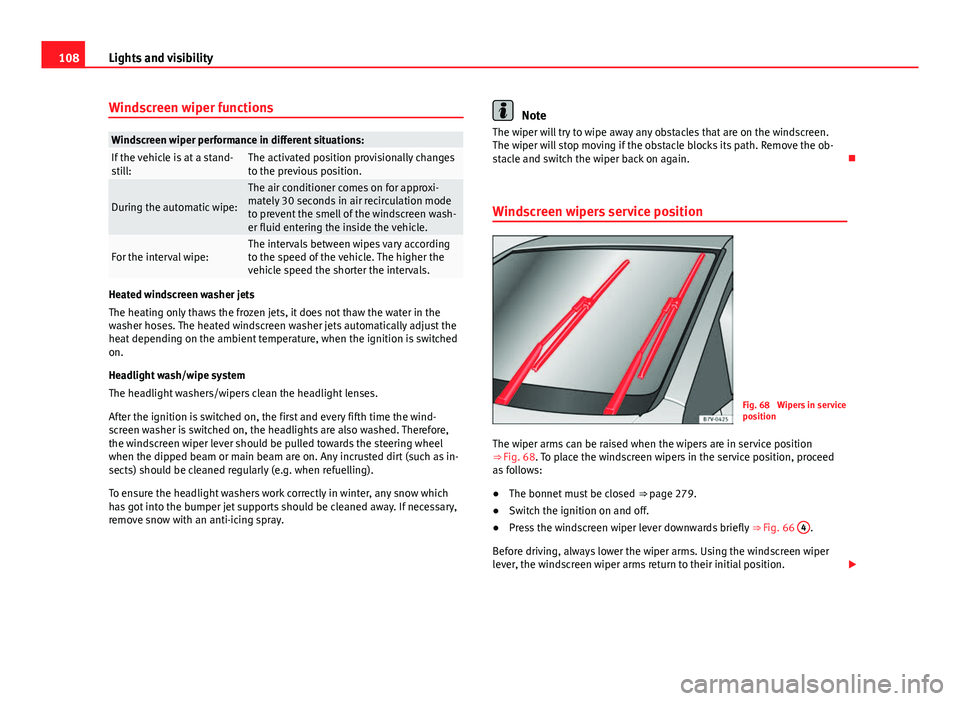
Fig. 68 Wipers in service
position
The wiper arms can be raised when the wipers are in service position
⇒ Fig. 68. To place the windscreen wipers in the service position, proceed
as follows:
● The bonnet must be closed ⇒ page 279.
● Switch the ignition on and off.
● Press the windscreen wiper lever downwards briefly ⇒ Fig. 66 4
.
Before driving, always lower the wiper arms. Using the windscreen wiper
lever, the windscreen wiper arms return to their initial position.
Page 170 of 381
168Air conditioning
Checking programming
If the timer has been switched on after switching the ignition off, the instant
on button
will remain lit for around ten seconds.
WARNING
Never program the independent heating system to be activated and oper-
ated in closed, unventilated areas. The auxiliary heater fumes contain
carbon dioxide, an odourless and colourless toxic gas. Carbon monoxide
can cause people to lose consciousness. It can also cause death.
Operating instructions
The auxiliary heater exhaust system located below the vehicle must be kept
clear of snow, mud and other objects. The exhaust gases must not be ob-
structed in any way. The exhaust gases generated by the auxiliary heater are
removed via an exhaust pipe fitted underneath the vehicle.
On heating the vehicle interior, depending on the outside temperature the
warm air is first directed at the windscreen and then to the rest of the vehi-
cle interior through the air vents. If the air vents are turned towards the win-
dows, for example, the form of air distribution may be affected.
Depending on the outside temperature, the temperature at which the auxili-
ary heater warms the vehicle interior may be somewhat higher if the heating
or air conditioner temperature control is set to maximum before switching
the heating on.
Depending on the engine, vehicles with auxiliary heater may be fitted with a
second battery in the luggage compartment that is responsible for powering
the auxiliary heater. Cases in which the auxiliary heater will not switch on
●
The auxiliary heater requires about as much power as the dipped beam
headlights. If the battery charge is low, the auxiliary heater will switch off
automatically or will not even switch on. This avoids problems when starting
the engine.
● The heater will switch just once each time. The timer will also have to be
switched back on every time it is required.
Note
● Noise will be heard while the auxiliary heater is running.
● When the air humidity is high and the outside temperature low, the
heating system may evaporate condensation from the auxiliary heater. In
this case, steam may be released from underneath the vehicle. This is com-
pletely normal and there is no need to suspect a fault!
● If the auxiliary heater runs several times over a prolonged period, the ve-
hicle battery may run flat. To re-charge the battery, drive the vehicle for a
long distance. In general: drive for as much time as the auxiliary heating
was working.
Page 224 of 381
222Driving
rain during travel, the traffic sign valid at this moment will move to the first
position along the additional sign “if the road is wet”.
The permanent display on the instrument panel screen is shown as you
pass the real traffic signs. The signs for entering and leaving towns activate
the display of the usual speed limits for that country on roads in populated
areas and national highways, even if the speed is not limited by an actual
traffic sign.
The end of a prohibition or limitation is not displayed. If you exceed the
speed limits shown, a warning will not appear. The system does not detect
areas with little traffic. The current legal provisions apply.
Connection and disconnection
● Connect or disconnect the assist system in the Settings menu in the
SEAT information system ⇒ page 62.
● OR: Press the button for the driver assist systems on the main beam lev-
er.
Trailer
Connect or disconnect the secondary display for speed limits and overtak-
ing bans that apply to trailers (trailer mode) in the Settings menu in the
SEAT information system ⇒ page 62.
Page 243 of 381
241
Trailer towing
For the sake of road safety, SEAT recommends using the maximum allowed
drawbar load. The handling of the combined vehicle and trailer will be poor
if the drawbar load is too low.
The drawbar load increases the weight on the rear axle, reducing the vehicle
carrying capacity.
Gross combination weight
This figure refers to the combined weight of the loaded vehicle and loaded
trailer.
Loading the trailer
The combined vehicle and trailer must be balanced. Use the maximum
drawbar load authorised and do not overload the front or the rear of the
trailer:
● Distribute loads in the trailer so that heavy objects are as near to the
axle as possible or even above it.
● Correctly secure the trailer load.
Tyre pressure
Inflate the trailer tyres according to the manufacturer's instructions.
Inflate the towing vehicles tyres to the maximum ⇒ page 297.
WARNING
Exceeding the maximum authorised axle load, drawbar load or the gross
combination weight of the towing vehicle and trailer could cause a seri-
ous accident with severe consequences.
● Never exceed the specifications.
● With the actual load on the front and rear axles, the maximum axle
load should never be exceeded. The weight on the front and rear should
never exceed the gross vehicle weight.
WARNING
If the load moves, the stability and safety of the vehicle and trailer com-
bination will be seriously affected and this could result in a serious acci-
dent.
● Always correctly load the trailer.
● Always secure loads correctly with suitable and undamaged attach-
ment rope or straps.
Driving with a trailer
Adjusting the headlights
When towing a trailer, the front of the vehicle may rise and so the dipped
beam headlights may blind other drivers. Use the headlight range control to
lower the cone of light. If you do not have headlight range control, have the
headlights adjusted by a specialised workshop. Vehicles with high-intensity
discharge lamps adapt automatically and do not require adjustment.
Details of driving with a trailer
● If the trailer has an overrun brake, apply the brakes gently at first and
then, firmly. This will prevent the jerking that can be caused by the trailer
wheels locking.
● As of the combined vehicle and trailer mass, braking distances will be
greater.
● Select a low gear before driving down a steep hill to use the engine
braking effect to slow down the vehicle. Otherwise, the braking system
could overheat and fail.
Safety FirstOperating instructionsPractical TipsTechnical Specifications
Page 370 of 381
Preparation before replacing . . . . . . . . . . . 328
Replacement . . . . . . . . . . . . . . . . . . . . . . . . 328
G General instrument panel Turn signal and headlight lever . . . . . . . . . . 97
General overview of the engine compartment 352
Glove compartment . . . . . . . . . . . . . . . . . . . . . 146
Glove compartment lighting . . . . . . . . . . . . . . 103
H Handbrake See "Parking brake" . . . . . . . . . . . . . . . . . . 187
Hazard warning lights . . . . . . . . . . . . . . . . . . . 316
Hazard warning triangle . . . . . . . . . . . . . . . . . 318
Headlamp range adjustment . . . . . . . . . . . . . . . 53
Headlight adjustment . . . . . . . . . . . . . . . . . . . 100
Headlight lever . . . . . . . . . . . . . . . . . . . . . . . . . . 97
Headlight range control . . . . . . . . . . . . . . . . . . 102
Headlights Adaptive headlights . . . . . . . . . . . . . . . . . . 100
Dipped beam headlights . . . . . . . . . . . . . . . 98
Driving abroad . . . . . . . . . . . . . . . . . . . . . . 101
Headlight control . . . . . . . . . . . . . . . . . . . . . 98
Headlight washers . . . . . . . . . . . . . . . . . . . 108
Side light . . . . . . . . . . . . . . . . . . . . . . . . . . . 98
Turning lights . . . . . . . . . . . . . . . . . . . . . . . 100
Head restraint . . . . . . . . . . . . . . . . . . . . . . . . . . 125
Head restraints . . . . . . . . . . . . . . . . . . . . . . . . . 124
Heated rear window . . . . . . . . . . . . . . . . . . . . . 160 Heated seats . . . . . . . . . . . . . . . . . . . . . . . . . . . 118
Heated windscreen . . . . . . . . . . . . . . . . . . . . . 160
High pressure cleaning equipment . . . . . . . . . 248
Hitch ball
Electric release . . . . . . . . . . . . . . . . . . . . . . 238
Horn . . . . . . . . . . . . . . . . . . . . . . . . . . . . . . . . . . 53
I
Ignition See "Engine and ignition" . . . . . . . . . . . . . 172
Ignition lock . . . . . . . . . . . . . . . . . . . . . . . . . . . 173 Safety interlock . . . . . . . . . . . . . . . . . . . . . . 174
Unauthorised vehicle key . . . . . . . . . . . . . 173
Immobiliser . . . . . . . . . . . . . . . . . . . . . . . . . . . . 176 Operating fault . . . . . . . . . . . . . . . . . . . . . . 172
In case of a breakdown Securing the vehicle . . . . . . . . . . . . . . . . . 316
In case of an emergency Checklist . . . . . . . . . . . . . . . . . . . . . . . . . . . 316
Hazard warning lights . . . . . . . . . . . . . . . . 316
In case of a breakdown . . . . . . . . . . . . . . . 316
Protecting yourself and securing the vehi-cle . . . . . . . . . . . . . . . . . . . . . . . . . . . . . . . 316
In case of emergency . . . . . . . . . . . . . . . . . . . . 316
Indication on display Sign Assist . . . . . . . . . . . . . . . . . . . . . . . . . 221
Indicator Vehicle key . . . . . . . . . . . . . . . . . . . . . . . . . . 74
Information on consumption . . . . . . . . . . . . . . 274
Initial operations Changing bulbs . . . . . . . . . . . . . . . . . . . . . 331 Instrument panel . . . . . . . . . . . . . . . . . . . . . 57, 63
Display . . . . . . . . . . . . . . . . . . . . . . . 57, 58, 63
Instruments . . . . . . . . . . . . . . . . . . . . . . . . . 57
Lamps . . . . . . . . . . . . . . . . . . . . . . . . . . . . . . 54
Menus . . . . . . . . . . . . . . . . . . . . . . . . . . . . . . 65
Service interval display . . . . . . . . . . . . . . . . 61
Integrated child seat . . . . . . . . . . . . . . . . . . . . . 45 Removing . . . . . . . . . . . . . . . . . . . . . . . . . . . 49
Seat belt routing . . . . . . . . . . . . . . . . . . . . . . 48
Setting up . . . . . . . . . . . . . . . . . . . . . . . . . . . 47
Interior monitoring . . . . . . . . . . . . . . . . . . . . . . . 80
ISOFIX . . . . . . . . . . . . . . . . . . . . . . . . . . . . . . . . . 44
J Jack . . . . . . . . . . . . . . . . . . . . . . . . . . . . . . . . . . 310 Raising the vehicle . . . . . . . . . . . . . . . . . . . 313
K
Keys . . . . . . . . . . . . . . . . . . . . . . . . . . . . . . . . . . . 72 Assigning a key . . . . . . . . . . . . . . . . . . . . . . 72
Changing the battery (vehicle key) . . . . . . . 74
Indicator . . . . . . . . . . . . . . . . . . . . . . . . . . . . 74
Remote control . . . . . . . . . . . . . . . . . . . . . . . 72
Spare key . . . . . . . . . . . . . . . . . . . . . . . . . . . 72
Vehicle key . . . . . . . . . . . . . . . . . . . . . . . . . . 72
Key switch Deactivating the front passenger front air-bag . . . . . . . . . . . . . . . . . . . . . . . . . . . . . . . 35
Kickdown system . . . . . . . . . . . . . . . . . . . . . . . 182
Knee airbag See "Airbag system" . . . . . . . . . . . . . . . . . . 38
368 Index
Page 375 of 381
Sliding doors . . . . . . . . . . . . . . . . . . . . . . . . . . . 81Childproof lock . . . . . . . . . . . . . . . . . . . . . . . 84
Opening and closing electrically . . . . . . . . . 82
Snow chains . . . . . . . . . . . . . . . . . . . . . . . 305, 351 All-wheel drive . . . . . . . . . . . . . . . . . . . . . . 305
Spanner symbol . . . . . . . . . . . . . . . . . . . . . . . . . 61
Spare fuel canister . . . . . . . . . . . . . . . . . . . . . . 268
Spare parts . . . . . . . . . . . . . . . . . . . . . . . . . . . . 261
Special features Automatic car wash . . . . . . . . . . . . . . . . . . 247
Folding exterior mirrors . . . . . . . . . . . . . . . 114
High pressure cleaning equipment . . . . . . 248
Parking . . . . . . . . . . . . . . . . . . . 185, 189, 359
Pushing . . . . . . . . . . . . . . . . . . . . . . . . . . . . 172
Radio reception . . . . . . . . . . . . . . . . . . . . . 259
Washing the vehicle . . . . . . . . . . . . . . . . . . 247
Windscreen wipers . . . . . . . . . . . . . . . . . . . 107
Special notes High-pressure cleaning system . . . . . . . . . 239
Long parking times . . . . . . . . . . . . . . . . . . . 75
Towing . . . . . . . . . . . . . . . . . . . . . . . . . 344, 345
Tow starting . . . . . . . . . . . . . . . . . . . . . . . . 344
Specifications Combined weight . . . . . . . . . . . . . . . . . . . . 244
Drawbar load . . . . . . . . . . . . . . . . . . . . . . . 235
Trailer weight . . . . . . . . . . . . . . . . . . . . . . . 244
Specific notes Electric sliding doors . . . . . . . . . . . . . . . . . . 83
Spectacle case . . . . . . . . . . . . . . . . . . . . . . . . . 143
Speed rating . . . . . . . . . . . . . . . . . . . . . . . . . . . 308
Stabilising the vehicle and trailer combina- tion . . . . . . . . . . . . . . . . . . . . . . . . . . . . . . . . . 242 Start-Stop function
Driving with a trailer . . . . . . . . . . . . . . . . . . 235
Start-Stop Function . . . . . . . . . . . . . . . . . . . . . 198
Start assist See "Start assist systems" . . . . . . . . . . . . . 196
Starting assistance . . . . . . . . . . . . . . . . . . . . . 341 Description . . . . . . . . . . . . . . . . . . . . . . . . . 342
Jump leads . . . . . . . . . . . . . . . . . . . . . . . . . 342
Positive pole on the starting assistancepoints . . . . . . . . . . . . . . . . . . . . . . . . . . . . 342
Starting using an external battery See Starting assistance . . . . . . . . . . . . . . . 341
Steering Control lamp . . . . . . . . . . . . . . . . . . . . . . . . 169
Counter steering assistance system . . . . . 170
Electromechanical . . . . . . . . . . . . . . . . . . . 170
Power steering . . . . . . . . . . . . . . . . . . . . . . 170
Steering column lock . . . . . . . . . . . . . . . . . 170
Tendency to pull to one side . . . . . . . . . . . 303
Warning lamp . . . . . . . . . . . . . . . . . . . . . . . 169
Steering wheel Adjustment . . . . . . . . . . . . . . . . . . . . . . . . . 171
Rocker switches (Tiptronic) . . . . . . . . . . . . 182
Storage compartment on the roof console . . . 144
Storage compartments . . . . . . . . . . . . . . . . . . 142 Glove compartment lighting . . . . . . . . . . . 103
Sudden braking . . . . . . . . . . . . . . . . . . . . . . . . 317
Sun blind . . . . . . . . . . . . . . . . . . . . . . . . . . . . . 104 Anti-trap function . . . . . . . . . . . . . . . . . . . . . 95
Closing . . . . . . . . . . . . . . . . . . . . . . . . . . . . . 94
Opening . . . . . . . . . . . . . . . . . . . . . . . . . . . . 94
Sun blinds Rear side windows . . . . . . . . . . . . . . . . . . . 104 Sun visor . . . . . . . . . . . . . . . . . . . . . . . . . . . . . . 104
Symbols
See "Lamps" . . . . . . . . . . . . . . . . . . . . . . . . . 54
System Automatic dipped beam control . . . . . . . . . 99
Systems ABS . . . . . . . . . . . . . . . . . . . . . . . . . . . . . . . 191
Adaptive headlights . . . . . . . . . . . . . . . . . . 100
Anti-lock brake system (ABS) . . . . . . . . . . 191
ASR . . . . . . . . . . . . . . . . . . . . . . . . . . . 192, 193
Auto Hold . . . . . . . . . . . . . . . . . . . . . . . . . . 196
BAS . . . . . . . . . . . . . . . . . . . . . . . . . . . . . . . 191
Brake assist system (BAS) . . . . . . . . . . . . . 191
Braking assist . . . . . . . . . . . . . . . . . . . . . . . 191
Cruise control . . . . . . . . . . . . . . . . . . . . . . . 214
EDL and XDS . . . . . . . . . . . . . . . . . . . . . . . . 192
Electronic differential lock system (EDL andXDS) . . . . . . . . . . . . . . . . . . . . . . . . . . . . . 192
Electronic Stability Control (ESC) . . . . . . . 191
ESC . . . . . . . . . . . . . . . . . . . . . . . . . . . . . . . 191
Lane Assist . . . . . . . . . . . . . . . . . . . . . . . . . 217
Lane Assist system . . . . . . . . . . . . . . . . . . . 217
Launch-Control Programme . . . . . . . . . . . . 183
Optical parking system . . . . . . . . . . . . . . . 202
Park Assist . . . . . . . . . . . . . . . . . . . . . . . . . 204
Park Assist system . . . . . . . . . . . . . . . . . . . 204
Parking aid . . . . . . . . . . . . . . . . . . . . . . . . . 201
Parking sensor system . . . . . . . . . . . . . . . . 201
Rear Assist . . . . . . . . . . . . . . . . . . . . . . . . . 209
Rear assist system . . . . . . . . . . . . . . . . . . . 209
Sign Assist . . . . . . . . . . . . . . . . . . . . . . . . . 220
Start-Stop . . . . . . . . . . . . . . . . . . . . . . . . . . 198
Start assist . . . . . . . . . . . . . . . . . . . . . . . . . 196
373
Index