check engine light Seat Alhambra 2015 User Guide
[x] Cancel search | Manufacturer: SEAT, Model Year: 2015, Model line: Alhambra, Model: Seat Alhambra 2015Pages: 305, PDF Size: 5.46 MB
Page 186 of 305
Operation
If the system detects that a trailer has been
connected electrically, the electrical equip-
ment on the trailer will receive voltage
through this connection (pins 9 and 10). Pin
9 has a permanent live. This powers, for ex-
ample, the trailer's interior lighting. Electrical
devices such as a fridge in a caravan only re-
c eiv
e electrical power if the engine is running
(through pin 10).
The earth wires, pin 3 and pin 13, should not
be connected to each other to avoid over-
loading the electrical system.
If the trailer has a 7-contact connector , you
will need to use an adapter cable. In this case
the function corresponding to pin 10 will not
be available.
Trailer cable
Always secure the trailer cable to the towing
vehicle correctly. Leave a little bit of slack in
the cable for turning. However, ensure that
the cable does not rub off the ground while
driving.
Trailer rear lights
Check the trailer rear lights to ensure they
work correctly and remain legal. Ensure that
the trailer does not use more than the maxi-
mum power ›››
page 181. Tr
ailer connected to the anti-theft alarm:
● When a vehicle comes from the factory fit-
ted with an anti-theft alarm and tow hitch.
● When the trailer is connected to the vehicle
using the socket.
● When the vehicle and trailer electrical sys-
tems work correctly and are not damaged.
● When the vehicle is locked using the vehi-
cle key and the anti-theft alarm is turned on.
When the vehicle is locked, the alarm is trig-
gered when the electrical connection be-
tween the vehicle and the trailer is removed.
Always turn off the anti-theft alarm system
before connecting or disconnecting a trailer.
Otherwise, the tilt sensor may erroneously
activate the alarm.
Trailer with rear LED lights
For technical reasons, trailers fitted with rear
LED lights cannot be connected to the anti-
theft alarm system.
When the vehicle is locked, the alarm does
not trigger if the electrical connection with
the trailer is cut if it has rear light with light-
emitting diodes. WARNING
Erroneous or unsuitable connection of elec-
tric cables may supply energy to the trailer
causing an anomaly in the vehicle electronics that could result in an accident with serious
consequences.
●
All work on the electrical system must be
carried out only by a specialised workshop.
● Never connect the trailer's electric system
to the electrical connections of the rear lights
or any other power sources. CAUTION
Do not leave the trailer connected to the vehi-
cle when parked; places on its support wheel
or its supports. For example, when changing
the load or a puncture, the vehicle will be
pushed up or down. The force acting on the
tow hitch and the trailer could damage the
vehicle or the trailer. Note
● In the event of a fault in the vehicle or trail-
er electrical system or in the event of prob-
lems with the anti-theft alarm system, have
the system checked by a specialised work-
shop.
● If the trailer accessories use energy from
the power socket when the engine is stop-
ped, the battery will be discharged.
● For technical reasons, trailers fitted with
rear LED lights cannot be connected to the
anti-theft alarm system.
● If the vehicle battery is running low, the
electrical connection with the trailer is auto-
matically cut. 184
Page 194 of 305
Advice
Check first with a specialised workshop that
understands the technical possibilities of in-
stallation if you wish to use a two-way radio
with a transmitting power of over 10 watts.
SEAT recommends taking your car in for tech-
nical service.
All legal requirements, together with the in-
structions for the use of two-way radios must
be observed. WARNING
If the two-way radio is not securely fastened
in position, it could be sent flying around the
vehicle in the event of sharp braking, sudden
manoeuvres or accident, causing injury.
● While driving, two-way radios must be se-
curely fastened in position, outside the radi-
us of action of the airbags, or safely stowed
away. WARNING
When using a two-way radio without a con-
nection to an exterior aerial, the maximum
permitted levels of electromagnetic radiation
may be exceeded. This is also the case if the
aerial has not been correctly installed.
● You should only use a two-way radio inside
the vehicle if it has first been correctly con-
nected to an exterior aerial. Information stored by the control
units
Your vehicle is fitted at the factory with a ser-
ies of electronic control units responsible for
the engine and gearbox management. In ad-
dition, the control units supervise the per-
formance of the exhaust gas system and the
airbag systems.
Therefore, while the vehicle is being driven,
these electronic control units are continuous-
ly analysing the vehicle data. In the event of
faults or deviations from the theoretical val-
ues, only this data is stored. Normally, the
warning lamps on the instrument panel light
up in the event of faults.
This data can only be read and analysed us-
ing special equipment.
The storing of the data allows specialised
workshops to detect and repair faults. Stored
data may include:
● Data relating to the engine or the gearbox
● Speed
● Direction of travel
● Braking force
● Detection of seat belt
The vehicle control units never record conver-
sations held by passengers in the vehicle.
In vehicles equipped with an emergency call
function via the mobile phone or other appli- ances connected in the vehicle, it is possible
to send the vehicle position. If the control
unit records an accident with airbag activa-
tion, the system may automatically send a
signal. This will depend on the network oper-
ator. Normally, transmission is only possible
in areas with good coverage.
Event Data Recorder
The vehicle is
not
fitted with an event data re-
c or
der.
An event data recorder temporarily stores the
vehicle information. Therefore, in the event of
an accident, it is possible to obtain detailed
information about how the accident occur-
red. For example, in vehicles with airbag sys-
tems, data relating to speed of impact, seat
belt status, seat positions and airbag activa-
tion times may be stored. The volume of data
depends on the manufacturer.
Event data recorders can only be mounted
with authorisation from the vehicle owner
and, in some countries, they are governed by
local legislation.
Reprogramming control units
On the whole, all the data required for the
component management is stored in the con-
trol units. The programming of certain con-
venience functions, such as the turn signals,
individual door opening and instructions on
the display can be modified using special
192
Page 197 of 305
Care and maintenance
CAUTION
● Never raise the vehicle at the engine oil
sump, the gearbox or the rear or front axles.
● Always use an intermediate rubber support
to prevent damage to the vehicle underbody. Check that the arms of the lifting platform are
able to move with obstruction.
● The arms should not come into contact with
the side running boards or other parts of the
vehicle. Care and cleaning the vehicle
exterior
Introduction Regular maintenance and washing help to
maintain the value
of the vehicle. This may
also be one of the requirements for acknowl-
edging warranty claims in the event of body-
work corrosion or paint defects.
Products suitable for the care of your vehicle
are available at any technical service. WARNING
Car-care products may be toxic and hazard-
ous. If car care products are not suitable or
are used inappropriately, this could result in
accident, serious injury, burns or intoxica-
tion. ●
Car care products must always be stored in
the original container which should be kept
closed.
● Observe information provided by the manu-
facturer.
● To prevent confusion, never store car care
products in empty food cans, bottles or other
containers.
● Keep all care products out of reach of chil-
dren.
● Harmful vapours may be produced when us-
ing car care products. Therefore, care prod-
ucts should only be used in well-ventilated
spaces or in the open air.
● Never use fuel, turpentine, engine oil, ace-
tone or any other volatile liquid to wash,
clean or care for the vehicle. These are toxic
and highly flammable. WARNING
Inappropriate care and cleaning of vehicle
components may effect the vehicle safety
equipment, increasing the risk of severe in-
jury.
● Vehicle components should only be
cleaned and maintained in accordance with
the manufacturer's instructions.
● Only use approved or recommended care
products. CAUTION
Cleaning products which contain solvents will
damage the material. For the sake of the environment
● Only wash the vehicle in areas allocated for
this purpose, to prevent dirty water which
may be contaminated by oil, grease or fuel,
from entering the drains. In some places,
washing it outside the planned areas is even
banned.
● Where possible, always use products which
respect the environment.
● The remains of car care products should not
be disposed of with ordinary household
waste. Observe information provided by the
manufacturer. Washing the vehicle
The longer substances such as insects, bird
droppings, resinous tree sap, road dirt, in-
dustrial deposits, tar, soot or road salt and
other aggressive materials remain on the ve-
hicle, the more damage they do to the paint-
work. High temperatures (for instance due to
strong sunlight) further intensify the corro-
sive effect. The vehicle
undercarriage should
also be thoroughly washed at regular inter-
vals. »
195Technical specifications
Advice
Operation
Safety
Page 202 of 305
Advice
Protection of vehicle undercarriage The vehicle underbody is coated to protect it
from chemical and mechanical damage. The
protective coat on the undercarriage may
wear from use while driving. Therefore, SEAT
recommends that the protective coating on
the undercarriage and on the running gear
should be regularly checked, and repaired if
necessary.
WARNING
Additional underseal or anti-corrosion prod-
ucts could catch fire due to the high tempera-
tures reached by the exhaust gas system and
other engine components.
● Do not apply additional underseal or anti-
corrosion products to the exhaust pipes, cat-
alytic converters, heat shields or other parts
of the vehicle which reach high temperatures. Cleaning the engine compartment
The engine compartment of any motor vehi-
cle is a potentially hazardous area
››› page 214 .
The en gine c
ompartment should only be
cleaned by qualified personnel. If it is not
correctly cleaned, the anti-corrosion coating
and consequently electrical components may
be damaged. Moreover, water may filter di- rectly into the vehicle interior through the wa-
ter chamber
››› .
If the engine compartment is very dirty, al-
ways take the vehicle to a specialised work-
shop for professional cleaning. SEAT recom-
mends taking your car in for technical serv-
ice.
Water box
The water box is in the engine compartment,
between the windscreen and the engine, and
beneath a perforated cover. Air is taken in
through the water box from outside to the ve-
hicle interior via the heating and air condi-
tioner.
Leaves and other loose objects should be
regularly cleaned away from the water box ei-
ther by hand or with a vacuum. WARNING
When working on the engine or in the engine
compartment, there is a risk of injury, burns,
accident or fire.
● Before starting work, please ensure you are
familiar with the required procedure and the
safety precautions ››› page 214.
● SEAT recommends getting a specialised
workshop to do these jobs. CAUTION
If water is manually poured into the water box
(e.g. using a high pressure cleaning appli-
ance), this could cause significant damage to
the vehicle. For the sake of the environment
Only wash the engine compartment in areas
allocated for this purpose, to prevent dirty
water which may be contaminated by oil,
grease or fuel, from entering the drains. In
some places, washing this compartment out-
side the planned areas is even banned. Caring for and cleaning the
vehicle interior
Introduction The dye used in many modern garments, for
example dark jeans, is not always sufficiently
colour-fast. Seat upholstery (material and
leather), especially when light-coloured, may
visibly discolour if the dye comes out of
clothing (even when used correctly). This is
not an upholstery defect but indicates that
the dye in the item of clothing is not suffi-
ciently colour-fast.
The longer stains or dirt remain on the vehi-
cle surfaces, especially the fabrics covering
the padded upholstery, the more difficult it
200
Page 213 of 305
Checking and refilling levels
A cold diesel engine makes more noise dur-
ing winter temperatures than summer tem-
peratures. Furthermore, the exhaust gases
may turn slightly bluish while the engine is
heating. The quantity of exhaust gases will
depend on the outside temperature.
Filter pre-heater
Vehicles with a diesel engine are fitted with a
fuel filter pre-heating system. This ensures
that the fuel system remains operational to
approx. -24 °C (-11.2 °F), provided you use
winter-grade diesel which is safe to -15 °C
(+5.0 °F).
However, if the fuel has waxed to such an ex-
tent that the engine will not start at tempera-
tures of under -24 °C (-11.2 °F), simply place
the vehicle in a warm garage or workshop for
a while to heat up.
Auxiliary heater
Vehicles with a diesel engine may be fitted
with an auxiliary heater. The heater runs off
the fuel from the fuel tank. On doing so,
smells and steam may be noticed outside the
vehicle for a short period. This is normal and
it is not an indication of a fault in the vehicle.
Whenever there is little fuel in the tank (re-
serve), the auxiliary heater automatically
switches off. WARNING
Never use start boosters. An aerosol start
booster could explode or cause a sudden rise
in engine speed leading to engine damage
and serious injury. CAUTION
● The vehicle is not prepared for the use of
biodiesel. Never, under any circumstances re-
fuel with biodiesel. It could damage the fuel
system and subsequently lead to engine
faults!
● The addition of biodiesel to diesel by the
diesel producer according to Standard EN 590
or other equivalent (DIN 51628 in Germany,
for example) is authorised and causes no
type of damage to the engine or the fuel sys-
tem.
● The diesel engine has been designed for to
use diesel fuel exclusively. Therefore, never
use petrol, fuel oil or other unsuitable fuels.
The composition of these fuels may signifi-
cantly damage the fuel system and the en-
gine.
● The use of diesel fuels with a high sulphur
percentage could considerably reduce the
service life of the diesel particulate filter.
Your technical service centre will be able to
tell you which countries have diesel with a
high sulphur content. Information on fuel consumption
The consumption and emission values indi-
cated do not refer to one specific vehicle.
They are only to be used to compare the val-
ues of the different vehicle versions. The fuel
consumption and CO
2 emissions of a vehicle
not only depend on the effective use of fuel.
They also depend on your driving style and
other non-technical factors.
Calculation of fuel consumption
Fuel consumption and emission values are
determined according to the current version
of the 715/2007/EC or 80/1268/EEC regula-
tion and are valid for the vehicle kerb weight.
The specifications do not
refer to an individu-
al
vehicle. Two measuring cycles are carried
out on a rolling road test bed to calculate fuel
consumption. The test criteria are as follows:
Urban cy-
cleMeasurement of the urban cycle starts
with an engine cold start. City driving is si-
mulated below at between 0 and 50 km/h
(31 mph).
Road cycle
In the road cycle simulation, the car under-
goes frequent acceleration and braking in
all gears, as in normal everyday driving.
The road speed ranges from 0 to
120 km/h (0 and 75 mph).
Combined
The average combined consumption is cal-
culated with a weighting of around 37 %
for the urban cycle and 63 % for the road
cycle.
» 211
Technical specifications
Advice
Operation
Safety
Page 214 of 305
AdviceCO
2 emis-
sions of
the combi-
nationThe exhaust gases are collected during
both driving cycles to calculate carbon di-
oxide emissions (urban and road). The gas
composition is then analysed to evaluate
the CO 2 content and other emissions. Note
● The kerb weight may vary according to the
vehicle equipment. This could raise consump-
tion and the CO 2 emissions slightly.
● In practice, consumption values could be
different to the values calculated based on
the 715/2007/EC or 80/1268/EEC regula-
tions. Selective catalytic reduction*
(AdBlue)
Introduction The AdBlue fill level must be checked when
the vehicle is being serviced.
WARNING
If the AdBlue fill level is too low, the vehicle
may not restart after switching the ignition
off. The emergency start or jump start will not
be possible either!
● Top up with AdBlue at the latest 1,000 km
or 600 miles before it runs out.
● Do not allow the AdBlue to run too low. WARNING
AdBlue is an irritant, corrosive liquid that can
cause injuries if it touches the skin, eyes or
respiratory organs.
● If AdBlue get in contact with eyes and skin,
rinse for at least 15 minutes with plenty of
water and seek medical help.
● If the AdBlue is swallowed, wash your
mouth with plenty of water for at least 15 mi-
nutes. Do not try to provoke vomiting unless
recommended by a Doctor. Seek medical ad-
vice immediately. CAUTION
AdBlue damages surfaces such as painted ve-
hicle parts, plastic, items of clothing and car-
pets. Spilt AdBlue should be removed as
quickly as possible using a damp cloth and
plenty of cold water.
● If the AdBlue has crystallised, remove with
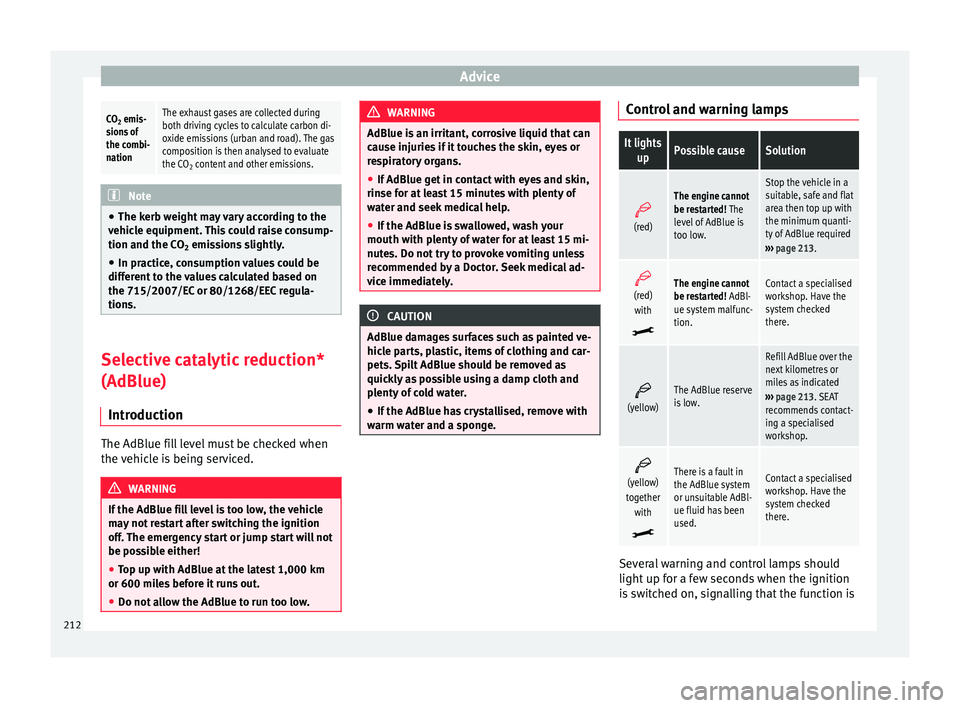
warm water and a sponge. Control and warning lamps
It lights
upPossible causeSolution
(red)
The engine cannot
be restarted! The
level of AdBlue is
too low.Stop the vehicle in a
suitable, safe and flat
area then top up with
the minimum quanti-
ty of AdBlue required
››› page 213.
(red)
with
The engine cannot
be restarted! AdBl-
ue system malfunc-
tion.Contact a specialised
workshop. Have the
system checked
there.
(yellow)The AdBlue reserve
is low.
Refill AdBlue over the
next kilometres or
miles as indicated
››› page 213. SEAT
recommends contact-
ing a specialised
workshop.
(yellow)
together with
There is a fault in
the AdBlue system
or unsuitable AdBl-
ue fluid has been
used.Contact a specialised
workshop. Have the
system checked
there. Several warning and control lamps should
light up for a few seconds when the ignition
is switched on, signalling that the function is
212
Page 215 of 305
Checking and refilling levels
being verified. They will switch off after a few
seconds. WARNING
Observe the safety warnings ››› in Control
and warning lamps on page 47. Information on AdBlue
In vehicles with "Selective Catalytic Reduc-
tion", a special urea solution (AdBlue) is in-
jected into the exhaust gas system in front of
the catalytic converter to reduce nitrogen ox-
ide emissions.
The consumption of AdBlue depends on indi-
vidual driving style, the temperature at which
the system operates and the outside temper-
ature where the vehicle is driven.
AdBlue is kept in an independent tank in the
vehicle and should be refilled at an official
supplier. The AdBlue tank holds about 17 li-
tres.
A message will be displayed on the dash
panel around 2,400 km before the next serv-
ice to indicate that AdBlue must be refilled
››› page 213 . If you ignore this message and
do not r
efill, you will be unable to start the
engine afterwards ›››
page 212.
SEAT recommends contacting a specialised
workshop. If not possible, it should be parti-
ally filled with a minimum 10 litres of AdBlue. Only refill using AdBlue expressly approved
by SEAT.
When the indicators
and
light simulta-
neously, there is a fault. SEAT recommends
visiting the closest specialised workshop.
AdBlue ®
is a registered trademark in the US,
Germany, the European Union and other
countries belonging to the German automo-
bile industry ("Verband der Automobilindus-
trie e. V.", VDA).
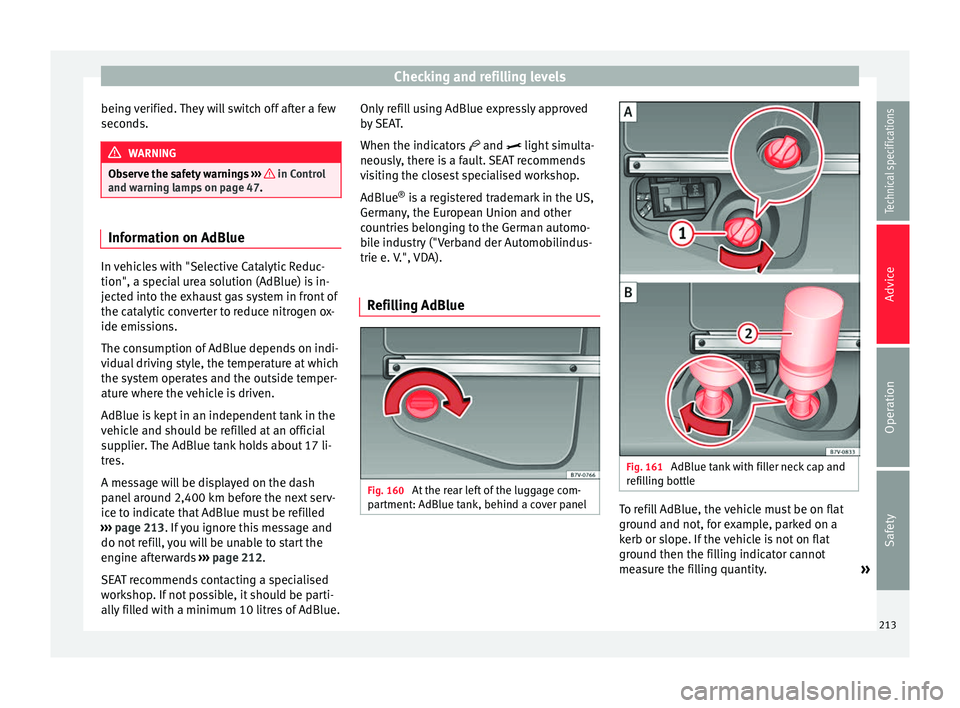
Refilling AdBlue Fig. 160
At the rear left of the luggage com-
partment: AdBlue tank, behind a cover panel Fig. 161
AdBlue tank with filler neck cap and
refilling bottle To refill AdBlue, the vehicle must be on flat
ground and not, for example, parked on a
kerb or slope. If the vehicle is not on flat
ground then the filling indicator cannot
measure the filling quantity.
»
213
Technical specifications
Advice
Operation
Safety
Page 220 of 305
Advice
The checking and refilling of service fluids
are carried out on the components men-
tioned above. These operations are descri-
bed in ››› page 214 .
Ov er
view
Further explanations, instructions and restric-
tions on the technical data are contained as
of ››› page 274
Engine oil Introduction WARNING
Incorrectly handling engine oil can cause in-
jury and serious burns.
● Always protect your eyes when handling
engine oil.
● Oil is toxic and must be kept out of the
reach of children.
● Engine oil should only be kept in its origi-
nal packaging; the same goes for used oil un-
til it is disposed of.
● Never store engine oil in empty food con-
tainers or bottles as other people may acci-
dentally drink it.
● Regular contact with engine oil can be bad
for the skin. If you come into contact with en-
gine oil, wash your skin with soap and water. ●
With the engine running, the engine oil
gets extremely hot and can cause severe skin
burns. Always wait until the engine has fully
cooled. For the sake of the environment
Similar to the other service liquids, spilled
engine oil can be bad for the environment.
Collect these liquids in suitable containers
and dispose of them while respecting the en-
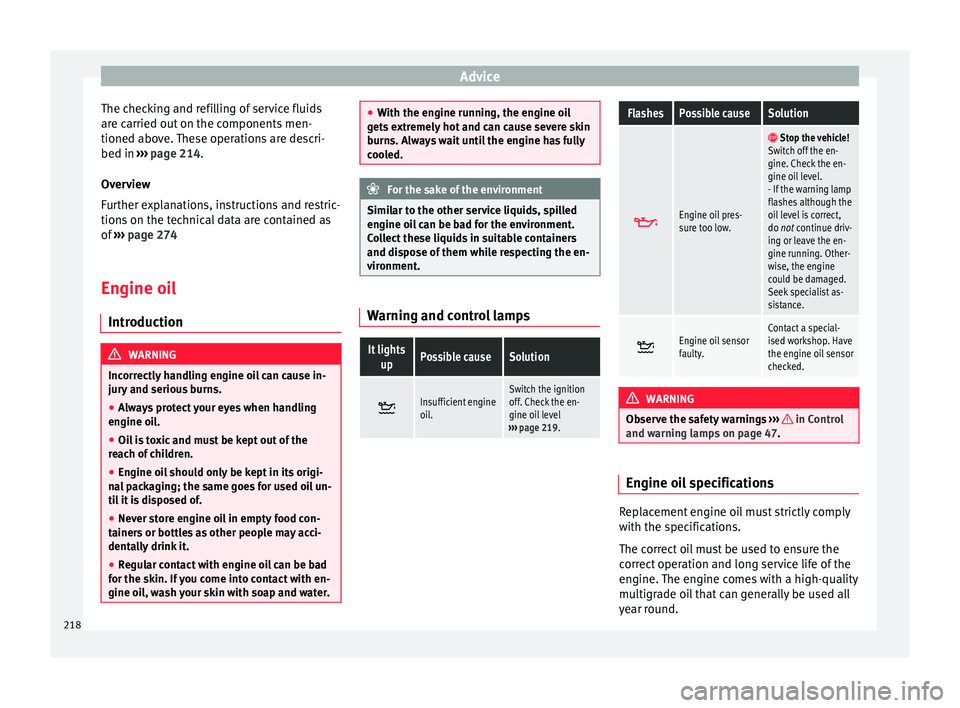
vironment. Warning and control lamps
It lights
upPossible causeSolution
Insufficient engine
oil.Switch the ignition
off. Check the en-
gine oil level
››› page 219.
FlashesPossible causeSolution
Engine oil pres-
sure too low.
Stop the vehicle!
Switch off the en-
gine. Check the en-
gine oil level.
- If the warning lamp
flashes although the
oil level is correct,
do not continue driv-
ing or leave the en-
gine running. Other-
wise, the engine
could be damaged.
Seek specialist as-
sistance.
Engine oil sensor
faulty.Contact a special-
ised workshop. Have
the engine oil sensor
checked.
WARNING
Observe the safety warnings ››› in Control
and warning lamps on page 47. Engine oil specifications
Replacement engine oil must strictly comply
with the specifications.
The correct oil must be used to ensure the
correct operation and long service life of the
engine. The engine comes with a high-quality
multigrade oil that can generally be used all
year round.
218
Page 224 of 305
Advice
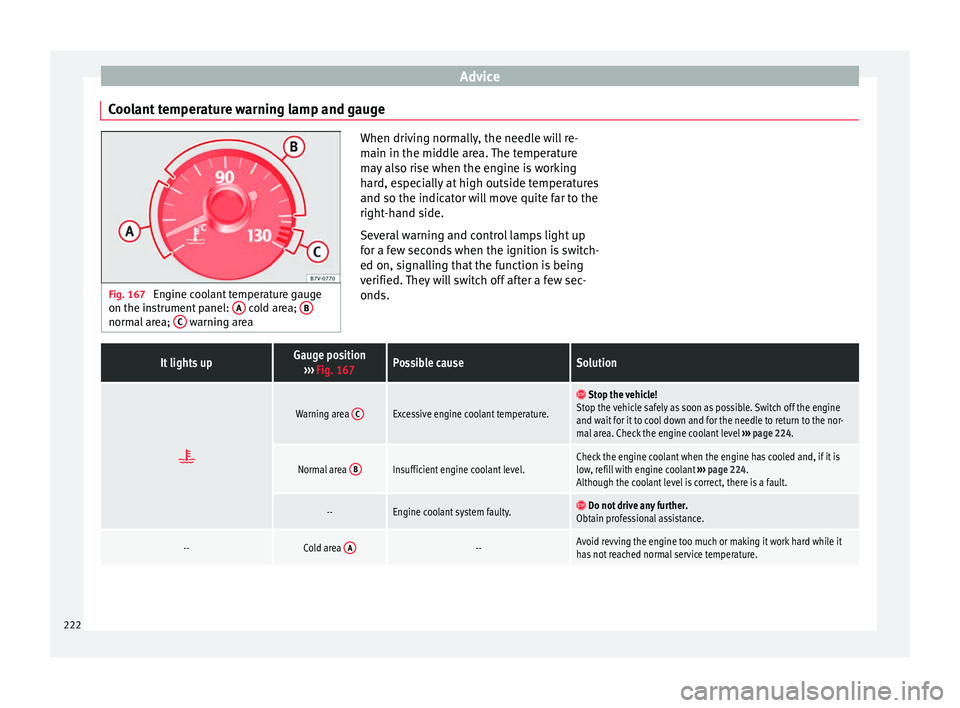
Coolant temperature warning lamp and gauge Fig. 167
Engine coolant temperature gauge
on the instrument panel: A cold area;
B normal area;
C warning area When driving normally, the needle will re-
main in the middle area. The temperature
may also rise when the engine is working
hard, especially at high outside temperatures
and so the indicator will move quite far to the
right-hand side.
Several warning and control lamps light up
for a few seconds when the ignition is switch-
ed on, signalling that the function is being
verified. They will switch off after a few sec-
onds.It lights upGauge position
››› Fig. 167Possible causeSolution
Warning area
CExcessive engine coolant temperature.
Stop the vehicle!
Stop the vehicle safely as soon as possible. Switch off the engine
and wait for it to cool down and for the needle to return to the nor-
mal area. Check the engine coolant level ››› page 224.
Normal area BInsufficient engine coolant level.Check the engine coolant when the engine has cooled and, if it is
low, refill with engine coolant
››› page 224.
Although the coolant level is correct, there is a fault.
--Engine coolant system faulty. Do not drive any further.
Obtain professional assistance.
--Cold area A--Avoid revving the engine too much or making it work hard while it
has not reached normal service temperature.222
Page 225 of 305
Checking and refilling levelsFlashesPossible causeSolution
Engine coolant sys-
tem faulty.Seek specialist as-
sistance.
WARNING
Observe the safety warnings ››› in Control
and warning lamps on page 47. Engine coolant specifications
The engine cooling system is supplied from
the factory with a specially treated mixture of
water and, at least, 40 % of the additive
G 13
(TLVW 774 J). The engine coolant additive is
recognisable by its purple colour. This mix-
ture of water and additive gives the necessa-
ry frost protection down to -25°C (-13 F) and
protects the light alloy parts of the cooling
system against corrosion. It also prevents
scaling and considerably raises the boiling
point of the coolant.
To protect the engine cooling system, the
percentage of additive must always be at
l e
ast 40 %, even in warm climates where an-
ti-freeze protection is not required.
If greater frost protection is required in very
cold climates, the proportion of additive can
be increased. However, the percentage of ad-
ditive should not exceed 60%, as this would
reduce the frost protection and, in turn, de-
crease the cooling capacity. When the coolant is topped up, use a mixture
of
distilled water and, at least, 40 % of the G
13 or G 12 plu
s-plus (TL-VW 774 G) additive
(both are purple) to obtain an optimum anti-
corrosion protection ››› . The mixture of G
13 with G 12 plus (TL-VW 774 F), G 12 (red) or
G 11 (green-blue) engine coolants will signifi-
cantly reduce the anticorrosion protection
and should, therefore be avoided ››› .
WARNING
If there is not enough anti-freeze in the cool-
ant system, the engine may fail leading to se-
rious damage.
● Please make sure that the percentage of
additive is correct with respect to the lowest
expected ambient temperature in the zone in
which the vehicle is to be used.
● When the outside temperature is very low,
the coolant could freeze and the vehicle
would be immobilised. In this case, the heat-
ing would not work either and inadequately
dressed passengers could die of cold. CAUTION
The original additives should never be mixed
with coolants which are not approved by
SEAT. Otherwise, you run the risk of causing
severe damage to the engine and the engine
cooling system. ● If the fluid in the expansion tank is not pur-
ple but is, for example, brown, this indicates
that the G 13 additive has been mixed with an inadequate coolant. The coolant must be
changed as soon as possible if this is the
case! This could result in serious faults and
engine damage.
For the sake of the environment
Coolants and additives can contaminate the
environment. If any fluids are spilled, they
should be collected and correctly disposed
of, with respect to the environment. 223
Technical specifications
Advice
Operation
Safety