warning Seat Alhambra 2015 Owner's Guide
[x] Cancel search | Manufacturer: SEAT, Model Year: 2015, Model line: Alhambra, Model: Seat Alhambra 2015Pages: 305, PDF Size: 5.46 MB
Page 26 of 305
Safety
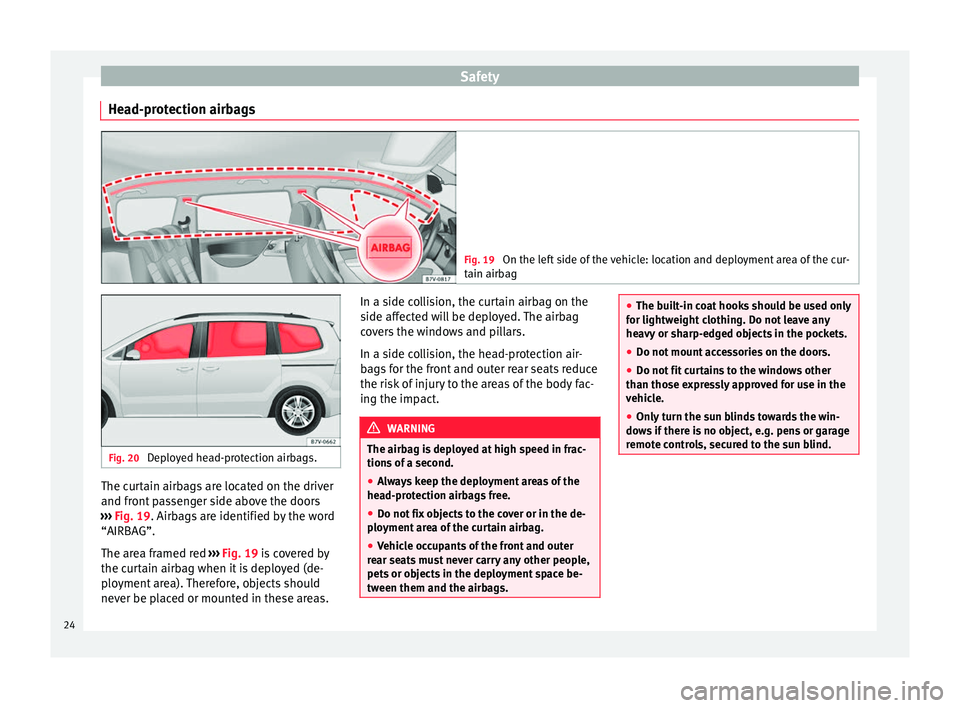
Head-protection airbags Fig. 19
On the left side of the vehicle: location and deployment area of the cur-
tain airbag Fig. 20
Deployed head-protection airbags. The curtain airbags are located on the driver
and front passenger side above the doors
››› Fig. 19 . Airbags are identified by the word
“AIRB AG”.
The ar
ea framed red ››› Fig. 19
is covered by
the curtain airbag when it is deployed (de-
ployment area). Therefore, objects should
never be placed or mounted in these areas. In a side collision, the curtain airbag on the
side affected will be deployed. The airbag
covers the windows and pillars.
In a side collision, the head-protection air-
bags for the front and outer rear seats reduce
the risk of injury to the areas of the body fac-
ing the impact.
WARNING
The airbag is deployed at high speed in frac-
tions of a second.
● Always keep the deployment areas of the
head-protection airbags free.
● Do not fix objects to the cover or in the de-
ployment area of the curtain airbag.
● Vehicle occupants of the front and outer
rear seats must never carry any other people,
pets or objects in the deployment space be-
tween them and the airbags. ●
The built-in coat hooks should be used only
for lightweight clothing. Do not leave any
heavy or sharp-edged objects in the pockets.
● Do not mount accessories on the doors.
● Do not fit curtains to the windows other
than those expressly approved for use in the
vehicle.
● Only turn the sun blinds towards the win-
dows if there is no object, e.g. pens or garage
remote controls, secured to the sun blind. 24
Page 27 of 305
Airbag system
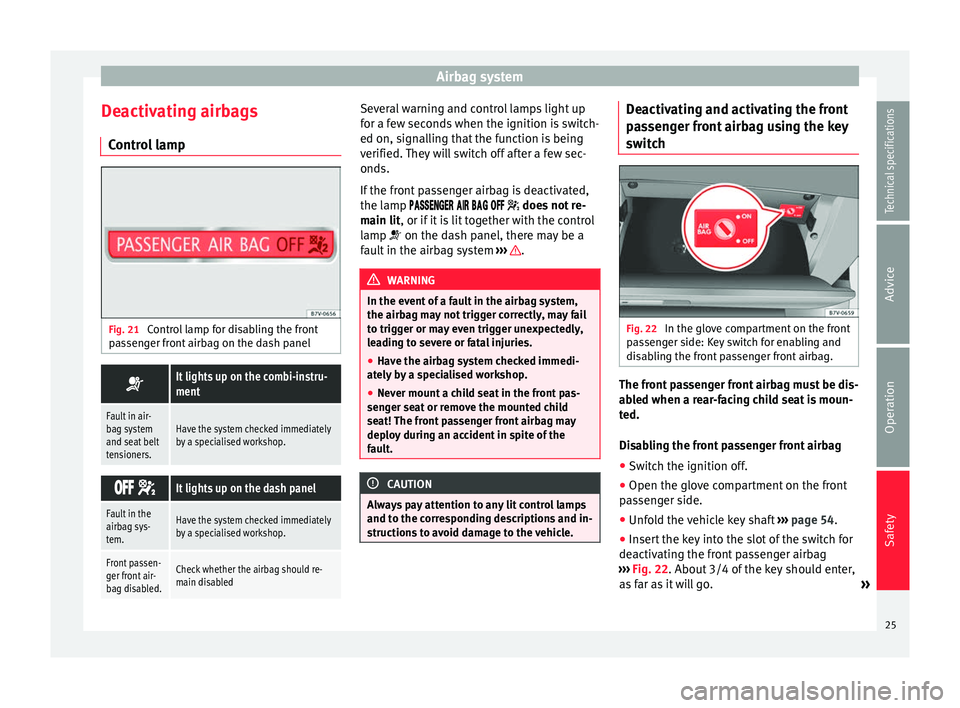
Deactivating airbags Control lamp Fig. 21
Control lamp for disabling the front
passenger front airbag on the dash panel It lights up on the combi-instru-
ment
Fault in air-
bag system
and seat belt
tensioners.Have the system checked immediately
by a specialised workshop.
It lights up on the dash panel
Fault in the
airbag sys-
tem.Have the system checked immediately
by a specialised workshop.
Front passen-
ger front air-
bag disabled.Check whether the airbag should re-
main disabled Several warning and control lamps light up
for a few seconds when the ignition is switch-
ed on, signalling that the function is being
verified. They will switch off after a few sec-
onds.
If the front passenger airbag is deactivated,
the lamp
does not re-
main lit, or if it is lit together with the control
lamp on the dash panel, there may be a
f
ault in the airbag system ››› .
WARNING
In the event of a fault in the airbag system,
the airbag may not trigger correctly, may fail
to trigger or may even trigger unexpectedly,
leading to severe or fatal injuries.
● Have the airbag system checked immedi-
ately by a specialised workshop.
● Never mount a child seat in the front pas-
senger seat or remove the mounted child
seat! The front passenger front airbag may
deploy during an accident in spite of the
fault. CAUTION
Always pay attention to any lit control lamps
and to the corresponding descriptions and in-
structions to avoid damage to the vehicle. Deactivating and activating the front
passenger front airbag using the key
switch
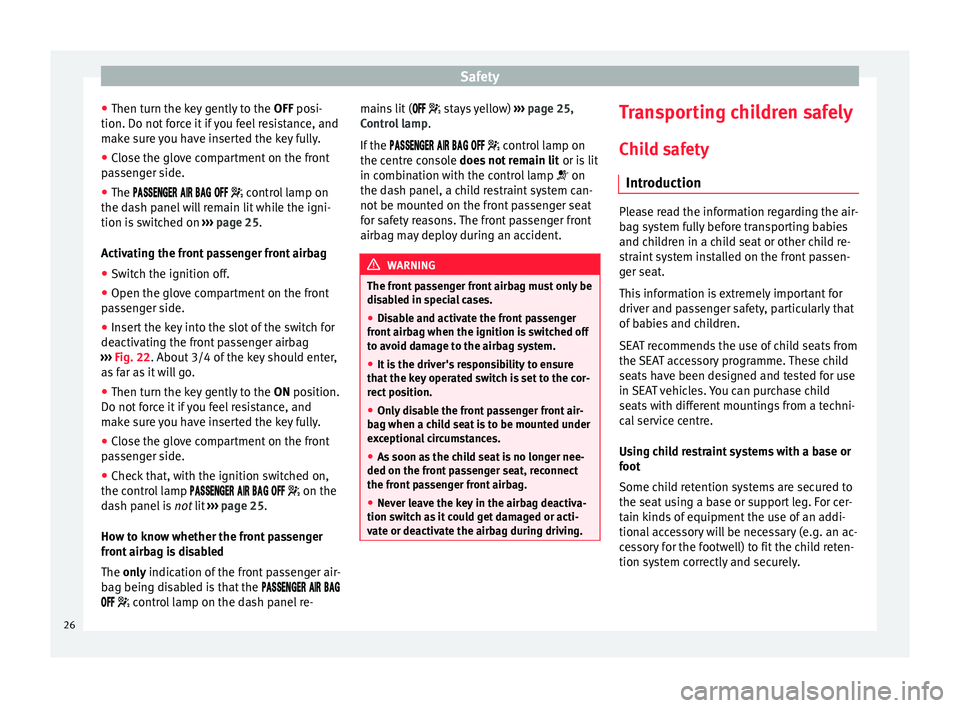
Fig. 22
In the glove compartment on the front
passenger side: Key switch for enabling and
disabling the front passenger front airbag. The front passenger front airbag must be dis-
abled when a rear-facing child seat is moun-
ted.
Disabling the front passenger front airbag
● Switch the ignition off.
● Open the glove compartment on the front
passenger side.
● Unfold the vehicle key shaft ››› page 54.
● Insert the key into the slot of the switch for
deactivating the front passenger airbag
››› Fig. 22 . About 3/4 of the key should enter,
a s
far as it will go. »
25
Technical specifications
Advice
Operation
Safety
Page 28 of 305
Safety
● Then turn the key gently to the OFF posi-
tion. Do not f
orce it if you feel resistance, and
make sure you have inserted the key fully.
● Close the glove compartment on the front
passenger side.
● The
control lamp on
the dash panel will remain lit while the igni-
tion is switched on ››› page 25.
Activating the front passenger front airbag ● Switch the ignition off.
● Open the glove compartment on the front
passenger side.
● Insert the key into the slot of the switch for
deactivating the front passenger airbag
››› Fig. 22
. About 3/4 of the key should enter,
as far as it will go.
● Then turn the key gently to the ON
position.
Do not force it if you feel resistance, and
make sure you have inserted the key fully.
● Close the glove compartment on the front
passenger side.
● Check that, with the ignition switched on,
the control lamp on the
dash panel is not
lit ››› page 25.
How to know whether the front passenger
front airbag is disabled
The only indication of the front passenger air-
b
ag being disabled is that the
control lamp on the dash panel re- mains lit (
stays yellow) ››› page 25,
Control lamp .
If the
control lamp on
the centre console does not remain lit or is lit
in combination with the control lamp on
the da
sh panel, a child restraint system can-
not be mounted on the front passenger seat
for safety reasons. The front passenger front
airbag may deploy during an accident. WARNING
The front passenger front airbag must only be
disabled in special cases.
● Disable and activate the front passenger
front airbag when the ignition is switched off
to avoid damage to the airbag system.
● It is the driver's responsibility to ensure
that the key operated switch is set to the cor-
rect position.
● Only disable the front passenger front air-
bag when a child seat is to be mounted under
exceptional circumstances.
● As soon as the child seat is no longer nee-
ded on the front passenger seat, reconnect
the front passenger front airbag.
● Never leave the key in the airbag deactiva-
tion switch as it could get damaged or acti-
vate or deactivate the airbag during driving. Transporting children safely
Child safety Introduction Please read the information regarding the air-
bag system fully before transporting babies
and children in a child seat or other child re-
straint system installed on the front passen-
ger seat.
This information is extremely important for
driver and passenger safety, particularly that
of babies and children.
SEAT recommends the use of child seats from
the SEAT accessory programme. These child
seats have been designed and tested for use
in SEAT vehicles. You can purchase child
seats with different mountings from a techni-
cal service centre.
Using child restraint systems with a base or
foot
Some child retention systems are secured to
the seat using a base or support leg. For cer-
tain kinds of equipment the use of an addi-
tional accessory will be necessary (e.g. an ac-
cessory for the footwell) to fit the child reten-
tion system correctly and securely.
26
Page 29 of 305
Transporting children safely
WARNING
Make sure children are properly belted in and
correctly secured to avoid severe or fatal inju-
ries while the vehicle is in motion.
● Never use a rear-facing child seat in the
front passenger seat if the front passenger
front airbag is enabled.
● Children up to 12 years old should always
travel on the rear seat.
● Children must always be protected with an
approved child restraint system suited to
their height and weight.
● Children must assume the proper sitting
position and be properly belted in while trav-
elling.
● Ensure the seat backrest is upright when a
child seat is being used on it.
● Do not allow the child's head or other part
of his or her body to fall into the deployment
area of the side airbags.
● Make sure the belt webbing is correctly
positioned.
● Never hold children or babies on your lap or
in your arms.
● Only one child may occupy a child seat.
● If you are using a child seat with a base or
foot, always install this base or foot correctly
and safely.
● If the vehicle has a storage compartment in
the footwell in front of the last row of seats,
this compartment cannot be used as de-
signed; on the contrary: It must be filled us- ing the specially designed accessory so that
the base or foot is correctly supported by the
closed compartment and the child seat is se-
cured properly. If this compartment is not
suitably secured when using a child seat with
a base or foot then the compartment cover
could rupture in an accident and the child will
be ejected and suffer serious injury.
●
Please read and observe the child seat
manufacturer's handling instructions. WARNING
An empty or loose child seat could fly uncon-
trollably around the vehicle interior and
cause injuries in the event of an accident or
sudden braking.
● When not in use while the vehicle is in mo-
tion, always safely secure the child seat or
store it in the luggage compartment. Note
Replace the child seat after an accident, as it
may have invisible damage. Important information regarding the
front passenger's airbag
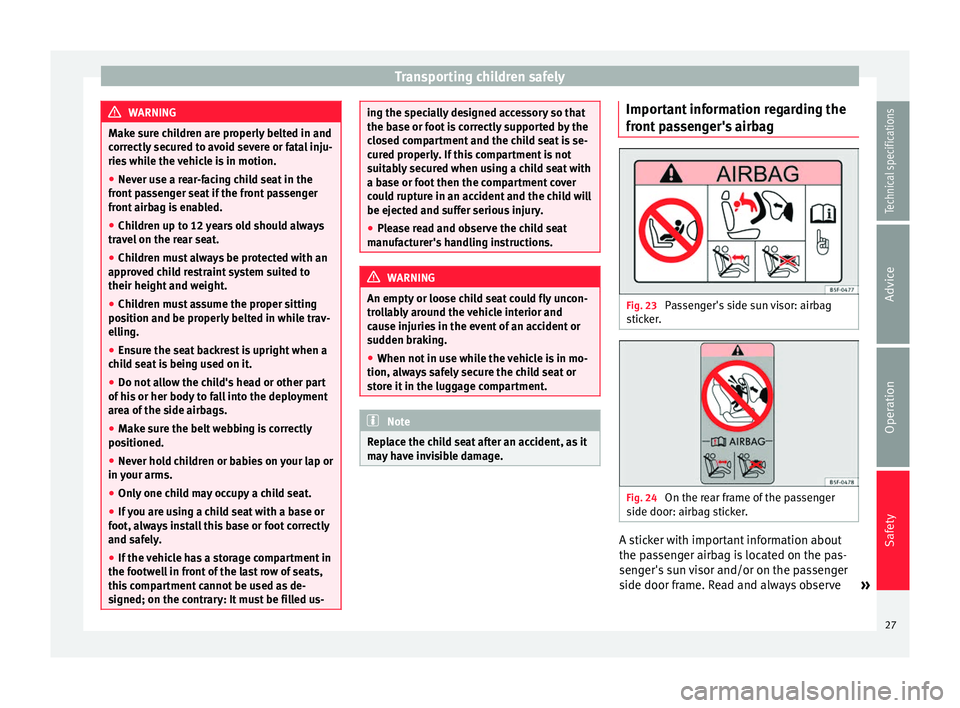
Fig. 23
Passenger's side sun visor: airbag
sticker. Fig. 24
On the rear frame of the passenger
side door: airbag sticker. A sticker with important information about
the passenger airbag is located on the pas-
senger's sun visor and/or on the passenger
side door frame. Read and always observe
»
27Technical specifications
Advice
Operation
Safety
Page 30 of 305
Safety
the safety information included in the follow-
ing chapters:
● Child seats and passenger side airbag
››› page 29, Use of the child seat on the
front passenger seat .
● Safety distance with respect to the passen-
ger airbag ››› in Introduction on page 18.
● Objects between the passenger and the
passenger side airbag ››› in Front airbags
on page 21 .
Gener a
l information on transporting
children in the vehicle Legal regulations and provisions will always
take priority over the descriptions of this in-
struction manual. There are different regula-
tions and provisions for the use of child seats
and their mountings (
›››
table on page 28).
In some countries, for example, the use of
child seats on certain seats in the vehicle
may be forbidden.
The physical principles and the forces acting
on the vehicle in the event of a collision or
other type of accidents also apply to children
››› page 14 . However, unlike adults and
y ou
ngsters, children do not have fully devel-
oped muscle and bone structures. In the
event of an accident, children are subject to a
greater risk than adults of sustaining severe
injuries. Given that children's bodies are not yet fully
developed, child restraint systems must be
used that are especially adapted to their
height, weight and constitution. There are
laws in force in many countries that indicate
the use of approved seat systems for trans-
porting babies and children.
Only used authorised, approved child seats
that are suitable for the vehicle. Always con-
sult with a technical service centre or a speci-
alised workshop should you have any
doubts.
Specific child seat regulations for each
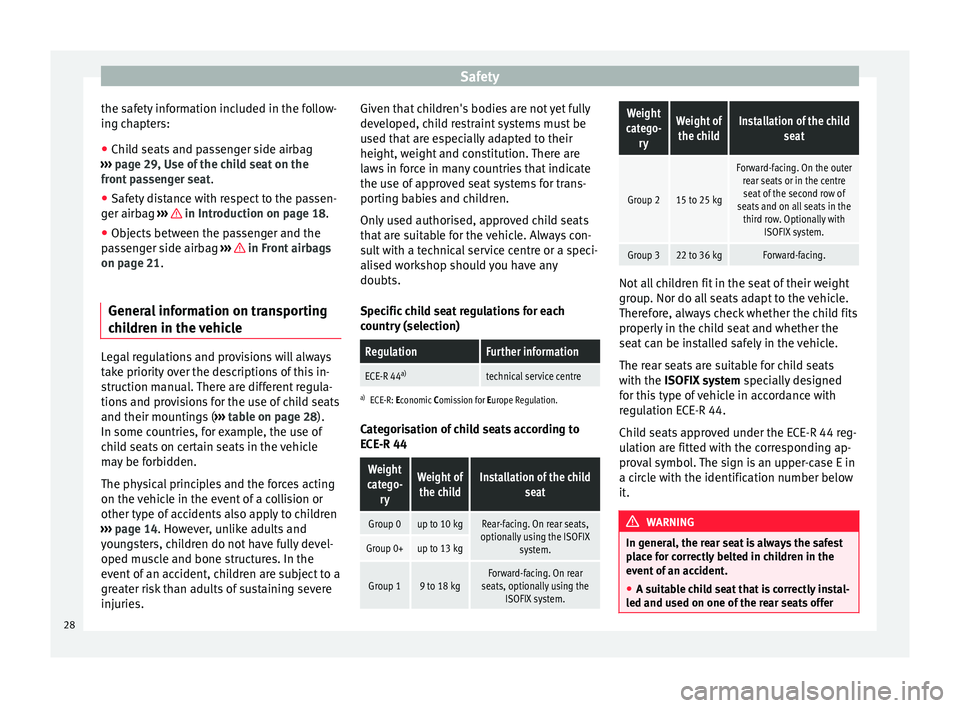
country (selection)
RegulationFurther information
ECE-R 44
a)technical service centre
a)
ECE-R: Economic Comission for Europe Regulation.
Categorisation of child seats according to
ECE-R 44
Weight
catego- ryWeight ofthe childInstallation of the child seat
Group 0up to 10 kgRear-facing. On rear seats,
optionally using the ISOFIX system.
Group 0+up to 13 kg
Group 19 to 18 kgForward-facing. On rear
seats, optionally using the ISOFIX system.
Weight
catego- ryWeight ofthe childInstallation of the child seat
Group 215 to 25 kg
Forward-facing. On the outerrear seats or in the centreseat of the second row of
seats and on all seats in the third row. Optionally with ISOFIX system.
Group 322 to 36 kgForward-facing. Not all children fit in the seat of their weight
group. Nor do all seats adapt to the vehicle.
Therefore, always check whether the child fits
properly in the child seat and whether the
seat can be installed safely in the vehicle.
The rear seats are suitable for child seats
with the
ISOFIX system spec
ially designed
for this type of vehicle in accordance with
regulation ECE-R 44.
Child seats approved under the ECE-R 44 reg-
ulation are fitted with the corresponding ap-
proval symbol. The sign is an upper-case E in
a circle with the identification number below
it. WARNING
In general, the rear seat is always the safest
place for correctly belted in children in the
event of an accident.
● A suitable child seat that is correctly instal-
led and used on one of the rear seats offer 28
Page 32 of 305
Safety
service centre has an updated list of all ap-
proved child seats. Only used child seats that
are approved for each vehicle.
The front airbag on the front passenger side
is highly dangerous for a child. The front pas-
senger seat is life-threatening to a child if he
or she is transported in a rear-facing child
seat.
If a rear-facing child seat is secured to the
front passenger seat, an inflating front airbag
can strike it with such great force that severe
or fatal injuries may result ››› . Therefore,
rear-facing child seats must never be placed
on the fr ont
passenger seat when the front
passenger front airbag is enabled.
Only use a rear-facing child seat on the front
passenger seat if the front passenger front
airbag is disabled. When it is disabled, the
yellow PASSENGER AIR BAG control lamp
on the dash panel will be lit ››› page 20. If
you cannot disable the front passenger front
airbag and it remains activated, it is forbid-
den to transport children on the front pas-
senger seat ››› .
Things to note if using a child seat on the
front passenger seat:
● The front passenger front airbag must be
disabled when using a rear-facing child
seat ››› page 25 .
● The se at
backrest of the front passenger
seat must be upright. ●
The front passenger seat must be moved as
far back as possible.
● The seat backrest of the front passenger
seat must be upright.
● The seat belt height adjustment must be as
high as possible.
Suitable child seats
The child seat must be authorised by the
manufacturer especially for use on a front
passenger seat with a front or side airbag.
If the front passenger seat is equipped with
retaining rings, the child seat can be secured
us
ing an approved retaining system provided
it is approved for this type of vehicle in ac-
cordance with current regulations of the
country in question.
Universal seats for children of groups 0, 0+,
1, 2 or 3 according to the standard ECE-R 44
can be mounted on the front passenger seat
and the rear seats. WARNING
If a child seat is mounted on the front passen-
ger seat, the risk of the child sustaining se-
vere or fatal injuries in the event of an acci-
dent increases. Rear-facing child seats must
never be mounted on the front passenger
seat when the front passenger front airbag is
enabled. This is life-threatening to the child
should the front airbag deploy, as the child seat would be struck by the inflated airbag
and thrown against the seat backrest.
WARNING
If, in exceptional circumstances, a child must
be transported in a rear-facing child seat on
the front passenger seat, strictly observe the
following:
● Always disable the front passenger front
airbag and leave it disabled.
● The child seat must be approved by the
manufacturer for use on a front passenger
seat with front and side airbag.
● Follow the installation instructions of the
child seat manufacturer and observe the
warnings.
● Move the front passenger seat as far back
as possible and adjust it to its highest posi-
tion to keep as far away as possible from the
front airbag.
● Move the seat backrest to the upright posi-
tion.
● The seat belt height adjustment must be as
high as possible.
● Children must always be protected with an
approved child restraint system suited to
their height and weight. Use of the child seat on the rear seat
If a child seat is mounted on the rear seat,
adapt the position of the front passenger
30
Page 33 of 305
Transporting children safely
seat so that the child has enough space.
Therefore, adapt the front passenger seat to
the size of the child seat and the height of
the child. Ensure the passenger is in the cor-
rect position
›
›› page 6.
Move the second and third rows of seats fully
back and lock them. Place the seat backs in a
vertical position and fold the head restraints
down.
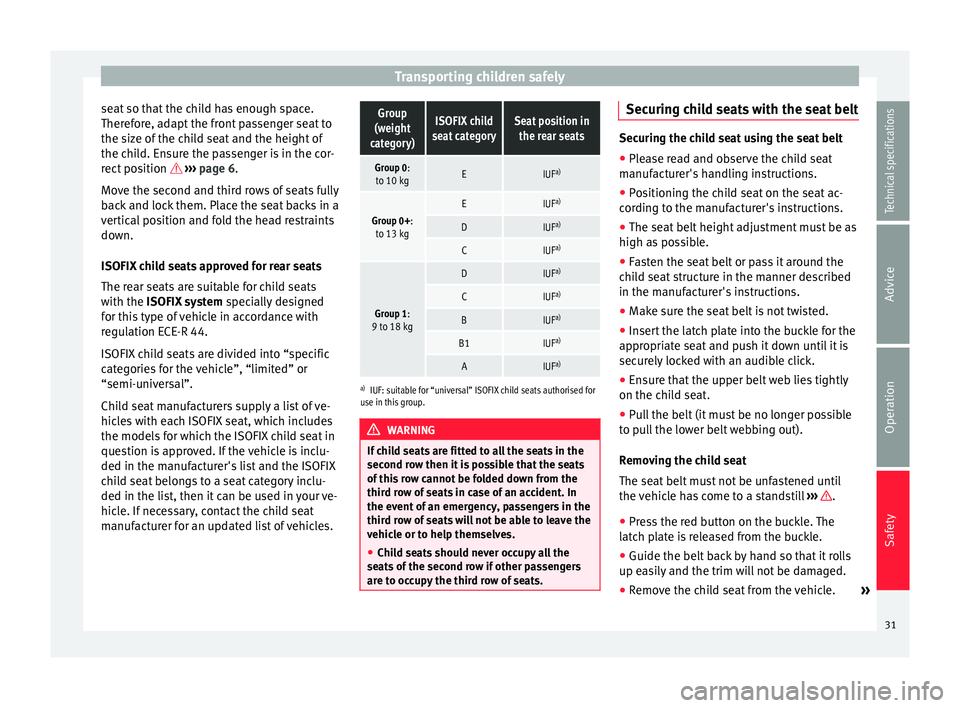
ISOFIX child seats approved for rear seats
The rear seats are suitable for child seats
with the ISOFIX system spec
ially designed
for this type of vehicle in accordance with
regulation ECE-R 44.
ISOFIX child seats are divided into “specific
categories for the vehicle”, “limited” or
“semi-universal”.
Child seat manufacturers supply a list of ve-
hicles with each ISOFIX seat, which includes
the models for which the ISOFIX child seat in
question is approved. If the vehicle is inclu-
ded in the manufacturer's list and the ISOFIX
child seat belongs to a seat category inclu-
ded in the list, then it can be used in your ve-
hicle. If necessary, contact the child seat
manufacturer for an updated list of vehicles.
Group
(weight
category)ISOFIX child
seat categorySeat position in the rear seats
Group 0:to 10 kgEIUF a)
Group 0+:
to 13 kgEIUF a)
DIUFa)
CIUFa)
Group 1:
9 to 18 kg
DIUF a)
CIUFa)
BIUFa)
B1IUFa)
AIUFa)
a)
IUF: suitable for “universal” ISOFIX child seats authorised for
use in this group. WARNING
If child seats are fitted to all the seats in the
second row then it is possible that the seats
of this row cannot be folded down from the
third row of seats in case of an accident. In
the event of an emergency, passengers in the
third row of seats will not be able to leave the
vehicle or to help themselves.
● Child seats should never occupy all the
seats of the second row if other passengers
are to occupy the third row of seats. Securing child seats with the seat belt
Securing the child seat using the seat belt
● Please read and observe the child seat
manufacturer's handling instructions.
● Positioning the child seat on the seat ac-
cording to the manufacturer's instructions.
● The seat belt height adjustment must be as
high as possible.
● Fasten the seat belt or pass it around the
child seat structure in the manner described
in the manufacturer's instructions.
● Make sure the seat belt is not twisted.
● Insert the latch plate into the buckle for the
appropriate seat and push it down until it is
securely locked with an audible click.
● Ensure that the upper belt web lies tightly
on the child seat.
● Pull the belt (it must be no longer possible
to pull the lower belt webbing out).
Removing the child seat
The seat belt must not be unfastened until
the vehicle has come to a standstill ››› .
● Press the red button on the buckle. The
latch plate is released from the buckle.
● Guide the belt back by hand so that it rolls
up easily and the trim will not be damaged.
● Remove the child seat from the vehicle. »
31
Technical specifications
Advice
Operation
Safety
Page 34 of 305
Safety
WARNING
Unbuckling the seat belt while the vehicle is
in motion can cause severe or fatal injuries in
the event of an accident or sudden braking.
● The seat belt must not be unfastened until
the vehicle has come to a standstill. Fix the child seat with the lower
anchor points (ISOFIX)
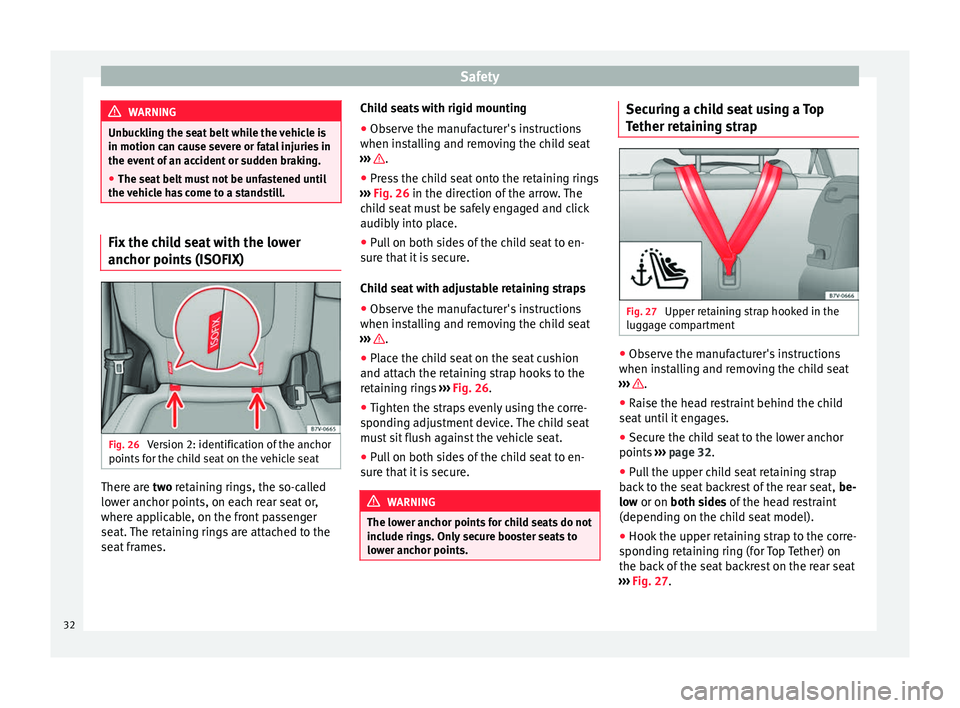
Fig. 26
Version 2: identification of the anchor
points for the child seat on the vehicle seat There are
two
retaining rings, the so-called
lo
wer anchor points, on each rear seat or,
where applicable, on the front passenger
seat. The retaining rings are attached to the
seat frames. Child seats with rigid mounting
● Observe the manufacturer's instructions
when installing and removing the child seat
››› .
● Press the child seat onto the retaining rings
››› Fig. 26 in the direction of the arrow. The
c hi
ld seat must be safely engaged and click
audibly into place.
● Pull on both sides of the child seat to en-
sure that it is secure.
Child seat with adjustable retaining straps
● Observe the manufacturer's instructions
when installing and removing the child seat
››› .
● Place the child seat on the seat cushion
and attach the retaining strap hooks to the
retaining rings ››› Fig. 26 .
● Tight en the s
traps evenly using the corre-
sponding adjustment device. The child seat
must sit flush against the vehicle seat.
● Pull on both sides of the child seat to en-
sure that it is secure. WARNING
The lower anchor points for child seats do not
include rings. Only secure booster seats to
lower anchor points. Securing a child seat using a Top
Tether retaining strap
Fig. 27
Upper retaining strap hooked in the
luggage compartment ●
Observe the manufacturer's instructions
when installing and removing the child seat
››› .
● Raise the head restraint behind the child
seat until it engages.
● Secure the child seat to the lower anchor
points ››› page 32 .
● Pu
ll the upper child seat retaining strap
back to the seat backrest of the rear seat, be-
low or on both sides
of the head restraint
(depending on the child seat model).
● Hook the upper retaining strap to the corre-
sponding retaining ring (for Top Tether) on
the back of the seat backrest on the rear seat
››› Fig. 27.
32
Page 35 of 305
Transporting children safely
● Push the head restraint down as far as it
will go. Ensure that it does not interfere with
the seatbelt from the upper attachment.
● Tighten the strap so that the top of the
child seat rests on the seat backrest. WARNING
Child seats with lower anchor points and with
an upper retaining strap must be installed in
line with the manufacturer's instructions.
Failure to comply could result in severe inju-
ries.
● Always secure just one retaining strap from
a c hi
ld seat to a retaining ring (for Top Tether)
on the seat backrest on the rear seat in the
boot.
● Never secure a child seat to the retaining
rings.
● Never secure a child seat to the movable at-
tachment elements for vehicles with an at-
tachment element and rail system .Integrated child seat
Introduction The integrated child seat is only suitable for
children in Group 2 (15-25 kg) and Group 3
(22-36 kg), according to the ECE-R 44 regula-
tion. WARNING
Child travelling without their seat belt fas-
tened or not secured using a suitable re-
straint system may sustain fatal injuries if
the airbag is deployed.
● Children up to 12 years old should always
travel on the rear seat.
● Always disable the front passenger front
airbag if, in exceptional cases, you have no
alternative but to transport a child in a rear-
facing child safety seat on the front passen-
ger seat.
● Children must always be protected with a
child restraint system suited to their height
and weight.
● Always fasten children's seat belts correct-
ly. WARNING
Children must travel in a child seat appropri-
ate to their weight and height while the vehi-
cle is in motion.
● Children must always be protected with a
child restraint system suited to their height
and weight.
● Children must assume the proper sitting
position and be properly belted in while trav-
elling.
● The shoulder part of the seat belt must lie
approximately on the centre of the shoulder,
never across the neck or the arm. ●
The seat belt must lie close to the upper
part of the body.
● The lap belt part must lie across the pelvis,
not across the stomach, and always fit close-
ly.
● Allow the belt to retract until it fits tightly
over the child's seat.
● Never hold children or babies on your lap.
● Always use a child seat and the seat belt
for children who are under 1.5 m tall. The nor-
mal seat belt could cause injuries to the ab-
domin a
l and neck areas.
● Only one child may occupy a child seat.
● Read and follow the information and warn-
ings provided by the child seat manufacturer.
● Never leave an unsupervised child alone on
a child seat or in the vehicle.
● All modifications to the integrated child
seat must be carried out by a specialised
workshop.
● Replace the child seat or any seat compo-
nents damaged or involved in an accident. WARNING
Loose objects could fly uncontrollably around
the vehicle interior and cause injuries in the
event of an accident or sudden braking.
● Do not leave toys or other hard, loose ob-
jects on the child seat or on the seat while
the vehicle is in motion. 33
Technical specifications
Advice
Operation
Safety
Page 37 of 305
Transporting children safely
Seat belt routing on the integrated
child seat Fig. 30
Integrated child seats. adjusting the
seat belt. Fig. 31
Integrated child seats. seat belt rout-
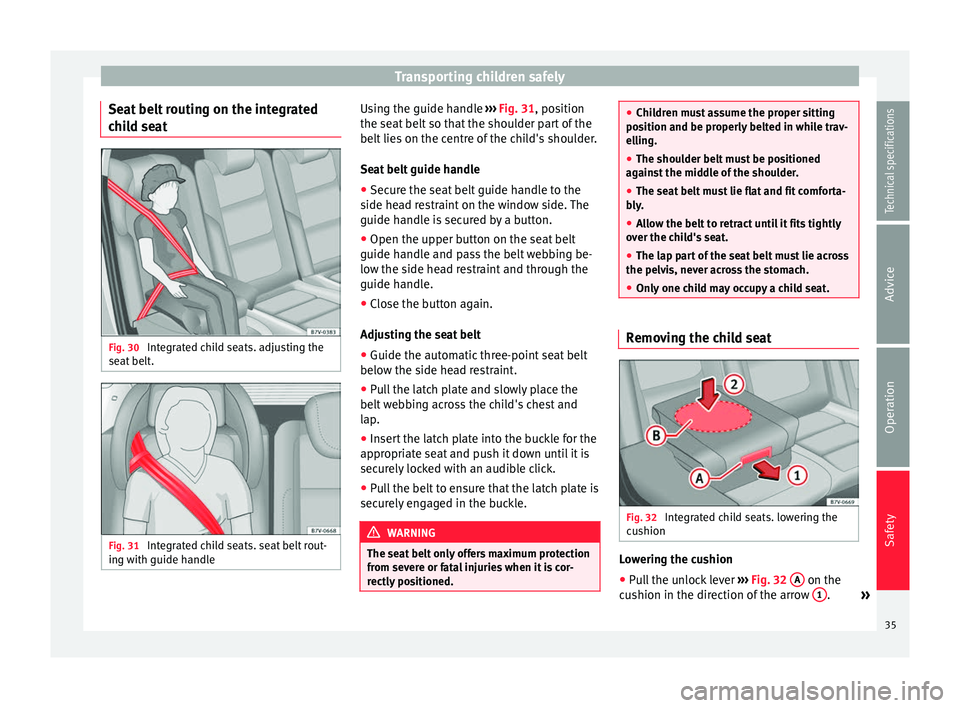
ing with guide handle Using the guide handle
››› Fig. 31 , position
the se at
belt so that the shoulder part of the
belt lies on the centre of the child's shoulder.
Seat belt guide handle
● Secure the seat belt guide handle to the
side head restraint on the window side. The
guide handle is secured by a button.
● Open the upper button on the seat belt
guide handle and pass the belt webbing be-
low the side head restraint and through the
guide handle.
● Close the button again.
Adjusting the seat belt
● Guide the automatic three-point seat belt
below the side head restraint.
● Pull the latch plate and slowly place the
belt webbing across the child's chest and
lap.
● Insert the latch plate into the buckle for the
appropriate seat and push it down until it is
securely locked with an audible click.
● Pull the belt to ensure that the latch plate is
securely engaged in the buckle. WARNING
The seat belt only offers maximum protection
from severe or fatal injuries when it is cor-
rectly positioned. ●
Children must assume the proper sitting
position and be properly belted in while trav-
elling.
● The shoulder belt must be positioned
against the middle of the shoulder.
● The seat belt must lie flat and fit comforta-
bly.
● Allow the belt to retract until it fits tightly
over the child's seat.
● The lap part of the seat belt must lie across
the pelvis, never across the stomach.
● Only one child may occupy a child seat. Removing the child seat
Fig. 32
Integrated child seats. lowering the
cushion Lowering the cushion
● Pull the unlock lever ››› Fig. 32 A on the
cushion in the direction of the arrow 1 .
»
35
Technical specifications
Advice
Operation
Safety