wheel Seat Alhambra 2015 Repair Manual
[x] Cancel search | Manufacturer: SEAT, Model Year: 2015, Model line: Alhambra, Model: Seat Alhambra 2015Pages: 305, PDF Size: 5.46 MB
Page 209 of 305
Checking and refilling levels
●
Never enter the vehicle while refuelling. If it
is absolutely necessary to enter, close the
door and touch a metal surface before touch-
ing the filler nozzle again. This will prevent
the generation of static electricity. Sparks
could cause a fire when refuelling.
● Never handle fuel close to flames, sparks or
objects with slow combustion (e.g. ciga-
rettes).
● Avoid static electricity and electro-magnet-
ic radiation when refuelling.
● Observe the safety regulations of the serv-
ice station.
● Never spill fuel on the vehicle or in the lug-
gage compartment. WARNING
For safety reasons, SEAT does not recommend
carrying a spare fuel canister in the vehicle.
Fuel could be spilled and catch fire, above all
in case of an accident and this applies to a
full container as well as empty containers.
This could lead to explosions, fires and inju-
ries.
● Observe the following if you exceptionally
have to carry fuel in a canister:
–Never place a fuel container to fill it in-
side the vehicle or on the vehicle, for ex-
ample, in the boot or on the hatch. Filling
in these circumstances could create an
electrostatic charge and spark that could
ignite fuel fumes. –
Always place the canister on the ground
to fill it.
– Insert the fuel nozzle into the neck of the
canister as far as possible.
– If you are using a metal fuel canister, the
nozzle must always touch the canister
while it is being filled to avoid static elec-
tricity.
– Follow the legal requirements for the use,
storage and transport of spare fuel canis-
ters.
– Insure that the fuel container complies
with manufacturing standards, for exam-
ple, ANSI or ASTM F852-86. CAUTION
● Always remove any fuel spilled on the vehi-
cle paintwork immediately to avoid damage
to the wheel housing, the tyre and vehicle
paintwork.
● Refuelling a petrol engine with diesel or a
diesel engine with petrol can cause serious
engine and fuel system damage; the resulting
malfunctions are not covered by the SEAT
warranty. If you refuel with the wrong type of
fuel, never start the engine. This applies to
even the smallest amount of the wrong fuel.
Seek specialist assistance. With the engine
running, the composition of the wrong fuel
could significantly damage the fuel system
and the engine itself.
● In vehicles with a diesel engine, under no
circumstances should you refuel or drive with petrol, kerosene, heating oil or any other
type of different fuel. Other types of fuels
could cause serious damage to the engine
and to the fuel supply system and the result-
ing problems are not covered by the SEAT
warranty.
For the sake of the environment
Fuels can contaminate the environment. Col-
lect any spilt service fluids and allow a pro-
fessional to dispose of them. Note
There is no emergency mechanism for the
manual release of the tank flap. If necessary,
request assistance from specialised person-
nel. 207Technical specifications
Advice
Operation
Safety
Page 211 of 305
Checking and refilling levels
● Unscrew the tank cap anticlockwise and in-
sert it in the hole in the tank flap hinge
››› Fig. 159 .
R ef
uelling
The correct petrol type for the vehicle is loca-
ted on a sticker inside the fuel tank flap
››› page 209.
● If the aut
omatic filler nozzle is operated
correctly, it will switch itself off as soon as
the tank is full ››› .
● Do not continue to refuel if it is turned off!
Otherwise, this will fill the expansion cham-
ber and fuel may leak out if the ambient con-
ditions are warm.
Closing the fuel tank cap
● Screw on the tank cap clockwise until it you
hear it click into position.
● Press the tank flap until you hear it click in-
to place. The tank flap must be flush with the
body contour. WARNING
Do not continue refilling once the fuel nozzle
has switched itself off. The fuel tank may be
filled too much. As a result, fuel may spurt
out and spill. This could lead to a fire, explo-
sion and severe injuries. CAUTION
● Always remove any fuel spilled on the vehi-
cle paintwork immediately to avoid damage
to the wheel housing, the tyre and vehicle
paintwork. For the sake of the environment
Spilt fuel can contaminate the environment. Fuel
Introduction You will find a factory-fitted sticker containing
information on the type of fuel for your vehi-
cle on the inside of the fuel tank flap.
WARNING
Refuelling or handling fuel carelessly can
cause an explosion or fire resulting in serious
burns and injuries.
● Fuel is a highly explosive, easily flammable
substance.
● Observe current safety instructions and lo-
cal regulations concerning the handling of
fuel. Types of fuel
The type of fuel to use when refilling will de-
pend on the vehicle's engine. You will find a
factory-fitted sticker containing information
on the type of fuel for your vehicle on the in-
side of the fuel tank flap.
SEAT recommends the use of sulphur-free or
low sulphur fuel to reduce consumption and
prevent engine damage.
Possible
types of fuelAlternative namesFurther in-formation
91 a)
RONNormal petrol, normal
unleaded petrol
››› page 20995 a)
RONPremium unleaded
petrol (95 RON)
98 a)
RONPremium unleaded
petrol (98 RON)
Diesel ››› page 210
a)
RON = Regulation Octane Number
Petrol Petrol types
Vehicles with petrol engines must refuel us-
ing unleaded petrol according to European
norm EN 228
››› .
»
209
Technical specifications
Advice
Operation
Safety
Page 217 of 305
Checking and refilling levels
carried out by a specialised workshop if you
are uncertain. Negligent work can cause seri-
ous injury. WARNING
If the vehicle moves unexpectedly, this could
cause serious injury.
● Never work under the vehicle if it has not
been immobilized. If you must work under-
neath the vehicle with the wheels in contact
with the ground then it should be parked on
flat ground, the wheels should be prevented
from moving and the key should be removed
from the ignition.
● If you have to work underneath the vehicle,
you must use suitable stands additionally to
support the vehicle, there is a risk of acci-
dent!. The jack is not intended for this kind of
work and its failure could lead to severe inju-
ries. WARNING
The engine compartment is a dangerous area
capable of causing serious injury.
● For all type of work, always take the utmost
precautions, work carefully and note the gen-
eral safety standards in force. Never take per-
sonal risks.
● Never work on the engine or in the engine
compartment if you are not familiar with the
necessary operations. If you are not sure
about procedures then visit a specialised
workshop to carry out the necessary work. Working incorrectly can cause serious inju-
ries.
●
Never open the bonnet if you see steam or
coolant escaping from the engine compart-
ment. This may cause serious burns. Always
wait until you cannot see or hear the sound of
steam or coolant coming from the engine
compartment.
● Always allow the engine to cool down be-
fore opening the bonnet.
● Contact with hot elements of the engine
and the exhaust system can cause burns.
● Once the engine has cooled, follow the in-
structions below before opening the bonnet:
– Turn on the electronic parking brake and
place the gear selector lever in P or the
gearbox lever in neutral.
– Remove the key from the ignition.
– Keep children away from the engine com-
partment and never leave them unsuper-
vised.
● When the engine is warm or hot, the cool-
ing system is pressurised. Do not unscrew
the cap on the expansion tank when the en-
gine is hot. Otherwise, coolant may spray out
under pressure causing burns and serious in-
jury.
– Carefully and slowly unscrew the cap an-
ticlockwise, gently pressing down on it.
– Always protect your face, hands and arms
from hot coolant and steam using a large,
thick cloth. ●
When refilling liquids, avoid spilling them
on parts of the engine and the exhaust sys-
tem. Spilled liquids could cause a fire. WARNING
The high voltages of the electrical system can
give electric shocks as well as causing burns
and serious injury and possibly even death!
● Never cause short circuits in the electrical
system. The battery could explode.
● To minimise the risk of electric shock and
serious consequences while the engine is
running or starting the engine, note the fol-
lowing:
– Never touch the electrical wiring of the
ignition system.
– Never touch electric cables or the gas dis-
charge lamps. WARNING
In the engine compartment, there are rotat-
ing parts that could cause serious injury.
● Never place your hands on or near the radi-
ator fan. Touching the rotor blades could seri-
ously harm you. The ventilator works accord-
ing to the engine temperature and could start
suddenly even when the ignition is turned off
and the key is removed.
● If any work has to be performed when the
engine is started or with the engine running,
there is an additional, potentially fatal, safety » 215Technical specifications
Advice
Operation
Safety
Page 233 of 305
Wheels and tyres
lighter. This could damage the vehicle's
electrical system.
For the sake of the environment
● Dispose of the battery in an environment-
friendly manner. Batteries contain toxic sub-
stances such as sulphuric acid and lead.
● Battery acid can contaminate the environ-
ment. Collect any spilt service fluids and dis-
pose of them correctly. Wheels and tyres
Wheels Introduction The SEAT Alhambra is equipped as standard
with anti-puncture technology tyres (Conti-
Seal). In the event of a puncture or air leak of
up to 5 mm, the tyre seals the hole with a
protective layer inside the tread.
The inclusion of this technology means that
there is no type of spare wheel included in
the vehicle's equipment.
SEAT recommend that all work on tyres and
wheels is carried out by a specialised work-
shop. These workshops have the necessary
special tools and replacement parts, trained
personnel and facilities for disposing of the
old tyres while respecting the environment.
SEAT recommends taking your car in for tech-
nical service.
WARNING
The vehicle cannot be totally controlled or
braked if the tyres (new or used) are worn or
damaged.
● Incorrect use of wheels and tyres could
make driving more dangerous and result in
serious accidents and damage. ●
All four wheels must be fitted with radial
tyres of the same type, size (rolling circumfer-
ence) and the same tread pattern.
● New tyres do not give maximum grip and
will not have reached their maximum braking
capacity to start with, and therefore need
running in. To prevent accidents and major
damage, extreme caution should be taken for
the first 600 km.
● Check tyre pressures regularly and ensure
they are maintained at the pressures indica-
ted. If the tyre pressure is too low, they could
overheat, resulting in tread detachment or
even burst tyres.
● Never drive on damaged (punctured, cut,
cracked or dented) or worn tyres. Driving on
damaged or worn tyres could result in burst
tyres, serious accidents or damage. Worn or
damaged tyres must be replaced immediate-
ly.
● Never exceed the maximum permitted
speed or loads specified for the type of tyre
fitted on your vehicle.
● The effectiveness of driver and brake assist
systems also depends on the grip of the
tyres.
● If you notice unusual vibration or if the ve-
hicle pulls to one side when driving, stop the
car immediately and check the tyres and
wheels for damage.
● To minimise the risk of losing control of the
vehicle or causing a serious accident, never
undo the bolted joints of beadlock wheels. » 231Technical specifications
Advice
Operation
Safety
Page 234 of 305
Advice
●
Never mount used tyres or wheels if you are
not sure of their previous history. They may
be damaged, although the damage is not im-
mediately visible.
● Old tyres, even if they have never been
used, may lose air or burst unexpectedly
while driving, resulting in serious accident or
damage. If tyres are over six years old, they
should only be used in an emergency and
with extreme caution. Note
● For technical reasons, it is not generally
possible to use the wheels from other vehi-
cles. In some cases, this may also be true for
the same model of wheel. Please refer to the
vehicle documentation or ask at a technical
service. About your tyres and wheels
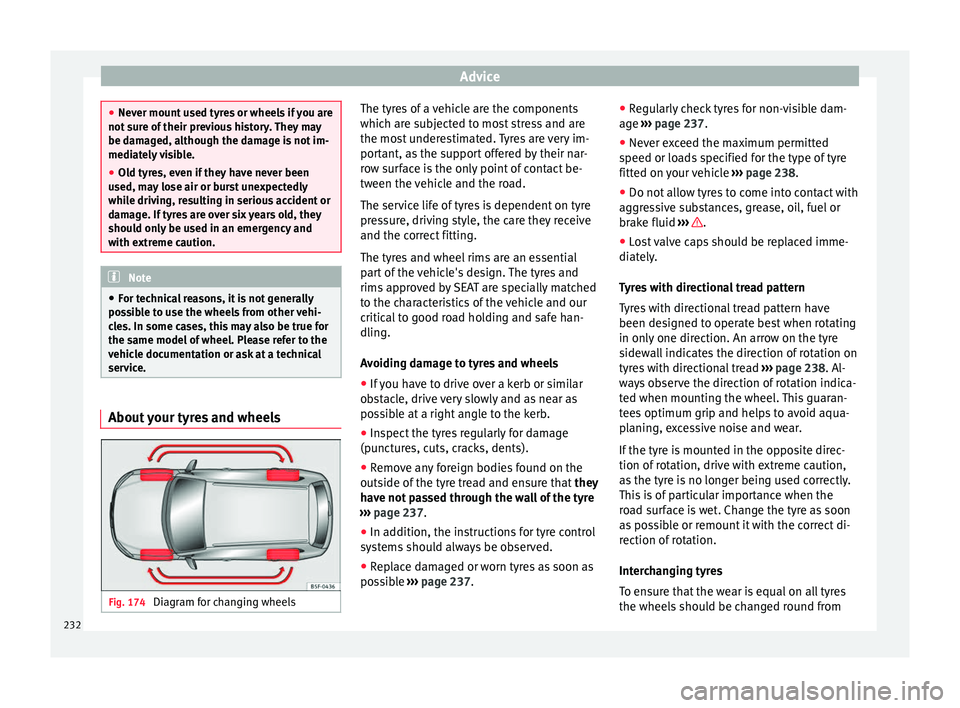
Fig. 174
Diagram for changing wheels The tyres of a vehicle are the components
which are subjected to most stress and are
the most underestimated. Tyres are very im-
portant, as the support offered by their nar-
row surface is the only point of contact be-
tween the vehicle and the road.
The service life of tyres is dependent on tyre
pressure, driving style, the care they receive
and the correct fitting.
The tyres and wheel rims are an essential
part of the vehicle's design. The tyres and
rims approved by SEAT are specially matched
to the characteristics of the vehicle and our
critical to good road holding and safe han-
dling.
Avoiding damage to tyres and wheels
● If you have to drive over a kerb or similar
obstacle, drive very slowly and as near as
possible at a right angle to the kerb.
● Inspect the tyres regularly for damage
(punctures, cuts, cracks, dents).
● Remove any foreign bodies found on the
outside of the tyre tread and ensure that they
have not passed through the wall of the tyre
››› page 237 .
● In a d
dition, the instructions for tyre control
systems should always be observed.
● Replace damaged or worn tyres as soon as
possible ››› page 237. ●
Re
gularly check tyres for non-visible dam-
age ››› page 237.
● Never e
xceed the maximum permitted
speed or loads specified for the type of tyre
fitted on your vehicle ››› page 238.
● Do not allow tyres to come into contact with
aggressive substances, grease, oil, fuel or
brake fluid ››› .
● Lost valve caps should be replaced imme-
diately.
Tyres with directional tread pattern
Tyres with directional tread pattern have
been designed to operate best when rotating
in only one direction. An arrow on the tyre
sidewall indicates the direction of rotation on
tyres with directional tread ››› page 238. Al-
ways observe the direction of rotation indica-
ted when mounting the wheel. This guaran-
tees optimum grip and helps to avoid aqua-
planing, excessive noise and wear.
If the tyre is mounted in the opposite direc-
tion of rotation, drive with extreme caution,
as the tyre is no longer being used correctly.
This is of particular importance when the
road surface is wet. Change the tyre as soon
as possible or remount it with the correct di-
rection of rotation.
Interchanging tyres
To ensure that the wear is equal on all tyres
the wheels should be changed round from
232
Page 235 of 305
Wheels and tyres
time to time according to the system
››› Fig. 174 . The useful life of all the tyres will
then be about the s
ame time.
SEAT recommends you take the vehicle to a
specialised workshop to have the tyres
changed.
Tyres that are over 6 years old
Tyres are subject to an ageing process as a
result of physical and chemical processes.
This may affect their performance. Tyres
which are stored for long periods of time
without being used, harden and become
more fragile than tyres which are in constant
use.
SEAT recommends that tyres over six years
old are replaced with new tyres. This also ap-
plies to tyres which appear to be in perfect
condition on the outside and which have a
tread depth within the values stipulated by
the Law ››› .
The date of manufacture, part of the tyre
identification number (TIN), indicates the age
of the tyre ››› page 238 .
St orin
g tyres
Mark tyres when you remove them to indicate
the direction of rotation (left, right, forwards,
backwards). This ensures you will be able to
mount them correctly when you replace
them. When removed, the wheels and/or
tyres should be stored in a cool, dry and pref- erably dark location. Do
not place tyres
mount
ed on the wheel in a vertical position.
Protect tyres not mounted on wheels from
dirt by storing them in suitable bags and
standing them on the ground on their tread. WARNING
Aggressive fluids or substances could result
in visible or invisible damage with the conse-
quent risks.
● Always ensure that tyres do not come into
contact with chemical products, oil, grease,
fuel, brake fluid or other aggressive substan-
ces. WARNING
Old tyres, even if they have never been used,
may lose air or burst unexpectedly while driv-
ing, resulting in serious accident or damage.
● If tyres are over six years old, they should
only be used in an emergency and with ex-
treme caution. For the sake of the environment
Old tyres must be disposed of by qualified
personnel according to the laws in the coun-
try concerned. Wheel rims
The design of wheel bolts is matched to the
rims. If different rims are fitted, the correct
wheel bolts with the right length and correct-
ly shaped bolt heads must be used. This en-
sures that wheels are fitted securely and that
the brake system functions correctly
››› page 246.
F or t
echnical reasons, it is not generally pos-
sible to use the wheels from other vehicles.
In some cases, this may also be true for the
same model of wheel.
The tyres and rims approved by SEAT are spe-
cially matched to the characteristics of the
vehicle and are critical to good road holding
and safe handling.
Note for Italy: A SEAT Service Centre should
be c on
sulted whether different sized wheels
or tyres to those originally fitted by SEAT may
be fitted, as well as the combinations al-
lowed between the front axle (axle 1) and
back axle (axle 2).
Wheel bolts
Wheel bolts must be tightened to the correct
torque ›››
page 246
.
Beadlock wheel rims
Beadlock wheel rims have various compo-
nents. These are joined together by special
bolts using a special procedure. This ensures »
233
Technical specifications
Advice
Operation
Safety
Page 236 of 305
Advice
good performance, a better seal, improved
safety and wheel run out. Therefore, worn
rims should always be replaced and must on-
ly be repaired in a specialised workshop.
SEAT recommends visiting a technical service
››› .
Wheel rims with bolted trims
Wheel rims may be fitted with interchangea-
ble trim parts which are attached to the rim
using self-locking bolts. Worn trims should
only be replaced at a specialised workshop.
SEAT recommends visiting a technical service
››› .
WARNING
The use of worn or damaged wheel rims could
make driving more dangerous and result in
serious accidents and damage.
● Only wheel rims which have been approved
for use with your vehicle should be used.
● Inspect wheel rims regularly for damage
and replace as required. WARNING
If the bolted joints of wheel rims with bolted
ring trims are not correctly tightened or loos-
ened, this could result in serious accident.
● Never loosen the bolted joints of wheel
rims with bolted ring trims.
● Any work relating to wheel rims with bolted
rims should be carried out at specialised workshop. SEAT recommends taking your car
in for technical service.
Replacement of wheel rims and new
tyres
New tyres
● When tyres are new, drive with extreme
caution for the first 500 km, as all tyres need
to be run-in . Tyres which have not been run-
in do not
have such good grip ››› or brak-
ing capacity ››› .
● All four wheels must be fitted with radial
tyres of the same type, size (rolling circumfer-
ence) and the same tread pattern.
● The tread depth of new tyres may vary, ac-
cording to the type and make of tyre and the
tread pattern.
Replacing tyres
● Where possible, always replace both
wheels on an axle (both wheels on the front
axle or both wheels on the rear axle) ››› .
● Old tyres should only be replaced by SEAT
approved tyres for the vehicle in question,
and in accordance with the maximum permit-
ted size, diameter, load and speed capacity.
● If replacing tyres, make sure the new ones
have an emergency ride system (Conti-
Seal/Run flat). Otherwise, we recommend
carrying a tyre mobility system. ●
Never use tyres which are larger than SEAT
approved tyres. If the tyres are too big, they
may knock or rub against the chassis or other
components, resulting in damage. WARNING
New tyres do not give maximum grip and will
not have reached their maximum braking ca-
pacity to start with, and therefore need run-
ning in.
● To prevent accidents and major damage,
extreme caution should be taken for the first
600 km. WARNING
There should be adequate space between the
tyres and the vehicle in accordance with the
vehicle design. If this is not the case, the
tyres may rub against parts of the running
gear, chassis or brake lines, leading to faults
in the brake system or to tread detachment,
and the risk of burst tyres.
● The true tyre dimension should not be
greater than the dimensions of tyres manu-
factured and approved by SEAT and should
not rub against parts of the vehicle. Note
● Although tyres may be shown as being the
same size, the true dimensions of different
types of tyre may vary with respect to the
nominal size, or tread patterns may be differ-
ent. 234
Page 237 of 305
Wheels and tyres
●
If you use tyres that are approved by SEAT,
you can be sure that the true tyre dimensions
will be correct for your vehicle. For other tyre
models, the tyre vendor should provide the
manufacturer's certificate with the tyre, indi-
cating that this type of tyre is suitable for
your vehicle. This certificate should always
be carried with the vehicle. Tyre pressures
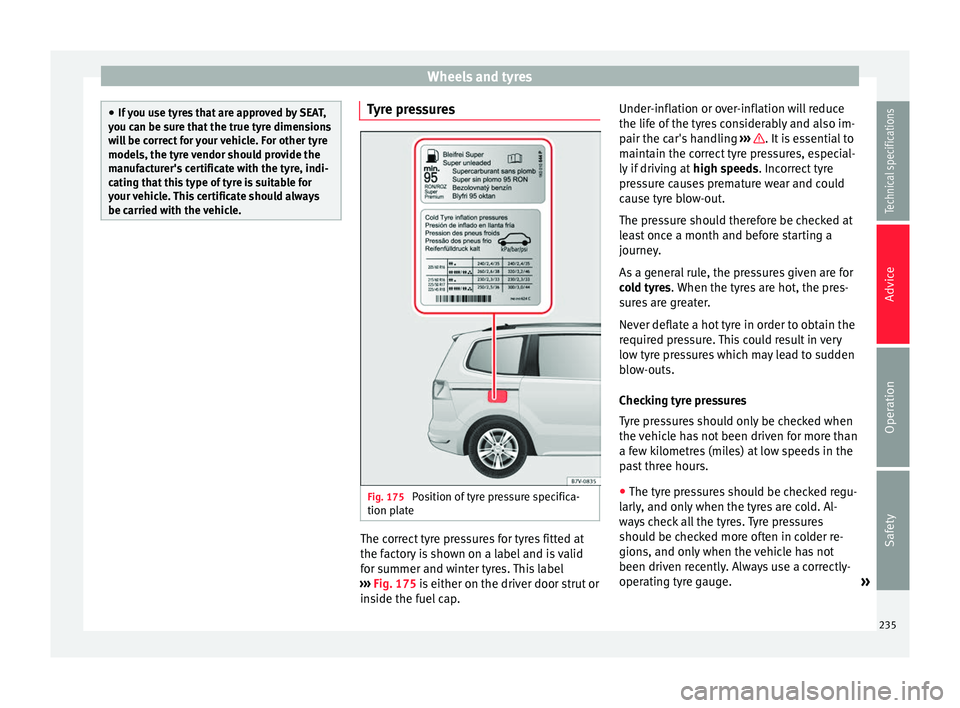
Fig. 175
Position of tyre pressure specifica-
tion plate The correct tyre pressures for tyres fitted at
the factory is shown on a label and is valid
for summer and winter tyres. This label
››› Fig. 175 is either on the driver door strut or
in s
ide the fuel cap. Under-inflation or over-inflation will reduce
the life of the tyres considerably and also im-
pair the car's handling
››› . It is essential to
maintain the correct tyre pressures, especial-
ly if driving at high speeds. Incorrect tyre
pressure causes premature wear and could
cause tyre blow-out.
The pressure should therefore be checked at
least once a month and before starting a
journey.
As a general rule, the pressures given are for
cold tyres . When the tyres are hot, the pres-
s ur
es are greater.
Never deflate a hot tyre in order to obtain the
required pressure. This could result in very
low tyre pressures which may lead to sudden
blow-outs.
Checking tyre pressures
Tyre pressures should only be checked when
the vehicle has not been driven for more than
a few kilometres (miles) at low speeds in the
past three hours.
● The tyre pressures should be checked regu-
larly, and only when the tyres are cold. Al-
ways check all the tyres. Tyre pressures
should be checked more often in colder re-
gions, and only when the vehicle has not
been driven recently. Always use a correctly-
operating tyre gauge. »
235
Technical specifications
Advice
Operation
Safety
Page 239 of 305
Wheels and tyres
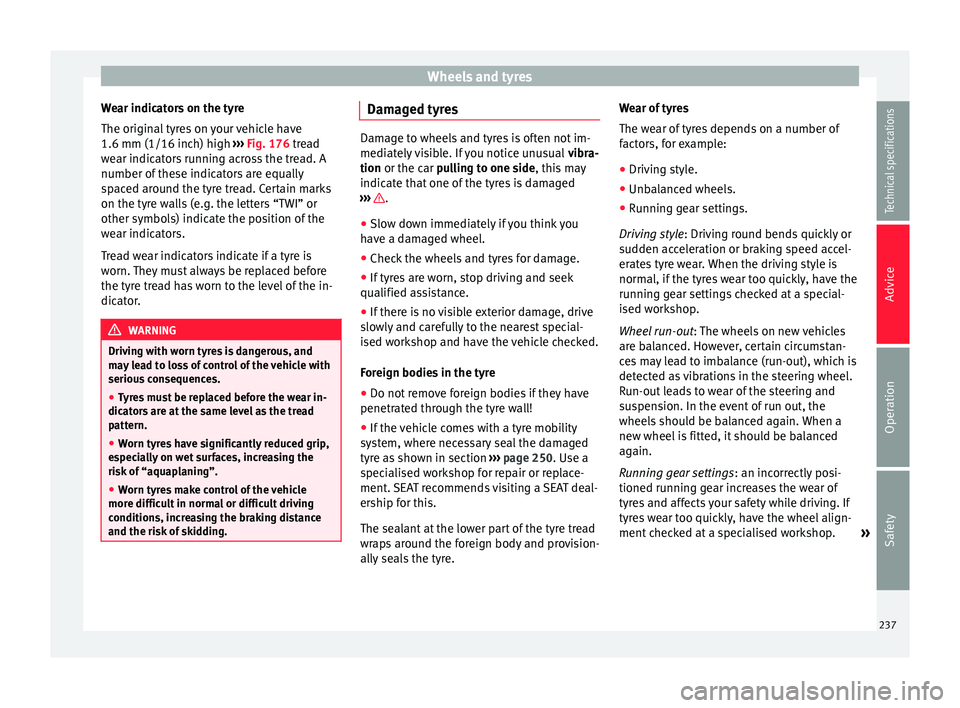
Wear indicators on the tyre
The original tyres on your vehicle have
1.6 mm (1/16 inch) high ››› Fig. 176 tread
w e
ar indicators running across the tread. A
number of these indicators are equally
spaced around the tyre tread. Certain marks
on the tyre walls (e.g. the letters “TWI” or
other symbols) indicate the position of the
wear indicators.
Tread wear indicators indicate if a tyre is
worn. They must always be replaced before
the tyre tread has worn to the level of the in-
dicator. WARNING
Driving with worn tyres is dangerous, and
may lead to loss of control of the vehicle with
serious consequences.
● Tyres must be replaced before the wear in-
dicators are at the same level as the tread
pattern.
● Worn tyres have significantly reduced grip,
especially on wet surfaces, increasing the
risk of “aquaplaning”.
● Worn tyres make control of the vehicle
more difficult in normal or difficult driving
conditions, increasing the braking distance
and the risk of skidding. Damaged tyres
Damage to wheels and tyres is often not im-
mediately visible. If you notice unusual
vibra-
tion or the car pulling to one side
, this may
indicate that one of the tyres is damaged
››› .
● Slow down immediately if you think you
have a damaged wheel.
● Check the wheels and tyres for damage.
● If tyres are worn, stop driving and seek
qualified assistance.
● If there is no visible exterior damage, drive
slowly and carefully to the nearest special-
ised workshop and have the vehicle checked.
Foreign bodies in the tyre
● Do not remove foreign bodies if they have
penetrated through the tyre wall!
● If the vehicle comes with a tyre mobility
system, where necessary seal the damaged
tyre as shown in section ›››
page 250. Use a
specialised workshop for repair or replace-
ment. SEAT recommends visiting a SEAT deal-
ership for this.
The sealant at the lower part of the tyre tread
wraps around the foreign body and provision-
ally seals the tyre. Wear of tyres
The wear of tyres depends on a number of
factors, for example:
● Driving style.
● Unbalanced wheels.
● Running gear settings.
Driving style : Driving round bends quickly or
sudden acceleration or braking speed accel-
erates tyre wear. When the driving style is
normal, if the tyres wear too quickly, have the
running gear settings checked at a special-
ised workshop.
Wheel run-out : The wheels on new vehicles
ar e b
alanced. However, certain circumstan-
ces may lead to imbalance (run-out), which is
detected as vibrations in the steering wheel.
Run-out leads to wear of the steering and
suspension. In the event of run out, the
wheels should be balanced again. When a
new wheel is fitted, it should be balanced
again.
Running gear settings : an incorrectly posi-
tioned running gear increases the wear of
tyres and affects your safety while driving. If
tyres wear too quickly, have the wheel align-
ment checked at a specialised workshop. »
237
Technical specifications
Advice
Operation
Safety
Page 240 of 305
Advice
WARNING
If you notice unusual vibration or the car pulls
to one side while driving, this may indicate
that one of the tyres is damaged. ●
Reduce speed immediately and stop, while
observing the highway code.
● Check the wheels and tyres for damage. ●
Never carry on driving on worn tyres or
wheels. Request qualified assistance immedi-
ately.
● If there is no visible exterior damage, drive
slowly and carefully to the nearest special-
ised workshop and have the vehicle checked. Tyre code
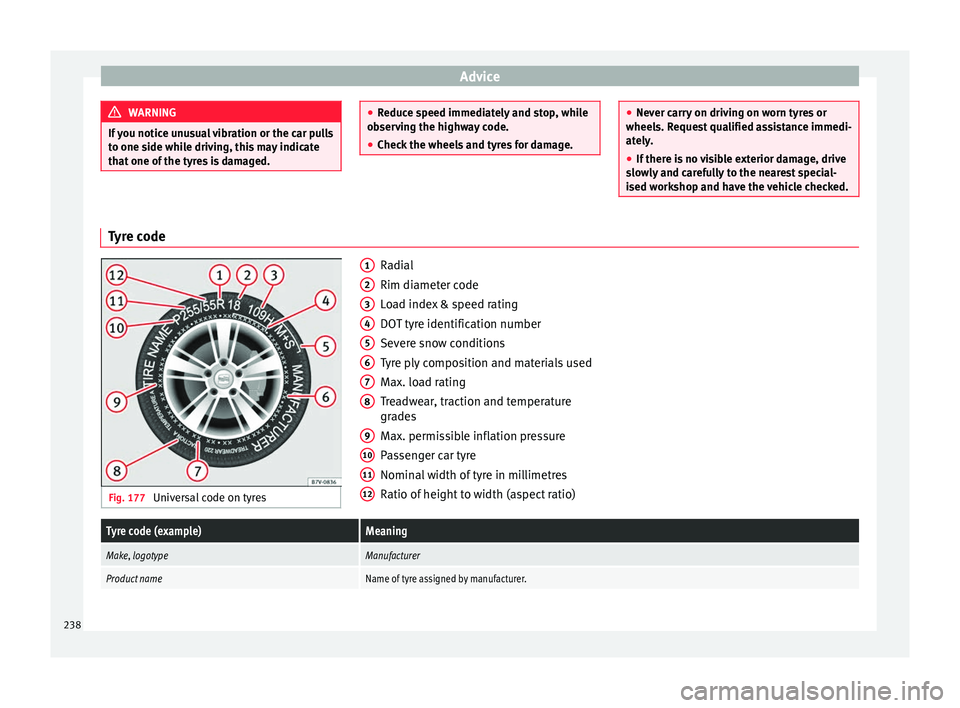
Fig. 177
Universal code on tyres Radial
Rim diameter code
Load index & speed rating
DOT tyre identification number
Severe snow conditions
Tyre ply composition and materials used
Max. load rating
Treadwear, traction and temperature
grades
Max. permissible inflation pressure
Passenger car tyre
Nominal width of tyre in millimetres
Ratio of height to width (aspect ratio)
1 2
3
4
5
6
7
8
9
10
11
12Tyre code (example)Meaning
Make, logotypeManufacturer
Product nameName of tyre assigned by manufacturer.
238