ABS Seat Alhambra 2016 Owner's Guide
[x] Cancel search | Manufacturer: SEAT, Model Year: 2016, Model line: Alhambra, Model: Seat Alhambra 2016Pages: 324, PDF Size: 5.93 MB
Page 241 of 324
Towing bracket device
CAUTION
● If the r e
ar lights of the trailer are not cor-
rectly connected, the vehicle electronics may
be damaged.
● If the trailer absorbs excessive electric cur-
rent, the v
ehicle electronics may be dam-
aged.
● Never connect the trailer's electric system
to the electric
al connections of the rear lights
or any other power sources. Only use suitable
connections for providing electric current to
the trailer. Note
● To w
ing a trailer places additional demands
on the vehicle. At SEAT, we recommend addi-
tional services between the normal inspec-
tion intervals if the vehicle is used frequently
for towing a trailer.
● In some countries, an additional fire extin-
guisher is
required if the trailer weight is
more than 2500 kg Electric tow hitch ball*
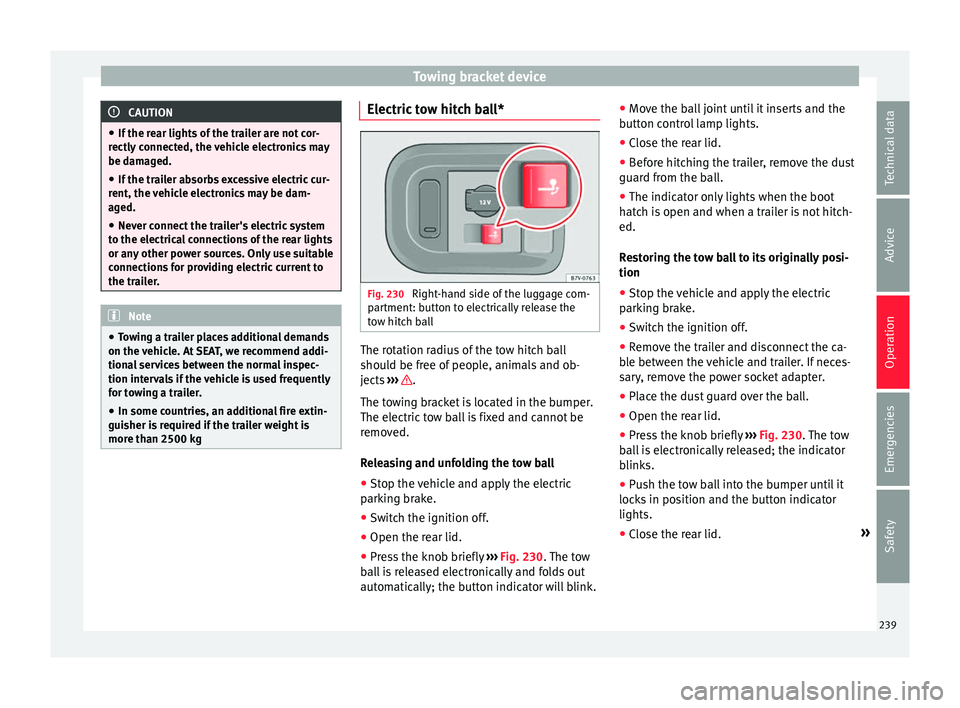
Fig. 230
Right-hand side of the luggage com-
p ar
tment: b
utton to electrically release the
tow hitch ball The rotation radius of the tow hitch ball
shou
l
d be fr
ee of people, animals and ob-
jects ››› .
The t o
w
ing bracket is located in the bumper.
The electric tow ball is fixed and cannot be
removed.
Releasing and unfolding the tow ball
● Stop the vehicle and apply the electric
parkin
g brake.
● Switch the ignition off.
● Open the rear lid.
● Press the knob briefly ›››
Fig. 230. The tow
ball is released electronically and folds out
automatically; the button indicator will blink. ●
Move the b
all joint until it inserts and the
button control lamp lights.
● Close the rear lid.
● Before hitching the trailer, remove the dust
guard from the b
all.
● The indicator only lights when the boot
hatc
h is open and when a trailer is not hitch-
ed.
Restoring the tow ball to its originally posi-
tion
● Stop the vehicle and apply the electric
parkin
g brake.
● Switch the ignition off.
● Remove the trailer and disconnect the ca-
ble betw
een the vehicle and trailer. If neces-
sary, remove the power socket adapter.
● Place the dust guard over the ball.
● Open the rear lid.
● Press the knob briefly ›››
Fig. 230. The tow
ball is electronically released; the indicator
blinks.
● Push the tow ball into the bumper until it
locks
in position and the button indicator
lights.
● Close the rear lid. »
239
Technical data
Advice
Operation
Emergencies
Safety
Page 246 of 324
Operation
Stabilising the vehicle and trailer
c omb
in
ation Stabilisation of the vehicle and trailer combi-
nation i
s
an extension of the electronic sta-
bility control (ESC) and helps, with the assis-
tance of the trajectory control, to reduce trail-
er “snaking”.
Stabilisation of the vehicle and trailer combi-
nation is active when the ESC indicator on
the dash panel remains lit for about two sec-
onds more than the ABS indicator.
Requirements for stabilising the vehi-
cle/trailer combination
● An original tow hitch is fitted by the manu-
fact ur
er or a compatible model is retrofitted.
● The ECS is switched on. The warning lamp
on the dash p
anel is not lit.
● The trailer is connected to the vehicle using
the power soc
ket.
● It travels faster than 60 km/h (37 mph).
● The maximum drawbar load is used.
● The trailer must have a fixed drawbar.
● Trailers with brakes must be equipped with
a mechanic
al inertia brake. WARNING
Do not let the extra safety afforded by the
st ab
ilisation system tempt you into taking
any risks when driving. ●
Adjus t
your speed and driving style to visi-
bility, road, traffic and weather conditions.
● If the road surface is slippery, take care
when accel
erating.
● When a system is operating, lift your foot
off the acc
elerator. WARNING
It is possible that the combination stabilisa-
tion sy st
em does not correctly recognised all
driving situations.
● It is possible that the stabilisation system
does not
detect snaking of a light trailer and
thus does not intervene.
● When driving on slippery ground, the trail-
er coul
d jack-knife despite the stabilisation
system.
● Trailers with a high centre of gravity may
even tip ov
er before they start to rock side-
ways.
● If a trailer is not used and the trailer power
socket
is connected (e.g. installation of a bi-
cycle carrier with lights), repeated automatic
braking may occur in extreme driving condi-
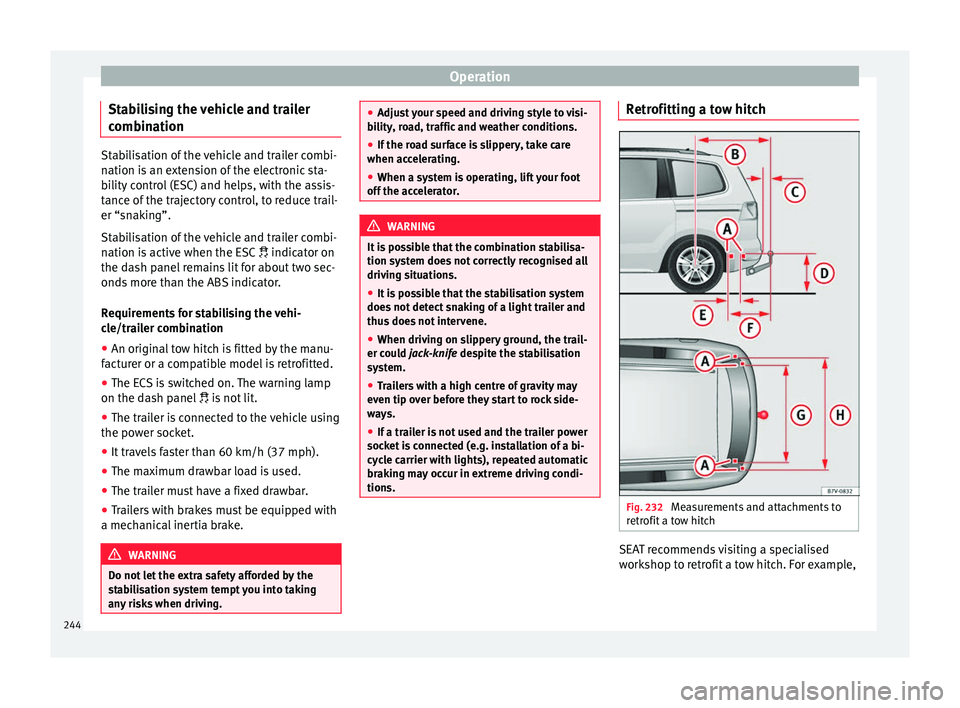
tions. Retrofitting a tow hitch
Fig. 232
Measurements and attachments to
r etr
ofit
a tow hitch SEAT recommends visiting a specialised
w
ork
shop t
o retrofit a tow hitch. For example,
244
Page 267 of 324
Checking and refilling levels
●
Never ent er the
vehicle while refuelling. If it
is absolutely necessary to enter, close the
door and touch a metal surface before touch-
ing the filler nozzle again. This will prevent
the generation of static electricity. Sparks
could cause a fire when refuelling.
● Never handle fuel close to flames, sparks or
obj
ects with slow combustion (e.g. ciga-
rettes).
● Avoid static electricity and electro-magnet-
ic ra
diation when refuelling.
● Observe the safety regulations of the serv-
ice st
ation.
● Never spill fuel on the vehicle or in the lug-
gage c
ompartment. WARNING
For safety reasons, SEAT does not recommend
carr y
ing a spare fuel canister in the vehicle.
Fuel could be spilled and catch fire, above all
in case of an accident and this applies to a
full container as well as empty containers.
This could lead to explosions, fires and inju-
ries.
● Observe the following if you exceptionally
have t
o carry fuel in a canister:
– Never place a fuel container to fill it in-
side the vehicle or on the vehicle, for ex-
ample, in the boot or on the hatch. Filling
in these circumstances could create an
electrostatic charge and spark that could
ignite fuel fumes. –
Alw a
ys place the canister on the ground
to fill it.
– Insert the fuel nozzle into the neck of the
canister as far as possible.
– If you are using a metal fuel canister, the
nozzle must always touch the canister
while it is being filled to avoid static elec-
tricity.
– Follow the legal requirements for the use,
storage and transport of spare fuel canis-
ters.
– Insure that the fuel container complies
with manufacturing standards, for exam-
ple, ANSI or ASTM F852-86. CAUTION
● Alw a
ys remove any fuel spilled on the vehi-
cle paintwork immediately to avoid damage
to the wheel housing, the tyre and vehicle
paintwork.
● Refuelling a petrol engine with diesel or a
diesel en
gine with petrol can cause serious
engine and fuel system damage; the resulting
malfunctions are not covered by the SEAT
warranty. If you refuel with the wrong type of
fuel, never start the engine. This applies to
even the smallest amount of the wrong fuel.
Seek specialist assistance. With the engine
running, the composition of the wrong fuel
could significantly damage the fuel system
and the engine itself.
● In vehicles with a diesel engine, under no
circ
umstances should you refuel or drive with petrol, kerosene, heating oil or any other
type of
diff
erent fuel. Other types of fuels
could cause serious damage to the engine
and to the fuel supply system and the result-
ing problems are not covered by the SEAT
warranty. For the sake of the environment
Fuels can contaminate the environment. Col-
l ect an
y spilt service fluids and allow a pro-
fessional to dispose of them. Note
There is no emergency mechanism for the
manua l
release of the fuel tank flap. If neces-
sary, request assistance from specialised per-
sonnel. 265
Technical data
Advice
Operation
Emergencies
Safety
Page 284 of 324
Advice
●
When refi l
ling liquids, avoid spilling them
on parts of the engine and the exhaust sys-
tem. Spilled liquids could cause a fire. Under
specific circumstances, the ethylene glycol
can catch fire. CAUTION
● On ly fi
ll with distilled water. Any other type
of water may lead to considerable rusting in
the engine due to its chemical components.
This could consequently damage the engine.
If you have not used distilled water but an-
other type of water to top up the coolant, a
specialised workshop must immediately re-
place all of the fluid in the engine cooling
system.
● Only top up coolant to the top level of the
marked ar
ea ››› Fig. 245. Otherwise the ex-
cess coolant will be forced out of the cooling
system when the engine is hot, causing dam-
age.
● If a lot of liquid coolant has been lost, wait
for the engine t
o cool down completely before
adding coolant. Extensive coolant loss is an
indication of leaks in the engine cooling sys-
tem. Have the engine cooling system inspec-
ted immediately by a specialised workshop.
Otherwise engine damage may occur.
● When refilling service liquids, ensure that
you put
the liquids into the right tank. Mak-
ing a mistake when refilling could cause seri-
ous malfunctions and damage the engine! Brake fluid
Chec k
in
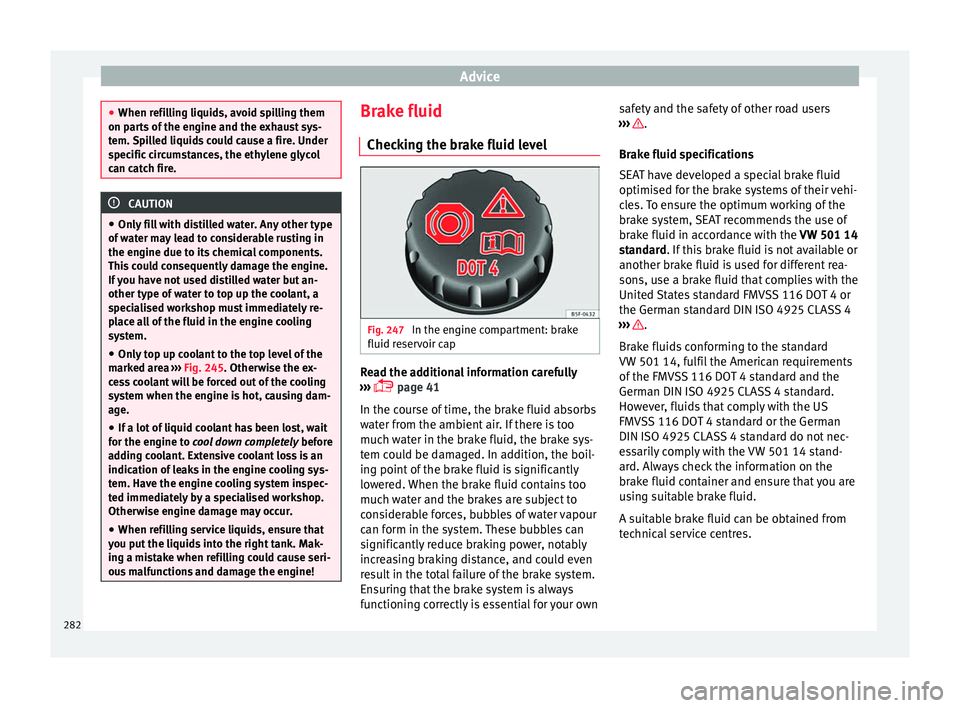
g the brake fluid level Fig. 247
In the engine compartment: brake
fluid r e
ser
voir cap Read the additional information carefully
› ›
›
page 41
In the course of time, the brake fluid absorbs
water from the ambient air. If there is too
much water in the brake fluid, the brake sys-
tem could be damaged. In addition, the boil-
ing point of the brake fluid is significantly
lowered. When the brake fluid contains too
much water and the brakes are subject to
considerable forces, bubbles of water vapour
can form in the system. These bubbles can
significantly reduce braking power, notably
increasing braking distance, and could even
result in the total failure of the brake system.
Ensuring that the brake system is always
functioning correctly is essential for your own safety and the safety of other road users
›››
.
Br ak
e fluid s
pecifications
SEAT have developed a special brake fluid
optimised for the brake systems of their vehi-
cles. To ensure the optimum working of the
brake system, SEAT recommends the use of
brake fluid in accordance with the VW 501 14
standard. If this brake fluid is not available or
another brake fluid is used for different rea-
sons, use a brake fluid that complies with the
United States standard FMVSS 116 DOT 4 or
the German standard DIN ISO 4925 CLASS 4
››› .
Br ak
e fluid
s conforming to the standard
VW 501 14, fulfil the American requirements
of the FMVSS 116 DOT 4 standard and the
German DIN ISO 4925 CLASS 4 standard.
However, fluids that comply with the US
FMVSS 116 DOT 4 standard or the German
DIN ISO 4925 CLASS 4 standard do not nec-
essarily comply with the VW 501 14 stand-
ard. Always check the information on the
brake fluid container and ensure that you are
using suitable brake fluid.
A suitable brake fluid can be obtained from
technical service centres.
282
Page 286 of 324
Advice
Windscreen washer reservoir Chec k
in
g and topping up the wind-
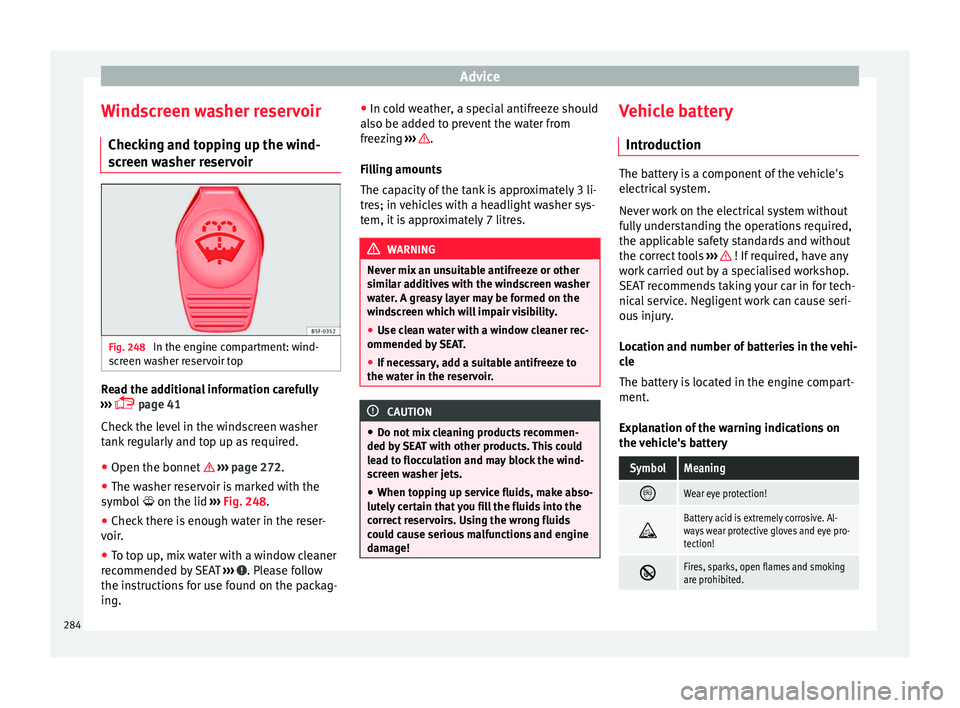
screen washer reservoir Fig. 248
In the engine compartment: wind-
s c
r
een washer reservoir top Read the additional information carefully
› ›
›
page 41
Check the level in the windscreen washer
tank regularly and top up as required.
● Open the bonnet ›››
page 272.
● The washer reservoir is marked with the
symbol
on the lid ››› Fig. 248.
● Check there is enough water in the reser-
voir.
● T
o top up, mix water with a window cleaner
recommended b
y SEAT ››› . Please follow
the in struction
s for use found on the packag-
ing. ●
In col
d weather, a special antifreeze should
also be added to prevent the water from
freezing ››› .
Fi l
lin
g amounts
The capacity of the tank is approximately 3 li-
tres; in vehicles with a headlight washer sys-
tem, it is approximately 7 litres. WARNING
Never mix an unsuitable antifreeze or other
simi l
ar additives with the windscreen washer
water. A greasy layer may be formed on the
windscreen which will impair visibility.
● Use clean water with a window cleaner rec-
ommended by
SEAT.
● If necessary, add a suitable antifreeze to
the water in the r
eservoir. CAUTION
● Do not mi x
cleaning products recommen-
ded by SEAT with other products. This could
lead to flocculation and may block the wind-
screen washer jets.
● When topping up service fluids, make abso-
lutely c
ertain that you fill the fluids into the
correct reservoirs. Using the wrong fluids
could cause serious malfunctions and engine
damage! Vehicle battery
Intr oduction The battery is a component of the vehicle's
electric
al
system.
Never work on the electrical system without
fully understanding the operations required,
the applicable safety standards and without
the correct tools ››› ! If required, have any
work c
arried out by a specialised workshop.
SEAT recommends taking your car in for tech-
nical service. Negligent work can cause seri-
ous injury.
Location and number of batteries in the vehi-
cle
The battery is located in the engine compart-
ment.
Explanation of the warning indications on
the vehicle's battery
SymbolMeaning
Wear eye protection!
Battery acid is extremely corrosive. Al-
ways wear protective gloves and eye pro-
tection!
Fires, sparks, open flames and smoking
are prohibited.
284
Page 309 of 324
Index
Index
A
Abr o
a
d
extended stay abroad with your vehicle . . . . . 263
sale of vehicle . . . . . . . . . . . . . . . . . . . . . . . . . . 263
ABS see Anti-lock brake system . . . . . . . . . . . . . . . 205
Accessories . . . . . . . . . . . . . . . . . . . . . . . . . . . . . . 247
Acoustic alarms seatbelt unfastened . . . . . . . . . . . . . . . . . . . . . . 62
warning and indication lamps . . . . . . . . . . . . . . 32
Adaptive headlights dynamic . . . . . . . . . . . . . . . . . . . . . . . . . . . . . . . 132
AdBlue information . . . . . . . . . . . . . . . . . . . . . . . . . . . . 271
minimum quantity for a refill . . . . . . . . . . . . . . 271
refilling . . . . . . . . . . . . . . . . . . . . . . . . . . . . . . . 271
specifications . . . . . . . . . . . . . . . . . . . . . . . . . . 272
tank filling capacity . . . . . . . . . . . . . . . . . . . . . 270
warning and indication lamps . . . . . . . . . . . . . 270
Additional heater see "Auxiliary heater" . . . . . . . . . . . . . . . . . . . . 180
Adjusting folding the backrest of the front passengerseat . . . . . . . . . . . . . . . . . . . . . . . . . . . . . . . . 150
front seats . . . . . . . . . . . . . . . . . . . . . . . . . . . . . 142
lights . . . . . . . . . . . . . . . . . . . . . . . . . . . . . . . . . 135
seats . . . . . . . . . . . . . . . . . . . . . . . . . . . . . . . . . . 57
seat with position memory . . . . . . . . . . . . . . . 148
Adjusting the head restraint rear head restraints . . . . . . . . . . . . . . . . . 14, 144
Adjusting the seats front seats . . . . . . . . . . . . . . . . . . . . . . . . . . . . . 142
rear seats . . . . . . . . . . . . . . . . . . . . . . . . . . . . . 143
AFS . . . . . . . . . . . . . . . . . . . . . . . . . . . . . . . . . . . . 132 Air-conditioning
malfu nctions . . . . . . . . . . . . . . . . . . . . . . . . . . . 177
Airbag covers . . . . . . . . . . . . . . . . . . . . . . . . . . . . . 17
Airbags see Airbag system . . . . . . . . . . . . . . . . . . . . . . . 18
Airbag system . . . . . . . . . . . . . . . . . . . . . . . . . . 17, 68 activation . . . . . . . . . . . . . . . . . . . . . . . . . . . . . . 70
cleaning dash panel . . . . . . . . . . . . . . . . . . . . . 262
control lamp . . . . . . . . . . . . . . . . . . . . . . . . . . . . 72
description . . . . . . . . . . . . . . . . . . . . . . . . . . . . . 69
front airbags . . . . . . . . . . . . . . . . . . . . . . . . . 17, 71
functioning . . . . . . . . . . . . . . . . . . . . . . . . . . . . . 70
head-protection airbag . . . . . . . . . . . . . . . . . . . 20
knee airbag . . . . . . . . . . . . . . . . . . . . . . . . . . . . . 18
locking the vehicle after deployment . . . . . . . 115
repairs . . . . . . . . . . . . . . . . . . . . . . . . . . . . . . . . 249
side airbags . . . . . . . . . . . . . . . . . . . . . . . . . . . . 19
use of child seats . . . . . . . . . . . . . . . . . . . . . 18, 73
vehicle care . . . . . . . . . . . . . . . . . . . . . . . . . . . . 262
Air conditioning . . . . . . . . . . . . . . . . . . . . . . . . . . 176 air recirculation . . . . . . . . . . . . . . . . . . . . . . . . . 179
air vents . . . . . . . . . . . . . . . . . . . . . . . . . . . . . . 178
climatronic . . . . . . . . . . . . . . . . . . . . . . . . 36, 176
controls . . . . . . . . . . . . . . . . . . . . . . . . . . . 36, 176
electronic manual air conditioning . . . . . . . . . 176
indirect ventilation . . . . . . . . . . . . . . . . . . . . . . 178
rear seats . . . . . . . . . . . . . . . . . . . . . . . . . . . . . 177
special features . . . . . . . . . . . . . . . . . . . . . . . . 178
user instructions . . . . . . . . . . . . . . . . . . . . . . . . 177
Air recirculation . . . . . . . . . . . . . . . . . . . . . . . . . . 179
Air vents . . . . . . . . . . . . . . . . . . . . . . . . . . . . . . . . 178
Alcantara . . . . . . . . . . . . . . . . . . . . . . . . . . . . . . . . 259
All-wheel drive snow chains . . . . . . . . . . . . . . . . . . . . . . . . . . . . 49
winter tyres . . . . . . . . . . . . . . . . . . . . . . . . . . . . 297
Ambient lighting . . . . . . . . . . . . . . . . . . . . . . . . . 136
Anodized surfaces . . . . . . . . . . . . . . . . . . . . . . . . 257 Antenna . . . . . . . . . . . . . . . . . . . . . . . . . . . 249, 263
Anti-freeze
. . . . . . . . . . . . . . . . . . . . . . . . . . . . . . . 40
Anti-lock brake system . . . . . . . . . . . . . . . . . . . . . 205
Anti-lock system . . . . . . . . . . . . . . . . . . . . . . . . . . 206
Anti-puncture kit . . . . . . . . . . . . . . . . . . . . . . . . 44, 85
Anti-theft alarm . . . . . . . . . . . . . . . . . . . . . . . . . . 119 Anti-tow system . . . . . . . . . . . . . . . . . . . . . . . . 120
false alarms . . . . . . . . . . . . . . . . . . . . . . . . . . . 120
Interior monitoring . . . . . . . . . . . . . . . . . . . . . . 120
trailer . . . . . . . . . . . . . . . . . . . . . . . . . . . . . . . . . 241
Anti-theft security system . . . . . . . . . . . . . . . . . . 119
Anti-tow system . . . . . . . . . . . . . . . . . . . . . . . . . . 120
Anti-trap function panoramic sunroof . . . . . . . . . . . . . . . . . . . . . . 129
sun blind . . . . . . . . . . . . . . . . . . . . . . . . . . . . . . 129
Antifreeze . . . . . . . . . . . . . . . . . . . . . . . . . . . 40, 280
Armrests . . . . . . . . . . . . . . . . . . . . . . . . . . . . . . . . 151
Ashtray . . . . . . . . . . . . . . . . . . . . . . . . . . . . . . . . . 172
ASR see Braking assist systems . . . . . . . . . . 206, 207
switching on and off . . . . . . . . . . . . . . . . . . . . . 207
see also Traction control system . . . . . . . . . . . 205
Assistance call . . . . . . . . . . . . . . . . . . . . . . . . . . . 110
Assistance systems Electronic differential lock system (EDS) . . . . 206
Electronic drive torque management (XDS) . . 206
Launch-Control programme . . . . . . . . . . . . . . . 198
tiredness detection . . . . . . . . . . . . . . . . . . . . . 232
tyre monitoring systems . . . . . . . . . . . . . . . . . 236
Assisted starting . . . . . . . . . . . . . . . . . . . . . . . . . . 51
Assist systems adaptive headlights . . . . . . . . . . . . . . . . . . . . . 132
auto Hold . . . . . . . . . . . . . . . . . . . . . . . . . . . . . 208
blind spot detector (BSD) with parking assis-tant (RTA) . . . . . . . . . . . . . . . . . . . . . . . . . . . . 225
brake assist system (BAS) . . . . . . . . . . . . . . . . 206
cruise control system . . . . . . . . . . . . . . . . . . . . 221
dynamic chassis control (DCC) . . . . . . . . . . . . 233 307
Page 321 of 324
Index
protection of vehicle undercarriage . . . . . . . . 258
rubber se al
s
. . . . . . . . . . . . . . . . . . . . . . . . . . . 257
Special features . . . . . . . . . . . . . . . . . . . . . . . . 254
vehicle paintwork . . . . . . . . . . . . . . . . . . . . . . . 256
windows . . . . . . . . . . . . . . . . . . . . . . . . . . . . . . 255
Wooden trim . . . . . . . . . . . . . . . . . . . . . . . . . . . 262
Vehicle care products . . . . . . . . . . . . . . . . . . . . . . 253
Vehicle code Vehicle data label . . . . . . . . . . . . . . . . . . . . . . . 298
Vehicle data label . . . . . . . . . . . . . . . . . . . . . . . . . 298
Vehicle key set . . . . . . . . . . . . . . . . . . . . . . . . . . . 112
Vehicle tool kit . . . . . . . . . . . . . . . . . . . . . . . . . 45, 82 components . . . . . . . . . . . . . . . . . . . . . . . . . . . . 83
location . . . . . . . . . . . . . . . . . . . . . . . . . . . . . . . . 82
Vehicle undercarriage guard . . . . . . . . . . . . . . . . . 56
Vibrations steering . . . . . . . . . . . . . . . . . . . . . . . . . . . . . . . 294
Voice control . . . . . . . . . . . . . . . . . . . . . . . . . . . . . 111
W Warning and control lamp ABS . . . . . . . . . . . . . . . . . . . . . . . . . . . . . . . . . . 190
adBlue . . . . . . . . . . . . . . . . . . . . . . . . . . . . . . . . 270
airbag system . . . . . . . . . . . . . . . . . . . . . . . . . . . 72
blind spot detector (BSD) . . . . . . . . . . . . . . . . 225
brake system . . . . . . . . . . . . . . . . . . . . . . . . . . . 190
catalytic converter . . . . . . . . . . . . . . . . . . . . . . 202
changing bulbs . . . . . . . . . . . . . . . . . . . . . . . . . . 92
coolant . . . . . . . . . . . . . . . . . . . . . . . . . . . . . . . 279
Cruise Control System (CCS) . . . . . . . . . . . . . . 221
door . . . . . . . . . . . . . . . . . . . . . . . . . . . . . . . . . . 121
emission control system . . . . . . . . . . . . . . . . . 202
engine management . . . . . . . . . . . . . . . . . . . . 202
engine oil sensor . . . . . . . . . . . . . . . . . . . . . . . 276
ESC . . . . . . . . . . . . . . . . . . . . . . . . . . . . . . . . . . 190
generator . . . . . . . . . . . . . . . . . . . . . . . . . . . . . . 285 indication of break pad wear . . . . . . . . . . . . . . 190
lights . . . . . . . . . . . . . . . . . . . . . . . . . . . . . . . . . 130
lock
ing the steering column . . . . . . . . . . . . . . 184
overview . . . . . . . . . . . . . . . . . . . . . . . . . . 32, 105
parking assistance (RTA) . . . . . . . . . . . . . . . . . 225
rear lid . . . . . . . . . . . . . . . . . . . . . . . . . . . . . . . . 124
refuelling . . . . . . . . . . . . . . . . . . . . . . . . . . . . . . 266
remote control . . . . . . . . . . . . . . . . . . . . . . . . . 181
tyre monitoring indicator . . . . . . . . . . . . . . . . . 235
vehicle battery . . . . . . . . . . . . . . . . . . . . . . . . . 285
windscreen washer fluid level . . . . . . . . . . . . . 137
Warning lamps . . . . . . . . . . . . . . . . . . . . . . . . . . . . 32
Warning triangle . . . . . . . . . . . . . . . . . . . . . . . . . . . 82
Washing the vehicle . . . . . . . . . . . . . . . . . . . . . . . 253 sensors . . . . . . . . . . . . . . . . . . . . . . . . . . 211, 214
special features . . . . . . . . . . . . . . . . . . . . . . . . 254
things to note . . . . . . . . . . . . . . . . . . . . . . . . . . 118
Wax . . . . . . . . . . . . . . . . . . . . . . . . . . . . . . . . . . . . 255
Wear indicators . . . . . . . . . . . . . . . . . . . . . . . . . . 293
Weights . . . . . . . . . . . . . . . . . . . . . . . . . . . . . . . . . 299
Wheel bolts . . . . . . . . . . . . . . . . . . . . . . . . . . 84, 300 anti-theft . . . . . . . . . . . . . . . . . . . . . . . . 45, 83, 84
caps . . . . . . . . . . . . . . . . . . . . . . . . . . . . . . . . . . . 46
loosen . . . . . . . . . . . . . . . . . . . . . . . . . . . . . . . . . 46
tightening torque . . . . . . . . . . . . . . . . . . . . . . . . 47
Wheel load capacity . . . . . . . . . . . . . . . . . . . . . . . 295
Wheel rims beadlock . . . . . . . . . . . . . . . . . . . . . . . . . . . . . . 291
bolted trims . . . . . . . . . . . . . . . . . . . . . . . . . . . 291
Wheels . . . . . . . . . . . . . . . . . . . . . . . . 288, 290, 300 changing a wheel . . . . . . . . . . . . . . . . . 45, 48, 84
hubcaps . . . . . . . . . . . . . . . . . . . . . . . . . . . . . . . 45
Wheels and tyres speed rating . . . . . . . . . . . . . . . . . . . . . . . . . . . 295
Wheel trim hubcaps . . . . . . . . . . . . . . . . . . . . . . . . . . . . . . . 45
remove . . . . . . . . . . . . . . . . . . . . . . . . . . . . . . . . 46 Windows
automatic operation . . . . . . . . . . . . . . . . . . . . . 127
automatic raising/lowering . . . . . . . . . . . . . . . 127
convenience closing . . . . . . . . . . . . . . . . . . . . . 127
convenience opening . . . . . . . . . . . . . . . . . . . . 127
malfunction . . . . . . . . . . . . . . . . . . . . . . . . . . . . 128
removing ice . . . . . . . . . . . . . . . . . . . . . . . . . . . 255
roll-back function . . . . . . . . . . . . . . . . . . . . . . . 128
Window wiper . . . . . . . . . . . . . . . . . . . . . . . . . . . . 137
Window wiper blade . . . . . . . . . . . . . . . . . . . . . . . . 26
Windscreen and rear window wiper blades . . . . . 87
Windscreen washer . . . . . . . . . . . . . . . . . . . 41, 137
Windscreen washer fluid checking . . . . . . . . . . . . . . . . . . . . . . . . . . . . . . 284
control lamp . . . . . . . . . . . . . . . . . . . . . . . . . . . 137
Topping up . . . . . . . . . . . . . . . . . . . . . . . . . . . . 284
Windscreen wipers . . . . . . . . . . . . . . . . . . . . 26, 137 functions . . . . . . . . . . . . . . . . . . . . . . . . . . . . . . 138
headlight washer system . . . . . . . . . . . . . . . . . 138
heated windscreen washer jets . . . . . . . . . . . . 138
lifting the wiper blade . . . . . . . . . . . . . . . . . . . . 54
rain sensor . . . . . . . . . . . . . . . . . . . . . . . . . . . . 138
replacing the wiper blade . . . . . . . . . . . . . . . . . 54
service position . . . . . . . . . . . . . . . . . . . . . . . . . 54
special features . . . . . . . . . . . . . . . . . . . . . . . . 138
window wiper lever . . . . . . . . . . . . . . . . . . . . . . 137
Windscreen wipers service position . . . . . . . . . . . 54
Wing mirrors driving with a trailer . . . . . . . . . . . . . . . . . . . . . 238
Winter additional heater . . . . . . . . . . . . . . . . . . . . . . . 180
menu configuration . . . . . . . . . . . . . . . . . . . . . . 30
Winter driving Driving with a trailer . . . . . . . . . . . . . . . . . . . . . 237
filter pre-heater . . . . . . . . . . . . . . . . . . . . . . . . . 268
winter-grade diesel . . . . . . . . . . . . . . . . . . . . . 268
winter tyres . . . . . . . . . . . . . . . . . . . . . . . . . . . . 296
319