height Seat Alhambra 2016 Owner's Guide
[x] Cancel search | Manufacturer: SEAT, Model Year: 2016, Model line: Alhambra, Model: Seat Alhambra 2016Pages: 324, PDF Size: 5.93 MB
Page 155 of 324
Transport and practical equipment
Transporting a load Secure all objects in the vehicle
● Distribute the load throughout the vehicle,
on the roof and in a tr
ailer as uniformly as
possible.
● Transport heavy objects as far forward as
poss
ible in the luggage compartment and
lock the seat backs in the vertical position.
● Secure luggage in the luggage compart-
ment with s
uitable straps on the fastening
rings ››› page 154.
● Check the headlight adjustment
›› ›
page 130.
● Use the suitable tyre pressure according to
the load bein
g transported. Read the tyre in-
flation information label ›››
page 288.
● For vehicles with a tyre pressure indicator,
chan
ge the vehicle load status ›››
page 234. CAUTION
Objects on the shelf could chafe against the
wir e
s of the heating element in the heated
rear window and cause damage. Note
Please note the information about loading a
trai l
er ››› page 237 and the roof carrier sys-
tem ››› page 164. Driving with the rear lid open
Driving with the rear lid open creates an addi-
tional
ri
sk. Secure all objects and secure the
rear lid correctly and take all measures possi-
ble to reduce toxic gases from entering the
vehicle. WARNING
Driving with the rear lid unlocked or open
cou l
d cause serious injuries.
● Always drive with the rear lid closed.
● Secure all objects in the vehicle. Loose
items c
ould fall out of the vehicle and injure
other road users or damage other vehicles.
● Drive particularly carefully and think
ahead.
● A
void sudden manoeuvres and braking giv-
en that thi
s could cause an uncontrolled
movement of the open rear lid.
● When transporting objects that protrude
out of the lug
gage compartment, indicate
them suitably. Observe legal requirements.
● If objects must project out of the luggage
compar
tment, the rear lid must never be used
to “secure” or “attach” objects.
● If a baggage rack is fitted on the rear lid, it
should be r
emoved before travelling with the
rear lid open. WARNING
Toxic gases may enter the vehicle interior
when the re ar lid i
s open. This could cause
loss of consciousness, carbon monoxide poi-
soning, serious injury and accidents.
● To avoid toxic gases entering the vehicle al-
way
s drive with the rear lid closed.
● In exceptional circumstances, if you must
drive with the r
ear lid open, observe the fol-
lowing to reduce the entry of toxic gases in-
side the vehicle:
– Close all windows and the sliding sun-
roof.
– Turn off the air recirculation for the heat-
ing and air conditioner.
– Open all of the air outlets in the dash
panel.
– Turn the heating fan and heater to the
highest level. CAUTION
An open boot hatch changes the length and
height of the
vehicle. Driving with the vehicle loaded
For the best handling when driving a loaded
v
ehic
l
e, note the following:
● Secure all objects ›››
page 153.
● Accelerate gently and carefully. »
153
Technical data
Advice
Operation
Emergencies
Safety
Page 166 of 324
Operation
● Car
ef
ully unhook the baggage net hooks
from the fastening rings ››› Fig. 174 2 .
WARNING
The elastic baggage net stretches when it is
secur ed t
o the luggage compartment fasten-
ing rings. The secured baggage net is taut.
The hooks on the net can cause injury if the
net is incorrectly hooked or unhooked.
● Always ensure that the hooks do not sud-
denly r
elease from the fastening rings when
hooking or un-hooking.
● Always keep your face and eyes protected
at a saf
e distance to avoid injury should a
hook slip while hooking or unhooking.
● Always engage the hooks in the order giv-
en. If a bag
gage net hook springs back this
can cause injury. Roof carrier*
Intr oduction The vehicle roof has been designed to opti-
mi
se aer
ody
namics. For this reason, conven-
tional roof carrier systems cannot be secured
to the roof water drain channel.
Given that the water drains have been incor-
porated into the roof for aerodynamic rea-
sons, only the SEAT approved basic supports
and roof carrier systems can be used. When should the roof carrier system be re-
moved?
● When it
is not being used.
● When the vehicle is being washed in a car
wash.
● When the
vehicle height exceeds the maxi-
mum height (e.g. in a g
arage). WARNING
The risk of an accident is increased by trans-
portin g he
avy or bulky loads on the roof,
which affects the car's handling by shifting
the centre of gravity and increasing suscepti-
bility to cross winds.
● Always secure loads correctly with suitable
and undam
aged attachment rope or straps.
● Large, heavy, wide and flat loads negatively
affect the
vehicle aerodynamics, centre of
gravity and handling.
● Avoid brusque manoeuvres and sudden
brakin
g.
● Adjust your speed and driving style to visi-
bility
, road, traffic and weather conditions. CAUTION
● Alw a
ys remove the roof carrier system from
the roof before entering a car wash.
● The height of your vehicle is changed by
the inst
allation of the roof carrier and the
load secured on it. Compare the vehicle
height with the passage height, for example
in underground car parks or for garage doors. ●
The roof ant
enna, the range of the panor-
amic sliding sunroof and the boot hatch
should not be affected by the roof carrier sys-
tem and the load being transported.
● Take extra care not to let the hatch strike
the roof lo
ad when opening. For the sake of the environment
The vehicle uses more fuel when the roof car-
rier sy st
em is fitted. Fastening the base supports and the
r
oof
c
arrier system Fig. 175
Attachment points for the basic sup-
por t and the r
oof carrier system The mounts are the basis of a complete roof
c
arrier sy
s
tem. Special fixtures must then be
added in order to safely transport luggage,
bicycles, skis, surf boards, boats, etc. on the
164
Page 251 of 324
Care and maintenance
●
All
repairs and modifications to the vehicle
should only be performed by a specialised
workshop. Repairs and malfunctions in the air-
bag sy
s
tem When performing repairs and technical mod-
ification
s,
SEAT's directives must be ob-
served! ››› Modifications and repairs to the front bump-
er
, door
s, fr
ont seats, and repairs to the roof
or chassis should only be carried out in a
specialised workshop. These components
may contain parts or sensors belonging to
the airbag system.
If work is carried out on the airbag system or
parts have to be removed and fitted on the
system when performing other repair work,
parts of the airbag system may be damaged.
The consequence may be that, in the event of
an accident, the airbag inflates incorrectly or
does not inflate at all.
So that the effectiveness of the airbag is not
reduced and that removed parts do not cause
any injuries or environmental pollution, regu-
lations must be observed. These require-
ments are known to specialised workshops.
Modifications to the vehicle suspension may
affect the operation of the airbag system in
the event of collision. For example, if wheel and tyre combinations not approved by SEAT
are used, or if
the vehicle height is lowered,
the suspension is stiffened or the suspension
springs, telescopic arms, dampers, etc., are
modified, the results received by the airbag
sensors and sent to the control unit may not
be accurate. For example, some modifica-
tions to the suspension could increase the
force measured by the sensors and result in
the triggering of the airbag systems in colli-
sions. Under normal conditions, the meas-
ured values would be lower and the airbag
would not have been triggered. Other modifi-
cations may reduce the forces measured by
the sensors and prevent the airbags from be-
ing triggered when they should. WARNING
Repairs or modifications which are not per-
formed c orr
ectly may result in damage or er-
rors in the vehicle operation, affecting the ef-
fectiveness of the airbag systems. This could
result in serious or fatal accidents.
● All repairs and modifications to the vehicle
should on
ly be performed by a specialised
workshop.
● Airbag modules must never be repaired: if
damag
ed, they must be replaced.
● Never fit recycled or reused airbag compo-
nents in
your vehicle. WARNING
Modifications to the vehicle suspension, in-
cludin g the u
se of unauthorised wheel and
tyre combinations, may affect the perform-
ance of the airbags and increase the risk of
serious or fatal injury in the event of acci-
dent.
● Never fit suspension components which are
not identica
l to the original parts in the vehi-
cle.
● Never use wheel and tyre combinations not
appro
ved by SEAT. Retrofitting of mobile phones
An exterior aerial is required for the use of
tw
o-w
a
y radios in the vehicle.
The retro-fitting of electrical or electronic ap-
pliances in the vehicle is subject to their ap-
proval for use in your vehicle. Under certain
circumstances, this could mean that your ve-
hicle registration documents are no longer
valid.
SEAT has approved your vehicle for use with
two-way radios providing the following condi-
tions are observed:
● The exterior aerial must be mounted pro-
fes
sionally.
● The maximum transmitting power is 10
watts. »
249
Technical data
Advice
Operation
Emergencies
Safety
Page 256 of 324
Advice
Automatic car washes
A lw
a
ys observe the instructions provided at
the automatic car wash. The standard pre-
cautionary measures prior to entering the car
wash should be taken to avoid damage to
the vehicle (close all windows, fold in exterior
mirrors). If the vehicle is fitted with additional
components (spoiler, roof-rack, aerial, etc.),
check with the car wash supervisor whether
these can enter the car wash ››› .
The v
ehic
le paintwork is so durable that the
vehicle can normally be washed without
problems in an automatic car wash tunnel.
However, wear and damage to the paintwork
will depend on the type of car wash used.
SEAT recommends the use of car washes
without brushes.
To remove traces of wax on windows and to
prevent wiper blades from scratching, please
observe the following ››› page 255, Cleaning
windows and exterior mirrors .
Washing the car by hand
When washing the car by hand, use plenty of
water to soften the dirt first, and rinse off as
well as possible.
Then clean the vehicle with a soft sponge,
glove or brush using only slight pressure.
Start at the roof and work downwards. Spe-
cial car shampoo should only be used for
very persistent dirt. Rinse the sponge or glove thoroughly and of-
ten.
Wheels, s
ills and similar should be cleaned
last. Use a second sponge for this. WARNING
Sharp components on the vehicle may cause
injury .
● Pr
otect arms and hands from sharp edges
when cle
aning the vehicle undercarriage or
the interior of the wheel hubs. WARNING
After the vehicle has been washed, the brak-
ing eff ect
will be reduced (and the braking
distance increased) due to moisture (and ice
in winter) on the brakes.
● “Dry the brakes and remove ice” by braking
caref
ully. Ensure that you are not endanger-
ing other road-users or breaking traffic regu-
lations in the process. CAUTION
● The temper at
ure of the water must not ex-
ceed +60°C (+140°F).
● To avoid damage to the paintwork, do not
wash the
vehicle in full sun.
● Do not use rough sponges or similar which
coul
d damage the surface to clean away the
traces of insects. ●
Never w ipe the he
adlights with a dry cloth
or sponge, always moisten first. It is best to
use soapy water.
● Washing the vehicle in low temperatures:
When washin
g the vehicle with a hose, do
not direct water into the lock cylinders or the
gaps around the doors or roof. Locks and
seals could freeze! CAUTION
To avoid any risk of damage to the vehicle,
p le
ase check the following points before us-
ing an automatic car wash:
● Compare the distance between the vehicle
wheels and the di
stance between the guide-
rails of the car wash to prevent damage to the
wheels and tyres!
● Switch off the rain sensor and the Au-
to Hol
d function before entering a car wash.
● Compare the height and width of your vehi-
cle w
ith the available height and width when
entering and driving through the car wash.
● Fold in exterior mirrors Electrically retracta-
ble e
xterior mirrors must not be folded in or
out by hand. Always use the electrical power
control.
● To avoid damaging the bonnet paintwork,
res
t the wipers on the windscreen after dry-
ing them. Do not let them fall!
● Lock the rear lid to prevent it from opening
unexpect
edly while inside the car wash.254
Page 297 of 324
Wheels and tyres
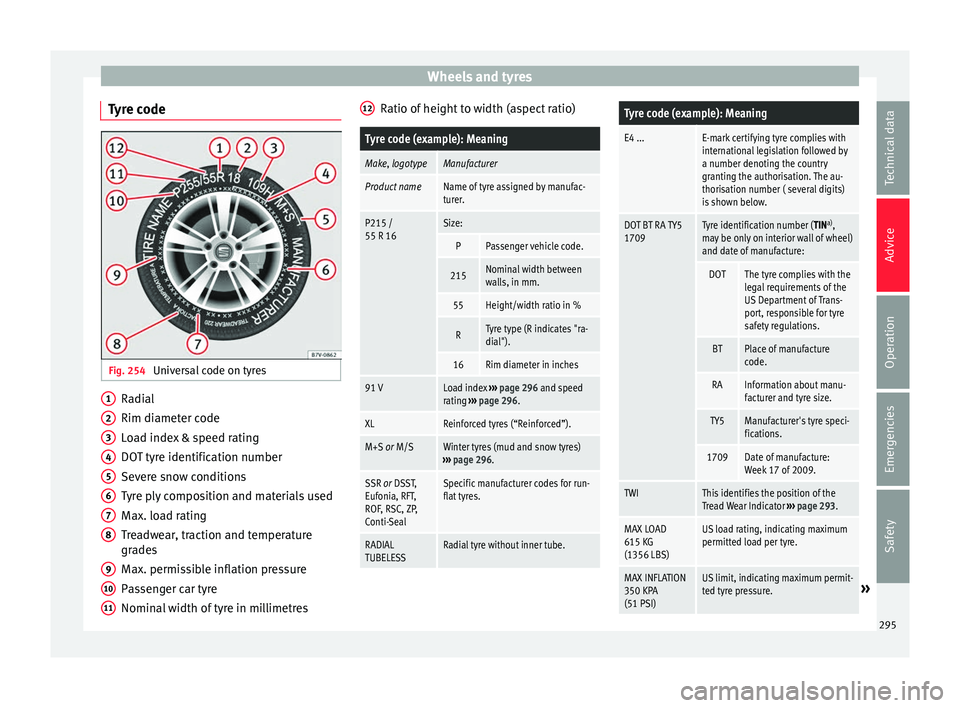
Tyre code Fig. 254
Universal code on tyres Radial
Rim di
amet
er c
ode
Load index & speed rating
DOT tyre identification number
Severe snow conditions
Tyre ply composition and materials used
Max. load rating
Treadwear, traction and temperature
grades
Max. permissible inflation pressure
Passenger car tyre
Nominal width of tyre in millimetres
1 2
3
4
5
6
7
8
9
10
11 Ratio of height to width (aspect ratio)
Tyre code (example): Meaning
Make, logotypeManufacturer
Product nameName of tyre assigned by manufac-
turer.
P215 /
55 R 16Size:
PPassenger vehicle code.
215Nominal width between
walls, in mm.
55Height/width ratio in %
RTyre type (R indicates "ra-
dial").
16Rim diameter in inches
91 VLoad index
››› page 296 and speed
rating ››› page 296.
XLReinforced tyres (“Reinforced”).
M+S or M/SWinter tyres (mud and snow tyres)
››› page 296.
SSR or DSST,
Eufonia, RFT,
ROF, RSC, ZP,
Conti-SealSpecific manufacturer codes for run-
flat tyres.
RADIAL
TUBELESSRadial tyre without inner tube. 12
Tyre code (example): Meaning
E4 ...E-mark certifying tyre complies with
international legislation followed by
a number denoting the country
granting the authorisation. The au-
thorisation number ( several digits)
is shown below.
DOT BT RA TY5
1709Tyre identification number (TIN
a)
,
may be only on interior wall of wheel)
and date of manufacture:
DOTThe tyre complies with the
legal requirements of the
US Department of Trans-
port, responsible for tyre
safety regulations.
BTPlace of manufacture
code.
RAInformation about manu-
facturer and tyre size.
TY5Manufacturer's tyre speci-
fications.
1709Date of manufacture:
Week 17 of 2009.
TWIThis identifies the position of the
Tread Wear Indicator ››› page 293.
MAX LOAD
615 KG
(1356 LBS)US load rating, indicating maximum
permitted load per tyre.
MAX INFLATION
350 KPA
(51 PSI)US limit, indicating maximum permit-
ted tyre pressure.» 295
Technical data
Advice
Operation
Emergencies
Safety
Page 308 of 324
Technical data
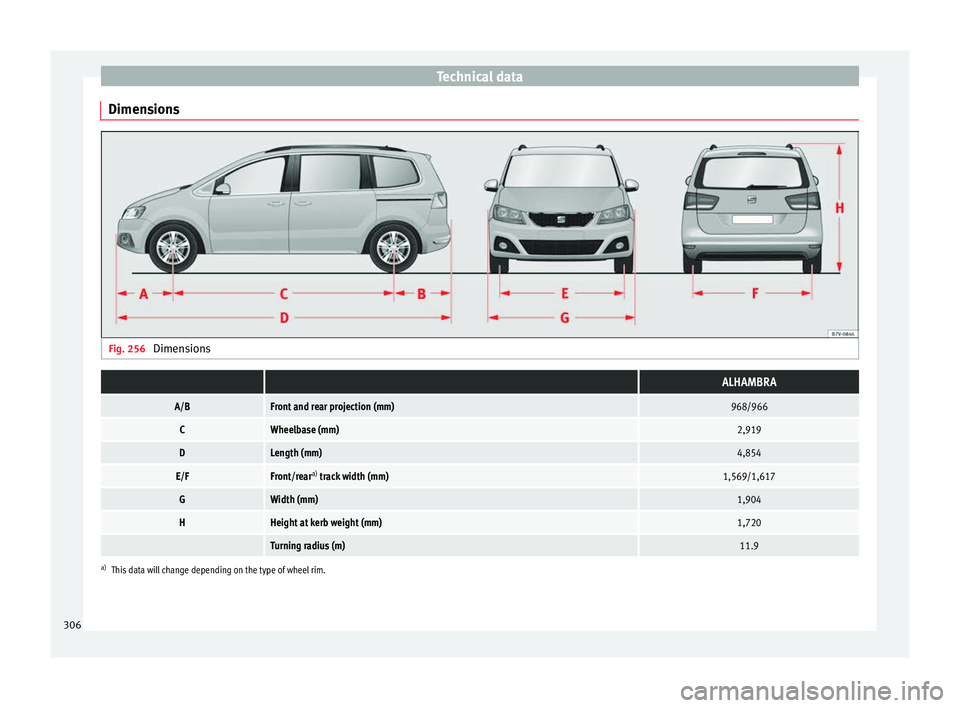
Dimensions Fig. 256
Dimensions ALHAMBRA
A/BFront and rear projection (mm)968/966
CWheelbase (mm)2,919
DLength (mm)4,854
E/FFront/rear a)
track width (mm)1,569/1,617
GWidth (mm)1,904
HHeight at kerb weight (mm)1,720
Turning radius (m)11.9
a) This data will change depending on the type of wheel rim.
306
Page 310 of 324
Index
lane assist system . . . . . . . . . . . . . . . . . . . . . . 222
optic al
p
arking system . . . . . . . . . . . . . . . . . . . 213
Park Assist . . . . . . . . . . . . . . . . . . . . . . . . . . . . 214
parking assistance . . . . . . . . . . . . . . . . . . . . . . 212
parking assistant (RTA) . . . . . . . . . . . . . . . . . . 225
Parking distance warning system . . . . . . . . . . 212
rear assist . . . . . . . . . . . . . . . . . . . . . . . . . . . . . 217
rear View Camera . . . . . . . . . . . . . . . . . . . . . . . 217
sign Assist . . . . . . . . . . . . . . . . . . . . . . . . . . . . . 230
Start-Stop . . . . . . . . . . . . . . . . . . . . . . . . . . . . . 209
start assistance . . . . . . . . . . . . . . . . . . . . . . . . 208
traction control when accelerating (ASR) . . .206, 207
traffic signal detection . . . . . . . . . . . . . . . . . . . 230
Auto Hold . . . . . . . . . . . . . . . . . . . . . . . . . . . . . . . 208
Automatic belt retractor . . . . . . . . . . . . . . . . . . . . . 67
Automatic car wash Switching Auto Hold off . . . . . . . . . . . . . . . . . . 209
switching the start assist off . . . . . . . . . . . . . . 209
Automatic dipped beam control . . . . . . . . . . . . . 132
Automatic gearbox driving tips . . . . . . . . . . . . . . . . . . . . . . . . . . . . 198
emergency release . . . . . . . . . . . . . . . . . . . . . . . 35
ignition key removal lock . . . . . . . . . . . . . . . . . 186
kick-down . . . . . . . . . . . . . . . . . . . . . . . . . . . . . 198
malfunction . . . . . . . . . . . . . . . . . . . . . . . . . . . . 198
AUX-IN . . . . . . . . . . . . . . . . . . . . . . . . . . . . . . . . . . 110
Auxiliary heater . . . . . . . . . . . . . . . . . . . . . 180, 269 automatic off . . . . . . . . . . . . . . . . . . . . . . . . . . . 266
operating instructions . . . . . . . . . . . . . . . . . . . 183
Programming . . . . . . . . . . . . . . . . . . . . . . . . . . 182
remote control . . . . . . . . . . . . . . . . . . . . . . . . . 181
remote control range . . . . . . . . . . . . . . . . . . . . 181
remote control: replacing the battery . . . . . . . 181
special features . . . . . . . . . . . . . . . . . . . . . . . . 180
switching off . . . . . . . . . . . . . . . . . . . . . . . . . . . 180
Switching on . . . . . . . . . . . . . . . . . . . . . . . . . . . 180
things to note . . . . . . . . . . . . . . . . . . . . . . . . . . 183 Auxiliary heater remote control
auxili ary heater . . . . . . . . . . . . . . . . . . . . . . . . . 181
replacing the battery . . . . . . . . . . . . . . . . . . . . 181
B BAS see Brake assist systems . . . . . . . . . . . . . . . . . 206
Battery changing in the vehicle key . . . . . . . . . . . . . . . 113
Before setting off . . . . . . . . . . . . . . . . . . . . . . . . . . 56
Belt height adjustment . . . . . . . . . . . . . . . . . . . . . 67
Belt tension device service and disposal . . . . . . . . . . . . . . . . . . . . . 68
Belt tensioner . . . . . . . . . . . . . . . . . . . . . . . . . . . . . 67
Belt tension limiter . . . . . . . . . . . . . . . . . . . . . . . . . 67
Belt tightening . . . . . . . . . . . . . . . . . . . . . . . . . . . . 67
Bicycle carrier Installing on tow hitch . . . . . . . . . . . . . . . . . . . 240
Maximum load . . . . . . . . . . . . . . . . . . . . . . . . . 240
Biodiesel . . . . . . . . . . . . . . . . . . . . . . . . . . . . . . . . 269
Blind spot detector (BSD) . . . . . . . . . . . . . . . . . . 225 control lamps . . . . . . . . . . . . . . . . . . . . . . . . . . 225
driving conditions . . . . . . . . . . . . . . . . . . . . . . 228
indication in the external rear view mirror . . . 226
malfunction . . . . . . . . . . . . . . . . . . . . . . . . . . . . 225
operating . . . . . . . . . . . . . . . . . . . . . . . . . . . . . . 226
towing . . . . . . . . . . . . . . . . . . . . . . . . . . . . . . . . 230
Bonnet . . . . . . . . . . . . . . . . . . . . . . . . . . . . . . . . . . 11 opening and closing . . . . . . . . . . . . . . . . . . . . 274
Boot hatch emergency locking and unlocking . . . . . . . . . . . 10
Bottle holders . . . . . . . . . . . . . . . . . . . . . . . . . . . . 171
Brake assist systems . . . . . . . . . . . . . . . . . . . . . . 205
Brake fluid . . . . . . . . . . . . . . . . . . . . . . . . . . . . . . . 41 specification . . . . . . . . . . . . . . . . . . . . . . . . . . . 282 Brakes . . . . . . . . . . . . . . . . . . . . . . . . . . . . . . . . . . 189
brake a ssist systems . . . . . . . . . . . . . . . . . . . . 205
brake fluid . . . . . . . . . . . . . . . . . . . . . . . . . . . . . 282
brake fluid level . . . . . . . . . . . . . . . . . . . . . . . . 283
brake pads . . . . . . . . . . . . . . . . . . . . . . . . . . . . 193 brake servo . . . . . . . . . . . . . . . . . . . . . . . . . . . . 193
changing the brake fluid . . . . . . . . . . . . . . . . . 283
electronic parking brake . . . . . . . . . . . . . . . . . 191
emergency braking function . . . . . . . . . . . . . . 192
running in new brake pads . . . . . . . . . . . . . . . 193
warning and indication lamps . . . . . . . . . . . . . 190
Brake servo . . . . . . . . . . . . . . . . . . . . . . . . . 193, 205
Brake system . . . . . . . . . . . . . . . . . . . . . . . . . . . . 205 fault . . . . . . . . . . . . . . . . . . . . . . . . . . . . . . . . . . 193
Braking brake assist system . . . . . . . . . . . . . . . . . . . . . 205
BSD see Blind spot detector . . . . . . . . . . . . . . . . . . 225
Bulb malfunction see Changing bulbs . . . . . . . . . . . . . . . . . . . . . . 91
C
Capacities . . . . . . . . . . . . . . . . . . . . . . . . . . . . . . . . 39 windshield wiper fluid tank . . . . . . . . . . . . . . . 284
Card compartment . . . . . . . . . . . . . . . . . . . . . . . . 168
Caring for paintwork . . . . . . . . . . . . . . . . . . . . . . . 256
Caring for the vehicle exterior . . . . . . . . . . . . . . . . . . . . . . . . . . . . . . . 253
interior . . . . . . . . . . . . . . . . . . . . . . . . . . . . . . . . 253
Catalytic converter . . . . . . . . . . . . . . . . . . . . . . . . 203 Malfunction . . . . . . . . . . . . . . . . . . . . . . . . . . . . 203
warning and indication lamps . . . . . . . . . . . . . 202
CCS . . . . . . . . . . . . . . . . . . . . . . . . . . . . . . . . . . . . 221 see cruise control . . . . . . . . . . . . . . . . . . . . . . . . 32
CD changer . . . . . . . . . . . . . . . . . . . . . . . . . 166, 171
308
Page 318 of 324
Index
disconnecting the passenger front airbag . . . . 18
Saf e driv
in
g . . . . . . . . . . . . . . . . . . . . . . . . . . . . . 56
Safety equipment . . . . . . . . . . . . . . . . . . . . . . . . . . 57
Safety instructions using child seats . . . . . . . . . . . . . . . . . . . . . 20, 75
Sale of vehicle in other countries / continents . . . . . . . . . . . . 263
Salt water . . . . . . . . . . . . . . . . . . . . . . . . . . . . . . . 205
Scrapping . . . . . . . . . . . . . . . . . . . . . . . . . . . . . . . 264 airbag system . . . . . . . . . . . . . . . . . . . . . . . . . . 264
vend-of-life vehicles . . . . . . . . . . . . . . . . . . . . . 264
Seat . . . . . . . . . . . . . . . . . . . . . . . . . . . . . . . . . . . . . 59 adjustment . . . . . . . . . . . . . . . . . . . . . . . . . . . . 142
convenient entry function for the third row ofseats . . . . . . . . . . . . . . . . . . . . . . . . . . . . . . . 149
electric front seat . . . . . . . . . . . . . . . . . . . . . . . . 14
folding down rear seats . . . . . . . . . . . . . . . . . . 155
folding the backrest of the front passenger seat . . . . . . . . . . . . . . . . . . . . . . . . . . . . . . . . 150
heating . . . . . . . . . . . . . . . . . . . . . . . . . . . . . . . 146
incorrect position . . . . . . . . . . . . . . . . . . . . . . . . 59
number of seats . . . . . . . . . . . . . . . . . . . . . . . . . 59
rear seats . . . . . . . . . . . . . . . . . . . . . . . . . . . . . 143
seat with position memory . . . . . . . . . . . . . . . 148
Seat belt position . . . . . . . . . . . . . . . . . . . . . . . . . . 65 for pregnant women . . . . . . . . . . . . . . . . . . . . . . 15
seat belts . . . . . . . . . . . . . . . . . . . . . . . . . . . . . . 15
Seat belts . . . . . . . . . . . . . . . . . . . . . . . . . . . . . . . . 61 adjustment . . . . . . . . . . . . . . . . . . . . . . . . . . 15, 64
automatic belt retractor . . . . . . . . . . . . . . . . . . . 67
belt height adjustments . . . . . . . . . . . . . . . . . . . 67
belt tensioner . . . . . . . . . . . . . . . . . . . . . . . . . . . 67
belt tension limiter . . . . . . . . . . . . . . . . . . . . . . . 67
cleaning . . . . . . . . . . . . . . . . . . . . . . . . . . . . . . 262
protective function . . . . . . . . . . . . . . . . . . . . . . . 62
purpose . . . . . . . . . . . . . . . . . . . . . . . . . . . . . . . . 61
seat belt position . . . . . . . . . . . . . . . . . . . . . . . . 65
twisted belt . . . . . . . . . . . . . . . . . . . . . . . . . . . . . 64 unfastened . . . . . . . . . . . . . . . . . . . . . . . . . . . . . 63
use . . . . . . . . . . . . . . . . . . . . . . . . . . . . . . . . . . . . 64
w
arning lamp . . . . . . . . . . . . . . . . . . . . . . . . . . . 62
with two buckles . . . . . . . . . . . . . . . . . . . . . . . . . 66
Seat belt tensioner . . . . . . . . . . . . . . . . . . . . . . 15, 67
Seat belt with two buckles fastening . . . . . . . . . . . . . . . . . . . . . . . . . . . . . . . 66
twisting . . . . . . . . . . . . . . . . . . . . . . . . . . . . . . . . 66
unfastening . . . . . . . . . . . . . . . . . . . . . . . . . . . . . 66
Seat functions . . . . . . . . . . . . . . . . . . . . . . . . . . . 146 convenient entry function for the third row ofseats . . . . . . . . . . . . . . . . . . . . . . . . . . . . . . . 149
folding the backrest of the front passenger seat . . . . . . . . . . . . . . . . . . . . . . . . . . . . . . . . 150
lumbar massage . . . . . . . . . . . . . . . . . . . . . . . . 147
Seat heating . . . . . . . . . . . . . . . . . . . . . . . . . . . . . 146
SEAT information system . . . . . . . . . . . . . . . . . . . . 26 structure . . . . . . . . . . . . . . . . . . . . . . . . . . . . . . . 26
Seat upholstery cleaning and maintenance of natural leather . 261
synthetic leather . . . . . . . . . . . . . . . . . . . . . . . . 261
Selective Catalytic Reduction . . . . . . . . . . . . . . . 270
Selector lever locking . . . . . . . . . . . . . . . . . . . . . . 196
Service fluids . . . . . . . . . . . . . . . . . . . . . . . . . . . . 247
Service interval display . . . . . . . . . . . . . . . . . . . . 103
Service notification: read . . . . . . . . . . . . . . . . . . . 104
Signal lever . . . . . . . . . . . . . . . . . . . . . . . . . . . . . . . 25
Sign Assist . . . . . . . . . . . . . . . . . . . . . . . . . 230, 231 Connection . . . . . . . . . . . . . . . . . . . . . . . . . . . . 232
Disconnection . . . . . . . . . . . . . . . . . . . . . . . . . . 232
indication on display . . . . . . . . . . . . . . . . . . . . 231
Operation mode . . . . . . . . . . . . . . . . . . . . . . . . 232
trailer . . . . . . . . . . . . . . . . . . . . . . . . . . . . . . . . . 232
Sliding door . . . . . . . . . . . . . . . . . . . . . . . . . . . . . 121 childproof lock . . . . . . . . . . . . . . . . . . . . . . . . . 123
manually opening and closing . . . . . . . . . . . . 122
opening and closing electrically . . . . . . . . . . . 122 Snow chains . . . . . . . . . . . . . . . . . . . . . . . . . 49, 300
all-wheel driv e . . . . . . . . . . . . . . . . . . . . . . . . . . 49
Spanner symbol . . . . . . . . . . . . . . . . . . . . . . . . . . 104
Spare fuel canister . . . . . . . . . . . . . . . . . . . . . . . . 265
Spare parts . . . . . . . . . . . . . . . . . . . . . . . . . . . . . . 247
Specifications combined weight . . . . . . . . . . . . . . . . . . . . . . . 245
drawbar load . . . . . . . . . . . . . . . . . . . . . . . . . . . 237
Trailer weight . . . . . . . . . . . . . . . . . . . . . . . . . . 245
Spectacle case . . . . . . . . . . . . . . . . . . . . . . . . . . . 166
Speed rating . . . . . . . . . . . . . . . . . . . . . . . . . . . . . 296
Stabilising the vehicle and trailer combination . 244
Start-Stop function . . . . . . . . . . . . . . . . . . . . . . . . 209 Driving with a trailer . . . . . . . . . . . . . . . . . . . . . 237
Start assist See Assist systems . . . . . . . . . . . . . . . . . . . . . . 208
Starter button . . . . . . . . . . . . . . . . . . . . . . . . . . . . 186
Starting assistance description . . . . . . . . . . . . . . . . . . . . . . . . . . . . . 52
jump leads . . . . . . . . . . . . . . . . . . . . . . . . . . . . . 52
positive pole . . . . . . . . . . . . . . . . . . . . . . . . . . . . 52
Starting the vehicle . . . . . . . . . . . . . . . . . . . . . . . . 23
Steering counter steering assistance system . . . . . . . . 185
electromechanical . . . . . . . . . . . . . . . . . . . . . . 184
power steering . . . . . . . . . . . . . . . . . . . . . . . . . 184
steering column lock . . . . . . . . . . . . . . . . . . . . 184
tendency to pull to one side . . . . . . . . . . . . . . 294
warning and indication lamps . . . . . . . . . . . . . 184
Steering wheel adjustment . . . . . . . . . . . . . . . . . . . . . . . . . . . . . 16
Setting . . . . . . . . . . . . . . . . . . . . . . . . . . . . . . . . . 58
Steering wheel controls . . . . . . . . . . . . . . . . . . . . 106
Storage compartment in the roof console . . . . . 167
Storage compartments . . . . . . . . . . . . . . . . . . . . 166 cards . . . . . . . . . . . . . . . . . . . . . . . . . . . . . . . . . 168
drawers . . . . . . . . . . . . . . . . . . . . . . . . . . . . . . . 169
316