weight Seat Alhambra 2016 Owner's Guide
[x] Cancel search | Manufacturer: SEAT, Model Year: 2016, Model line: Alhambra, Model: Seat Alhambra 2016Pages: 324, PDF Size: 5.93 MB
Page 254 of 324
Advice
may be exceeded. This is also the case if the
aeria
l
has not been correctly installed.
● A minimum of 20 centimetres should be
kept betw
een mobile phone aerials and artifi-
cial pacemakers, as mobile telephones may
affect the working of pacemakers.
● Do not keep mobile phones in breast pock-
ets dir
ectly above pacemakers.
● Switch off the mobile phone immediately if
you su
spect there may be interference. Support points for raising the vehicle
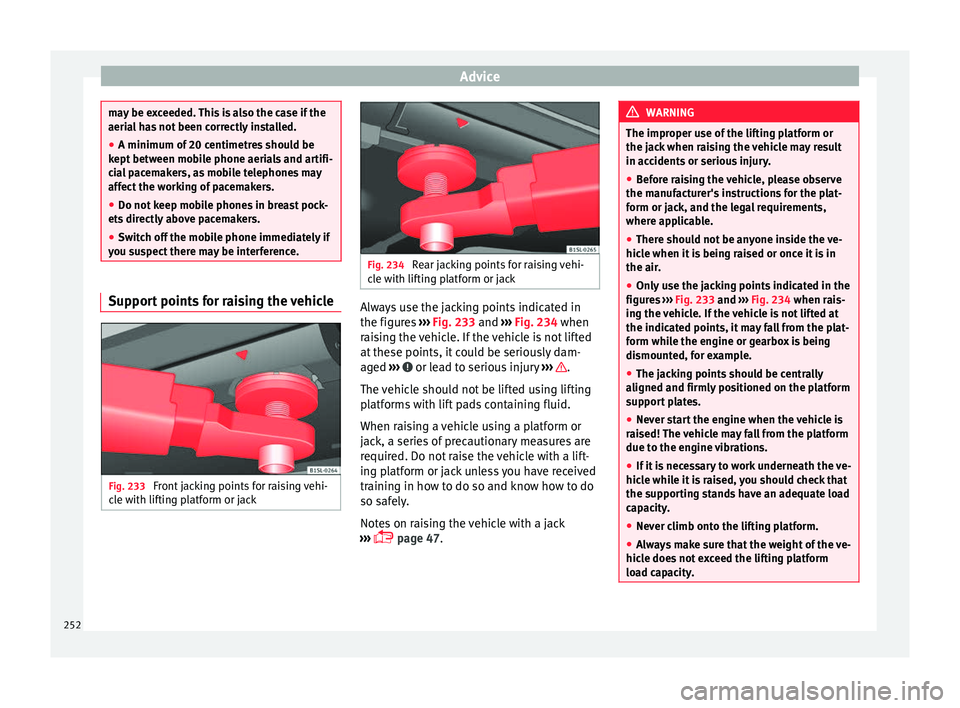
Fig. 233
Front jacking points for raising vehi-
c l
e w
ith lifting platform or jack Fig. 234
Rear jacking points for raising vehi-
cl e w
ith lifting platform or jack Always use the jacking points indicated in
the figur
e
s
››› Fig. 233 and ››› Fig. 234 when
raising the vehicle. If the vehicle is not lifted
at these points, it could be seriously dam-
aged ››› or lead to serious injury
››
›
.
The v
ehic
le should not be lifted using lifting
platforms with lift pads containing fluid.
When raising a vehicle using a platform or
jack, a series of precautionary measures are
required. Do not raise the vehicle with a lift-
ing platform or jack unless you have received
training in how to do so and know how to do
so safely.
Notes on raising the vehicle with a jack
››› page 47. WARNING
The improper use of the lifting platform or
the jac k
when raising the vehicle may result
in accidents or serious injury.
● Before raising the vehicle, please observe
the manufact
urer's instructions for the plat-
form or jack, and the legal requirements,
where applicable.
● There should not be anyone inside the ve-
hicle when it
is being raised or once it is in
the air.
● Only use the jacking points indicated in the
figures
››› Fig. 233 and ››› Fig. 234 when rais-
ing the vehicle. If the vehicle is not lifted at
the indicated points, it may fall from the plat-
form while the engine or gearbox is being
dismounted, for example.
● The jacking points should be centrally
aligned and firmly
positioned on the platform
support plates.
● Never start the engine when the vehicle is
raised!
The vehicle may fall from the platform
due to the engine vibrations.
● If it is necessary to work underneath the ve-
hicle whi
le it is raised, you should check that
the supporting stands have an adequate load
capacity.
● Never climb onto the lifting platform.
● Always make sure that the weight of the ve-
hicle doe
s not exceed the lifting platform
load capacity. 252
Page 271 of 324
Checking and refilling levels
Auxiliary heater
V ehic
l
es with a diesel engine may be fitted
with an auxiliary heater. The heater runs off
the fuel from the fuel tank. On doing so,
smells and steam may be noticed outside the
vehicle for a short period. This is normal and
it is not an indication of a fault in the vehicle.
Whenever there is little fuel in the tank (re-
serve), the auxiliary heater automatically
switches off. WARNING
Never use start boosters. An aerosol start
boos t
er could explode or cause a sudden rise
in engine speed leading to engine damage
and serious injury. CAUTION
● The v ehic
le is not prepared for the use of
biodiesel. Never, under any circumstances re-
fuel with biodiesel. It could damage the fuel
system and subsequently lead to engine
faults!
● The addition of biodiesel to diesel by the
diesel pr
oducer according to Standard EN 590
or other equivalent (DIN 51628 in Germany,
for example) is authorised and causes no
type of damage to the engine or the fuel sys-
tem.
● The diesel engine has been designed for to
use diesel
fuel exclusively. Therefore, never
use petrol, fuel oil or other unsuitable fuels. The composition of these fuels may signifi-
cantly
d
amage the fuel system and the en-
gine.
● The use of diesel fuels with a high sulphur
percent
age could considerably reduce the
service life of the diesel particulate filter.
Your technical service centre will be able to
tell you which countries have diesel with a
high sulphur content. Information on fuel consumption
The consumption and emission values indi-
c
at
ed do not
refer to one specific vehicle.
They are only to be used to compare the val-
ues of the different vehicle versions. The fuel
consumption and CO 2 emissions of a vehicle
not only depend on the effective use of fuel.
They also depend on your driving style and
other non-technical factors.
Calculation of fuel consumption
Fuel consumption and emission values are
determined according to the current version
of the 715/2007/EC or 80/1268/EEC regula-
tion and are valid for the vehicle kerb weight.
The specifications do not refer to an individu-
al vehicle. Two measuring cycles are carried
out on a rolling road test bed to calculate fuel
consumption. The test criteria are as follows:
Urban cycle
Measurement of the urban cycle
starts with an engine cold start. City
driving is simulated below at be-
tween 0 and 50 km/h (31 mph).
Road cycle
In the road cycle simulation, the car
undergoes frequent acceleration and
braking in all gears, as in normal ev-
eryday driving. The road speed rang-
es from 0 to 120 km/h (0 to 75 mph).
Combined
The average combined consumption
is calculated with a weighting of
around 37 % for the urban cycle and
63 % for the road cycle.
CO 2 emissions
of the combina-
tion
The exhaust gases are collected dur-
ing both driving cycles to calculate
carbon dioxide emissions (urban and
road). The gas composition is then
analysed to evaluate the CO 2 content
and other emissions. Note
● The kerb w eight
may vary according to the
vehicle equipment. This could raise consump-
tion and the CO 2 emissions slightly.
● In practice, consumption values could be
different
to the values calculated based on
the 715/2007/EC or 80/1268/EEC regula-
tions. 269
Technical data
Advice
Operation
Emergencies
Safety
Page 301 of 324
Technical features
● Vehic
l
e identification number (chassis
number).
● Vehicle type, engine power, gearbox type.
● Engine and gearbox code, paint number,
interior equipment.
● Option
al extras, PR numbers.
These dat
a are also provided in the Mainte-
nance Programme.
Type plate
The type plate is visible when the driver door
is opened, on the lower part of the strut. Ve-
hicles for certain export countries do not
have a type plate.
The manufacturer's type plate contains the
following data:
● Gross vehicle weight
● Maximum authorised weight of vehicle and
trail
er
● Maximum gross front axle weight
● Maximum rear axle weight
Information on fuel consumption The consumption and emission details
sho
wn on the
v
ehicle data sticker differ from
one vehicle to another. The fuel consumption, CO
2 emiss
ions and ac-
tual kerb weight of the vehicle are noted on
the vehicle data sticker.
The fuel consumption and emissions figures
given are based on the vehicle weight cate-
gory, which is determined according to the
engine/gearbox combination and the equip-
ment fitted.
The consumption and emission figures are
calculated in accordance with the EC test re-
quirements 1999/100/EC. These test re-
quirements specify a realistic test method
based on normal everyday driving.
The following test conditions are applied:
Urban cycleThe urban cycle starts with an engine
cold start. City driving is then simulated.
Extra urban
cycle
In the extra urban cycle simulation the
vehicle frequently accelerates and
brakes in all gears, as in normal every-
day driving. The road speed ranges from
0 to 120 km/h (0 to 75 mph).
Total con-
sumptionThe average total consumption is calcu-
lated with a weighting of around 37% for
the urban cycle and 63% for the extra ur-
ban cycle.
CO 2 emis-
sions
The exhaust gases are collected during
both driving cycles to calculate carbon
dioxide emissions. The gas composition
is then analysed to evaluate the CO 2
content and other emissions. Note
● Act ua
l consumption may vary from quoted
test values, depending on personal driving
style, road and traffic conditions, the weather
and the vehicle condition.
● Fuel consumption and CO
2 value
s can vary
depending on the vehicle's tyres. Weights
Kerb weight refers to the basic model with a
f
uel
t
ank filled to 90% capacity and without
optional extras. The figure quoted includes
75 kg to allow for the weight of the driver.
Special versions, optional equipment fittings
or retro-fitting accessories will increase the
weight of the vehicle ››› .
WARNING
● Ple a
se note that the centre of gravity may
shift when transporting heavy objects; this
may affect vehicle handling and lead to an ac-
cident. Always adjust your speed and driving
style to suit road conditions and require-
ments.
● Never exceed the gross axle weight rating
or the gros
s vehicle weight rating. If the per-
missible axle load or the permissible total
weight is exceeded, the driving characteris-
tics of the vehicle may change, leading to ac-
cidents, injuries and damage to the vehicle. 299
Technical data
Advice
Operation
Emergencies
Safety
Page 302 of 324
Technical data
Towing a trailer Tr
ai
ler weights Trailer weight
The trai
l
er weights and drawbar loads ap-
proved are selected in intensive trials accord-
ing to precisely defined criteria. The ap-
proved trailer weights are valid for vehicles in
the EU for maximum speeds of 80 km/h (50
mph) (in certain circumstances up to 100
km/h (62 mph)). The figures may be different
in other countries. All data in the official vehi-
cle documentation takes precedence over
these data at all times ››› .
Dr a
wb
ar loads
The maximum permitted drawbar load on the
ball joint of the towing bracket must not ex-
ceed 100 kg.
In the interest of road safety, we recommend
that you always tow approaching the maxi-
mum drawbar load. The response of the trail-
er on the road will be poor, if the drawbar
load is too small.
If the maximum permissible drawbar load
cannot be met (e.g. with small, empty and
light-weight single axle trailers or tandem
axle trailers with a wheelbase of less than 1
metre), a minimum of 4% of the actual trailer
weight is legally required for the drawbar
load. WARNING
● For s af
ety reasons, do not exceed the 80
km/h (50 mph) limit. This is also valid in
countries where higher speeds are permitted.
● Never exceed the maximum trailer weights
or the drawb
ar load. If the permissible axle
load or the permissible total weight is excee-
ded, the driving characteristics of the vehicle
may change, leading to accidents, injuries
and damage to the vehicle. Wheels
Ty
r
e pressure, snow chains, wheel
bolts Tyre pressures
The s
tic
k
er with the tyre pressure values can
be found on the inside of the fuel tank flap.
The tyre pressure values given there are for
cold tyres. The slightly raised pressures of
warm tyres must not be reduced. ››› The pressure for winter tyres is 0.2 bar
(2.9 p
s
i / 20 kP
a) higher than that of summer
tyres.
Snow chains
Snow chains may be fitted only to the front
wheels.
Consult the section “wheels” of this manual. Wheel bolts
After the wheel
s have been changed, the
tightening torque of the wheel bolts should
be checked as soon as possible with a torque
wrench ››› . The tightening torque for steel
and al lo
y
wheels is 140 Nm. WARNING
● Check the ty
re pressure at least once per
month. Checking the tyre pressure is very im-
portant. If the tyre pressure is too high or too
low, there is an increased danger of accidents
- particularly at high speeds.
● If the tightening torque of the wheel bolts
is t
oo low, they could loosen while the vehi-
cle is in motion. Risk of accident! If the tight-
ening torque is too high, the wheel bolts and
threads can be damaged. Note
We recommend that you ask your Technical
Serv ic
e for information about appropriate
wheel, tyre and snow chain size. 300
Page 303 of 324
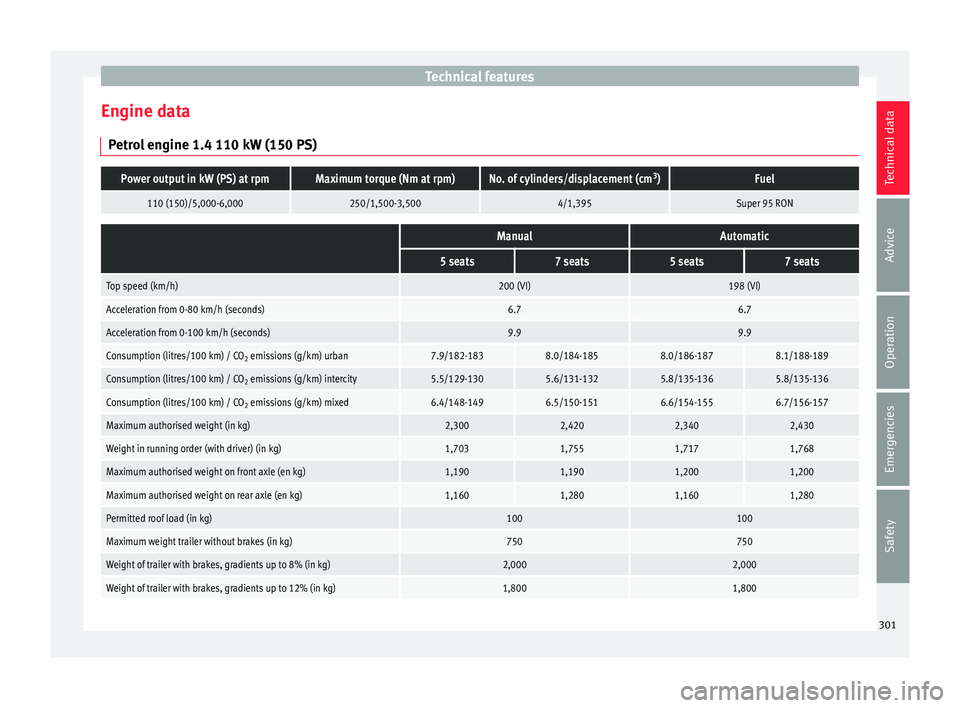
Technical features
Engine data P etr
o
l engine 1.4 110 kW (150 PS)
Power output in kW (PS) at rpmMaximum torque (Nm at rpm)No. of cylinders/displacement (cm 3
)Fuel
110 (150)/5,000-6,000250/1,500-3,5004/1,395Super 95 RON
ManualAutomatic
5 seats7 seats5 seats7 seats
Top speed (km/h)200 (VI)198 (VI)
Acceleration from 0-80 km/h (seconds)6.76.7
Acceleration from 0-100 km/h (seconds)9.99.9
Consumption (litres/100 km) / CO 2 emissions (g/km) urban7.9/182-1838.0/184-1858.0/186-1878.1/188-189
Consumption (litres/100 km) / CO
2 emissions (g/km) intercity5.5/129-1305.6/131-1325.8/135-1365.8/135-136
Consumption (litres/100 km) / CO
2 emissions (g/km) mixed6.4/148-1496.5/150-1516.6/154-1556.7/156-157
Maximum authorised weight (in kg)2,3002,4202,3402,430
Weight in running order (with driver) (in kg)1,7031,7551,7171,768
Maximum authorised weight on front axle (en kg)1,1901,1901,2001,200
Maximum authorised weight on rear axle (en kg)1,1601,2801,1601,280
Permitted roof load (in kg)100100
Maximum weight trailer without brakes (in kg)750750
Weight of trailer with brakes, gradients up to 8% (in kg)2,0002,000
Weight of trailer with brakes, gradients up to 12% (in kg)1,8001,800 301
Technical data
Advice
Operation
Emergencies
Safety
Page 304 of 324
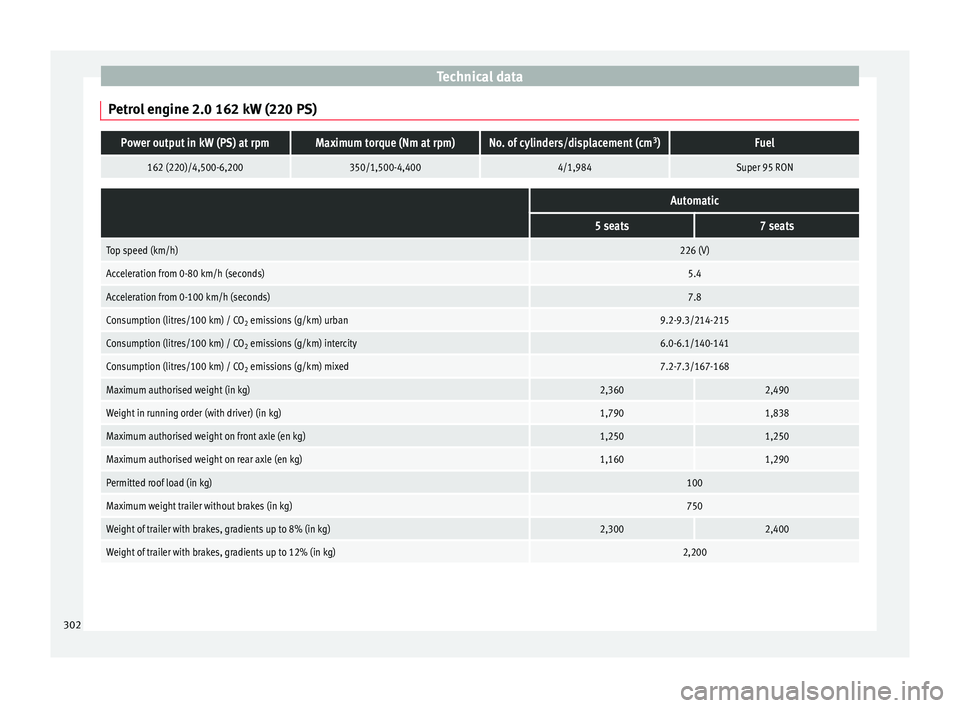
Technical data
Petrol engine 2.0 162 kW (220 PS)Power output in kW (PS) at rpmMaximum torque (Nm at rpm)No. of cylinders/displacement (cm 3
)Fuel
162 (220)/4,500-6,200350/1,500-4,4004/1,984Super 95 RON
Automatic
5 seats7 seats
Top speed (km/h)226 (V)
Acceleration from 0-80 km/h (seconds)5.4
Acceleration from 0-100 km/h (seconds)7.8
Consumption (litres/100 km) / CO 2 emissions (g/km) urban9.2-9.3/214-215
Consumption (litres/100 km) / CO
2 emissions (g/km) intercity6.0-6.1/140-141
Consumption (litres/100 km) / CO
2 emissions (g/km) mixed7.2-7.3/167-168
Maximum authorised weight (in kg)2,3602,490
Weight in running order (with driver) (in kg)1,7901,838
Maximum authorised weight on front axle (en kg)1,2501,250
Maximum authorised weight on rear axle (en kg)1,1601,290
Permitted roof load (in kg)100
Maximum weight trailer without brakes (in kg)750
Weight of trailer with brakes, gradients up to 8% (in kg)2,3002,400
Weight of trailer with brakes, gradients up to 12% (in kg)2,200 302
Page 305 of 324
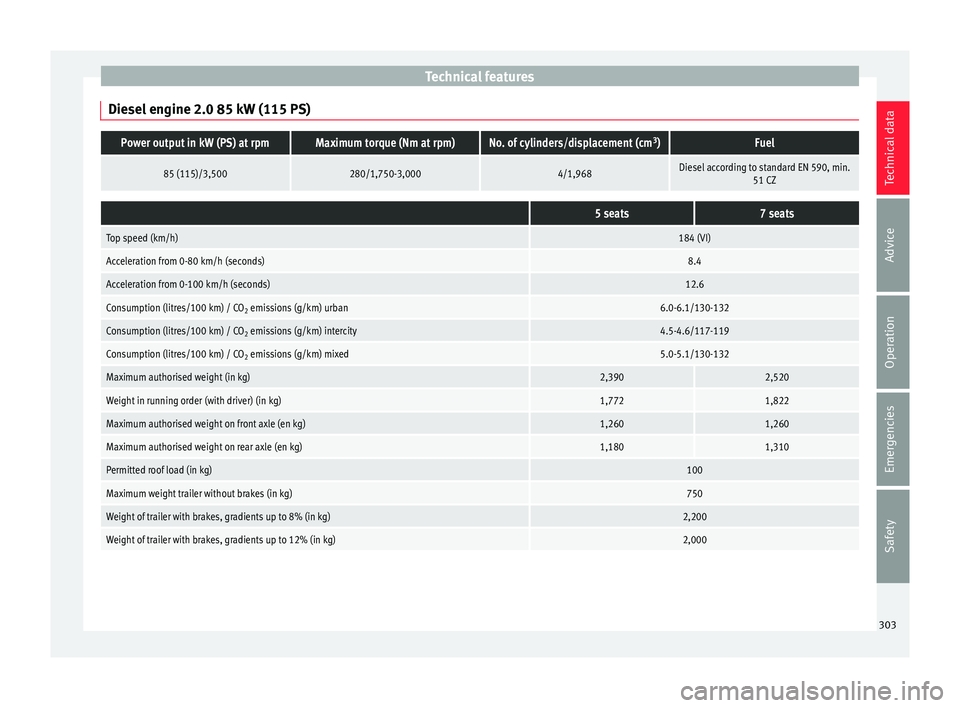
Technical features
Diesel engine 2.0 85 kW (115 PS)Power output in kW (PS) at rpmMaximum torque (Nm at rpm)No. of cylinders/displacement (cm 3
)Fuel
85 (115)/3,500280/1,750-3,0004/1,968Diesel according to standard EN 590, min.
51 CZ
5 seats7 seats
Top speed (km/h)184 (VI)
Acceleration from 0-80 km/h (seconds)8.4
Acceleration from 0-100 km/h (seconds)12.6
Consumption (litres/100 km) / CO 2 emissions (g/km) urban6.0-6.1/130-132
Consumption (litres/100 km) / CO
2 emissions (g/km) intercity4.5-4.6/117-119
Consumption (litres/100 km) / CO
2 emissions (g/km) mixed5.0-5.1/130-132
Maximum authorised weight (in kg)2,3902,520
Weight in running order (with driver) (in kg)1,7721,822
Maximum authorised weight on front axle (en kg)1,2601,260
Maximum authorised weight on rear axle (en kg)1,1801,310
Permitted roof load (in kg)100
Maximum weight trailer without brakes (in kg)750
Weight of trailer with brakes, gradients up to 8% (in kg)2,200
Weight of trailer with brakes, gradients up to 12% (in kg)2,000 303
Technical data
Advice
Operation
Emergencies
Safety
Page 306 of 324
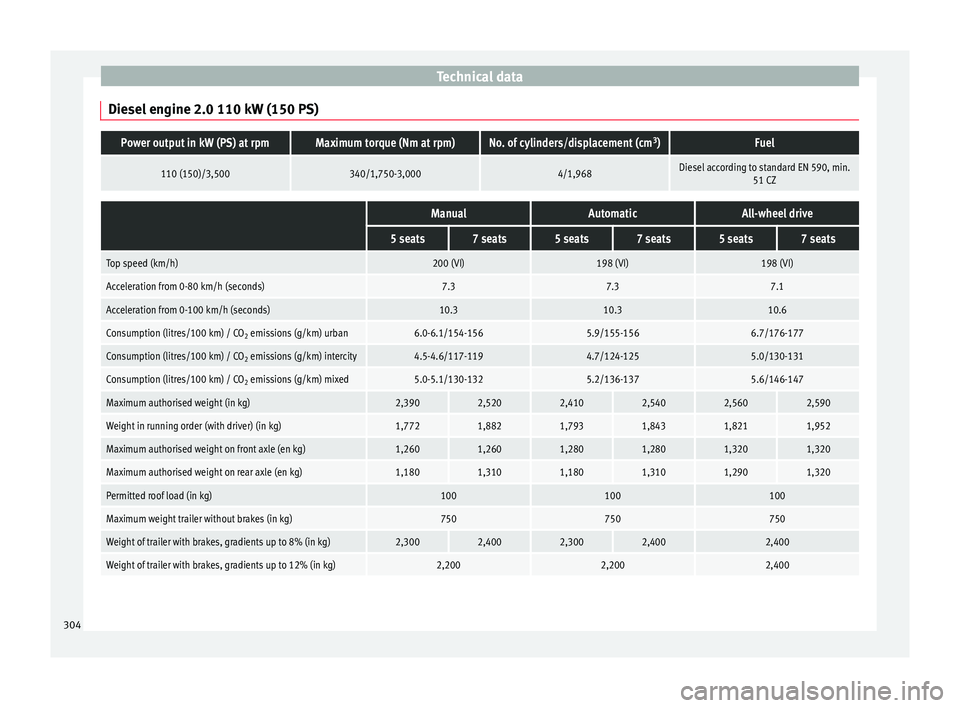
Technical data
Diesel engine 2.0 110 kW (150 PS)Power output in kW (PS) at rpmMaximum torque (Nm at rpm)No. of cylinders/displacement (cm 3
)Fuel
110 (150)/3,500340/1,750-3,0004/1,968Diesel according to standard EN 590, min.
51 CZ
ManualAutomaticAll-wheel drive
5 seats7 seats5 seats7 seats5 seats7 seats
Top speed (km/h)200 (VI)198 (VI)198 (VI)
Acceleration from 0-80 km/h (seconds)7.37.37.1
Acceleration from 0-100 km/h (seconds)10.310.310.6
Consumption (litres/100 km) / CO 2 emissions (g/km) urban6.0-6.1/154-1565.9/155-1566.7/176-177
Consumption (litres/100 km) / CO
2 emissions (g/km) intercity4.5-4.6/117-1194.7/124-1255.0/130-131
Consumption (litres/100 km) / CO
2 emissions (g/km) mixed5.0-5.1/130-1325.2/136-1375.6/146-147
Maximum authorised weight (in kg)2,3902,5202,4102,5402,5602,590
Weight in running order (with driver) (in kg)1,7721,8821,7931,8431,8211,952
Maximum authorised weight on front axle (en kg)1,2601,2601,2801,2801,3201,320
Maximum authorised weight on rear axle (en kg)1,1801,3101,1801,3101,2901,320
Permitted roof load (in kg)100100100
Maximum weight trailer without brakes (in kg)750750750
Weight of trailer with brakes, gradients up to 8% (in kg)2,3002,4002,3002,4002,400
Weight of trailer with brakes, gradients up to 12% (in kg)2,2002,2002,400 304
Page 307 of 324
Technical features
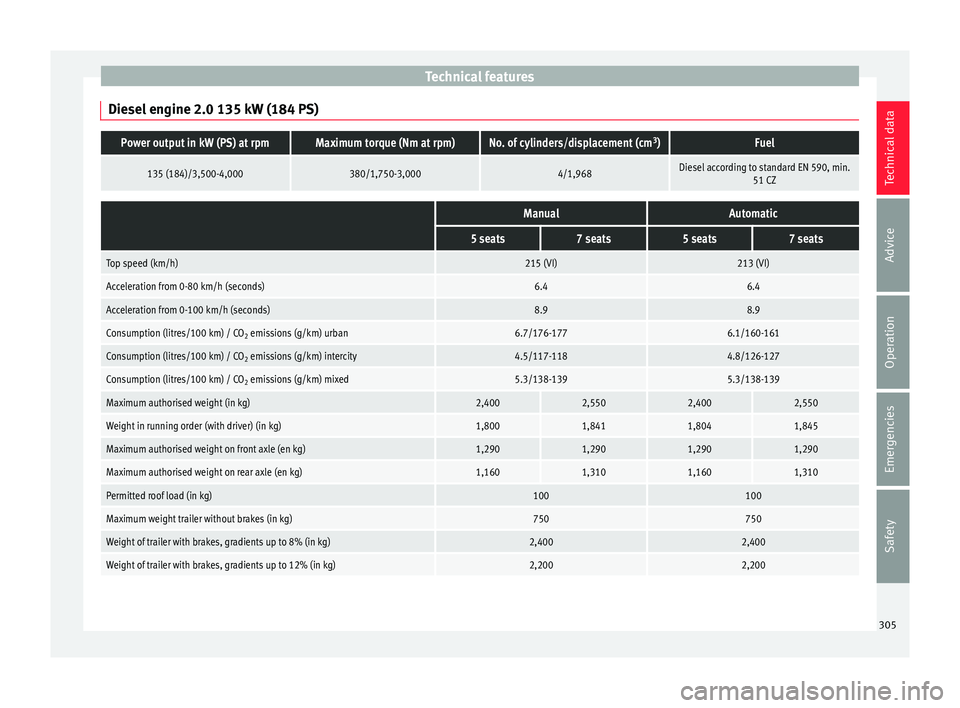
Diesel engine 2.0 135 kW (184 PS)Power output in kW (PS) at rpmMaximum torque (Nm at rpm)No. of cylinders/displacement (cm 3
)Fuel
135 (184)/3,500-4,000380/1,750-3,0004/1,968Diesel according to standard EN 590, min.
51 CZ
ManualAutomatic
5 seats7 seats5 seats7 seats
Top speed (km/h)215 (VI)213 (VI)
Acceleration from 0-80 km/h (seconds)6.46.4
Acceleration from 0-100 km/h (seconds)8.98.9
Consumption (litres/100 km) / CO 2 emissions (g/km) urban6.7/176-1776.1/160-161
Consumption (litres/100 km) / CO
2 emissions (g/km) intercity4.5/117-1184.8/126-127
Consumption (litres/100 km) / CO
2 emissions (g/km) mixed5.3/138-1395.3/138-139
Maximum authorised weight (in kg)2,4002,5502,4002,550
Weight in running order (with driver) (in kg)1,8001,8411,8041,845
Maximum authorised weight on front axle (en kg)1,2901,2901,2901,290
Maximum authorised weight on rear axle (en kg)1,1601,3101,1601,310
Permitted roof load (in kg)100100
Maximum weight trailer without brakes (in kg)750750
Weight of trailer with brakes, gradients up to 8% (in kg)2,4002,400
Weight of trailer with brakes, gradients up to 12% (in kg)2,2002,200 305
Technical data
Advice
Operation
Emergencies
Safety
Page 308 of 324
Technical data
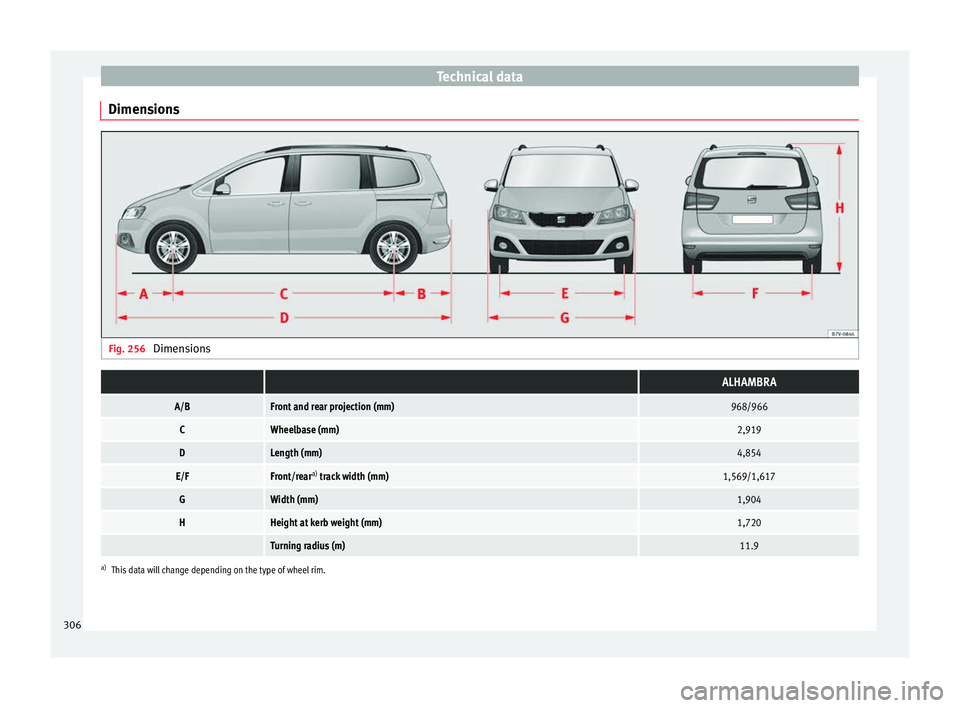
Dimensions Fig. 256
Dimensions ALHAMBRA
A/BFront and rear projection (mm)968/966
CWheelbase (mm)2,919
DLength (mm)4,854
E/FFront/rear a)
track width (mm)1,569/1,617
GWidth (mm)1,904
HHeight at kerb weight (mm)1,720
Turning radius (m)11.9
a) This data will change depending on the type of wheel rim.
306