warning Seat Alhambra 2016 Manual Online
[x] Cancel search | Manufacturer: SEAT, Model Year: 2016, Model line: Alhambra, Model: Seat Alhambra 2016Pages: 324, PDF Size: 5.93 MB
Page 143 of 324
Lights and visibility
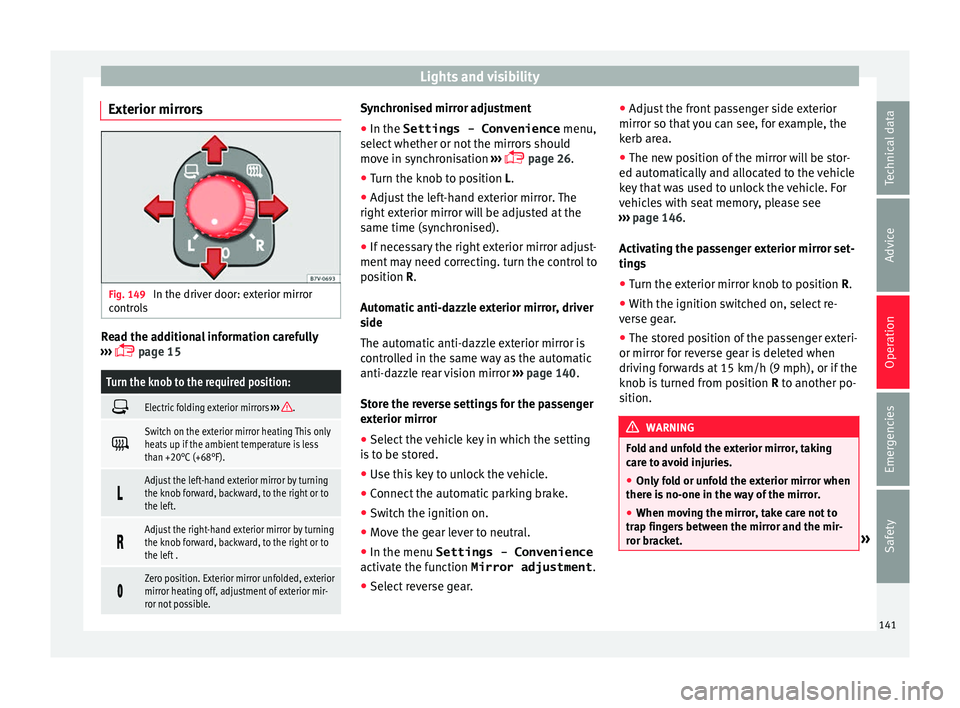
Exterior mirrors Fig. 149
In the driver door: exterior mirror
c ontr
o
ls Read the additional information carefully
› ›
›
page 15
Turn the knob to the required position:
Electric folding exterior mirrors
››› .
Switch on the exterior mirror heating This only
heats up if the ambient temperature is less
than +20°C (+68°F).
Adjust the left-hand exterior mirror by turning
the knob forward, backward, to the right or to
the left.
Adjust the right-hand exterior mirror by turning
the knob forward, backward, to the right or to
the left .
Zero position. Exterior mirror unfolded, exterior
mirror heating off, adjustment of exterior mir-
ror not possible. Synchronised mirror adjustment
●
In the Settings - Convenience menu,
sel ect
whether or not
the mirrors should
move in synchronisation ›››
page 26.
● Turn the knob to position L.
● Adjust the left-hand exterior mirror. The
right ext
erior mirror will be adjusted at the
same time (synchronised).
● If necessary the right exterior mirror adjust-
ment ma
y need correcting. turn the control to
position R.
Automatic anti-dazzle exterior mirror, driver
side
The automatic anti-dazzle exterior mirror is
controlled in the same way as the automatic
anti-dazzle rear vision mirror ››› page 140.
Store the reverse settings for the passenger
exterior mirror ● Select the vehicle key in which the setting
is t
o be stored.
● Use this key to unlock the vehicle.
● Connect the automatic parking brake.
● Switch the ignition on.
● Move the gear lever to neutral.
● In the menu Settings - Convenience
activate the f
unction Mirror adjustment .
● Select reverse gear. ●
Adjust
the front passenger side exterior
mirror so that you can see, for example, the
kerb area.
● The new position of the mirror will be stor-
ed automatic
ally and allocated to the vehicle
key that was used to unlock the vehicle. For
vehicles with seat memory, please see
››› page 146.
Activating the passenger exterior mirror set-
tings
● Turn the exterior mirror knob to position R.
● With the ignition switched on, select re-
verse g
ear.
● The stored position of the passenger exteri-
or mirror for r
everse gear is deleted when
driving forwards at 15 km/h (9 mph), or if the
knob is turned from position R to another po-
sition. WARNING
Fold and unfold the exterior mirror, taking
car e t
o avoid injuries.
● Only fold or unfold the exterior mirror when
there is
no-one in the way of the mirror.
● When moving the mirror, take care not to
trap fing
ers between the mirror and the mir-
ror bracket. » 141
Technical data
Advice
Operation
Emergencies
Safety
Page 144 of 324
Operation
WARNING
Failure to correctly estimate the distance of
the v ehic
le behind could lead to serious acci-
dent.
● Rear-view convex or aspheric mirrors in-
cre
ase the field of vision, however objects ap-
pear smaller and further away in the mirrors.
● The use of these mirrors to estimate the
dist
ance to the next vehicle when changing
lane is imprecise and could result in serious
accident.
● If possible, use the rear vision mirror to es-
timate di
stances to vehicles behind you or in
other circumstances.
● Make sure that the rear visibility is ade-
quate. CAUTION
● Bef or
e entering a car wash, always ensure
that the exterior mirrors are correctly folded
in.
● Electrically-folding exterior mirrors should
not be fo
lded and unfolded mechanically as
this may damage the electrical operation. For the sake of the environment
The exterior mirror heating should be switch-
ed off when it i
s no longer needed. Other-
wise, it is an unnecessary fuel waste. Note
● The ext erior mirr
or heating initially heats
up with a high power, after two minutes the
heat will depend upon the ambient tempera-
ture.
● In the event of a fault, the electric exterior
mirrors
can be adjusted manually by pressing
the edge of the mirror surface. Seats and head restraints
Adju
s
tin
g the seats and head
restraints
Manual adjustment of seats Read the additional information carefully
›› ›
page 13 WARNING
The safe driving chapter contains important
inform ation, tip
s, suggestions and warnings
that you should read and observe for your
own safety and the safety of your passengers
››› page 56. WARNING
● Adjus t
the front seats only when the vehi-
cle is stationary. Failure to follow this instruc-
tion could result in an accident.
● Be careful when adjusting the seat height.
Carel
ess or uncontrolled adjustment can
cause injuries.
● The front seat backrests must not be re-
clined for driv
ing. Otherwise, seat belts and
the airbag system might not protect as they
should in the case of an accident, increasing
risk of injury. 142
Page 145 of 324
Seats and head restraints
Electric driver seat adjustment* Read the additional information carefully
›› ›
page 14 WARNING
Using the front electric seats in a careless or
unc ontr
olled manner may lead to severe inju-
ries.
● The front seats can also be electrically ad-
just
ed when the ignition is switched off. Nev-
er leave children or disabled people alone in
the vehicle.
● In the event of an emergency, stop electri-
cal
adjustment by pressing any button. CAUTION
So as not the damage the electrical compo-
nents of
the front seats, do not kneel on the
seats or apply specific pressure to one point
of the seat or seat backrest. Note
● It m a
y not be possible to electrically adjust
the seat if the vehicle battery is very low.
● Seat adjustment is stopped when the en-
gine is s
tarted. Adjusting the rear seats
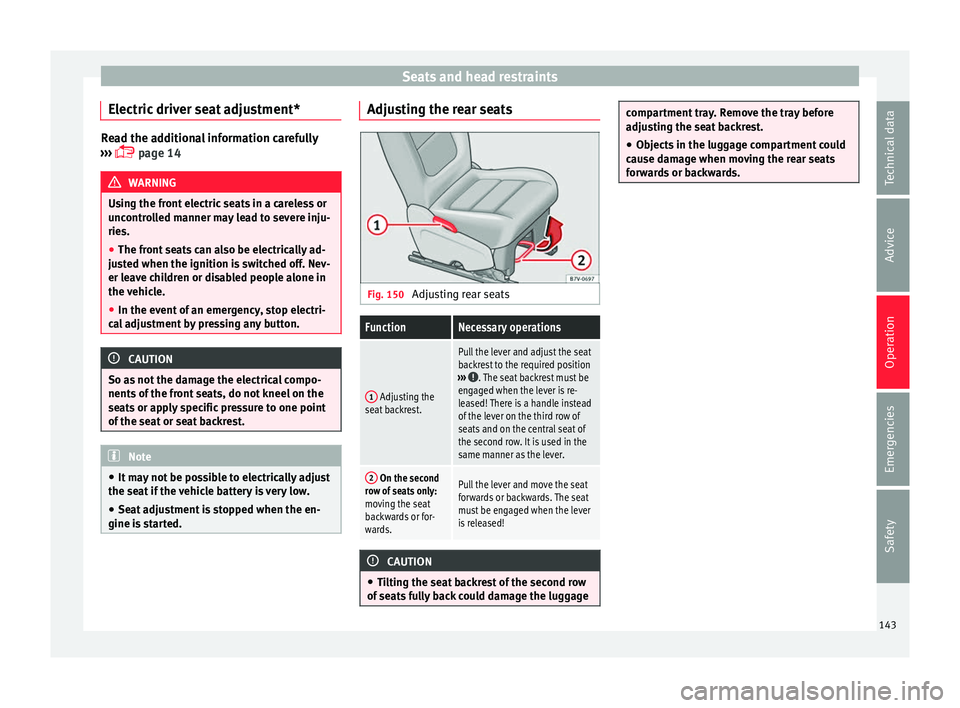
Fig. 150
Adjusting rear seats
FunctionNecessary operations
1 Adjusting the
seat backrest.
Pull the lever and adjust the seat
backrest to the required position
›››
. The seat backrest must be
engaged when the lever is re-
leased! There is a handle instead
of the lever on the third row of
seats and on the central seat of
the second row. It is used in the
same manner as the lever.
2 On the second
row of seats only:
moving the seat
backwards or for-
wards.Pull the lever and move the seat
forwards or backwards. The seat
must be engaged when the lever
is released! CAUTION
● Tiltin g the se
at backrest of the second row
of seats fully back could damage the luggage compartment tray. Remove the tray before
adju
s
ting the seat backrest.
● Objects in the luggage compartment could
cause d
amage when moving the rear seats
forwards or backwards. 143
Technical data
Advice
Operation
Emergencies
Safety
Page 148 of 324
Operation
Removing the head restraints from the sec-
ond and thir d r
o
w of seats
● Fold the backrest of the rear seat forwards
›››
page 154.
● Push the head restraint up as far as it will
go ››
› .
● Pull out the head restraint ››
›
Fig. 154 1 with the button pressed.
●
Fold the backrest of the rear seat back-
w ar
d
s until it is engaged.
Fitting the head restraints in the second and
third row of seats
● Fold the backrest of the rear seat forwards
›››
page 154.
● Insert the head restraint into the guides on
the seat b
ackrest.
● Push the head restraint down while press-
ing the butt
on 1 .
● Fold the backrest of the rear seat backward
ag ain u
nti
l it is engaged.
● Adjust the head restraint to the correct po-
sition ››
› page 144. WARNING
Travelling with the head restraints removed
or improperly a
djusted increases the risk of
severe or fatal injuries in the event of acci-
dents and sudden braking or manoeuvres. ●
Alw a
ys fit and adjust the head restraint
properly whenever a person is occupying a
seat.
● Refit any removed head restraints immedi-
ately so th
at passengers are properly protec-
ted.
● All vehicle occupants must correctly adjust
the head r
estraint according to their height to
reduce the risk of back injuries in the event of
an accident. The upper edge of the head re-
straint must be as close as possible to the
same level as the top of your head and under
no circumstances below eye level. Keep the
back of your neck as close as possible to the
head restraint.
● Never adjust the head restraint while the
vehicl
e is in motion. CAUTION
When removing and fitting the head restraint,
mak e s
ure it does not hit the headliner of the
vehicle or the front seat backrest. Otherwise,
the interior roof and other parts of the vehicle
could be damaged. Seat functions
Se at
he
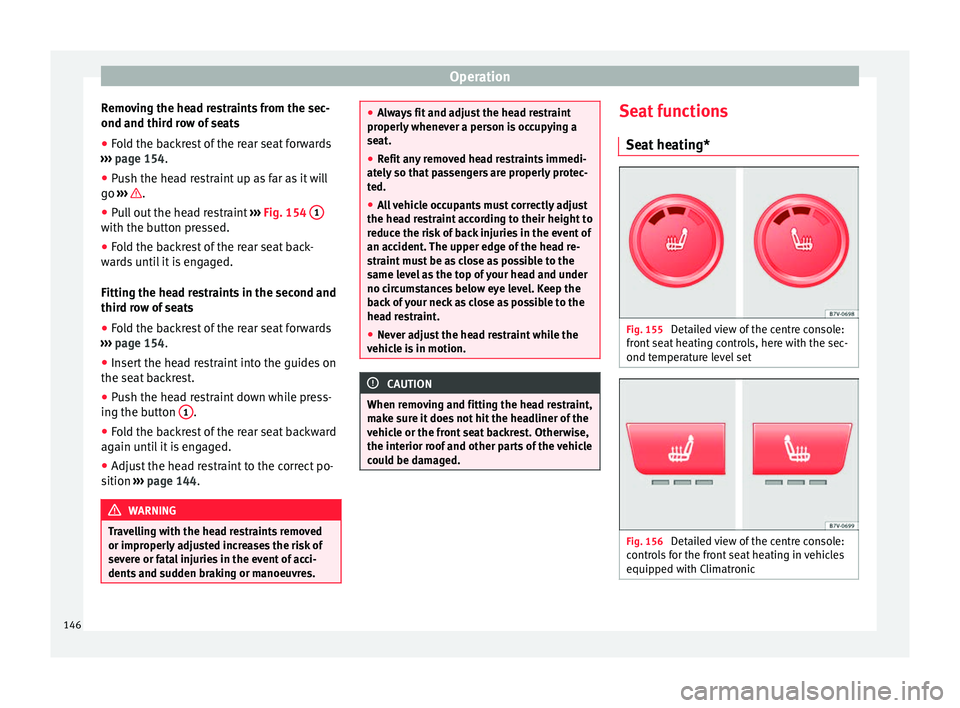
ating* Fig. 155
Detailed view of the centre console:
fr ont
se
at heating controls, here with the sec-
ond temperature level set Fig. 156
Detailed view of the centre console:
c ontr o
ls for the front seat heating in vehicles
equipped with Climatronic 146
Page 149 of 324
Seats and head restraints
The seat cushions can be heated electrically
when the ignition i s
sw
itched on. The back-
rest is also heated in some versions.
Switch off seat heating if there is nobody in
the seat.
FunctionAction ››› Fig. 155, ››› Fig. 156
ActivatePress button . Seat heating is
switched on fully.
Adjusting the
heating outputKeep pressing button until the re-
quired intensity is set.
DeactivatingKeep pressing button until all of
the lights are switched off
››› Fig. 155, ››› Fig. 156. WARNING
Inappropriate use of the seat functions can
cau se sev
ere injuries.
● Assume the proper sitting position before
your trip and rem
ain in it throughout. This al-
so applies to the other occupants.
● Only adjust the seat position memory when
the vehic
le is stationary.
● Only switch the lumbar massage function
on and off when the v
ehicle is stationary.
● Keep hands, fingers, feet and other limbs
awa
y from the seat operating and adjustment
radius. WARNING
People whose pain and temperature thresh-
ol d h
as been affected by some kind of medi-
cine, paraplegia or chronic illness (e.g. diabe-
tes) may sustain burns to the back, buttocks
and legs from using the seat heaters that
may lead to a long healing process or that
may never completely heal. Seek medical ad-
vice if you have doubts regarding your health.
● People with limited pain and temperature
thresho
lds must never use seat heating. CAUTION
● To av oid d
amaging the heating elements of
the seat heaters, please do not kneel on the
seat or apply sharp pressure to a single point
on the seat cushion or backrest.
● Liquids, sharp objects and insulating mate-
rial
s on the seat could damage the seat heat-
ing.
● In the event of smells, switch off the seat
heating immedi
ately and have the unit in-
spected by a specialised workshop. For the sake of the environment
The seat heating should remain on only when
needed. Otherw i
se, it is an unnecessary fuel
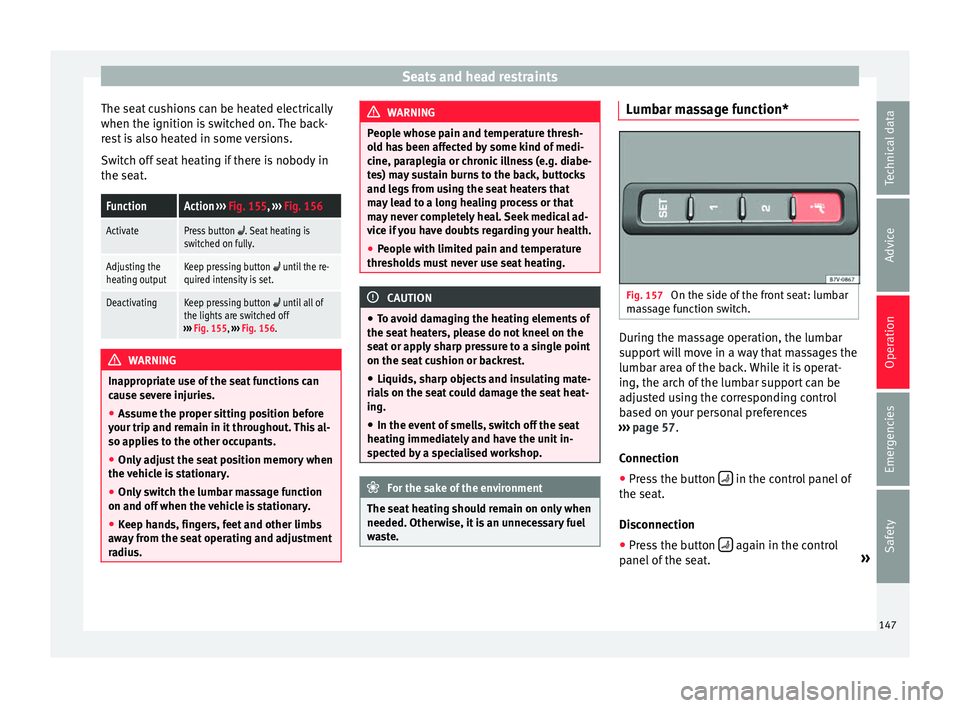
waste. Lumbar massage function*
Fig. 157
On the side of the front seat: lumbar
m a
s
sage function switch. During the massage operation, the lumbar
s
up
por
t will move in a way that massages the
lumbar area of the back. While it is operat-
ing, the arch of the lumbar support can be
adjusted using the corresponding control
based on your personal preferences
››› page 57.
Connection ● Press the button in the control panel of
the se at
.
Di
sconnection
● Press the button again in the control
p anel
of
the seat. »
147
Technical data
Advice
Operation
Emergencies
Safety
Page 150 of 324
Operation
Automatic off
● The lumbar massage will disconnect auto-
m atic
al
ly after approx. 10 minutes.
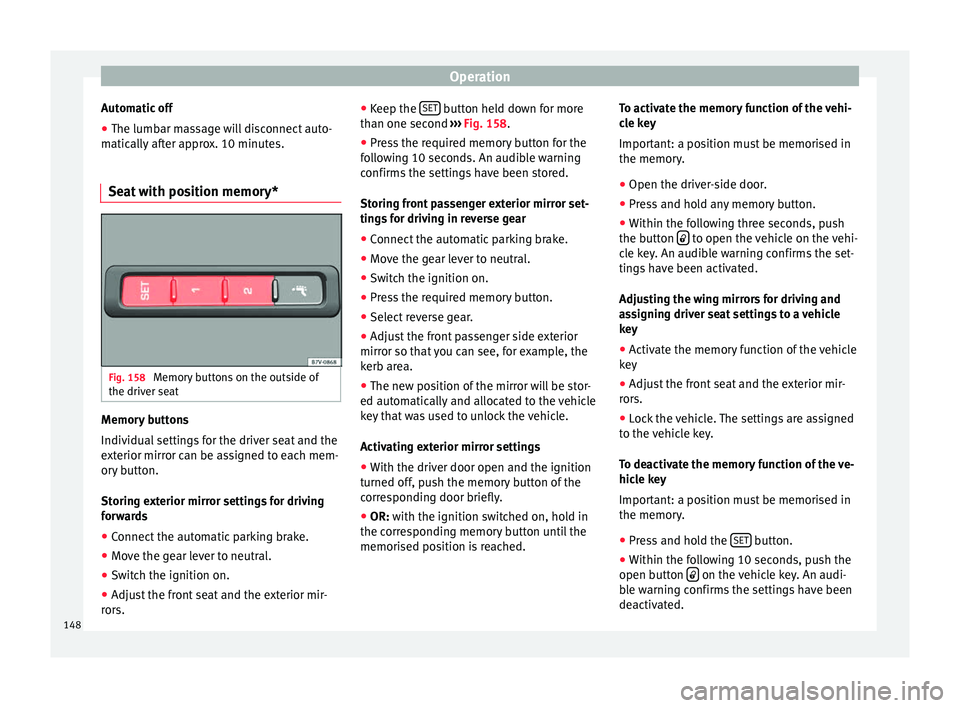
Seat with position memory* Fig. 158
Memory buttons on the outside of
the driv er se
at Memory buttons
Indiv
idual
settin
gs for the driver seat and the
exterior mirror can be assigned to each mem-
ory button.
Storing exterior mirror settings for driving
forwards
● Connect the automatic parking brake.
● Move the gear lever to neutral.
● Switch the ignition on.
● Adjust the front seat and the exterior mir-
rors. ●
K
eep the
SET button held down for more
th an one sec
ond ›
›› Fig. 158.
● Press the required memory button for the
fol
lowing 10 seconds. An audible warning
confirms the settings have been stored.
Storing front passenger exterior mirror set-
tings for driving in reverse gear
● Connect the automatic parking brake.
● Move the gear lever to neutral.
● Switch the ignition on.
● Press the required memory button.
● Select reverse gear.
● Adjust the front passenger side exterior
mirror so that
you can see, for example, the
kerb area.
● The new position of the mirror will be stor-
ed automatic
ally and allocated to the vehicle
key that was used to unlock the vehicle.
Activating exterior mirror settings
● With the driver door open and the ignition
turned off, p
ush the memory button of the
corresponding door briefly.
● OR: with the ignition switched on, hold in
the corr
esponding memory button until the
memorised position is reached. To activate the memory function of the vehi-
cle k
ey
Important: a position must be memorised in
the memory.
● Open the driver-side door.
● Press and hold any memory button.
● Within the following three seconds, push
the button to open the vehicle on the vehi-
c l
e k
ey. An audible warning confirms the set-
tings have been activated.
Adjusting the wing mirrors for driving and
assigning driver seat settings to a vehicle
key
● Activate the memory function of the vehicle
key
● Adjus
t the front seat and the exterior mir-
rors.
● L
ock the vehicle. The settings are assigned
to the v
ehicle key.
To deactivate the memory function of the ve-
hicle key
Important: a position must be memorised in
the memory.
● Press and hold the SET button.
● Within the following 10 seconds, push the
open b utt
on on the vehicle key. An audi-
b l
e w
arning confirms the settings have been
deactivated.
148
Page 151 of 324
Seats and head restraints
Initialising the seat position memory
The po s
ition memor
y system must be restar-
ted if, for example, the driver seat has been
changed.
Restarting deletes all memories and assign-
ments for the seat with position memory. The
memory buttons can then be reprogrammed
and the vehicle keys re-assigned.
● Open the driver door and do not get into
the vehic
le.
● Operating the seat settings from outside
the vehic
le.
● Move the angle of the seat backrest com-
plet
ely forwards.
● Release the control to set the angle and
then pres
s again until an audible warning is
heard. Note
The front passenger side exterior mirror auto-
matic a
lly changes from the position stored
for reversing as soon as the vehicle moves
forward at a speed of at least 15 km/h
(9 mph) or when the gear selection lever is
changed to a position other than R. Convenient entry function for the third
r
o
w of
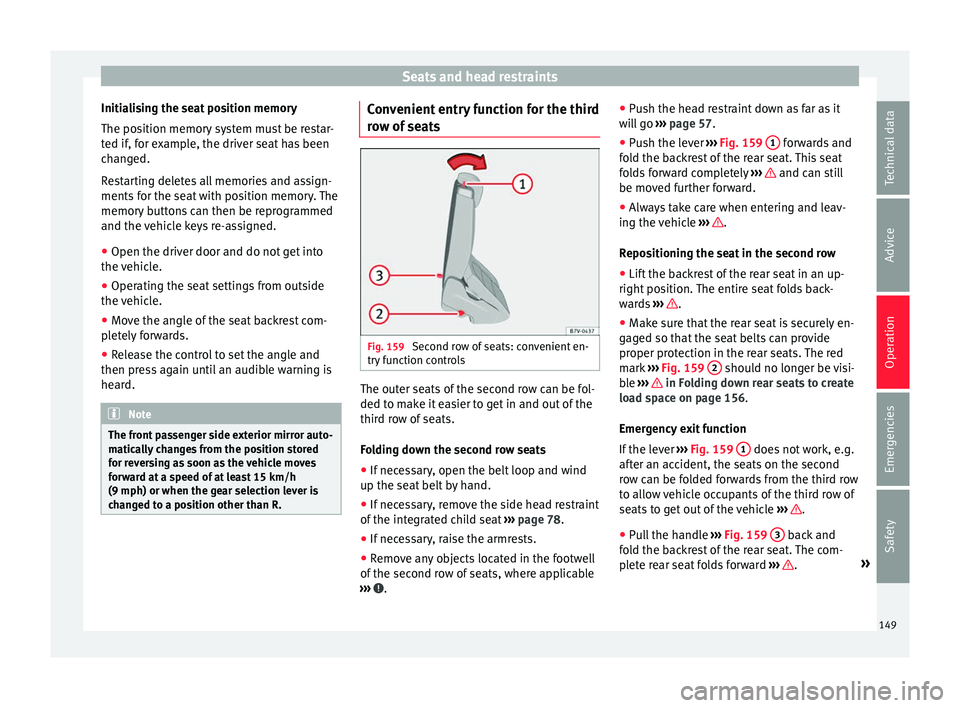
seats Fig. 159
Second row of seats: convenient en-
tr y
f
unction controls The outer seats of the second row can be fol-
ded t
o m
ak
e it easier to get in and out of the
third row of seats.
Folding down the second row seats
● If necessary, open the belt loop and wind
up the seat belt
by hand.
● If necessary, remove the side head restraint
of the inte
grated child seat ›››
page 78.
● If necessary, raise the armrests.
● Remove any objects located in the footwell
of the second r
ow of seats, where applicable
››› .●
Pu sh the he
ad restraint down as far as it
will go ››› page 57.
● Push the lever ›››
Fig. 159 1 forwards and
f o
l
d the backrest of the rear seat. This seat
folds forward completely ››› and can still
be mo v
ed f
urther forward.
● Always take care when entering and leav-
ing the v
ehicle ››› .
R epo
s
itioning the seat in the second row
● Lift the backrest of the rear seat in an up-
right pos
ition. The entire seat folds back-
wards ››› .
● Make sure that the rear seat is securely en-
g ag
ed so th
at the seat belts can provide
proper protection in the rear seats. The red
mark ››› Fig. 159 2 should no longer be visi-
b l
e ›
›› in Folding down rear seats to create
lo a
d s
pace on page 156.
Emergency exit function
If the lever ››› Fig. 159 1 does not work, e.g.
af t
er an ac
cident, the seats on the second
row can be folded forwards from the third row
to allow vehicle occupants of the third row of
seats to get out of the vehicle ››› .
● Pull the handle ››
›
Fig. 159 3 back and
f o
l
d the backrest of the rear seat. The com-
plete rear seat folds forward ››› .
»
149
Technical data
Advice
Operation
Emergencies
Safety
Page 152 of 324
Operation
WARNING
Careless or uncontrolled use of the conven-
ient entr y
assistant may result in severe in-
jury and accident.
● Never use the convenient entry function
when the vehic
le is in motion.
● Avoid trapping or damaging the seat belt
when fol
ding the rear seats back.
● Keep your hands, fingers, feet and other
body par
ts out of the hinges and the seat
locking mechanism when folding and unfold-
ing.
● Mats or other objects can be caught in the
hinge
s of the seat backrests or rear seat. This
could prevent the seat backrest from locking
safely when positioned upright.
● All seat backrests must engage correctly for
the seat belt
s on the rear seats to work prop-
erly. When the seat backrest of an occupied
seat is not correctly locked in place, the pas-
senger can be thrust forward with the seat
backrest in case of sudden braking, sudden
manoeuvres or an accident.
● A red mark on the side of the seat
›››
Fig. 159 2 indicates that the seat back-
re s
t is not engaged. The mark is no longer
visible when it is correctly engaged.
● If the seat backrest or seat are folded down
and are not c
orrectly locked in place, no pas-
senger should use them.
● When getting in or out, never lean or hold
onto the fo
lded seat on the second row of
seats. WARNING
If child seats are fitted to all the seats in the
second r o
w then it is possible that the seats
of this row cannot be folded down from the
third row of seats in the event of an accident.
In the event of an emergency, passengers in
the third row of seats will not be able to leave
the vehicle or to help themselves.
● Child seats should not occupy all the seats
of the second r
ow if other passengers are to
occupy the third row. CAUTION
● Bef or
e folding down the rear seat backrest
for returning it to its position, adjust the front
seats so that the head restraints and seat
backrests do not hit each other when folding
and unfolding.
● Any objects located in the footwell of the
second ro
w of seats may be damaged on fold-
ing the rear seat forwards. Remove any ob-
jects before folding the seat down. Folding the backrest of the front pas-
sen
g
er se
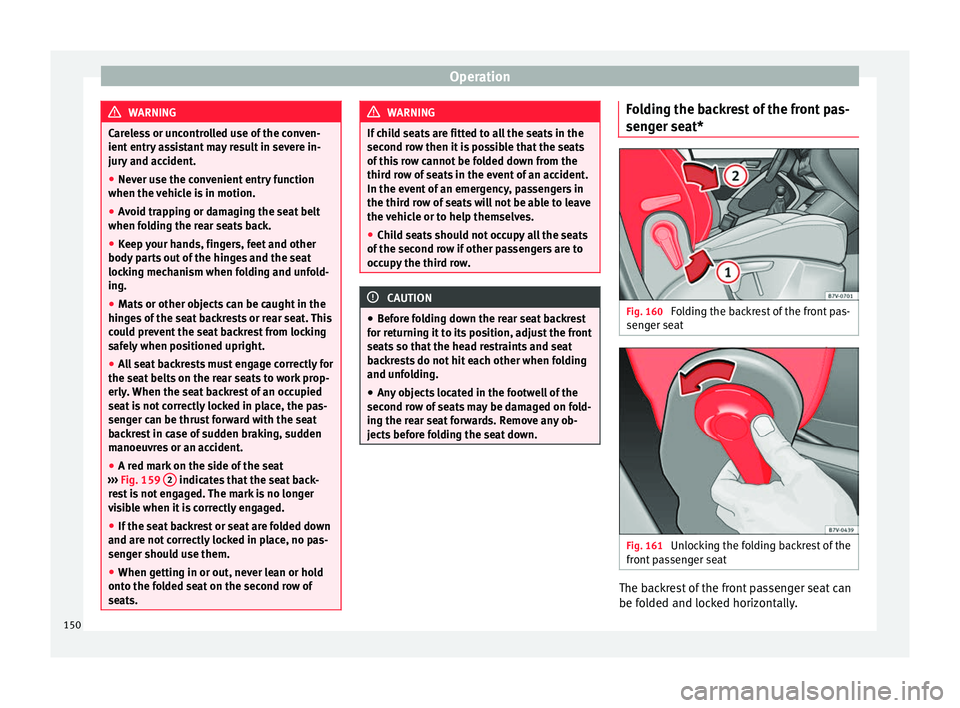
at* Fig. 160
Folding the backrest of the front pas-
sen g
er se
at Fig. 161
Unlocking the folding backrest of the
fr ont
p
assenger seat The backrest of the front passenger seat can
be f
o
l
ded and locked horizontally.
150
Page 153 of 324
Seats and head restraints
The front passenger front airbag must be dis-
ab l
ed ›
›› page 18 if objects are being
transported on the folded front passenger
seat.
Folding the backrest of the front passenger
seat
● Remove any objects from the front passen-
ger seat
cushion ››› .
● Adjust the front passenger seat to its low-
e s
t
position ››› page 57.
● Push the head restraint down as far as it
wil
l go ››› page 57.
● Unlock the backrest of the front passenger
seat in the dir
ection of the arrow ››› Fig. 160
1 .
● Fold the backrest of the front passenger
se at
f
orwards in the direction of the arrow
››› Fig. 160 2 until it is horizontal.
● The backrest of the front passenger seat
mu s
t
engage safely in its folded position.
Lifting the backrest of the front passenger
seat
● Check that there are no objects or parts of
the body in the hing
e area.
● Lift the backrest of the front passenger seat
by fir
st unlocking it again ››› Fig. 161.
● Lift the backrest of the front passenger seat
unti l
it is upright. The seat backrest must be
engaged. ●
The upright b ac
krest of the front passenger
seat must safely engage. WARNING
Folding and lifting the backrest of the front
pa s
senger seat uncontrollably or without
paying attention may lead to severe injuries.
● Only fold and lift the backrest of the front
pas
senger seat when the vehicle is station-
ary.
● While the backrest of the front passenger
seat i
s folded, the front airbag must remain
disabled and the PASSENGER AIRBAG OFF light on.
● Keep your hands, fingers, feet and other
body par
ts out of the hinges and the seat
locking mechanism when folding and unfold-
ing.
● Mats or other objects can be caught in the
hinge
s of the backrest of the front passenger
seat. This could prevent the seat backrest
from locking safely when positioned upright.
● The upright backrest of the front passenger
seat mu
st engage. If the backrest of the front
passenger seat is not locked, it may suddenly
move and cause severe injuries. WARNING
Seat anchors and hinges exposed when the
bac k
rest of the front passenger seat is folded
may lead to severe injuries in the event of an
accident or sudden braking. ●
Never c arr
y people or children on the front
passenger seat when the seat backrest is fol-
ded.
● When the backrest of the front passenger
seat i
s folded, only the outer seat behind the
driver on the second row of seats may be oc-
cupied. This also applies to children sitting in
a child seat. Centre armrest
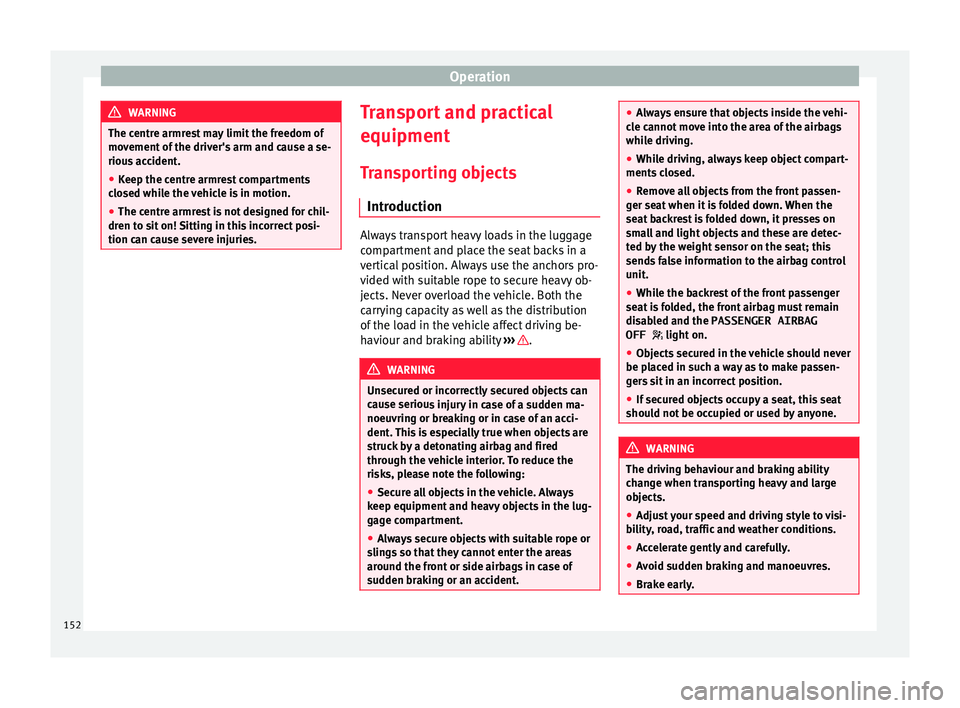
Fig. 162
Front centre armrest To lif
t the central armrest, lift it upwards in
the dir ection of
the arrow ››› Fig. 162, setting
by setting.
To lower the centre armrest, pull it down-
wards. Then lower the centre armrest. »
151
Technical data
Advice
Operation
Emergencies
Safety
Page 154 of 324
Operation
WARNING
The centre armrest may limit the freedom of
mov ement
of the driver's arm and cause a se-
rious accident.
● Keep the centre armrest compartments
closed whi
le the vehicle is in motion.
● The centre armrest is not designed for chil-
dren to s
it on! Sitting in this incorrect posi-
tion can cause severe injuries. Transport and practical
equipment
T r
an
sporting objects
Introduction Always transport heavy loads in the luggage
comp
ar
tment and place the seat backs in a
vertical position. Always use the anchors pro-
vided with suitable rope to secure heavy ob-
jects. Never overload the vehicle. Both the
carrying capacity as well as the distribution
of the load in the vehicle affect driving be-
haviour and braking ability ››› .
WARNING
Unsecured or incorrectly secured objects can
cau se seriou
s injury in case of a sudden ma-
noeuvring or breaking or in case of an acci-
dent. This is especially true when objects are
struck by a detonating airbag and fired
through the vehicle interior. To reduce the
risks, please note the following:
● Secure all objects in the vehicle. Always
keep equipment and he
avy objects in the lug-
gage compartment.
● Always secure objects with suitable rope or
sling
s so that they cannot enter the areas
around the front or side airbags in case of
sudden braking or an accident. ●
Alw a
ys ensure that objects inside the vehi-
cle cannot move into the area of the airbags
while driving.
● While driving, always keep object compart-
ments c
losed.
● Remove all objects from the front passen-
ger seat
when it is folded down. When the
seat backrest is folded down, it presses on
small and light objects and these are detec-
ted by the weight sensor on the seat; this
sends false information to the airbag control
unit.
● While the backrest of the front passenger
seat i
s folded, the front airbag must remain
disabled and the PASSENGER AIRBAG OFF light on.
● Objects secured in the vehicle should never
be plac
ed in such a way as to make passen-
gers sit in an incorrect position.
● If secured objects occupy a seat, this seat
should not
be occupied or used by anyone. WARNING
The driving behaviour and braking ability
ch an
ge when transporting heavy and large
objects.
● Adjust your speed and driving style to visi-
bility
, road, traffic and weather conditions.
● Accelerate gently and carefully.
● Avoid sudden braking and manoeuvres.
● Brake early. 152