fold seats Seat Alhambra 2017 User Guide
[x] Cancel search | Manufacturer: SEAT, Model Year: 2017, Model line: Alhambra, Model: Seat Alhambra 2017Pages: 320, PDF Size: 6.88 MB
Page 156 of 320
Operation
● Remo
v
e objects from the footwell in front of
and behind the rear seat ››› .
● Remove objects from the space below the
r e
ar se
at.
● Remove the attachment elements and sup-
ports f
or the net from the rail system.
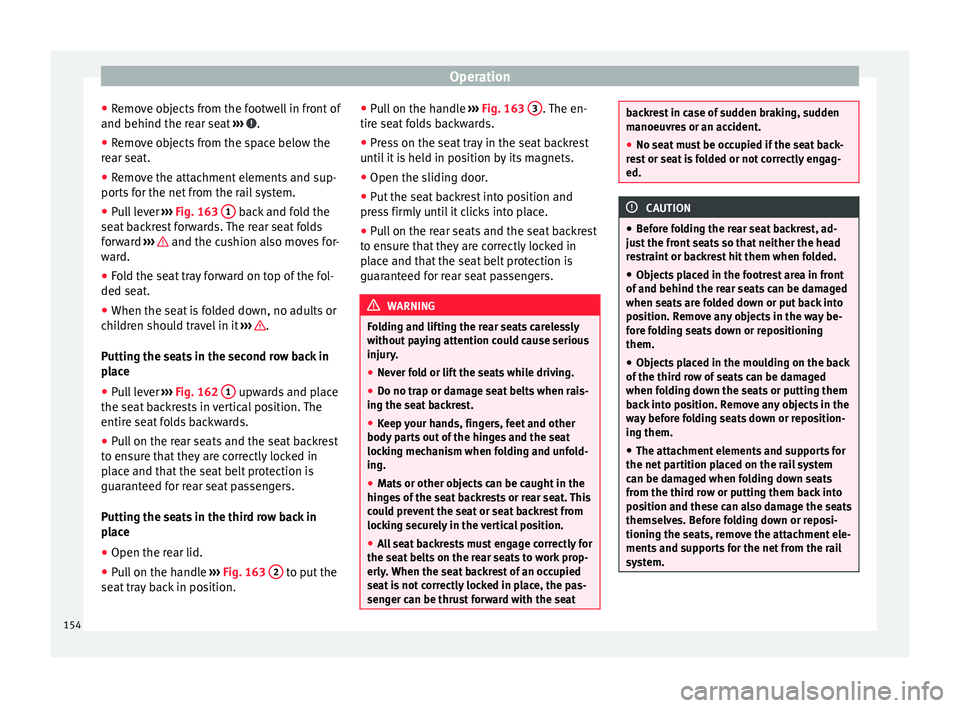
● Pull lever ››› Fig. 163 1 back and fold the
se at
b
ackrest forwards. The rear seat folds
forward ››› and the cushion also moves for-
w ar
d.
● F
old the seat tray forward on top of the fol-
ded seat.
● When the se
at is folded down, no adults or
chil
dren should travel in it ››› .
P uttin
g the se
ats in the second row back in
place
● Pull lever ››› Fig. 162
1 upwards and place
the se at
b
ackrests in vertical position. The
entire seat folds backwards.
● Pull on the rear seats and the seat backrest
to ens
ure that they are correctly locked in
place and that the seat belt protection is
guaranteed for rear seat passengers.
Putting the seats in the third row back in
place
● Open the rear lid.
● Pull on the handle ›››
Fig. 163 2 to put the
se at
tr
ay back in position. ●
Pul
l on the handle ››› Fig. 163 3 . The en-
tir e se
at
folds backwards.
● Press on the seat tray in the seat backrest
until
it is held in position by its magnets.
● Open the sliding door.
● Put the seat backrest into position and
pres
s firmly until it clicks into place.
● Pull on the rear seats and the seat backrest
to ens
ure that they are correctly locked in
place and that the seat belt protection is
guaranteed for rear seat passengers. WARNING
Folding and lifting the rear seats carelessly
without p
aying attention could cause serious
injury.
● Never fold or lift the seats while driving.
● Do no trap or damage seat belts when rais-
ing the seat
backrest.
● Keep your hands, fingers, feet and other
body par
ts out of the hinges and the seat
locking mechanism when folding and unfold-
ing.
● Mats or other objects can be caught in the
hinge
s of the seat backrests or rear seat. This
could prevent the seat or seat backrest from
locking securely in the vertical position.
● All seat backrests must engage correctly for
the seat belt
s on the rear seats to work prop-
erly. When the seat backrest of an occupied
seat is not correctly locked in place, the pas-
senger can be thrust forward with the seat backrest in case of sudden braking, sudden
manoeu
vr
es or an accident.
● No seat must be occupied if the seat back-
res
t or seat is folded or not correctly engag-
ed. CAUTION
● Bef or
e folding the rear seat backrest, ad-
just the front seats so that neither the head
restraint or backrest hit them when folded.
● Objects placed in the footrest area in front
of and behind the re
ar seats can be damaged
when seats are folded down or put back into
position. Remove any objects in the way be-
fore folding seats down or repositioning
them.
● Objects placed in the moulding on the back
of the third r
ow of seats can be damaged
when folding down the seats or putting them
back into position. Remove any objects in the
way before folding seats down or reposition-
ing them.
● The attachment elements and supports for
the net par
tition placed on the rail system
can be damaged when folding down seats
from the third row or putting them back into
position and these can also damage the seats
themselves. Before folding down or reposi-
tioning the seats, remove the attachment ele-
ments and supports for the net from the rail
system. 154
Page 157 of 320
Transport and practical equipment
Shelf* Fig. 164
In the luggage compartment: rear
shelf Fig. 165
Remove the shelf supports A then
p ut
them a
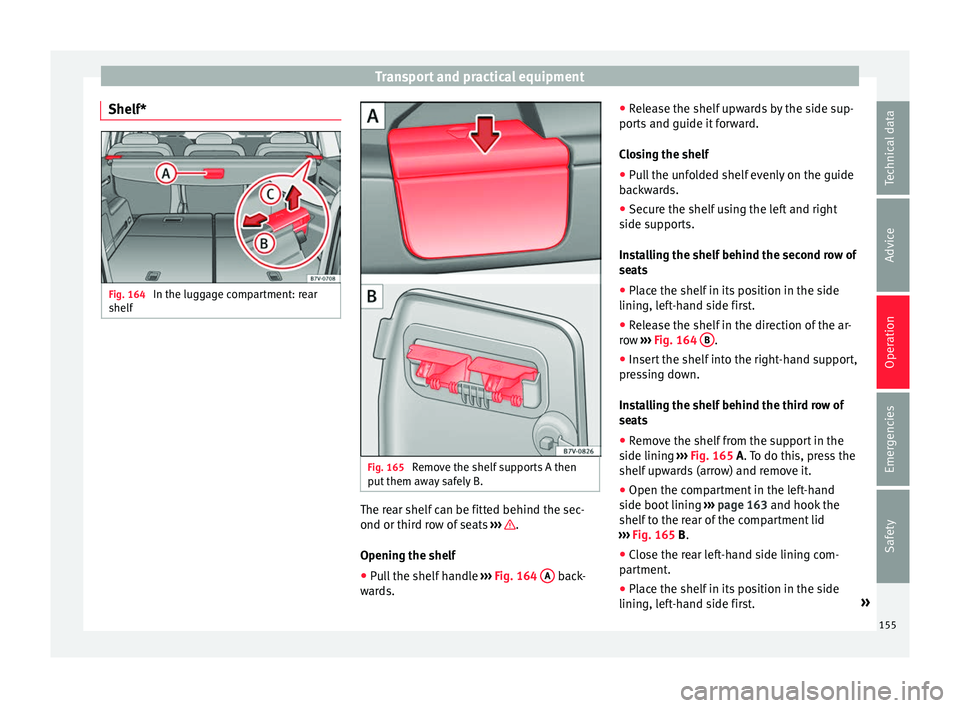
way safely B. The rear shelf can be fitted behind the sec-
ond or thir
d r
o
w of seats ››› .
Openin g the shelf
● Pu
ll the shelf handle ›››
Fig. 164 A back-
w ar
d
s. ●
Rele
ase the shelf upwards by the side sup-
ports and guide it forward.
Closing the shelf
● Pull the unfolded shelf evenly on the guide
back
wards.
● Secure the shelf using the left and right
side sup
ports.
Installing the shelf behind the second row of
seats
● Place the shelf in its position in the side
lining, lef
t-hand side first.
● Release the shelf in the direction of the ar-
row ›
›› Fig. 164 B .
● Insert the shelf into the right-hand support,
pr e
s
sing down.
Installing the shelf behind the third row of
seats
● Remove the shelf from the support in the
side lining ›
›› Fig. 165 A. To do this, press the
shelf upwards (arrow) and remove it.
● Open the compartment in the left-hand
side boot linin
g ››› page 163 and hook the
shelf to the rear of the compartment lid
››› Fig. 165 B.
● Close the rear left-hand side lining com-
partment
.
● Place the shelf in its position in the side
lining, lef
t-hand side first. »
155
Technical data
Advice
Operation
Emergencies
Safety
Page 158 of 320
Operation
● Lif t
the shelf
off in direction of the arrow
››› Fig. 164 B .
● Insert the shelf into the right-hand support,
pr e
s
sing down.
Removing the shelf
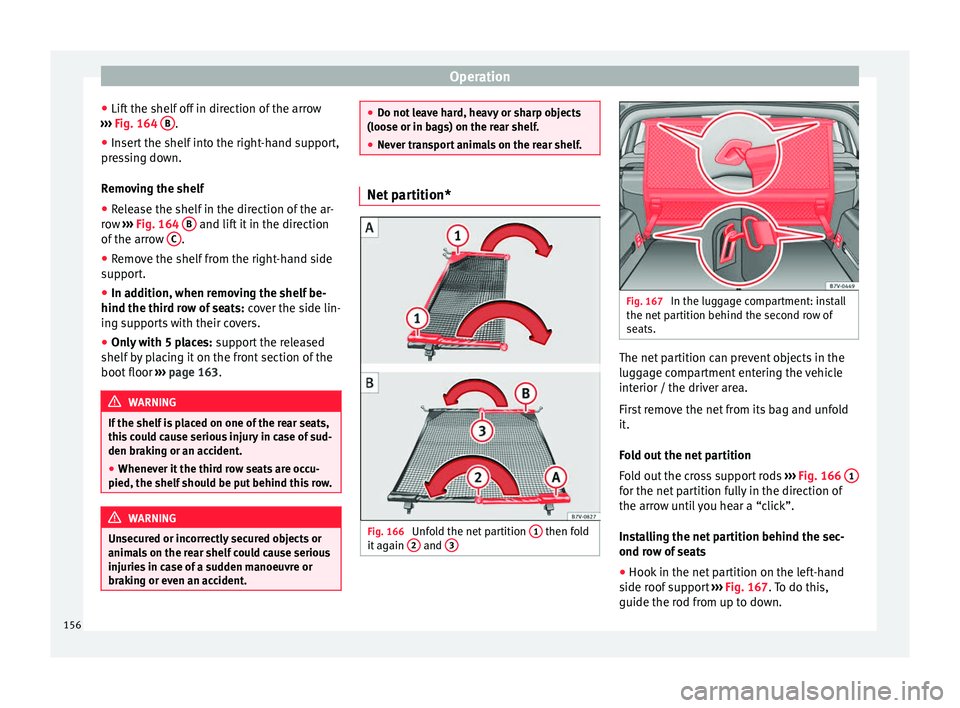
● Release the shelf in the direction of the ar-
row ›
›› Fig. 164 B and lift it in the direction
of the arr
o
w C .
● Remove the shelf from the right-hand side
s up
por
t.
● In addition, when removing the shelf be-
hind the third ro
w of seats: cover the side lin-
ing supports with their covers.
● Only with 5 places: suppor
t the released
shelf by placing it on the front section of the
boot floor ››› page 163. WARNING
If the shelf is placed on one of the rear seats,
this c
ould cause serious injury in case of sud-
den braking or an accident.
● Whenever it the third row seats are occu-
pied, the shelf shoul
d be put behind this row.WARNING
Unsecured or incorrectly secured objects or
anima l
s on the rear shelf could cause serious
injuries in case of a sudden manoeuvre or
braking or even an accident. ●
Do not l e
ave hard, heavy or sharp objects
(loose or in bags) on the rear shelf.
● Never transport animals on the rear shelf. Net partition*
Fig. 166
Unfold the net partition 1 then fold
it ag
ain 2 and
3 Fig. 167
In the luggage compartment: install
the net p
ar
tition behind the second row of
seats. The net partition can prevent objects in the
lug
g
ag
e compartment entering the vehicle
interior / the driver area.
First remove the net from its bag and unfold
it.
Fold out the net partition
Fold out the cross support rods ››› Fig. 166 1 for the net partition fully in the direction of
the arr
o
w u
ntil you hear a “click”.
Installing the net partition behind the sec-
ond row of seats
● Hook in the net partition on the left-hand
side roof
support ››› Fig. 167. To do this,
guide the rod from up to down.
156
Page 159 of 320
Transport and practical equipment
● Hook in the net
p
artition on the rear right-
hand side roof support by pressing on the
rod.
● Secure the net partition hooks into the
strap
s in the front of the boot ››› Fig. 167 then
tighten the belts.
Installing the net partition behind the front
seats
● Hook in the net partition on the front left-
hand side r
oof support ››› Fig. 167. To do this,
guide the rod from up to down.
● Hook in the net partition on the rear right-
hand side r
oof support by pressing on the
rod.
● Secure the hooks of the net partition to the
attachment
rings in the left and right hand
side footwells on the second row of seats
then tighten the straps.
Removing the net partition
● Loosen the net partition straps.
● Release the net partition hooks from the
rings
››› Fig. 167.
● Unhook the net partition on the right-hand
side roof
support ››› Fig. 167 by pressing on
the rod.
● Unhook the net partition from the left-hand
side roof
support. Folding in the net partition
●
Press on the release button ›››
Fig. 166 2 and bend the rod
A in the direction of the
arr o
w w
ith the release button pressed.
● Press on the release button ›››
Fig. 166 3 and bend the rod
B in the direction of the
arr o
w w
ith the release button pressed.
● Store the net partition securely in the vehi-
cle. WARNING
Loose objects in the vehicle interior can be vi-
ol ently
thrown in case of a sudden manoeu-
vre or braking and especially in accidents
causing serious injury.
● Ensure that the rods are correctly locked in
plac
e.
● Even when the net partition is correctly fit-
ted, ob
jects must be secured.
● When driving with the net partition, no pas-
senger
s should be behind it. Fastening rings*
Fig. 168
In the luggage compartment: fasten-
in g rin
g
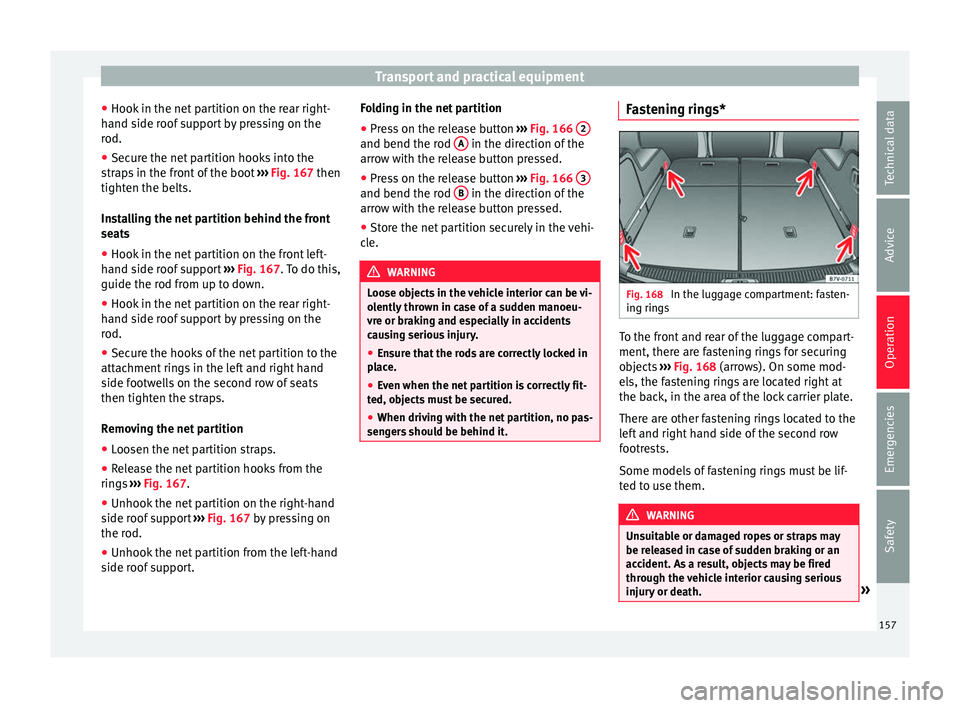
s To the front and rear of the luggage compart-
ment, ther
e ar
e f
astening rings for securing
objects ››› Fig. 168 (arrows). On some mod-
els, the fastening rings are located right at
the back, in the area of the lock carrier plate.
There are other fastening rings located to the
left and right hand side of the second row
footrests.
Some models of fastening rings must be lif-
ted to use them. WARNING
Unsuitable or damaged ropes or straps may
be rel e
ased in case of sudden braking or an
accident. As a result, objects may be fired
through the vehicle interior causing serious
injury or death. » 157
Technical data
Advice
Operation
Emergencies
Safety
Page 161 of 320
Transport and practical equipment
●
Alw a
ys ensure that the movable attach-
ment elements are correctly inserted into the
guides. WARNING
Unsuitable or damaged ropes or straps may
be r ele
ased in case of sudden braking or an
accident. As a result, objects may be fired
through the vehicle interior causing serious
injury or death.
● Always use the attachment straps of the
rail
and attachment system.
● Secure the attachment straps firmly to the
attachment
elements.
● Loose objects in the luggage compartment
can sud
denly slide and change the way the
vehicle handles.
● Secure all objects, little and large.
● Never secure a child seat to the attachment
elements. CAUTION
● The attac hment
elements placed on the rail
system can be damaged when folding down
seats from the third row or putting them back
into position and these can also damage the
seats themselves. Before folding down or re-
positioning the seats, remove the attachment
elements and supports for the net from the
rail system. Baggage net*
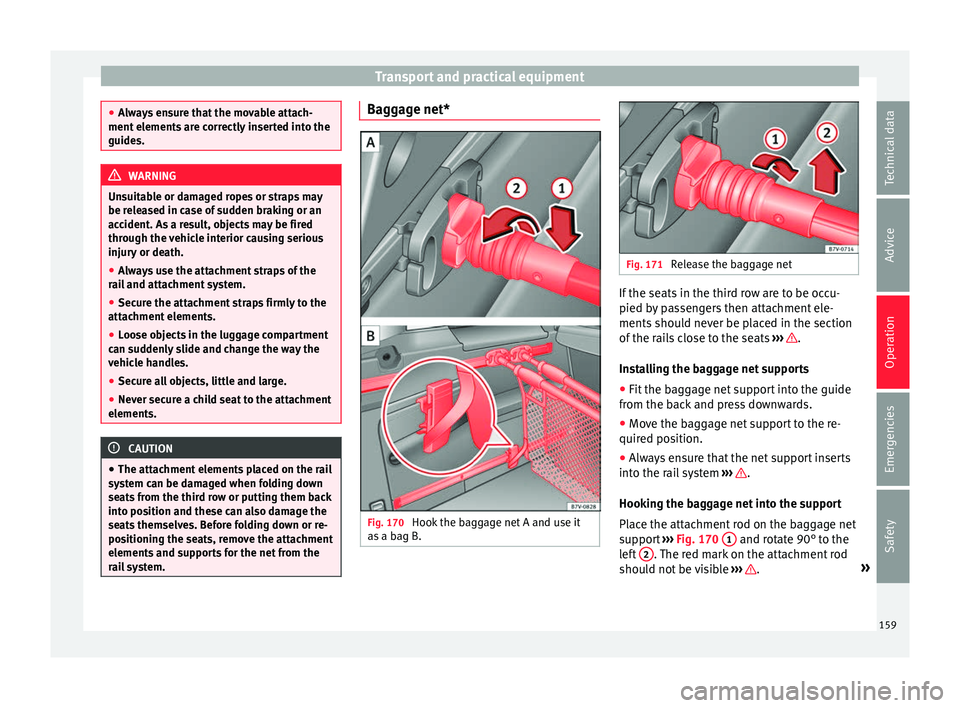
Fig. 170
Hook the baggage net A and use it
a s
a b
ag B. Fig. 171
Release the baggage net If the seats in the third row are to be occu-
pied b
y
p
assengers then attachment ele-
ments should never be placed in the section
of the rails close to the seats ››› .
In s
t
alling the baggage net supports
● Fit the baggage net support into the guide
from the bac
k and press downwards.
● Move the baggage net support to the re-
quired pos
ition.
● Always ensure that the net support inserts
into the rai
l system ››› .
Hook in
g the b
aggage net into the support
Place the attachment rod on the baggage net
support ››› Fig. 170 1 and rotate 90° to the
l ef
t
2 . The red mark on the attachment rod
shou ld not
be visible ››› .
»
159
Technical data
Advice
Operation
Emergencies
Safety
Page 162 of 320

Operation
Using the net for bag type baggage
● Fit the baggage net supports to each one of
the up per r
ai
ls.
● Fit a movable baggage net attachment ele-
ment to e
ach one of the lower guides
››› page 158.
● Hook the baggage net into the supports.
● Hook the baggage net attachment strap un-
derneath into one of
the movable attachment
elements ››› Fig. 170 B.
● Join the baggage net supports to the upper
rail
s as much as possible by pushing them.
● Press the sides of the baggage net together
so that they
are held by the Velcro.
Using the baggage net to separate the lug-
gage compartment
● Fit the baggage net supports to each one of
the upper rai
ls.
● Fit the baggage net supports to each one of
the lower r
ails.
● Hook the baggage net into the supports.
To rel
ease the baggage net
● Rotate the attachment rod 90° to the right
›››
Fig. 171 1 until you can see the red mark
on the r od. P
u
ll the attachment rod upwards
2 .
● Only with 5 places: af
ter r
emoving, place
the baggage net safely in the front compart-
ment on the floor of the boot ››› page 163. Removing the baggage net supports
●
Remove the net attachment element from
the rai l
and pull it out downwards. WARNING
In case of an accident or sudden braking, the
net att ac
hment elements in the parts of the
rails close to the seats of the third row could
injure seat occupants.
● Whenever the seats on the third row are to
be occupied, r
emove the attachment ele-
ments from the rails or move them all the way
back. WARNING
Baggage net supports that are not secured
corr ectly
can be released from the guide in
case of the sudden braking or accident. As a
result, objects may be fired through the vehi-
cle interior causing serious injury or death.
● Always ensure that the baggage net sup-
ports
are correctly inserted into the rails; the
red mark should not be visible.
● Never secure a child seat to the baggage
net sup
ports. CAUTION
● The bag g
age net supports placed on the
rail system can be damaged when folding
down seats from the third row or putting
them back into position and these can also
damage the seats themselves. Before folding down or repositioning the seats, remove the
bag
g
age net supports from the rail system. Retaining hooks
Fig. 172
In the luggage compartment: retain-
in g hook
s On the right-hand side of the luggage com-
p
ar
tment, ther
e are folding retaining hooks
››› Fig. 172 that can be used to secure light
shopping bags.
● Press the retaining hooks down ›››
Fig. 172
(arrow) and fold them.
● Hook the bags in place.
● After use, raise the hooks again. WARNING
Never use these hooks to secure objects. In
the event of
sudden braking or an accident,
they could be pulled out. 160
Page 169 of 320

Transport and practical equipment
this compartment cannot be used as de-
signed; on the c
ontr
ary, it must be filled us-
ing the specially designed accessory so that
the base or foot is correctly supported by the
closed compartment and the child seat is se-
cured properly. If this compartment is not
suitably secured when using a child seat with
a base or foot then the compartment cover
could rupture in an accident and the child will
be ejected and suffer serious injury.
● Please read and observe the child seat
manufact
urer's handling instructions. Drawers*
Fig. 184
Drawer under the front seat There may be a drawer below the front seats.
Openin
g and c
lo
sing the drawer
To open, press the button on the drawer han-
dle and pull the drawer out. To close, push the drawer under the seat until
it c
licks into place. WARNING
If the drawer is open it could obstruct use of
the peda l
s. This could result in serious acci-
dent.
● The drawers must remain closed while the
vehicl
e is in motion. Otherwise, the drawer
and any objects in it could fall into the driv-
er's footwell and obstruct the pedals. Folding table*
Fig. 185
Folding table on the front seat Fold out the t
ab
l
e by pulling on it ››› Fig. 185
(arrow).
A drink holder is built into the folding table
››› page 168.
To fold it back , push the folding table down
as far as possible ››› Fig. 185. WARNING
The folding table must not be folded down
whil e the
vehicle is in motion to avoid the
risk of injuries. Portable waste bin*
Fig. 186
Left sliding door trim: portable waste
b in. The portable waste bin fits onto the bottle
ho
l
der on the trim of
the left-hand sliding
door. WARNING
Do not use the portable waste bin as an ash-
tra y
to avoid the risk of fire. 167
Technical data
Advice
Operation
Emergencies
Safety
Page 171 of 320
Transport and practical equipment
WARNING
Improper use of the drink holders can cause
injury .
● Nev
er place hot drinks in the drink holders.
During s
udden braking or driving manoeu-
vres, the hot drink could be spilled and lead
to scalding.
● Ensure that no bottles or other object are
dropped in the driv
er footwell, as they could
get under the pedals and obstruct their work-
ing.
● Never place heavy containers, food or other
heavy o
bjects in the drink holder. In the
event of an accident, these heavy objects
could be “thrown around” the vehicle interior
and cause serious injuries. WARNING
Closed bottles inside the vehicle could ex-
plode or c r
ack due to the heat or the cold.
● Never leave a closed bottle in the vehicle if
the inside t
emperature is too high or too low. CAUTION
Do not leave open cans in the drink holders
when the v ehic
le is in motion. They could
spill during braking, for example, and cause
damage to the vehicle and the electrical sys-
tem. Note
The drink holders can be removed for clean-
ing. Drink holders in front centre console
Fig. 189
Front centre console: drink holder ●
To open, mo v
e the c
over backwards
››› Fig. 189.
● To close, move the cover forwards. Drink ho
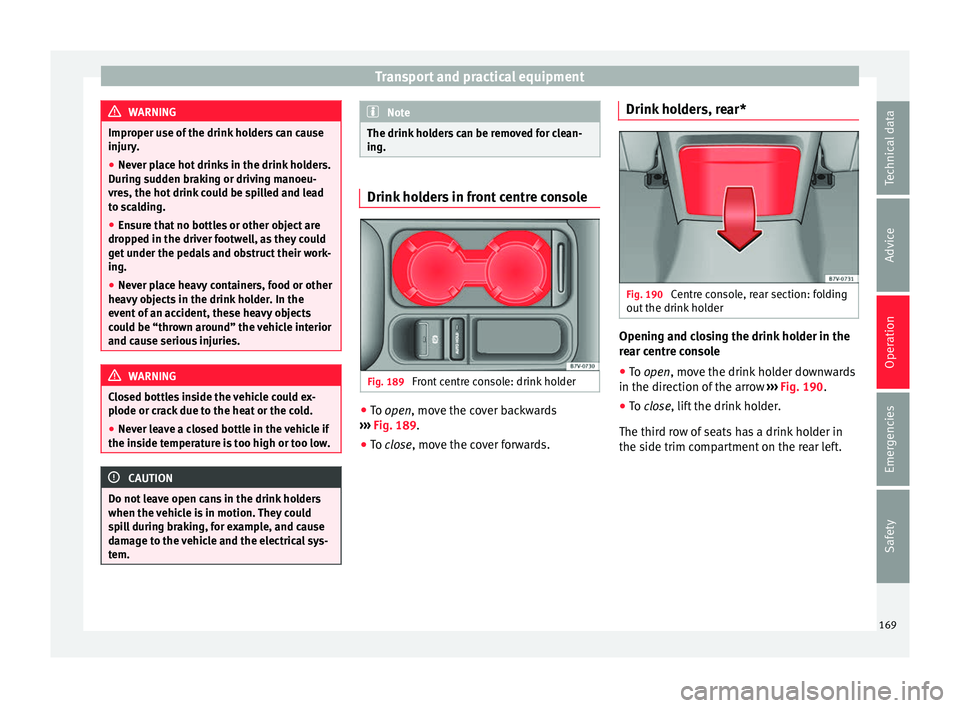
lders, rear* Fig. 190
Centre console, rear section: folding
out the drink
ho
lder Opening and closing the drink holder in the
r
e
ar c
entre console
● To open, move the drink
holder downwards
in the direction of the arrow ››› Fig. 190.
● To close, lift the drink holder.
The third r
ow of seats has a drink holder in
the side trim compartment on the rear left.
169
Technical data
Advice
Operation
Emergencies
Safety
Page 258 of 320
Advice
Caring for and cleaning the ve-
hic l
e int
erior
Introduction The dye used in many modern garments, for
ex
amp
le dark jeans, is not always sufficiently
colour-fast. Seat upholstery (material and
leather), especially when light-coloured, may
visibly discolour if the dye comes out of
clothing (even when used correctly). This is
not an upholstery defect but indicates that
the dye in the item of clothing is not suffi-
ciently colour-fast.
The longer stains or dirt remain on the vehi-
cle surfaces, especially the fabrics covering
the padded upholstery, the more difficult it
becomes to clean and maintain them. If
stains and dirt are left for a long time, it may
be that they are impossible to remove. WARNING
Car-care products may be toxic and hazard-
ous. U s
ing unsuitable car-care products or,
using them in the wrong way, may cause acci-
dents, serious injury, burns or intoxication.
● Keep your car-care products in their origi-
nal
containers.
● Read the instructions.
● Never keep car-care products in empty food
container
s, bottles or other similar contain-
ers. Other people may confuse them. ●
Keep a l
l car-care products out of the reach
of children.
● Some products may give off harmful va-
pours durin
g use. Therefore, they should be
used outdoors in well-ventilated places.
● Never use fuel, turpentine, engine oil, nail-
varnish r
emover or any other volatile product
for washing, maintenance or cleaning. These
are toxic and highly flammable. WARNING
Unsuitable maintenance and cleaning of vehi-
c le c
omponents may impair proper operation
of safety equipment and cause serious injury.
● Maintain and clean vehicle components ac-
cordin
g to the manufacturer's instructions.
● Only use approved or recommended clean-
ing product
s. CAUTION
● Cle
aning products which contain solvents
have a corrosive effect and may damage the
material irreparably.
● Stains and dirt containing aggressive sub-
stanc
es or solvents attack the material and
may damage it irreparably, even when they
are cleaned quickly.
● Dirt and stains should not be allowed to dry
and should be c
leaned as quickly as possible.
● In the case of stubborn stains, take the ve-
hicle t
o a specialised workshop to avoid dam-
age. How to care for the upholstery
To treat and maintain your seat upholstery,
keep the f
o
llowing in mind ››› :
● Before entering the vehicle, close any Vel-
cr o f
asteners that might snag on the uphols-
tery or trim fabric. Any open Velcro fasteners
may damage the trim or upholstery fabrics.
● To prevent damage, avoid direct contact
between sharp dec
orative objects and the
upholstery and trim fabrics. Decorative ob-
jects include zips, rivets and rhinestones on
clothing and belts.
● From time to time, clean the dust that gath-
ers in the per
forations, folds and seams so
that the surfaces of the seats are not dam-
aged by its abrasive effect.
● Make sure clothes are colour-fast to avoid
them running and s
taining the upholstery.
This is especially important if the upholstery
is light in colour. CAUTION
If you ignore this advice, which is important
for m aint
aining your seat upholstery, the fab-
ric may be damaged or stained. Note
SEAT recommends you take the vehicle to a
spec i
alised workshop to treat any stains on
the upholstery caused by the discolouration
of clothing. 256
Page 305 of 320
Index
Index
A
Abr o
a
d
extended stay abroad with your vehicle . . . . . 260
sale of vehicle . . . . . . . . . . . . . . . . . . . . . . . . . . 260
ABS see Anti-lock brake system . . . . . . . . . . . . . . . 203
Accessories . . . . . . . . . . . . . . . . . . . . . . . . . . . . . . 244
Acoustic alarm control and warning lamps . . . . . . . . . . . . . . . . 32
seatbelt unfastened . . . . . . . . . . . . . . . . . . . . . . 62
Adaptive headlights dynamic . . . . . . . . . . . . . . . . . . . . . . . . . . . . . . . 130
AdBlue control and warning lamps . . . . . . . . . . . . . . . 266
information . . . . . . . . . . . . . . . . . . . . . . . . . . . . 266
minimum quantity for a refill . . . . . . . . . . . . . . 266
refilling . . . . . . . . . . . . . . . . . . . . . . . . . . . . . . . 267
specifications . . . . . . . . . . . . . . . . . . . . . . . . . . 267
tank filling capacity . . . . . . . . . . . . . . . . . . . . . 265
Additional heater see "Auxiliary heater" . . . . . . . . . . . . . . . . . . . . 177
Adjusting folding the backrest of the front passengerseat . . . . . . . . . . . . . . . . . . . . . . . . . . . . . . . . 148
front seats . . . . . . . . . . . . . . . . . . . . . . . . . . . . . 140
lights . . . . . . . . . . . . . . . . . . . . . . . . . . . . . . . . . 133
rear head restraints . . . . . . . . . . . . . . . . . 15, 142
seats . . . . . . . . . . . . . . . . . . . . . . . . . . . . . . . . . . 57
seat with position memory . . . . . . . . . . . . . . . 146
Adjusting the head restraint rear head restraints . . . . . . . . . . . . . . . . . . . . . . 15
Adjusting the head restraints rear head restraints . . . . . . . . . . . . . . . . . . . . . 142 Adjusting the seats
front se ats . . . . . . . . . . . . . . . . . . . . . . . . . . . . . 140
rear seats . . . . . . . . . . . . . . . . . . . . . . . . . . . . . 141
AFS . . . . . . . . . . . . . . . . . . . . . . . . . . . . . . . . . . . . 130
Air-conditioning malfunctions . . . . . . . . . . . . . . . . . . . . . . . . . . . 175
Airbag covers . . . . . . . . . . . . . . . . . . . . . . . . . . . . . 17
Airbags see Airbag system . . . . . . . . . . . . . . . . . . . . . . . 18
Airbag system . . . . . . . . . . . . . . . . . . . . . . . . . . 17, 68 activation . . . . . . . . . . . . . . . . . . . . . . . . . . . . . . 70
cleaning dash panel . . . . . . . . . . . . . . . . . . . . . 259
control lamp . . . . . . . . . . . . . . . . . . . . . . . . . . . . 72
description . . . . . . . . . . . . . . . . . . . . . . . . . . . . . 69
front airbags . . . . . . . . . . . . . . . . . . . . . . . . . 17, 71
functioning . . . . . . . . . . . . . . . . . . . . . . . . . . . . . 70
head-protection airbag . . . . . . . . . . . . . . . . . . . 20
knee airbag . . . . . . . . . . . . . . . . . . . . . . . . . . . . . 18
locking the vehicle after deployment . . . . . . . 113
repairs . . . . . . . . . . . . . . . . . . . . . . . . . . . . . . . . 246
side airbags . . . . . . . . . . . . . . . . . . . . . . . . . . . . 19
use of child seats . . . . . . . . . . . . . . . . . . . . . 18, 73
vehicle care . . . . . . . . . . . . . . . . . . . . . . . . . . . . 259
Air conditioning . . . . . . . . . . . . . . . . . . . . . . . . . . 173 air recirculation . . . . . . . . . . . . . . . . . . . . . . . . . 176
air vents . . . . . . . . . . . . . . . . . . . . . . . . . . . . . . 176
climatronic . . . . . . . . . . . . . . . . . . . . 36, 173, 174
controls . . . . . . . . . . . . . . . . . . . . . . . . . . . 36, 174
electronic manual air conditioning . . . . . . . . . 174
indirect ventilation . . . . . . . . . . . . . . . . . . . . . . 176
rear seats . . . . . . . . . . . . . . . . . . . . . . . . . . . . . 174
special features . . . . . . . . . . . . . . . . . . . . . . . . 175
user instructions . . . . . . . . . . . . . . . . . . . . . . . . 174
Air recirculation . . . . . . . . . . . . . . . . . . . . . . . . . . 176
Air vents . . . . . . . . . . . . . . . . . . . . . . . . . . . . . . . . 176
Alcantara . . . . . . . . . . . . . . . . . . . . . . . . . . . . . . . . 257 All-wheel drive
snow c hains . . . . . . . . . . . . . . . . . . . . . . . . . . . . 49
winter tyres . . . . . . . . . . . . . . . . . . . . . . . . . . . . 293
Ambient lighting . . . . . . . . . . . . . . . . . . . . . . . . . 134
Anodized surfaces . . . . . . . . . . . . . . . . . . . . . . . . 254
Antenna . . . . . . . . . . . . . . . . . . . . . . . . . . . 246, 260
Anti-freeze . . . . . . . . . . . . . . . . . . . . . . . . . . . . . . . 40
Anti-lock brake system . . . . . . . . . . . . . . . . . . . . . 203
Anti-lock system . . . . . . . . . . . . . . . . . . . . . . . . . . 203
Anti-puncture . . . . . . . . . . . . . . . . . . . . . . . . . . 44, 85
Anti-puncture kit . . . . . . . . . . . . . . . . . . . . . . . . 44, 85
Anti-puncture set . . . . . . . . . . . . . . . . . . . . . . . . . . 85
Anti-theft alarm . . . . . . . . . . . . . . . . . . . . . . . . . . 117 false alarms . . . . . . . . . . . . . . . . . . . . . . . . . . . 118
trailer . . . . . . . . . . . . . . . . . . . . . . . . . . . . . . . . . 238
Anti-theft alarm system anti-tow system . . . . . . . . . . . . . . . . . . . . . . . . 118
vehicle interior monitoring . . . . . . . . . . . . . . . 118
Anti-theft security system . . . . . . . . . . . . . . . . . . 117
Anti-tow system . . . . . . . . . . . . . . . . . . . . . . . . . . 118
Anti-trap function panoramic sunroof . . . . . . . . . . . . . . . . . . . . . . 127
sun blind . . . . . . . . . . . . . . . . . . . . . . . . . . . . . . 127
Antifreeze . . . . . . . . . . . . . . . . . . . . . . . . . . . 40, 276
Armrests . . . . . . . . . . . . . . . . . . . . . . . . . . . . . . . . 149
Ashtray . . . . . . . . . . . . . . . . . . . . . . . . . . . . . . . . . 170
ASR see Brake assist systems . . . . . . . . . . . . . . . . . 204
see Braking assist systems . . . . . . . . . . . . . . . 205
switching on and off . . . . . . . . . . . . . . . . . . . . . 205
see also Traction control system . . . . . . . . . . . 203
Assistance call . . . . . . . . . . . . . . . . . . . . . . . . . . . 109
Assistance systems electronic differential lock system (EDS) . . . . 204
electronic drive torque management (XDS) . . 204
launch-Control programme . . . . . . . . . . . . . . . 196
303