fold seats Seat Alhambra 2017 Owner's Manual
[x] Cancel search | Manufacturer: SEAT, Model Year: 2017, Model line: Alhambra, Model: Seat Alhambra 2017Pages: 320, PDF Size: 6.88 MB
Page 18 of 320
The essentials
Seat belt tensioners In the event of a head-on, lateral or rear colli-
sion, the se
at
belts on the front seats and the
outer seats of the second row will tighten au-
tomatically.
The tensioner can be triggered only once.
››› in Service and disposal of belt ten-
sion devices on page 68
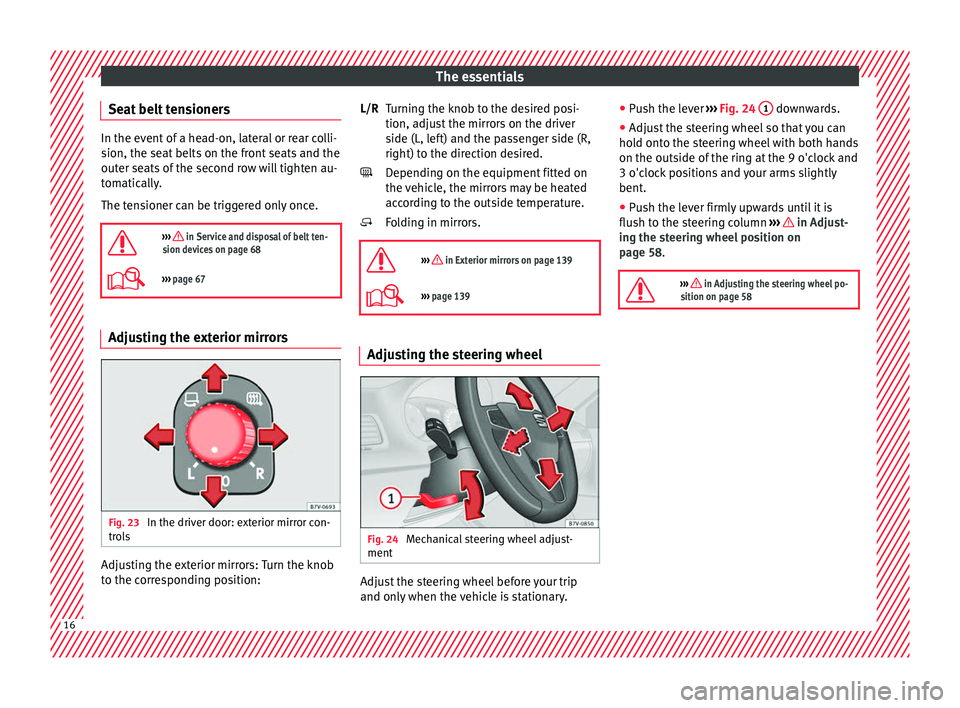
››› page 67 Adjusting the exterior mirrors
Fig. 23
In the driver door: exterior mirror con-
tr o
l
s Adjusting the exterior mirrors: Turn the knob
t
o the c
orr
esponding position: Turning the knob to the desired posi-
tion, adjus
t the mirrors on the driver
side (L, left) and the passenger side (R,
right) to the direction desired.
Depending on the equipment fitted on
the vehicle, the mirrors may be heated
according to the outside temperature.
Folding in mirrors.
››› in Exterior mirrors on page 139
››› page 139 Adjusting the steering wheel
Fig. 24
Mechanical steering wheel adjust-
ment Adjust the steering wheel before your trip
and on
ly
when the
vehicle is stationary.
L/R
●
Push the l
ever ››› Fig. 24 1 downwards.
● Adjust the steering wheel so that you can
ho l
d ont
o the steering wheel with both hands
on the outside of the ring at the 9 o'clock and
3 o'clock positions and your arms slightly
bent.
● Push the lever firmly upwards until it is
flush to the s
teering column ››› in Adjust-
in g the s
t
eering wheel position on
page 58.
››› in Adjusting the steering wheel po-
sition on page 58 16
Page 79 of 320
Transporting children safely
Only use a rear-facing child seat on the front
p a
s
senger seat if the front passenger front
airbag is disabled. When it is disabled, the
yellow PASSENGER AIR BAG control
lamp on the dash panel will be lit ››› page 72.
If you cannot disable the front passenger
front airbag and it remains activated, it is
forbidden to transport children on the front
passenger seat ››› .
Thin g
s
to note if using a child seat on the
front passenger seat:
● The front passenger front airbag must
be
disabled when using a rear-facing child
seat ››› page 73.
● The seat backrest of the front passenger
seat mu
st be upright.
● The front passenger seat must be moved as
far bac
k as possible.
● The seat backrest of the front passenger
seat mu
st be upright.
● The seat belt height adjustment must be as
high as po
ssible.
Suitable child seats
The child seat must be authorised by the
manufacturer especially for use on a front
passenger seat with a front or side airbag.
If the front passenger seat is equipped with
retaining rings, the child seat can be secured
using an approved retaining system provided
it is approved for this type of vehicle in ac- cordance with current regulations of the
countr
y in question.
Universal seats for children of groups 0, 0+,
1, 2 or 3 according to the standard ECE-R 44
can be mounted on the front passenger seat
and the rear seats. WARNING
If a child seat is mounted on the front passen-
ger se at, the ri
sk of the child sustaining se-
vere or fatal injuries in the event of an acci-
dent increases. Rear-facing child seats must
never be mounted on the front passenger
seat when the front passenger front airbag is
enabled. This is life-threatening to the child
should the front airbag deploy, as the child
seat would be struck by the inflated airbag
and thrown against the seat backrest. WARNING
If, in exceptional circumstances, a child must
be tran s
ported in a rear-facing child seat on
the front passenger seat, strictly observe the
following:
● Always disable the front passenger front
airbag and le
ave it disabled.
● The child seat must be approved by the
manufact
urer for use on a front passenger
seat with front and side airbag.
● Follow the installation instructions of the
chil
d seat manufacturer and observe the
warnings. ●
Mov e the fr
ont passenger seat as far back
as possible and adjust it to its highest posi-
tion to keep as far away as possible from the
front airbag.
● Move the seat backrest to the upright posi-
tion.
● The seat belt height adjustment must be as
high as po
ssible.
● Children must always be protected with an
appro
ved child restraint system suited to
their height and weight. Use of the child seat on the rear seat
If a child seat is mounted on the rear seat,
a
d
apt
the position of the front passenger
seat so that the child has enough space.
Therefore, adapt the front passenger seat to
the size of the child seat and the height of
the child. Ensure the passenger is in the cor-
rect position ››› page 57.
Move the second and third rows of seats fully
back and lock them. Place the seat backs in a
vertical position and fold the head restraints
down.
ISOFIX child seats approved for rear seats
The rear seats are suitable for child seats
with the ISOFIX system specially designed
for this type of vehicle in accordance with
regulation ECE-R 44. »
77
Technical data
Advice
Operation
Emergencies
Safety
Page 80 of 320
Safety
ISOFIX child seats are divided into “specific
c at
e
gories for the vehicle”, “limited” or
“semi-universal”.
Child seat manufacturers supply a list of ve-
hicles with each ISOFIX seat, which includes
the models for which the ISOFIX child seat in
question is approved. If the vehicle is inclu-
ded in the manufacturer's list and the ISOFIX
child seat belongs to a seat category inclu-
ded in the list, then it can be used in your ve-
hicle. If necessary, contact the child seat
manufacturer for an updated list of vehicles.
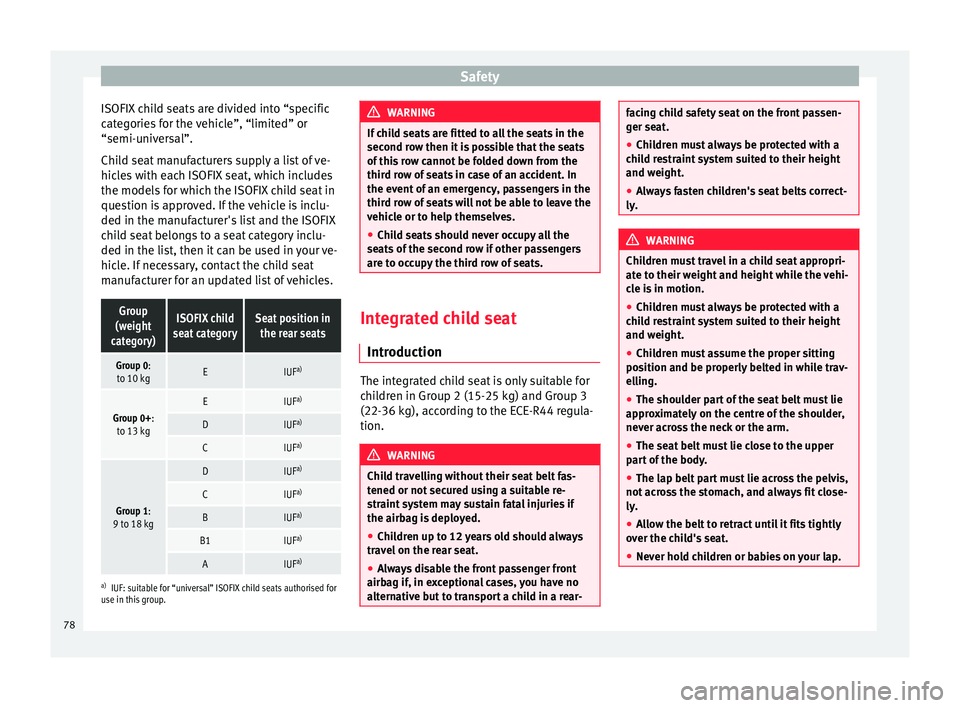
Group
(weight
category)ISOFIX child
seat categorySeat position in the rear seats
Group 0:to 10 kgEIUF a)
Group 0+:
to 13 kgEIUF a)
DIUFa)
CIUFa)
Group 1:
9 to 18 kg
DIUF a)
CIUFa)
BIUFa)
B1IUFa)
AIUFa)
a)
IUF: suitable for “universal” ISOFIX child seats authorised for
use in this group. WARNING
If child seats are fitted to all the seats in the
second r o
w then it is possible that the seats
of this row cannot be folded down from the
third row of seats in case of an accident. In
the event of an emergency, passengers in the
third row of seats will not be able to leave the
vehicle or to help themselves.
● Child seats should never occupy all the
seats
of the second row if other passengers
are to occupy the third row of seats. Integrated child seat
Intr oduction The integrated child seat is only suitable for
c
hi
l
dren in Group 2 (15-25 kg) and Group 3
(22-36 kg), according to the ECE-R44 regula-
tion. WARNING
Child travelling without their seat belt fas-
tened or not sec
ured using a suitable re-
straint system may sustain fatal injuries if
the airbag is deployed.
● Children up to 12 years old should always
travel
on the rear seat.
● Always disable the front passenger front
airbag if, in e
xceptional cases, you have no
alternative but to transport a child in a rear- facing child safety seat on the front passen-
ger se
at
.
● Children must always be protected with a
chil
d restraint system suited to their height
and weight.
● Always fasten children's seat belts correct-
ly. WARNING
Children must travel in a child seat appropri-
at e t o their w
eight and height while the vehi-
cle is in motion.
● Children must always be protected with a
chil
d restraint system suited to their height
and weight.
● Children must assume the proper sitting
position and be pr
operly belted in while trav-
elling.
● The shoulder part of the seat belt must lie
appro
ximately on the centre of the shoulder,
never across the neck or the arm.
● The seat belt must lie close to the upper
part
of the body.
● The lap belt part must lie across the pelvis,
not acr
oss the stomach, and always fit close-
ly.
● Allow the belt to retract until it fits tightly
over the c
hild's seat.
● Never hold children or babies on your lap. 78
Page 81 of 320

Transporting children safely
●
Alw a
ys use a child seat and the seat belt
for children who are under 1.5 m tall. The nor-
mal seat belt could cause injuries to the
abdominal and neck areas.
● Only one child may occupy a child seat.
● Read and follow the information and warn-
ings
provided by the child seat manufacturer.
● Never leave an unsupervised child alone on
a chil
d seat or in the vehicle.
● All modifications to the integrated child
seat mu
st be carried out by a specialised
workshop.
● Replace the child seat or any seat compo-
nents d
amaged or involved in an accident. WARNING
Loose objects could fly uncontrollably around
the v ehic
le interior and cause injuries in the
event of an accident or sudden braking.
● Do not leave toys or other hard, loose ob-
jects
on the child seat or on the seat while
the vehicle is in motion. Unfolding the integrated child seat
Fig. 93
Integrated child seats. lift up the
c u
shion Fig. 94
Integrated child seats. install its head
s up
por
t. Lifting the cushion
●
Pull the unlock lever ››
›
Fig. 93 A on the
c u
shion in the dir
ection of the arrow
››› Fig. 93 1 .
● Fold both sides ››
›
Fig. 93 B up in the di-
r ection of
the arr
ow ››› Fig. 93 2 .
● Push the cushion ››
›
Fig. 93 C back in the
dir ection of
the arr
ow ››› Fig. 93 3 until it en-
g ag
e
s.
Install the head restraint on the child safety
seat
● Remove the head support and store it safe-
ly in the v
ehicle ››› page 140.
● Make sure that the seat belt guide is instal-
led in the hea
d support of the seat for chil-
dren on the window side ››› page 80.
● Enter the child seat head support in the
corre
sponding backrest until it fits correctly
into place ››› Fig. 94.
● Make sure that the rear seats and backrests
are corr
ectly locked into place, pulling on
both of them.
79
Technical data
Advice
Operation
Emergencies
Safety
Page 142 of 320

Operation
●
When mov in
g the mirror, take care not to
trap fingers between the mirror and the mir-
ror bracket. WARNING
Failure to correctly estimate the distance of
the vehic
le behind could lead to serious acci-
dent.
● Rear-view convex or aspheric mirrors in-
cre
ase the field of vision, however objects ap-
pear smaller and further away in the mirrors.
● The use of these mirrors to estimate the
dist
ance to the next vehicle when changing
lane is imprecise and could result in serious
accident.
● If possible, use the rear vision mirror to es-
timate di
stances to vehicles behind you or in
other circumstances.
● Make sure that the rear visibility is ade-
quate. CAUTION
● Bef or
e entering a car wash, always ensure
that the exterior mirrors are correctly folded
in.
● Electrically-folding exterior mirrors should
not be fo
lded and unfolded mechanically as
this may damage the electrical operation. For the sake of the environment
The exterior mirror heating should be switch-
ed off when it i
s no longer needed. Other-
wise, it is an unnecessary fuel waste. Note
● The ext erior mirr
or heating initially heats
up with a high power, after two minutes the
heat will depend upon the ambient tempera-
ture.
● In the event of a fault, the electric exterior
mirrors
can be adjusted manually by pressing
the edge of the mirror surface. Seats and head restraints
Adju
s
tin
g the seats and head
restraints
Manual adjustment of seats Read the additional information carefully
›› ›
page 13 WARNING
The safe driving chapter contains important
inform ation, tip
s, suggestions and warnings
that you should read and observe for your
own safety and the safety of your passengers
››› page 56. WARNING
● Adjus t
the front seats only when the vehi-
cle is stationary. Failure to follow this instruc-
tion could result in an accident.
● Be careful when adjusting the seat height.
Carel
ess or uncontrolled adjustment can
cause injuries.
● The front seat backrests must not be re-
clined for driv
ing. Otherwise, seat belts and
the airbag system might not protect as they
should in the case of an accident, increasing
risk of injury. 140
Page 146 of 320
Operation
Removing the head restraints from the sec-
ond and thir d r
o
w of seats
● Fold the backrest of the rear seat forwards
›››
page 152.
● Push the head restraint up as far as it will
go ››
› .
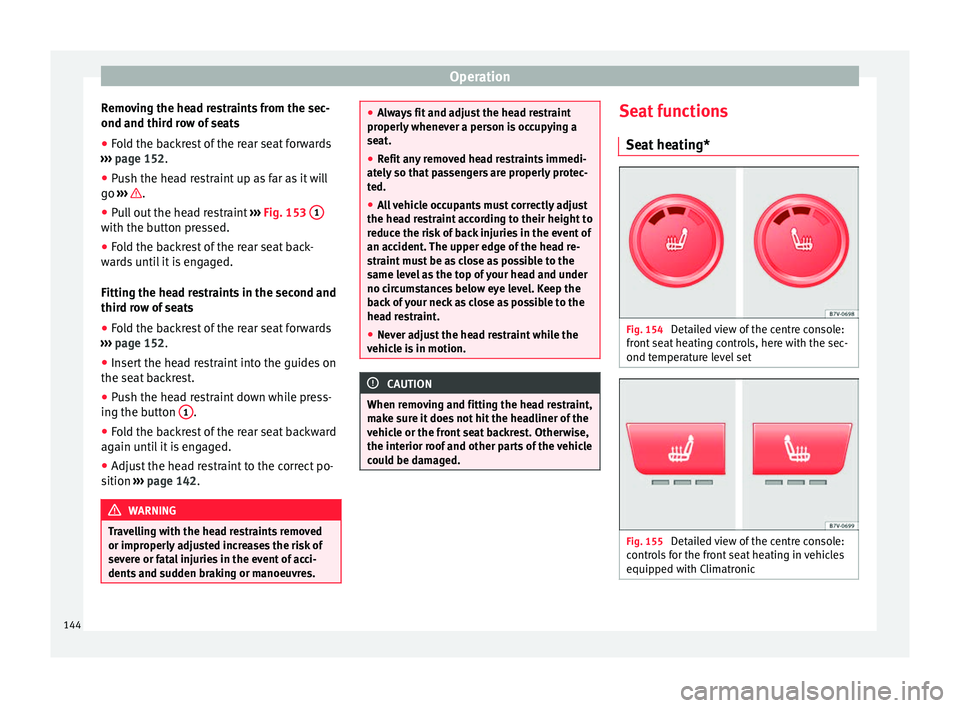
● Pull out the head restraint ››
›
Fig. 153 1 with the button pressed.
●
Fold the backrest of the rear seat back-
w ar
d
s until it is engaged.
Fitting the head restraints in the second and
third row of seats
● Fold the backrest of the rear seat forwards
›››
page 152.
● Insert the head restraint into the guides on
the seat b
ackrest.
● Push the head restraint down while press-
ing the butt
on 1 .
● Fold the backrest of the rear seat backward
ag ain u
nti
l it is engaged.
● Adjust the head restraint to the correct po-
sition ››
› page 142. WARNING
Travelling with the head restraints removed
or improperly a
djusted increases the risk of
severe or fatal injuries in the event of acci-
dents and sudden braking or manoeuvres. ●
Alw a
ys fit and adjust the head restraint
properly whenever a person is occupying a
seat.
● Refit any removed head restraints immedi-
ately so th
at passengers are properly protec-
ted.
● All vehicle occupants must correctly adjust
the head r
estraint according to their height to
reduce the risk of back injuries in the event of
an accident. The upper edge of the head re-
straint must be as close as possible to the
same level as the top of your head and under
no circumstances below eye level. Keep the
back of your neck as close as possible to the
head restraint.
● Never adjust the head restraint while the
vehicl
e is in motion. CAUTION
When removing and fitting the head restraint,
mak e s
ure it does not hit the headliner of the
vehicle or the front seat backrest. Otherwise,
the interior roof and other parts of the vehicle
could be damaged. Seat functions
Se at
he
ating* Fig. 154
Detailed view of the centre console:
fr ont
se
at heating controls, here with the sec-
ond temperature level set Fig. 155
Detailed view of the centre console:
c ontr o
ls for the front seat heating in vehicles
equipped with Climatronic 144
Page 149 of 320

Seats and head restraints
Initialising the seat position memory
The po s
ition memor
y system must be restar-
ted if, for example, the driver seat has been
changed.
Restarting deletes all memories and assign-
ments for the seat with position memory. The
memory buttons can then be reprogrammed
and the vehicle keys re-assigned.
● Open the driver door and do not get into
the vehic
le.
● Operating the seat settings from outside
the vehic
le.
● Move the angle of the seat backrest com-
plet
ely forwards.
● Release the control to set the angle and
then pres
s again until an audible warning is
heard. Note
The front passenger side exterior mirror auto-
matic a
lly changes from the position stored
for reversing as soon as the vehicle moves
forward at a speed of at least 15 km/h
(9 mph) or when the gear selection lever is
changed to a position other than R. Convenient entry function for the third
r
o
w of
seats Fig. 158
Second row of seats: convenient en-
tr y
f
unction controls The outer seats of the second row can be fol-
ded t
o m
ak
e it easier to get in and out of the
third row of seats.
Folding down the second row seats
● If necessary, open the belt loop and wind
up the seat belt
by hand.
● If necessary, remove the side head restraint
of the inte
grated child seat ›››
page 78.
● If necessary, raise the armrests.
● Remove any objects located in the footwell
of the second r
ow of seats, where applicable
››› .●
Pu sh the he
ad restraint down as far as it
will go ››› page 57.
● Push the lever ›››
Fig. 158 1 forwards and
f o
l
d the backrest of the rear seat. This seat
folds forward completely ››› and can still
be mo v
ed f
urther forward.
● Always take care when entering and leav-
ing the v
ehicle ››› .
R epo
s
itioning the seat in the second row
● Lift the backrest of the rear seat in an up-
right pos
ition. The entire seat folds back-
wards ››› .
● Make sure that the rear seat is securely en-
g ag
ed so th
at the seat belts can provide
proper protection in the rear seats. The red
mark ››› Fig. 158 2 should no longer be visi-
b l
e ›
›› in Folding down rear seats to create
lo a
d s
pace on page 154.
Emergency exit function
If the lever ››› Fig. 158 1 does not work, e.g.
af t
er an ac
cident, the seats on the second
row can be folded forwards from the third row
to allow vehicle occupants of the third row of
seats to get out of the vehicle ››› .
● Pull the handle ››
›
Fig. 158 3 back and
f o
l
d the backrest of the rear seat. The com-
plete rear seat folds forward ››› .
»
147
Technical data
Advice
Operation
Emergencies
Safety
Page 150 of 320

Operation
WARNING
Careless or uncontrolled use of the conven-
ient entr y
assistant may result in severe in-
jury and accident.
● Never use the convenient entry function
when the vehic
le is in motion.
● Avoid trapping or damaging the seat belt
when fol
ding the rear seats back.
● Keep your hands, fingers, feet and other
body par
ts out of the hinges and the seat
locking mechanism when folding and unfold-
ing.
● Mats or other objects can be caught in the
hinge
s of the seat backrests or rear seat. This
could prevent the seat backrest from locking
safely when positioned upright.
● All seat backrests must engage correctly for
the seat belt
s on the rear seats to work prop-
erly. When the seat backrest of an occupied
seat is not correctly locked in place, the pas-
senger can be thrust forward with the seat
backrest in case of sudden braking, sudden
manoeuvres or an accident.
● A red mark on the side of the seat
›››
Fig. 158 2 indicates that the seat back-
re s
t is not engaged. The mark is no longer
visible when it is correctly engaged.
● If the seat backrest or seat are folded down
and are not c
orrectly locked in place, no pas-
senger should use them.
● When getting in or out, never lean or hold
onto the fo
lded seat on the second row of
seats. WARNING
If child seats are fitted to all the seats in the
second r o
w then it is possible that the seats
of this row cannot be folded down from the
third row of seats in the event of an accident.
In the event of an emergency, passengers in
the third row of seats will not be able to leave
the vehicle or to help themselves.
● Child seats should not occupy all the seats
of the second r
ow if other passengers are to
occupy the third row. CAUTION
● Bef or
e folding down the rear seat backrest
for returning it to its position, adjust the front
seats so that the head restraints and seat
backrests do not hit each other when folding
and unfolding.
● Any objects located in the footwell of the
second ro
w of seats may be damaged on fold-
ing the rear seat forwards. Remove any ob-
jects before folding the seat down. Folding the backrest of the front pas-
sen
g
er se
at* Fig. 159
Folding the backrest of the front pas-
sen g
er se
at Fig. 160
Unlocking the folding backrest of the
fr ont
p
assenger seat The backrest of the front passenger seat can
be f
o
l
ded and locked horizontally.
148
Page 151 of 320
Seats and head restraints
The front passenger front airbag must be dis-
ab l
ed ›
›› page 18 if objects are being
transported on the folded front passenger
seat.
Folding the backrest of the front passenger
seat
● Remove any objects from the front passen-
ger seat
cushion ››› .
● Adjust the front passenger seat to its low-
e s
t
position ››› page 57.
● Push the head restraint down as far as it
wil
l go ››› page 57.
● Unlock the backrest of the front passenger
seat in the dir
ection of the arrow ››› Fig. 159
1 .
● Fold the backrest of the front passenger
se at
f
orwards in the direction of the arrow
››› Fig. 159 2 until it is horizontal.
● The backrest of the front passenger seat
mu s
t
engage safely in its folded position.
Lifting the backrest of the front passenger
seat
● Check that there are no objects or parts of
the body in the hing
e area.
● Lift the backrest of the front passenger seat
by fir
st unlocking it again ››› Fig. 160.
● Lift the backrest of the front passenger seat
unti l
it is upright. The seat backrest must be
engaged. ●
The upright b ac
krest of the front passenger
seat must safely engage. WARNING
Folding and lifting the backrest of the front
pa s
senger seat uncontrollably or without
paying attention may lead to severe injuries.
● Only fold and lift the backrest of the front
pas
senger seat when the vehicle is station-
ary.
● While the backrest of the front passenger
seat i
s folded, the front airbag must remain
disabled and the PASSENGER AIRBAG OFF light on.
● Keep your hands, fingers, feet and other
body par
ts out of the hinges and the seat
locking mechanism when folding and unfold-
ing.
● Mats or other objects can be caught in the
hinge
s of the backrest of the front passenger
seat. This could prevent the seat backrest
from locking safely when positioned upright.
● The upright backrest of the front passenger
seat mu
st engage. If the backrest of the front
passenger seat is not locked, it may suddenly
move and cause severe injuries. WARNING
Seat anchors and hinges exposed when the
bac k
rest of the front passenger seat is folded
may lead to severe injuries in the event of an
accident or sudden braking. ●
Never c arr
y people or children on the front
passenger seat when the seat backrest is fol-
ded.
● When the backrest of the front passenger
seat i
s folded, only the outer seat behind the
driver on the second row of seats may be oc-
cupied. This also applies to children sitting in
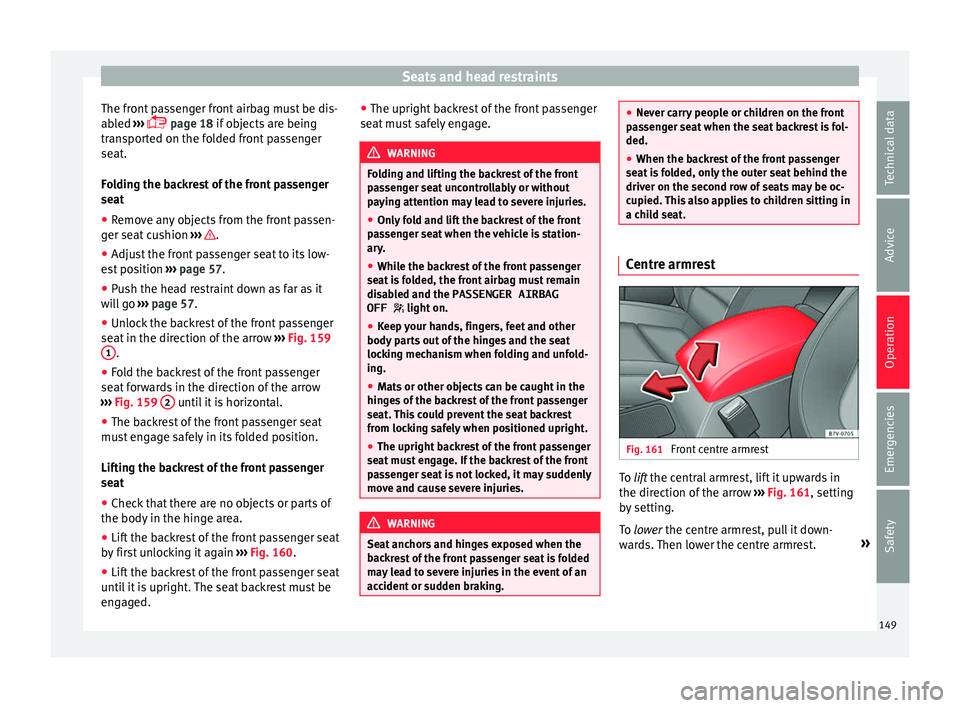
a child seat. Centre armrest
Fig. 161
Front centre armrest To lif
t the central armrest, lift it upwards in
the dir ection of
the arrow ››› Fig. 161, setting
by setting.
To lower the centre armrest, pull it down-
wards. Then lower the centre armrest. »
149
Technical data
Advice
Operation
Emergencies
Safety
Page 155 of 320
Transport and practical equipment
Note
The ventilating slits between the heated rear
windo w and the shelf
must not be covered so
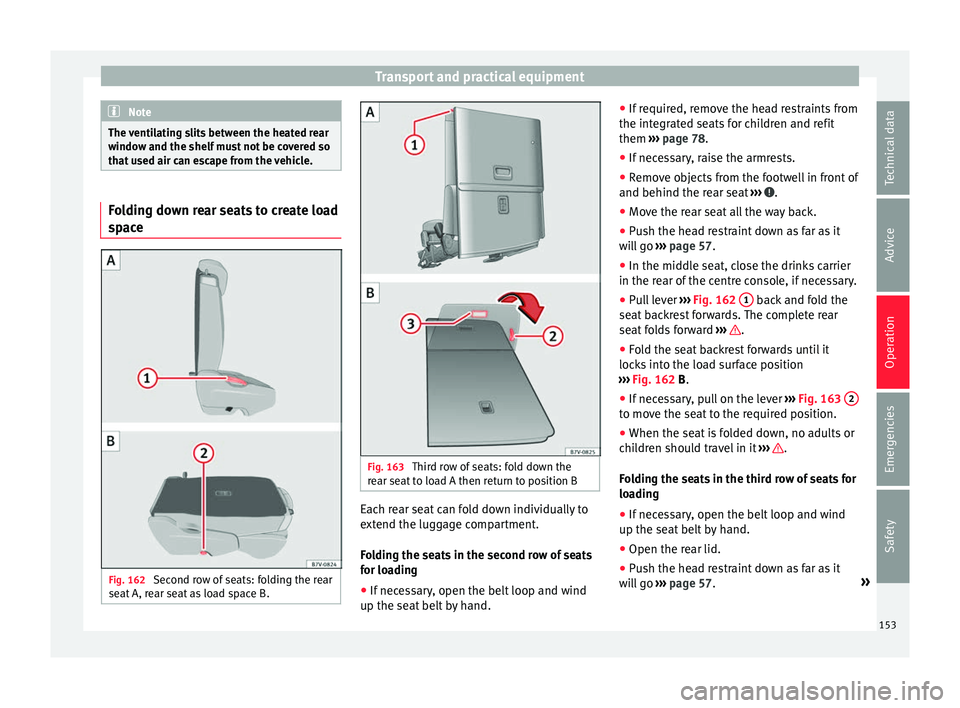
that used air can escape from the vehicle. Folding down rear seats to create load
sp
ac
e Fig. 162
Second row of seats: folding the rear
se at
A
, rear seat as load space B. Fig. 163
Third row of seats: fold down the
r e
ar se
at to load A then return to position B Each rear seat can fold down individually to
e
xt
end the lug
gage compartment.
Folding the seats in the second row of seats
for loading
● If necessary, open the belt loop and wind
up the seat belt
by hand. ●
If requir
ed, remove the head restraints from
the integrated seats for children and refit
them ››› page 78.
● If necessary, raise the armrests.
● Remove objects from the footwell in front of
and behind the rear se
at ››› .
● Move the rear seat all the way back.
● Push the head restraint down as far as it
w i
l
l go ››› page 57.
● In the middle seat, close the drinks carrier
in the rear of
the centre console, if necessary.
● Pull lever ››› Fig. 162
1 back and fold the
se at
b
ackrest forwards. The complete rear
seat folds forward ››› .
● Fold the seat backrest forwards until it
loc k
s
into the load surface position
››› Fig. 162 B.
● If necessary, pull on the lever ›››
Fig. 163 2 to move the seat to the required position.
●
When the seat is folded down, no adults or
c hi
l
dren should travel in it ››› .
F o
l
ding the seats in the third row of seats for
loading
● If necessary, open the belt loop and wind
up the seat belt
by hand.
● Open the rear lid.
● Push the head restraint down as far as it
wi l
l go ››› page 57. »
153
Technical data
Advice
Operation
Emergencies
Safety