seats Seat Alhambra 2017 Workshop Manual
[x] Cancel search | Manufacturer: SEAT, Model Year: 2017, Model line: Alhambra, Model: Seat Alhambra 2017Pages: 320, PDF Size: 6.88 MB
Page 176 of 320
Operation
Note
● When the coo lin
g system is turned off, air
coming from the outside will not be dried. To
avoid fogging up the windows, SEAT recom-
mends leaving the cooler (compressor) on. To
do this, press the A/C button. The button
lamp shou l
d light up.
● If the humidity and temperature outside the
vehicl
e are high, condensation can drip off
the evaporator in the cooling system and
form a pool underneath the vehicle, this is
completely normal and there is no need to
suspect a leak.
● Keep the air intake slots in front of the
winds
creen free of snow, ice and leaves to en-
sure heating and cooling are not impaired,
and to prevent the windows from misting
over. Controls
Read the additional information carefully
› ›
›
page 36
To switch a function on or off, press the ap-
propriate button. Press the button again to
switch off the function.
The LED on each control lights up to indicate
that the respective function of a control has
been switched on.
Some Climatronic controls may also be on
the air conditioner control panel located in
the rear centre console. These controls are used to make the appropriate settings for the
rear se
ats. Note
● Not a l
l Climatronic buttons are operational
in REAR mode.
● The REAR button is locked in defrost mode.
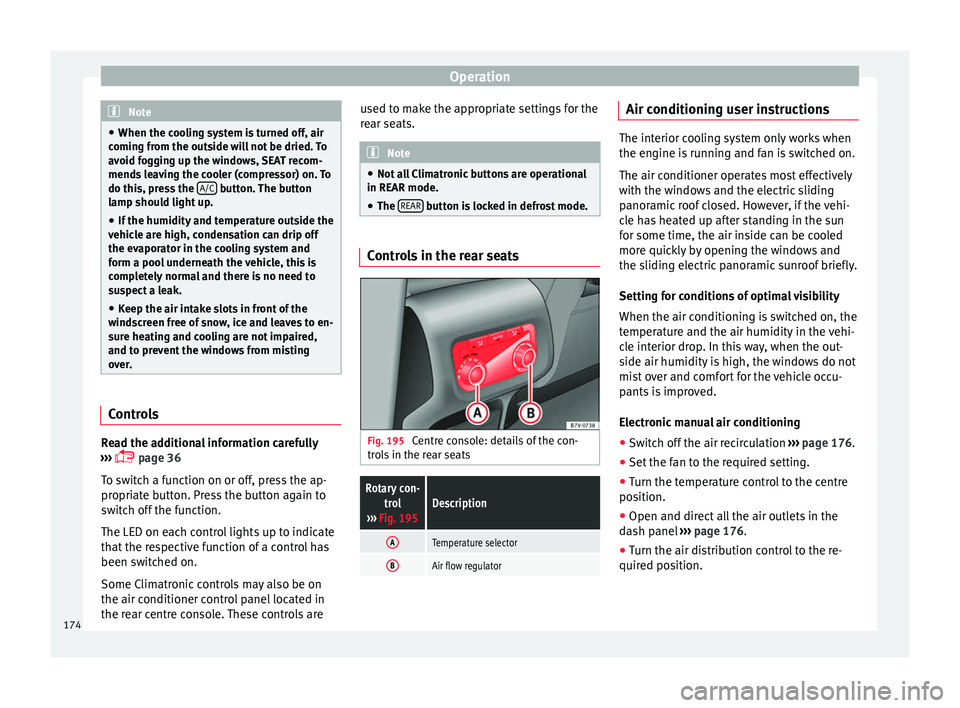
Controls in the rear seats
Fig. 195
Centre console: details of the con-
tr o
l
s in the rear seats
Rotary con-
trol
››› Fig. 195Description
ATemperature selector
BAir flow regulator Air conditioning user instructions
The interior cooling system only works when
the engine i
s
running and fan is switched on.
The air conditioner operates most effectively
with the windows and the electric sliding
panoramic roof closed. However, if the vehi-
cle has heated up after standing in the sun
for some time, the air inside can be cooled
more quickly by opening the windows and
the sliding electric panoramic sunroof briefly.
Setting for conditions of optimal visibility
When the air conditioning is switched on, the
temperature and the air humidity in the vehi-
cle interior drop. In this way, when the out-
side air humidity is high, the windows do not
mist over and comfort for the vehicle occu-
pants is improved.
Electronic manual air conditioning
● Switch off the air recirculation ››
›
page 176.
● Set the fan to the required setting.
● Turn the temperature control to the centre
position.
● Open and dir
ect all the air outlets in the
dash p
anel ›››
page 176.
● Turn the air distribution control to the re-
quired pos
ition.
174
Page 201 of 320
Driving
accelerator. This eliminates the need for con-
s t
ant
braking and acceleration.
Calm and steady driving
Constancy is more important than speed: The
more you drive at a constant speed, the lower
the fuel consumption.
When driving on the motorway, it is more effi-
cient to drive at a constant and more moder-
ate speed than to be continuously accelerat-
ing and braking. As a general rule, you will
reach your destination just as quickly when
you drive at a constant speed.
The cruise control function helps you to ach-
ieve a constant style of driving.
Moderate use of additional devices
It is important to travel in comfort, but con-
venience systems should be used ecological-
ly.
Some equipment, when connected, increase
fuel consumption considerably, for example:
● Air conditioning cooling system: If the air
conditioning sy
stem is required to cool to
significantly lower temperatures than the true
outside temperature, it will require a large
amount of energy from the engine. Therefore,
we recommend that the selected temperature
for the vehicle is not too different to the out-
side temperature. It is a good idea to air the
vehicle before starting your journey and to drive a short distance with all the windows
open. Only then shou
ld you close all the win-
dows and switch on the air conditioning.
Keep windows closed when travelling at high
speeds. Driving with the windows open in-
creases fuel consumption.
● Switch off the seat heating when the seats
have w
armed up.
● Switch off the heated rear window and the
winds
creen heating when the windows have
demisted and are free of ice.
● Do not leave the auxiliary heater switched
on when the vehic
le is moving ››› page 177.
Avoid short journeys
Fuel consumption is much higher when the
engine is cold, immediately after it has been
started. It takes a few kilometres of driving
for the engine to warm up and to normalise
consumption.
The engine and catalytic converter need to
reach their proper working temperature in or-
der to minimise fuel consumption and emis-
sions. The ambient temperature has a deci-
sive influence.
Therefore, unnecessary short journeys
should be avoided. Try to combine trips.
The vehicle uses more fuel in winter than in
summer, even when other conditions are the
same. The engine takes a long time to warm up
when it is
idling. Mechanical wear and pollu-
tant emissions are also especially high dur-
ing this initial warm-up phase. It is therefore
best to drive off immediately after starting
the engine. Avoid running the engine at high
speed.
Adjusting type pressures.
Having the correct pressure in your tyres
helps to reduce rolling resistance and, as a
result reduces fuel consumption. Increasing
the tyre pressure slightly (+0.2 bar
[2.9 psi/20 kPa]) can help to save fuel.
If you are prepared to accept a slight reduc-
tion in comfort, the tyres may be filled to the
pressures recommended for a fully-loaded
vehicle. This is also valid when driving alone
without luggage.
When you buy new tyres, make sure they are
optimised for minimum rolling resistance.
Avoid carrying unnecessary loads
The lighter the vehicle, the more economical
and ecological the driving style. For example,
an additional weight of 100 kg will increase
fuel consumption up to 0.3 l/100 km.
Remove any unnecessary objects or loads
from the vehicle. »
199
Technical data
Advice
Operation
Emergencies
Safety
Page 248 of 320
Advice
●
All
repairs and modifications to the vehicle
should only be performed by a specialised
workshop. Repairs and malfunctions in the air-
bag sy
s
tem When performing repairs and technical mod-
ification
s,
SEAT's directives must be ob-
served! ››› Modifications and repairs to the front bump-
er
, door
s, fr
ont seats, and repairs to the roof
or chassis should only be carried out in a
specialised workshop. These components
may contain parts or sensors belonging to
the airbag system.
If work is carried out on the airbag system or
parts have to be removed and fitted on the
system when performing other repair work,
parts of the airbag system may be damaged.
The consequence may be that, in the event of
an accident, the airbag inflates incorrectly or
does not inflate at all.
So that the effectiveness of the airbag is not
reduced and that removed parts do not cause
any injuries or environmental pollution, regu-
lations must be observed. These require-
ments are known to specialised workshops.
Modifications to the vehicle suspension may
affect the operation of the airbag system in
the event of collision. For example, if wheel and tyre combinations not approved by SEAT
are used, or if
the vehicle height is lowered,
the suspension is stiffened or the suspension
springs, telescopic arms, dampers, etc., are
modified, the results received by the airbag
sensors and sent to the control unit may not
be accurate. For example, some modifica-
tions to the suspension could increase the
force measured by the sensors and result in
the triggering of the airbag systems in colli-
sions. Under normal conditions, the meas-
ured values would be lower and the airbag
would not have been triggered. Other modifi-
cations may reduce the forces measured by
the sensors and prevent the airbags from be-
ing triggered when they should. WARNING
Repairs or modifications which are not per-
formed c orr
ectly may result in damage or er-
rors in the vehicle operation, affecting the ef-
fectiveness of the airbag systems. This could
result in serious or fatal accidents.
● All repairs and modifications to the vehicle
should on
ly be performed by a specialised
workshop.
● Airbag modules must never be repaired: if
damag
ed, they must be replaced.
● Never fit recycled or reused airbag compo-
nents in
your vehicle. WARNING
Modifications to the vehicle suspension, in-
cludin g the u
se of unauthorised wheel and
tyre combinations, may affect the perform-
ance of the airbags and increase the risk of
serious or fatal injury in the event of acci-
dent.
● Never fit suspension components which are
not identica
l to the original parts in the vehi-
cle.
● Never use wheel and tyre combinations not
appro
ved by SEAT. Retrofitting of mobile phones
An exterior aerial is required for the use of
tw
o-w
a
y radios in the vehicle.
The retro-fitting of electrical or electronic ap-
pliances in the vehicle is subject to their ap-
proval for use in your vehicle. Under certain
circumstances, this could mean that your ve-
hicle registration documents are no longer
valid.
SEAT has approved your vehicle for use with
two-way radios providing the following condi-
tions are observed:
● The exterior aerial must be mounted pro-
fes
sionally.
● The maximum transmitting power is 10
watts.
246
Page 258 of 320
Advice
Caring for and cleaning the ve-
hic l
e int
erior
Introduction The dye used in many modern garments, for
ex
amp
le dark jeans, is not always sufficiently
colour-fast. Seat upholstery (material and
leather), especially when light-coloured, may
visibly discolour if the dye comes out of
clothing (even when used correctly). This is
not an upholstery defect but indicates that
the dye in the item of clothing is not suffi-
ciently colour-fast.
The longer stains or dirt remain on the vehi-
cle surfaces, especially the fabrics covering
the padded upholstery, the more difficult it
becomes to clean and maintain them. If
stains and dirt are left for a long time, it may
be that they are impossible to remove. WARNING
Car-care products may be toxic and hazard-
ous. U s
ing unsuitable car-care products or,
using them in the wrong way, may cause acci-
dents, serious injury, burns or intoxication.
● Keep your car-care products in their origi-
nal
containers.
● Read the instructions.
● Never keep car-care products in empty food
container
s, bottles or other similar contain-
ers. Other people may confuse them. ●
Keep a l
l car-care products out of the reach
of children.
● Some products may give off harmful va-
pours durin
g use. Therefore, they should be
used outdoors in well-ventilated places.
● Never use fuel, turpentine, engine oil, nail-
varnish r
emover or any other volatile product
for washing, maintenance or cleaning. These
are toxic and highly flammable. WARNING
Unsuitable maintenance and cleaning of vehi-
c le c
omponents may impair proper operation
of safety equipment and cause serious injury.
● Maintain and clean vehicle components ac-
cordin
g to the manufacturer's instructions.
● Only use approved or recommended clean-
ing product
s. CAUTION
● Cle
aning products which contain solvents
have a corrosive effect and may damage the
material irreparably.
● Stains and dirt containing aggressive sub-
stanc
es or solvents attack the material and
may damage it irreparably, even when they
are cleaned quickly.
● Dirt and stains should not be allowed to dry
and should be c
leaned as quickly as possible.
● In the case of stubborn stains, take the ve-
hicle t
o a specialised workshop to avoid dam-
age. How to care for the upholstery
To treat and maintain your seat upholstery,
keep the f
o
llowing in mind ››› :
● Before entering the vehicle, close any Vel-
cr o f
asteners that might snag on the uphols-
tery or trim fabric. Any open Velcro fasteners
may damage the trim or upholstery fabrics.
● To prevent damage, avoid direct contact
between sharp dec
orative objects and the
upholstery and trim fabrics. Decorative ob-
jects include zips, rivets and rhinestones on
clothing and belts.
● From time to time, clean the dust that gath-
ers in the per
forations, folds and seams so
that the surfaces of the seats are not dam-
aged by its abrasive effect.
● Make sure clothes are colour-fast to avoid
them running and s
taining the upholstery.
This is especially important if the upholstery
is light in colour. CAUTION
If you ignore this advice, which is important
for m aint
aining your seat upholstery, the fab-
ric may be damaged or stained. Note
SEAT recommends you take the vehicle to a
spec i
alised workshop to treat any stains on
the upholstery caused by the discolouration
of clothing. 256
Page 259 of 320

Care and maintenance
Cleaning the trim and seat fabrics, the
A lc
ant
ara® Cleaning the upholstery on heated seats and
electric
a
lly operated seats or seats with air-
bag components
It is possible that there are important airbag
components and electrical connections in-
side the driver seat, passenger seat and pos-
sibly the outer rear seats. If these seats and
seat backrests are damaged, or are cleaned
and are treated incorrectly, or if they get wet,
the vehicle electric system may be destroyed
and the airbag system damaged ››› .
El ectric
and he
ated seats contain compo-
nents and electrical connections that may be
damaged if the seats are cleaned or incor-
rectly treated ››› . Similarly, damage might
be c au
sed at
other points in the vehicle's
electric system.
For this reason, bear the following indica-
tions in mind for cleaning:
● Do not use high-pressure or steam cleaning
equipment or co
ld aerosols.
● Do not use cream detergents or detergent-
based so
lutions for delicate garments.
● Prevent the fabric from getting wet at all
times.
● Only
use cleaning products approved by
SEA T
. ●
If in doubt, t ak
e the vehicle to a professio-
nal cleaning company.
Cleaning the upholstery on non-heated seats
and non-electrically operated seats or seats
without airbag components
● Before using any cleaning products, con-
sult
and keep in mind the instructions of use,
indications and warnings on the container.
● Use a vacuum cleaner (with the brush at-
tachment) on the trim and se
at fabrics, the
Alcantara ®
upholstery of the seats and the
carpet.
● Do not use high-pressure or steam cleaning
equipment or co
ld aerosols.
● For general cleaning, use a soft sponge or
an ordinar
y lint-free microfibre cloth ››› .
● Clean Alcantara ®
s ur
f
aces with a slightly
damp cotton or woollen cloth, or a standard
lint-free microfibre cloth ››› .
If the dir
t
on the trim and upholstery fabrics
is only superficial, you can use a standard
foam cleaner.
If the upholstery and trim are very dirty, be-
fore cleaning them we recommend you find
out about the most suitable cleaning options
from a professional cleaning company. If nec-
essary, the cleaning should be carried out by
a specialised company. Stain removal
When remov
ing stains, it may be necessary
to clean the whole surface and not just the
stain itself. Especially if the surface has been
dirtied through normal use. If you only clean
the stained area, that part may then look
lighter than the rest. If in doubt, take the ve-
hicle to a professional cleaning company. WARNING
If there is a fault in the airbag system, it is
likely th
at the airbag will not deploy correct-
ly, not deploy at all, or do so unexpectedly,
which could cause serious or fatal injuries.
● Have the system checked immediately by a
speci
alised workshop. CAUTION
If the upholstery on electrically operated
seat s
or seats with airbag components gets
soaked, the vehicle's electric system and cer-
tain other components may be damaged.
● If the seat gets soaked, take the vehicle im-
mediately
to a specialised workshop to be
dried and for the system components to be
inspected.
● Do not use steam cleaning equipment as
the dirt bec
omes more encrusted and fixed in
the material.
● High-pressure cleaning equipment and cold
aeroso
ls may damage the upholstery. » 257
Technical data
Advice
Operation
Emergencies
Safety
Page 260 of 320
Advice
CAUTION
● Brushe s
should only be used to clean the
carpet and floor mats! Other fabrics may be
damaged if cleaned with a brush.
● If cream detergents or detergents for deli-
cate g
arments are applied with a damp cloth
or sponge, they may, for example, leave rings
when dry because of the surfactant compo-
nents they contain. Generally, such rings are
very difficult or almost impossible to remove. CAUTION
● Do not l et
water soak into Alcantara ®
under
any circumstances.
● Do not use leather cleaning products, sol-
vents, w
ax polish, shoe cream, stain remov-
ers or similar products on Alcantara ®
.
● Never use brushes for cleaning damp mate-
rial
as they could damage the surface. Cleaning and maintenance of natural
l
e
ather upho
lsteryConsult a professional cleaning workshop if
y
ou h
av
e any doubts on cleaning and main-
taining the leather equipment in your vehicle.
Maintenance and treatment
Nappa natural leather is delicate because it
has no additional protective layer. ●
After c
leaning, regularly apply a condition-
er with sun-screen and impregnating action.
These products nourish the leather, soften it
and make it more breathable, as well as re-
hydrating it. They also provide it with a pro-
tective film.
● Clean the leather every 2 or 3 months and
remov
e stains as they appear.
● Treat the leather every 6 months with a
suitab
le maintenance product.
● Apply as few cleaning and maintenance
products a
s possible, always using a dry, lint-
free cotton or woollen cloth. Do not apply
cleaning and maintenance products directly
to the leather.
● Remove recent ball-point pen and ink
stain
s, lipstick, shoe cream and similar
stains as soon as possible.
● Maintain the colour of the leather. To do
this, use a s
pecial cream especially coloured
for leather to achieve the same overall colour,
if necessary.
● Afterwards, go over it with a soft cloth.
Cle
aning the vehicle
SEAT recommends using a slightly damp cot-
ton or woollen cloth for general cleaning pur-
poses.
Generally, the leather should never be
soaked at any point, nor should water pene-
trate the seams. Before cleaning the leather upho
lstery, bear
in mind the following recommendations
››› page 257, Cleaning the upholstery on
heated seats and electrically operated seats
or seats with airbag components . CAUTION
● On no acc ou
nt use solvents, wax polish,
shoe cream, stain removers or similar materi-
als on leather.
● If the stain remains on the leather for long,
it wi
ll soak in and be impossible to remove.
● In the event of spilt liquids, dry immediate-
ly with an ab
sorbent cloth to prevent the liq-
uid penetrating through the leather or seams.
● If the vehicle is left standing in the sun for
long periods, the l
eather should be protected
against direct sunlight to prevent it from fad-
ing. Note
The leather will usually change colour slight-
ly w ith u
se. Cleaning synthetic leather upholstery
Before cleaning synthetic leather upholstery,
be
ar in mind the f
o
llowing recommendations
››› page 257, Cleaning the upholstery on
heated seats and electrically operated seats
or seats with airbag components
258
Page 299 of 320
Technical features
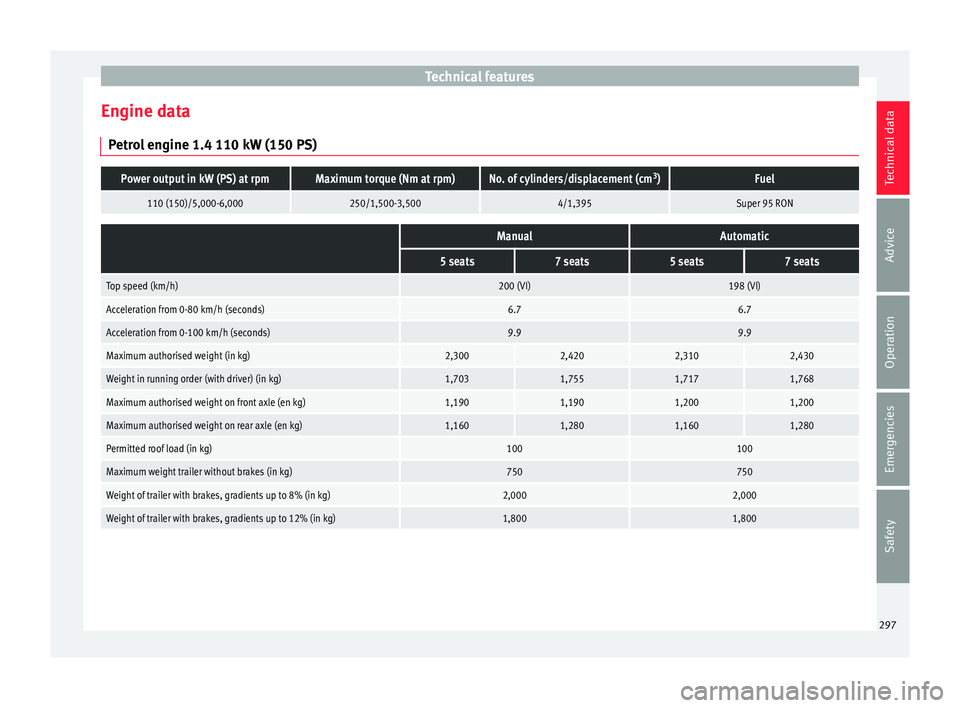
Engine data P etr
o
l engine 1.4 110 kW (150 PS)
Power output in kW (PS) at rpmMaximum torque (Nm at rpm)No. of cylinders/displacement (cm 3
)Fuel
110 (150)/5,000-6,000250/1,500-3,5004/1,395Super 95 RON
ManualAutomatic
5 seats7 seats5 seats7 seats
Top speed (km/h)200 (VI)198 (VI)
Acceleration from 0-80 km/h (seconds)6.76.7
Acceleration from 0-100 km/h (seconds)9.99.9
Maximum authorised weight (in kg)2,3002,4202,3102,430
Weight in running order (with driver) (in kg)1,7031,7551,7171,768
Maximum authorised weight on front axle (en kg)1,1901,1901,2001,200
Maximum authorised weight on rear axle (en kg)1,1601,2801,1601,280
Permitted roof load (in kg)100100
Maximum weight trailer without brakes (in kg)750750
Weight of trailer with brakes, gradients up to 8% (in kg)2,0002,000
Weight of trailer with brakes, gradients up to 12% (in kg)1,8001,800 297
Technical data
Advice
Operation
Emergencies
Safety
Page 300 of 320
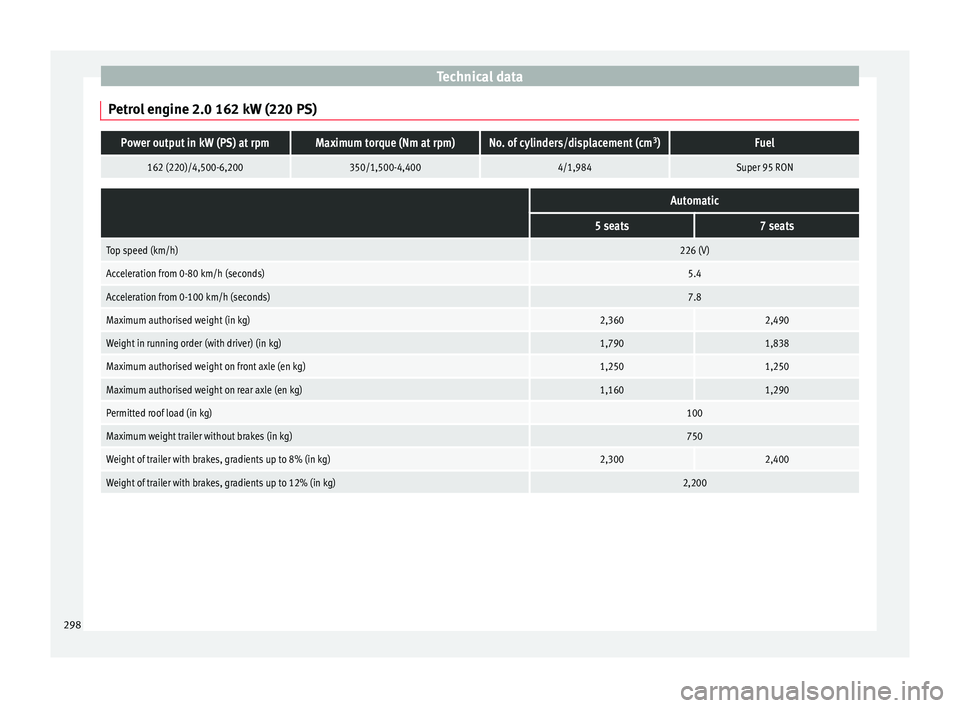
Technical data
Petrol engine 2.0 162 kW (220 PS)Power output in kW (PS) at rpmMaximum torque (Nm at rpm)No. of cylinders/displacement (cm 3
)Fuel
162 (220)/4,500-6,200350/1,500-4,4004/1,984Super 95 RON
Automatic
5 seats7 seats
Top speed (km/h)226 (V)
Acceleration from 0-80 km/h (seconds)5.4
Acceleration from 0-100 km/h (seconds)7.8
Maximum authorised weight (in kg)2,3602,490
Weight in running order (with driver) (in kg)1,7901,838
Maximum authorised weight on front axle (en kg)1,2501,250
Maximum authorised weight on rear axle (en kg)1,1601,290
Permitted roof load (in kg)100
Maximum weight trailer without brakes (in kg)750
Weight of trailer with brakes, gradients up to 8% (in kg)2,3002,400
Weight of trailer with brakes, gradients up to 12% (in kg)2,200 298
Page 301 of 320
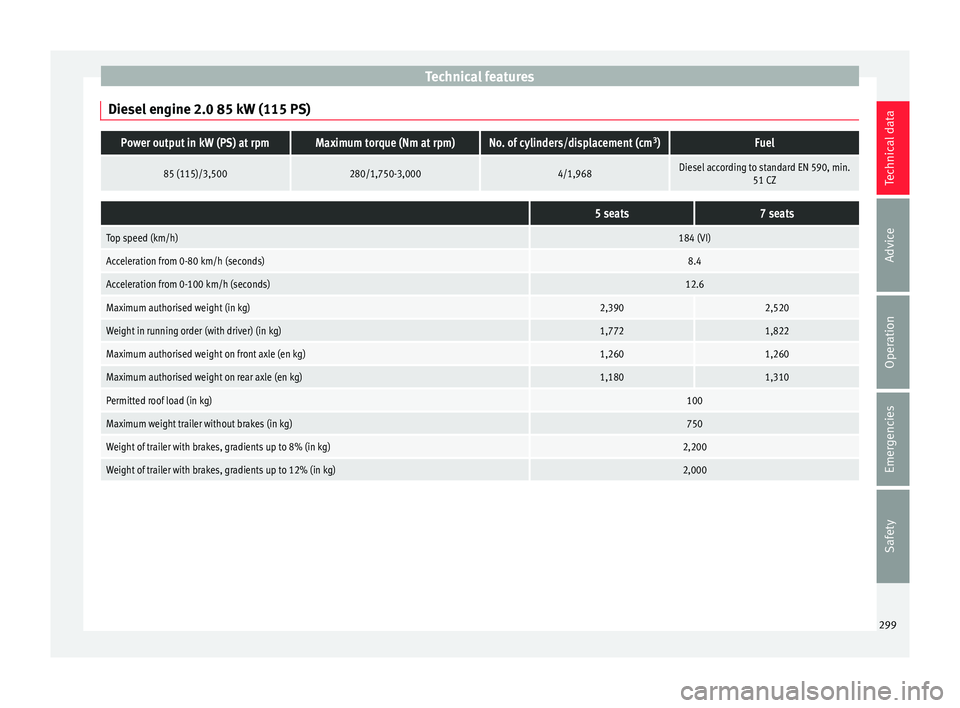
Technical features
Diesel engine 2.0 85 kW (115 PS)Power output in kW (PS) at rpmMaximum torque (Nm at rpm)No. of cylinders/displacement (cm 3
)Fuel
85 (115)/3,500280/1,750-3,0004/1,968Diesel according to standard EN 590, min.
51 CZ
5 seats7 seats
Top speed (km/h)184 (VI)
Acceleration from 0-80 km/h (seconds)8.4
Acceleration from 0-100 km/h (seconds)12.6
Maximum authorised weight (in kg)2,3902,520
Weight in running order (with driver) (in kg)1,7721,822
Maximum authorised weight on front axle (en kg)1,2601,260
Maximum authorised weight on rear axle (en kg)1,1801,310
Permitted roof load (in kg)100
Maximum weight trailer without brakes (in kg)750
Weight of trailer with brakes, gradients up to 8% (in kg)2,200
Weight of trailer with brakes, gradients up to 12% (in kg)2,000 299
Technical data
Advice
Operation
Emergencies
Safety
Page 302 of 320
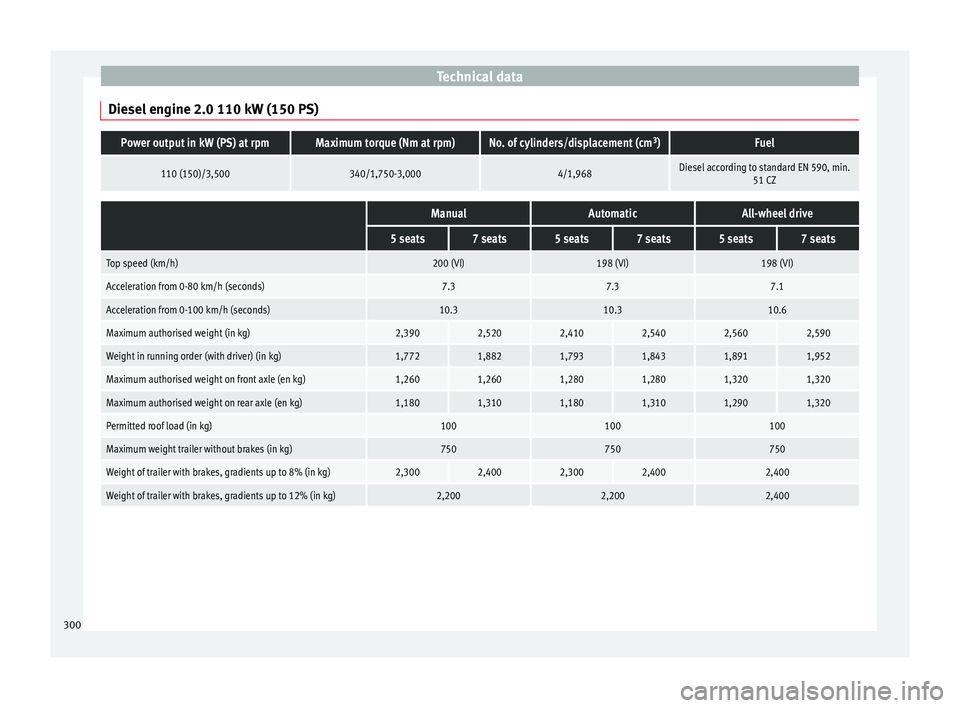
Technical data
Diesel engine 2.0 110 kW (150 PS)Power output in kW (PS) at rpmMaximum torque (Nm at rpm)No. of cylinders/displacement (cm 3
)Fuel
110 (150)/3,500340/1,750-3,0004/1,968Diesel according to standard EN 590, min.
51 CZ
ManualAutomaticAll-wheel drive
5 seats7 seats5 seats7 seats5 seats7 seats
Top speed (km/h)200 (VI)198 (VI)198 (VI)
Acceleration from 0-80 km/h (seconds)7.37.37.1
Acceleration from 0-100 km/h (seconds)10.310.310.6
Maximum authorised weight (in kg)2,3902,5202,4102,5402,5602,590
Weight in running order (with driver) (in kg)1,7721,8821,7931,8431,8911,952
Maximum authorised weight on front axle (en kg)1,2601,2601,2801,2801,3201,320
Maximum authorised weight on rear axle (en kg)1,1801,3101,1801,3101,2901,320
Permitted roof load (in kg)100100100
Maximum weight trailer without brakes (in kg)750750750
Weight of trailer with brakes, gradients up to 8% (in kg)2,3002,4002,3002,4002,400
Weight of trailer with brakes, gradients up to 12% (in kg)2,2002,2002,400300