remove seats Seat Alhambra 2018 User Guide
[x] Cancel search | Manufacturer: SEAT, Model Year: 2018, Model line: Alhambra, Model: Seat Alhambra 2018Pages: 324, PDF Size: 7.04 MB
Page 153 of 324
Seats and head restraints
Folding the backrest of the front pas-
sen g
er se
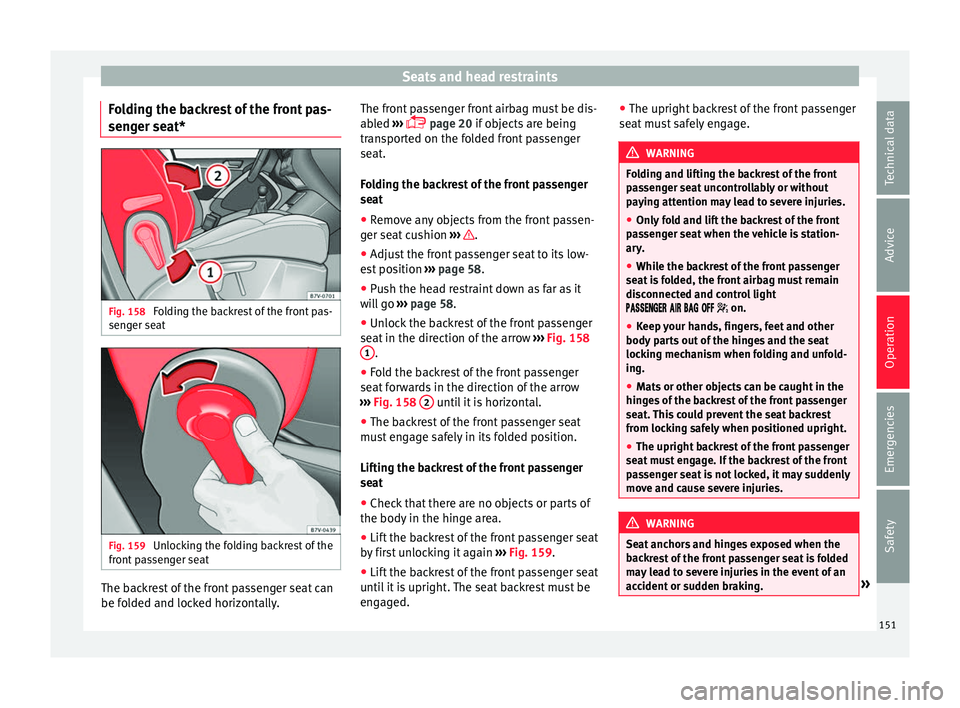
at*Fig. 158
Folding the backrest of the front pas-
sen g
er se
at Fig. 159
Unlocking the folding backrest of the
fr ont
p
assenger seat The backrest of the front passenger seat can
be f
o
l
ded and locked horizontally. The front passenger front airbag must be dis-
abled
›
›› page 20 if objects are being
transported on the folded front passenger
seat.
Folding the backrest of the front passenger
seat
● Remove any objects from the front passen-
ger seat
cushion ››› .
● Adjust the front passenger seat to its low-
e s
t
position ››› page 58.
● Push the head restraint down as far as it
wil
l go ››› page 58.
● Unlock the backrest of the front passenger
seat in the dir
ection of the arrow ››› Fig. 158
1 .
● Fold the backrest of the front passenger
se at
f
orwards in the direction of the arrow
››› Fig. 158 2 until it is horizontal.
● The backrest of the front passenger seat
mu s
t
engage safely in its folded position.
Lifting the backrest of the front passenger
seat
● Check that there are no objects or parts of
the body in the hing
e area.
● Lift the backrest of the front passenger seat
by fir
st unlocking it again ››› Fig. 159.
● Lift the backrest of the front passenger seat
unti l
it is upright. The seat backrest must be
engaged. ●
The upright b ac
krest of the front passenger
seat must safely engage. WARNING
Folding and lifting the backrest of the front
pa s
senger seat uncontrollably or without
paying attention may lead to severe injuries.
● Only fold and lift the backrest of the front
pas
senger seat when the vehicle is station-
ary.
● While the backrest of the front passenger
seat i
s folded, the front airbag must remain
disconnected and control light
on.
● Keep your hands, fingers, feet and other
body par
ts out of the hinges and the seat
locking mechanism when folding and unfold-
ing.
● Mats or other objects can be caught in the
hinge
s of the backrest of the front passenger
seat. This could prevent the seat backrest
from locking safely when positioned upright.
● The upright backrest of the front passenger
seat mu
st engage. If the backrest of the front
passenger seat is not locked, it may suddenly
move and cause severe injuries. WARNING
Seat anchors and hinges exposed when the
bac k
rest of the front passenger seat is folded
may lead to severe injuries in the event of an
accident or sudden braking. » 151
Technical data
Advice
Operation
Emergencies
Safety
Page 157 of 324
Transport and practical equipment
●
Whil e driv
ing, always keep object compart-
ments closed.
● Do not place hard, heavy or sharp objects
inside the
vehicle interior, in open storage
compartments, the rear shelf or on the dash
panel.
● Remove hard, heavy and sharp objects from
clothes
and pockets inside the vehicle and
store securely. WARNING
The transport of heavy object changes vehi-
c le h
andling and increases braking distance.
Heavy loads that have not been stored or se-
cured correctly could cause loss of control
and result in serious injury.
● Vehicle handling changes when transport-
ing heavy
objects due to a change in the cen-
tre of gravity.
● Distribute the load as uniformly and as low
down on the v
ehicle as possible.
● Store heavy objects in the luggage com-
partment
as far from the rear axle as possi-
ble. CAUTION
● Hard o b
jects on the rear shelf could chafe
the wires of the heating element and antenna
of the rear window and cause damage.
● The side window antenna could be dam-
aged due to c
hafing from objects. Note
The ventilating slits between the heated rear
windo w and the shelf
must not be covered so
that used air can escape from the vehicle. Folding down rear seats to create load
sp
ac
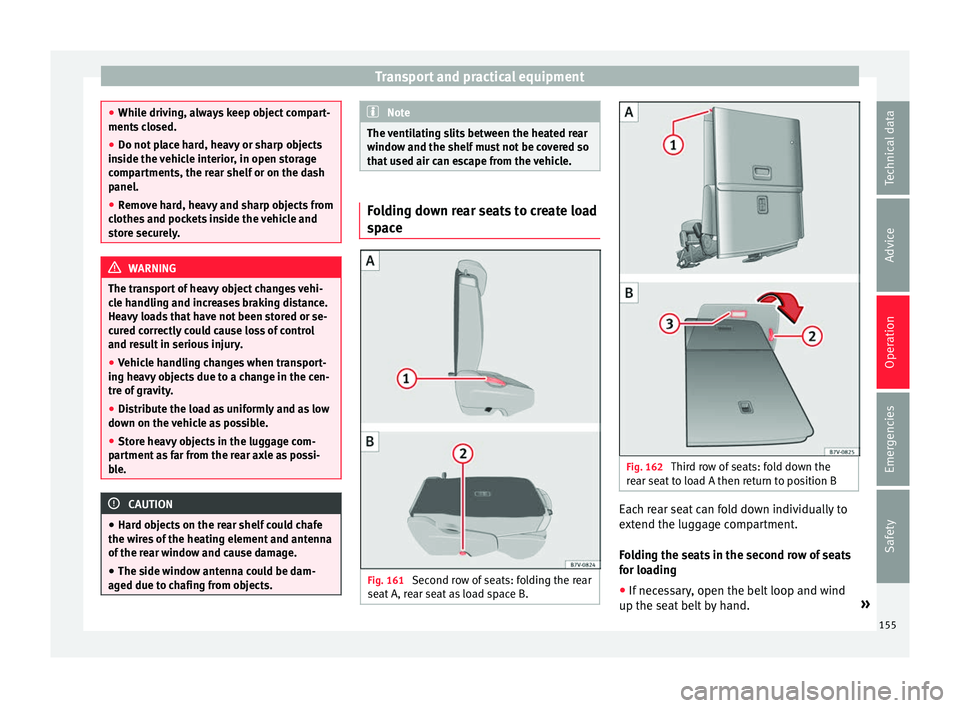
e Fig. 161
Second row of seats: folding the rear
se at
A
, rear seat as load space B. Fig. 162
Third row of seats: fold down the
r e
ar se
at to load A then return to position B Each rear seat can fold down individually to
e
xt
end the lug
gage compartment.
Folding the seats in the second row of seats
for loading
● If necessary, open the belt loop and wind
up the seat belt
by hand. »
155
Technical data
Advice
Operation
Emergencies
Safety
Page 158 of 324
Operation
● If r
equir
ed, remove the head restraints from
the integrated seats for children and refit
them ››› page 79.
● If necessary, raise the armrests.
● Remove objects from the footwell in front of
and behind the rear se
at ››› .
● Move the rear seat all the way back.
● Push the head restraint down as far as it
w i
l
l go ››› page 58.
● In the middle seat, close the drinks carrier
in the rear of
the centre console, if necessary.
● Pull lever ››› Fig. 161
1 back and fold the
se at
b
ackrest forwards. The complete rear
seat folds forward ››› .
● Fold the seat backrest forwards until it
loc k
s
into the load surface position
››› Fig. 161 B.
● If necessary, pull on the lever ›››
Fig. 162 2 to move the seat to the required position.
●
When the seat is folded down, no adults or
c hi
l
dren should travel in it ››› .
F o
l
ding the seats in the third row of seats for
loading
● If necessary, open the belt loop and wind
up the seat belt
by hand.
● Open the rear lid.
● Push the head restraint down as far as it
wi l
l go ››› page 58. ●
Remo v
e objects from the footwell in front of
and behind the rear seat ››› .
● Remove objects from the space below the
r e
ar se
at.
● Remove the attachment elements and sup-
ports f
or the net from the rail system.
● Pull lever ››› Fig. 162 1 back and fold the
se at
b
ackrest forwards. The rear seat folds
forward ››› and the cushion also moves for-
w ar
d.
● F
old the seat tray forward on top of the fol-
ded seat.
● When the se
at is folded down, no adults or
chil
dren should travel in it ››› .
P uttin
g the se
ats in the second row back in
place
● Pull lever ››› Fig. 161
1 upwards and place
the se at
b
ackrests in vertical position. The
entire seat folds backwards.
● Pull on the rear seats and the seat backrest
to ens
ure that they are correctly locked in
place and that the seat belt protection is
guaranteed for rear seat passengers.
Putting the seats in the third row back in
place
● Open the rear lid.
● Pull on the handle ›››
Fig. 162 2 to put the
se at
tr
ay back in position. ●
Pul
l the handle ››› Fig. 162 3 . The entire
se at
f
olds backwards.
● Press on the seat tray in the seat backrest
until
it is held in position by its magnets.
● Open the sliding door.
● Put the seat backrest into position and
pres
s firmly until it clicks into place.
● Pull on the rear seats and the seat backrest
to ens
ure that they are correctly locked in
place and that the seat belt protection is
guaranteed for rear seat passengers. WARNING
Folding and lifting the rear seats carelessly
without p
aying attention could cause serious
injury.
● Never fold or lift the seats while driving.
● Do no trap or damage seat belts when rais-
ing the seat
backrest.
● Keep your hands, fingers, feet and other
body par
ts out of the hinges and the seat
locking mechanism when folding and unfold-
ing.
● Mats or other objects can be caught in the
hinge
s of the seat backrests or rear seat. This
could prevent the seat or seat backrest from
locking securely in the vertical position.
● All seat backrests must engage correctly for
the seat belt
s on the rear seats to work prop-
erly. When the seat backrest of an occupied
seat is not correctly locked in place, the pas-
senger can be thrust forward with the seat 156
Page 159 of 324
Transport and practical equipment
backrest in case of sudden braking, sudden
manoeu
vr
es or an accident.
● No seat must be occupied if the seat back-
res
t or seat is folded or not correctly engag-
ed. CAUTION
● Bef or
e folding the rear seat backrest, ad-
just the front seats so that neither the head
restraint or backrest hit them when folded.
● Objects placed in the footrest area in front
of and behind the re
ar seats can be damaged
when seats are folded down or put back into
position. Remove any objects in the way be-
fore folding seats down or repositioning
them.
● Objects placed in the moulding on the back
of the third r
ow of seats can be damaged
when folding down the seats or putting them
back into position. Remove any objects in the
way before folding seats down or reposition-
ing them.
● The attachment elements and supports for
the net par
tition placed on the rail system
can be damaged when folding down seats
from the third row or putting them back into
position and these can also damage the seats
themselves. Before folding down or reposi-
tioning the seats, remove the attachment ele-
ments and supports for the net from the rail
system. Shelf*
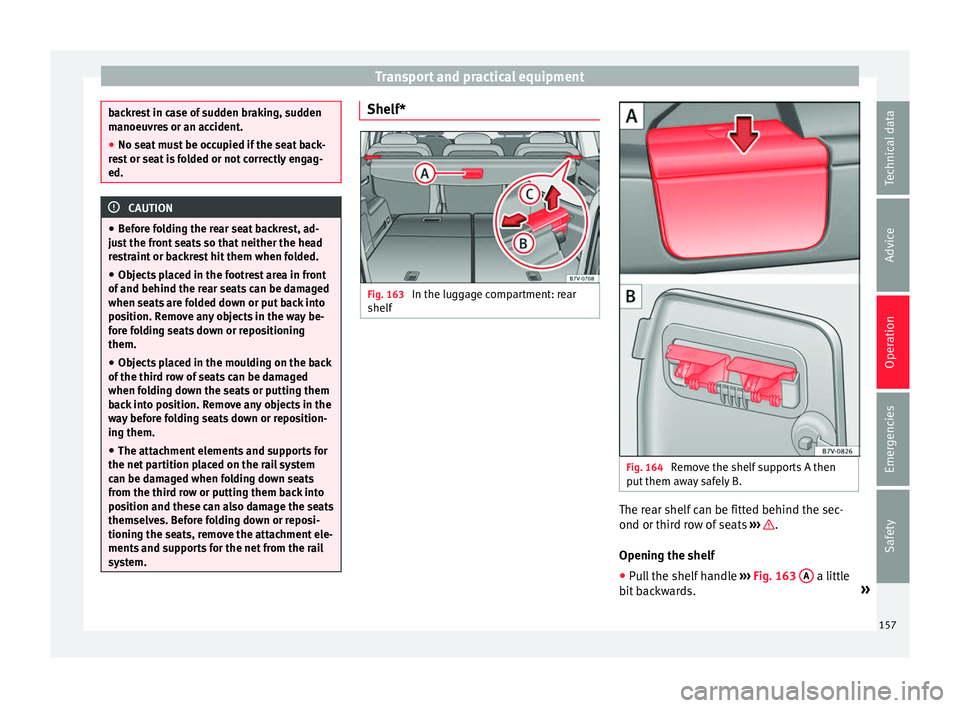
Fig. 163
In the luggage compartment: rear
shelf Fig. 164
Remove the shelf supports A then
p ut
them a
way safely B. The rear shelf can be fitted behind the sec-
ond or thir
d r
o
w of seats ››› .
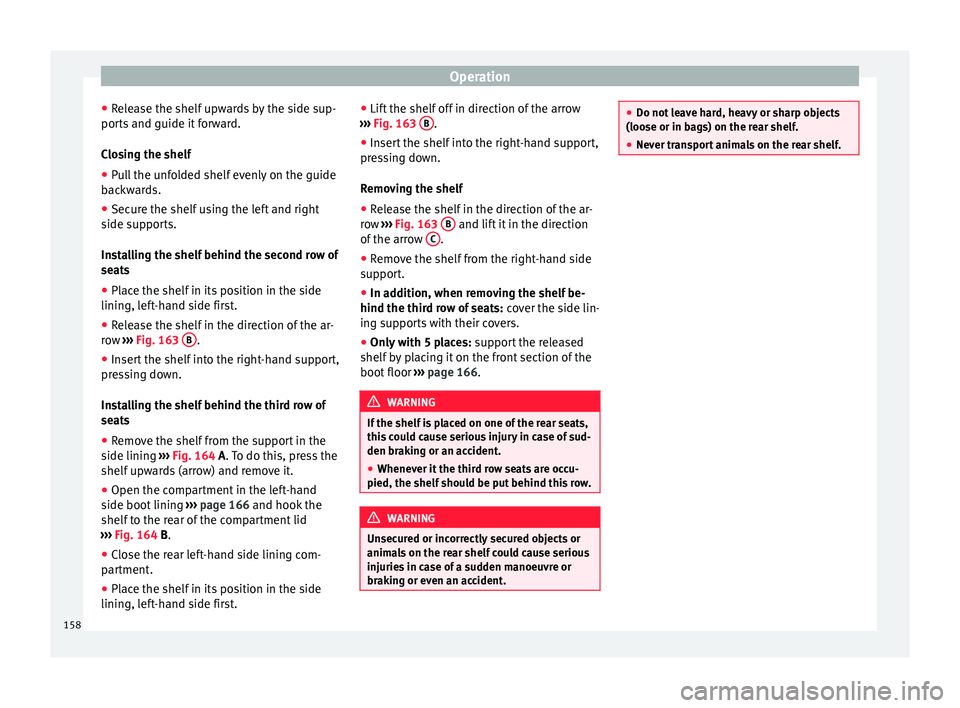
Openin g the shelf
● Pu
ll the shelf handle ›››
Fig. 163 A a little
b it
b
ackwards. »
157
Technical data
Advice
Operation
Emergencies
Safety
Page 160 of 324
Operation
● Rel
e
ase the shelf upwards by the side sup-
ports and guide it forward.
Closing the shelf
● Pull the unfolded shelf evenly on the guide
back
wards.
● Secure the shelf using the left and right
side sup
ports.
Installing the shelf behind the second row of
seats
● Place the shelf in its position in the side
lining, lef
t-hand side first.
● Release the shelf in the direction of the ar-
row ›
›› Fig. 163 B .
● Insert the shelf into the right-hand support,
pr e
s
sing down.
Installing the shelf behind the third row of
seats
● Remove the shelf from the support in the
side lining ›
›› Fig. 164 A. To do this, press the
shelf upwards (arrow) and remove it.
● Open the compartment in the left-hand
side boot linin
g ››› page 166 and hook the
shelf to the rear of the compartment lid
››› Fig. 164 B.
● Close the rear left-hand side lining com-
partment
.
● Place the shelf in its position in the side
lining, lef
t-hand side first. ●
Lift the shelf
off in direction of the arrow
››› Fig. 163 B .
● Insert the shelf into the right-hand support,
pr e
s
sing down.
Removing the shelf
● Release the shelf in the direction of the ar-
row ›
›› Fig. 163 B and lift it in the direction
of the arr
o
w C .
● Remove the shelf from the right-hand side
s up
por
t.
● In addition, when removing the shelf be-
hind the third ro
w of seats: cover the side lin-
ing supports with their covers.
● Only with 5 places: suppor
t the released
shelf by placing it on the front section of the
boot floor ››› page 166. WARNING
If the shelf is placed on one of the rear seats,
this c
ould cause serious injury in case of sud-
den braking or an accident.
● Whenever it the third row seats are occu-
pied, the shelf shoul
d be put behind this row. WARNING
Unsecured or incorrectly secured objects or
anima l
s on the rear shelf could cause serious
injuries in case of a sudden manoeuvre or
braking or even an accident. ●
Do not l e
ave hard, heavy or sharp objects
(loose or in bags) on the rear shelf.
● Never transport animals on the rear shelf. 158
Page 161 of 324
Transport and practical equipment
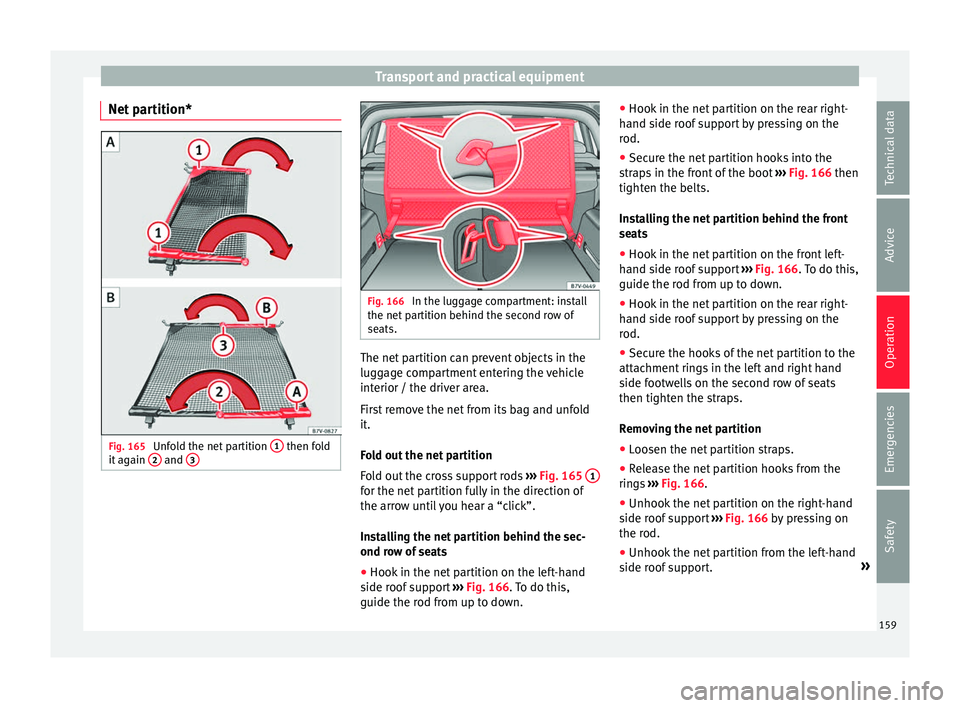
Net partition* Fig. 165
Unfold the net partition 1 then fold
it ag ain 2 and
3 Fig. 166
In the luggage compartment: install
the net p
ar
tition behind the second row of
seats. The net partition can prevent objects in the
lug
g
ag
e compartment entering the vehicle
interior / the driver area.
First remove the net from its bag and unfold
it.
Fold out the net partition
Fold out the cross support rods ››› Fig. 165 1 for the net partition fully in the direction of
the arr
o
w u
ntil you hear a “click”.
Installing the net partition behind the sec-
ond row of seats
● Hook in the net partition on the left-hand
side roof
support ››› Fig. 166. To do this,
guide the rod from up to down. ●
Hook in the net p
artition on the rear right-
hand side roof support by pressing on the
rod.
● Secure the net partition hooks into the
strap
s in the front of the boot ››› Fig. 166 then
tighten the belts.
Installing the net partition behind the front
seats
● Hook in the net partition on the front left-
hand side r
oof support ››› Fig. 166. To do this,
guide the rod from up to down.
● Hook in the net partition on the rear right-
hand side r
oof support by pressing on the
rod.
● Secure the hooks of the net partition to the
attachment
rings in the left and right hand
side footwells on the second row of seats
then tighten the straps.
Removing the net partition
● Loosen the net partition straps.
● Release the net partition hooks from the
rings
››› Fig. 166.
● Unhook the net partition on the right-hand
side roof
support ››› Fig. 166 by pressing on
the rod.
● Unhook the net partition from the left-hand
side roof
support. »
159
Technical data
Advice
Operation
Emergencies
Safety
Page 163 of 324
Transport and practical equipment
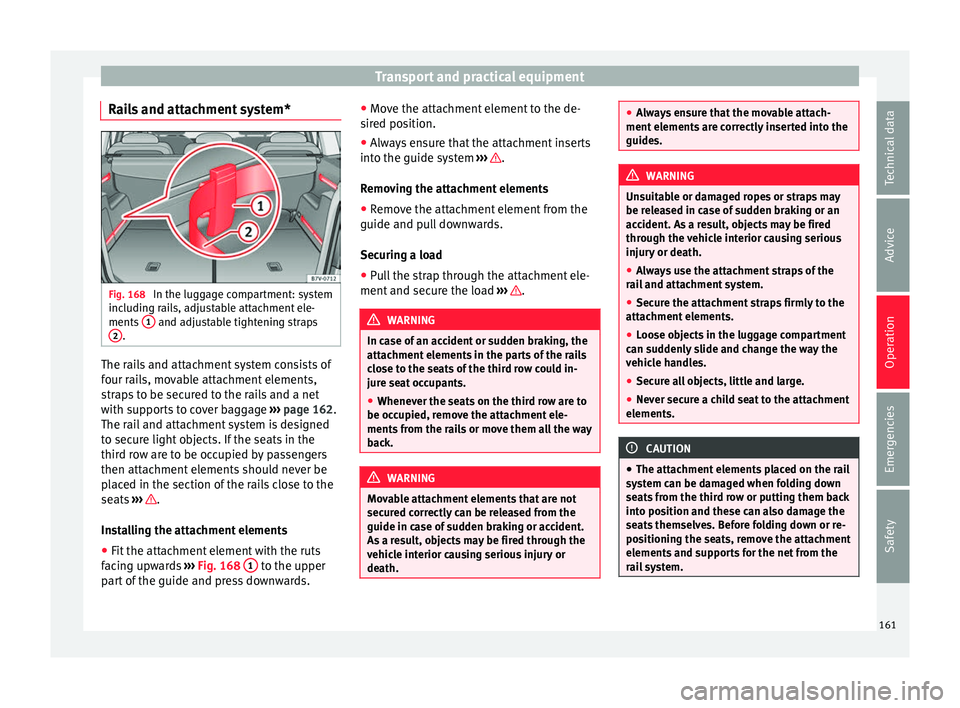
Rails and attachment system* Fig. 168
In the luggage compartment: system
inc ludin
g r
ails, adjustable attachment ele-
ments 1 and adjustable tightening straps
2 .
The rails and attachment system consists of
f
our r
ai
ls, movable attachment elements,
straps to be secured to the rails and a net
with supports to cover baggage ››› page 162.
The rail and attachment system is designed
to secure light objects. If the seats in the
third row are to be occupied by passengers
then attachment elements should never be
placed in the section of the rails close to the
seats ››› .
In s
t
alling the attachment elements
● Fit the attachment element with the ruts
facin
g upwards ››› Fig. 168 1 to the upper
p ar
t
of the guide and press downwards. ●
Move the att
achment element to the de-
sired position.
● Always ensure that the attachment inserts
into the guide sys
tem ››› .
R emo
v
ing the attachment elements
● Remove the attachment element from the
guide and pul
l downwards.
Securing a load
● Pull the strap through the attachment ele-
ment and secur
e the load ››› .
WARNING
In case of an accident or sudden braking, the
attac hment
elements in the parts of the rails
close to the seats of the third row could in-
jure seat occupants.
● Whenever the seats on the third row are to
be occupied, r
emove the attachment ele-
ments from the rails or move them all the way
back. WARNING
Movable attachment elements that are not
secur ed c
orrectly can be released from the
guide in case of sudden braking or accident.
As a result, objects may be fired through the
vehicle interior causing serious injury or
death. ●
Alw a
ys ensure that the movable attach-
ment elements are correctly inserted into the
guides. WARNING
Unsuitable or damaged ropes or straps may
be r ele
ased in case of sudden braking or an
accident. As a result, objects may be fired
through the vehicle interior causing serious
injury or death.
● Always use the attachment straps of the
rail
and attachment system.
● Secure the attachment straps firmly to the
attachment
elements.
● Loose objects in the luggage compartment
can sud
denly slide and change the way the
vehicle handles.
● Secure all objects, little and large.
● Never secure a child seat to the attachment
elements. CAUTION
● The attac hment
elements placed on the rail
system can be damaged when folding down
seats from the third row or putting them back
into position and these can also damage the
seats themselves. Before folding down or re-
positioning the seats, remove the attachment
elements and supports for the net from the
rail system. 161
Technical data
Advice
Operation
Emergencies
Safety
Page 165 of 324
Transport and practical equipment
Removing the baggage net supports
● Remove the net attachment element from
the r ai
l
and pull it out downwards. WARNING
In case of an accident or sudden braking, the
net att ac
hment elements in the parts of the
rails close to the seats of the third row could
injure seat occupants.
● Whenever the seats on the third row are to
be occupied, r
emove the attachment ele-
ments from the rails or move them all the way
back. WARNING
Baggage net supports that are not secured
corr ectly
can be released from the guide in
case of the sudden braking or accident. As a
result, objects may be fired through the vehi-
cle interior causing serious injury or death.
● Always ensure that the baggage net sup-
ports
are correctly inserted into the rails; the
red mark should not be visible.
● Never secure a child seat to the baggage
net sup
ports. CAUTION
● The bag g
age net supports placed on the
rail system can be damaged when folding
down seats from the third row or putting
them back into position and these can also
damage the seats themselves. Before folding down or repositioning the seats, remove the
bag
g
age net supports from the rail system. Retaining hooks
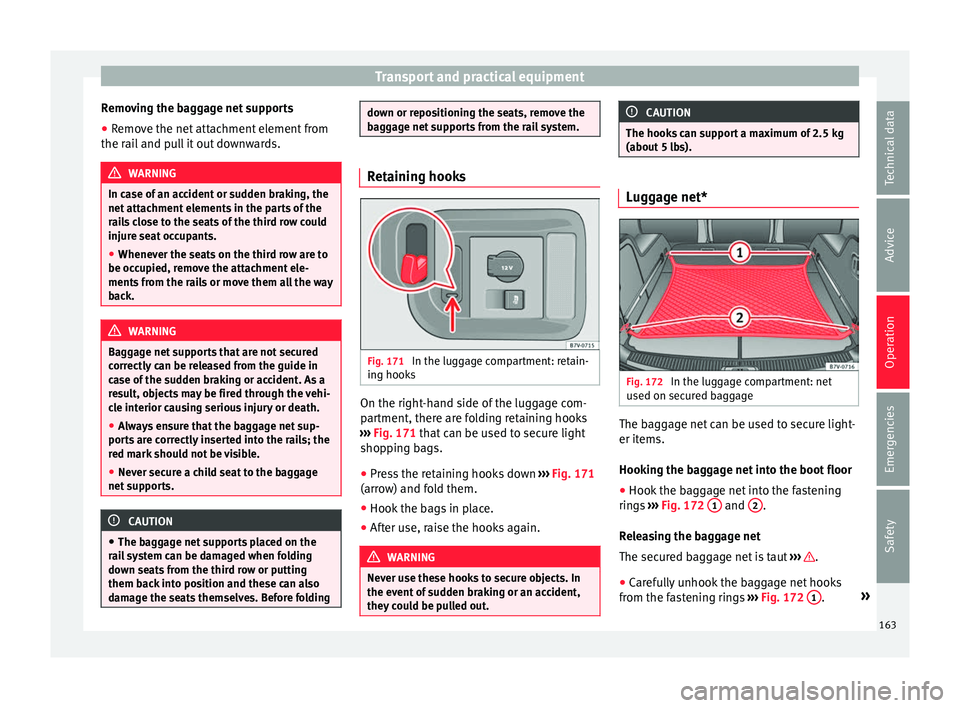
Fig. 171
In the luggage compartment: retain-
in g hook
s On the right-hand side of the luggage com-
p
ar
tment, ther
e are folding retaining hooks
››› Fig. 171 that can be used to secure light
shopping bags.
● Press the retaining hooks down ›››
Fig. 171
(arrow) and fold them.
● Hook the bags in place.
● After use, raise the hooks again. WARNING
Never use these hooks to secure objects. In
the event of
sudden braking or an accident,
they could be pulled out. CAUTION
The hooks can support a maximum of 2.5 kg
(about 5 l
bs). Luggage net*
Fig. 172
In the luggage compartment: net
u sed on sec
ur
ed baggage The baggage net can be used to secure light-
er it
ems.
Hook in
g the baggage net into the boot floor
● Hook the baggage net into the fastening
rings
››› Fig. 172 1 and
2 .
R el
e
asing the baggage net
The secured baggage net is taut ››› .
● Carefully unhook the baggage net hooks
fr om the f
a
stening rings ››› Fig. 172 1 .
»
163
Technical data
Advice
Operation
Emergencies
Safety
Page 174 of 324
Operation
Note
The drink holders can be removed for clean-
ing. Drink holders in front centre console
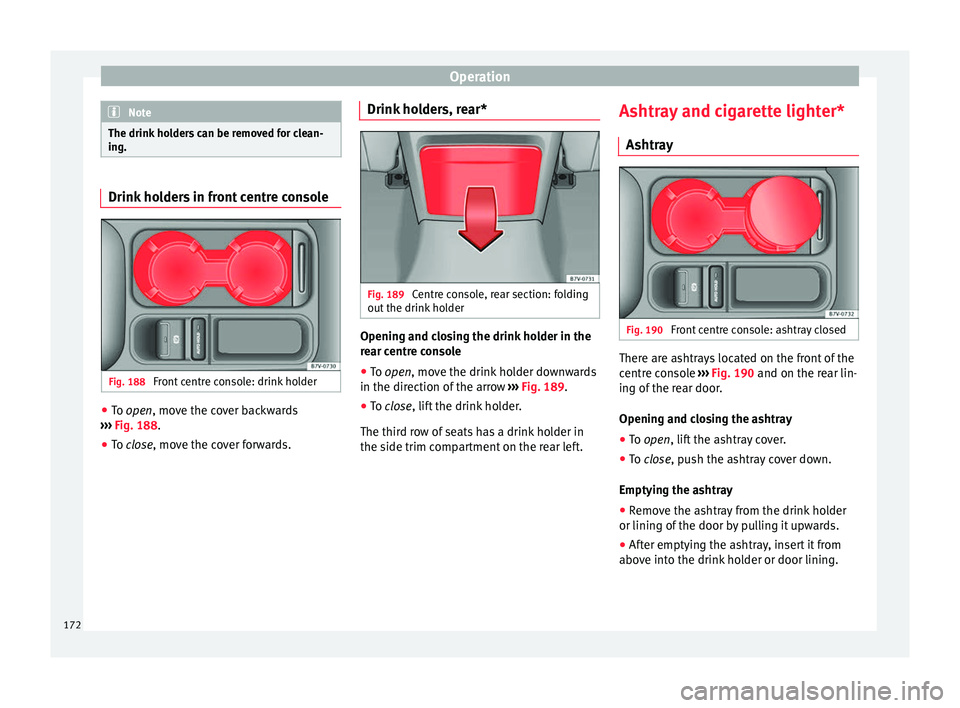
Fig. 188
Front centre console: drink holder ●
To open, mo v
e the c over backwards
››› Fig. 188.
● To close, move the cover forwards. Drink ho
lders, rear* Fig. 189
Centre console, rear section: folding
out the drink
ho
lder Opening and closing the drink holder in the
r
e
ar c
entre console
● To open, move the drink
holder downwards
in the direction of the arrow ››› Fig. 189.
● To close, lift the drink holder.
The third r
ow of seats has a drink holder in
the side trim compartment on the rear left. Ashtray and cigarette lighter*
Ashtray Fig. 190
Front centre console: ashtray closed There are ashtrays located on the front of the
c
entr
e c
onsole ››› Fig. 190 and on the rear lin-
ing of the rear door.
Opening and closing the ashtray
● To open, lift the ashtray cover.
● To
close, push the ashtray cover down.
Emptyin
g the ashtray
● Remove the ashtray from the drink holder
or lining of the door b
y pulling it upwards.
● After emptying the ashtray, insert it from
above int
o the drink holder or door lining.
172
Page 251 of 324
Care and maintenance
●
All
repairs and modifications to the vehicle
should only be performed by a specialised
workshop. Repairs and malfunctions in the air-
bag sy
s
tem When performing repairs and technical mod-
ification
s,
SEAT's directives must be ob-
served! ››› Modifications and repairs to the front bump-
er
, door
s, fr
ont seats, and repairs to the roof
or chassis should only be carried out in a
specialised workshop. These components
may contain parts or sensors belonging to
the airbag system.
If work is carried out on the airbag system or
parts have to be removed and fitted on the
system when performing other repair work,
parts of the airbag system may be damaged.
The consequence may be that, in the event of
an accident, the airbag inflates incorrectly or
does not inflate at all.
So that the effectiveness of the airbag is not
reduced and that removed parts do not cause
any injuries or environmental pollution, regu-
lations must be observed. These require-
ments are known to specialised workshops.
Modifications to the vehicle suspension may
affect the operation of the airbag system in
the event of collision. For example, if wheel and tyre combinations not approved by SEAT
are used, or if
the vehicle height is lowered,
the suspension is stiffened or the suspension
springs, telescopic arms, dampers, etc., are
modified, the results received by the airbag
sensors and sent to the control unit may not
be accurate. For example, some modifica-
tions to the suspension could increase the
force measured by the sensors and result in
the triggering of the airbag systems in colli-
sions. Under normal conditions, the meas-
ured values would be lower and the airbag
would not have been triggered. Other modifi-
cations may reduce the forces measured by
the sensors and prevent the airbags from be-
ing triggered when they should. WARNING
Repairs or modifications which are not per-
formed c orr
ectly may result in damage or er-
rors in the vehicle operation, affecting the ef-
fectiveness of the airbag systems. This could
result in serious or fatal accidents.
● All repairs and modifications to the vehicle
should on
ly be performed by a specialised
workshop.
● Airbag modules must never be repaired: if
damag
ed, they must be replaced.
● Never fit recycled or reused airbag compo-
nents in
your vehicle. WARNING
Modifications to the vehicle suspension, in-
cludin g the u
se of unauthorised wheel and
tyre combinations, may affect the perform-
ance of the airbags and increase the risk of
serious or fatal injury in the event of acci-
dent.
● Never fit suspension components which are
not identica
l to the original parts in the vehi-
cle.
● Never use wheel and tyre combinations not
appro
ved by SEAT. Retrofitting of mobile phones
An exterior aerial is required for the use of
tw
o-w
a
y radios in the vehicle.
The retro-fitting of electrical or electronic ap-
pliances in the vehicle is subject to their ap-
proval for use in your vehicle. Under certain
circumstances, this could mean that your ve-
hicle registration documents are no longer
valid.
SEAT has approved your vehicle for use with
two-way radios providing the following condi-
tions are observed:
● The exterior aerial must be mounted pro-
fes
sionally.
● The maximum transmitting power is 10
watts. »
249
Technical data
Advice
Operation
Emergencies
Safety