remove seats Seat Alhambra 2018 Owner's Manual
[x] Cancel search | Manufacturer: SEAT, Model Year: 2018, Model line: Alhambra, Model: Seat Alhambra 2018Pages: 324, PDF Size: 7.04 MB
Page 26 of 324
The essentials
Removing the child seat
The se at
belt
must not be unfastened until
the vehicle has come to a standstill.
● Press the red button on the buckle. The
latc
h plate is released from the buckle.
● Guide the belt back by hand so that it rolls
up eas
ily and the trim will not be damaged.
● Remove the child seat from the vehicle.
››› in Safety instructions on page 76 Fix the child seat with the lower an-
c
hor point
s
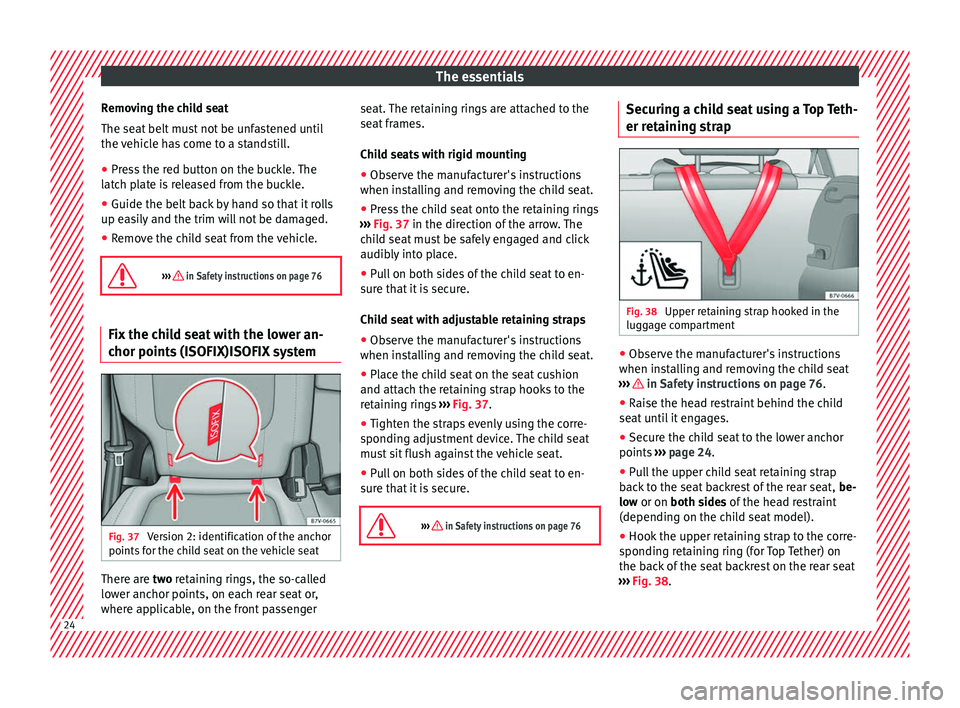
(ISOFIX)ISOFIX systemFig. 37
Version 2: identification of the anchor
points f
or the c
hild seat on the vehicle seat There are tw
o
r
etaining rings, the so-called
lower anchor points, on each rear seat or,
where applicable, on the front passenger seat. The retaining rings are attached to the
seat fr
ames.
Child seats with rigid mounting ● Observe the manufacturer's instructions
when inst
alling and removing the child seat.
● Press the child seat onto the retaining rings
›››
Fig. 37 in the direction of the arrow. The
child seat must be safely engaged and click
audibly into place.
● Pull on both sides of the child seat to en-
sure th
at it is secure.
Child seat with adjustable retaining straps
● Observe the manufacturer's instructions
when inst
alling and removing the child seat.
● Place the child seat on the seat cushion
and attach the r
etaining strap hooks to the
retaining rings ››› Fig. 37.
● Tighten the straps evenly using the corre-
sponding a
djustment device. The child seat
must sit flush against the vehicle seat.
● Pull on both sides of the child seat to en-
sure th
at it is secure.
››› in Safety instructions on page 76 Securing a child seat using a Top Teth-
er r
et
ainin
g strap Fig. 38
Upper retaining strap hooked in the
lug g
ag
e compartment ●
Observe the manufacturer's instructions
when in s
t
alling and removing the child seat
››› in Safety instructions on page 76.
● Raise the head restraint behind the child
se at
u
ntil it engages.
● Secure the child seat to the lower anchor
points ››
› page 24.
● Pull the upper child seat retaining strap
back
to the seat backrest of the rear seat, be-
low or on both sides of the head restraint
(depending on the child seat model).
● Hook the upper retaining strap to the corre-
sponding r
etaining ring (for Top Tether) on
the back of the seat backrest on the rear seat
››› Fig. 38.24
Page 65 of 324
Seat belts
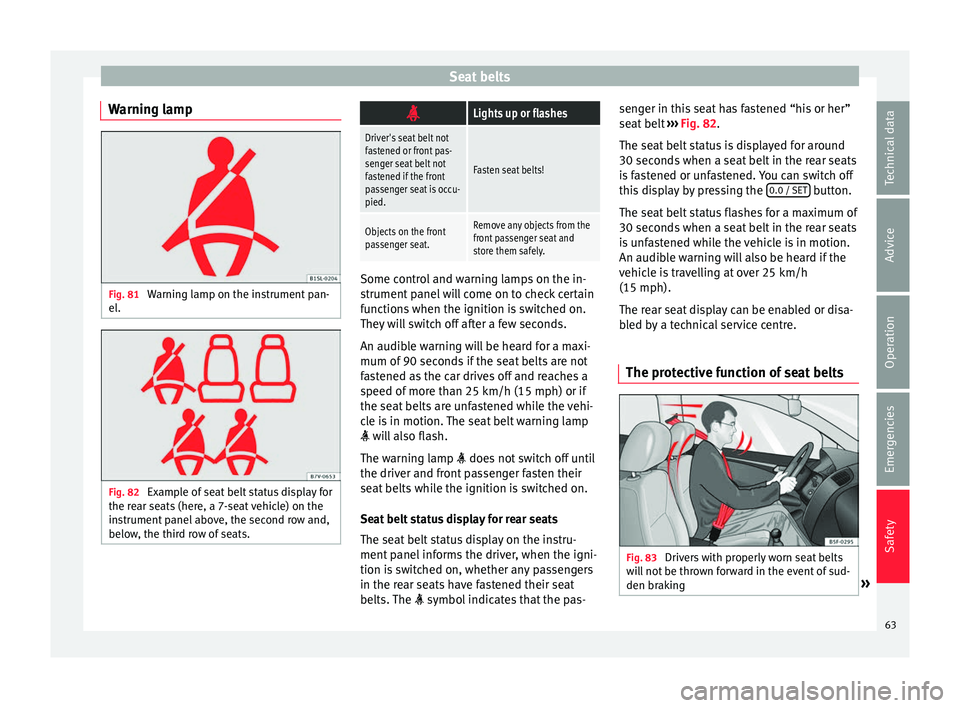
Warning lamp Fig. 81
Warning lamp on the instrument pan-
el . Fig. 82
Example of seat belt status display for
the r ear se
ats (here, a 7-seat vehicle) on the
instrument panel above, the second row and,
below, the third row of seats.
Lights up or flashes
Driver's seat belt not
fastened or front pas-
senger seat belt not
fastened if the front
passenger seat is occu-
pied.
Fasten seat belts!
Objects on the front
passenger seat.Remove any objects from the
front passenger seat and
store them safely.
Some control and warning lamps on the in-
strument
p
anel will come on to check certain
functions when the ignition is switched on.
They will switch off after a few seconds.
An audible warning will be heard for a maxi-
mum of 90 seconds if the seat belts are not
fastened as the car drives off and reaches a
speed of more than 25 km/h (15 mph) or if
the seat belts are unfastened while the vehi-
cle is in motion. The seat belt warning lamp
will also flash.
The warning lamp does not switch off until
the driver and front passenger fasten their
seat belts while the ignition is switched on.
Seat belt status display for rear seats
The seat belt status display on the instru-
ment panel informs the driver, when the igni-
tion is switched on, whether any passengers
in the rear seats have fastened their seat
belts. The symbol indicates that the pas- senger in this seat has fastened “his or her”
seat
belt
››› Fig. 82.
The seat belt status is displayed for around
30 seconds when a seat belt in the rear seats
is fastened or unfastened. You can switch off
this display by pressing the 0.0 / SET button.
The se at
belt
status flashes for a maximum of
30 seconds when a seat belt in the rear seats
is unfastened while the vehicle is in motion.
An audible warning will also be heard if the
vehicle is travelling at over 25 km/h
(15 mph).
The rear seat display can be enabled or disa-
bled by a technical service centre.
The protective function of seat belts Fig. 83
Drivers with properly worn seat belts
w i
l
l not be thrown forward in the event of sud-
den braking » 63
Technical data
Advice
Operation
Emergencies
Safety
Page 67 of 324
Seat belts
event of crashing against a wall, all of the oc-
c up
ants' k
inetic energy will be absorbed
solely by said impact.
Even at speeds of 30 km/h (19 mph) to
50 km/h (30 mph), the forces acting on bod-
ies in a collision can easily exceed one tonne
(1000 kg). At greater speed these forces are
even higher.
Vehicle occupants not wearing seat belts are
not “attached” to the vehicle. In a head-on
collision, they will move forward at the same
speed their vehicle was travelling just before
the impact. This example applies not only to
head-on collisions, but to all accidents and
collisions.
Even at low speeds the forces acting on the
body in a collision are so great that it is not
possible to brace oneself with one's hands.
In a frontal collision, unbelted passengers
are thrown forward and will make violent con-
tact with the steering wheel, dash panel,
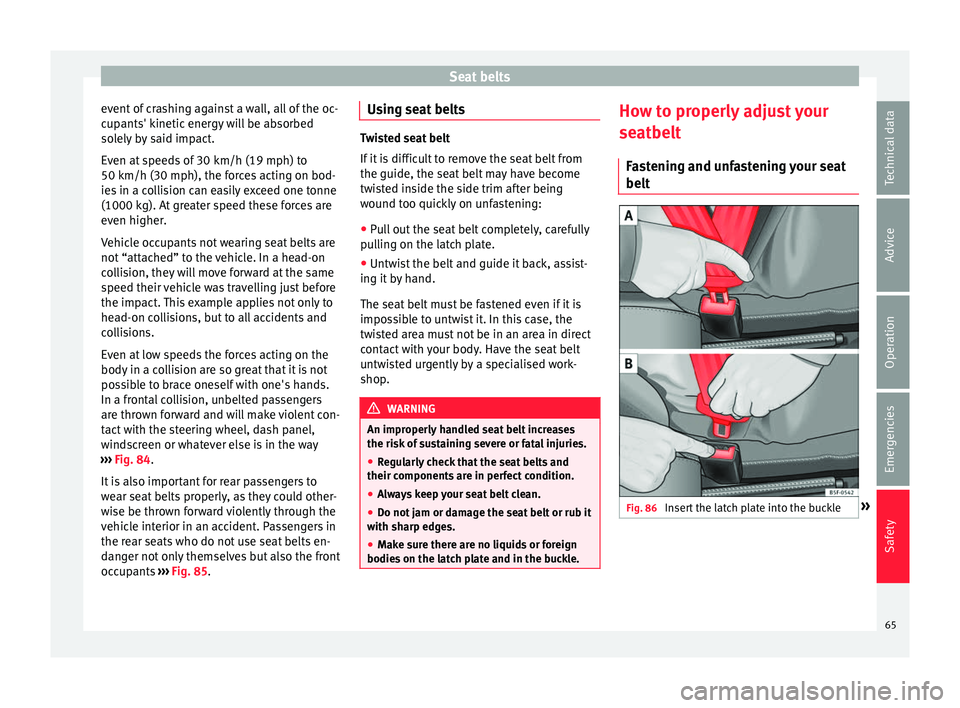
windscreen or whatever else is in the way
››› Fig. 84.
It is also important for rear passengers to
wear seat belts properly, as they could other-
wise be thrown forward violently through the
vehicle interior in an accident. Passengers in
the rear seats who do not use seat belts en-
danger not only themselves but also the front
occupants ››› Fig. 85. Using seat belts Twisted seat belt
If it
i
s difficult to remove the seat belt from
the guide, the seat belt may have become
twisted inside the side trim after being
wound too quickly on unfastening:
● Pull out the seat belt completely, carefully
pul
ling on the latch plate.
● Untwist the belt and guide it back, assist-
ing it b
y hand.
The seat belt must be fastened even if it is
impossible to untwist it. In this case, the
twisted area must not be in an area in direct
contact with your body. Have the seat belt
untwisted urgently by a specialised work-
shop. WARNING
An improperly handled seat belt increases
the risk of
sustaining severe or fatal injuries.
● Regularly check that the seat belts and
their components
are in perfect condition.
● Always keep your seat belt clean.
● Do not jam or damage the seat belt or rub it
with sharp edg
es.
● Make sure there are no liquids or foreign
bodies on the l
atch plate and in the buckle. How to properly adjust your
se
at
belt
F
astening and unfastening your seat
belt Fig. 86
Insert the latch plate into the buckle » 65
Technical data
Advice
Operation
Emergencies
Safety
Page 71 of 324
Airbag system
Note
The relevant safety requirements must be ob-
serv ed when the
vehicle is dismantled or sys-
tem components are removed. These require-
ments are known to specialised workshops
››› page 69. Service and disposal of belt tension
devic
e
s If you work on the belt tensioners or remove
and ins
t
all other parts of the vehicle when
performing other repair work, the seat belt
may be damaged. The consequence may be
that, in the event of an accident, the belt ten-
sioners function incorrectly or not at all.
So that the effectiveness of the belt tensioner
is not reduced and that removed parts do not
cause any injuries or environmental pollu-
tion, regulations must be observed. These re-
quirements are known to specialised work-
shops. WARNING
Improper handling and homemade repairs of
seat belt
s, automatic belt retainers and ten-
sion devices increase the risk of sustaining
severe or fatal injuries. The belt tensioner
may fail to trigger or may trigger in the wrong
circumstances. ●
Never att empt
to repair, adjust or remove or
install parts of the belt tensioners or seat
belts. Any work must be performed by a spe-
cialised workshop only ››› page 247.
● Belt tensioners and automatic belt retain-
ers c
annot be repaired and must be replaced. For the sake of the environment
Airbag modules and belt tensioners may con-
t ain per c
hlorate. Observe the legal require-
ments for their disposal. Airbag system
Brief intr
oduction
Intr
oduction Front airbags have been installed for both
driver and p
a
ssenger. The front airbags can
also protect the chest and head of driver and
passenger if the seats, seat belts head re-
straints and, for the driver, the steering
wheel are correctly adjusted and used. Air-
bags are considered as additional safety
equipment. An airbag cannot replace the
seat belt, which must be worn at all times,
even in front seats where front airbags have
been installed. WARNING
Never exclusively trust the airbag system as a
mean s
of protection.
● Even when triggered, airbag protection is
only aux
iliary.
● The airbags provide the best protection
when the seat belt
s are properly fastened,
thus reducing the risk of sustaining injuries
››› page 65, How to properly adjust your seat-
belt.
● Before each trip, every occupant must sit
properly, c
orrectly fasten the seat belt be-
longing to his or her seat and keeping it fas-
tened throughout the trip. This rule is valid
for all vehicle occupants. » 69
Technical data
Advice
Operation
Emergencies
Safety
Page 74 of 324
Safety
Airbag safety instructions Fr ont
airb
agsRead the additional information carefully
›› ›
page 19. WARNING
The airbag is deployed at high speed in frac-
tions of
a second.
● Always keep the deployment areas of the
front airb
ags free.
● Never secure objects to the covers or in the
deployment
area of the airbag modules, e.g.
drink holders or phone supports.
● The deployment space between the front
pas
sengers and the airbags must not in any
case be occupied by other passenger, pets
and objects.
● Never fix any object to the windscreen
above the fr
ont airbag on the front passenger
side.
● Do not alter, cover or stick anything to the
steerin
g wheel hub or the surface of the air-
bag module on the passenger side of the
dash panel. WARNING
Front airbags are deployed in front of the
st eerin
g wheel ›››
Fig. 25 and the dash
panel ›››
Fig. 26. ●
When drivin g, a
lways hold the steering
wheel on the outer edge of the ring with both
hands: 9 o'clock and 3 o'clock position.
● Adjust the driver seat so that there is at
lea
st 25 cm distance between your chest and
the hub of the steering wheel. If your physi-
cal constitution prevents you from meeting
these requirements, make sure you contact a
specialised workshop.
● Adjust the front passenger seat so there is
as muc
h distance as possible between the
front passenger and the dash panel. Knee airbag*
Read the additional information carefully
› ›
›
page 20. WARNING
The airbag is deployed at high speed in frac-
tions of
a second.
● The knee airbag is deployed in front of the
driver's knee
s. Always keep the deployment
areas of the knee airbags free.
● Never not fix objects to the cover or in the
deployment
area of the knee airbag.
● Adjust the driver seat so that there is a dis-
tance of
at least 10 cm (4 inches) between
your knees and the location of the knee air-
bag. If your physical constitution prevents
you from meeting these requirements, make
sure you contact a specialised workshop. Side airbags*
Read the additional information carefully
›› ›
page 21. WARNING
The airbag is deployed at high speed in frac-
tions of
a second.
● Always keep the deployment areas of the
side airbag
s free.
● Vehicle occupants of the front and outer
rear se
ats must never carry any other people,
pets or objects in the deployment space be-
tween them and the airbags.
● The built-in coat hooks should be used only
for lightweight
clothing. Do not leave any
heavy or sharp-edged objects in the pockets.
● Do not mount accessories on the doors.
● Only used protective covers for the seats
that ar
e approved for the vehicle. Otherwise,
the side airbag would be obstructed when de-
ployed. WARNING
Incorrect handling of the driver's and front
pa s
senger seat could prevent the side airbag
from deploying properly and cause severe in-
juries.
● Never remove the front seats of the vehicle
or modify an
y of their components.72
Page 82 of 324
Safety
●
Alw a
ys use a child seat and the seat belt
for children who are under 1.5 m tall. The nor-
mal seat belt could cause injuries to the
abdominal and neck areas.
● Only one child may occupy a child seat.
● Read and follow the information and warn-
ings
provided by the child seat manufacturer.
● Never leave an unsupervised child alone on
a chil
d seat or in the vehicle.
● All modifications to the integrated child
seat mu
st be carried out by a specialised
workshop.
● Replace the child seat or any seat compo-
nents d
amaged or involved in an accident. WARNING
Loose objects could fly uncontrollably around
the v ehic
le interior and cause injuries in the
event of an accident or sudden braking.
● Do not leave toys or other hard, loose ob-
jects
on the child seat or on the seat while
the vehicle is in motion. Unfolding the integrated child seat
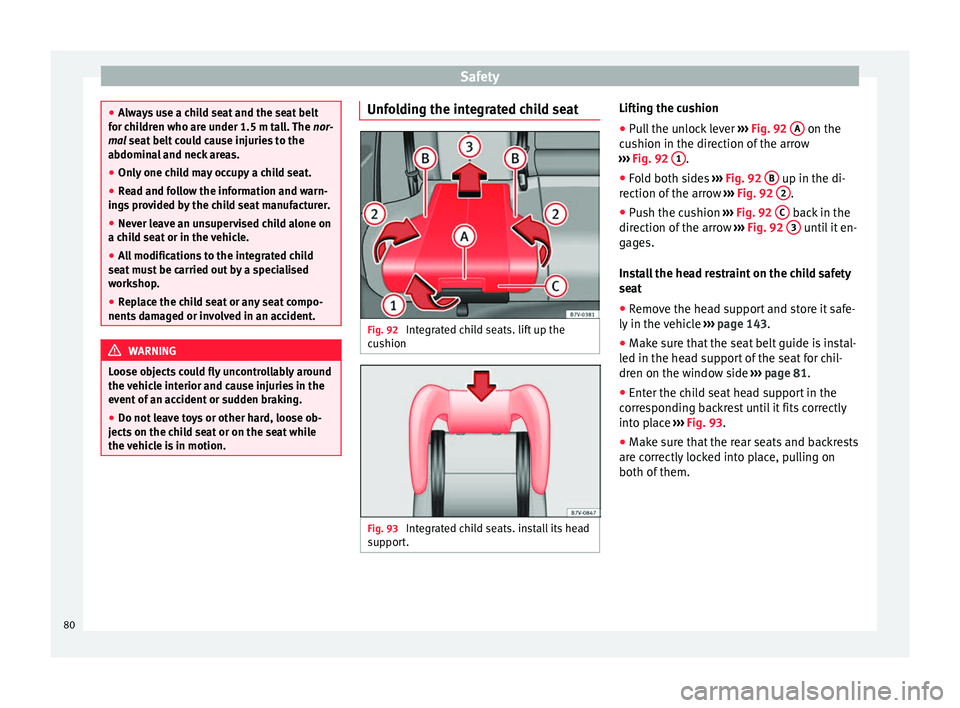
Fig. 92
Integrated child seats. lift up the
c u
shion Fig. 93
Integrated child seats. install its head
s up
por
t. Lifting the cushion
●
Pull the unlock lever ››
›
Fig. 92 A on the
c u
shion in the dir
ection of the arrow
››› Fig. 92 1 .
● Fold both sides ››
›
Fig. 92 B up in the di-
r ection of
the arr
ow ››› Fig. 92 2 .
● Push the cushion ››
›
Fig. 92 C back in the
dir ection of
the arr
ow ››› Fig. 92 3 until it en-
g ag
e
s.
Install the head restraint on the child safety
seat
● Remove the head support and store it safe-
ly in the v
ehicle ››› page 143.
● Make sure that the seat belt guide is instal-
led in the hea
d support of the seat for chil-
dren on the window side ››› page 81.
● Enter the child seat head support in the
corre
sponding backrest until it fits correctly
into place ››› Fig. 93.
● Make sure that the rear seats and backrests
are corr
ectly locked into place, pulling on
both of them.
80
Page 146 of 324
Operation
compartment tray. Remove the tray before
adju
s
ting the seat backrest.
● Objects in the luggage compartment could
cause d
amage when moving the rear seats
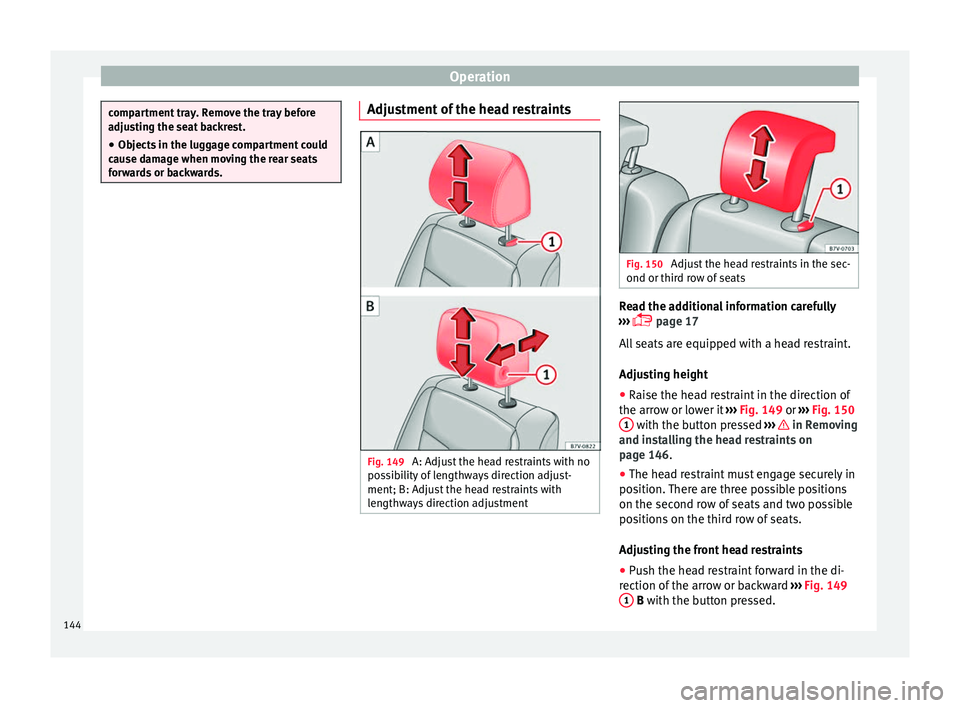
forwards or backwards. Adjustment of the head restraints
Fig. 149
A: Adjust the head restraints with no
po s
s
ibility of lengthways direction adjust-
ment; B: Adjust the head restraints with
lengthways direction adjustment Fig. 150
Adjust the head restraints in the sec-
ond or third r o
w of seats Read the additional information carefully
› ›
›
page 17
All seats are equipped with a head restraint.
Adjusting height
● Raise the head restraint in the direction of
the arrow or lo
wer it ››› Fig. 149 or ››› Fig. 150
1 with the button pressed
››
›
in Removing
and in s
t
alling the head restraints on
page 146.
● The head restraint must engage securely in
position.
There are three possible positions
on the second row of seats and two possible
positions on the third row of seats.
Adjusting the front head restraints
● Push the head restraint forward in the di-
rection of the arr
ow or backward ››› Fig. 149
1 B w
ith the button pressed.
144
Page 148 of 324
Operation
● Adju s
t
the head restraint according to the
correct seat position and secure it
››› page 145.
Removing the front head restraints in vehi-
cles with the lengthways direction adjust-
ment of the head restraints
● If necessary, adjust the seat backrest so
that the he
ad restraint can be fitted.
● Push the head restraint up and backward
as f
ar as it will go ››› .
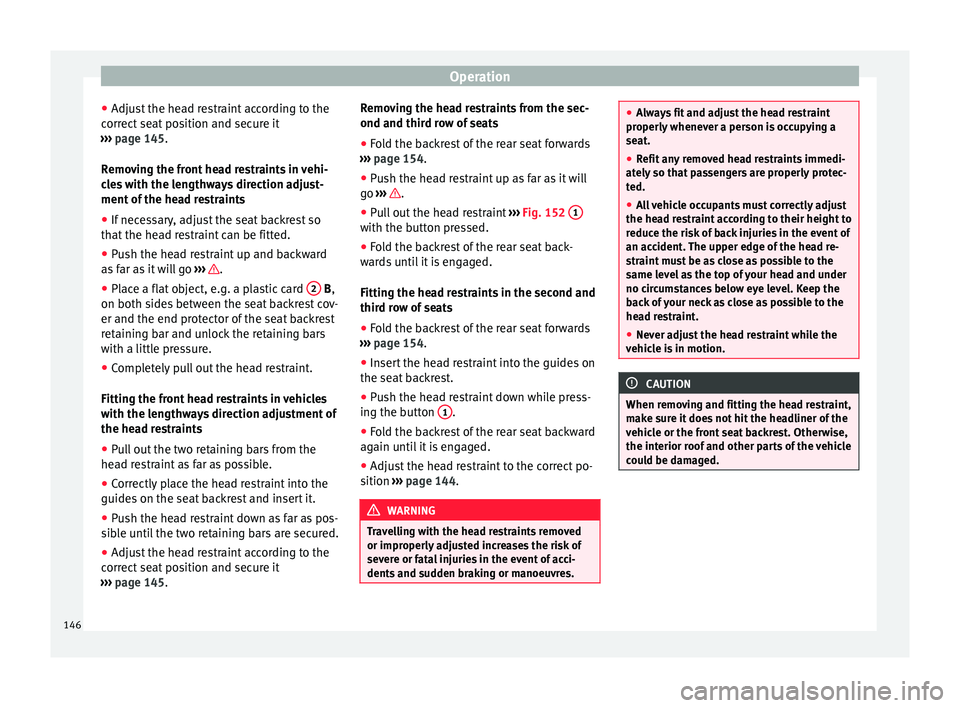
● Place a flat object, e.g. a plastic card 2 B,
on both s ide
s
between the seat backrest cov-
er and the end protector of the seat backrest
retaining bar and unlock the retaining bars
with a little pressure.
● Completely pull out the head restraint.
Fitting the front
head restraints in vehicles
with the lengthways direction adjustment of
the head restraints
● Pull out the two retaining bars from the
head r
estraint as far as possible.
● Correctly place the head restraint into the
guides on the se
at backrest and insert it.
● Push the head restraint down as far as pos-
sibl
e until the two retaining bars are secured.
● Adjust the head restraint according to the
correct
seat position and secure it
››› page 145. Removing the head restraints from the sec-
ond and third ro
w of seats
● Fold the backrest of the rear seat forwards
›››
page 154.
● Push the head restraint up as far as it will
go ››
› .
● Pull out the head restraint ››
›
Fig. 152 1 with the button pressed.
●
Fold the backrest of the rear seat back-
w ar
d
s until it is engaged.
Fitting the head restraints in the second and
third row of seats
● Fold the backrest of the rear seat forwards
›››
page 154.
● Insert the head restraint into the guides on
the seat b
ackrest.
● Push the head restraint down while press-
ing the butt
on 1 .
● Fold the backrest of the rear seat backward
ag ain u
nti
l it is engaged.
● Adjust the head restraint to the correct po-
sition ››
› page 144. WARNING
Travelling with the head restraints removed
or improperly a
djusted increases the risk of
severe or fatal injuries in the event of acci-
dents and sudden braking or manoeuvres. ●
Alw a
ys fit and adjust the head restraint
properly whenever a person is occupying a
seat.
● Refit any removed head restraints immedi-
ately so th
at passengers are properly protec-
ted.
● All vehicle occupants must correctly adjust
the head r
estraint according to their height to
reduce the risk of back injuries in the event of
an accident. The upper edge of the head re-
straint must be as close as possible to the
same level as the top of your head and under
no circumstances below eye level. Keep the
back of your neck as close as possible to the
head restraint.
● Never adjust the head restraint while the
vehicl
e is in motion. CAUTION
When removing and fitting the head restraint,
mak e s
ure it does not hit the headliner of the
vehicle or the front seat backrest. Otherwise,
the interior roof and other parts of the vehicle
could be damaged. 146
Page 151 of 324
Seats and head restraints
To activate the memory function of the vehi-
c l
e k
ey
Important: a position must be memorised in
the memory.
● Open the driver-side door.
● Press and hold any memory button.
● Within the following three seconds, push
the open button
on the vehicle key. An au-
dible warning confirms the settings have
been activated.
Adjusting the wing mirrors for driving and
assigning driver seat settings to a vehicle
key
● Activate the memory function of the vehicle
key
● Adjus
t the front seat and the exterior mir-
rors.
● L
ock the vehicle. The settings are assigned
to the v
ehicle key.
To deactivate the memory function of the ve-
hicle key
Important: a position must be memorised in
the memory.
● Press and hold the SET button.
● Within the following 10 seconds, push the
open b utt
on
on the vehicle key. An audible
warning confirms the settings have been de-
activated. Initialising the seat position memory
The position memor
y system must be restar-
ted if, for example, the driver seat has been
changed.
Restarting deletes all memories and assign-
ments for the seat with position memory. The
memory buttons can then be reprogrammed
and the vehicle keys re-assigned.
● Open the driver door and do not get into
the vehic
le.
● Operating the seat settings from outside
the vehic
le.
● Move the angle of the seat backrest com-
plet
ely forwards.
● Release the control to set the angle and
then pres
s again until an audible warning is
heard. Note
The front passenger side exterior mirror auto-
matic a
lly changes from the position stored
for reversing as soon as the vehicle moves
forward at a speed of at least 15 km/h
(9 mph) or when the gear selection lever is
changed to a position other than R. Convenient entry function for the third
r
o
w of
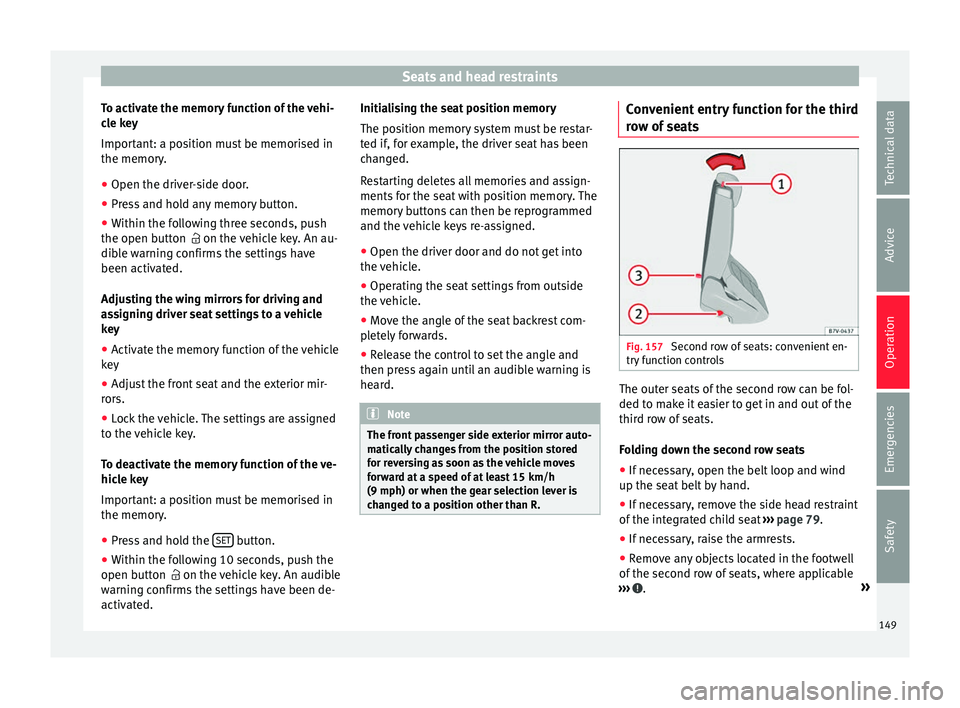
seats Fig. 157
Second row of seats: convenient en-
tr y
f
unction controls The outer seats of the second row can be fol-
ded t
o m
ak
e it easier to get in and out of the
third row of seats.
Folding down the second row seats
● If necessary, open the belt loop and wind
up the seat belt
by hand.
● If necessary, remove the side head restraint
of the inte
grated child seat ›››
page 79.
● If necessary, raise the armrests.
● Remove any objects located in the footwell
of the second r
ow of seats, where applicable
››› .
»
149
Technical data
Advice
Operation
Emergencies
Safety
Page 152 of 324
Operation
● Pu
sh the he
ad restraint down as far as it
will go ››› page 58.
● Push the lever ›››
Fig. 157 1 forwards and
f o
l
d the backrest of the rear seat. This seat
folds forward completely ››› and can still
be mo v
ed f
urther forward.
● Always take care when entering and leav-
ing the v
ehicle ››› .
R epo
s
itioning the seat in the second row
● Lift the backrest of the rear seat in an up-
right pos
ition. The entire seat folds back-
wards ››› .
● Make sure that the rear seat is securely en-
g ag
ed so th
at the seat belts can provide
proper protection in the rear seats. The red
mark ››› Fig. 157 2 should no longer be visi-
b l
e ›
›› in Folding down rear seats to create
lo a
d s
pace on page 156.
Emergency exit function
If the lever ››› Fig. 157 1 does not work, e.g.
af t
er an ac
cident, the seats on the second
row can be folded forwards from the third row
to allow vehicle occupants of the third row of
seats to get out of the vehicle ››› .
● Pull the handle ››
›
Fig. 157 3 back and
f o
l
d the backrest of the rear seat. The com-
plete rear seat folds forward ››› . WARNING
Careless or uncontrolled use of the conven-
ient entr y
assistant may result in severe in-
jury and accident.
● Never use the convenient entry function
when the vehic
le is in motion.
● Avoid trapping or damaging the seat belt
when fol
ding the rear seats back.
● Keep your hands, fingers, feet and other
body par
ts out of the hinges and the seat
locking mechanism when folding and unfold-
ing.
● Mats or other objects can be caught in the
hinge
s of the seat backrests or rear seat. This
could prevent the seat backrest from locking
safely when positioned upright.
● All seat backrests must engage correctly for
the seat belt
s on the rear seats to work prop-
erly. When the seat backrest of an occupied
seat is not correctly locked in place, the pas-
senger can be thrust forward with the seat
backrest in case of sudden braking, sudden
manoeuvres or an accident.
● A red mark on the side of the seat
›››
Fig. 157 2 indicates that the seat back-
re s
t is not engaged. The mark is no longer
visible when it is correctly engaged.
● If the seat backrest or seat are folded down
and are not c
orrectly locked in place, no pas-
senger should use them.
● When getting in or out, never lean or hold
onto the fo
lded seat on the second row of
seats. WARNING
If child seats are fitted to all the seats in the
second r o
w then it is possible that the seats
of this row cannot be folded down from the
third row of seats in the event of an accident.
In the event of an emergency, passengers in
the third row of seats will not be able to leave
the vehicle or to help themselves.
● Child seats should not occupy all the seats
of the second r
ow if other passengers are to
occupy the third row. CAUTION
● Bef or
e folding down the rear seat backrest
for returning it to its position, adjust the front
seats so that the head restraints and seat
backrests do not hit each other when folding
and unfolding.
● Any objects located in the footwell of the
second ro
w of seats may be damaged on fold-
ing the rear seat forwards. Remove any ob-
jects before folding the seat down. 150