maintenance Seat Altea 2005 Owner's Guide
[x] Cancel search | Manufacturer: SEAT, Model Year: 2005, Model line: Altea, Model: Seat Altea 2005Pages: 286, PDF Size: 9.59 MB
Page 43 of 286
Airbag system41
Safety First
Operating instructions
Tips and Maintenance
Te c h n i c a l D a t a
Curtain airbagsDescription of curtain airbags
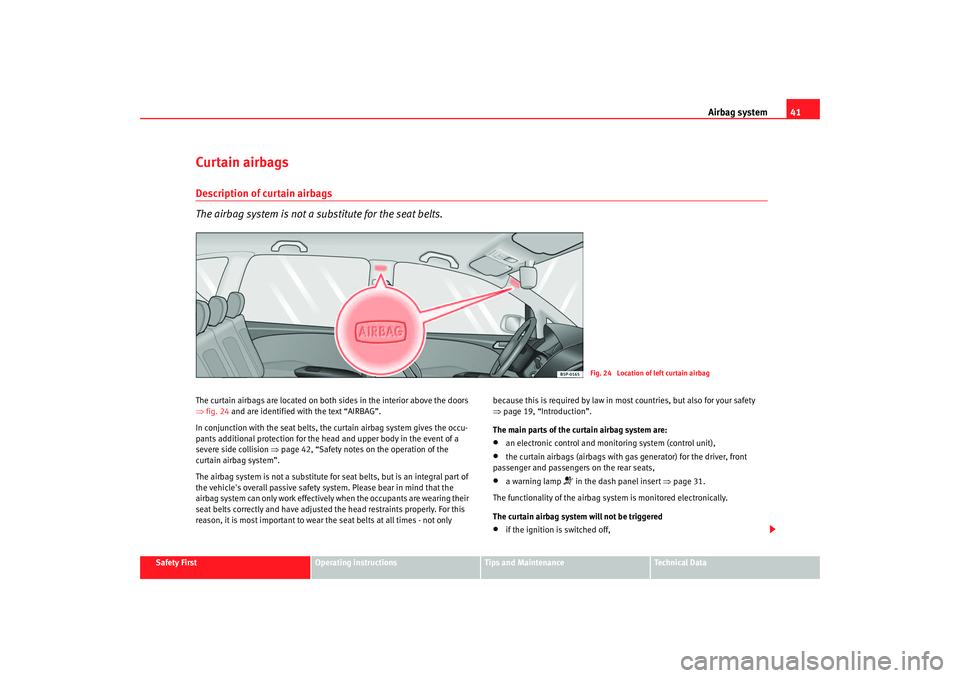
The airbag system is not a substitute for the seat belts.The curtain airbags are located on both sides in the interior above the doors
⇒fig. 24 and are identified with the text “AIRBAG”.
In conjunction with the seat belts, th e curtain airbag system gives the occu-
pants additional protection for the head and upper body in the event of a
severe side collision ⇒ page 42, “Safety notes on the operation of the
curtain airbag system”.
The airbag system is not a substitute for seat belts, but is an integral part of
the vehicle's overall passive safety system. Please bear in mind that the
airbag system can only work effectively when the occupants are wearing their
seat belts correctly and have adjusted the head restraints properly. For this
reason, it is most important to wear the seat belts at all times - not only because this is required by law in most
countries, but also for your safety
⇒ page 19, “Introduction”.
The main parts of the curtain airbag system are:
•
an electronic control and monitoring system (control unit),
•
the curtain airbags (airbags with gas generator) for the driver, front
passenger and passengers on the rear seats,
•
a warning lamp
in the dash panel insert ⇒page 31.
The functionality of the airbag system is monitored electronically.
The curtain airbag system will not be triggered
•
if the ignition is switched off,
Fig. 24 Location of left curtain airbag
altea_ingles Seite 41 Donnerstag, 19. Mai 2005 3:02 15
Page 45 of 286

Airbag system43
Safety First
Operating instructions
Tips and Maintenance
Te c h n i c a l D a t a
•
There must be no other persons, animals or objects between the occu-
pants of the outer seats and the deployment space of the curtain airbags
so that the curtain airbag can deploy without restriction and provide the
greatest possible protection. Therefore, sun blinds which have not been
expressly approved for use in your vehicle may not be attached to the side
windows ⇒ page 194, “Accessories, parts replacement and modifica-
tions”.
•
The built-in coat hooks should be used only for lightweight clothing. Do
not leave any heavy or sharp-edged obje cts in the pockets. When using the
coat hooks, do not hang th e clothes on coat hangers.
•
The airbags provide protection for one accident only, if they have been
deployed they must be replaced.
•
Any work on the curtain airbag system or removal and installation of
the airbag components for other repairs (such as removal of the roof lining)
should only be performed by qualified workshop. Otherwise, a fault may be
introduced into the operation of the airbag system.
•
Do not attempt to modify components of the airbag system in any way.
•
The side and head airbags are managed through sensors located in the
interior of the front doors. To ensure the correct functioning of the side and
head airbags neither the doors nor the door panels should be modified in
any way (e.g. fitting loudspeakers). If the front door is damaged in any way,
this may affect the correct working of the system. All work carried out on
the front door must be made in a qualified workshop.WARNING (continued)
altea_ingles Seite 43 Donnerstag, 19. Mai 2005 3:02 15
Page 47 of 286
Airbag system45
Safety First
Operating instructions
Tips and Maintenance
Te c h n i c a l D a t a
– Check that the warning lamp “PASSENGER AIRBAG OFF” in the
dash panel does ⇒page 44, fig. 27 not light up when the igni-
tion is switched on ⇒.
WARNING
•
The driver is responsible for the proper position of the key-operated
switch.
•
You should deactivate the front passenger airbag only if you have to use
a rear-facing child seat in exceptional cases. ⇒ page 46, “Child safety”.
•
Never install a rear-facing child seat on the front passenger seat unless
the front passenger airbag has been disabled. Risk of potentially fatal inju-
ries to the child! However, if it is necessary in exceptional circumstances to
transport a child in a rear-facing child seat on the front passenger seat, you
must always disable the front passenger airbag.
•
As soon as the child seat is no longer needed on the front passenger
seat, enable the front passenger airbag again.
•
Only deactivate the passenger airbag when the ignition is off, other-
wise a fault may occur in the airbag system, this will create a danger that
in case of an accident, the airbag do es not deploy properly or does not
deploy at all.
•
If, while the passenger airbag is tu rned off, the indicator PASSENGER
AIRBAG OFF on the instrument panel does not remain lit, this could indicate
a fault in the airbag system:
−Have the airbag system inspected immediately by a qualified work-
shop.
− Do not use a child seat in the front passenger seat! The front
passenger airbag could be triggered in an accident despite the fact that
there is a fault in the system. A child could sustain serious or fatal inju-
ries.
− It is not certain whether the front passenger airbag will deploy
during an accident! Inform your passengers of this.
•
When using the ignition key to activate / deactivate the passenger
frontal airbag, only the passenger frontal airbag will be activated / deacti-
vated. The side airbag and head airbag on the passenger side will remain
active.WARNING (continued)
altea_ingles Seite 45 Donnerstag, 19. Mai 2005 3:02 15
Page 49 of 286
Child safety47
Safety First
Operating instructions
Tips and Maintenance
Te c h n i c a l D a t a
Safety notes on using child seats
Proper use of child seats substantially reduces the risk of
injury in an accident!As the driver, you are responsible for any children you transport in
your vehicle.
– Protect your children by properly using appropriate child seats
⇒page 48.
– Always ensure that the belt webbing is properly positioned according to the instructions prov ided by the manufacturer of the
child seat.
– When travelling, do not allow children to distract you from traffic.
– Take breaks regularly during long trips. Take a break at least every two hours.
WARNING
•
Never install a rear-facing child seat on the front passenger seat unless
the front passenger airbag has been disabled. Risk of potentially fatal inju-
ries to the child! If it is necessary, in exceptional circumstances, to trans-
port a child on the front passenger seat, always disable the front passenger
airbag ⇒ page 44, “Deactivating airbags*”.
•
For those vehicles that do not include a key lock switch to turn the
airbag off, an Authorised Service Centre must be consulted.
•
All passengers, especially children, must assume the proper sitting
position and be properly belted in while travelling.
•
Never hold children or babies on your lap, this can result in potentially
fatal injuries to the child!
•
Never allow a child to be transported in a vehicle without being properly
secured, or to stand up or kneel on a seat while travelling. In an accident,
the child could be flung through the vehicle, causing possibly fatal injuries
to themselves and other occupants.
•
If children assume an improper sitting position when the car is moving,
they expose themselves to greater risk of injury during a sudden braking
manoeuvre or in an accident. This is particularly the case if the child is trav-
elling on the front passenger seat and the airbag system is triggered in an
accident; this could have consequences including serious injury or death.
•
A suitable child seat can protect your child!
•
Never leave a child unsupervised in a child seat or alone in the vehicle.
•
Depending on weather conditions, it may become extremely hot or cold
inside the vehicle. This can be fatal.
•
Children who are less than 1.5 metres tall must not wear a normal seat
belt without a child restraint system, as this could cause injuries to the
abdominal and neck areas during a sudden braking manoeuvre or in an
accident.
•
Do not allow the belt webbing to become twisted or jammed, or to rub
on any sharp edges.
•
Incorrectly worn seat belts can cause injuries even in a minor collision
or sudden braking manoeuvres.
•
The seat belt provides maximum protection only when the belt web is
properly positioned ⇒page 24, “Seat belts”.
•
Only one child may occupy a child seat ⇒page 48, “Child seats”.WARNING (continued)
altea_ingles Seite 47 Donnerstag, 19. Mai 2005 3:02 15
Page 51 of 286
Child safety49
Safety First
Operating instructions
Tips and Maintenance
Te c h n i c a l D a t a
Group 1 child seats
A suitable child seat and a correctly adjusted seat belt can
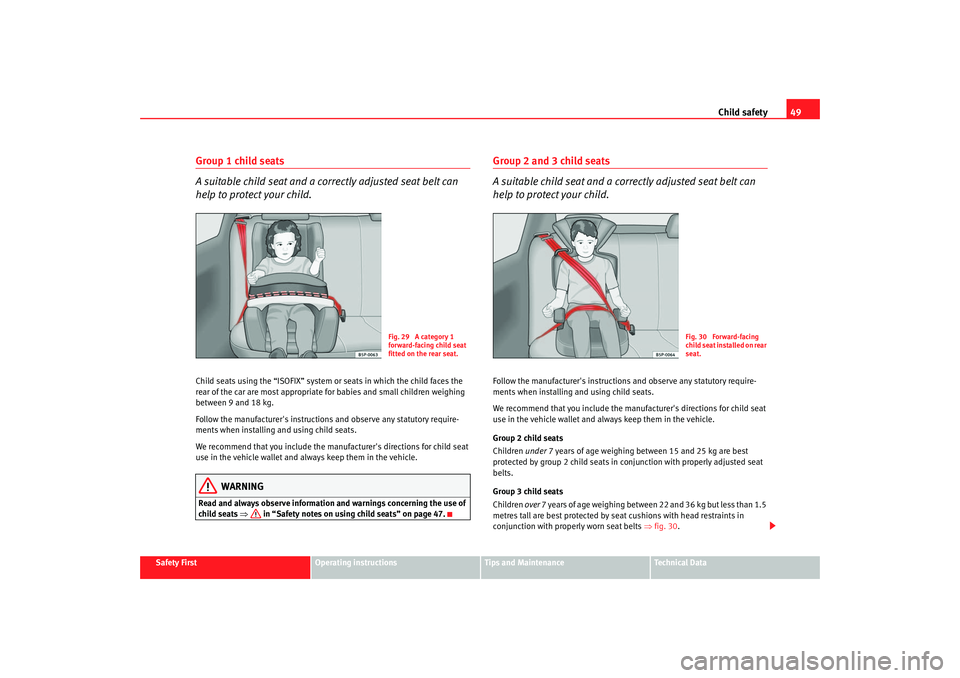
help to protect your child.Child seats using the “ISOFIX” system or seats in which the child faces the
rear of the car are most appropriate for babies and small children weighing
between 9 and 18 kg.
Follow the manufacturer's instructions and observe any statutory require-
ments when installing and using child seats.
We recommend that you include the manufacturer's directions for child seat
use in the vehicle wallet and always keep them in the vehicle.
WARNING
Read and always observe information and warnings concerning the use of
child seats ⇒ in “Safety notes on using child seats” on page 47.
Group 2 and 3 child seats
A suitable child seat and a corr ectly adjusted seat belt can
help to protect your child.Follow the manufacturer's instructio ns and observe any statutory require-
ments when installing and using child seats.
We recommend that you include the manufacturer's directions for child seat
use in the vehicle wallet and always keep them in the vehicle.
Group 2 child seats
Children under 7 years of age weighing between 15 and 25 kg are best
protected by group 2 child seats in conjunction with properly adjusted seat
belts.
Group 3 child seats
Children over 7 years of age weighing between 22 and 36 kg but less than 1.5
metres tall are best protected by seat cushions with head restraints in
conjunction with properly worn seat belts ⇒fig. 30.
Fig. 29 A category 1
forward-facing child seat
fitted on the rear seat.
Fig. 30 Forward-facing
child seat installed on rear
seat.
altea_ingles Seite 49 Donnerstag, 19. Mai 2005 3:02 15
Page 53 of 286
Child safety51
Safety First
Operating instructions
Tips and Maintenance
Te c h n i c a l D a t a
WARNING
•
When travelling, children must be secured in the vehicle with a
restraint system suitable for age, weight and size.
•
Never install a rear-facing child seat on the front passenger seat unless
the front passenger airbag has been disabled. Risk of potentially fatal inju-
ries to the child! If it is necessary in exceptional cases to transport a child
on the front passenger seat, you must always disable the front passenger
airbag ⇒ page 44, “Deactivating airbags*”.
•
Read and always observe information and warnings concerning the use
of child seats ⇒ in “Safety notes on using child seats” on page 47.
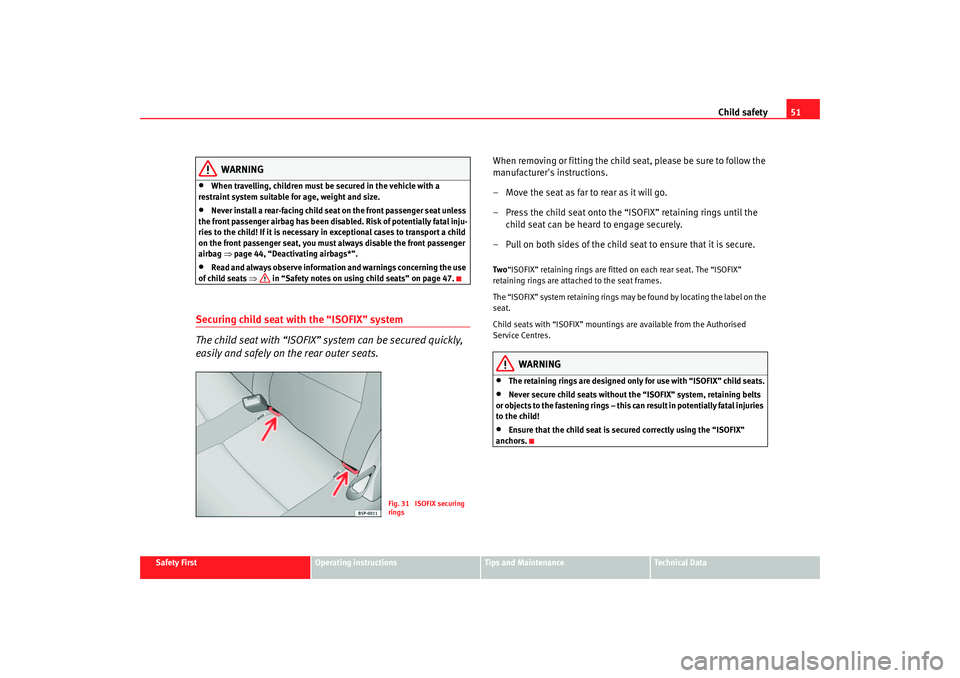
Securing child seat with the “ISOFIX” system
The child seat with “ISOFIX” system can be secured quickly,
easily and safely on the rear outer seats.
When removing or fitting the child seat, please be sure to follow the
manufacturer's instructions.
– Move the seat as far to rear as it will go.
– Press the child seat onto the “ISOFIX” retaining rings until the
child seat can be heard to engage securely.
– Pull on both sides of the child seat to ensure that it is secure.Two “ISOFIX” retaining rings are fitted on each rear seat. The “ISOFIX”
retaining rings are attached to the seat frames.
The “ISOFIX” system retaining rings may be found by locating the label on the
seat.
Child seats with “ISOFIX” mountings are available from the Authorised
Service Centres.
WARNING
•
The retaining rings are designed only for use with “ISOFIX” child seats.
•
Never secure child seats without the “ISOFIX” system, retaining belts
or objects to the fastening rings – this can result in potentially fatal injuries
to the child!
•
Ensure that the child seat is secured correctly using the “ISOFIX”
anchors.
Fig. 31 ISOFIX securing
rings
altea_ingles Seite 51 Donnerstag, 19. Mai 2005 3:02 15
Page 55 of 286
53
Safety First
Operating instructions
Tips and Maintenance
Te c h n i c a l D a t a
altea_ingles Seite 53 Donnerstag, 19. Mai 2005 3:02 15
Page 57 of 286
Cockpit55
Safety First
Operating instructions
Tips and Maintenance
Te c h n i c a l D a t a
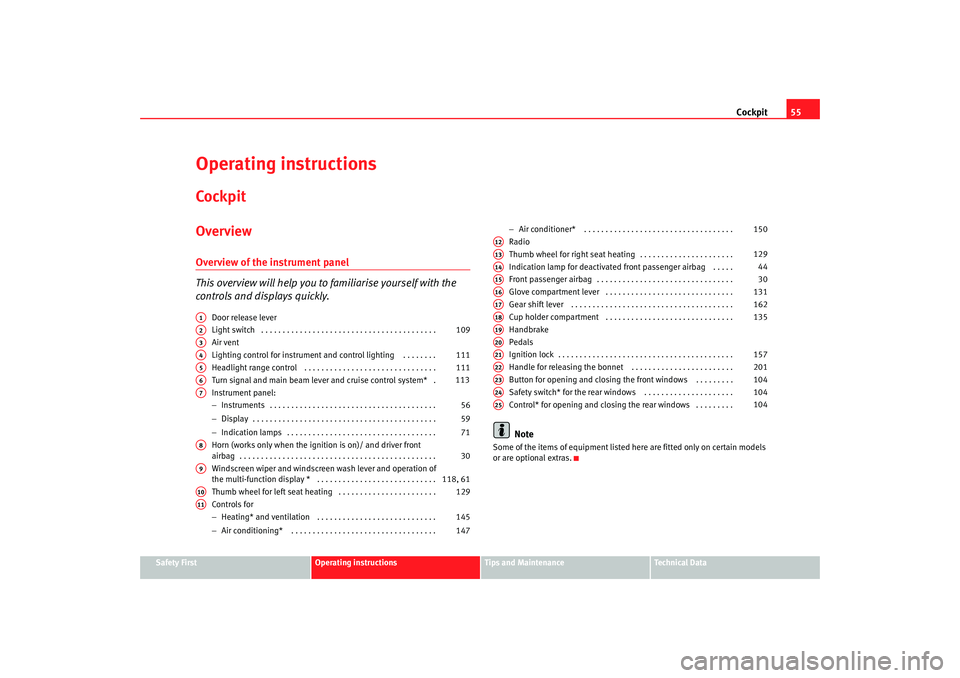
Operating instructionsCockpitOverviewOverview of the instrument panel
This overview will help you to familiarise yourself with the
controls and displays quickly.
Door release lever
Light switch . . . . . . . . . . . . . . . . . . . . . . . . . . . . . . . . . . . . . . . . .
Air vent
Lighting control for instrument and control lighting . . . . . . . .
Headlight range control . . . . . . . . . . . . . . . . . . . . . . . . . . . . . . .
Turn signal and main beam lever and cruise control system* .
Instrument panel:
− Instruments . . . . . . . . . . . . . . . . . . . . . . . . . . . . . . . . . . . . . . .
− Display . . . . . . . . . . . . . . . . . . . . . . . . . . . . . . . . . . . . . . . . . . .
− Indication lamps . . . . . . . . . . . . . . . . . . . . . . . . . . . . . . . . . . .
Horn (works only when the igni tion is on)/ and driver front
airbag . . . . . . . . . . . . . . . . . . . . . . . . . . . . . . . . . . . . . . . . . . . . . .
Windscreen wiper and windscreen wash lever and operation of
the multi-function display * . . . . . . . . . . . . . . . . . . . . . . . . . . . .
Thumb wheel for left seat heating . . . . . . . . . . . . . . . . . . . . . . .
Controls for
− Heating* and ventilation . . . . . . . . . . . . . . . . . . . . . . . . . . . .
− Air conditioning* . . . . . . . . . . . . . . . . . . . . . . . . . . . . . . . . . . −
Air conditioner* . . . . . . . . . . . . . . . . . . . . . . . . . . . . . . . . . . .
Radio
Thumb wheel for right seat heating . . . . . . . . . . . . . . . . . . . . . .
Indication lamp for deactivated front passenger airbag . . . . .
Front passenger airbag . . . . . . . . . . . . . . . . . . . . . . . . . . . . . . . .
Glove compartment lever . . . . . . . . . . . . . . . . . . . . . . . . . . . . . .
Gear shift lever . . . . . . . . . . . . . . . . . . . . . . . . . . . . . . . . . . . . . .
Cup holder compartment . . . . . . . . . . . . . . . . . . . . . . . . . . . . . .
Handbrake
Pedals
Ignition lock . . . . . . . . . . . . . . . . . . . . . . . . . . . . . . . . . . . . . . . . .
Handle for releasing the bonnet . . . . . . . . . . . . . . . . . . . . . . . .
Button for opening and closing the front windows . . . . . . . . .
Safety switch* for the rear windows . . . . . . . . . . . . . . . . . . . . .
Control* for opening and closing the rear windows . . . . . . . . .
Note
Some of the items of equipment listed here are fitted only on certain models
or are optional extras.
A1A2
109
A3A4
111
A5
111
A6
113
A7
56
59
71
A8
30
A9
118, 61
A10
129
A11
145
147 150
A12A13
129
A14
44
A15
30
A16
131
A17
162
A18
135
A19A20A21
157
A22
201
A23
104
A24
104
A25
104
altea_ingles Seite 55 Donnerstag, 19. Mai 2005 3:02 15
Page 59 of 286
Cockpit57
Safety First
Operating instructions
Tips and Maintenance
Te c h n i c a l D a t a
Fuel gauge
and reserve indicator
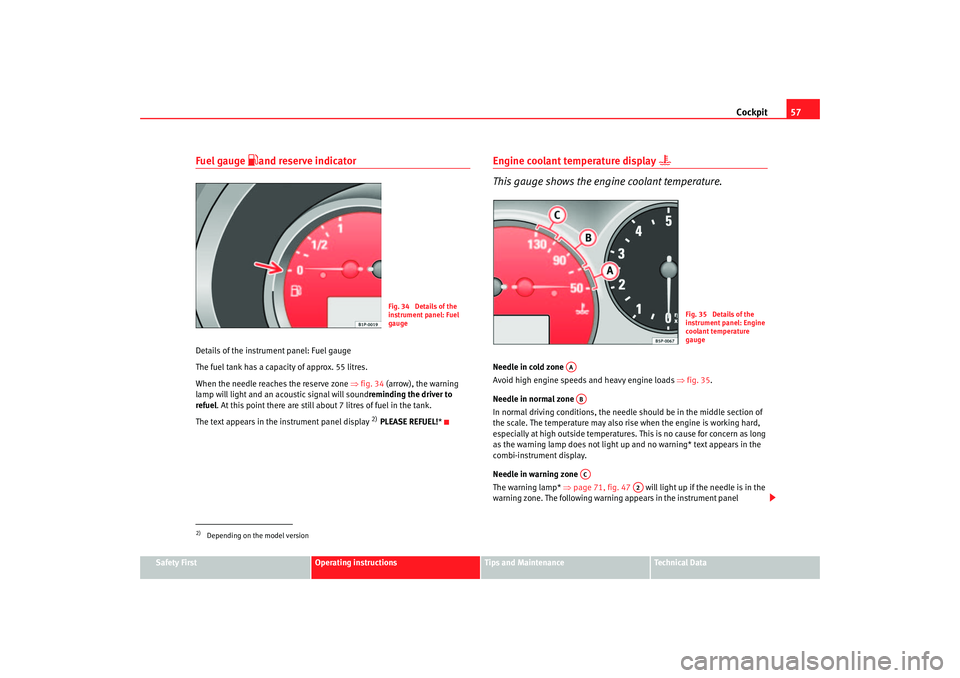
Details of the instrument panel: Fuel gauge
The fuel tank has a capacity of approx. 55 litres.
When the needle reaches the reserve zone ⇒fig. 34 (arrow), the warning
lamp will light and an acoustic signal will sound reminding the driver to
refuel . At this point there are still about 7 litres of fuel in the tank.
The text appears in the instrument panel display
2) PLEASE REFUEL! *
Engine coolant temperature display
This gauge shows the engine coolant temperature.
Needle in cold zone
Avoid high engine speeds and heavy engine loads ⇒fig. 35.
Needle in normal zone
In normal driving conditions, the needle should be in the middle section of
the scale. The temperature may also rise when the engine is working hard,
especially at high outside temperatures. This is no cause for concern as long
as the warning lamp does not light up and no warning* text appears in the
combi-instrument display.
Needle in warning zone
The warning lamp* ⇒page 71, fig. 47 will light up if the needle is in the
warning zone. The following warning appears in the instrument panel
2)Depending on the model version
Fig. 34 Details of the
instrument panel: Fuel
gauge
Fig. 35 Details of the
instrument panel: Engine
coolant temperature
gauge
AAABAC
A2
altea_ingles Seite 57 Donnerstag, 19. Mai 2005 3:02 15
Page 61 of 286
Cockpit59
Safety First
Operating instructions
Tips and Maintenance
Te c h n i c a l D a t a
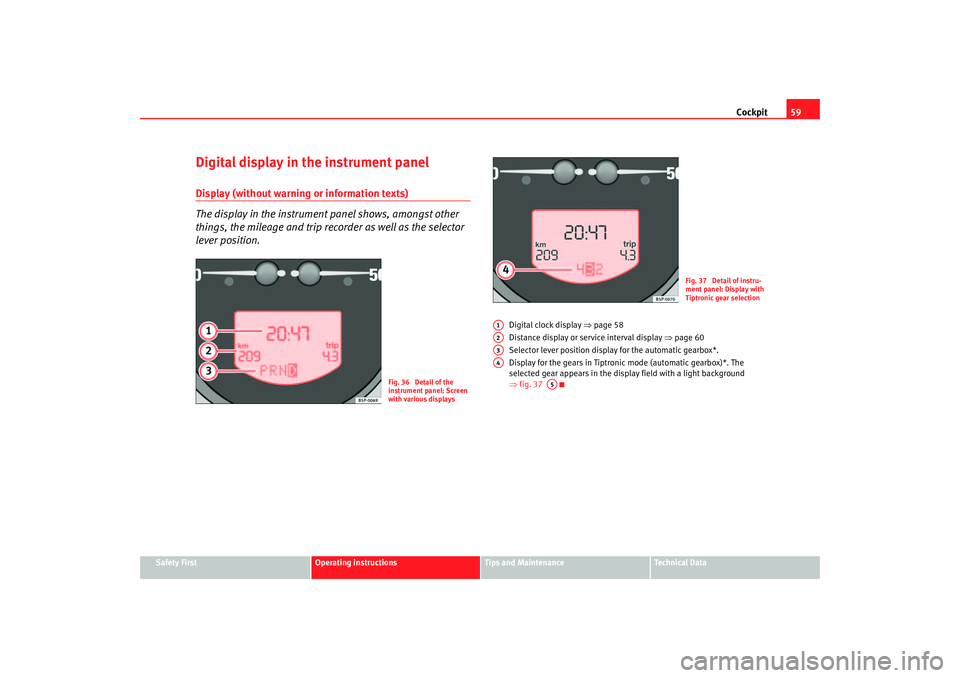
Digital display in the instrument panelDisplay (without warning or information texts)
The display in the instrument panel shows, amongst other
things, the mileage and trip recorder as well as the selector
lever position.
Digital clock display ⇒page 58
Distance display or service interval display ⇒page 60
Selector lever position display for the automatic gearbox*.
Display for the gears in Tiptronic mode (automatic gearbox)*. The
selected gear appears in the display field with a light background
⇒ fig. 37
Fig. 36 Detail of the
instrument panel: Screen
with various displays
Fig. 37 Detail of instru-
ment panel: Display with
Tiptronic gear selection
A1A2A3A4
A5
altea_ingles Seite 59 Donnerstag, 19. Mai 2005 3:02 15