maintenance Seat Altea 2006 Owners Manual
[x] Cancel search | Manufacturer: SEAT, Model Year: 2006, Model line: Altea, Model: Seat Altea 2006Pages: 288, PDF Size: 8.61 MB
Page 183 of 288
Driving and the environment181
Safety First
Operating instructions
Tips and Maintenance
Te c h n i c a l D a t a
WARNING
The catalytic converter reaches very high temperatures! Risk of fire.•
Never park where the catalytic converter could come into contact with
dry grass or inflammable materials under the vehicle.
•
Do not apply additional underseal or anti-corrosion coatings to the
exhaust pipes, catalytic converter or the heat shields on the exhaust
system. These materials could catch fire when the vehicle is driven.Caution
Never fully drain the fuel tank, in this case, the irregularity of the fuel supply
may cause ignition problems. This allow s unburnt fuel to enter the exhaust
system, which could cause overheating and damage the catalytic converter.
For the sake of the environment
Even when the emission control system is working perfectly, there may be a
smell of sulphur from the exhaust unde r some conditions. This depends on
the sulphur content of the fuel used. Quite often the problem can be reme-
died by changing to another brand of fuel.Driving abroadNotesFor driving abroad, the following must be taken into consideration:
•
For vehicles fitted with a catalytic converter ensure that unleaded petrol is
available for the journey. See the chap ter “Refuelling”. Automobile organisa-
tions will have information about service station networks selling unleaded
fuel.
•
In some countries it is possible that a vehicle model is sold under condi-
tions where some spare parts are not available or that the Authorised Service
Centre may only carry out limited repairs.
SEAT importers and distributors will gladly provide information about the
technical preparation of your vehicle in addition to necessary maintenance
and repair possibilities.
Adhesive strips for headlightsIf you have to drive a right-hand drive vehicle in a left-hand drive country, or
vice versa, the asymmetric dipped beam headlights will dazzle oncoming
traffic.
To prevent dazzling, you must apply stickers to certain parts of the headlight
lenses. Further information is available from your Authorised Service
Centre.
altea_ingles Seite 181 Dienstag, 4. Oktober 2005 6:57 18
Page 185 of 288
Driving and the environment183
Safety First
Operating instructions
Tips and Maintenance
Te c h n i c a l D a t a
On the right headlight, if you are changing from driving on the left-hand side
to the right-hand side.
On the left headlight, if you are changing from driving on the left-hand side to
the right-hand side.
Trailer towingWhat do you need to bear in mind when towing a trailer?Your vehicle may be used to tow a trailer when fitted with the correct equip-
ment.
If the car is supplied with a
factory-fitted towing bracket it will already have
the necessary technical modifications and meet the statutory requirements
for towing a trailer. For the posterior fitting of a trailer towing bracket see
⇒ page 198.
Connectors
Your vehicle is fitted with a 12-pin co nnector for the electrical connection
between the trailer and the vehicle.
If the trailer has a 7-pin plug you will need to use an adapter cable. This is
available from any Technical Service.
Trailer weight / draw bar loading
Never exceed the authorised towing limit. If you do not load the trailer up to
the maximum permitted trailer weight , you can then climb correspondingly
steeper gradients.
The maximum trailer weights listed are only applicable for altitudes up to
1,000 m above sea level. With increasing altitude the engine power and
therefore the vehicle's climbing ability are impaired because of the reduced
air density. The maximum trailer weight has to be reduced accordingly. The weight of the vehicle and trailer combination must be reduced by 10% for
every further 1,000m (or part thereof).
The gross combination weight is the
actual weight of the laden vehicle plus the actual weight of the laden trailer.
Where possible, operate the trailer with the maximum permitted draw bar
weight on the ball joint of the towing bracket, but do not exceed the specified
limit.
The figures for trailer weights and draw bar weights that are given on the
data plate of the towing bracket are for certification purposes only. The
correct figures for your specific model, which may be lower than these figures
for the towing bracket, are given in the registration documents and
⇒ Section “Technical data”.
Distributing the load
Distribute loads in the trailer so that heavy objects are as near to the axle as
possible. Loads carried in the trailer must be secured to prevent them
moving.
Tyre pressure
Set tyre pressure to the maximum permissible pressure shown on the sticker
on the inside of the fuel tank flap. Set the tyre pressure of the trailer tyres in
accordance with the trailer manufacturer's recommendations.
Exterior mirrors
Check whether you can see enough of the road behind the trailer with the
standard mirrors. If this is not the case you should have additional mirrors
fitted. Both exterior mirrors should be mounted on hinged extension
brackets. Adjust the mirrors to give sufficient vision to the rear.
WARNING
Never transport people in a trailer. This could result in fatal accidents.
altea_ingles Seite 183 Dienstag, 4. Oktober 2005 6:57 18
Page 187 of 288
Driving and the environment185
Safety First
Operating instructions
Tips and Maintenance
Te c h n i c a l D a t a
Driving economically and with respect for the
environmentGeneral notes
Fuel consumption depends largely on your personal driving
style.Fuel economy, environmental impact and wear on the engine, brakes and
tyres depend largely on three factors:•
Personal driving style
•
Conditions of use (weather, road surface)
•
Technical requirements
By adopting an economical driving styl e and anticipating the traffic situation
ahead, you can easily reduce fuel consumption by 10-15%. This section
suggests methods of lessening the impact on the environment and reducing
your operating costs at the same time.
Think ahead when drivingA vehicle uses most fuel when accelera ting. If you think ahead when driving,
you will need to brake less and thus accelerate less. Wherever possible, let
the vehicle roll slowly to a stop, for instance when you can see that the next
traffic lights are red.
Regular servicingBy taking your car to an Authorised Se rvice Centre for regular servicing you
can establish a basis for good fuel economy before you start driving. A well-
serviced engine gives you the benefit of improved fuel efficiency as well as
maximum reliability and an enhanced resale value.
A badly serviced engine can consume up to 10% more fuel than necessary.
Check the oil level every time you fill the tank ⇒page 208. Oil consumption
depends to a great extent on the engine load and engine speed. Depending
on your personal driving style, oil con sumption ca
n be up to 1 litre per
1,000
km.
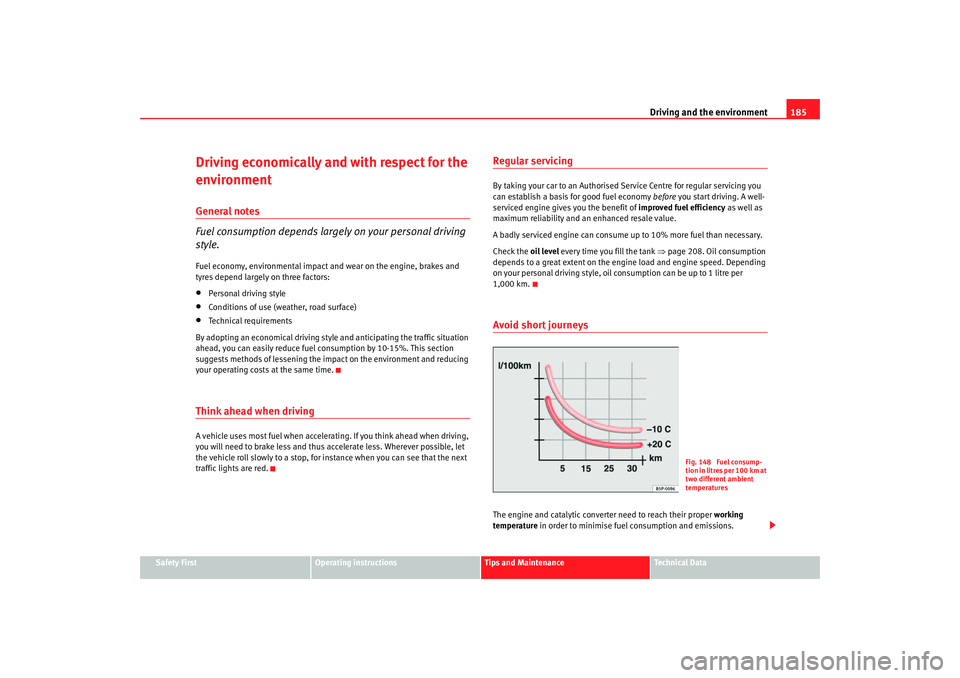
Avoid short journeysThe engine and catalytic converter need to reach their proper working
temperature in order to minimise fuel consumption and emissions.
Fig. 148 Fuel consump-
tion in litres per 100 km at
two different ambient
temperatures
altea_ingles Seite 185 Dienstag, 4. Oktober 2005 6:57 18
Page 189 of 288
Cleaning and caring for your vehicle187
Safety First
Operating instructions
Tips and Maintenance
Te c h n i c a l D a t a
Cleaning and caring for your vehicleGeneral notesRegular washing and care help maintain the value of your
vehicle.Regular care
Regular and expert care helps to maintain the value of the vehicle. This may
also be one of the requirements for acknowledging warranty claims in the
event of corrosion or paint defects.
The best way to protect the car against environmental contaminants is to
wash and wax it frequently. The longer substances such as insects, bird drop-
pings, resinous tree sap, road dirt, industrial deposits, tar, soot or road salt
and other aggressive materials remain on the vehicle, the more damage they
do to the paintwork. High temperatur es (for instance in strong sunlight)
further intensify the corrosive effect.
After the period when salt is put on the roads it is important to have the
underside of the vehicle washed thoroughly.
Car care products
Car care products are available from your Authorised Service Centre. Keep the
product instructions until you have used up the product.
WARNING
•
Car care products can be toxic. For this, they must always be kept
closed in their original container. Keep out of children's reach. Failure to
comply could result in poisoning.
•
Always read and observe the instructions and warnings on the package
before using car care products. Improper use could damage your health or your vehicle. The use of certain products may produce noxious vapours;
these should be used in well ventilated areas.
•
Never use fuel, turpentine, engine oil, nail varnish remover or other
volatile fluids. These are toxic and highly flammable. There is a fire / explo-
sion risk.
•
Before you wash your vehicle, or carry out any maintenance, switch off
the engine, apply the handbrake firmly and remove the key from the igni-
tion.Caution
Never attempt to remove dirt, mud or dust if the surface of the vehicle is dry.
Never use a dry cloth or sponge for clea ning purposes. This could damage the
paintwork or glass on your vehicle. Soak dirt, mud or dust with plenty of
water.
For the sake of the environment
•
When purchasing car care products, try to select ones which are not
harmful to the environment.
•
Left over car care products should not be disposed of with ordinary house-
hold waste. Observe the disposal information on the package.WARNING (continued)
altea_ingles Seite 187 Dienstag, 4. Oktober 2005 6:57 18
Page 191 of 288
Cleaning and caring for your vehicle189
Safety First
Operating instructions
Tips and Maintenance
Te c h n i c a l D a t a
luggage compartment, or bonnet. This could cause them to freeze. Otherwise
there is a risk of malfunction.
For the sake of the environment
In the interests of environmental protection, the car should be washed only
in specially provided wash bays. This prevents toxic, oil-laden waste water
entering the sewerage system. In some districts, washing vehicles anywhere
else may be prohibited.
Note
Do not wash the vehicle in direct sunlight.Washing the car with a high pressure cleaner
Be particularly careful when using a high pressure cleaner!– Always observe the instructions for the high-pressure cleaner,
particularly those concerning the pressure and the spraying
distance .
– Increase the spraying distance for soft materials and painted bumpers.
– Do not use a high pressure cleaner to remove ice or snow from windows ⇒page 190.
– Never use concentrated jet nozzl es or so-called “dirt blasters”
⇒ .
– If possible, avoid sudden braking directly after washing the vehicle. You must “dry” the brakes by applying the brakes care-
fully several times ⇒page 179.
WARNING
•
Never wash tyres with a concentrated jet or cylindrical jet (“rotating
nozzle”). Even at large spraying distances and short cleaning times, visible
and invisible damage can occur to the tyres. This may be an accident risk.
•
Moisture, ice and salt on the brakes may affect braking efficiency. Risk
of accident.Caution
•
Do not use water hotter than 60
°C. This could damage the car.
•
To avoid damage to the vehicle, maintain a sufficient distance from sensi-
tive materials for example: flexible hoses, plastic, sound proofing, etc. This is
especially important for bumpers painte d in the same colour as the vehicle.
The closer the nozzle is to the surface, the greater the wear on the material.
Waxing the car
Regular waxing protects the paintwork.You need to apply wax to your car if water does not form small drops and run
off the paintwork when it is clean.
Good quality hard wax is available from your Authorised Service Centre.
A good coat of wax helps to protects the paintwork from environmental
contaminants ⇒ pag
e 187. It is also effecti ve in protecting again st minor
scratches.
Even if a wax solution is used regularly in the car wash, it is advisable to
protect the paint with a coat of hard wax at least twice a year.
altea_ingles Seite 189 Dienstag, 4. Oktober 2005 6:57 18
Page 193 of 288
Cleaning and caring for your vehicle191
Safety First
Operating instructions
Tips and Maintenance
Te c h n i c a l D a t a
•
The heating element for the rear window is located on the inner side of the
window. To prevent damage, do not put stickers over the heating elements on
the inside of the window.
Cleaning windscreen wiper bladesClean wiper blades are essential for clear vision.
1. Use a soft cloth to remove dust and dirt from the windscreen wiper blades.
2. Use window cleanser to clean the windscreen wiper blades. Use a sponge or a cloth to remove stubborn stains.Care of rubber seals
If rubber seals are well looked after, they will not freeze so
quickly.1. Use a soft cloth to remove dust and dirt from the rubber seals.
2. Apply a specialist care product to the rubber seals.The weather strips on the doors, wind ows, bonnet and rear lid will remain
pliable and last longer if they are treated with a suitable care product (for
example silicone spray).
Caring for rubber seals will also prevent premature ageing and leaks. The
doors will be easier to open. If rubber seals are well looked after, they will not
freeze so quickly in winter.
Door lock cylinders
The door lock cylinders can freeze up in winter.To de-ice the lock cylinders you should only use spray with lubricating and
anti-corrosive properties.Cleaning chrome parts1. Clean chrome parts with a damp cloth.
2. Polish chrome parts with a soft, dry cloth.If this does not provide satisfying results, use a specialist chrome cleaning
product . Chrome cleaning products will remove stains and coatings from the
surface.
Caution
To prevent scratching chrome surfaces:•
Never use an abrasive care product on chrome.
•
Do not clean or polish chrome parts in a sandy or dusty environment.
Steel wheels– Clean steel wheels regularly using a separate sponge.Use an industrial cleanser to remove brake dust. Any damage to the paint on
steel wheels should be repaired be fore the metal starts to rust.
altea_ingles Seite 191 Dienstag, 4. Oktober 2005 6:57 18
Page 195 of 288
Cleaning and caring for your vehicle193
Safety First
Operating instructions
Tips and Maintenance
Te c h n i c a l D a t a
Cleaning the engine compartment
Take special care when cleaning the engine compartment.Anti-corrosion treatment
The engine compartment and the surface of the power unit are given anti-
corrosion treatment at the factory.
Good corrosion protection is particularly important in winter when the car is
frequently driven on salted roads. To prevent the salt corroding the vehicle,
the entire engine compartment should be thoroughly cleaned before and
after the salting period.
Your Authorised Service Centre is able to provide the correct cleaning and
preserving products and has the necessary equipment. For this reason, we
recommend having this work performed by them.
The anti-corrosion protection is usua lly removed if the engine compartment
is cleaned with grease removing solution s, or if you have the engine cleaned.
If this job is carried out, you should ensure that all surfaces, seams, joints and
components in the engine compartmen t are given anti-corrosion treatment
afterwards.
WARNING
•
When working in the engine compartment, always observe the safety
warnings ⇒ page 203.
•
Switch off the engine, apply the parking brake firmly and always
remove the key from the ignition before you open the bonnet.
•
Allow the engine to cool before you clean the engine compartment.
•
Do not clean the underside of vehicle, wheel arches without protecting
your hands and arms. You may cut your self on sharp-edged metal parts.
Failure to comply could result in injury.
•
Moisture, ice and salt on the brakes may affect braking efficiency. Risk
of accident. If possible, avoid sudden braking immediately after washing
the vehicle.
•
Never touch the radiator fan. It is temperature-controlled and could
start automatically, even when the key is removed from the ignition!For the sake of the environment
Fuel, grease and oil deposits could be removed when the engine is washed.
The polluted water must be cleaned in an oil separator. For this reason,
engine washing should be carried out only by a qualified workshop or a suit-
able filling station.Care of the vehicle interiorCleaning plastic parts and the dash panel– Use a clean, damp cloth to clean plastic parts and the dash panel.
– If this does not provide satisfactory results, use a special solvent-free plastic cleaning product.
WARNING
Never clean the dash panel and surface of the airbag module with cleansers
containing solvents. Solvents cause the surface to become porous. If the
airbag inflates, disintegrating plastic parts can cause substantial injuries.
WARNING (continued)
altea_ingles Seite 193 Dienstag, 4. Oktober 2005 6:57 18
Page 197 of 288
Cleaning and caring for your vehicle195
Safety First
Operating instructions
Tips and Maintenance
Te c h n i c a l D a t a
•
To avoid damage, stubborn stains should be removed by a qualified
workshop.
Cleaning seat belts
A dirty belt may stop the seat belt working properly.Keep the seat belts clean and check all seat belts regularly.
Cleaning seat belts
– Carefully pull the dirty seat belt right out and leave it out.
– Clean the dirty seat belts with a gentle soap solution.
– Allow the seat belt fabric to dry.
– Do not roll up the seat belt until it is dry.If large stains form on the belts the belt will not retract correctly into the auto-
matic belt retractor.
WARNING
•
Do not use chemical cleaning agents on the seat belts, as this can
impair the strength of the webbing. Ensure that the belts do not come into
contact with corrosive fluids.
•
Check the condition of all seat belts at regular intervals. If you notice
that the belt webbing, fittings, retractor mechanism or buckle of any of the
belts is damaged, the belt must be replaced by a specialist workshop.
•
Do not attempt to repair a damaged seat belt yourself. The seat belts
must not be removed or modified in any way.
Caution
After cleaning, allow seat belts to dr y completely before rolling them up.
Otherwise the belt retracto rs could become damaged.
altea_ingles Seite 195 Dienstag, 4. Oktober 2005 6:57 18
Page 199 of 288
Accessories, parts replacement and modifications197
Safety First
Operating instructions
Tips and Maintenance
Te c h n i c a l D a t a
WARNING
Incorrectly performed modifications or other work on your vehicle can lead
to malfunctions and cause accidents.Roof aerial*The vehicle may be fitted with a collapsible roof aerial* with antitheft
system*, which can be folded backwards, when, for example, going through
an automatic carwash.
To f o l d
Unscrew the aerial rod, tilting it backwards into a horizontal position and then
screw in again.
To return to working position
Continue in the reverse order to that given in the previous instruction.Mobile telephones and two-way radiosYou will require an external aerial for mobile phones and two-
way radios.SEAT has approved your vehicle for use with mobile telephones and two-way
radios providing the following conditions are observed:•
The correct installation of an external aerial,
•
transmitting power of maximum 10 watts.
An external aerial is needed to give the equipment its optimal range. First consult your Authorised Service Centre if you wish to use a mobile tele-
phone or a two-way radio with a transmitting power in excess of 10 watts.
Here you will receive information concerning the technical possibilities for
retro-fitting this equipment.
Mobile telephones and two-way radios
should be fitted only by a qualified
workshop, for example an Authorised Service Centre.
WARNING
•
Always concentrate primarily on driving. If you are distracted while
driving you could have an accident.
•
Never attach the telephone mountings to the surfaces covering the
airbag units or within the range of the airbags, danger of injury if the airbag
is triggered.
•
If you use mobile telephones or two-way radios in the vehicle without
an external aerial, electromagnetic ra diation in the vehicle could exceed
authorised limits. This also applies to external aerials that have not been
correctly installed.Caution
Failure to observe the above conditions could cause the electronics to
malfunction. The most common causes of faults are:•
no external aerial,
•
external aerial incorrectly installed,
•
transmitting power in excess of 10 watts.Note
Please observe the operating instructions of your mobile telephone / two-way
radio.
altea_ingles Seite 197 Dienstag, 4. Oktober 2005 6:57 18
Page 201 of 288
Accessories, parts replacement and modifications199
Safety First
Operating instructions
Tips and Maintenance
Te c h n i c a l D a t a
If a towing bracket is to be fitted after the vehicle is purchased, this must be
completed according to the instructions of the towing bracket manufacturer.
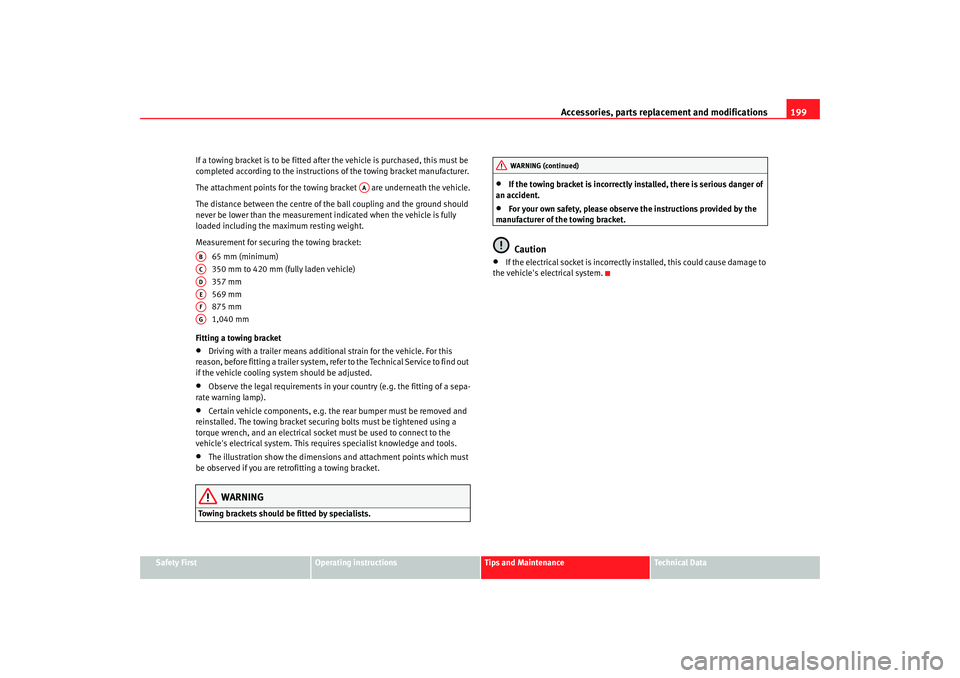
The attachment points for the towing bracket are underneath the vehicle.
The distance between the centre of th
e ball coupling and the ground should
never be lower than the measurement indicated when the vehicle is fully
loaded including the maximum resting weight.
Measurement for securin g the towing bracket:
65 mm (minimum)
350 mm to 420 mm (fully laden vehicle)
357 mm
569 mm
875 mm
1,040 mm
Fitting a towing bracket
•
Driving with a trailer means additional strain for the vehicle. For this
reason, before fitting a trailer system, refe r to the Technical Service to find out
if the vehicle cooling system should be adjusted.
•
Observe the legal requirements in yo ur country (e.g. the fitting of a sepa-
rate warning lamp).
•
Certain vehicle componen ts, e.g. the rear bumper must be removed and
reinstalled. The towing bracket securi ng bolts must be tightened using a
torque wrench, and an electrical sock et must be used to connect to the
vehicle's electrical system. This requires specialist knowledge and tools.
•
The illustration show the dimensions and attachment points which must
be observed if you are retrofitting a towing bracket.
WARNING
Towing brackets should be fitted by specialists.
•
If the towing bracket is incorrectly installed, there is serious danger of
an accident.
•
For your own safety, please observe the instructions provided by the
manufacturer of the towing bracket.Caution
•
If the electrical socket is incorrectly installed, this could cause damage to
the vehicle's electrical system.
AA
ABACADAEAFAG
WARNING (continued)
altea_ingles Seite 199 Dienstag, 4. Oktober 2005 6:57 18