maintenance Seat Altea 2006 Owner's Manual
[x] Cancel search | Manufacturer: SEAT, Model Year: 2006, Model line: Altea, Model: Seat Altea 2006Pages: 288, PDF Size: 8.61 MB
Page 221 of 288
Checking and refilling levels219
Safety First
Operating instructions
Tips and Maintenance
Te c h n i c a l D a t a
•
If the vehicle is left standing in cold conditions for a long period, protect
the battery from frost. If it “freezes” it will be damaged.
Checking the electrolyte level
The electrolyte level should be checked regularly in high-
mileage vehicles, in hot countries and in older batteries.– Open the bonnet and open the battery cover at the front ⇒ in
“Safety instructions on working in the engine compartment” on
page 203 ⇒ in “Warnings on handling the battery” on
page 218.
– Check the colour display in the magic eye on the top of the battery.
– If there are air bubbles in the window, tap the window gently until they disperse.The position of the battery is shown in the corresponding engine compart-
ment diagram ⇒page 262.
The round window (“magic eye”) on the top of the battery changes colour,
depending on the charge level and electrolyte level of the battery.
If the colour in the window is colourless or bright yellow, the electrolyte level
of the battery is too low. Have the battery checked by a qualified workshop.
The colours green and black are used by the workshops for diagnostic
purposes.
Charging and changing the vehicle battery
The battery is maintenance-free and is checked during the
inspection service. All work on the vehicle battery requires
specialist knowledge.If you often drive short distances or if the vehicle is not driven for long
periods, the battery should be checked by a qualified workshop between the
scheduled services.
If the battery has discharged and you have problems starting the vehicle, the
battery might be damaged. If this happens, we recommend you have the
vehicle battery checked by an Authorised Service Centre where it will be re-
charged or replaced.
Charging the battery
The vehicle battery should be charged by a qualified workshop only, as
batteries using special technology have been installed and they must be
charged in a controlled environment.
Replacing a vehicle battery
The battery has been developed to suit the conditions of their location and
has special safety features.
Genuine SEAT batteries fulfil the maintenance, performance and safety spec-
ifications of your vehicle.
WARNING
•
We recommend you use only maintenance-free or cycle free leak-proof
batteries which comply with the standards T 825 06 and VW 7 50 73. This
standard applies as of 2001.
•
Before starting any work on the batteries, you must read and observe
the warnings ⇒ in “Warnings on handling the battery” on page 218.
altea_ingles Seite 219 Dienstag, 4. Oktober 2005 6:57 18
Page 223 of 288
Checking and refilling levels221
Safety First
Operating instructions
Tips and Maintenance
Te c h n i c a l D a t a
Checking tyre pressure
The correct tyre pressure can be seen on the sticker on the
inside of the tank flap.1. Read the required tyre inflation pressure from the sticker. The
values refer to Summer tyres. For Winter tyres, you must add 0.2
bar to the values given on the sticker.
2. The tyre pressures should only be checked when the tyres are cold. The slightly raised pressures of warm tyres must not be
reduced.
3. Adjust the tyre pressure to the load you are carrying.Tyre pressure
The correct tyre pressure is especially important at high speeds. The pressure
should therefore be checked at least once a month and before starting a
journey.
WARNING
A tyre can easily burst if the pressure is too low, causing an accident!•
At continuously high speeds, a tyre with insufficient pressure flexes
more. In this way it becomes too hot, and this can cause tread separation
and tyre blow-out. Always observe the recommended tyre pressures.
•
If the tyre pressure is too low or too high, the tyres will wear prema-
turely and the vehicle will not handle well. Risk of accident!For the sake of the environment
Under-inflated tyres will increase fuel consumption.
Tyre service life
The service life of tyres is dependent on tyre pressure, driving
style and fitting.
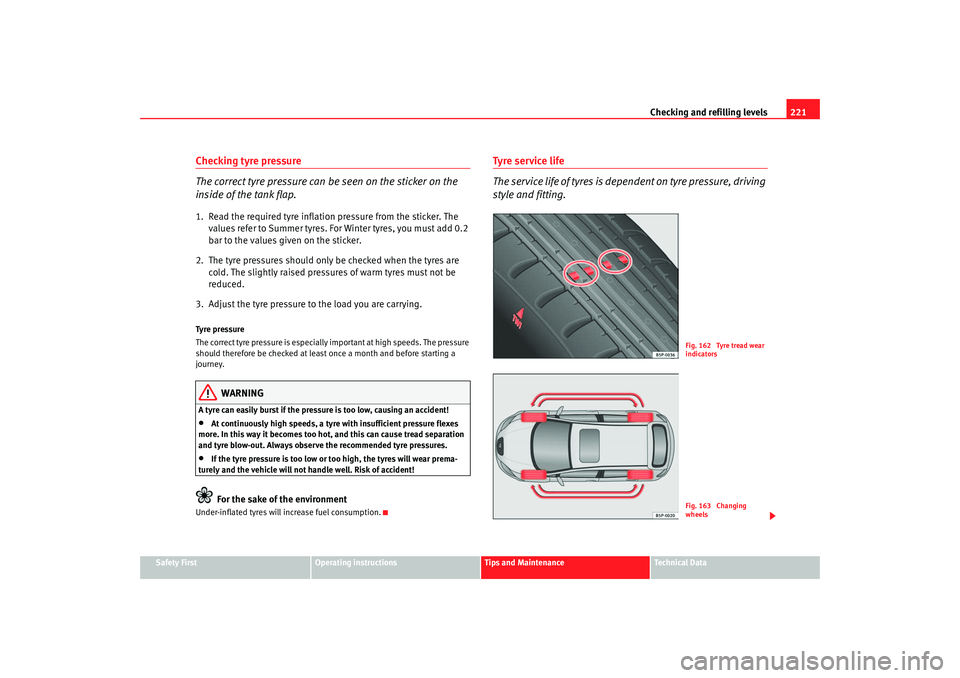
Fig. 162 Tyre tread wear
indicatorsFig. 163 Changing
wheels
altea_ingles Seite 221 Dienstag, 4. Oktober 2005 6:57 18
Page 225 of 288
Checking and refilling levels223
Safety First
Operating instructions
Tips and Maintenance
Te c h n i c a l D a t a
easier to choose the correct tyres. Radial tyres have the tyre designations
marked on the sidewall, for example:
195/65 R15 91T
This contains the following information:
195 Tyre width in mm
65 Height/width ratio in %
R Tyre construction: Radial
15 Rim diameter in inches
91 Load rating code
T Speed rating
The tyres could also have the following information:
•
A direction of rotation symbol
•
“Reinforced” denotes heavy-duty tyres.
The manufacturing date is also indicated on the tyre sidewall (possibly only
on the inner side of the wheel).
“DOT ... 1103 ...” means, for example, th at the tyre was produced in the 11th
week of 2003.
We recommend that work on tyres and wheels is carried out by an Authorised
Service Centre. They are familiar with the procedure and have the necessary
special tools and spare parts as well as the proper facilities for disposing of
the old tyres.
Any Authorised Service Centre has full information on the technical require-
ments when installing or changing tyres, wheels or wheel trims.
WARNING
•
We recommend that you use only use wheels and tyres which have been
approved by SEAT for your model. Fa ilure to do so could impair vehicle
handling. Risk of accident.
•
Avoid running the vehicle on tyres th at are more than six years old. If
you have no alternative, you should dr ive slowly and with extra care at all
times.
•
Never use old tyres or those with an unknown “history of use”.
•
If wheel trims are retrofitted, you must ensure that the flow of air to the
brakes is not restricted. This could cause them to overheat.
•
All four wheels must be fitted with radial tyres of the same type, size
(rolling circumference) and the same tread pattern.For the sake of the environment
Old tyres must be disposed of accordi ng to the laws in the country concerned.
Note
•
For technical reasons, it is not generally possible to use the wheels from
other vehicles. This can also apply to wheels of the same model. The use of
wheels or tyres which have not been approved by SEAT for use with your
model may invalidate the vehicle's type approval for use on public roads.
•
If the spare tyre is not the same as the tyres that are mounted on the
vehicle - for example with winter tyres - you should only use the spare tyre for
a short period of time and drive with extra care. Refit the normal road wheel
as soon as possible.
Wheel bolts
Wheel bolts must be tightened to the correct torque.The design of wheel bolts is matched to the rims. If different wheel rims are
fitted, the correct wheel bolts with the right length and correctly shaped bolt
WARNING (continued)
altea_ingles Seite 223 Dienstag, 4. Oktober 2005 6:57 18
Page 227 of 288
Checking and refilling levels225
Safety First
Operating instructions
Tips and Maintenance
Te c h n i c a l D a t a
Snow chainsSnow chains may be fitted only to the front wheels, and only to certain tyre
sizes ⇒page 260.
Snow chains must have fine-pitch link s which do not protrude more that 9
mm, including tension device.
Remove wheel hub covers and trim rings before fitting snow chains. For safety
reasons cover caps, available in any Authorised Service Centre, must then be
fitted over the wheel bolts.
WARNING
Observe the fitting instructions provided by the snow chain manufacturer.
Caution
You must remove the snow chains to drive on roads which are free of snow.
Otherwise they will impair handling, damage the tyres and wear out very
quickly.
Note
In some countries, the speed limit for using snow chains is 50 km/h. The legal
requirements of the country should be followed.
altea_ingles Seite 225 Dienstag, 4. Oktober 2005 6:57 18
Page 229 of 288
If and when227
Safety First
Operating instructions
Tips and Maintenance
Te c h n i c a l D a t a
Compact temporary spare wheel
The compact temporary spare wh eel is only intended for
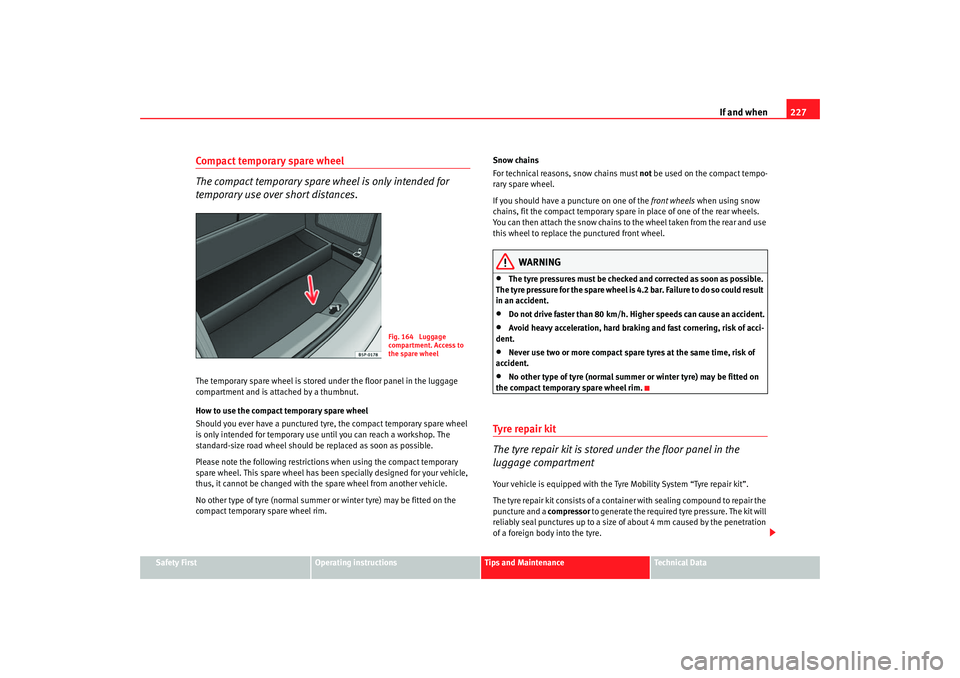
temporary use over short distances.The temporary spare wheel is stored under the floor panel in the luggage
compartment and is attached by a thumbnut.
How to use the compact temporary spare wheel
Should you ever have a punctured tyre, the compact temporary spare wheel
is only intended for temporary use until you can reach a workshop. The
standard-size road wheel should be replaced as soon as possible.
Please note the following restrictions when using the compact temporary
spare wheel. This spare wheel has been specially designed for your vehicle,
thus, it cannot be changed with th e spare wheel from another vehicle.
No other type of tyre (normal summer or winter tyre) may be fitted on the
compact temporary spare wheel rim. Snow chains
For technical reasons, snow chains must not
be used on the compact tempo-
rary spare wheel.
If you should have a puncture on one of the front wheels when using snow
chains, fit the compact temporary spare in place of one of the rear wheels.
You can then attach the snow chains to the wheel taken from the rear and use
this wheel to replace the punctured front wheel.
WARNING
•
The tyre pressures must be checked and corrected as soon as possible.
The tyre pressure for the spare wheel is 4.2 bar. Failure to do so could result
in an accident.
•
Do not drive faster than 80 km/h. High er speeds can cause an accident.
•
Avoid heavy acceleration, hard braking and fast cornering, risk of acci-
dent.
•
Never use two or more compact spare tyres at the same time, risk of
accident.
•
No other type of tyre (normal summer or winter tyre) may be fitted on
the compact temporary spare wheel rim.
Tyre repair kit
The tyre repair kit is stored under the floor panel in the
luggage compartmentYour vehicle is equipped with the Tyre Mobility System “Tyre repair kit”.
The tyre repair kit consists of a contai ner with sealing compound to repair the
puncture and a compressor to generate the required tyre pressure. The kit will
reliably seal punctures up to a size of about 4 mm caused by the penetration
of a foreign body into the tyre.
Fig. 164 Luggage
compartment. Access to
the spare wheel
altea_ingles Seite 227 Dienstag, 4. Oktober 2005 6:57 18
Page 231 of 288
If and when229
Safety First
Operating instructions
Tips and Maintenance
Te c h n i c a l D a t a
After changing a wheel
After changing the wheel there are still tasks to complete.– Put the tools and jack back in the luggage compartment.
– Place the wheel with the defective tyre in the luggage compart-
ment and secure it.
– Check the tyre pressure of the newly fitted tyre as soon as
possible.
– Have the tightening torque of the wheel bolts checked as soon as possible with a torque wrench. The prescribed torque is 120 Nm.
Note•
If you notice that the wheel bolts are corroded and difficult to turn when
changing a wheel, they must be replaced before having the wheel bolt torque
checked.
•
In the interest of safety, drive at moderate speeds until the wheel bolt
torque has been checked.
Wheel trims
The wheel trims must be removed to gain access to the wheel
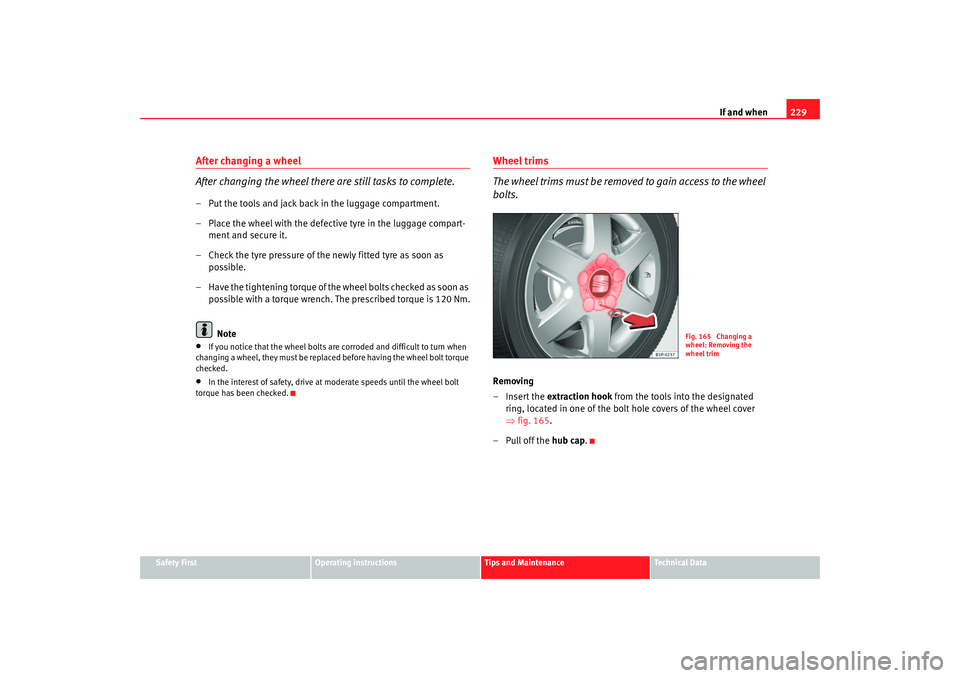
bolts.Removing
–Insert the extraction hook from the tools into the designated ring, loca ted in one of the bolt ho le c ov
ers of the wheel co ver
⇒ fig. 165
.
–Pull off the hub cap .
Fig. 165 Changing a
wheel: Removing the
wheel trim
altea_ingles Seite 229 Dienstag, 4. Oktober 2005 6:57 18
Page 233 of 288
If and when231
Safety First
Operating instructions
Tips and Maintenance
Te c h n i c a l D a t a
WARNING
Loosen the wheel bolts only about one tu rn before raising the vehicle with
the jack, loosening the wheel bolts more than one turn can result in an acci-
dent.
Note
•
Do not use the hexagonal socket in th e screwdriver handle to loosen or
tighten the wheel bolts.
•
If the wheel bolt is very tight, you may be able to loosen it by pushing
down the end of the spanner carefully with your foot. Hold on to the vehicle
for support and take care not to slip.
Raising the vehicle
The vehicle must be raised with a jack to remove the wheel.
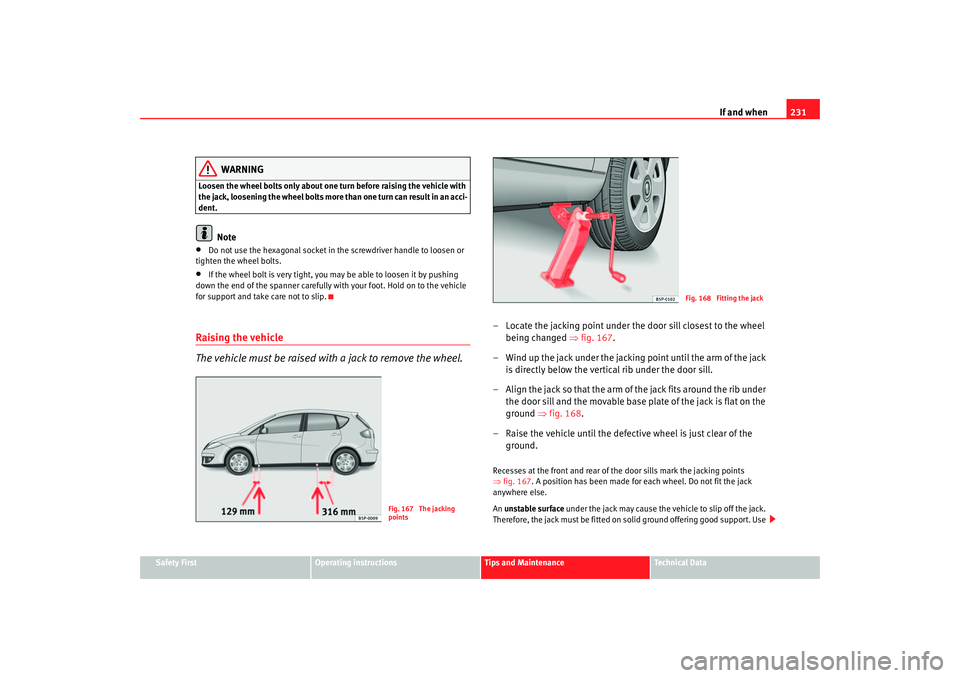
– Locate the jacking point under the door sill closest to the wheel being changed ⇒ fig. 167.
–
Wind up the jack under the jacking point until the arm of the jack
is directly below the vertical rib under the door sill.
– Align the jack so that the arm of the jack fits around the rib under the door sill and the movable base plate of the jack is flat on the
ground ⇒ fig. 168 .
– R
aise the vehicle until the defect ive wheel is just clear of the
ground.
Recesses at the front and rear of the door sills mark the jacking points
⇒ fig. 167 . A position has been made for each wheel. Do not fit the jack
anywhere else.
An unstable surface under the jack may cause the vehicle to slip off the jack.
Therefore, the jack must be fitted on solid ground offering good support. Use
Fig. 167 The jacking
points
Fig. 168 Fitting the jack
altea_ingles Seite 231 Dienstag, 4. Oktober 2005 6:57 18
Page 235 of 288
If and when233
Safety First
Operating instructions
Tips and Maintenance
Te c h n i c a l D a t a
Theft inhibiting wheel bolts*
A special adapter is required to turn the theft inhibiting wheel
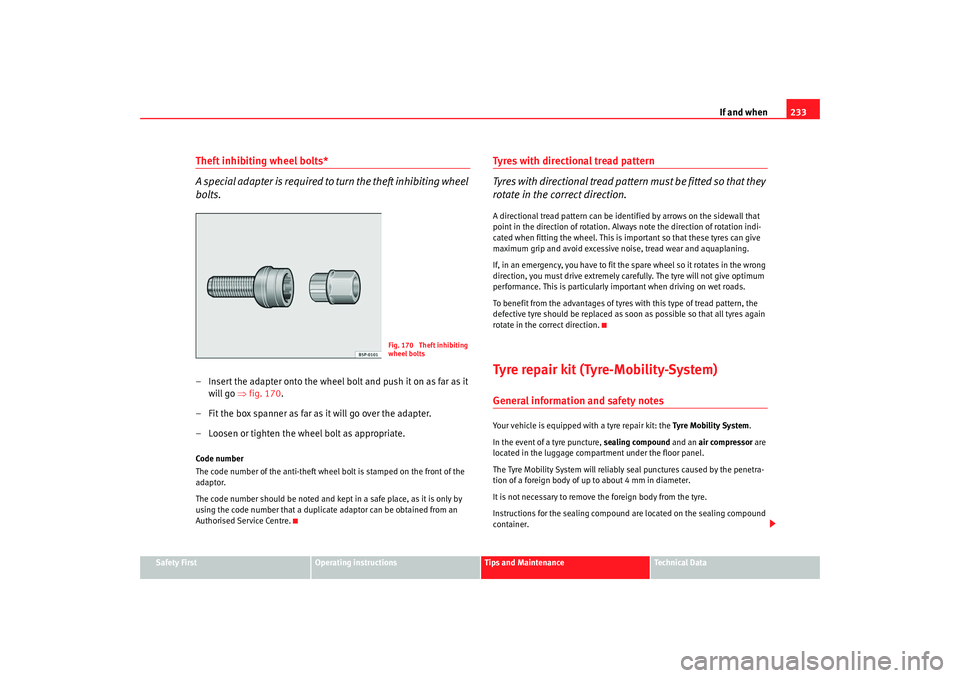
bolts.– Insert the adapter onto the wheel bolt and push it on as far as it
will go ⇒fig. 170 .
– Fit the box spanner as far as it will go over the adapter.
– Loosen or tighten the wheel bolt as appropriate.Code number
The code number of the anti-theft wheel bolt is stamped on the front of the
adaptor.
The code number should be noted and kept in a safe place, as it is only by
using the code number that a duplicat e adaptor can be obtained from an
Authorised Service Centre.
Tyres with directional tread pattern
Tyres with directional tread pattern must be fitted so that they
rotate in the correct direction.A directional tread pattern can be ident ified by arrows on the sidewall that
point in the direction of rotation. Always note the direction of rotation indi-
cated when fitting the wheel. This is important so that these tyres can give
maximum grip and avoid excessive noise, tread wear and aquaplaning.
If, in an emergency, you have to fit the spare wheel so it rotates in the wrong
direction, you must drive extremely care fully. The tyre will not give optimum
performance. This is particularly important when driving on wet roads.
To benefit from the advantages of tyres with this type of tread pattern, the
defective tyre should be replaced as soon as possible so that all tyres again
rotate in the correct direction.Tyre repair kit (Tyre-Mobility-System)General information and safety notesYour vehicle is equipped with a tyre repair kit: the Tyre Mobility System.
In the event of a tyre puncture, sealing compound and an air compressor are
located in the luggage compartment under the floor panel.
The Tyre Mobility System will reliably seal punctures caused by the penetra-
tion of a foreign body of up to about 4 mm in diameter.
It is not necessary to remove the foreign body from the tyre.
Instructions for the sealing compound are located on the sealing compound
container.
Fig. 170 Theft inhibiting
wheel bolts
altea_ingles Seite 233 Dienstag, 4. Oktober 2005 6:57 18
Page 237 of 288
If and when235
Safety First
Operating instructions
Tips and Maintenance
Te c h n i c a l D a t a
Inflating the tyre.
– Remove the air compressor and hose from the container.
– Screw the retaining nut onto the valve.
– Plug the compressor cable into a 12 volt socket.
– Turn on compressor and monitor the pressure shown on the pres-
sure gauge.
Completing the repair
– Remove the compressor hose from the valve.
– Fit the valve cap.
– Unplug the compressor from the socket.
– Return all tools to their proper storing location.
NoteThe compressor should never be allowed to run for longer than 6 minutes.
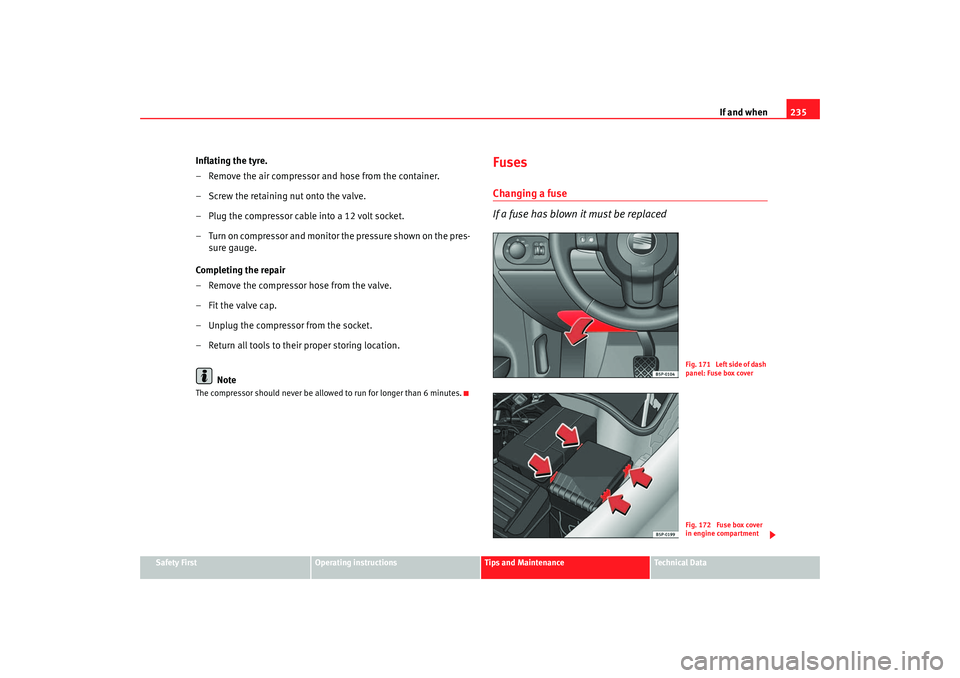
FusesChanging a fuse
If a fuse has blown it must be replaced
Fig. 171 Left side of dash
panel: Fuse box coverFig. 172 Fuse box cover
in engine compartment
altea_ingles Seite 235 Dienstag, 4. Oktober 2005 6:57 18
Page 239 of 288
If and when237
Safety First
Operating instructions
Tips and Maintenance
Te c h n i c a l D a t a
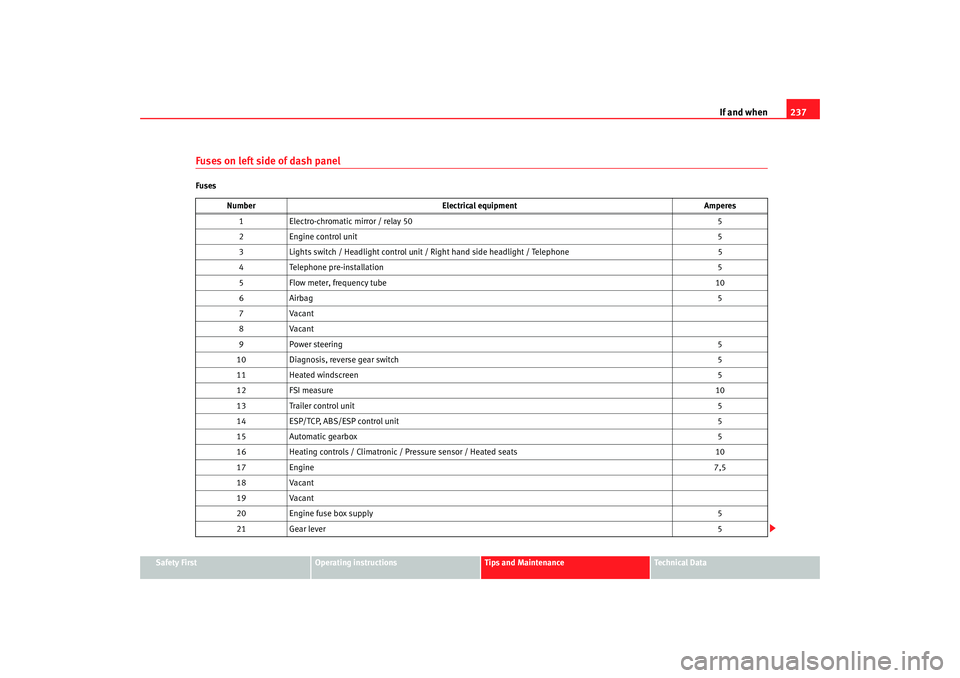
Fuses on left side of dash panelFuses
Number Electrical equipment Amperes
1 Electro-chromatic mirror / relay 50 5
2 Engine control unit 5
3 Lights switch / Headlight control unit / Right hand side headlight / Telephone 5
4 Telephone pre-installation 5
5 Flow meter, frequency tube 10
6A ir b ag 5
7 Vacant
8 Vacant
9 Power steering 5
10 Diagnosis, reverse gear switch 5
11 Heated windscreen 5
12 FSI measure 10
13 Trailer control unit 5
14 ESP/TCP, ABS/ESP control unit 5
15 Automatic gearbox 5
16 Heating controls / Climatronic / Pressure sensor / Heated seats 10
17 Engine 7,5
18 Vacant
19 Vacant
20 Engine fuse box supply 5
21 Gear lever 5
altea_ingles Seite 237 Dienstag, 4. Oktober 2005 6:57 18