change Seat Altea 2007 Owner's Guide
[x] Cancel search | Manufacturer: SEAT, Model Year: 2007, Model line: Altea, Model: Seat Altea 2007Pages: 302, PDF Size: 9.17 MB
Page 148 of 302
Seats and stowage
146Luggage compartmentStowing luggage
All luggage must be securely stowed.Please observe the following points to ensure the vehicle handles
well at all times:
– Distribute the load as evenly as possible.
– Place heavy objects as far forward in the luggage compartment
as possible.
– Secure luggage in the luggage compartment with suitable straps on the fastening rings.
WARNING
•
Loose luggage and other loose items in the vehicle can cause serious
injuries.
•
Loose objects in the luggage compartment can suddenly move and
change the way the vehicle handles.
•
During sudden manoeuvres or accidents, loose objects in the
passenger compartment can be flung forward, injuring vehicle occupants.
•
Always store objects in the luggage compartment and secure with suit-
able straps. This is especially important for heavy objects.
•
When you transport heavy objects, always keep in mind that a change
in the centre of gravity can also cause changes in vehicle handling.
•
Please observe information on safe driving ⇒page 7, “Safe driving”.
Caution
Hard objects on the shelf could chafe against the wires of the heating
element in the rear window and cause damage.
Note
The ventilation slots in front of the rear side windows must not be covered as
this would prevent stale air being extracted from the vehicle.
altea_ingles_0706.book Seite 146 Mittwoch, 30. August 2006 3:48 15
Page 150 of 302
Seats and stowage
148tion manual. Not following these instructions may lead to paintwork damage
or marks on the bodywork.•
Pay special attention to the tightening torque of the attachment bolts and
check them following a short journey. If necessary, retighten the bolts and
check them at regular intervals.
•
Distribute the load evenly. A maximum load of 40 kg only is permitted for
each roof carrier system support bar, the load must be distributed evenly over
the entire length. However, the maximu m load permitted for the entire roof
(including the support system) of 75 kg must not be exceeded nor should the
total weight of the vehicle be exceeded. See the chapter on “Technical Data”.
•
When transporting heavy or large objects on the roof, any change in the
normal vehicle behaviour due to a change in the centre of gravity or an
increased wind resistance must be taken into account. For this reason, a suit-
able speed and driving style must be used.
•
For those vehicles fitted with a sunroof*, ensure that it does not interfere
with the load on the roof carrier system when opened.
altea_ingles_0706.book Seite 148 Mittwoch, 30. August 2006 3:48 15
Page 158 of 302
Heating, Ventilation and Air conditioning
156
– Press the temperature selectors to set the desired temperatures
for the left and right sides of the interior. We recommend 22°C
(72°F).A comfortable interior climate is quickly reached when a temperature of
+22°C (72°F) is set in automatic mode. It can be changed as necessary to suit
individual preferences or particular ci rcumstances. It is possible to select
interior temperatures from +16°C (61°F) to +29.5°C (86°F). These are approx-
imate temperatures and the actual temperature may be slightly higher or
lower depending on the ambient conditions. Climatronic automatically maintains a constant temperature. The tempera-
ture of the air supplied to the interior, the blower speed and the air distribu-
tion are regulated automatically. The system also allows for the effect of
strong sunlight, so there is no need
for manual adjustment. Therefore, auto-
matic mode provides the best comfort for the vehicle occupants in virtually all
conditions throughout the year.
Automatic mode is switched off whenever an adjustment is made using the
buttons for the air distribution, airflow or . The temperature will
continue to be regulated within the parameters manually selected by the
user.Manual mode
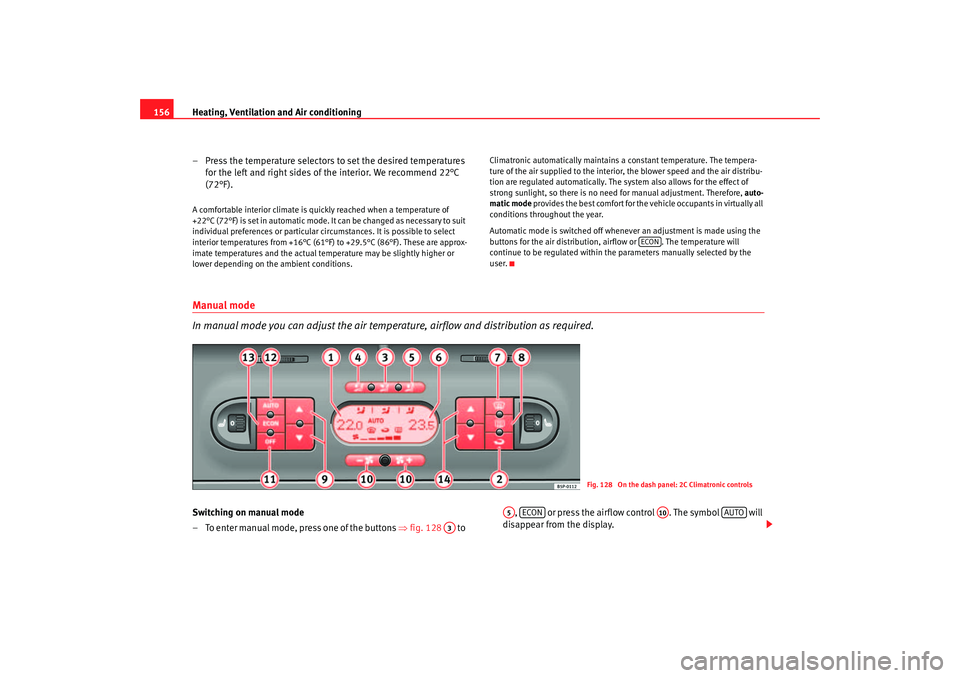
In manual mode you can adjust the air temper ature, airflow and distribution as required.Switching on manual mode
– To enter manual mode, press one of the buttons ⇒fig. 128 to , or press the airflow control . The symbol will
disappear from the display.
ECON
Fig. 128 On the dash panel: 2C Climatronic controls
A3
A5
ECON
A10
AUTO
altea_ingles_0706.book Seite 156 Mittwoch, 30. August 2006 3:48 15
Page 160 of 302
Heating, Ventilation and Air conditioning
158General notesThe pollen filter
The pollution filter (a combined pa rticulate filter and activated carbon filter)
serves as a barrier against impurities in the outside air, including dust and
pollen.
For the air conditioning system to work with maximum efficiency, the pollen
filter must be replaced at the intervals specified in the Service Schedule.
If the filter loses efficiency prematurely due to use in areas with very high
levels of air pollution, the pollen filte r must be changed more frequently than
stated in the Service Schedule.
Caution
•
If you suspect that the air conditioner is damaged, switch off the air condi-
tioner with button to prevent further damage and have it checked by a
qualified workshop.
•
Repairs to the air conditioning system require specialist knowledge and
special tools. Therefore, we recommend that you take the vehicle to a quali-
fied workshop should problems occur.Note
•
If the humidity and temperature outside the vehicle are high, condensa-
tion can drip off the evaporator in the cooling system and form a pool under-
neath the vehicle, this is completely normal and there is no need to suspect
a leak.
•
Keep the air intake slots in front of the windscreen free of snow, ice and
leaves to ensure heating and cooling is not impaired, and to prevent the
windows misting over.
•
The air from the vents flows through the passenger compartment and is
extracted by slots designed for this purpose. Do not cover these slots with
articles of clothing or other objects.
•
The air conditioning system operates most effectively with the windows
and the sliding/tilting roof* closed. Howe ver, if the sun has heated up the
vehicle, the air inside can be cooled more quickly by opening the windows for
a short period.
•
Do not smoke while air recirculation mode is on, as smoke drawn into the
air conditioning system leaves a r esidue on the evaporator, producing a
permanent unpleasant odour.
•
The air conditioning should be turned on at least once a month, to lubri-
cate the system gaskets and prevent leaks. If a decrease in the cooling
capacity is detected, an Authorised Service Centre should be consulted to
check the system.
ECON
altea_ingles_0706.book Seite 158 Mittwoch, 30. August 2006 3:48 15
Page 169 of 302
Driving167
Safety First
Operating instructions
Tips and Maintenance
Te c h n i c a l D a t a
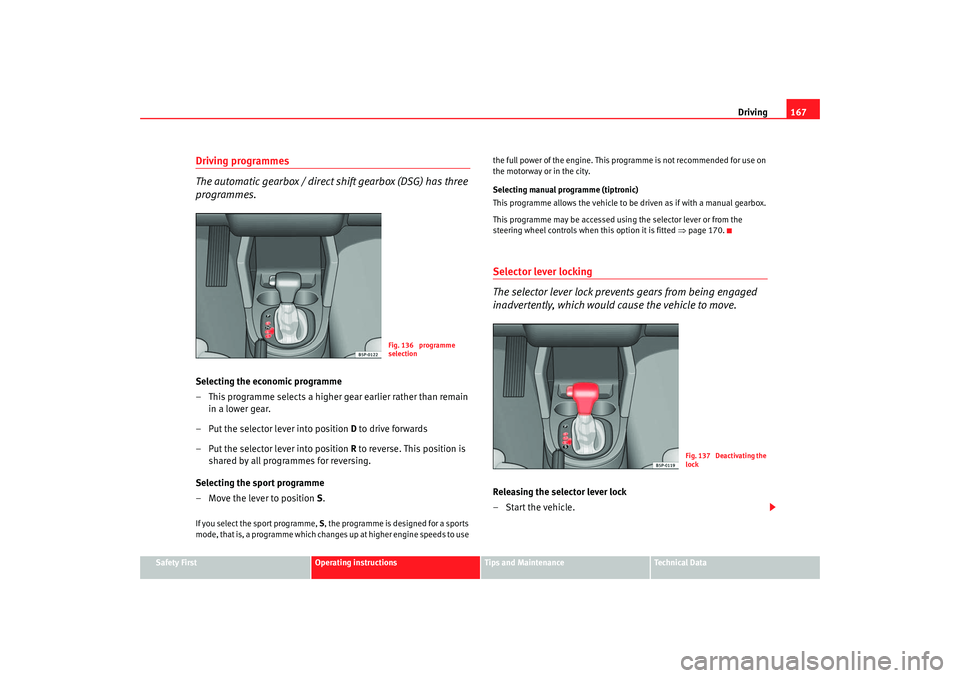
Driving programmes
The automatic gearbox / direct shift gearbox (DSG) has three
programmes.Selecting the economic programme
– This programme selects a higher gear earlier rather than remain
in a lower gear.
– Put the selector lever into position D to drive forwards
– Put the selector lever into position R to reverse. This position is
shared by all programmes for reversing.
Selecting the sport programme
– Move the lever to position S .If you select the sport programme, S, the programme is designed for a sports
mode, that is, a programme which changes up at higher engine speeds to use the full power of the engine. This pr
ogramme is not recommended for use on
the motorway or in the city.
Selecting manual programme (tiptronic)
This programme allows the vehicle to be driven as if with a manual gearbox.
This programme may be accessed us ing the selector lever or from the
steering wheel controls when this option it is fitted ⇒page 170.
Selector lever locking
The selector lever lock prevents gears from being engaged
inadvertently, which would cause the vehicle to move.Releasing the selector lever lock
–Start the vehicle.
Fig. 136 programme
selection
Fig. 137 Deactivating the
lock
altea_ingles_0706.book Seite 167 Mittwoch, 30. August 2006 3:48 15
Page 170 of 302
Driving
168
– Press and release the brake pedal, at the same time press the button on the selector lever.The lock is only activated when the vehicle is stopped or at a speed of less
than 5 km/h. At higher speeds, the lock is automatically released in position
N.
For rapid changes of position (e.g. from R to D) the lever will not lock. If the
lever remains in the position N more than one second then it is locked. With
the automatic lock, the lever is prevented passing from P and N to any other
gear without first pressing the brake pedal.
The selector lever must be put in the position P in order to remove the key.Driving with an automatic gearbox* / DSG automatic gearbox
The drive and reverse gears are automatically engaged.
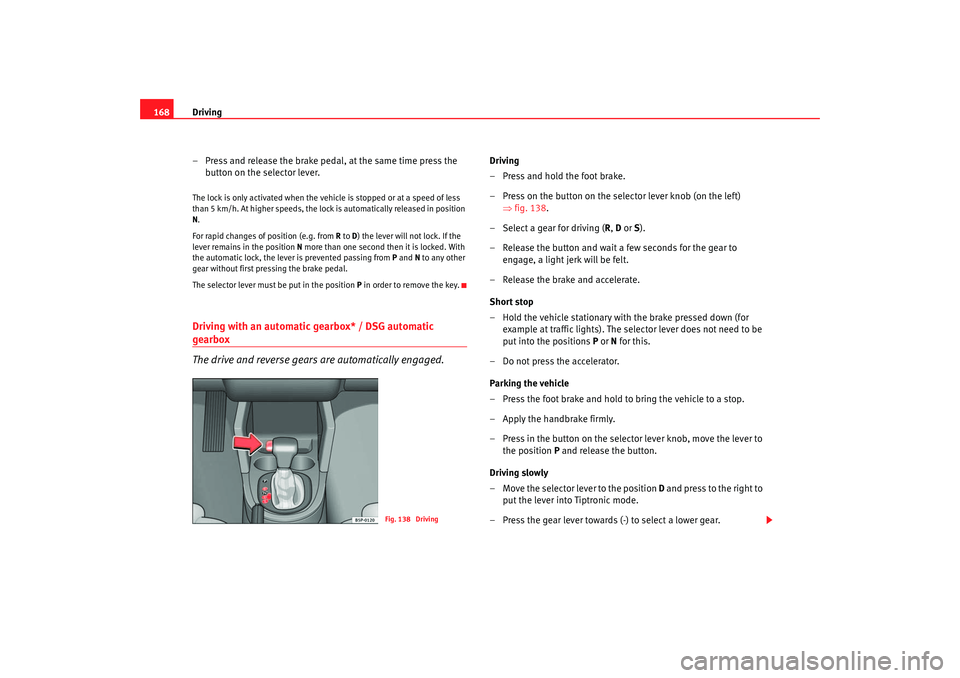
Driving
– Press and hold the foot brake.
– Press on the button on the se lector lever knob (on the left)
⇒ fig. 138.
– Select a gear for driving ( R, D or S).
– Release the button and wait a few seconds for the gear to engage, a light jerk will be felt.
– Release the brake and accelerate.
Short stop
– Hold the vehicle stationary with the brake pressed down (for example at traffic lights). The sele ctor lever does not need to be
put into the positions P or N for this.
– Do not press the accelerator.
Parking the vehicle
– Press the foot brake and hold to bring the vehicle to a stop.
–Apply the handbrake firmly.
– Press in the button on the selector lever knob, move the lever to the position P and release the button.
Driving slowly
– Move the selector lever to the position D and press to the right to
put the lever into Tiptronic mode.
– Press the gear lever towards (-) to select a lower gear.
Fig. 138 Driving
altea_ingles_0706.book Seite 168 Mittwoch, 30. August 2006 3:48 15
Page 171 of 302
Driving169
Safety First
Operating instructions
Tips and Maintenance
Te c h n i c a l D a t a
Hill stop
– Hold the vehicle, in all cases, using the foot brake to prevent
rolling back.
– Do not try to slow the vehicle using another forward gear (engine braking).
Descending gradients
– With the gear engaged, release the brake and accelerate.The steeper the gradient the lower the gear must be for effective engine
braking. For example, if 3rd gear is used on a very steep gradient, the engine
braking is insufficient and vehicle accelerates. So that the engine speed does
not become excessive, the gearbox changes to the next highest gear. Depress
the brake pedal and move the selector lever to the Tiptronic gate to return to
3rd gear.
WARNING
•
The driver should never leave the vehicle while the engine is running or
with any gear selected. If for any reason you must leave the vehicle with the
engine running, apply the handbrake and move the selector lever to posi-
tion P.
•
When the engine is running and the po sitions D, S or R are selected, it
is necessary to hold the vehicle with the foot brake because the vehicle will
creep at a low speed.
•
Never accelerate while changing the position of the selector lever (risk
of an accident).
•
The selector lever must never be mo ved into the positions R or P while
moving (risk of an accident).
•
Before descending a steep gradient, reduce speed and use the Tiptronic
programme to select a lower gear.
•
If you must stop on a hill, always hold the vehicle using the footbrake
to avoid rolling back.
•
The footbrake must not be held for a long period of time, not even
lightly; continuous braking will ca use overheating of the brakes and a
reduction or even a loss of braking power and a significant increase in
braking distances.
•
Never allow the vehicle to coast down a gradient with the selector lever
in positions N or D, even when the engine is not running. For descents, the
use of the Tiptronic programme is recommended to keep the speed
reduced.Caution
•
Never use the automatic gearbox to hold the vehicle stationary on a hill,
even for short periods, as this may overheat the gearbox and cause damage.
Apply the handbrake or depress the foot brake to hold the vehicle in position.
•
If the vehicle is allowed to roll with the engine stopped but the selector in
position N then the gearbox may be damaged because it will not be
lubricated.WARNING (continued)
altea_ingles_0706.book Seite 169 Mittwoch, 30. August 2006 3:48 15
Page 172 of 302
Driving
170Using the Tiptronic gear system
The Tiptronic system allows the driver to manually select
gears
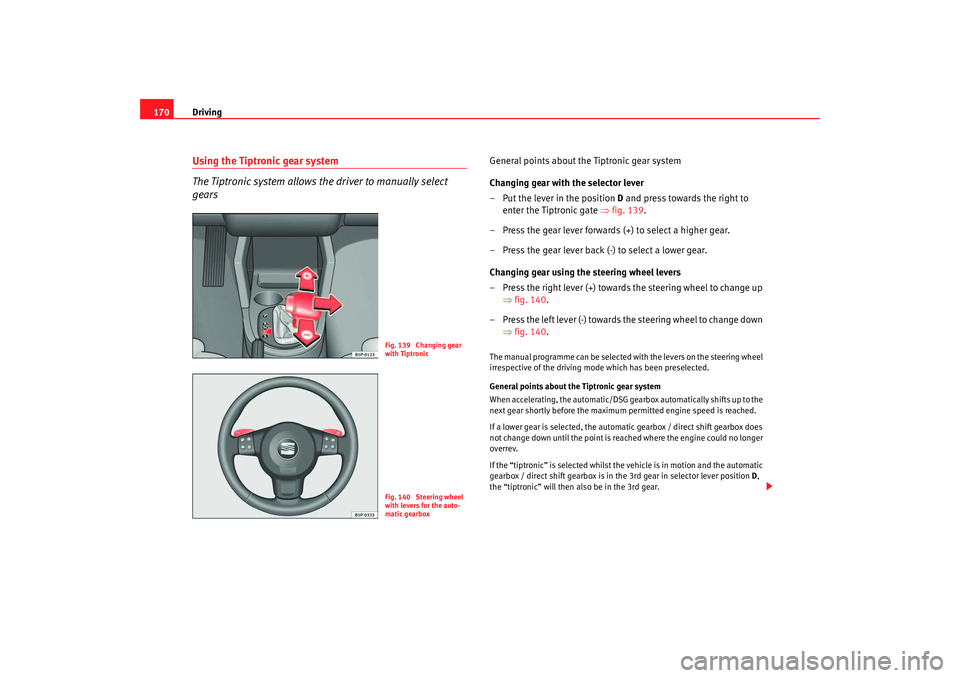
General points about the Tiptronic gear system
Changing gear with the selector lever
– Put the lever in the position D and press towards the right to
enter the Tiptronic gate ⇒fig. 139.
– Press the gear lever forwards (+) to select a higher gear.
– Press the gear lever back (-) to select a lower gear.
Changing gear using the steering wheel levers
– Press the right lever (+) towards the steering wheel to change up ⇒fig. 140.
– Press the left lever (-) towards the steering wheel to change down ⇒fig. 140.The manual programme can be selected wi th the levers on the steering wheel
irrespective of the driving mode which has been preselected.
General points about the Tiptronic gear system
When accelerating, the automatic/DSG gearbox automatically shifts up to the
next gear shortly before the maximu m permitted engine speed is reached.
If a lower gear is selected, the automatic gearbox / direct shift gearbox does
not change down until the point is reached where the engine could no longer
overrev.
If the “tiptronic” is selected whilst the vehicle is in motion and the automatic
gearbox / direct shift gearbox is in the 3rd gear in selector lever position D,
the “tiptronic” will then also be in the 3rd gear.
Fig. 139 Changing gear
with TiptronicFig. 140 Steering wheel
with levers for the auto-
matic gearbox
altea_ingles_0706.book Seite 170 Mittwoch, 30. August 2006 3:48 15
Page 183 of 302
Intelligent technology181
Safety First
Operating instructions
Tips and Maintenance
Te c h n i c a l D a t a
The TCS should be switched on again afterwards as soon as possible.
WARNING
•
It must be remembered that TCS cann
ot defy the laws of physics. This
should be kept in mind, particular ly on slippery and wet roads and when
towing a trailer.
•
Always adapt your driving style to suit the condition of the roads and
the traffic situation. Do not let the extra safety afforded by TCS tempt you
into taking any risks when driving, this can cause accidents.Caution
•
In order to ensure that TCS function correctly, all four wheels must be
fitted with the same tyres. Any differences in the rolling radius of the tyres can
cause the system to reduce engine power when this is not desired.
•
Modifications to the vehicle (e.g. to the engine, the brake system, running
gear or any components affecting the wh eels and tyres) could affect the effi-
ciency of the ABS and TCS.
Electronic stabilisation program (ESP)*General notes
The electronic stabilisation program increases the vehicle's
stability on the road.The electronic stabilisation program helps to reduce the danger of skidding.
The electronic stabilisation programme (ESP) consists of ABS, EDL, TCS and
Steering manoeuvre recommendations. Electronic Stabilising Program (ESP)*
ESP reduces the danger of skidding by braking the wheels individually.
The system uses the steering wheel angle and road speed to calculate the
changes of direction desired by the driver, and constantly compares them
with the actual behaviour of the vehi
cle. If the desired course is not being
maintained (for instance, if the car is starting to skid), then the ESP compen-
sates automatically by braking the appropriate wheel.
The forces acting on the braked wheel bring the vehicle back to a stable
condition. If the vehicle tends to oversteer, the system will act on the front
wheel on the outside of the turn.
Steering manoeuvre recommendations
This is a complementary safety function included in the ESP This function aids
the driver to better stabilize the vehicle in a critical situation. For example, in
case of sudden braking surface with varied adherence, the vehicle will tend
to destabilize its trajectory to the right to or to the left. In this case the ESP
recognizes the situation and helps the driver with a counter steering
manoeuvre from the power steering.
This function simply provides the dr iver with a recommended manoeuvre in
critical situations.
The vehicle doesn't steer itself with this function, the driver has full control of
the vehicle at all times.
WARNING
•
It must be remembered that ESP cann ot defy the laws of physics. This
should be kept in mind, particularly on slippery and wet roads and when
towing a trailer.
•
Always adapt your driving style to suit the condition of the roads and
the traffic situation. Do not let the extra safety afforded by ESP tempt you
into taking any risks when driving, this can cause accidents.
altea_ingles_0706.book Seite 181 Mittwoch, 30. August 2006 3:48 15
Page 186 of 302
Driving and the environment
184Authorised Service Centre more frequently than recommended in the Service
Schedule.
If you drive with wet brakes, for example after driving through water, after
heavy rainfall or after washing the car, the braking effect will be reduced as
the brake discs will be wet, or possibly frozen (in winter): the brakes must be
“dried” through careful braking.
The brake fluid must be changed every two years at the latest. Heavy use of
the brakes may cause a vapour lock if the brake fluid is left in the system for
too long. This prevents the brakes developing their full braking effect.
WARNING
Longer braking distances and faults in the brake system increase the risk
of accidents.•
New brake pads must be run-in and do not have the correct friction
during the first 200 km. However, the reduced braking capacity may be
compensated by pressing on the brake pedal a little harder. This also
applies when new brake pads are fitted.
•
If brakes are wet or frozen, or if you are driving on roads which have
been gritted with salt, braking power may set in later than normal.
•
On steep descents if the brakes are excessively used they will over
heat. Before driving down a long steep gradient, it is advisable to reduce
speed and change to a lower gear (or mo ve the selector lever to a lower gear
if your vehicle has automatic transmission). This makes use of engine
braking and relieves the brakes.
•
Never let the brakes “rub” by applying light pressure. Continuous
braking will cause the brakes to overheat and will increase the braking
distance. Apply and then release the brakes alternately.
•
Never let the vehicle coast with the engine switched off. The braking
distance is increased considerably as the brake servo does not function.
•
Very heavy use of the brakes may cause a vapour lock if the brake fluid
is left in the system for too long. This impairs the braking effect.
•
Non-standard or damaged front spoilers could restrict the airflow to the
brakes and cause them to overheat. Observe the relevant instructions
before purchasing accessories ⇒page 201, “Modifications”.
•
If a brake circuit fails, the braking distance will be increased consider-
ably. Contact a qualified workshop immediately and avoid unnecessary
journeys.
Exhaust gas purification systemCatalytic converter*To conserve the useful life of the catalytic converter
– Always use unleaded petrol.
– Do not run the fuel tank dry.
– For engine oil changes, do not replenish with too much engine oil ⇒page 214, “Topping up engine oil ”.
– Never tow the vehicle to start it, use jump leads if necessary ⇒page 258.If you notice misfiring, uneven running or loss of power when the vehicle is
moving, reduce speed immediately and have the vehicle inspected at the
nearest qualified workshop. In general, the exhaust warning lamp will light
up when any of the described symptoms occur ⇒page 72. If this happens,
unburnt fuel can enter the exhaust system and escape into the environment.
The catalytic converter can also be damaged by overheating.
WARNING (continued)
altea_ingles_0706.book Seite 184 Mittwoch, 30. August 2006 3:48 15