roof Seat Altea 2007 Owner's Guide
[x] Cancel search | Manufacturer: SEAT, Model Year: 2007, Model line: Altea, Model: Seat Altea 2007Pages: 302, PDF Size: 9.17 MB
Page 229 of 302
Checking and refilling levels227
Safety First
Operating instructions
Tips and Maintenance
Te c h n i c a l D a t a
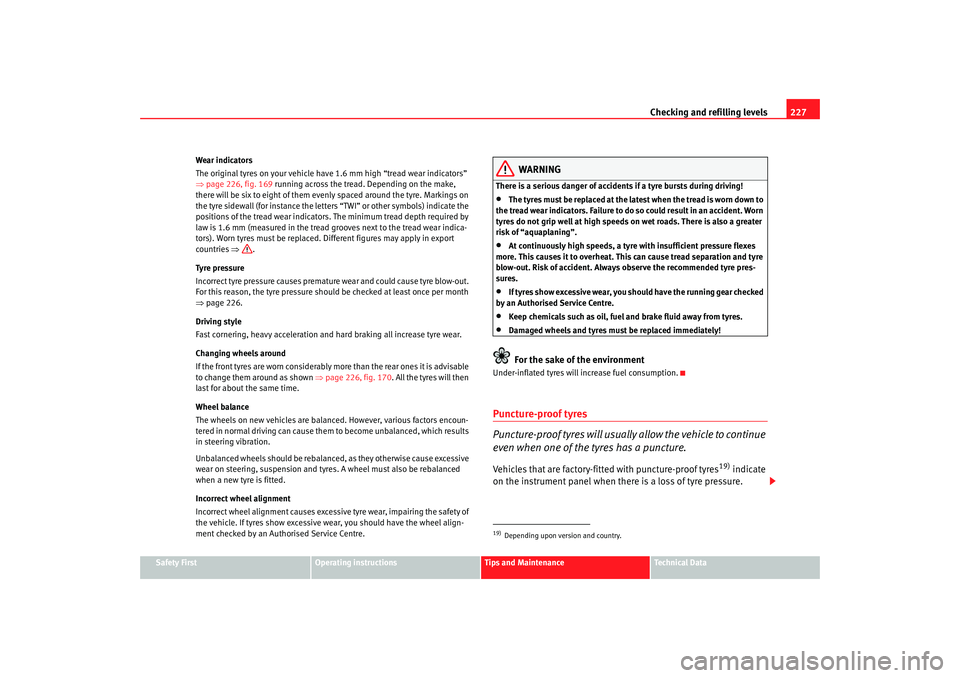
Wear indicators
The original tyres on your vehicle have 1.6 mm high “tread wear indicators”
⇒
page 226, fig. 169 running across the tread. Depending on the make,
there will be six to eight of them evenly spaced around the tyre. Markings on
the tyre sidewall (for instance the letters “TWI” or other symbols) indicate the
positions of the tread wear indicators. The minimum tread depth required by
law is 1.6 mm (measured in the tread grooves next to the tread wear indica-
tors). Worn tyres must be replaced. Different figures may apply in export
countries ⇒.
Tyre pressure
Incorrect tyre pressure causes premature wear and could cause tyre blow-out.
For this reason, the tyre pressure should be checked at least once per month
⇒ page 226.
Driving style
Fast cornering, heavy acceleration and hard braking all increase tyre wear.
Changing wheels around
If the front tyres are worn considerably more than the rear ones it is advisable
to change them around as shown ⇒page 226, fig. 170 . All the tyres will then
last for about the same time.
Wheel balance
The wheels on new vehicles are balanced. However, various factors encoun-
tered in normal driving can cause them to become unbalanced, which results
in steering vibration.
Unbalanced wheels should be rebalanced, as they otherwise cause excessive
wear on steering, suspension and tyres. A wheel must also be rebalanced
when a new tyre is fitted.
Incorrect wheel alignment
Incorrect wheel alignment causes excessive tyre wear, impairing the safety of
the vehicle. If tyres show excessive wear, you should have the wheel align-
ment checked by an Authorised Service Centre.
WARNING
There is a serious danger of accidents if a tyre bursts during driving!•
The tyres must be replaced at the latest when the tread is worn down to
the tread wear indicators. Failure to do so could result in an accident. Worn
tyres do not grip well at high speeds on wet roads. There is also a greater
risk of “aquaplaning”.
•
At continuously high speeds, a tyre with insufficient pressure flexes
more. This causes it to overheat. This can cause tread separation and tyre
blow-out. Risk of accident. Always observe the recommended tyre pres-
sures.
•
If tyres show excessive wear, you should have the running gear checked
by an Authorised Service Centre.
•
Keep chemicals such as oil, fuel and brake fluid away from tyres.
•
Damaged wheels and tyres must be replaced immediately!For the sake of the environment
Under-inflated tyres will increase fuel consumption.Puncture-proof tyres
Puncture-proof tyres will usually allow the vehicle to continue
even when one of the tyres has a puncture.Vehicles that are factory-fitted with puncture-proof tyres
19)
indicate
on the instrument panel when there is a loss of tyre pressure.
19)Depending upon version and country.
altea_ingles_0706.book Seite 227 Mittwoch, 30. August 2006 3:48 15
Page 230 of 302
Checking and refilling levels
228
Driving on puncture-proof tyres (emergency use)
– Ensure that the ESP/TCS is operating (electronic stabilization program) ⇒page 181.
– Drive carefully and at moderate speed (80 km/h maximum).
– Avoid sharp turns and rapid manouevres.
– Avoid driving over obstacles (for example, kerbs) or potholes.
– If the ESP/TCS is frequently activated, check whether there is smoke coming from the tyres or a smell of rubber, or if the vehicle
vibrates or rattles. If this is the case, stop the vehicle.Puncture-proof tyres are marked on the tyre wall as follows: “DSST”,
“Eufonia”, “RFT”, “ROF”, “RSC”, “SSR” or “ZP”.
The tyre walls of this type of tyre are reinforced. When the tyres lose air, the
tyre walls keep the tyre up (emergency use).
Loss of air pressure in the tyre is shown on the instrument panel. The vehicle
may still be driven for at least 80 km and, under ideal conditions (for example,
no load) further.
The faulty tyre should be replaced as soon as possible. The tyre rim should be
checked for damage at a specialised workshop and replaced as necessary.
We recommend you contact your Authorised Service Centre. If more than one
tyre is being used under emergency co nditions, this reduces the distance
which can be travelled.
Starting driving in emergency conditions
When the loss in tyre pressure is displayed on the instrument panel, this
implies that at least one tyre is being driven in emergency conditions ⇒.
End of emergency operation
Do not drive on if:
•
smoke is coming from one of the tyres,
•
there is a smell of rubber,
•
the vehicle vibrates,
•
there is a rattling noise.
WARNING
When driving in emergency conditions, the driving quality of the vehicle is
considerably impaired.•
Drive carefully and at moderate speed (80km/h maximum).
•
Avoid sharp turns and rapid manoeuvres, and brake earlier than usual.
•
Avoid driving over obstacles (for example, kerbs) or potholes.
•
If one or more tyres is being driven in emergency conditions, the driving
quality of the vehicle is impaired and there is a risk of accident.Note
•
Puncture-proof tyres do not “deflate” on losing pressure as they are
supported by the tyre walls. Therefore defects in the tyre can not be deteced
with a visual inspection.
•
Snow chains must not be used on front tyres used in emergency
conditions.
New tyres and wheels
New tyres and wheels have to be run-in.The tyres and wheel rims are an essenti al part of the vehicle's design. The
tyres and rims approved by SEAT are specially matched to the characteristics
of the vehicle and make a major contribution to good road holding and safe
handling ⇒.
altea_ingles_0706.book Seite 228 Mittwoch, 30. August 2006 3:48 15
Page 248 of 302
If and when
246Some of the electrical items listed in the table are only fitted on certain
models or are optional extras.
Please note that the above list, while corr ect at the time of printing, is subject
to alterations. If discrepancies should occur, please refer to the sticker on the
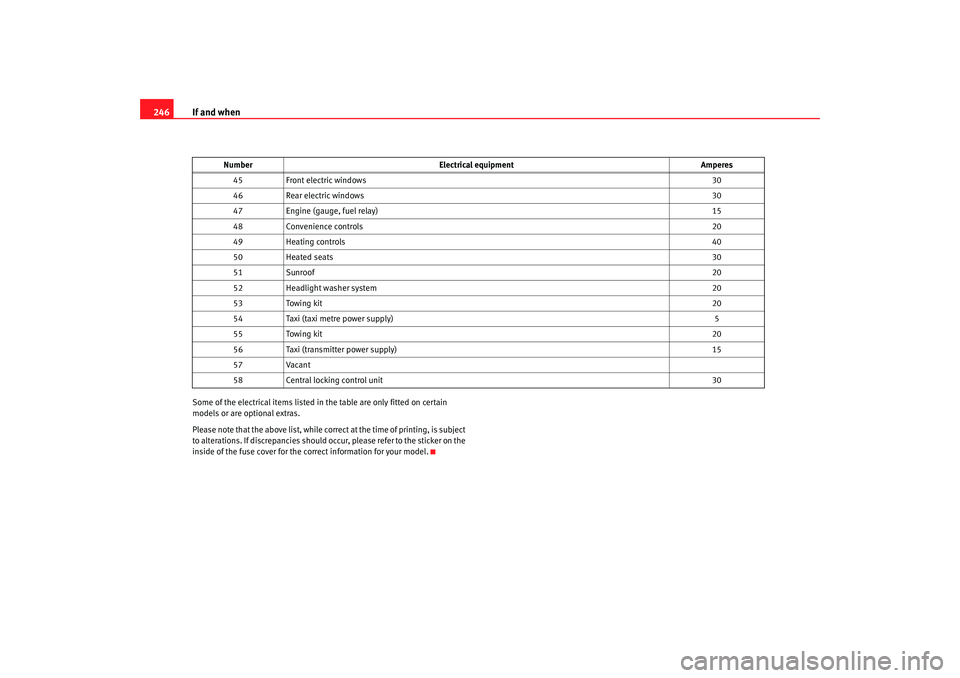
inside of the fuse cover for the correct information for your model. 45
Front electric windows 30
46 Rear electric windows 30
47 Engine (gauge, fuel relay) 15
48 Convenience controls 20
49 Heating controls 40
50 Heated seats 30
51 Sunroof 20
52 Headlight washer system 20
53 Towing kit 20
54 Taxi (taxi metre power supply) 5
55 Towing kit 20
56 Taxi (transmitter power supply) 15
57 Vacant
58 Central locking control unit 30
Number
Electrical equipment Amperes
altea_ingles_0706.book Seite 246 Mittwoch, 30. August 2006 3:48 15
Page 260 of 302
If and when
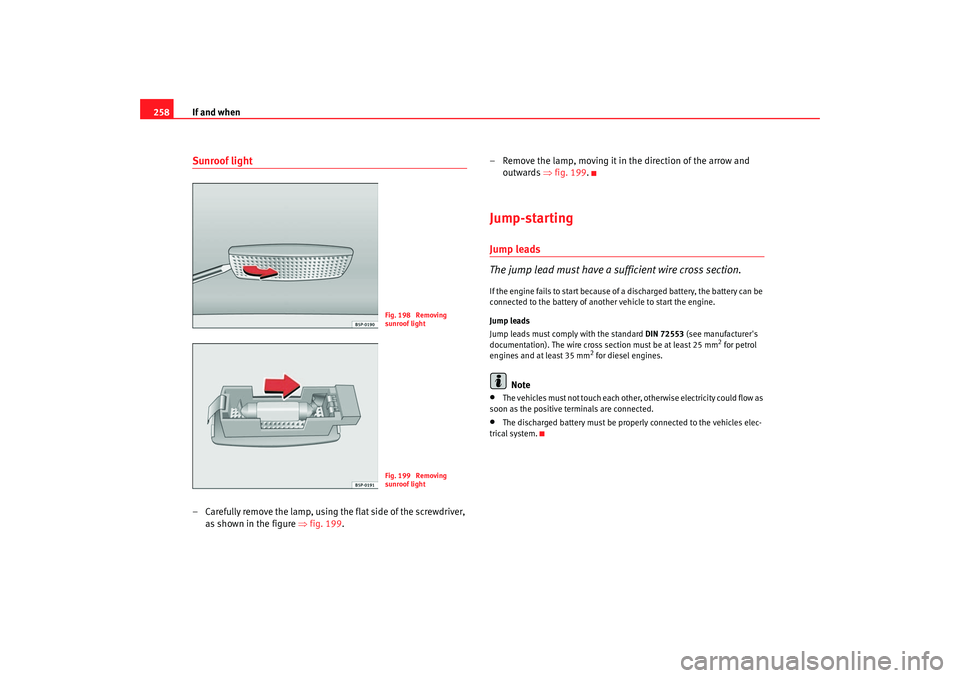
258Sunroof light– Carefully remove the lamp, using the flat side of the screwdriver,
as shown in the figure ⇒fig. 199 . – Remove the lamp, moving it in the direction of the arrow and
outwards ⇒fig. 199 .
Jump-startingJump leads
The jump lead must have a sufficient wire cross section.If the engine fails to start because of a discharged battery, the battery can be
connected to the battery of anot her vehicle to start the engine.
Jump leads
Jump leads must comply with the standard DIN 72553 (see manufacturer's
documentation). The wire cross section must be at least 25 mm
2 for petrol
engines and at least 35 mm
2 for diesel engines.
Note
•
The vehicles must not touch each other, otherwise electricity could flow as
soon as the positive terminals are connected.
•
The discharged battery must be properly connected to the vehicles elec-
trical system.
Fig. 198 Removing
sunroof lightFig. 199 Removing
sunroof light
altea_ingles_0706.book Seite 258 Mittwoch, 30. August 2006 3:48 15
Page 275 of 302
Technical Data273
Safety First
Operating instructions
Tips and Maintenance
Te c h n i c a l D a t a
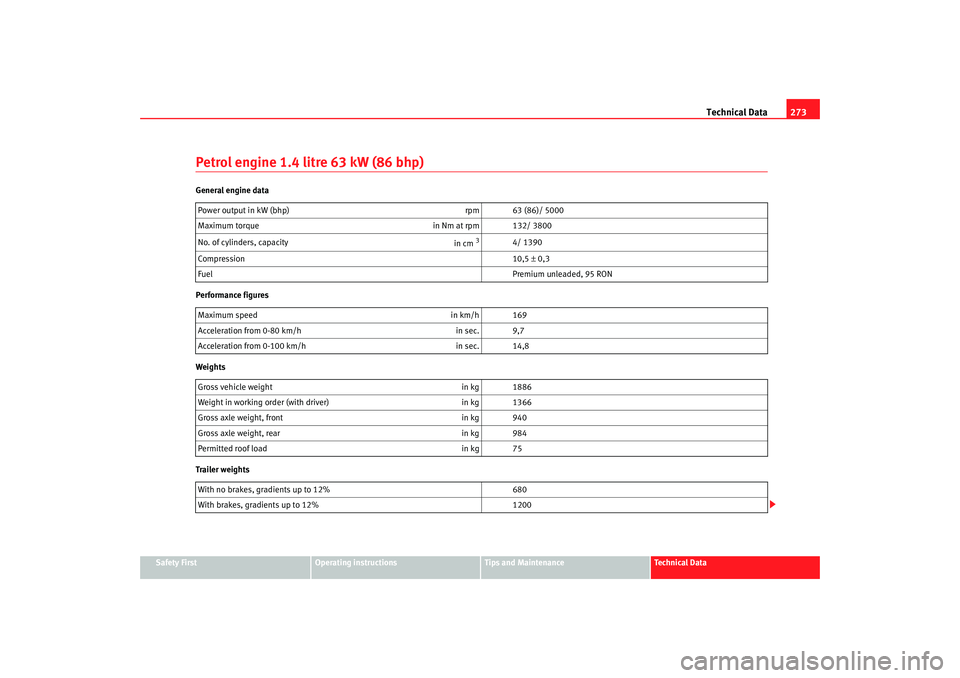
Petrol engine 1.4 litre 63 kW (86 bhp)General engine data
Performance figures
Weights
Trailer weightsPower output in kW (bhp)
rpm 63 (86)/ 5000
Maximum torque in Nm at rpm 132/ 3800
No. of cylinders, capacity in cm
3
4/ 1390
Compression 10,5 ± 0,3
Fuel Premium unleaded, 95 RON
Maximum speed in km/h 169
Acceleration from 0-80 km/h in sec. 9,7
Acceleration from 0-100 km/h in sec. 14,8
Gross vehicle weight in kg 1886
Weight in working order (with driver) in kg 1366
Gross axle weight, front in kg 940
Gross axle weight, rear in kg 984
Permitted roof load in kg 75
With no brakes, gradients up to 12% 680
With brakes, gradients up to 12% 1200
altea_ingles_0706.book Seite 273 Mittwoch, 30. August 2006 3:48 15
Page 276 of 302
Technical Data
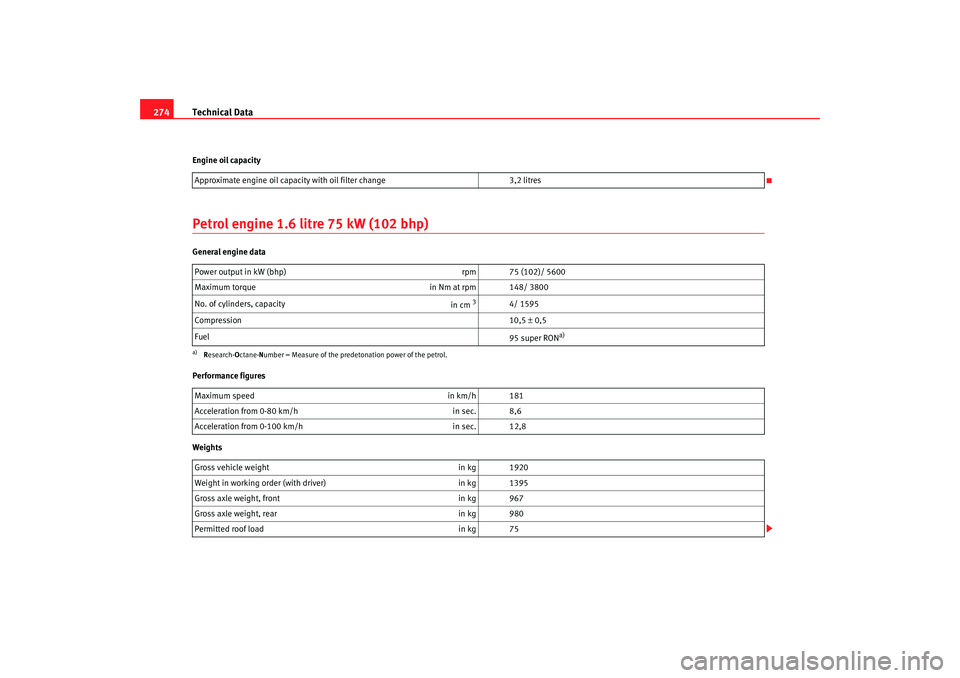
274Engine oil capacityPetrol engine 1.6 litre 75 kW (102 bhp)General engine data
Performance figures
Weights Approximate engine oil capacity with oil filter change
3,2 litres
Power output in kW (bhp) rpm 75 (102)/ 5600
Maximum torque in Nm at rpm 148/ 3800
No. of cylinders, capacity in cm
3
4/ 1595
Compression 10,5 ± 0,5
Fuel 95 super RON
a)
a)Research- Octane- Number = Measure of the predetonation power of the petrol.Maximum speed in km/h 181
Acceleration from 0-80 km/h in sec. 8,6
Acceleration from 0-100 km/h in sec. 12,8
Gross vehicle weight in kg 1920
Weight in working order (with driver) in kg 1395
Gross axle weight, front in kg 967
Gross axle weight, rear in kg 980
Permitted roof load in kg 75
altea_ingles_0706.book Seite 274 Mittwoch, 30. August 2006 3:48 15
Page 278 of 302
Technical Data
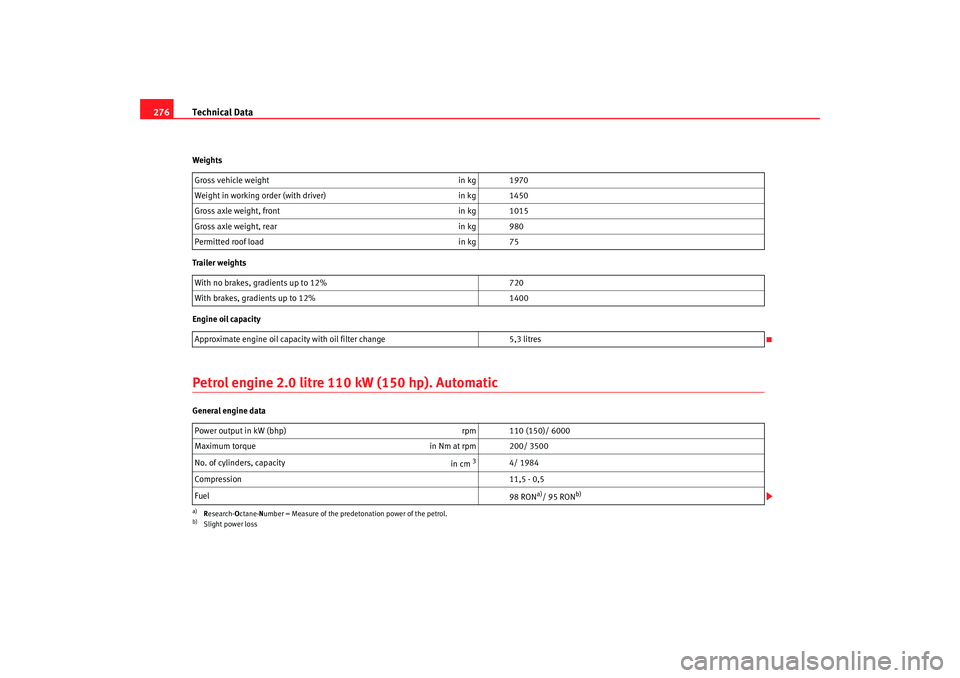
276Weights
Trailer weights
Engine oil capacityPetrol engine 2.0 litre 110 kW (150 hp). AutomaticGeneral engine data Gross vehicle weight
in kg 1970
Weight in working order (with driver) in kg 1450
Gross axle weight, front in kg 1015
Gross axle weight, rear in kg 980
Permitted roof load in kg 75
With no brakes, gradients up to 12% 720
With brakes, gradients up to 12% 1400
Approximate engine oil capacity with oil filter change 5,3 litres
Power output in kW (bhp) rpm 110 (150)/ 6000
Maximum torque in Nm at rpm 200/ 3500
No. of cylinders, capacity in cm
3
4/ 1984
Compression 11,5 - 0,5
Fuel 98 RON
a)/ 95 RON
b)
a)Research- Octane- Number = Measure of the predetonation power of the petrol.b)Slight power loss
altea_ingles_0706.book Seite 276 Mittwoch, 30. August 2006 3:48 15
Page 279 of 302
Technical Data277
Safety First
Operating instructions
Tips and Maintenance
Te c h n i c a l D a t a
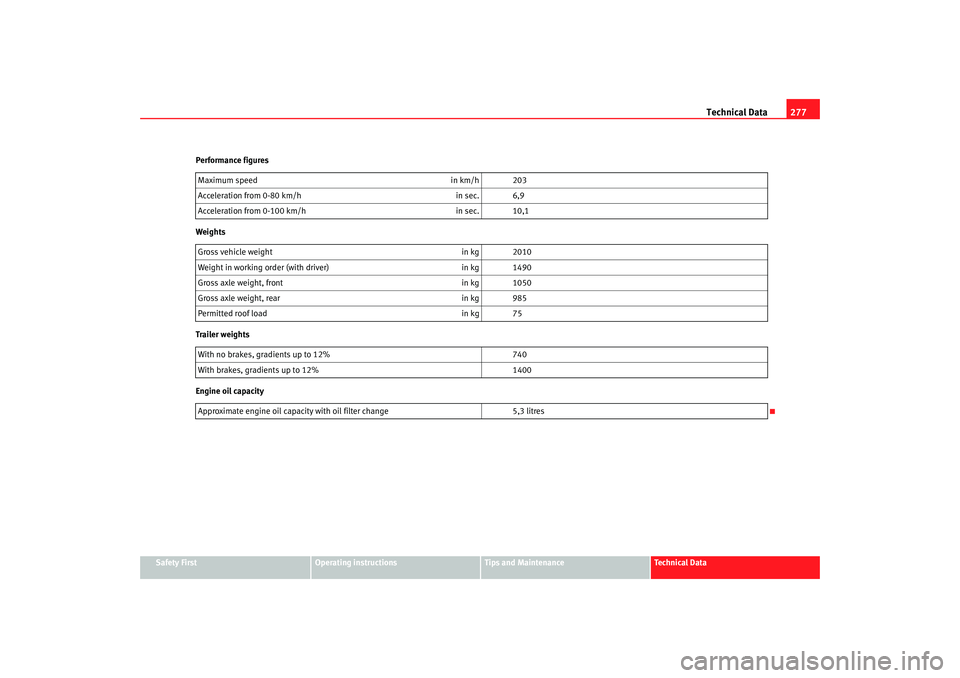
Performance figures
Weights
Trailer weights
Engine oil capacity
Maximum speed
in km/h 203
Acceleration from 0-80 km/h in sec. 6,9
Acceleration from 0-100 km/h in sec. 10,1
Gross vehicle weight in kg 2010
Weight in working order (with driver) in kg 1490
Gross axle weight, front in kg 1050
Gross axle weight, rear in kg 985
Permitted roof load in kg 75
With no brakes, gradients up to 12% 740
With brakes, gradients up to 12% 1400
Approximate engine oil capacity with oil filter change 5,3 litres
altea_ingles_0706.book Seite 277 Mittwoch, 30. August 2006 3:48 15
Page 280 of 302
Technical Data
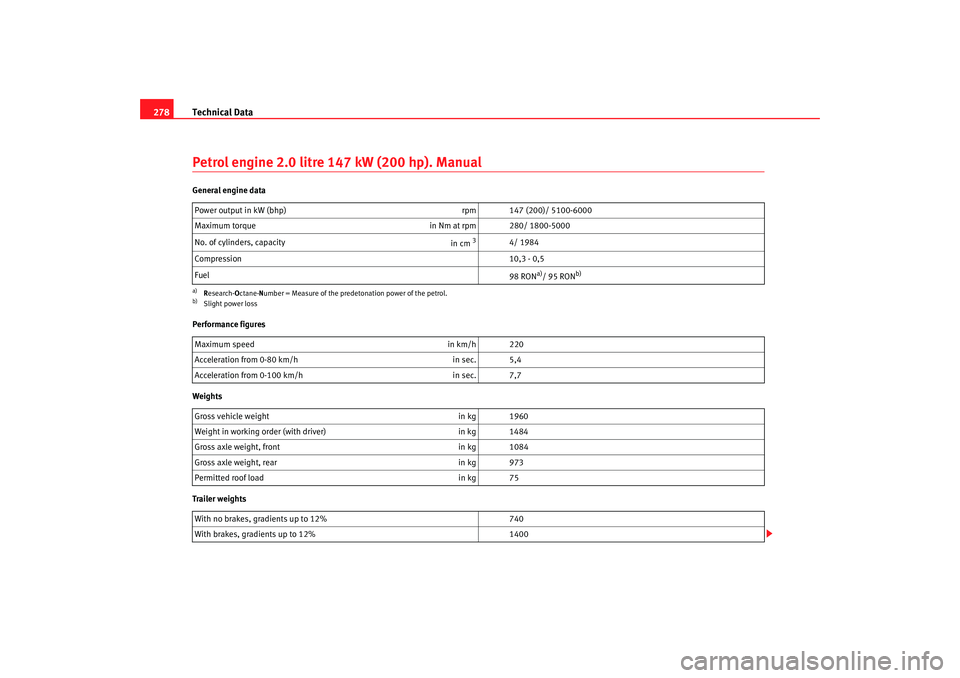
278Petrol engine 2.0 litre 147 kW (200 hp). ManualGeneral engine data
Performance figures
Weights
Trailer weights Power output in kW (bhp)
rpm 147 (200)/ 5100-6000
Maximum torque in Nm at rpm 280/ 1800-5000
No. of cylinders, capacity in cm
3
4/ 1984
Compression 10,3 - 0,5
Fuel 98 RON
a)/ 95 RON
b)
a)Research- Octane- Number = Measure of the predetonation power of the petrol.b)Slight power lossMaximum speed in km/h 220
Acceleration from 0-80 km/h in sec. 5,4
Acceleration from 0-100 km/h in sec. 7,7
Gross vehicle weight in kg 1960
Weight in working order (with driver) in kg 1484
Gross axle weight, front in kg 1084
Gross axle weight, rear in kg 973
Permitted roof load in kg 75
With no brakes, gradients up to 12% 740
With brakes, gradients up to 12% 1400
altea_ingles_0706.book Seite 278 Mittwoch, 30. August 2006 3:48 15
Page 282 of 302
Technical Data
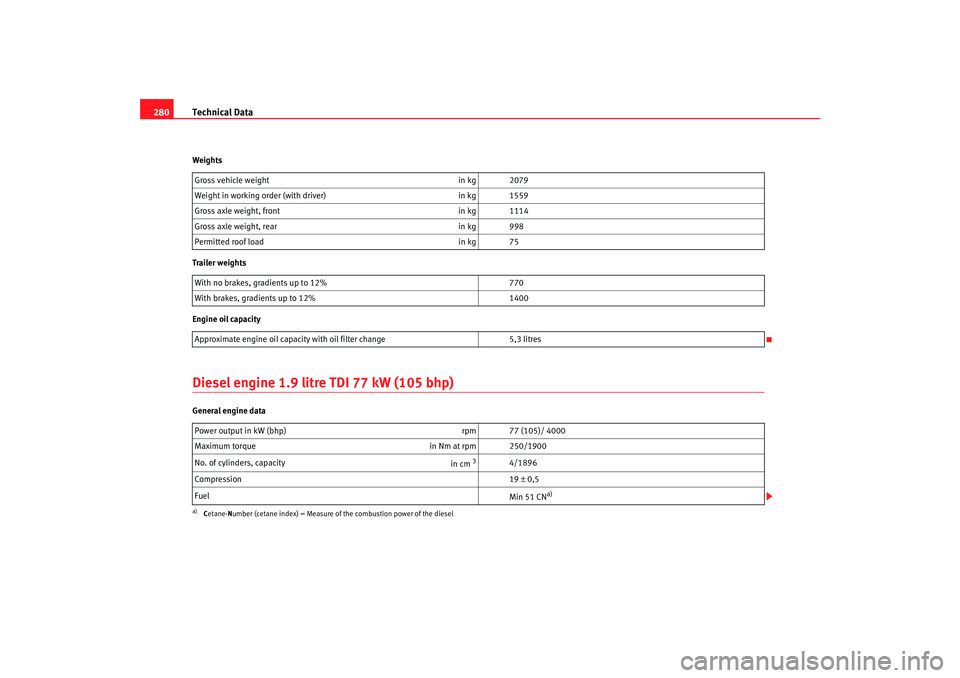
280Weights
Trailer weights
Engine oil capacityDiesel engine 1.9 litre TDI 77 kW (105 bhp)General engine data Gross vehicle weight
in kg 2079
Weight in working order (with driver) in kg 1559
Gross axle weight, front in kg 1114
Gross axle weight, rear in kg 998
Permitted roof load in kg 75
With no brakes, gradients up to 12% 770
With brakes, gradients up to 12% 1400
Approximate engine oil capacity with oil filter change 5,3 litres
Power output in kW (bhp) rpm 77 (105)/ 4000
Maximum torque in Nm at rpm 250/1900
No. of cylinders, capacity in cm
3
4/1896
Compression 19 ± 0,5
Fuel Min 51 CN
a)
a)Cetane- Number (cetane index) = Measure of the combustion power of the diesel
altea_ingles_0706.book Seite 280 Mittwoch, 30. August 2006 3:48 15