lights Seat Altea 2007 Service Manual
[x] Cancel search | Manufacturer: SEAT, Model Year: 2007, Model line: Altea, Model: Seat Altea 2007Pages: 302, PDF Size: 9.17 MB
Page 189 of 302
Driving and the environment187
Safety First
Operating instructions
Tips and Maintenance
Te c h n i c a l D a t a
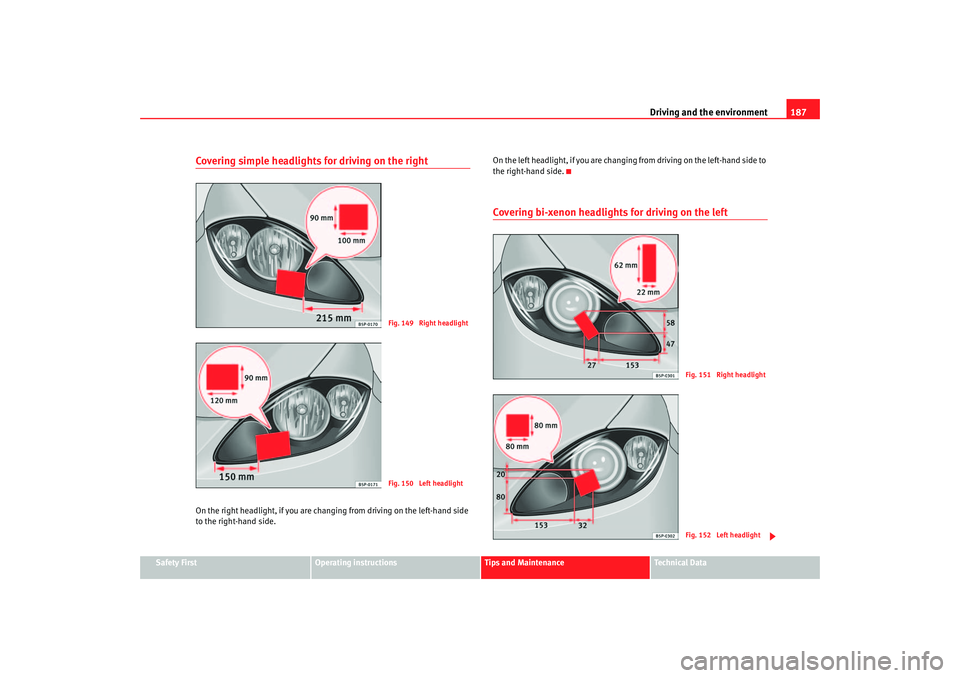
Covering simple headlights for driving on the rightOn the right headlight, if you are changing from driving on the left-hand side
to the right-hand side. On the left headlight, if you are changing from driving on the left-hand side to
the right-hand side.
Covering bi-xenon headlights for driving on the left
Fig. 149 Right headlightFig. 150 Left headlight
Fig. 151 Right headlightFig. 152 Left headlight
altea_ingles_0706.book Seite 187 Mittwoch, 30. August 2006 3:48 15
Page 190 of 302
Driving and the environment
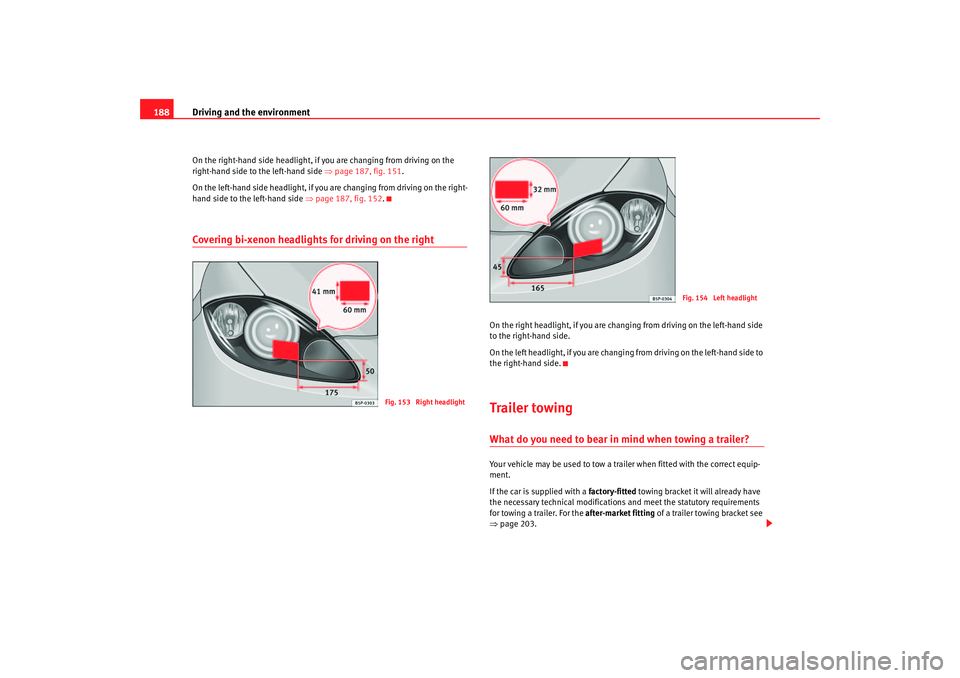
188On the right-hand side headlight, if you are changing from driving on the
right-hand side to the left-hand side ⇒page 187, fig. 151.
On the left -hand side headlight, if you are changing from driving on the right-
hand side to the left-hand side ⇒page 187, fig. 152 .Covering bi-xenon headlights for driving on the right
On the right headlight, if you are changing from driving on the left-hand side
to the right-hand side.
On the left headlight, if you are changi ng from driving on the left-hand side to
the right-hand side.Trailer towingWhat do you need to bear in mind when towing a trailer?Your vehicle may be used to tow a trailer when fitted with the correct equip-
ment.
If the car is supplied with a factory-fitted towing bracket it will already have
the necessary technical modifications and meet the statutory requirements
for towing a trailer. For the after-market fitting of a trailer towing bracket see
⇒ page 203.
Fig. 153 Right headlight
Fig. 154 Left headlight
altea_ingles_0706.book Seite 188 Mittwoch, 30. August 2006 3:48 15
Page 193 of 302
Driving and the environment191
Safety First
Operating instructions
Tips and Maintenance
Te c h n i c a l D a t a
Think ahead when drivingA vehicle uses most fuel when accelera ting. If you think ahead when driving,
you will need to brake less and thus accelerate less. Wherever possible, let
the vehicle roll slowly to a stop, for instance when you can see that the next
traffic lights are red.Regular servicingBy taking your car to an Authorised Service Centre for regular servicing you
can establish a basis for good fuel economy before you start driving. A well-
serviced engine gives you the benefit of improved fuel efficiency as well as
maximum reliability and an enhanced resale value.
A badly serviced engine can consume up to 10% more fuel than necessary.
Check the oil level every time you fill the tank ⇒page 213. Oil consumption
depends to a great extent on the engine load and engine speed. Depending
on your personal driving style, oil consumption can be up to 1 litre per 1,000
km.
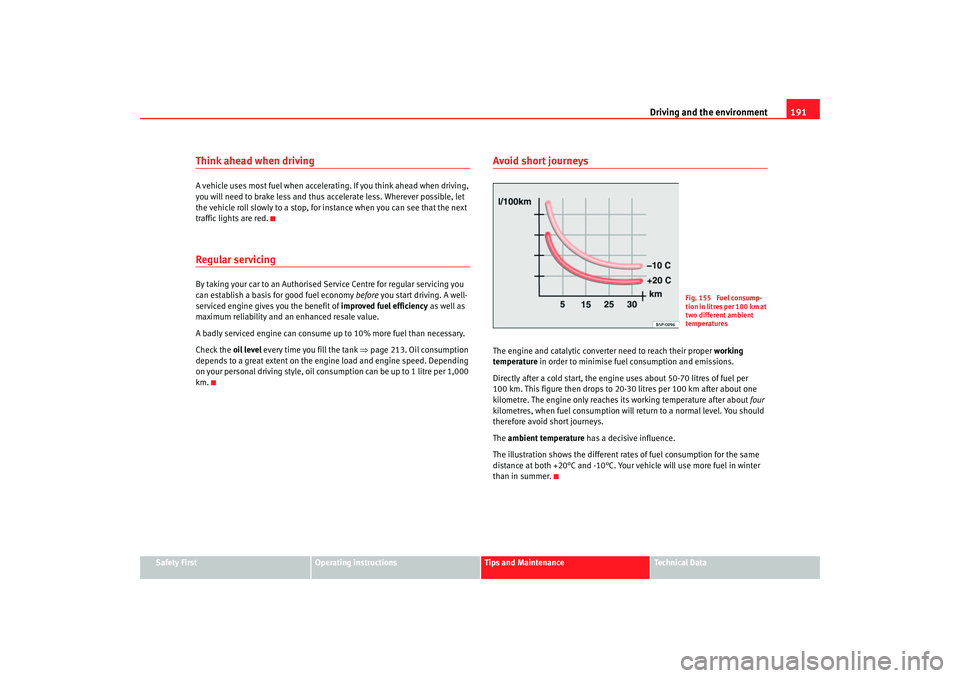
Avoid short journeysThe engine and catalytic converter need to reach their proper working
temperature in order to minimise fuel consumption and emissions.
Directly after a cold start, the engine uses about 50-70 litres of fuel per
100 km. This figure then drops to 20 -30 litres per 100 km after about one
kilometre. The engine only reaches its working temperature after about four
kilometres, when fuel consumption will return to a normal level. You should
therefore avoid short journeys.
The ambient temperature has a decisive influence.
The illustration shows the different rates of fuel consumption for the same
distance at both +20°C and -10°C. Your vehicle will use more fuel in winter
than in summer.
Fig. 155 Fuel consump-
tion in litres per 100 km at
two different ambient
temperatures
altea_ingles_0706.book Seite 191 Mittwoch, 30. August 2006 3:48 15
Page 220 of 302
Checking and refilling levels
218Washer fluid and windscreen wiper bladesTopping up washer fluid
The water for cleaning the windscreen should always be
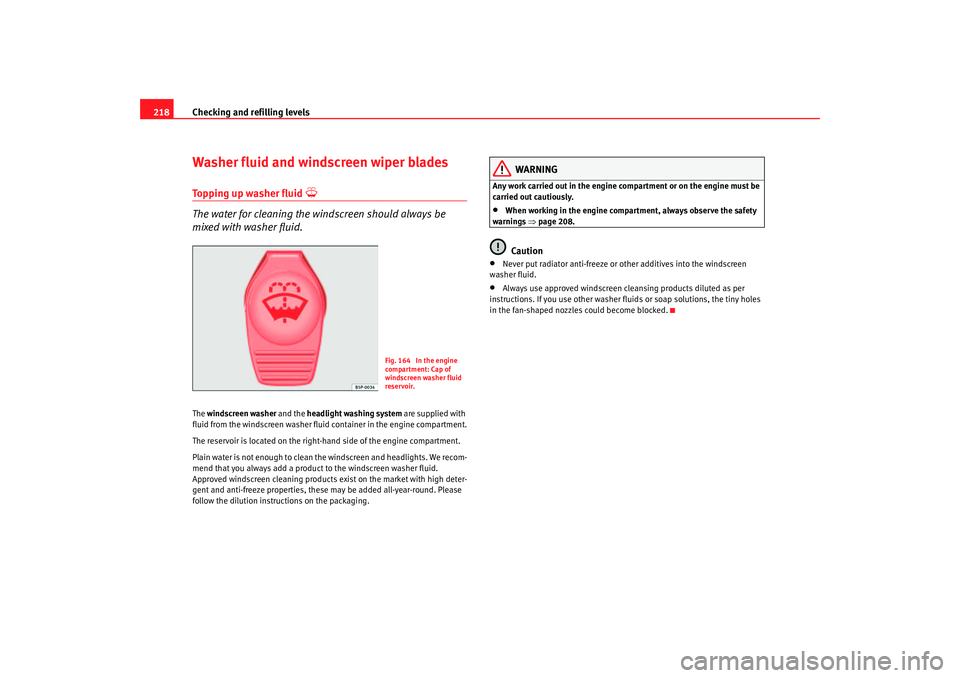
mixed with washer fluid.The windscreen washer and the headlight washing system are supplied with
fluid from the windscreen washer fluid container in the engine compartment.
The reservoir is located on the right-hand side of the engine compartment.
Plain water is not enough to clean th e windscreen and headlights. We recom-
mend that you always add a product to the windscreen washer fluid.
Approved windscreen cleaning products exist on the market with high deter-
gent and anti-freeze properties, thes e may be added all-year-round. Please
follow the dilution instructions on the packaging.
WARNING
Any work carried out in the engine compartment or on the engine must be
carried out cautiously.•
When working in the engine compartment, always observe the safety
warnings ⇒page 208.Caution
•
Never put radiator anti-freeze or other additives into the windscreen
washer fluid.
•
Always use approved windscreen cleansing products diluted as per
instructions. If you use other washer fluids or soap solutions, the tiny holes
in the fan-shaped nozzles could become blocked.
Fig. 164 In the engine
compartment: Cap of
windscreen washer fluid
reservoir.
altea_ingles_0706.book Seite 218 Mittwoch, 30. August 2006 3:48 15
Page 225 of 302
Checking and refilling levels223
Safety First
Operating instructions
Tips and Maintenance
Te c h n i c a l D a t a
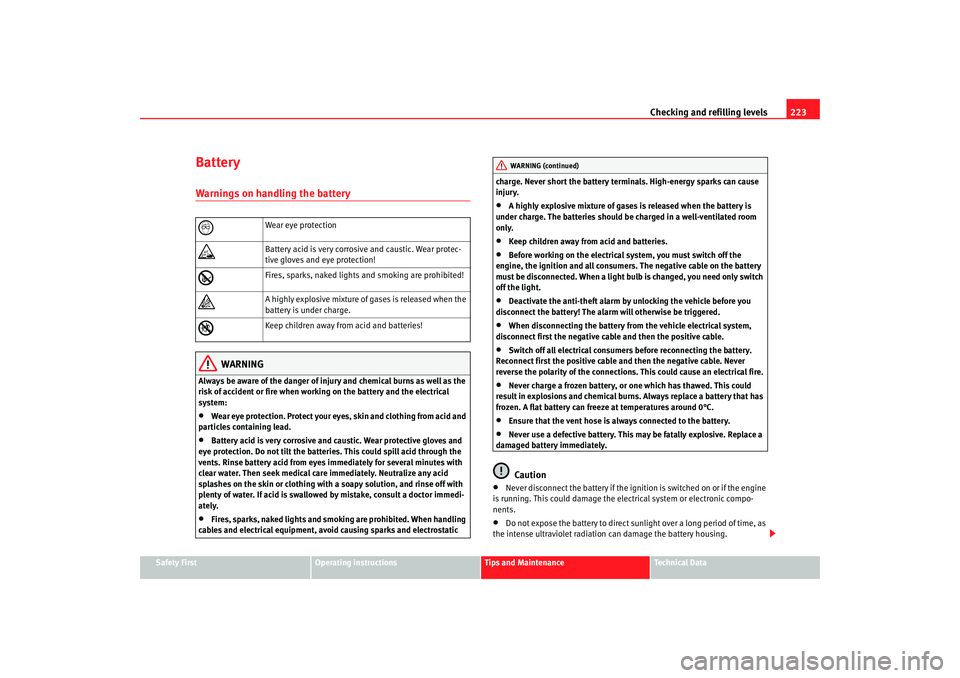
BatteryWarnings on handling the battery
WARNING
Always be aware of the danger of injury and chemical burns as well as the
risk of accident or fire when working on the battery and the electrical
system:•
Wear eye protection. Protect your eyes , skin and clothing from acid and
particles containing lead.
•
Battery acid is very corrosive and caustic. Wear protective gloves and
eye protection. Do not tilt the batteries. This could spill acid through the
vents. Rinse battery acid from eyes immediately for several minutes with
clear water. Then seek medical care immediately. Neutralize any acid
splashes on the skin or clothing with a soapy solution, and rinse off with
plenty of water. If acid is swallowed by mistake, consult a doctor immedi-
ately.
•
Fires, sparks, naked lights and smoking are prohibited. When handling
cables and electrical equipment, avoid causing sparks and electrostatic charge. Never short the battery terminals. High-energy sparks can cause
injury.
•
A highly explosive mixture of gases is released when the battery is
under charge. The batteries should be charged in a well-ventilated room
only.
•
Keep children away from acid and batteries.
•
Before working on the electrical system, you must switch off the
engine, the ignition and all consumers. The negative cable on the battery
must be disconnected. When a light bulb is changed, you need only switch
off the light.
•
Deactivate the anti-theft alarm by unlocking the vehicle before you
disconnect the battery! The alar m will otherwise be triggered.
•
When disconnecting the battery from the vehicle electrical system,
disconnect first the negative ca ble and then the positive cable.
•
Switch off all electrical consumers before reconnecting the battery.
Reconnect first the positive cable and then the negative cable. Never
reverse the polarity of the connections. This could cause an electrical fire.
•
Never charge a frozen battery, or one which has thawed. This could
result in explosions and chemical burns. Always replace a battery that has
frozen. A flat battery can freeze at temperatures around 0°C.
•
Ensure that the vent hose is always connected to the battery.
•
Never use a defective battery. This may be fatally explosive. Replace a
damaged battery immediately.Caution
•
Never disconnect the battery if the ignition is switched on or if the engine
is running. This could damage the electrical system or electronic compo-
nents.
•
Do not expose the battery to direct sunlight over a long period of time, as
the intense ultraviolet radiation can damage the battery housing.
Wear eye protection
Battery acid is very corrosive and caustic. Wear protec-
tive gloves and eye protection!
Fires, sparks, naked lights and smoking are prohibited!
A highly explosive mixture of gases is released when the
battery is under charge.
Keep children away from acid and batteries!
WARNING (continued)
altea_ingles_0706.book Seite 223 Mittwoch, 30. August 2006 3:48 15
Page 236 of 302
If and when
234
Note•
Seek professional assistance if the repair of a tyre puncture is not
possible with the sealing compound.
Wheel changePreparation work
What you must do before changing a wheel.– If you have a flat tyre or puncture, park the vehicle as far away from the flow of traffic as possible. Choose a location that is as
level as possible.
– All passengers should leave the ve hicle. They should wait in a
safe area (for instance behind the roadside crash barrier).
– Switch off the engine. Switch on the hazard warning lights.
–Apply the handbrake firmly.
– Engage the first gear, or put the selector lever to position P for
those vehicles with an automatic gearbox.
– If you are towing a trailer, unhitch it from your vehicle.
– Take the vehicle tools and the spare wheel out of the luggage
compartment.
WARNING
Put the hazard warning lights on and place the warning triangle in position.
This is for your own safety and also warns other road users.
Caution
If you have to change the tyre on a gradient, block the wheel opposite the
wheel being changed by placing a stone or similar object under it to prevent
the vehicle from rolling away.
Note
Please observe legal requirements when doing so.Changing a wheelChange the wheel as described below
–Pull off the hub cap. Also refer to ⇒page 235, fig. 172 .
– Slacken the wheel bolts .
– Raise the car with the jack in the corresponding zone.
– Ta k e o f f the wheel and then put on the spare wheel.
– Lower the vehicle.
– Tighten the wheel bolts firmly in diagonal sequence with the box
spanner.
–Replace the hub cap.
altea_ingles_0706.book Seite 234 Mittwoch, 30. August 2006 3:48 15
Page 243 of 302
If and when241
Safety First
Operating instructions
Tips and Maintenance
Te c h n i c a l D a t a
Note
Seek professional assistance if the repair of a tyre puncture is not possible
with the sealing compound.Preparation work
What you must do before changing a wheel.– If you have a flat tyre or puncture, park the vehicle as far away
from the flow of traffic as possible.
–Apply the handbrake firmly.
–Engage the first gear, or put the selector lever to position P for
those vehicles with an automatic gearbox.
– All passengers must leave the vehicle. They should wait in a safe
area (for instance behind the roadside crash barrier).
– Check whether the puncture can be mended using the Tyre Mobility System “General observations and safety advice”.
– Unscrew cap from the valve of the affected wheel.
–Take the tyre repair kit from the luggage compartment.
WARNING
Put the hazard warning lights on and place the warning triangle in position.
This is for your own safety and also warns other road users.
Caution
Take the utmost caution when repairing a flat tyre on a gradient.
Note
Please observe legal requirements when doing so.Repairing the puncture
To repair the puncture, once the preliminary tasks are done,
follow these steps.Apply the sealant
– The instructions for using the sealant correctly are on the pack-
aging.
Inflate the tyres.
– Remove the compressor and hose.
– Tighten the fastening nut onto the tyre valve.
– Connect the compressor power supply to the 12 Volt socket.
– Connect the compressor and chec k the tyre pressure with the
pressure gauge.
Finish the repair
– Remove the compressor hose from the valve.
– Check the cap on the tyre valve.
– Disconnect the compressor from the vehicle mains.
altea_ingles_0706.book Seite 241 Mittwoch, 30. August 2006 3:48 15
Page 246 of 302
If and when
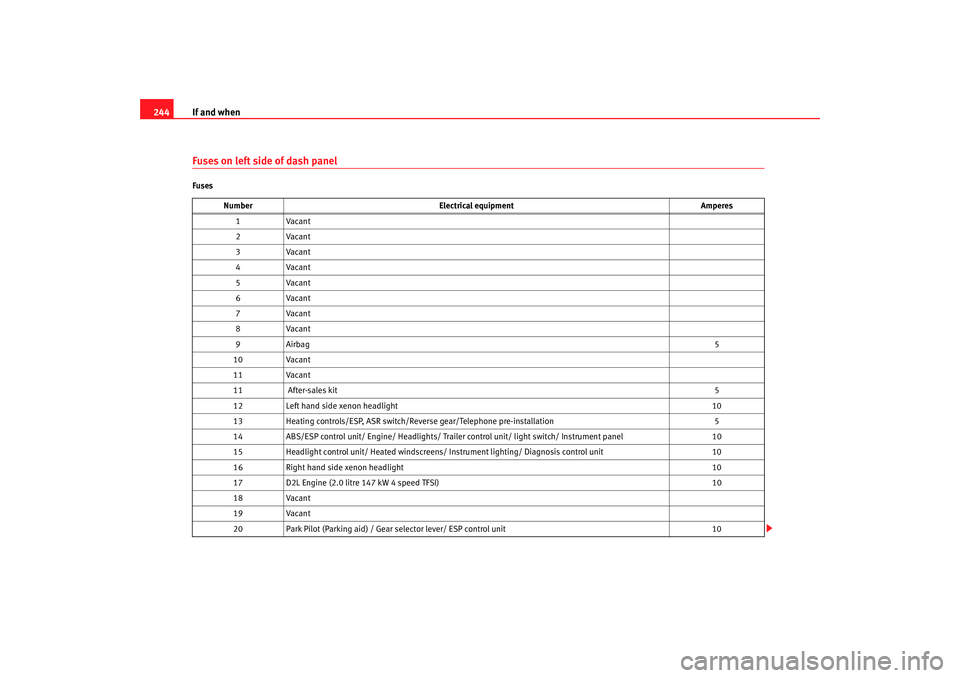
244Fuses on left side of dash panelFuses
Number Electrical equipment Amperes
1V aca n t
2V aca n t
3V aca n t
4V aca n t
5V aca n t
6V aca n t
7V aca n t
8V aca n t
9 Airbag 5
10 Vacant
11 Vacant
11 After-sales kit 5
12 Left hand side xenon headlight 10
13 Heating controls/ESP, ASR switch/Reverse gear/Telephone pre-installation 5
14 ABS/ESP control unit/ Engine/ Headlights/ Trailer control unit/ light switch/ Instrument panel 10
15 Headlight control unit/ Heated windscreens/ Instrument lighting/ Diagnosis control unit 10
16 Right hand side xenon headlight 10
17 D2L Engine (2.0 litre 147 kW 4 speed TFSI) 10
18 Vacant
19 Vacant
20 Park Pilot (Parking aid) / Gear selector lever/ ESP control unit 10
altea_ingles_0706.book Seite 244 Mittwoch, 30. August 2006 3:48 15
Page 251 of 302
If and when249
Safety First
Operating instructions
Tips and Maintenance
Te c h n i c a l D a t a
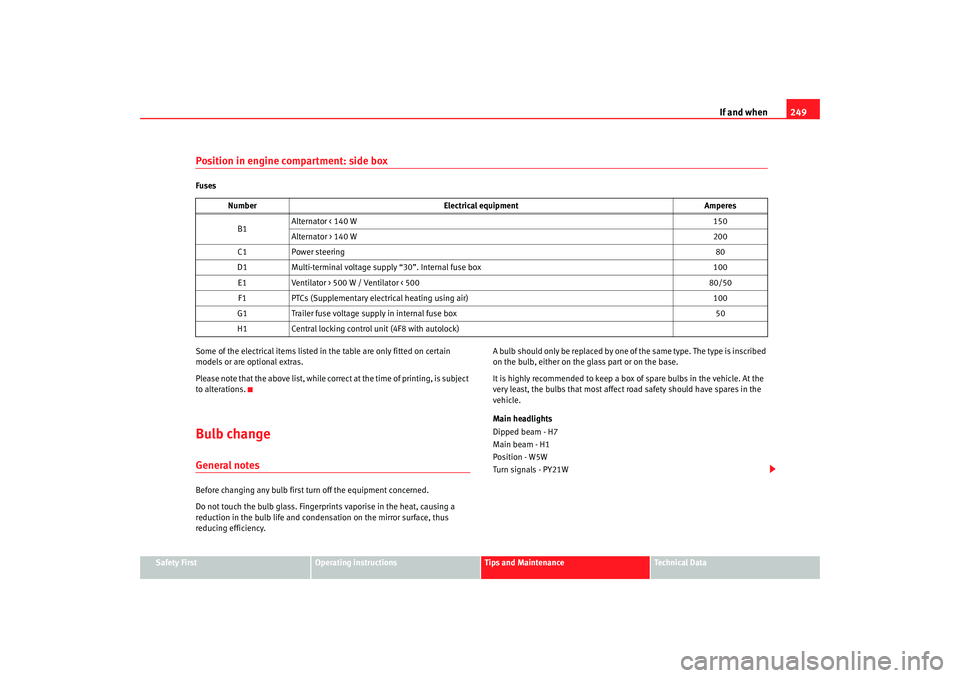
Position in engine compartment: side boxFuses
Some of the electrical items listed in the table are only fitted on certain
models or are optional extras.
Please note that the above list, while correct at the time of printing, is subject
to alterations.Bulb changeGeneral notesBefore changing any bulb first turn off the equipment concerned.
Do not touch the bulb glass. Fingerprints vaporise in the heat, causing a
reduction in the bulb life and condensation on the mirror surface, thus
reducing efficiency. A bulb should only be replaced by one of the same type. The type is inscribed
on the bulb, either on the glass part or on the base.
It is highly recommended to keep a box of spare bulbs in the vehicle. At the
very least, the bulbs that most affect road safety should have spares in the
vehicle.
Main headlights
Dipped beam - H7
Main beam - H1
Position - W5W
Turn signals - PY21W
Number
Electrical equipment Amperes
B1 Alternator < 140 W
150
Alternator > 140 W 200
C1 Power steering 80
D1 Multi-terminal voltage supply “30”. Internal fuse box 100
E1 Ventilator > 500 W / Ventilator < 500 80/50
F1 PTCs (Supplementary electrical heating using air) 100
G1 Trailer fuse voltage supply in internal fuse box 50
H1 Central locking control unit (4F8 with autolock)
altea_ingles_0706.book Seite 249 Mittwoch, 30. August 2006 3:48 15
Page 252 of 302
If and when
250Xenon headlights
20)/directional*
Dipped and full beam - D1S
21)
Light burst and additional full beam - H1
Position W5W
Turn signals PY21W
Fog lights
Fog lights - H3
Upper rear light
Stop/Position - P21W
22)
Turn signals - R10W
Lower rear light
Fog light - P21W
Reverse light - P21W
Indicator
Indicator - W5W
Registration plate light
Registration plate light - C5W
Note
•
Due to the difficulty in accessing the lamps, any replacement work should
be done by a SEAT dealer. However, the following is a description of how to
change the lamps except for the fog lights* and interior lamps.
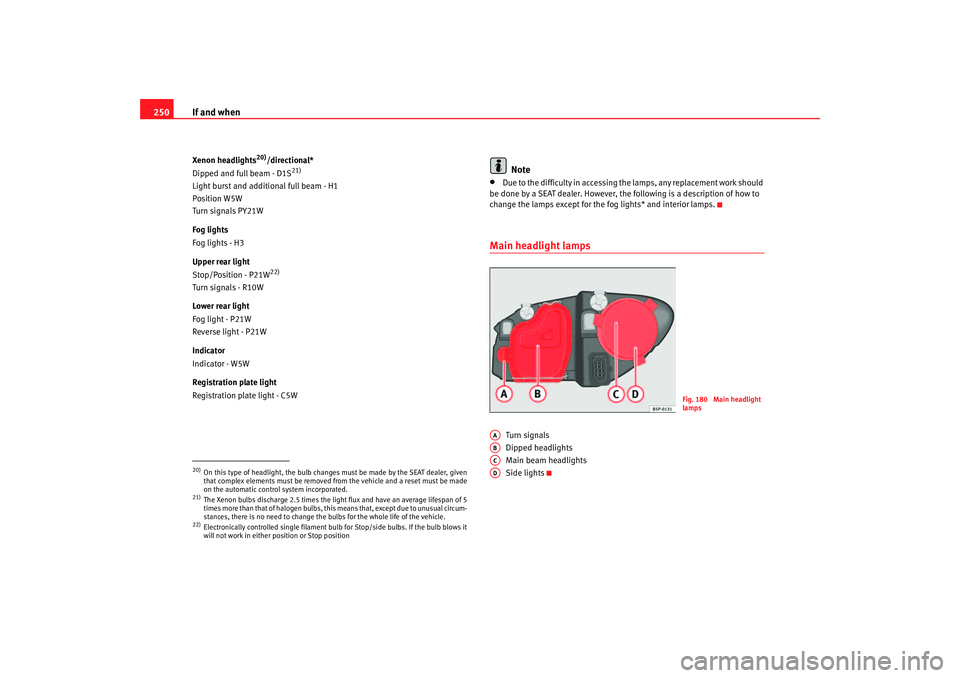
Main headlight lamps
Turn signals
Dipped headlights
Main beam headlights
Side lights
20)On this type of headlight, the bulb changes must be made by the SEAT dealer, given
that complex elements must be removed from the vehicle and a reset must be made
on the automatic control system incorporated.21)The Xenon bulbs discharge 2.5 times the light flux and have an average lifespan of 5
times more than that of halo gen bulbs, this means that, except due to unusual circum-
stances, there is no need to change the bulbs for the whole life of the vehicle.22)Electronically controlled single filament bulb for Stop/side bulbs. If the bulb blows it
will not work in either position or Stop position
Fig. 180 Main headlight
lamps
AAABACAD
altea_ingles_0706.book Seite 250 Mittwoch, 30. August 2006 3:48 15