lights Seat Altea 2007 Workshop Manual
[x] Cancel search | Manufacturer: SEAT, Model Year: 2007, Model line: Altea, Model: Seat Altea 2007Pages: 302, PDF Size: 9.17 MB
Page 253 of 302
If and when251
Safety First
Operating instructions
Tips and Maintenance
Te c h n i c a l D a t a
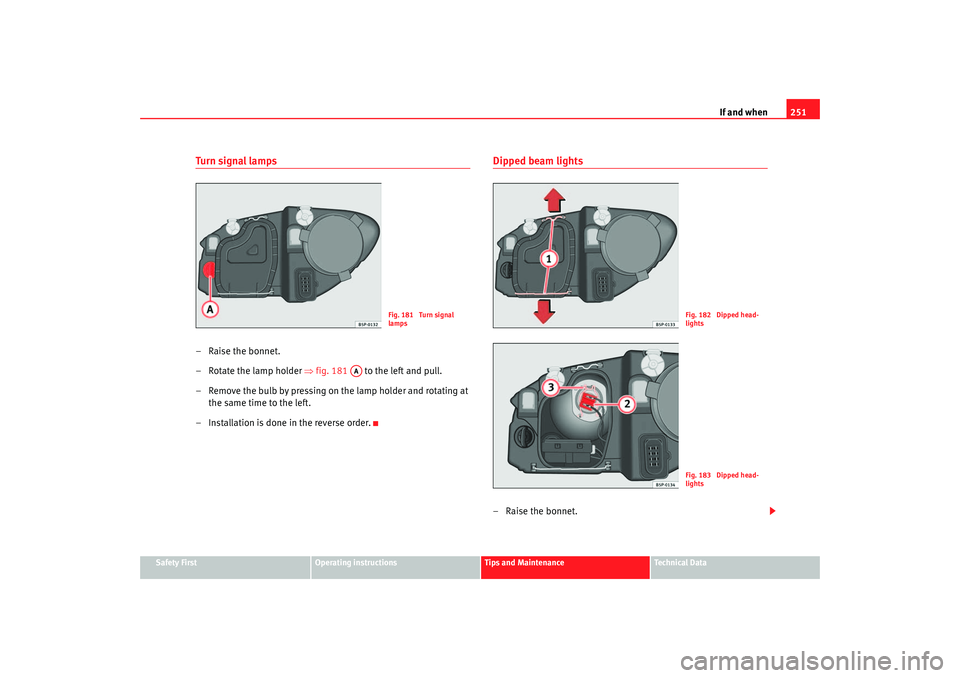
Turn signal lamps–Raise the bonnet.
– Rotate the lamp holder ⇒fig. 181 to the left and pull.
– Remove the bulb by pressing on the lamp holder and rotating at the same time to the left.
– Installation is done in the reverse order.
Dipped beam lights– Raise the bonnet.
Fig. 181 Turn signal
lamps
AA
Fig. 182 Dipped head-
lightsFig. 183 Dipped head-
lights
altea_ingles_0706.book Seite 251 Mittwoch, 30. August 2006 3:48 15
Page 254 of 302
If and when
252
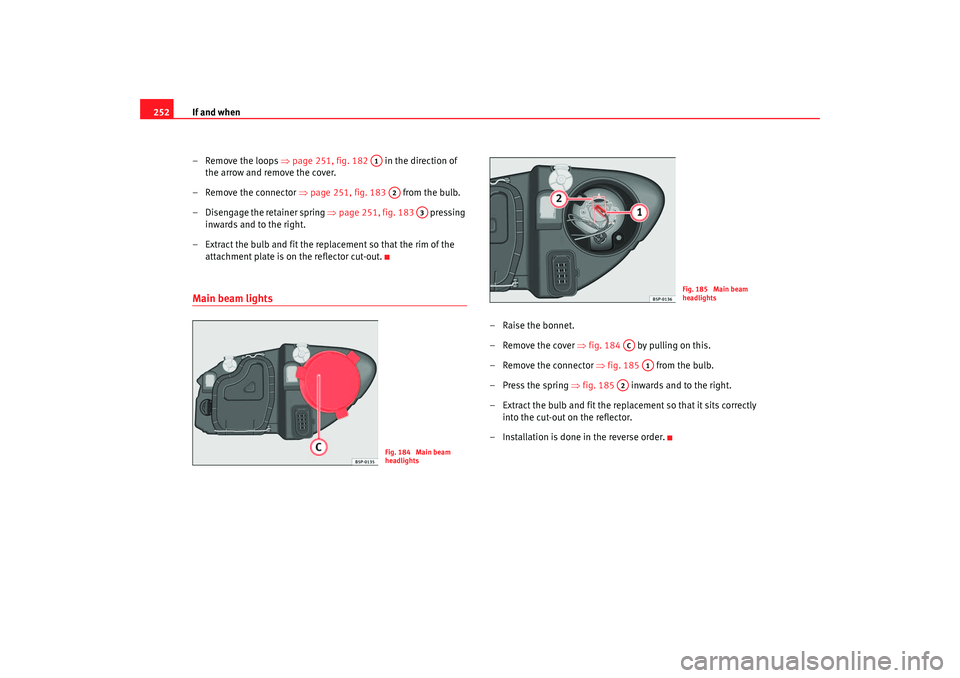
– Remove the loops ⇒page 251, fig. 182 in the direction of
the arrow and remove the cover.
– Remove the connector ⇒page 251, fig. 183 from the bulb.
– Disengage the retainer spring ⇒ page 251, fig. 183 pressing
inwards and to the right.
– Extract the bulb and fit the replacement so that the rim of the attachment plate is on the reflector cut-out.Main beam lights
–Raise the bonnet.
– Remove the cover ⇒fig. 184 by pulling on this.
– Remove the connector ⇒fig. 185 from the bulb.
– Press the spring ⇒fig. 185 inwards and to the right.
– Extract the bulb and fit the replacement so that it sits correctly into the cut-out on the reflector.
– Installation is done in the reverse order.
A1
A2
A3
Fig. 184 Main beam
headlights
Fig. 185 Main beam
headlights
AC
A1
A2
altea_ingles_0706.book Seite 252 Mittwoch, 30. August 2006 3:48 15
Page 255 of 302
If and when253
Safety First
Operating instructions
Tips and Maintenance
Te c h n i c a l D a t a
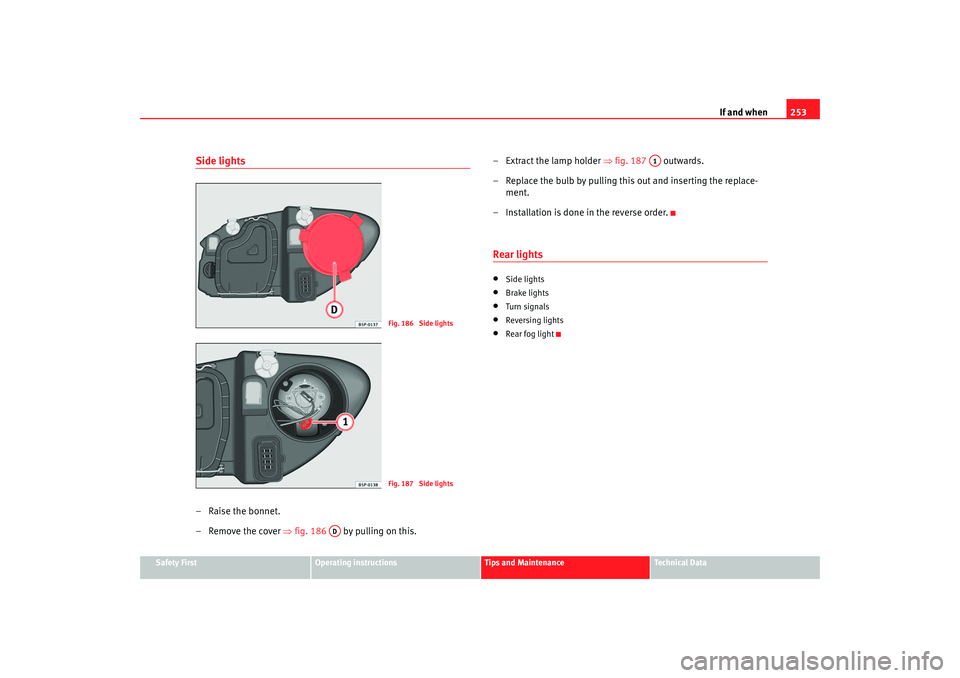
Side lights–Raise the bonnet.
– Remove the cover ⇒fig. 186 by pulling on this. – Extract the lamp holder
⇒fig. 187 outwards.
– Replace the bulb by pulling this out and inserting the replace- ment.
– Installation is done in the reverse order.
Rear lights•
Side lights
•
Brake lights
•
Turn signals
•
Reversing lights
•
Rear fog light
Fig. 186 Side lightsFig. 187 Side lights
AD
A1
altea_ingles_0706.book Seite 253 Mittwoch, 30. August 2006 3:48 15
Page 256 of 302
If and when
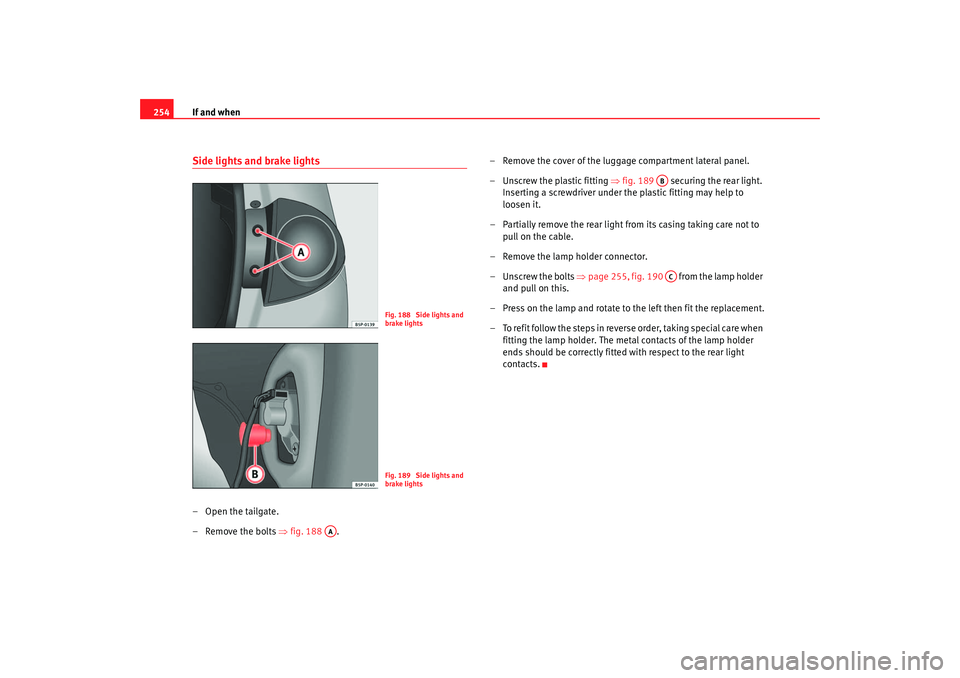
254Side lights and brake lights– Open the tailgate.
– Remove the bolts ⇒fig. 188 . – Remove the cover of the luggage compartment lateral panel.
– Unscrew the plastic fitting
⇒fig. 189 securing the rear light.
Inserting a screwdriver under the plastic fitting may help to
loosen it.
– Partially remove the rear light from its casing taking care not to pull on the cable.
– Remove the lamp holder connector.
– Unscrew the bolts ⇒page 255, fig. 190 from the lamp holder
and pull on this.
– Press on the lamp and rotate to the left then fit the replacement.
– To refit follow the steps in reverse order, taking special care when fitting the lamp holder. The metal contacts of the lamp holder
ends should be correctly fitted with respect to the rear light
contacts.
Fig. 188 Side lights and
brake lightsFig. 189 Side lights and
brake lights
AA
ABAC
altea_ingles_0706.book Seite 254 Mittwoch, 30. August 2006 3:48 15
Page 257 of 302
If and when255
Safety First
Operating instructions
Tips and Maintenance
Te c h n i c a l D a t a
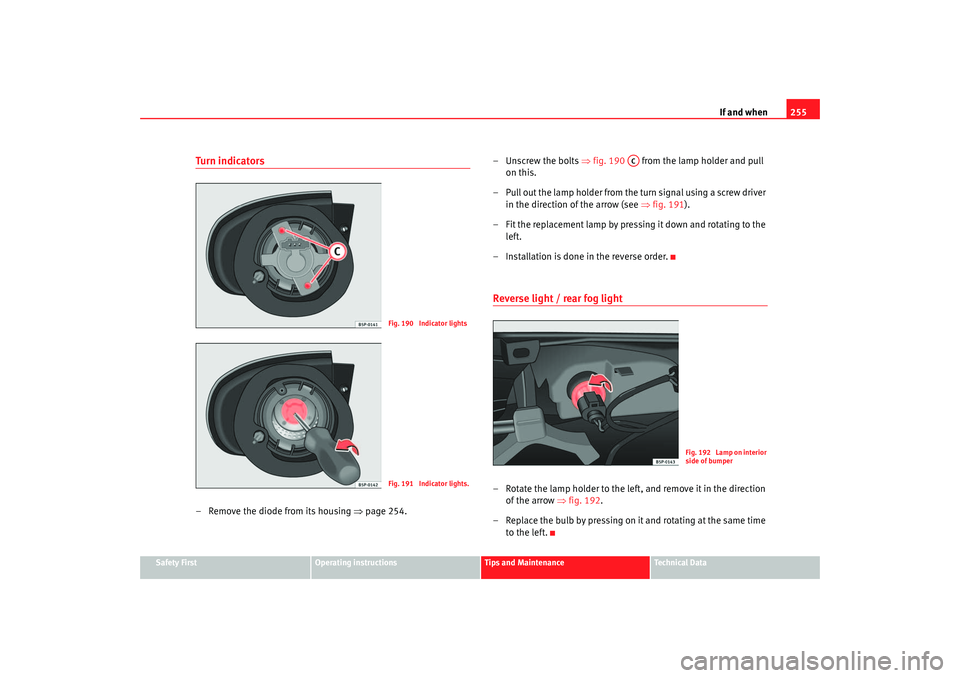
Turn indi cato rs– Remove the diode from its housing ⇒page 254. – Unscrew the bolts
⇒fig. 190 from the lamp holder and pull
on this.
– Pull out the lamp holder from the turn signal using a screw driver in the direction of the arrow (see ⇒fig. 191 ).
– Fit the replacement lamp by pressing it down and rotating to the left.
– Installation is done in the reverse order.
Reverse light / rear fog light– Rotate the lamp holder to the left, and remove it in the direction of the arrow ⇒fig. 192.
– Replace the bulb by pressing on it and rotating at the same time
to the left.
Fig. 190 Indicator lightsFig. 191 Indicator lights.
AC
Fig. 192 Lamp on interior
side of bumper
altea_ingles_0706.book Seite 255 Mittwoch, 30. August 2006 3:48 15
Page 258 of 302
If and when
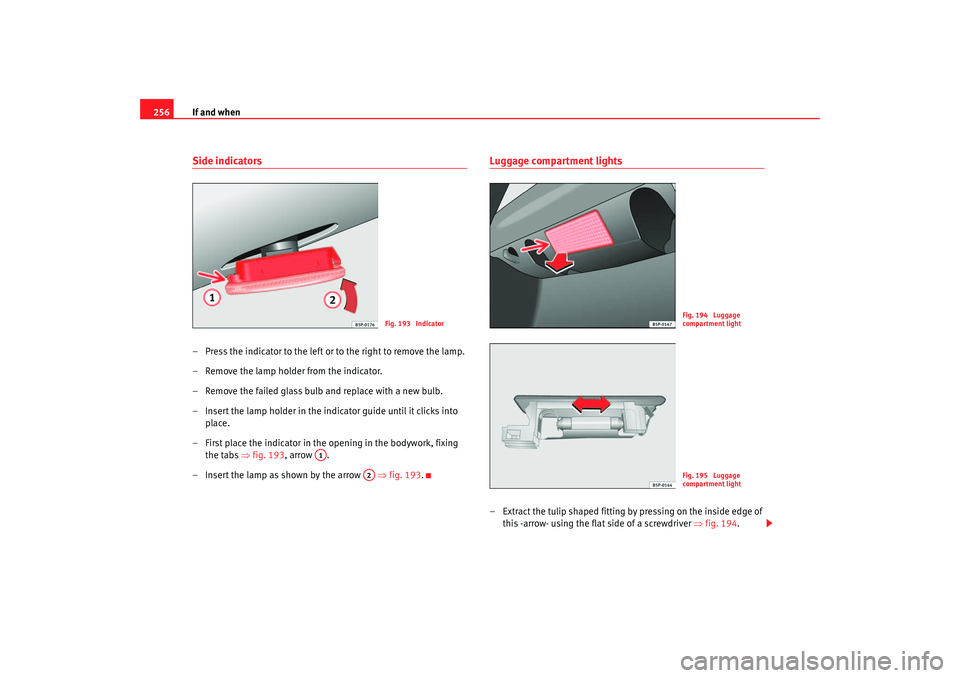
256Side indicators– Press the indicator to the left or to the right to remove the lamp.
– Remove the lamp holder from the indicator.
– Remove the failed glass bulb and replace with a new bulb.
– Insert the lamp holder in the indicator guide until it clicks into
place.
– First place the indicator in the opening in the bodywork, fixing the tabs ⇒fig. 193 , arrow .
– Insert the lamp as shown by the arrow ⇒fig. 193 .
Luggage compartment lights– Extract the tulip shaped fitting by pressing on the inside edge of
this -arrow- using the flat side of a screwdriver ⇒fig. 194.
Fig. 193 Indicator
A1
A2
Fig. 194 Luggage
compartment lightFig. 195 Luggage
compartment light
altea_ingles_0706.book Seite 256 Mittwoch, 30. August 2006 3:48 15
Page 261 of 302
If and when259
Safety First
Operating instructions
Tips and Maintenance
Te c h n i c a l D a t a
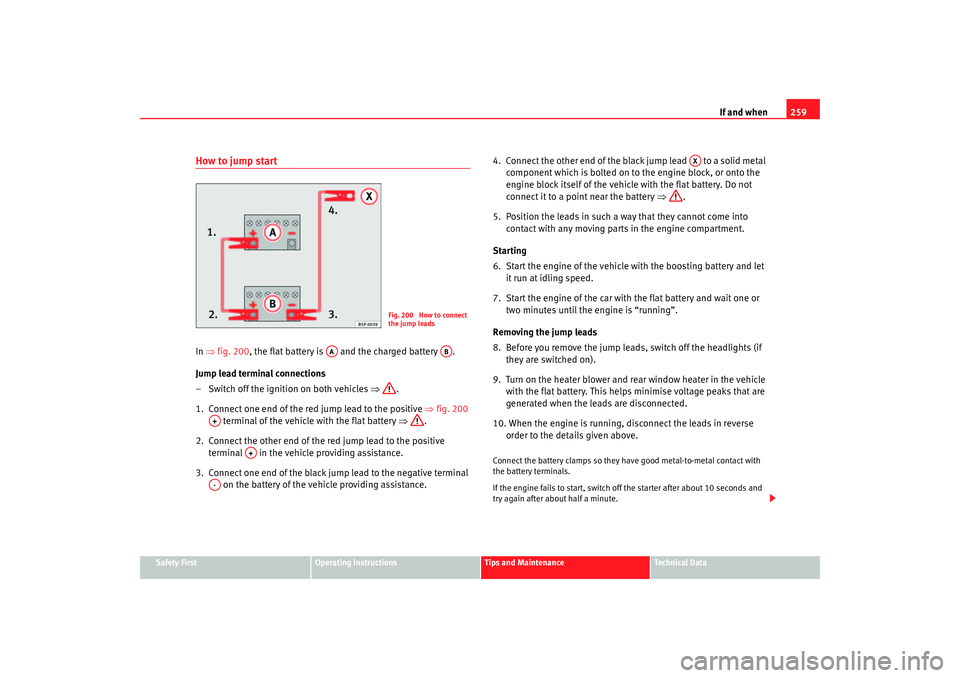
How to jump startIn ⇒ fig. 200, the flat battery is and the charged battery .
Jump lead terminal connections
– Switch off the ignition on both vehicles ⇒.
1. Connect one end of the red jump lead to the positive ⇒fig. 200
terminal of the vehicle with the flat battery ⇒.
2. Connect the other end of the red jump lead to the positive terminal in the vehicle providing assistance.
3. Connect one end of the black jump lead to the negative terminal on the battery of the vehicle providing assistance. 4. Connect the other end of the black jump lead to a solid metal
component which is bolted on to the engine block, or onto the
engine block itself of the vehicle with the flat battery. Do not
connect it to a point near the battery ⇒.
5. Position the leads in such a way that they cannot come into contact with any moving parts in the engine compartment.
Starting
6. Start the engine of the vehicle with the boosting battery and let
it run at idling speed.
7. Start the engine of the car with the flat battery and wait one or two minutes until the engine is “running”.
Removing the jump leads
8. Before you remove the jump leads, switch off the headlights (if they are switched on).
9. Turn on the heater blower and rear window heater in the vehicle with the flat battery. This helps minimise voltage peaks that are
generated when the leads are disconnected.
10. When the engine is running, disconnect the leads in reverse order to the details given above.
Connect the battery clamps so they ha ve good metal-to-metal contact with
the battery terminals.
If the engine fails to start, switch off the starter after about 10 seconds and
try again after about half a minute.
Fig. 200 How to connect
the jump leads
AA
AB
A+
A+
A-
AX
altea_ingles_0706.book Seite 259 Mittwoch, 30. August 2006 3:48 15
Page 264 of 302
If and when
262
Notes for the driver of the towing vehicle
– Drive slowly at first until the to w-rope is taut. Then accelerate
gradually.
– Begin and change gears cautiously. If you are driving an auto- matic vehicle, accelerate gently.
– Remember that the brake servo and power steering are not working in the vehicle you are towing. Brake earlier than you
would normally, but with a more gentle pressure on the brake.
Notes for the driver of the towed vehicle
– Ensure that the tow-rope remains taut at all times when towing.
Fitting the towing eye
– Take the towing ring from the onboard tools.
– Pull the lower front cover down and leave the cover hanging on the vehicle.
– Remove the cover of the screw hole, insert a screwdriver into the lower slot and lever gently.
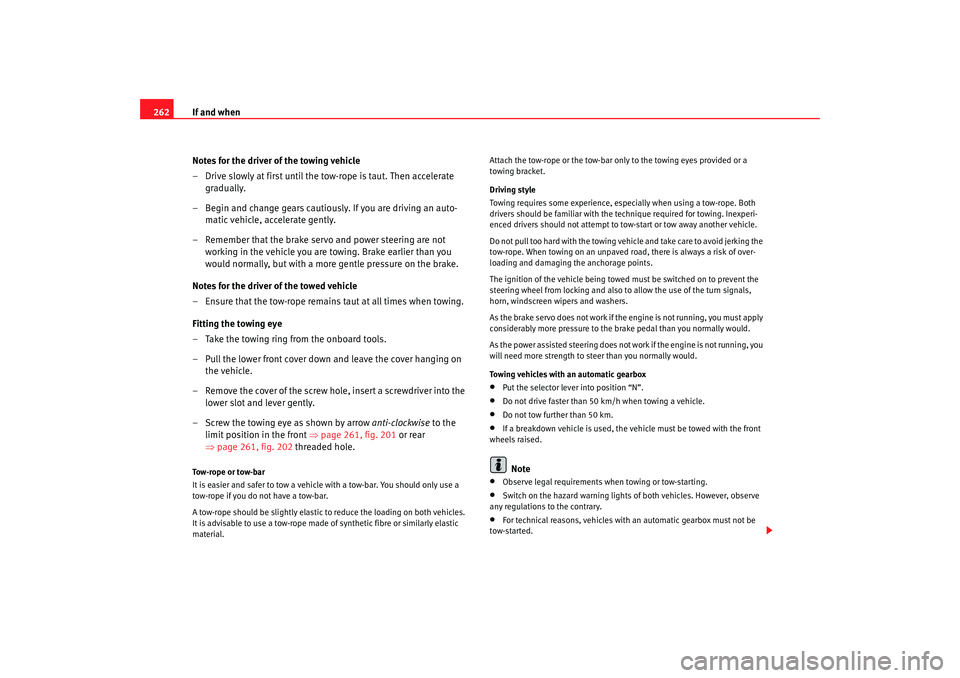
– Screw the towing eye as shown by arrow anti-clockwise to the
limit position in the front ⇒page 261, fig. 201 or rear
⇒ page 261, fig. 202 threaded hole.Tow-rope or tow-bar
It is easier and safer to tow a vehicle with a tow-bar. You should only use a
tow-rope if you do not have a tow-bar.
A tow-rope should be slightly elastic to reduce the loading on both vehicles.
It is advisable to use a tow-rope made of synthetic fibre or similarly elastic
material. Attach the tow-rope or the tow-bar only to the towing eyes provided or a
towing bracket.
Driving style
Towing requires some experience, espec
ially when using a tow-rope. Both
drivers should be familiar with the te chnique required for towing. Inexperi-
enced drivers should not attempt to tow-start or tow away another vehicle.
Do not pull too hard with the towing vehicle and take care to avoid jerking the
tow-rope. When towing on an unpaved road, there is always a risk of over-
loading and damaging the anchorage points.
The ignition of the vehicle being towed must be switched on to prevent the
steering wheel from locking and also to allow the use of the turn signals,
horn, windscreen wipers and washers.
As the brake servo does not work if the engine is not running, you must apply
considerably more pressure to the brake pedal than you normally would.
As the power assisted steering does not work if the engine is not running, you
will need more strength to steer than you normally would.
Towing vehicles with an automatic gearbox
•
Put the selector lever into position “N”.
•
Do not drive faster than 50 km/h when towing a vehicle.
•
Do not tow further than 50 km.
•
If a breakdown vehicle is used, the vehicle must be towed with the front
wheels raised.Note
•
Observe legal requirements when towing or tow-starting.
•
Switch on the hazard warning lights of both vehicles. However, observe
any regulations to the contrary.
•
For technical reasons, vehicles with an automatic gearbox must not be
tow-started.
altea_ingles_0706.book Seite 262 Mittwoch, 30. August 2006 3:48 15
Page 265 of 302
If and when263
Safety First
Operating instructions
Tips and Maintenance
Te c h n i c a l D a t a
•
If damage to your vehicle means that there is no lubricant in the gearbox,
you must raise the drive wheels while the vehicle is being towed.
•
If the vehicle has to be towed more than 50 km, the front wheels must be
raised during towing, and towing should be carried out by a qualified person.
•
The steering wheel is locked when the vehicle has no electrical power. The
vehicle must then be towed with the front wheels raised. Towing should be
carried out by a qualified person.
•
The towing eye should always be kept in the vehicle. Please refer to the
notes on ⇒page 261, “Tow-starting”.
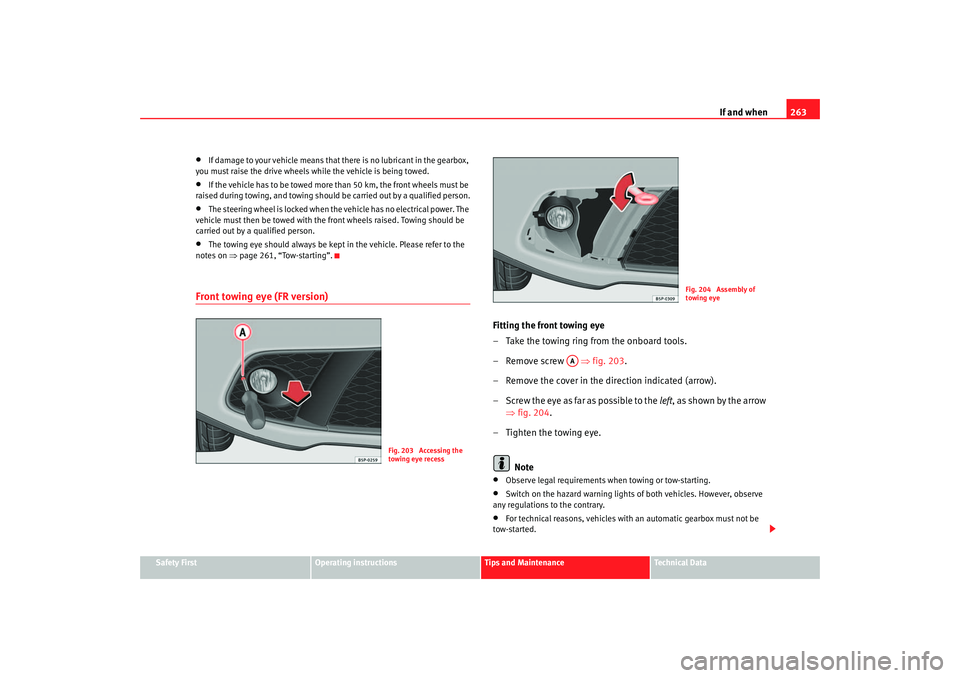
Front towing eye (FR version)
Fitting the front towing eye
– Take the towing ring from the onboard tools.
– Remove screw ⇒fig. 203 .
– Remove the cover in the direction indicated (arrow).
– Screw the eye as far as possible to the left, as shown by the arrow
⇒ fig. 204.
– Tighten the towing eye.
Note•
Observe legal requirements when towing or tow-starting.
•
Switch on the hazard warning lights of both vehicles. However, observe
any regulations to the contrary.
•
For technical reasons, vehicles with an automatic gearbox must not be
tow-started.
Fig. 203 Accessing the
towing eye recess
Fig. 204 Assembly of
towing eye
AA
altea_ingles_0706.book Seite 263 Mittwoch, 30. August 2006 3:48 15
Page 266 of 302
If and when
264•
If damage to your vehicle means that there is no lubricant in the gearbox,
you must raise the drive wheels while the vehicle is being towed.
•
If the vehicle has to be towed more than 50 km, the front wheels must be
raised during towing, and towing should be carried out by a qualified person.
•
The steering wheel is locked when the vehicle has no electrical power. The
vehicle must then be towed with the front wheels raised. Towing should be
carried out by a qualified person.
•
The towing eye should always be kept in the vehicle. Please refer to the
notes on ⇒page 261, “Tow-starting”.
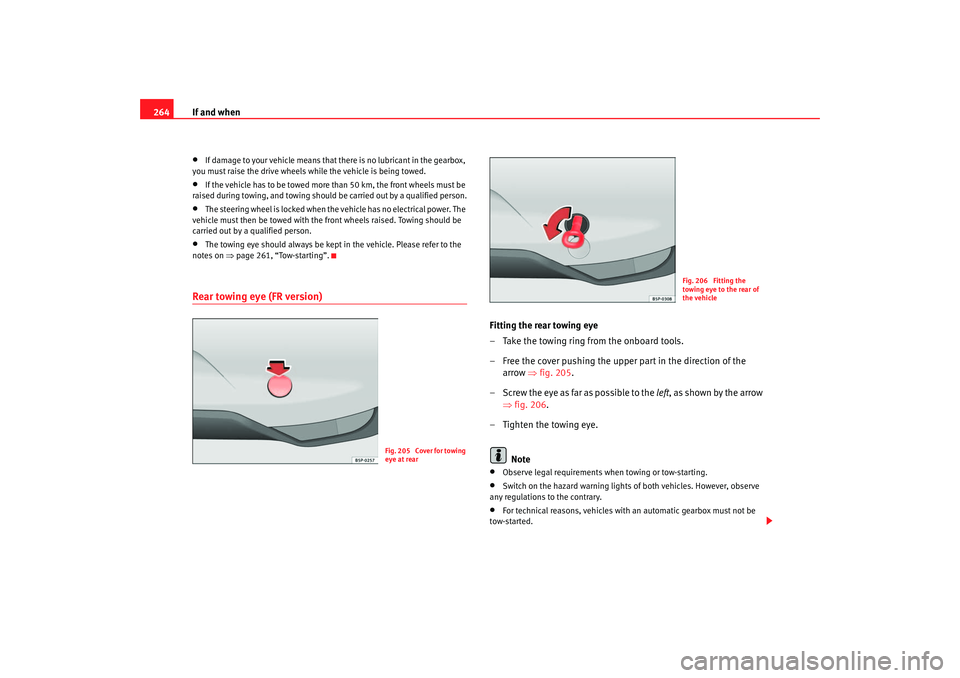
Rear towing eye (FR version)
Fitting the rear towing eye
– Take the towing ring from the onboard tools.
– Free the cover pushing the upper part in the direction of the
arrow ⇒fig. 205.
– Screw the eye as far as possible to the left, as shown by the arrow
⇒ fig. 206.
– Tighten the towing eye.
Note•
Observe legal requirements when towing or tow-starting.
•
Switch on the hazard warning lights of both vehicles. However, observe
any regulations to the contrary.
•
For technical reasons, vehicles with an automatic gearbox must not be
tow-started.
Fig. 205 Cover for towing
eye at rear
Fig. 206 Fitting the
towing eye to the rear of
the vehicle
altea_ingles_0706.book Seite 264 Mittwoch, 30. August 2006 3:48 15