air condition Seat Altea 2009 User Guide
[x] Cancel search | Manufacturer: SEAT, Model Year: 2009, Model line: Altea, Model: Seat Altea 2009Pages: 299, PDF Size: 9.39 MB
Page 159 of 299
Heating, Ventilation and Air conditioning
158Air recirculation mode ⇒page 157, fig. 128 prevents strong odours in
the outside air from entering the vehicle interior, for example when passing
through a tunnel or in queuing traffic.
With low temperatures outside, the air recirculation increases the effective-
ness of the heating system by warming the air inside the passenger compart-
ment rather than the cold air from outside.
With high ambient temperatures, the air recirculation increases the effective-
ness of the air conditioning system by cooling the air inside the passenger
compartment rather than the ambient air.
If the windscreen air output is on and the air recirculation mode is pressed,
this remains active. When the recirculation mode is on, if th e air distribution
towards the windscreen mode is selected, the recirculation mode is deacti-
vated. For safety reasons, the air recirculation mode should not be
connected.
WARNING
In air recirculation mode, no cold air from the outside enters the vehicle
interior. If the air conditioning syst em is switched off, the windows can
quickly mist over. Therefore, never leave the air recirculation mode
switched on for a long time (risk of accident).
Altea_EN.book Seite 158 Montag, 19. Januar 2009 1:31 13
Page 160 of 299
Heating, Ventilation and Air conditioning 159
Safety First
Operating instructions
Practical tips
Te c h n i c a l D a t a
2C-Climatronic*Control switches
The controls allow separate adjustment of air conditioning settings for the left and right.The air conditioning system controls the temperature when the
engine is running and the blower is switched on.
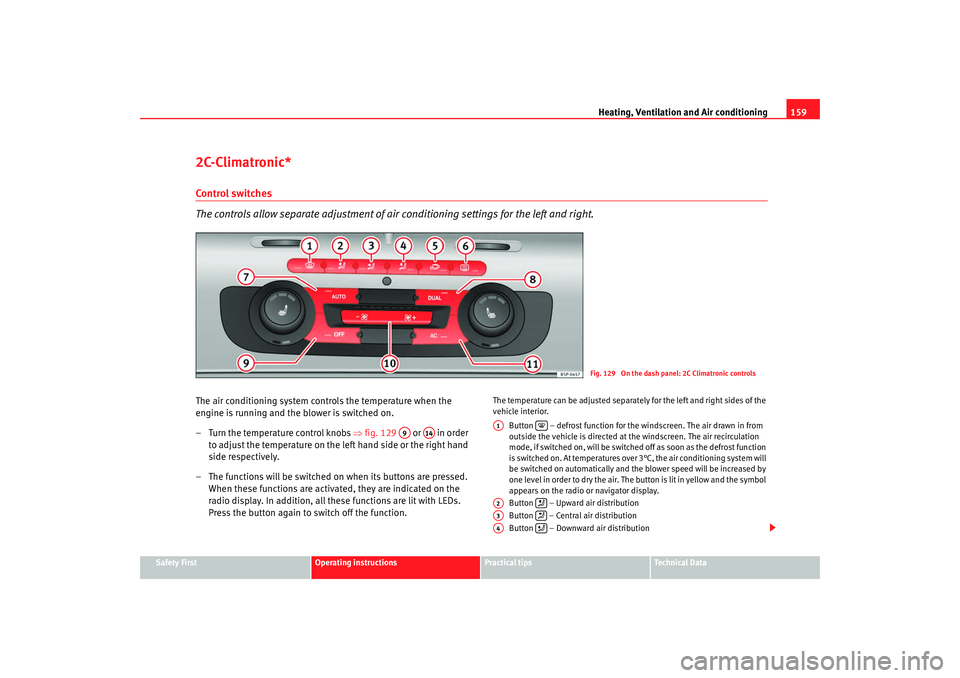
– Turn the temperature control knobs ⇒fig. 129 or in order
to adjust the temperature on the left hand side or the right hand
side respectively.
– The functions will be switched on when its buttons are pressed. When these functions are activated, they are indicated on the
radio display. In addition, all these functions are lit with LEDs.
Press the button again to switch off the function.
The temperature can be adjusted separately for the left and right sides of the
vehicle interior.
Button – defrost function for the windscreen. The air drawn in from
outside the vehicle is directed at the windscreen. The air recirculation
mode, if switched on, will be switched off as soon as the defrost function
is switched on. At temperatures over 3°C, the air conditioning system will
be switched on automatically and the blower speed will be increased by
one level in order to dry the air. The button is lit in yellow and the symbol
appears on the radio or navigator display.
Button – Upward air distribution
Button – Central air distribution
Button – Downward air distribution
Fig. 129 On the dash panel: 2C Climatronic controls
A9
A14
A1
A2
A3
A4
Altea_EN.book Seite 159 Montag, 19. Januar 2009 1:31 13
Page 161 of 299
Heating, Ventilation and Air conditioning
160
Button – Manual air recirculation mode.
Button – Rear window heating. The heating will be switched off auto-
matically approximately 20 minutes after switching on. However, it may
be turned off by pushing the button. Th e button lights up yellow and the
symbol appears in the display.
Button – Automatic temperature, ventilation and air distribution
control ⇒page 161
button - Dual zone synchroniser
Button – Switches the 2C-Climatronic on and off ⇒page 162
Blower control ⇒page 162
button – Switches heating, ventilation and air-conditioning system
onWARNING
For road safety all windows must be clear of ice, snow, and condensation.
This is essential to ensure good visibility. Please familiarise yourself with
the correct operation of the heating and ventilation system, including the
anti-fog/defrost functions for the windscreens.
Note
Please observe the general notes ⇒page 163.
Viewing Climatronic information
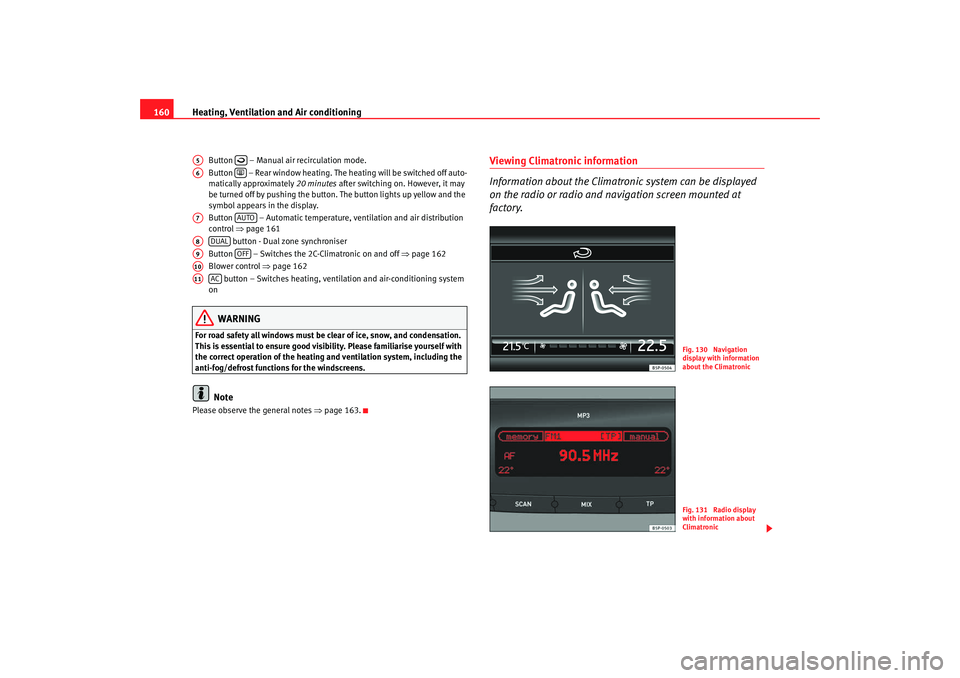
Information about the Climatronic system can be displayed
on the radio or radio and na vigation screen mounted at
factory.
A5
A6
A7
AUTO
A8
DUAL
A9
OFF
A10A11
AC
Fig. 130 Navigation
display with information
about the ClimatronicFig. 131 Radio display
with information about
Climatronic
Altea_EN.book Seite 160 Montag, 19. Januar 2009 1:31 13
Page 162 of 299
Heating, Ventilation and Air conditioning 161
Safety First
Operating instructions
Practical tips
Te c h n i c a l D a t a
The LEDs on the Climatronic controls indicate that the selected function has
been activated.
In addition, the radio or radio and navigation displays mounted at factory
briefly display the current settings of the Climatronic if any are modified.
The symbols used on the radio or radio and navigation displays are the same
as the symbols used for the Climatronic controls.
Automatic mode
In automatic mode air temperature, air flow and distribution
are automatically regulated so that a specified temperature is
attained as quickly as possible and then maintained.The temperature can be adjusted separately for the left and right
sides of the vehicle interior.
Switching on automatic mode
–Press the ⇒
page 159, fig. 129 button. “AUTO High” is
shown on the radio display (high fan speed).
– Press the button again ⇒ page 159, fig. 129. “AUTO Low”
is shown on the radio display (low fan speed).Depending upon the version and finish, the vehicle may include:
When a temperature of 22°C (72°F) is set in automatic mode a comfortable
interior climate is quickly reached. Therefore, we recommend you not to
change this adjustment, except as necessary to suit individual preferences or
particular circumstances. The compartment temperature can be set between
+18°C (64°F) and +26°C (80°F). These ar e approximate temperatures and the actual temperature may be slightly higher or lower depending on the ambient
conditions.
Climatronic maintains a constant temperature. The temperature of the air
supplied to the interior, the blower speed and the air distribution are regu-
lated automatically. The system also considers the sunlight radiation, so
there is no need for manual readjustment. Therefore,
automatic mode almost
always provides the best comfort for the vehicle occupants throughout the
year.
Automatic mode is switched off whenever an adjustment is made using the
buttons for the air distribution, air flow or or the air recirculation button
. The temperature will continue to be regulated within the parameters
manually selected by the user.
Note
There are two automatic modes:•
Automatic mode LO: This calculates the air flow for two people.
•
Automatic mode HI: This calculates the air flow for more than two
people.
AUTOAUTO
Altea_EN.book Seite 161 Montag, 19. Januar 2009 1:31 13
Page 163 of 299
Heating, Ventilation and Air conditioning
162Manual mode
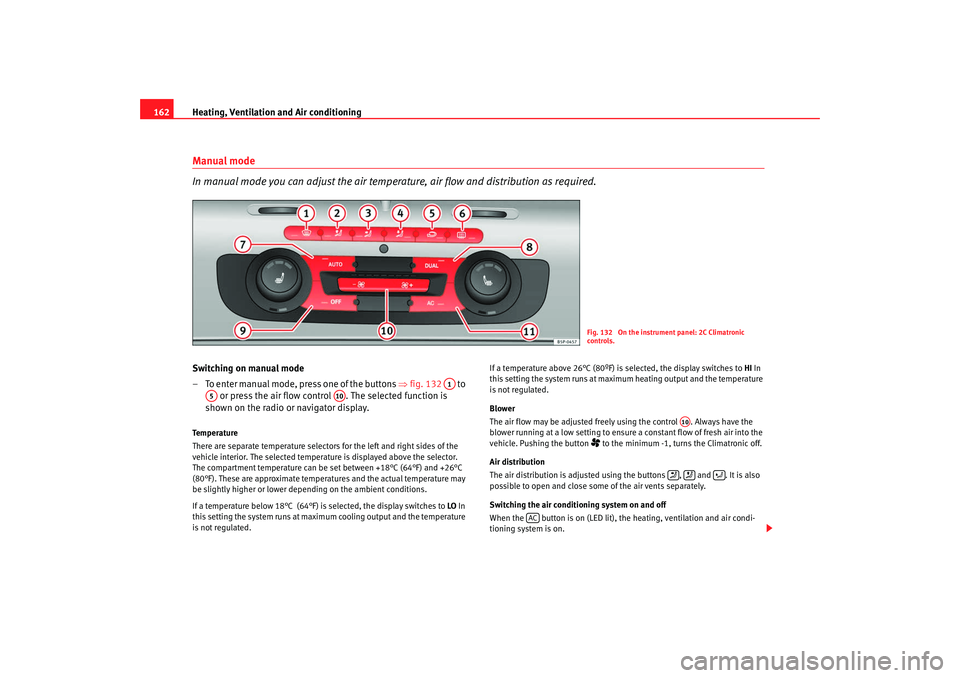
In manual mode you can adjust the air temperat ure, air flow and distribution as required.Switching on manual mode
– To enter manual mode, press one of the buttons ⇒fig. 132 to
or press the air flow control . The selected function is
shown on the radio or navigator display.Temperature
There are separate temperature selectors for the left and right sides of the
vehicle interior. The selected temperature is displayed above the selector.
The compartment temperature can be set between +18°C (64°F) and +26°C
(80°F). These are approximate temperat ures and the actual temperature may
be slightly higher or lower depending on the ambient conditions.
If a temperature below 18°C (64°F) is selected, the display switches to LO In
this setting the system runs at maximum cooling output and the temperature
is not regulated. If a temperature above 26°C (80ºF) is selected, the display switches to
HI In
this setting the system runs at maximum heating output and the temperature
is not regulated.
Blower
The air flow may be adjusted freely using the control . Always have the
blower running at a low setting to ensure a constant flow of fresh air into the
vehicle. Pushing the button
to the minimum -1, turns the Climatronic off.
Air distribution
The air distribution is adjusted using the buttons , and . It is also
possible to open and close some of the air vents separately.
Switching the air conditioning system on and off
When the button is on (LED lit), th e heating, ventilation and air condi-
tioning system is on.
Fig. 132 On the instrument panel: 2C Climatronic
controls.
A1
A5
A10
A10
AC
Altea_EN.book Seite 162 Montag, 19. Januar 2009 1:31 13
Page 164 of 299
Heating, Ventilation and Air conditioning 163
Safety First
Operating instructions
Practical tips
Te c h n i c a l D a t a
When the button is off (LED off),
the heating, ventilation and air condi-
tioning system is off.
When the button is off, the heating, ventilation and air conditioning
system is switched off to save fuel. The temperature continues to self-regu-
late. The set temperature can then only be reached if it is higher than the
ambient temperature.
Driver and passenger temperature control
The button controls the synchronisation of the 2 Climatronic climate
zones.
When the button is on (LED lit), the climate zone of the Climatronic is
personalised, for example: Driver side temperature 22°C and passenger side
temperature 23°C.
When the button is off (LED off), the climate zone of the Climatronic is
synchronised, for example: Driver side temperature 22°C and passenger side
temperature 22°C.
If the button is off and the passenger side temperature is changed, the
function is automatically activated.
Air recirculation mode
Air recirculation mode prevents fumes or unpleasant smells
from coming from the outside.– Press the button ⇒ page 162, fig. 132 to switch air recir-
culation mode on or off. It is switched on if the following symbol
appears in the display
.
Air recirculation mode prevents strong odours in the ambient air from
entering the vehicle interior, for example when passing through a tunnel or in
a traffic jam. With low temperatures outside, the air recirculation increases the effective-
ness of the heating system by heating the air inside the passenger compart-
ment rather than the air from outside.
With high ambient temperatures, the air recirculation increases the effective-
ness of the air conditioning system by cooling the air inside the passenger
compartment rather than the ambient air.
If the windscreen air output is on and the air recirculation mode is pressed,
this remains active. When the recirculation mode is on, if the air distribution
towards the windscreen mode is selecte
d, the recirculation mode is deacti-
vated. For safety reasons, the air recirculation mode should not be
connected.
WARNING
In air recirculation mode, no cold air from the outside enters the vehicle
interior. If the air conditioning syst em is switched off, the windows can
quickly mist over. Therefore, never leave the air recirculation mode
switched on for a long time (risk of accident).General notesThe impurity filter
The impurity filter (a combined particle filter and active carbon filter) serves
as a barrier against impurities in the ambient air, including dust and pollen.
For the air conditioning system to work with maximum efficiency, the pollen
filter must be replaced at the intervals specified in the Service Schedule.
If the filter loses efficiency prematurely due to use in areas reaching very high
pollution levels, the pollen filter must be changed more frequently than
stated in the Service Schedule.
ACAC
DUAL
DUALDUAL
DUAL
A2
Altea_EN.book Seite 163 Montag, 19. Januar 2009 1:31 13
Page 165 of 299
Heating, Ventilation and Air conditioning
164Air conditioner
When the air conditioning system is switched on, not only the temperature,
but also the air humidity in the vehicle interior is reduced. This improves
comfort for the vehicle occupants and prevents misting of the windows when
the ambient air hu midity is high.
If the air conditioning system cannot be switched on this may be caused by
the following reasons:•
The engine is not running.
•
The button is disconnected.
• The outside temperature is below +3°C .•
The air conditioning system compressor has been temporarily switched
off because the engine coola nt temperature is too high.
•
The air conditioning fuse is faulty.
•
Another fault in the vehicle. Have the air conditioning checked by a qual-
ified workshop.Caution
•
If you suspect that the air conditioning is damaged, switch it off with the button to prevent further damage and have it checked by a qualified
workshop.
•
Repairs to the air conditioning system require specialist knowledge and
special tools. Therefore, we recommend you to take the vehicle to a qualified
workshop.Note
•
If the humidity and temperature outside the vehicle are high, condensa-
tion can drip off the evaporator in the cooling system and so forming a puddle
underneath the vehicle. This is completely normal and there is no need to
suspect a leak.
•
Keep the air intake slots in front of the windscreen free of snow, ice and
leaves to ensure heating and cooling are not impaired, and to prevent the
windows from misting over.
•
The air from the vents flows through the passenger compartment and is
extracted by slots designed for this purpose. Therefore, do not cover these
slots with items of clothing or other objects.
•
The air conditioning system operates most effectively with the windows
and the sliding/tilting roof* closed. Howe ver, if the vehicle has been over-
heated by sun, the air inside can be cooled quicklier by opening the windows
for a short time.
•
Do not smoke while air recirculation mode is on, as smoke drawn into the
air conditioning system leaves a r esidue on the evaporator, producing a
permanent unpleasant odour.
•
It is advisable to connect the air conditioning at least once a month, to
lubricate the system gaskets and prevent leaks. If a decrease in the cooling
capacity is detected, an Authorised Service Centre should be consulted to
check the system.
AC
AC
Altea_EN.book Seite 164 Montag, 19. Januar 2009 1:31 13
Page 190 of 299
Intelligent technology189
Safety First
Operating instructions
Practical tips
Te c h n i c a l D a t a
WARNING
•
When accelerating on a slippery surface, for example on ice and snow,
press the accelerator carefully. Despite EDL, the driven wheels may start to
spin. This coul d impair the vehicle's stability.
•
Always adapt your driving style to suit road conditions and the traffic
situation. Do not let the extra safety afforded by EDL tempt you into taking
any risks when driving, this can cause accidents.Caution
Modifications to the vehicle (e.g. to the engine, the brake system, running
gear or any components affecting the wh eels and tyres) could affect the effi-
ciency of the EDL ⇒ page 210.The traction control system (TCS)The traction control system prevents th e drive wheels from spinning when the
car is accelerating ⇒page 186.Four-wheel drive*
On four-wheel drive models, the engine power is distributed
to all four wheelsGeneral notes
The four-wheel-drive system operates completely automatically. The propul-
sion force is distributed among the four wheels and adapted to the driving
style and the road conditions. The four-wheel drive is specially designed to complement the superior engine
power. This combination gives the car exceptional handling and performance
capabilities – both on normal roads and in more difficult conditions, such as
snow and ice.
Winter tyres
Thanks to its four-wheel drive, your car will have plenty of traction in winter
conditions, even with the standard tyres. Nevertheless, we still recommend
that winter tyres or all-season tyres sh
ould be fitted on all four wheels when
winter road conditions are expected, mainly because this will give a better
braking response.
Snow chains
On roads where snow chains are mandatory, this also applies to cars with
four-wheel drive.
Changing tyres
On vehicles with four-wheel drive, all four tyres must have the same rolling
circumference ⇒page 237.
WARNING
•
Even with four-wheel drive, you should always adjust your speed to suit
the conditions. Do not let the extra safety features tempt you into taking
any risks when driving. Failure to do so could result in an accident.
•
The braking capability of your vehicle is limited by the tyres' grip.
Vehicle behaviour is no different from a vehicle without four-wheel drive.
So do not be tempted to drive too fast on icy or slippery roads just because
the car still has good acceleration in these conditions. Failure to do so
could result in an accident.
•
On wet roads bear in mind that the front wheels may start to “aqua-
plane” and lose contact with the road if the car is driven too fast. If this
should happen, there will be no su dden increase in engine speed when
“aquaplaning” begins to warn the driver, as with a front-wheel drive car.
For this reason and for that mentio ned above, always choose a driving
Altea_EN.book Seite 189 Montag, 19. Januar 2009 1:31 13
Page 194 of 299
Driving and the environment193
Safety First
Operating instructions
Practical tips
Te c h n i c a l D a t a
gear if your vehicle has automatic tr
ansmission). This makes use of engine
braking and relieves the brakes.
•
Never let the brakes “rub” by applying light pressure. Continuous
braking will cause the brakes to overheat and the braking distance will
increase. Apply and then release the brakes alternately.
•
Never let the vehicle run with the engine switched off. The braking
distance is increased considerably as the brake servo does not function.
•
Very heavy use of the brakes may cause a vapour lock if the brake fluid
is left in the system for too long. This impairs the braking effect.
•
Non-standard or damaged front spoilers could restrict the airflow to the
brakes and cause them to overheat. Observe the relevant instructions
before purchasing accessories ⇒page 210, “Technical modifications”.
•
If a brake circuit fails, the braking distance will be increased consider-
ably. Contact a qualified workshop immediately and avoid unnecessary
journeys.
Exhaust gasses purification systemCatalytic converter*To conserve the useful life of the catalytic converter
– Always use unleaded petrol.
– Do not let the fuel get too low in the tank.
– For engine oil changes, do not top the reservoir up ⇒page 220,
“Topping up engine oil ”. – Never tow the vehicle to start it, use jump leads if necessary
⇒page 263.
If you notice misfiring, uneven running or loss of power when the vehicle is
moving, reduce speed immediately and have the vehicle inspected at the
nearest qualified workshop. In general, the exhaust warning lamp will light
up when any of the described symptoms occur ⇒page 75. If this happens,
unburnt fuel can enter the exhaust system and escape into the environment.
The catalytic converter can also be damaged by overheating.
WARNING
The catalytic converter reaches very high temperatures! Fire hazard!•
Never park where the catalytic converter could come into contact with
dry grass or inflammable materials under the vehicle.
•
Do not apply additional underseal or anti-corrosion coatings to the
exhaust pipes, catalytic converter or the heat shields on the exhaust
system. These materials could catch fire when the vehicle is being driven.Caution
Never fully drain the fuel tank because the irregularity of the fuel supply may
cause ignition problems. This allows unburnt fuel to enter the exhaust
system, which could cause overheating and damage the catalytic converter.
For the sake of the environment
Even when the emission control system is working perfectly, there may be a
smell of sulphur from the exhaust unde r some conditions. This depends on
the sulphur content of the fuel used. Quite often the problem can be solved
by changing to another fuel brand.
WARNING (continued)
Altea_EN.book Seite 193 Montag, 19. Januar 2009 1:31 13
Page 196 of 299
Driving and the environment195
Safety First
Operating instructions
Practical tips
Te c h n i c a l D a t a
during this initial warm-up phase. It is therefore best to drive off immediately
after starting the engine. Avoid running the engine at high speed.
Periodic maintenance
Periodic maintenance work guarantees
that, before beginning a journey, you
will not waste fuel. A well-serviced engine gives you the benefit of improved
fuel efficiency as well as maximum reliability and an enhanced resale value.
A badly serviced engine can consume up to 10% more fuel than necessary.
Avoid short journeys
To reduce the consumption and emission of polluting gases, the engine and
the exhaust filtration systems should reach the optimum service tempera-
ture .
With the engine cold, fuel consumption is proportionally higher. The engine
does not warm up and fuel consumption does not regularise until having
driven some four kilometres. This is the reason why we recommend avoiding
short trips wherever possible.
Maintain the correct tyre pressures
Bear in mind that keeping the tyres at an adequate pressure saves fuel. If the
tyre pressures are just 1 bar too low, this can put the fuel consumption up by
as much as 5 %. Due to the greater rolling resistance, under-inflation also
increases tyre wear and impairs handling.
The tyre pressures should always be checked when the tyres are cold.
Do not use winter tyres all through the year: they will increase fuel consump-
tion by up to 10 %.
Avoid unnecessary weight
Every kilo of extra weight will put up the fuel consumption, so it is worth
checking the luggage compartment occasionally to make sure that no unnec-
essary loads are being transported.
A roof carrier is often left in place for the sake of convenience, even when it is
no longer needed. At a speed of 100-120 km/h your car will use about 12% more fuel as a result of the extra wind resistance caused by the roof carrier
even when it is empty.
Save electrical energy
The engine activates the alternator, whic
h produces electricity. With the need
for electricity, fuel consumption is also increased. Because of this, always
turn off electrical equipme nt when you do not need them. Examples of equip-
ment that use a lot of electricity are: the fan at high speeds, the rear window
heating or the seat heaters*.
Environmental friendlinessEnvironmental protection is a top priori ty in the design, choice of materials
and production of your new Seat.
Design measures for economical recycling•
Joints and connections designed for ease of dismantling
•
Modular construction to facilitate dismantling
•
Increased use of single-grade materials
•
Plastic parts and elastomers are labelled in accordance with ISO 1043,
ISO 11469 and ISO 1629
Choice of materials
•
Nearly all materials used can be recycled
•
Similar types of plastics grouped together for easy recycling
•
Recycled materials used in manufacture
•
Reduction of the plastic volatile components
•
CFC-free refrigerant in air conditioning
Compliance with prohibited materials laws : cadmium, asbestos, lead,
mercury, chrome VI.
Altea_EN.book Seite 195 Montag, 19. Januar 2009 1:31 13