lights Seat Altea 2010 User Guide
[x] Cancel search | Manufacturer: SEAT, Model Year: 2010, Model line: Altea, Model: Seat Altea 2010Pages: 310, PDF Size: 7.46 MB
Page 82 of 310
Cockpit
80First look at the coolant temperature gauge. If the needle is in the normal
range, top up with coolant at the earliest opportunity ⇒.
WARNING
•If your vehicle is immobilised for any technical reasons, move it to a
safe distance from traffic. Turn the engine off, turn the hazard lights on and
place the warning triangle.•Never open the bonnet if you can see or hear steam or coolant escaping
from the engine compartment. Risk of scalding. Wait until you can no
longer see or hear escaping steam or coolant.•The engine compartment is a dangerous area! Before carrying out any
work in the engine compartment, switch off the engine and allow it to cool
down. Always note the corresponding warnings ⇒page 226.
Rear fog light
This warning lamp lights up when the rear fog light is switched on
. Further
information ⇒page 113.
Tu rn si g nal s
The warning lamp flashes when the indicators are in opera-
tion.Depending on which indicator is operating, either the left
or right
indi-
cator lamp flashes. Both warning lamps will flash at the same time when the
hazard warning lights are switched on.
If any of both indicators fails, the warning lamp will start flashing twice faster
than normal. Further information on the indicators ⇒
page 120.
Engine management*
This warning lamp monitors the engine management system
for petrol engines.
The warning lamp
(Electronic Power Control) lights up when the ignition
is switched on to show that the lamp is working properly. It should go out
once the engine is started.
If there is a fault in the electronic engine management system while you are
driving, this warning lamp will light up. Stop the vehicle and seek technical
assistance.
Glow plug system / Engine fault
The warning lamp lights up to show that the glow plugs are
preheating. It flashes if there is an engine fault.
Warning lamp
is lit
The warning lamp lights up while the glow plugs are preheating. When the
warning lamp goes off, the engine should be started straight away.
Warning lamp
flashes
If a fault develops in the engine management system while you are driving,
the glow plug lamp will flash
. Take the vehicle to an Authorised Service
Centre as soon as possible and have the engine checked.
altea_EN Seite 80 Mittwoch, 26. August 2009 6:00 18
Page 83 of 310
Cockpit81
Safety First
Operating instructions
Practical tips
Technical Data
Main beam headlights
This warning lamp lights up when the main beams are on.The warning lamp
is switched on once main beams are on or once the
headlight flasher is operating.
Further information ⇒ page 120.
Soot accumulation in the diesel engine particulate filter
If the indicator lights
you may help the filter clear itself by driving in the
appropriate manner.
To do this, drive about 15 minutes in 4t h or 5th gear (automatic gearbox: S
gear range) at a speed of 60 km/h, with the engine running at approximately
2000 rpm. In this way, the pollen build up in the filter is burned. When
cleaning is successful, the indicator turns off.
If the indicator
is not deactivated, bring the vehicle to a specialised work-
shop to repair the fault.
WARNING
•Always drive according to the road weather conditions, the terrain and
traffic. Driving recommendations should never lead to illegal manoeuvres
in surrounding traffic.•The diesel engine particulate filter may reach extremely high tempera-
tures; it should not enter into contact with flammable materials under-
neath the vehicle. Failure to comply could result in fire.
Anti-lock brake system (ABS)
A warning lamp system monitors the ABS.
The warning lamp
should light up for a few seconds when the ignition is
switched on. It goes out again after the system has run through an automatic
test sequence.
There is a fault in the ABS if:
•The warning lamp
does not light up when the ignition is switched on.
•The warning lamp does not go out again after a few seconds.•The warning lamp lights up when the vehicle is moving.
The vehicle can still be braked in the normal way (except that the ABS control
function will not function). Please take the vehicle to a qualified workshop as
soon as possible. For further information on the ABS see the ⇒ page 193.
If a fault occurs in the ABS, the ESP* warning lamp will also light up.
Brake system fault
If the ABS warning lamp
lights up together with the brake warning lamp
, this indicates not only a fault in the ABS function, but also a possible fault
in the brake system ⇒.
WARNING
•Before opening the bonnet, read and observe the warnings on
⇒ page 226, “Working in the engine compartment”.•If the brake warning lamp
should light up together with the ABS
warning lamp
, stop the vehicle immediately and check the brake fluid
level in the reservoir ⇒ page 239, “Brake fluid”. If the fluid level has
dropped below the “MIN” mark you must not drive on. Risk of accident.
Obtain technical assistance.
•If the brake fluid level is correct, the fault in the brake system may have
been caused by a failure of the ABS system. This could cause the rear
altea_EN Seite 81 Mittwoch, 26. August 2009 6:00 18
Page 84 of 310
Cockpit
82wheels to lock quickly when you brake. This could cause the rear to break
away. Risk of skidding. Stop the vehicle and seek technical assistance.Washer fluid
This warning lamp lights up to indicate that the windscreen
washer level is too low.This serves as a reminder to fill up the reservoir at the earliest opportunity
⇒ page 235
The following message is shown on the dash panel display*
12): REFILL
WINDSCREEN WASHER FLUID .
Alternator
This warning lamp signals a fault in the alternator.
The warning lamp
lights up when the ignition is switched on. It should go
out when the engine has started running.
If the warning lamp lights up while driving, the alternator is no longer
charging the battery. You should immediately drive to the nearest qualified
workshop.
You should avoid using electrical equipment that is not absolutely necessary
because this will drain the battery.
Tyre pressure
The tyre pressure control system controls the tyre speed and
the frequency spectrum of each tyre.The tyre monitor
13) compares wheel revolutions and with this information,
the diameter of each wheel using the ESP sensors. If the diameter of a wheel
changes, the tyre monitor indicator lights . The wheel diameter changes
when:
•Tyre pressure is insufficient.•The tyre structure is damaged.•The vehicle is unbalanced because of a load.•The wheels of one axle are under more pressure (for example, driving with
a trailer or on extreme slopes).•The vehicle is fitted with snow chains.•The emergency wheel is fitted.
12)Depending on the version of the model.WARNING (continued)
13)Depending on the model version
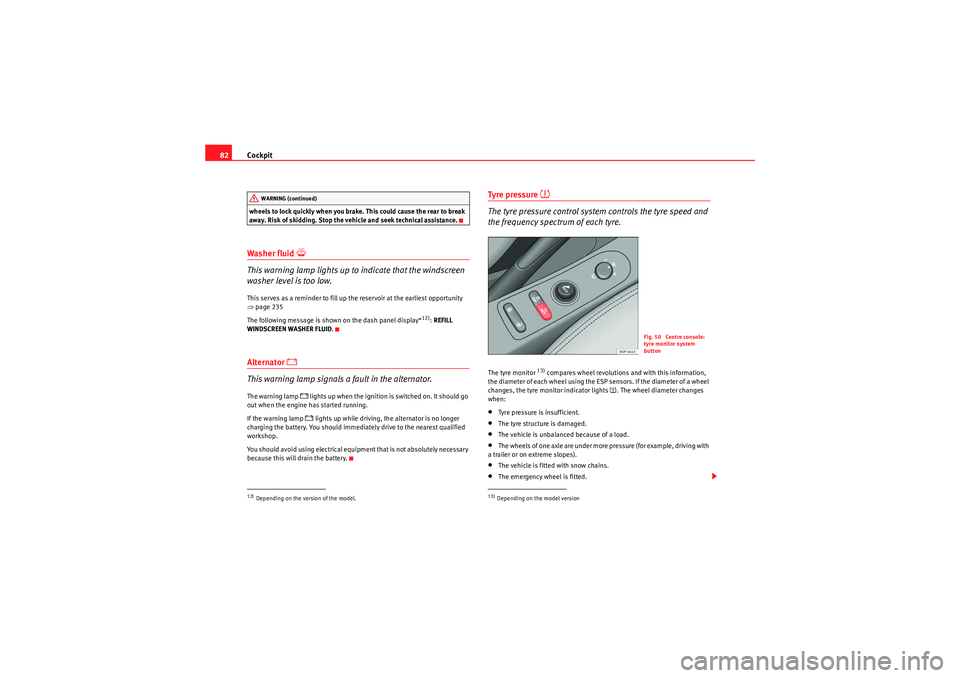
Fig. 50 Centre console:
tyre monitor system
button
altea_EN Seite 82 Mittwoch, 26. August 2009 6:00 18
Page 85 of 310
Cockpit83
Safety First
Operating instructions
Practical tips
Technical Data
•The wheel on one axle is changed.
Tyre pressure adjustment
Following the modification to tyre pressure or after changing one or more
wheels, the button ⇒page 82, fig. 50 must be kept pressed while the igni-
tion is on until an acoustic signal is heard and the warning lamp goes out.
If the wheels are under excessive load (for example, driving with a trailer or
heavy load), the tire pressure must be increased to the recommended value
for a full load (see the sticker on the inside of the fuel flap). If the tyre monitor
system button is pressed down, the new tyre pressures are confirmed.
The tyre pressure monitor indicator
lights up
If the tyre pressure of one or more wheels is much lower than the value set by
the driver, then the tyre control warning lamp lights up ⇒.
The tyre pressure monitor indicator flashes
If the tyre pressure indicator flashes, this indicates a fault. Go to the nearest
specialist workshop.
WARNING
•When the tyre pressure indicator lights, reduce speed immediately and
avoid any sudden manoeuvre or braking. Stop when possible, and check
the tyre pressure and status.•The driver is responsible for correct tyre pressure. For this reason, tyre
pressure must be regularly checked.•Under certain circumstances (for example, in a sports situation, in
winter conditions or on a dirt track) the tyre monitor indicator may light or
function incorrectly.Note
If the battery is disconnected, the yellow indicator
lights up after turning
the ignition on. This should turn off after a brief journey.
Brake system* / handbrake
The warning lamp lights up if the handbrake is applied, if the
brake fluid level falls too low or if there is a fault in the brake
system.
This warning lamp
lights up if
•If the handbrake is on.
If you drive faster than 6 km/h with the handbrake on, the following message
will appear on the dash panel display
14): HANDBRAKE ON. Also, an audible
warning is given.
•If the brake fluid level is too low ⇒page 239.
The dash panel displays the following message
14): STOP BRAKE FLUID
INSTRUCTION MANUAL .
•If there is a fault in the brake system.
The dash panel displays the following message
14): BRAKE SYSTEM FAULT
INSTRUCTIONS MANUAL .
This warning lamp can light up together with the anti-lock brake system
warning lamp.
WARNING
•Before opening the bonnet, read and observe the warnings on
⇒ page 226.•If the brake warning lamp does not go out, or if it lights up when
driving, the brake fluid level ⇒page 239, “Brake fluid” in the reservoir is
too low. Risk of accident. Stop the vehicle and do not drive on. Obtain tech-
nical assistance.
14)Depending on the version of the model.
altea_EN Seite 83 Mittwoch, 26. August 2009 6:00 18
Page 86 of 310
Cockpit
84•If the brake warning lamp
lights up together with the ABS warning
lamp
, the control function of the ABS could be out of action. This could
cause the rear wheels to lock quickly when you brake. This could cause the
rear to break away. Risk of skidding. Stop the vehicle and seek technical
assistance.
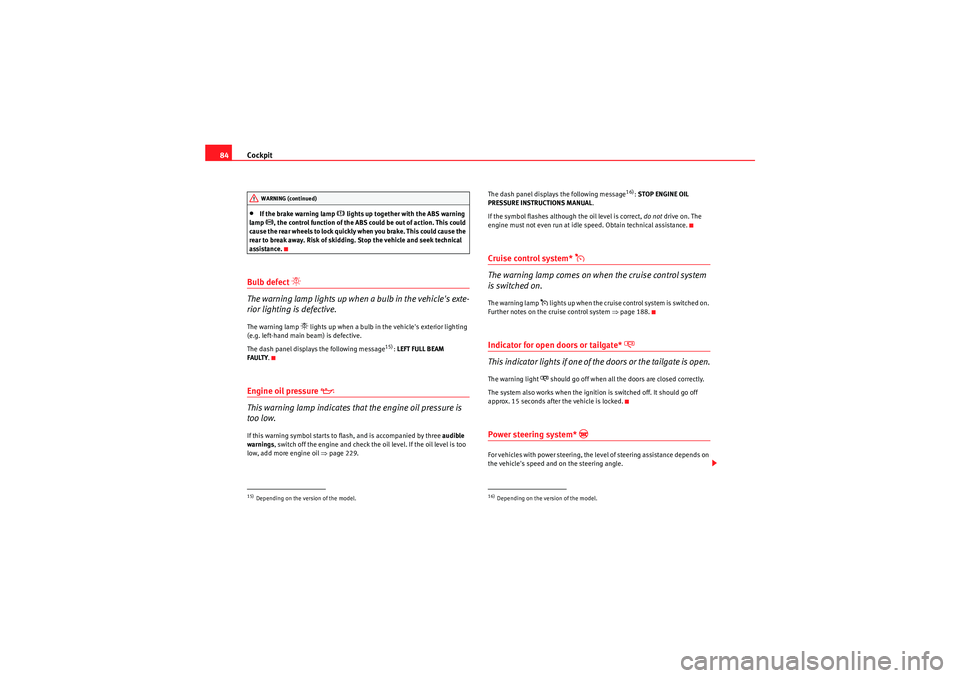
Bulb defect
The warning lamp lights up when a bulb in the vehicle's exte-
rior lighting is defective.The warning lamp
lights up when a bulb in the vehicle's exterior lighting
(e.g. left-hand main beam) is defective.
The dash panel displays the following m essage
15): LEFT FULL BEAM
FAULTY .
Engine oil pressure
This warning lamp indicates that the engine oil pressure is
too low.If this warning symbol starts to flash, and is accompanied by three audible
warnings , switch off the engine and check the oil level. If the oil level is too
low, add more engine oil ⇒page 229. The dash panel displays the following message
16):
STOP ENGINE OIL
PRESSURE INSTRUCTIONS MANUAL .
If the symbol flashes although the oil level is correct, do not drive on. The
engine must not even run at idle speed. Obtain technical assistance.
Cruise control system*
The warning lamp comes on when the cruise control system
is switched on.The warning lamp
lights up when the cruise control system is switched on.
Further notes on the cruise control system ⇒page 188.
Indicator for open doors or tailgate*
This indicator lights if one of the doors or the tailgate is open.The warning light
should go off when all the doors are closed correctly.
The system also works when the ignition is switched off. It should go off
approx. 15 seconds after the vehicle is locked.
Power steering system*
For vehicles with power steering, the level of steering assistance depends on
the vehicle's speed and on the steering angle.
15)Depending on the version of the model.WARNING (continued)
16)Depending on the version of the model.
altea_EN Seite 84 Mittwoch, 26. August 2009 6:00 18
Page 87 of 310
Cockpit85
Safety First
Operating instructions
Practical tips
Technical Data
The warning lamp should light up for a few seconds when the ignition is
switched on. It should go out once the engine is started.
If the battery is disconnected, the indicator remains lit, even with the engine
running. The warning light only goes off after a distance of approx. 50 m.
There is a fault in the electromechanical steering system if the lamp does not
go out or lights up whilst the vehicle is in motion. The indicator may appear
in two different colours to indicate faults. If it lights yellow, this indicates a
minor fault. If it lights red, seek workshop assistance immediately, if no
assistance is available stop driving. Stop the vehicle and seek technical
assistance. The power steering does not work if the battery is flat or if the
engine is off (for example, for towing). You should take into account that you
will need considerably more power than normal to steer the vehicle if the
steering assistance is reduced or has failed completely.
For those vehicles fitted with ESP* the function “Recommended steering
manoeuvre” is included. See
⇒page 195.
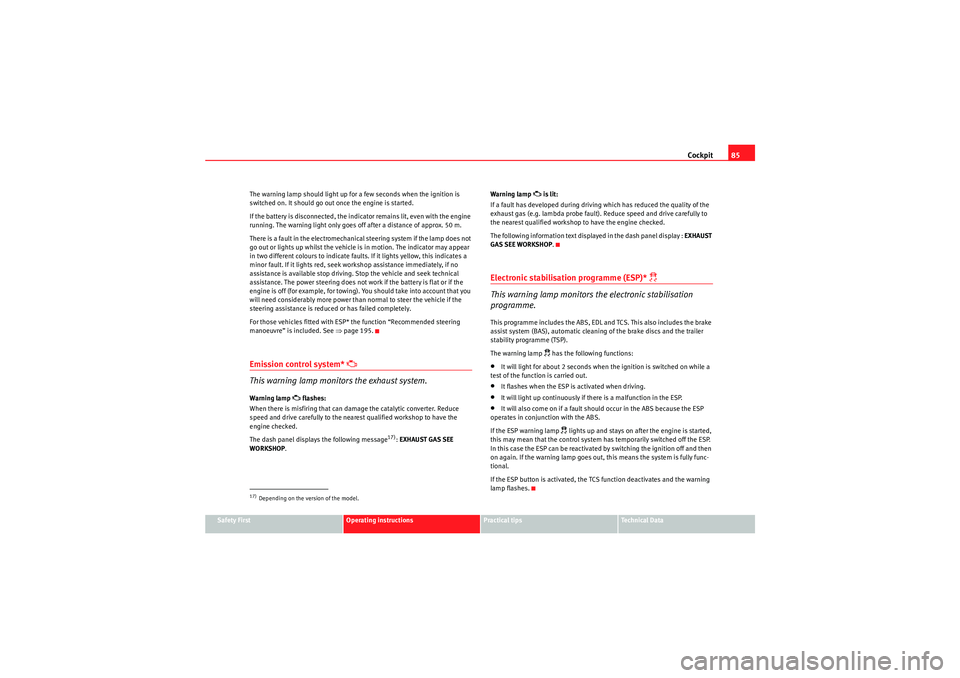
Emission control system*
This warning lamp monitors the exhaust system.
Warning lamp
flashes:
When there is misfiring that can damage the catalytic converter. Reduce
speed and drive carefully to the nearest qualified workshop to have the
engine checked.
The dash panel displays the following message
17): EXHAUST GAS SEE
WORKSHOP . Warning lamp
is lit:
If a fault has developed during driving which has reduced the quality of the
exhaust gas (e.g. lambda probe fault). Reduce speed and drive carefully to
the nearest qualified workshop to have the engine checked.
The following information text displayed in the dash panel display : EXHAUST
GAS SEE WORKSHOP .
Electronic stabilisation programme (ESP)*
This warning lamp monitors the electronic stabilisation
programme.
This programme includes the ABS, EDL and TCS. This also includes the brake
assist system (BAS), automatic cleaning of the brake discs and the trailer
stability programme (TSP).
The warning lamp
has the following functions:
•It will light for about 2 seconds when the ignition is switched on while a
test of the function is carried out.•It flashes when the ESP is activated when driving.•It will light up continuously if there is a malfunction in the ESP.•It will also come on if a fault should occur in the ABS because the ESP
operates in conjunction with the ABS.
If the ESP warning lamp
lights up and stays on after the engine is started,
this may mean that the control system has temporarily switched off the ESP.
In this case the ESP can be reactivated by switching the ignition off and then
on again. If the warning lamp goes out, this means the system is fully func-
tional.
If the ESP button is activated, the TCS function deactivates and the warning
lamp flashes.
17)Depending on the version of the model.
altea_EN Seite 85 Mittwoch, 26. August 2009 6:00 18
Page 88 of 310
Cockpit
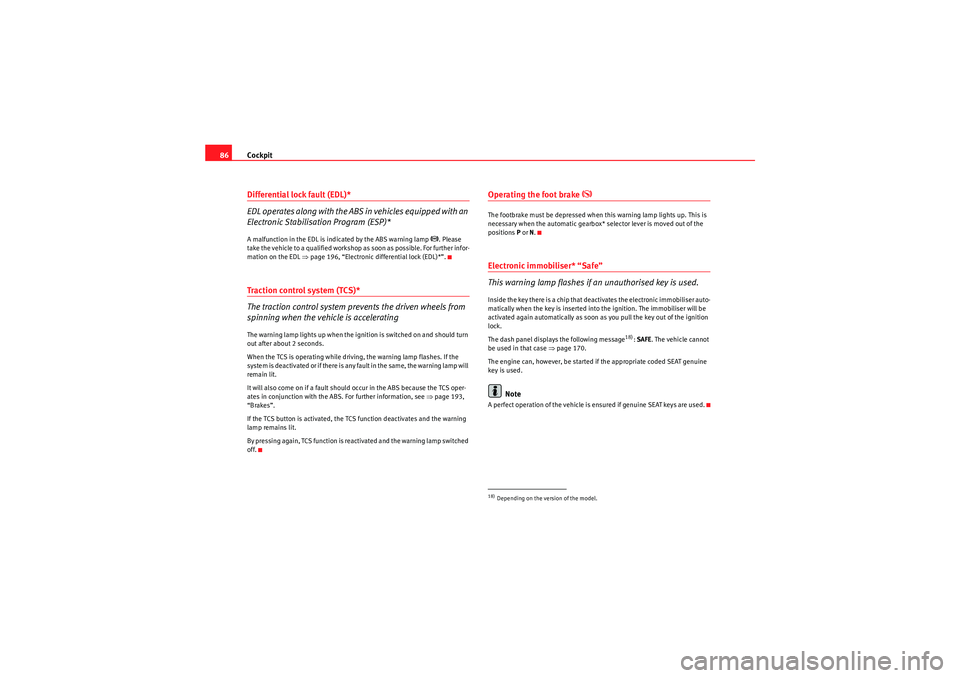
86Differential lock fault (EDL)*
EDL operates along with the ABS in vehicles equipped with an
Electronic Stabilisation Program (ESP)*A malfunction in the EDL is indicated by the ABS warning lamp
. Please
take the vehicle to a qualified workshop as soon as possible. For further infor-
mation on the EDL ⇒page 196, “Electronic differential lock (EDL)*”.
Traction control system (TCS)*
The traction control system prevents the driven wheels from
spinning when the vehicle is acceleratingThe warning lamp lights up when the ignition is switched on and should turn
out after about 2 seconds.
When the TCS is operating while driving, the warning lamp flashes. If the
system is deactivated or if there is any fault in the same, the warning lamp will
remain lit.
It will also come on if a fault should occur in the ABS because the TCS oper-
ates in conjunction with the ABS. For further information, see ⇒page 193,
“Brakes”.
If the TCS button is activated, the TCS function deactivates and the warning
lamp remains lit.
By pressing again, TCS function is reactivated and the warning lamp switched
off.
Operating the foot brake
The footbrake must be depressed when this warning lamp lights up. This is
necessary when the automatic gearbox* selector lever is moved out of the
positions P or N.Electronic immobiliser* “Safe”
This warning lamp flashes if an unauthorised key is used.Inside the key there is a chip that deactivates the electronic immobiliser auto-
matically when the key is inserted into the ignition. The immobiliser will be
activated again automatically as soon as you pull the key out of the ignition
lock.
The dash panel displays the following message
18): SAFE . The vehicle cannot
be used in that case ⇒ page 170.
The engine can, however, be started if the appropriate coded SEAT genuine
key is used.
Note
A perfect operation of the vehicle is ensured if genuine SEAT keys are used.18)Depending on the version of the model.
altea_EN Seite 86 Mittwoch, 26. August 2009 6:00 18
Page 115 of 310
Lights and visibility113
Safety First
Operating instructions
Practical tips
Technical Data
Lights and visibilityLightsSwitching lights on and off
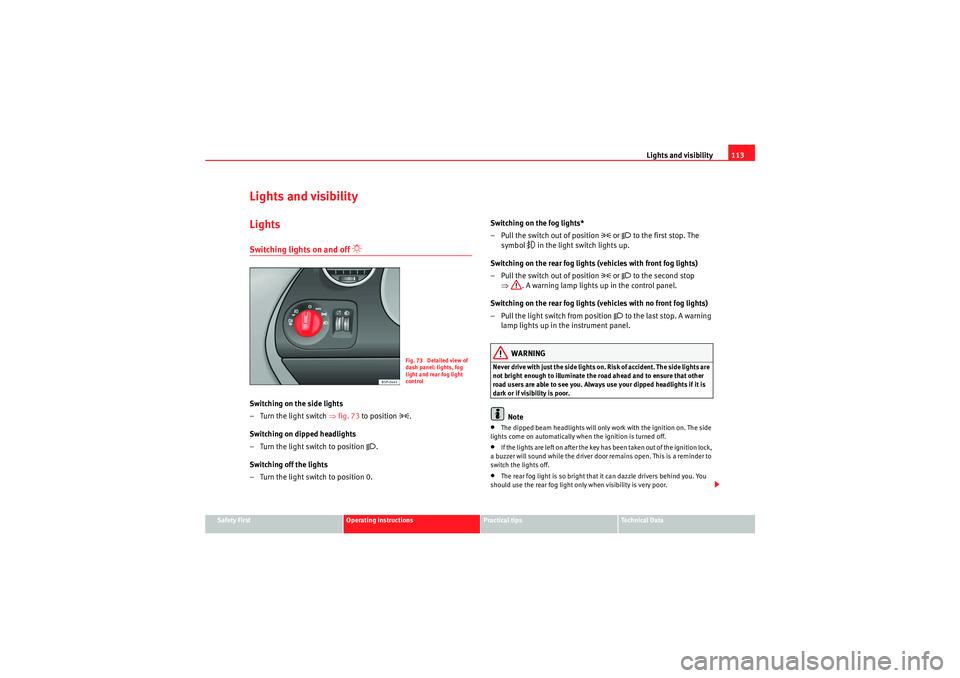
Switching on the side lights
–Turn the light switch ⇒ fig. 73 to position
.
Switching on dipped headlights
– Turn the light switch to position
.
Switching off the lights
– Turn the light switch to position 0. Switching on the fog lights*
– Pull the switch out of position
or to the first stop. The
symbol
in the light switch lights up.
Switching on the rear fog lights (vehicles with front fog lights)
– Pull the switch out of position
or to the second stop
⇒ . A warning lamp lights up in the control panel.
Switching on the rear fog lights (vehicles with no front fog lights)
– Pull the light switch from position
to the last stop. A warning
lamp lights up in the instrument panel.
WARNING
Never drive with just the side lights on. Risk of accident. The side lights are
not bright enough to illuminate the road ahead and to ensure that other
road users are able to see you. Always use your dipped headlights if it is
dark or if visibility is poor.
Note
•The dipped beam headlights will only work with the ignition on. The side
lights come on automatically when the ignition is turned off.•If the lights are left on after the key has been taken out of the ignition lock,
a buzzer will sound while the driver door remains open. This is a reminder to
switch the lights off.•The rear fog light is so bright that it can dazzle drivers behind you. You
should use the rear fog light only when visibility is very poor.
Fig. 73 Detailed view of
dash panel: lights, fog
light and rear fog light
control
altea_EN Seite 113 Mittwoch, 26. August 2009 6:00 18
Page 116 of 310
Lights and visibility
114•If you are towing a trailer equipped with a rear fog light on a vehicle with
a factory-fitted towing bracket , the rear fog light on the car will automatically
be switched off.•The use of the lighting described here is subject to the relevant statutory
requirements.•Depending on weather conditions (very cold or wet), the front and rear
lights and the indicators may be temporarily misted. This has no influence on
the life expectancy of the lighting system. The lights will soon demist when
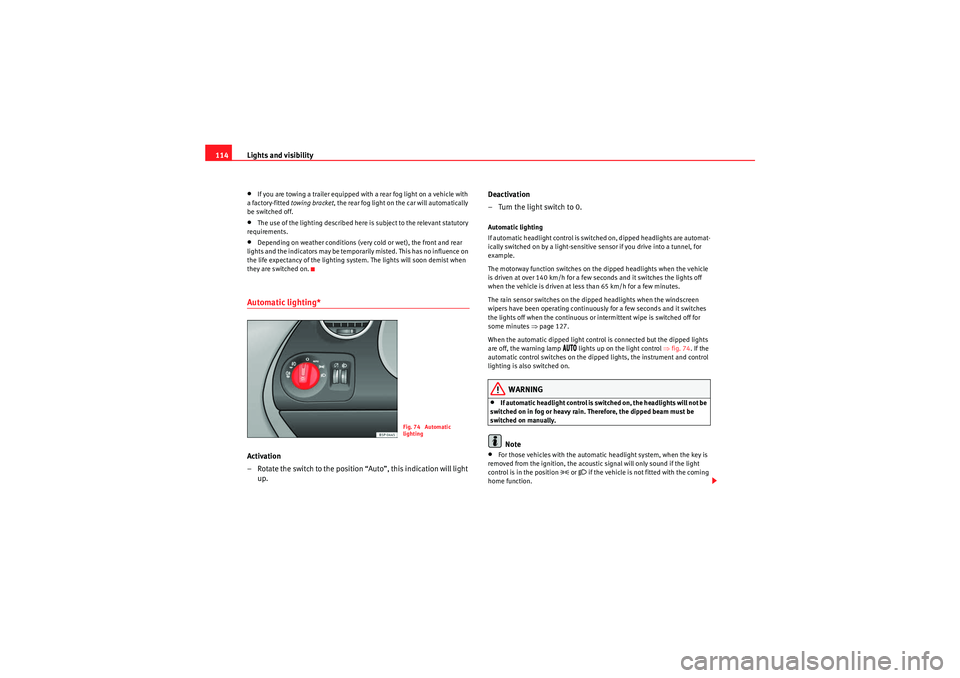
they are switched on.Automatic lighting*Activation
– Rotate the switch to the position “Auto”, this indication will light up. Deactivation
– Turn the light switch to 0.
Automatic lighting
If automatic headlight control is switched on, dipped headlights are automat-
ically switched on by a light-sensitive sensor if you drive into a tunnel, for
example.
The motorway function switches on the dipped headlights when the vehicle
is driven at over 140 km/h for a few seconds and it switches the lights off
when the vehicle is driven at less than 65 km/h for a few minutes.
The rain sensor switches on the dipped headlights when the windscreen
wipers have been operating continuously for a few seconds and it switches
the lights off when the continuous or intermittent wipe is switched off for
some minutes ⇒
page 127.
When the automatic dipped light control is connected but the dipped lights
are off, the warning lamp
lights up on the light control ⇒fig. 74 . If the
automatic control switches on the dipped lights, the instrument and control
lighting is also switched on.
WARNING
•If automatic headlight control is switched on, the headlights will not be
switched on in fog or heavy rain. Therefore, the dipped beam must be
switched on manually.Note
•For those vehicles with the automatic headlight system, when the key is
removed from the ignition, the acoustic signal will only sound if the light
control is in the position
or if the vehicle is not fitted with the coming
home function.
Fig. 74 Automatic
lighting
altea_EN Seite 114 Mittwoch, 26. August 2009 6:00 18
Page 117 of 310
Lights and visibility115
Safety First
Operating instructions
Practical tips
Technical Data
•If the daylight driving automatic light function is switched on, the fog
lights or rear fog light cannot be switched on in addition.•The use of the lighting described here is subject to the relevant statutory
requirements.•Do not put stickers on the windscreen in front of the sensor. This may
cause disruptions or faults in the automatic lighting system.•To avoid damage to the tail lights, the lights mounted on the tailgate go
off when the tailgate is opened (according to country).Daytime lights*
The daytime light reduces the risk of accidents by increasing
the visibility of the vehicle. The daytime running lights are
enabled automatically when the ignition is switched on. It is
automatically switched off when the side lights are turned on.Daytime lights (halogen lamps)
19)
The daytime lights increase road safety in vehicles fitted with halogen lamps.
These include the dipped, side and registration plate lights.
The daytime lights are switched on each time the ignition is turned on if the
light setting is in position 0 or
. Depending upon the model, a control
lamp
on the light control switch or the lighting up of the instrument panel
will indicate that the daytime lighting is on.
It is not possible for the driver to switch the daytime lights on or off. Please
contact a qualified workshop if you wish to deactivate the lights. Daytime lights (bi-xenon lamps)
The daytime lights increase road safety in vehicles fitted with bi-xenon lamps.
The lights are built-in separately to the headlights and are switched on each
time the ignition is turned on if the light setting is in position
0 or
.
Automatic control of the dipped light in combination with the daytime
lighting (bi-xenon headlamps)
If the dipped light control and the daytime lighting are activated at the same
time, the dipped lights and the instrument panel lighting will automatically
come on as required (e.g. on entering a tunnel) and the daytime lights will go
off. When the automatic dipped light control switches off the dipped lights
(e.g. on coming out of the tunnel), the daytime lights come back on.
Activating the daytime lights*
With the ignition switched off, move the indicator and main beam lever
upwards and back (right indicator and headlamp flash) and hold in this posi-
tion.
Switch on the ignition for 3 seconds while holding this position. The daytime
lights are activated and can be switched on.
Deactivating the daytime lights
With the ignition switched off, move the indicator and main beam lever
upwards and back (left indicator and headlamp flash) and hold in this posi-
tion.
Switch on the ignition for 3 seconds while holding this position. The daytime
lights are deactivated and can not be switched on.
Deactivating daytime lights (bi-xenon lamps)
With the ignition switched off, move the indicator and main beam lever
upwards and back (left indicator and headlamp flash).
Switch on the ignition for 3 seconds. The daytime lights are deactivated and
can not be switched on.
19)It is only available in some countries or as an optional extra
altea_EN Seite 115 Mittwoch, 26. August 2009 6:00 18