lights Seat Altea 2010 Workshop Manual
[x] Cancel search | Manufacturer: SEAT, Model Year: 2010, Model line: Altea, Model: Seat Altea 2010Pages: 310, PDF Size: 7.46 MB
Page 262 of 310
If and when
260
Note•If sealant should leak out, leave it to dry. When it has dried, you can pull
it off like a piece of foil.•Observe the expiry date stated on the sealing compound can. Have the
sealing compound exchanged by a qualified workshop.•Seek professional assistance if the repair of a tyre puncture is not
possible with the sealing compound.Preparation work
Certain steps must be taken before repairing a tyre.– If you have a flat tyre or puncture, park the vehicle as far away from the flow of traffic as possible.
– Apply the handbrake firmly.
– Engage first gear , or put the selector lever to position P.
– All passengers should leave the vehicle. They should wait in a
safe area (for instance behind the roadside crash barrier).
– Check whether a repair is possible using the Tyre Mobility System “General information and safety notes.”
– Unscrew inflation cap from the affected wheel.
– Take the tyre repair kit out of the luggage compartment.
WARNING
Put the hazard warning lights on and place the warning triangle in position.
This is for your own safety and also warns other road users.
Caution
Take special care if you have to repair a tyre on a slope.
Note
Please observe legal requirements when doing so.Tyre repair
The following sections describe the procedures for repairing
a tyre.Using the sealing compound
– The instructions on the container give detailed information on
how to use the sealing compound.
Inflating the tyre.
– Remove the air compressor and hose from the container.
– Screw the retaining nut onto the valve.
– Plug the compressor cable into a 12 volt power point.
– Turn on compressor and monitor the pressure shown on the pres- sure gauge.
altea_EN Seite 260 Mittwoch, 26. August 2009 6:00 18
Page 268 of 310
If and when
266
Bulb changeGeneral notesBefore changing any bulb, first turn off the failed component.
Do not touch the bulb glass. Fingerprints vaporise in the heat, causing a
reduction in the bulb life and condensation on the mirror surface, thus
reducing efficiency.
A bulb should only be replaced by one of the same type. The type is inscribed
on the bulb, either on the glass part or on the base.
It is highly recommended to keep a box of spare bulbs in the vehicle. At the
very least, the following spare bulbs, which are essential for road safety,
should be kept in the vehicle.
Main headlights
Dipped beam - H7
Main beam - H1
Position - W5W
Indicator - PY21W
Xenon headlights
24) / self-adjusting*
Dipped and full beam - D1S
25)
Daylight - P21W SLL
Position W5W
Indicators PY21W
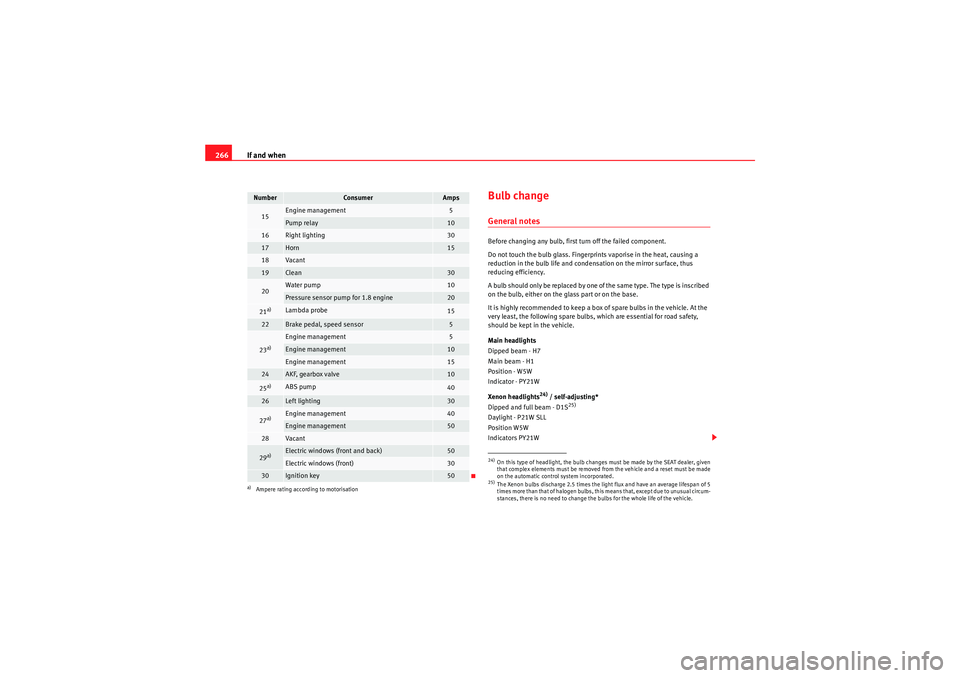
15
Engine management
5
Pump relay
10
16
Right lighting
30
17
Horn
15
18
Vacant
19
Clean
30
20
Water pump
10
Pressure sensor pump for 1.8 engine
20
21a)
Lambda probe
15
22
Brake pedal, speed sensor
5
23a)
Engine management
5
Engine management
10
Engine management
15
24
AKF, gearbox valve
10
25a)
ABS pump
40
26
Left lighting
30
27a)
Engine management
40
Engine management
50
28
Vacant
29a)
Electric windows (front and back)
50
Electric windows (front)
30
30
Ignition key
50
a)Ampere rating according to motorisationNumber
Consumer
Amps
24)On this type of headlight, the bulb changes must be made by the SEAT dealer, given
that complex elements must be removed from the vehicle and a reset must be made
on the automatic control system incorporated.25)The Xenon bulbs discharge 2.5 times the light flux and have an average lifespan of 5
t im es m o re t han tha t o f ha lo gen bu lbs , th is m ea ns t ha t, excep t du e to un u su a l ci rcu m -
stances, there is no need to change the bulbs for the whole life of the vehicle.
altea_EN Seite 266 Mittwoch, 26. August 2009 6:00 18
Page 269 of 310
If and when267
Safety First
Operating instructions
Practical tips
Technical Data
Fog lights
Fog lights - H3
Upper rear light
Stop/Position - P21W
26)
Indicator - R10W
Lower rear light
Fog light - P21W
Reverse light - P21W
Side indicator
Side indicator - W5W
Registration plate light
Registration plate light - C5W
Note
•Depending on weather conditions (cold or wet), the front lights, the fog
lights, the rear lights and the indicators may be temporarily misted. This has
no influence on the life expectancy of the lighting system. By switching on the
lights, the area through which the beam of light is projected will quickly be
demisted. However, the edges may continue to be misted.•Please check at regular intervals that all lighting (especially the exterior
lighting) on your vehicle is functioning properly. This is not only in the interest
of your own safety, but also in that of all other road users.•Due to the difficulty in accessing the lamps, any replacement work should
be done by a SEAT dealer. However, the following is a description of how to
change the lamps except for the fog lights* and interior lamps.
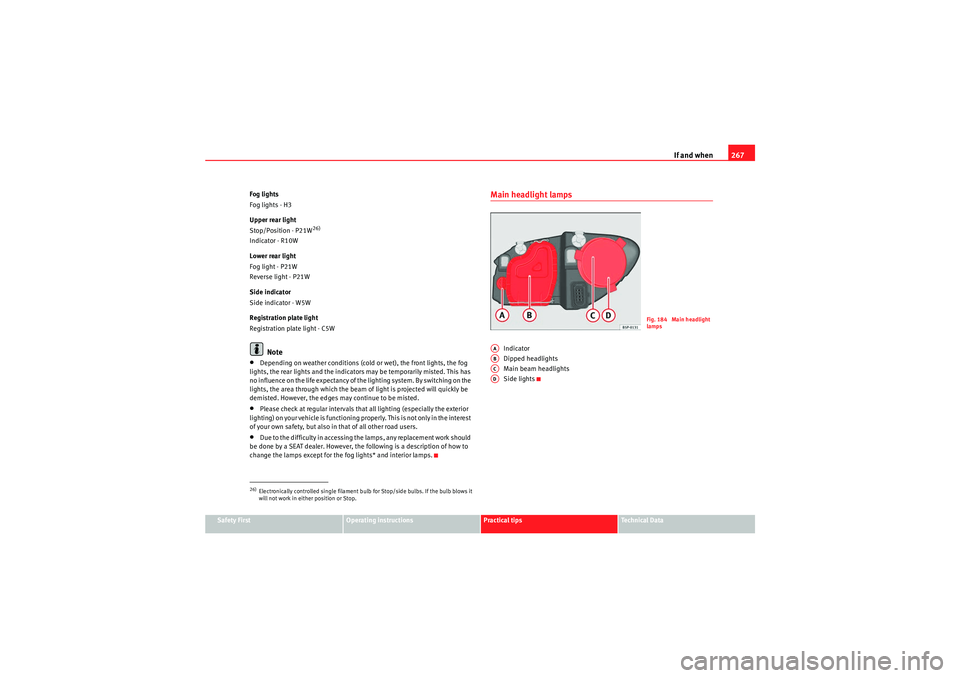
Main headlight lamps
Indicator
Dipped headlights
Main beam headlights
Side lights
26)Electronically controlled single filament bulb for Stop/side bulbs. If the bulb blows it
will not work in either position or Stop.
Fig. 184 Main headlight
lamps
AAABACAD
altea_EN Seite 267 Mittwoch, 26. August 2009 6:00 18
Page 270 of 310
If and when
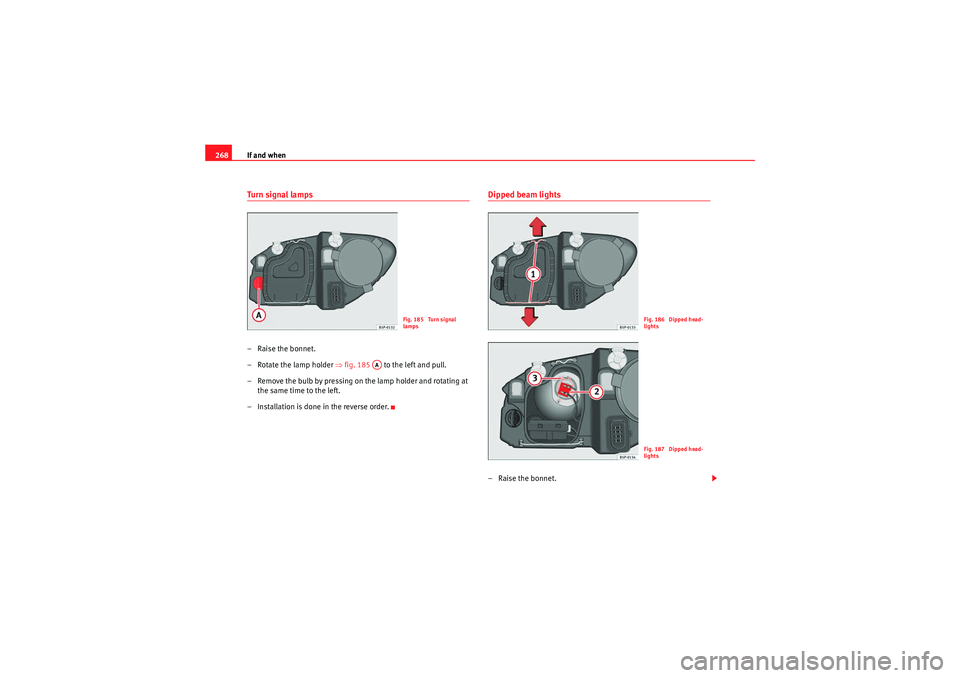
268Tu rn si g nal la m ps– Raise the bonnet.
– Rotate the lamp holder ⇒fig. 185 to the left and pull.
– Remove the bulb by pressing on the lamp holder and rotating at the same time to the left.
– Installation is done in the reverse order.
Dipped beam lights–Raise the bonnet.
Fig. 185 Turn signal
lamps
AA
Fig. 186 Dipped head-
lightsFig. 187 Dipped head-
lights
altea_EN Seite 268 Mittwoch, 26. August 2009 6:00 18
Page 271 of 310
If and when269
Safety First
Operating instructions
Practical tips
Technical Data
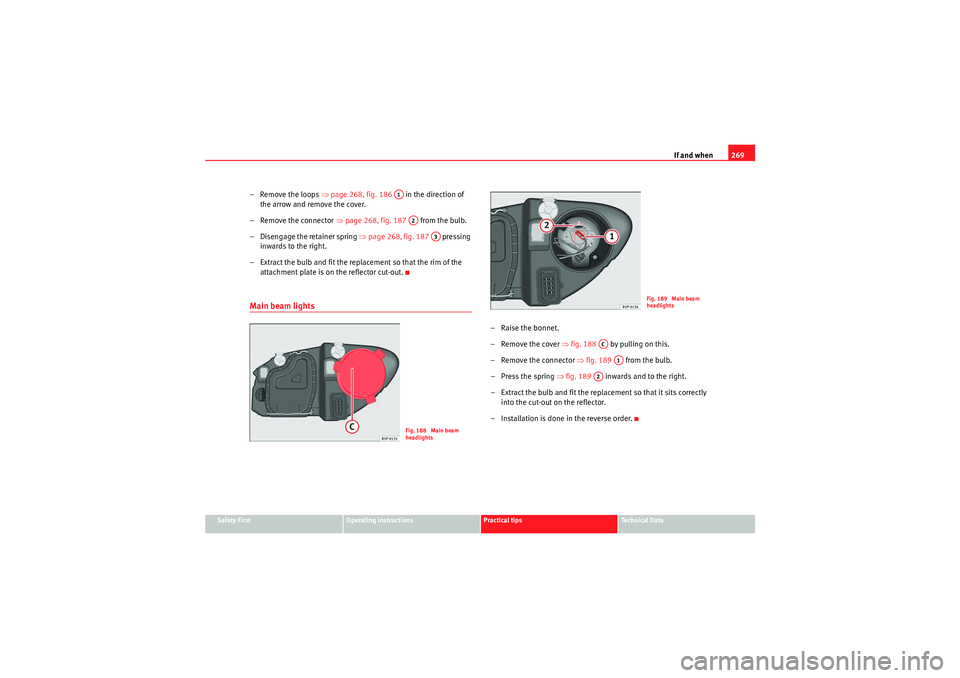
– Remove the loops ⇒page 268, fig. 186 in the direction of
the arrow and remove the cover.
– Remove the connector ⇒page 268, fig. 187 from the bulb.
– Disengage the retainer spring ⇒page 268, fig. 187 pressing
inwards to the right.
– Extract the bulb and fit the replacement so that the rim of the attachment plate is on the reflector cut-out.Main beam lights
– Raise the bonnet.
– Remove the cover ⇒ fig. 188 by pulling on this.
– Remove the connector ⇒fig. 189 from the bulb.
– Press the spring ⇒fig. 189 inwards and to the right.
– Extract the bulb and fit the replacement so that it sits correctly into the cut-out on the reflector.
– Installation is done in the reverse order.
A1A2
A3
Fig. 188 Main beam
headlights
Fig. 189 Main beam
headlights
AC
A1
A2
altea_EN Seite 269 Mittwoch, 26. August 2009 6:00 18
Page 272 of 310
If and when
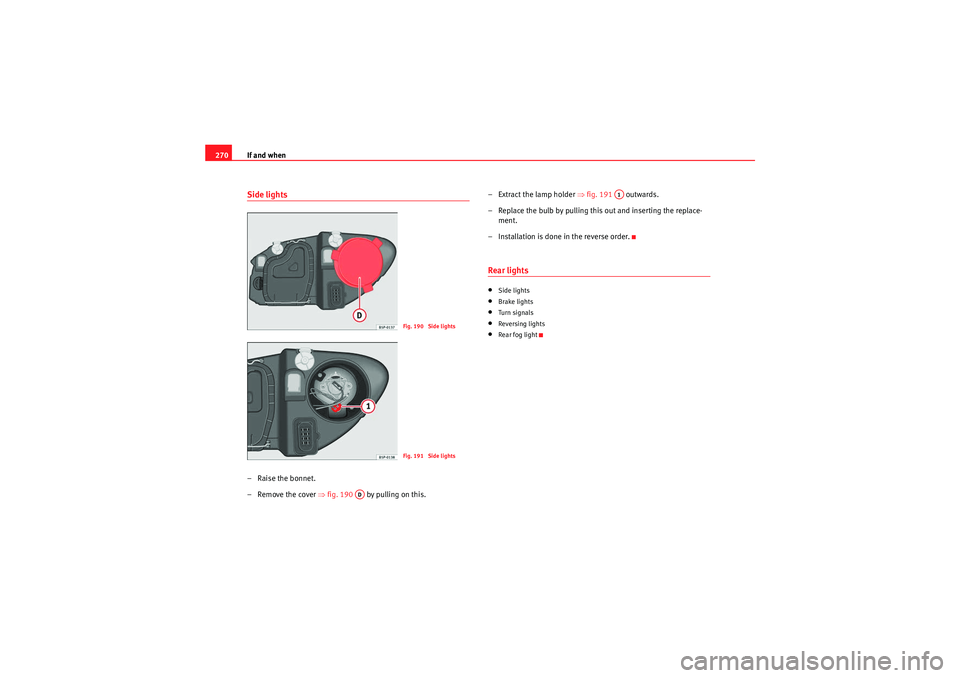
270Side lights– Raise the bonnet.
– Remove the cover ⇒ fig. 190 by pulling on this. – Extract the lamp holder
⇒fig. 191 outwards.
– Replace the bulb by pulling this out and inserting the replace- ment.
– Installation is done in the reverse order.
Rear lights•Side lights•Brake lights•Turn signals•Reversing lights•Rear fog light
Fig. 190 Side lightsFig. 191 Side lights
AD
A1
altea_EN Seite 270 Mittwoch, 26. August 2009 6:00 18
Page 273 of 310

If and when271
Safety First
Operating instructions
Practical tips
Technical Data
Side lights and brake lights– Open the tailgate.
– Remove the bolts ⇒ fig. 192 . – Remove the cover of the luggage compartment lateral panel.
– Unscrew the plastic fitting
⇒fig. 193 securing the rear light.
Inserting a screwdriver under th e plastic fitting may help to
loosen it.
– Partially remove the rear light from its casing taking care not to pull on the cable.
– Remove the lamp holder connector.
–Unscrew the bolts ⇒page 272, fig. 194 from the lamp holder
and pull on this.
– Press on the lamp and rotate to the left then fit the replacement.
– To refit follow the steps in reverse order, taking special care when fitting the lamp holder. The metal contacts of the lamp holder
ends should be correctly fitted with respect to the rear light
contacts.
Fig. 192 Side lights and
brake lightsFig. 193 Side lights and
brake lights
AA
ABAC
altea_EN Seite 271 Mittwoch, 26. August 2009 6:00 18
Page 274 of 310
If and when
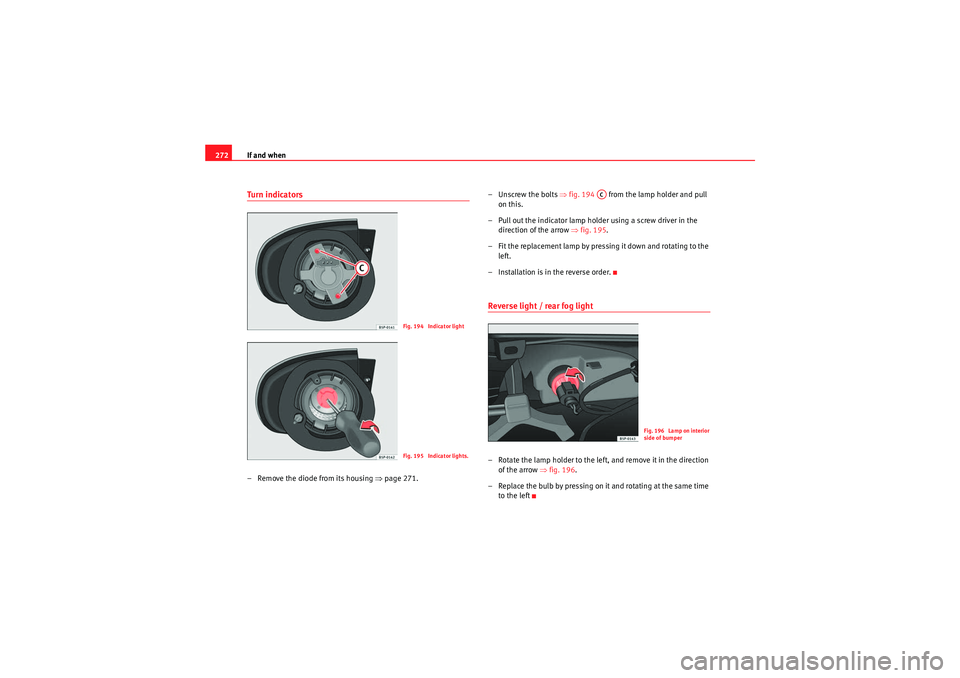
272Tu rn i nd ica t o rs– Remove the diode from its housing ⇒page 271. – Unscrew the bolts ⇒
fig. 194 from the lamp holder and pull
on this.
– Pull out the indicator lamp holder using a screw driver in the direction of the arrow ⇒fig. 195 .
– Fit the replacement lamp by pressing it down and rotating to the left.
– Installation is in the reverse order.
Reverse light / rear fog light– Rotate the lamp holder to the left, and remove it in the direction of the arrow ⇒fig. 196.
– Replace the bulb by pressing on it and rotating at the same time to the left
Fig. 194 Indicator lightFig. 195 Indicator lights.
AC
Fig. 196 Lamp on interior
side of bumper
altea_EN Seite 272 Mittwoch, 26. August 2009 6:00 18
Page 275 of 310
If and when273
Safety First
Operating instructions
Practical tips
Technical Data
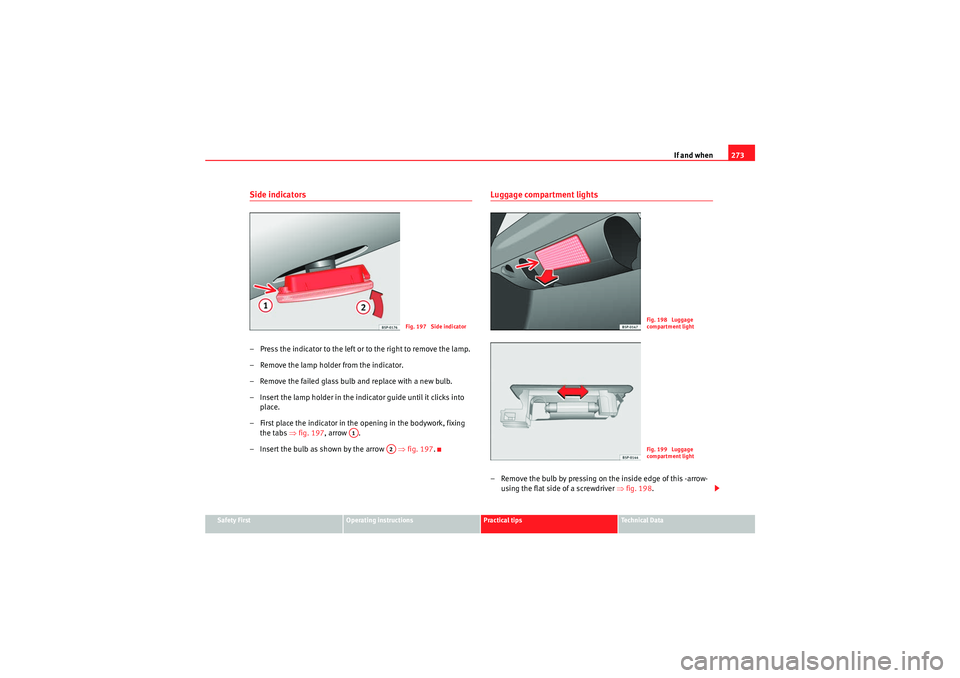
Side indicators– Press the indicator to the left or to the right to remove the lamp.
– Remove the lamp holder from the indicator.
– Remove the failed glass bulb and replace with a new bulb.
– Insert the lamp holder in the indicator guide until it clicks into
place.
– First place the indicator in th e opening in the bodywork, fixing
the tabs ⇒ fig. 197, arrow .
– Insert the bulb as shown by the arrow ⇒fig. 197 .
Luggage compartment lights– Remove the bulb by pressing on the inside edge of this -arrow-
using the flat side of a screwdriver ⇒fig. 198 .
Fig. 197 Side indicator
A1
A2
Fig. 198 Luggage
compartment lightFig. 199 Luggage
compartment light
altea_EN Seite 273 Mittwoch, 26. August 2009 6:00 18
Page 278 of 310
If and when
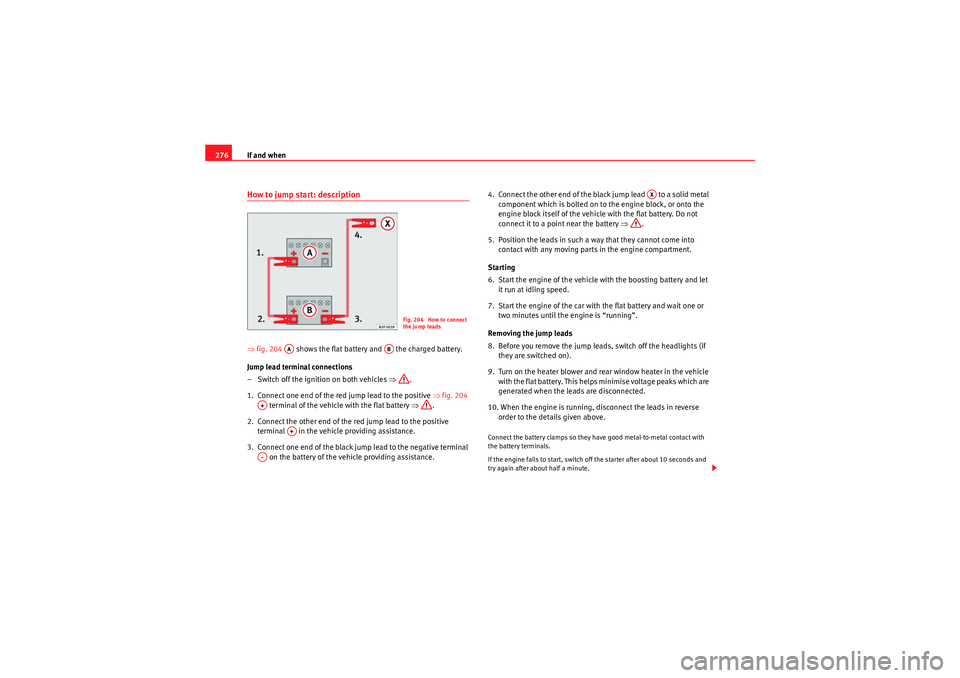
276How to jump start: description⇒ fig. 204 shows the flat battery and the charged battery.
Jump lead terminal connections
– Switch off the ignition on both vehicles ⇒.
1. Connect one end of the red jump lead to the positive ⇒fig. 204
terminal of the vehicle with the flat battery ⇒ .
2. Connect the other end of the red jump lead to the positive terminal in the vehicle providing assistance.
3. Connect one end of the black jump lead to the negative terminal on the battery of the vehicle providing assistance. 4. Connect the other end of the black jump lead to a solid metal
component which is bolted on to the engine block, or onto the
engine block itself of the vehicle with the flat battery. Do not
connect it to a point near the battery ⇒ .
5. Position the leads in such a way that they cannot come into contact with any moving parts in the engine compartment.
Starting
6. Start the engine of the vehicle with the boosting battery and let it run at idling speed.
7. Start the engine of the car with the flat battery and wait one or two minutes until the engine is “running”.
Removing the jump leads
8. Before you remove the jump leads, switch off the headlights (if they are switched on).
9. Turn on the heater blower and rear window heater in the vehicle with the flat battery. This helps minimise voltage peaks which are
generated when the leads are disconnected.
10. When the engine is running, disconnect the leads in reverse order to the details given above.
Connect the battery clamps so they have good metal-to-metal contact with
the battery terminals.
If the engine fails to start, switch off the starter after about 10 seconds and
try again after about half a minute.
Fig. 204 How to connect
the jump leads
AA
AB
A+
A+
A-
AX
altea_EN Seite 276 Mittwoch, 26. August 2009 6:00 18