steering Seat Altea 2010 Workshop Manual
[x] Cancel search | Manufacturer: SEAT, Model Year: 2010, Model line: Altea, Model: Seat Altea 2010Pages: 310, PDF Size: 7.46 MB
Page 198 of 310
Intelligent technology
196maintained (for instance, if the car is starting to skid), then the ESP compen-
sates automatically by braking the appropriate wheel.
The forces acting on the braked wheel bring the vehicle back to a stable
condition. If the vehicle tends to oversteer, the system will act on the front
wheel on the outside of the turn.
Steering manoeuvre recommendations
This is a complementary safety function included in the ESP This function aids
the driver to better stabilize the vehicle in a critical situation. For example, in
case of sudden braking surface with varied adherence, the vehicle will tend
to destabilize its trajectory to the right to or to the left. In this case the ESP
recognizes the situation and helps the driver with a counter steering
manoeuvre from the power steering.
This function simply provides the driver with a recommended manoeuvre in
critical situations.
The vehicle doesn't steer itself with this function, the driver has full control of
the vehicle at all times.
WARNING
•It must be remembered that ESP cannot defy the laws of physics. This
should be kept in mind, particularly on slippery and wet roads and when
towing a trailer.•Always adapt your driving style to suit the condition of the roads and
the traffic situation. Do not let the extra safety afforded by ESP tempt you
into taking any risks when driving, this can cause accidents.Caution
•In order to ensure that ESP functions correctly, all four wheels must be
fitted with the same tyres. Any differences in the rolling radius of the tyres can
cause the system to reduce engine power when this is not desired.
•Modifications to the vehicle (e.g. to the engine, the brake system, running
gear or any components affecting the wheels and tyres) could affect the effi-
ciency of the ABS, EDL, ESP and TCS.Anti-lock brake system (ABS)The anti-lock brake system prevents the wheels locking during braking
⇒ page 194.Electronic differential lock (EDL)*
The electronic differential lock helps prevent the loss of trac-
tion caused if one of the driven wheels starts spinning.EDL helps the vehicle to start moving, accelerate and climb a gradient in slip-
pery conditions where this may otherwise be difficult or even impossible.
The system will control the revolutions of the drive wheels using the ABS
sensors (in case of an EDL fault the warning lamp for ABS lights up)
⇒page 81.
At speeds of up to approximately 80 km/h, it is able to balance out differ-
ences in the speed of the driven wheels of approximately 100 rpm caused by
a slippery road surface on one side of the vehicle. It does this by braking the
wheel which has lost traction and distributing more driving force to the other
driven wheel via the differential.
To prevent the disc brake of the braking wheel from overheating, the EDL cuts
out automatically if subjected to excessive loads. The vehicle will continue to
function normally without EDL. For this reason, the driver is not informed that
the EDL has been switched off.
The EDL will switch on again automatically when the brake has cooled down.
altea_EN Seite 196 Mittwoch, 26. August 2009 6:00 18
Page 201 of 310
Intelligent technology199
Safety First
Operating instructions
Practical tips
Technical Data
Caution
•Never let the brakes “drag” by leaving your foot on the pedal when you do
not really intend to brake. This overheats the brakes, resulting in longer stop-
ping distances and greater wear.•Before driving down a long, steep gradient, it is advisable to reduce speed
and change to a lower gear (or move the selector lever to a lower gear position
if your car has automatic transmission). This makes use of engine braking
and prolongs the service life of the brakes. If you still have to use the brakes,
it is better to brake firmly at intervals than to apply the brakes continuously.Note
•If the brake servo is not functioning due to a malfunction, or if the vehicle
has to be towed, you will have to press the brake pedal considerably harder
to make up for the lack of servo assistance.•If you wish to equip the car with accessories such as a front spoiler or
wheel covers, it is important that the flow of air to the front wheels is not
obstructed, otherwise the brakes can overheat.Power steering (servotronic*)
The power steering assists th e driver when turning the
steering wheel (with the engine running).The power steering assists the driver by reducing the force needed to turn the
steering wheel. In cars equipped with servotronic* power steering the degree
of power assistance is regulated electronically according to road speed.
The power steering will keep on working even if the servotronic * device fails.
The degree of power assistance will, however, no longer adapt to different
speeds. If the electronic regulating system is not working properly, this is
most noticeable when turning the steering wheel at low speeds (for instance when parking) – more effort will be required than usual. The fault should be
corrected by a qualified workshop as soon as possible.
The power steering does not work if the engine is off. In this case the steering
wheel is very hard to turn.
If the steering is held at its
turning limit when the car is stationary, this will
place an excessive load on the power steering system. Turning the steering
wheel to its limit places a load on the system, which causes noise. It will also
reduce the idling speed of the engine.
Caution
When the engine is running, do not turn the steering wheel to its limit for
more than 15 seconds. Otherwise, there is a risk of damaging the power
steering.
Note
•If the power steering should fail at any time or the engine is switched off
(for instance when being towed), the car can still be steered. However, more
effort will be required to turn the steering wheel.•If the system is leaking or malfunctioning, please take the car to a quali-
fied workshop as soon as possible.•The power steering requires a special hydraulic fluid. The container is
located in the engine compartment (front left). The correct fluid level in the
reservoir is important for the power steering to function properly. The
hydraulic fluid level is checked at the Inspection Service.
altea_EN Seite 199 Mittwoch, 26. August 2009 6:00 18
Page 248 of 310
Wheels and tyres
246Wear indicators
The original tyres on your vehicle have 1.6 mm high “tread wear indicators”
⇒ page 245, fig. 173 , running across the tread. Depending on the make,
there will be six to eight of them evenly spaced around the tyre. Markings on
the tyre sidewall (for instance the letters “TWI” or other symbols) indicate the
positions of the tread wear indicators. The minimum tread depth required by
law is 1.6 mm (measured in the tread grooves next to the tread wear indica-
tors). Worn tyres must be replaced. Different figures may apply in export
countries ⇒.
Tyre pressure
Incorrect tyre pressure causes premature wear and could cause tyre blow-out.
For this reason, the tyre pressure should be checked at least once per month
⇒ page 243.
Driving style
Fast cornering, heavy acceleration and hard braking all increase tyre wear.
Changing wheels around
If the front tyres are worn considerably more than the rear ones it is advisable
to change them around as shown ⇒page 245, fig. 174 . All the tyres will then
last for about the same time.
Wheel balance
The wheels on new vehicles are balanced. However, various factors encoun-
tered in normal driving can cause them to become unbalanced, which results
in steering vibration.
Unbalanced wheels should be rebalanced, as they otherwise cause excessive
wear on steering, suspension and tyres. A wheel must also be rebalanced
when a new tyre is fitted.
Incorrect wheel alignment
Incorrect wheel alignment causes excessive tyre wear, impairing the safety of
the vehicle. If tyres show excessive wear, you should have the wheel align-
ment checked by an Authorised Service Centre.
WARNING
There is a serious danger of accidents if a tyre bursts during driving!•The tyres must be replaced at the latest when the tread is worn down to
the tread wear indicators. Failure to do so could result in an accident. Worn
tyres do not grip well at high speeds on wet roads. There is also a greater
risk of “aquaplaning” •At continuously high speeds, a tyre with insufficient pressure flexes
more. This causes it to overheat. This can cause tread separation and tyre
blow-out. Risk of accident. Always observe the recommended tyre pres-
sures.•If tyres show excessive wear, you should have the running gear checked
by an Authorised Service Centre.•Keep chemicals such as oil, fuel and brake fluid away from tyres.•Damaged wheels and tyres must be replaced immediately!For the sake of the environment
Under-inflated tyres will increase fuel consumption.Anti-puncture tyres
Anti-puncture tyres allow you to continue driving even with a
punctured tyre, in the majority of cases.Vehicles equipped with anti-puncture
23) tyres from the factory indi-
cate the loss of tyre pressu re on the instrument panel.
23)Depending upon version and country.
altea_EN Seite 246 Mittwoch, 26. August 2009 6:00 18
Page 264 of 310
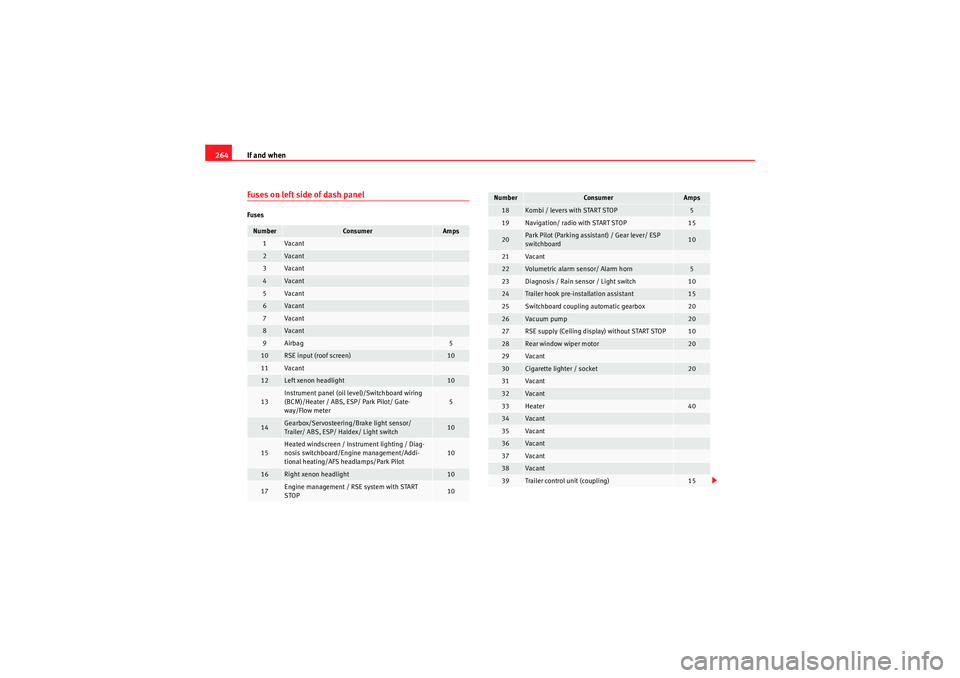
If and when
262
Fuse cover underneath the steering wheel
– Switch off the ignition and the component concerned.
– Identify the fuse for the failed component ⇒page 264.
– Take the plastic clip from inside the fuse cover, fit it onto the blown fuse and pull the fuse out.
– Replace the blown fuse (which will have a melted metal strip) with a new fuse of the same ampere rating.
Fuse cover in engine compartment
– Switch off the ignition and its failed electrical component.
– Prise off the fuse cover in the engine compartment by pressing the tabs towards the centre of the cover ⇒page 261, fig. 183 .
– Identify the fuse for the failed component ⇒ page 264.
– Take the plastic clip from inside the fuse cover (at left-hand end of the dash panel), fit it onto the blown fuse and pull the fuse out.
– Replace the blown fuse (which will have a melted metal strip) with a new fuse of the same ampere rating.
– Carefully fit the fuse cover back on to ensure no water can enter the fuse box.The individual electrical circuits are protected by fuses. The fuses are located
behind a cover at the left-hand end of the dash panel and on the left-hand
side of the engine compartment.
The electric windows are protected by circuit breakers. These reset automat-
ically after a few seconds when the overload (caused for example by frozen
windows) has been corrected. Fuses colour code
WARNING
Never “repair” damaged fuses and never replace them with fuses with a
higher rating. Failure to comply could result in fire. This could also cause
damage to other parts of the electrical system.
Note
•If a newly replaced fuse blows again after a short time, the electrical
system must be checked by a qualified workshop as soon as possible.•If you replace a fuse with higher-rating fuse, you could cause damage to
another location in the electrical system.•Always keep some spare fuses in the vehicle. These are available from
SEAT dealers.
Co lo ur
Amps
light brown
5
Red
10
Blue
15
Yellow
20
Natural (white)
25
Green
30
orange
40
Red
50
white
80
Blue
100
grey
150
violet
200
altea_EN Seite 262 Mittwoch, 26. August 2009 6:00 18
Page 266 of 310
If and when
264Fuses on left side of dash panelFusesNumber
Consumer
Amps
1
Va can t
2
Va can t
3
Va can t
4
Va can t
5
Va can t
6
Va can t
7
Va can t
8
Va can t
9
Airbag
5
10
RSE input (roof screen)
10
11
Va can t
12
Left xenon headlight
10
13
Instrument panel (oil level)/Switchboard wiring
(BCM)/Heater / ABS, ESP/ Park Pilot/ Gate-
way/Flow meter
5
14
Gearbox/Servosteering/Brake light sensor/
Trailer/ ABS, ESP/ Haldex/ Light switch
10
15
Heated windscreen / Instrument lighting / Diag-
nosis switchboard/Engine management/Addi-
tional heating/AFS headlamps/Park Pilot
10
16
Right xenon headlight
10
17
Engine management / RSE system with START
STOP
10
18
Kombi / levers with START STOP
5
19
Navigation/ radio with START STOP
15
20
Park Pilot (Parking assistant) / Gear lever/ ESP
switchboard
10
21
Vacant
22
Volumetric alarm sensor/ Alarm horn
5
23
Diagnosis / Rain sensor / Light switch
10
24
Trailer hook pre-installation assistant
15
25
Switchboard coupling automatic gearbox
20
26
Vacuum pump
20
27
RSE supply (Ceiling display) without START STOP
10
28
Rear window wiper motor
20
29
Vacant
30
Cigarette lighter / socket
20
31
Vacant
32
Vacant
33
Heater
40
34
Vacant
35
Vacant
36
Vacant
37
Vacant
38
Vacant
39
Trailer control unit (coupling)
15
Number
Co nsum er
Amps
altea_EN Seite 264 Mittwoch, 26. August 2009 6:00 18
Page 267 of 310
If and when265
Safety First
Operating instructions
Practical tips
Technical Data
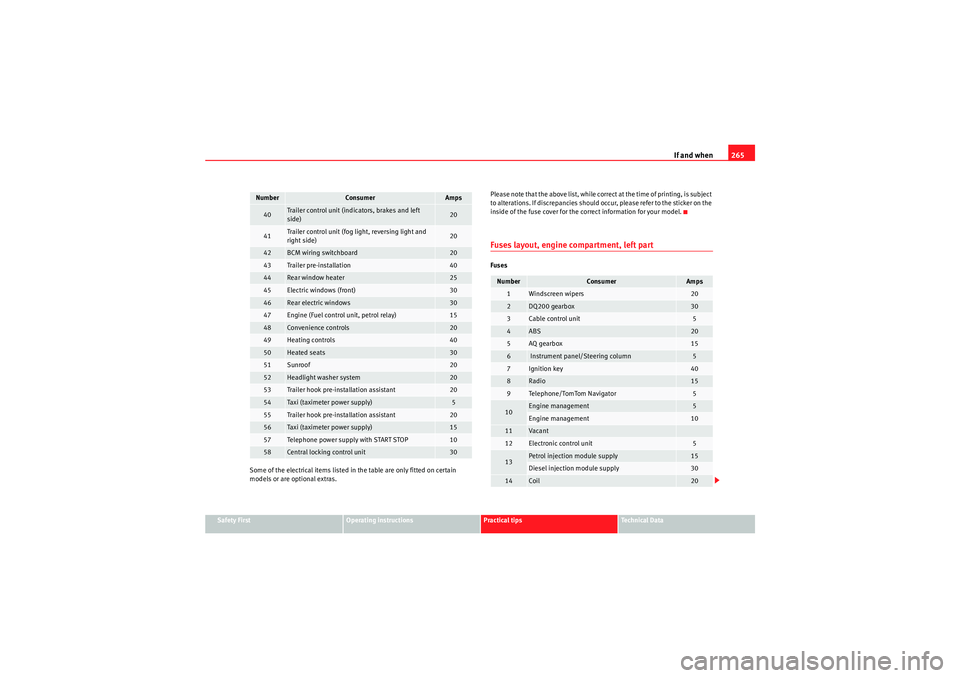
Some of the electrical items listed in the table are only fitted on certain
models or are optional extras. Please note that the above list, while correct at the time of printing, is subject
to alterations. If discrepancies should occur, please refer to the sticker on the
inside of the fuse cover for the correct information for your model.
Fuses layout, engine compartment, left partFuses
40
Trailer control unit (indicators, brakes and left
side)
20
41
Trailer control unit (fog light, reversing light and
right side)
20
42
BCM wiring switchboard
20
43
Trailer pre-installation
40
44
Rear window heater
25
45
Electric windows (front)
30
46
Rear electric windows
30
47
Engine (Fuel control unit, petrol relay)
15
48
Convenience controls
20
49
Heating controls
40
50
Heated seats
30
51
Sunroof
20
52
Headlight washer system
20
53
Trailer hook pre-installation assistant
20
54
Taxi (taximeter power supply)
5
55
Trailer hook pre-installation assistant
20
56
Taxi (taximeter power supply)
15
57
Telephone power supply with START STOP
10
58
Central locking control unit
30
Number
Consumer
Amps
Number
Consumer
Amps
1
Windscreen wipers
20
2
DQ200 gearbox
30
3
Cable control unit
5
4
ABS
20
5
AQ gearbox
15
6
Instrument panel/Steering column
5
7
Ignition key
40
8
Radio
15
9
Telephone/TomTom Navigator
5
10
Engine management
5
Engine management
10
11
Vaca nt
12
Electronic control unit
5
13
Petrol injection module supply
15
Diesel injection module supply
30
14
Coil
20
altea_EN Seite 265 Mittwoch, 26. August 2009 6:00 18
Page 280 of 310
If and when
278Towing and tow-startingTo w - s t a r t i n g
The use of jump leads is preferable to tow-starting.We recommend that you do not tow-start your vehicle. Jump-starting
is preferable ⇒page 275.
However, if your vehicle has to be tow-started:
– Engage the 2
nd or the 3
rd gear.
– Keep the clutch pressed down.
– Switch the ignition on.
– Once both vehicles are moving, release the clutch.
– As soon as the engine starts, press the clutch and move the gear lever into neutral. This helps to prevent driving into the towing
vehicle.
WARNING
The risk of accidents is high when tow-starting. The vehicle being towed
can easily collide with the towing vehicle.
Caution
When tow-starting, fuel could enter the catalytic converter and damage it.
CommentsPlease observe the following points if you use a tow-rope:
Notes for the driver of the towing vehicle
– Drive slowly at first until the tow-rope is taut. Then accelerate gradually.
– Begin and change gears cautiously. If you are driving an auto- matic vehicle, accelerate gently.
– Remember that the brake servo and power steering are not working in the vehicle you are towing. Brake earlier than you
would normally, but with a more gentle pressure on the brake.
Notes for the driver of the towed vehicle
– Ensure that the tow-rope remains taut at all times when towing.Tow-rope or tow-bar
It is easier and safer to tow a vehicle with a tow-bar. You should only use a
tow-rope if you do not have a tow-bar.
A tow-rope should be slightly elastic to reduce the loading on both vehicles.
It is advisable to use a tow-rope made of synthetic fibre or similarly elastic
material.
Attach the tow-rope or the tow-bar only to the towing eyes provided or a
towing bracket.
Driving style
Towing requires some experience, especially when using a tow-rope. Both
drivers should be familiar with the technique required for towing. Inexperi-
enced drivers should not attempt to tow-start or tow away another vehicle.
altea_EN Seite 278 Mittwoch, 26. August 2009 6:00 18
Page 281 of 310
If and when279
Safety First
Operating instructions
Practical tips
Technical Data
Do not pull too hard with the towing vehicle and take care to avoid jerking the
tow-rope. When towing on an unpaved road, there is always a risk of over-
loading and damaging the anchorage points.
The ignition of the vehicle being towed must be switched on to prevent the
steering wheel from locking and also to allow the use of the turn signals,
horn, windscreen wipers and washers.
As the brake servo does not work if the engine is not running, you must apply
considerably more pressure to the brake pedal than you normally would.
As the power assisted steering does not work if the engine is not running, you
will need more strength to steer than you normally would.
Towing vehicles with an automatic gearbox
•Put the selector lever into position “N”.•Do not drive faster than 50 km/h when towing a vehicle.•Do not tow further than 50 km.•If a breakdown vehicle is used, the vehicle must be towed with the front
wheels raised.Note
•Observe legal requirements when towing or tow-starting.•Switch on the hazard warning lights of both vehicles. However, observe
any regulations to the contrary.•For technical reasons, vehicles with an automatic gearbox must not be
tow-started.•If damage to your vehicle means that there is no lubricant in the gearbox,
you must raise the drive wheels while the vehicle is being towed.•If the vehicle has to be towed more than 50 km, the front wheels must be
raised during towing, and towing should be carried out by a qualified person.•The steering wheel is locked when the vehicle has no electrical power. The
vehicle must then be towed with the front wheels raised. Towing should be
carried out by a qualified person.
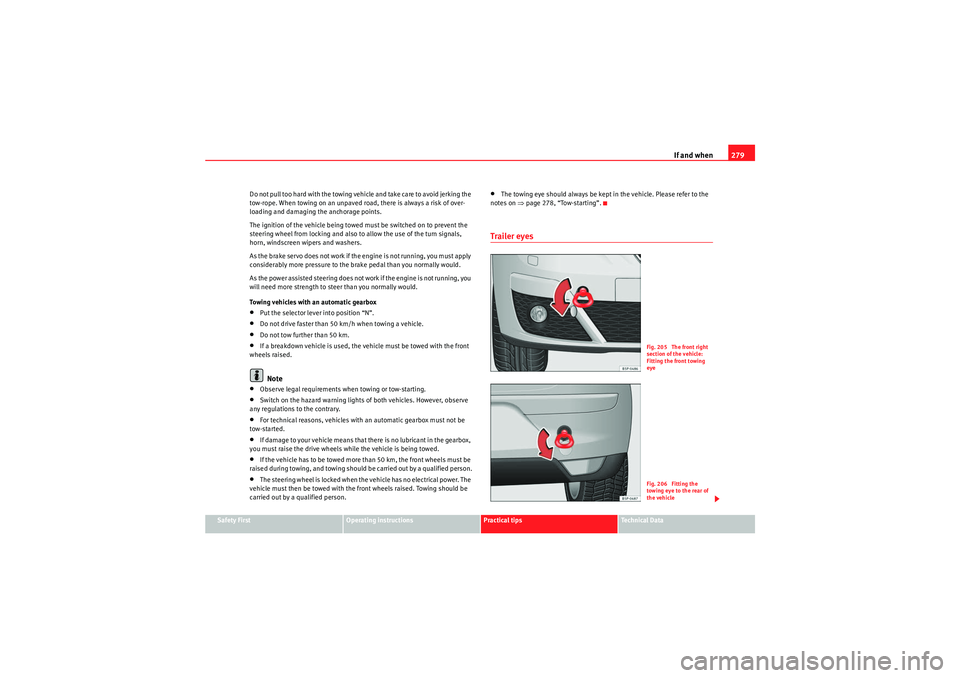
•The towing eye should always be kept in the vehicle. Please refer to the
notes on ⇒ page 278, “Tow-starting”.Trailer eyes
Fig. 205 The front right
section of the vehicle:
Fitting the front towing
eyeFig. 206 Fitting the
towing eye to the rear of
the vehicle
altea_EN Seite 279 Mittwoch, 26. August 2009 6:00 18
Page 304 of 310
Index
302Engine fault
Warning lamp . . . . . . . . . . . . . . . . . . . . . . . . 80
Engine management Warning lamp . . . . . . . . . . . . . . . . . . . . . . . . 80
Engine oil . . . . . . . . . . . . . . . . . . . . . . . . . . . . . . 229 Changing . . . . . . . . . . . . . . . . . . . . . . . . . . . 232
Checking level . . . . . . . . . . . . . . . . . . . . . . . 230
Oil properties . . . . . . . . . . . . . . . . . . . . . . . . 230
Specifications . . . . . . . . . . . . . . . . . . . . . . . 229
Topping up . . . . . . . . . . . . . . . . . . . . . . . . . . 231
Engine oil dipstick . . . . . . . . . . . . . . . . . . . . . . . 230
Engine oil pressure monitor indicator . . . . . . . . . . . . . . . . . . . . . . 66
Warning lamp . . . . . . . . . . . . . . . . . . . . . . . . 84
Environment . . . . . . . . . . . . . . . . . . . . . . . . . . . 202 Environmental friendliness . . . . . . . . . . . . 203
Environmental tip Avoiding pollution . . . . . . . . . . . . . . . . . . . . 221
ESP . . . . . . . . . . . . . . . . . . . . . . . . . . . . . . . . 85, 195
Example of menu use Program a speed limit warning . . . . . . . . . . 69
To activate and deactivate the speed limit warning . . . . . . . . . . . . . . . . . . . . . . . . . . . . 69
Example of the use of the menus Open the Configuration menu with the MFD lever . . . . . . . . . . . . . . . . . . . . . . . . . . . . . . 68
Open the Configuration menu with the steering wheel controls . . . . . . . . . . . . . . . . . . . . . . 69 Examples of menu use
Open the main menu . . . . . . . . . . . . . . . . . . 68
Open the winter tyres menu . . . . . . . . . . . . . 69
To close the winter tyres menu . . . . . . . . . . 69
Exhaust gasses purification system . . . . . . . . 201
Exterior mirrors . . . . . . . . . . . . . . . . . . . . . . . . . 212
FFabric trim cleaning . . . . . . . . . . . . . . . . . . . . . 216
Fastening rings . . . . . . . . . . . . . . . . . . . . . . . . . . 18
Fire extinguisher . . . . . . . . . . . . . . . . . . . . . . . . 151
First-aid kit . . . . . . . . . . . . . . . . . . . . . . . . . . . . . 151
Floor mats . . . . . . . . . . . . . . . . . . . . . . . . . . . . . . 16
Fog lights . . . . . . . . . . . . . . . . . . . . . . . . . . . . . . 113
Fog lights with cornering function . . . . . . . . . . 118
folding table* . . . . . . . . . . . . . . . . . . . . . . . . . . 140
Folding the seat backrests down . . . . . . . . . . . 138
Foot brake Warning lamp . . . . . . . . . . . . . . . . . . . . . . . . 86
Four wheel drive . . . . . . . . . . . . . . . . . . . . . . . . 197
Front airbags . . . . . . . . . . . . . . . . . . . . . . . . . . . . 34 Description . . . . . . . . . . . . . . . . . . . . . . . . . . 34
Front passenger airbag deactivation . . . . . . . . . 44
Front reading lights . . . . . . . . . . . . . . . . . . . . . . 123
Front seat adjustment Lumbar support . . . . . . . . . . . . . . . . . . . . . . 135
Frontal airbags Operation . . . . . . . . . . . . . . . . . . . . . . . . . . . . 35
safety notes . . . . . . . . . . . . . . . . . . . . . . . . . . 37 Fuel
Diesel . . . . . . . . . . . . . . . . . . . . . . . . . . . . . . 225
Petrol . . . . . . . . . . . . . . . . . . . . . . . . . . . . . . 224
Fuel level Indicator . . . . . . . . . . . . . . . . . . . . . . . . . . . . 58
Fuel reserve . . . . . . . . . . . . . . . . . . . . . . . . . . . . . 79 warning message . . . . . . . . . . . . . . . . . . . . . 67
Fuel Tank Opening the fuel tank flap . . . . . . . . . . . . . 220
Fuel tank See Fuel reserve . . . . . . . . . . . . . . . . . . . . . . 79
Fuel: saving . . . . . . . . . . . . . . . . . . . . . . . . . . . . 202
Fuses . . . . . . . . . . . . . . . . . . . . . . . . . . . . . . . . . 261
GG 12 . . . . . . . . . . . . . . . . . . . . . . . . . . . . . . . . . . 233
Gear shift pattern . . . . . . . . . . . . . . . . . . . . . . . 177
General overview of the engine compartment 285
Glove compartment . . . . . . . . . . . . . . . . . . . . . 139
Glow plug system . . . . . . . . . . . . . . . . . . . . . . . 171 Warning lamp . . . . . . . . . . . . . . . . . . . . . . . . 80
GRA . . . . . . . . . . . . . . . . . . . . . . . . . . . . . . . . . . 188HHandbrake . . . . . . . . . . . . . . . . . . . . . . . . . . . . . 183 Warning lamp . . . . . . . . . . . . . . . . . . . . 83, 183
Hazard warning lights . . . . . . . . . . . . . . . . . . . . 118
altea_EN Seite 302 Mittwoch, 26. August 2009 6:00 18
Page 306 of 310
Index
304Octane number . . . . . . . . . . . . . . . . . . . . . . . . . 224
Oil . . . . . . . . . . . . . . . . . . . . . . . . . . . . . . . . . . . . 229
Oil change . . . . . . . . . . . . . . . . . . . . . . . . . . . . . 232
Oil properties . . . . . . . . . . . . . . . . . . . . . . . . . . . 230
One-touch opening and closing
Electric windows . . . . . . . . . . . . . . . . . . . . . 109
Opening and locking . . . . . . . . . . . . . . . . . . . . 106
Overview Control lamps . . . . . . . . . . . . . . . . . . . . . . . . 77
Instrument panel . . . . . . . . . . . . . . . . . . . . . . 55
Instruments . . . . . . . . . . . . . . . . . . . . . . . . . . 57
Warning lamps . . . . . . . . . . . . . . . . . . . . . . . 77PPaintworkPolishing . . . . . . . . . . . . . . . . . . . . . . . . . . . 212
Parking . . . . . . . . . . . . . . . . . . . . . . . . . . . . . . . . 184
Parking aid acoustic system . . . . . . . . . . . . . . . 185
Parking lights . . . . . . . . . . . . . . . . . . . . . . . . . . 120
Parking system . . . . . . . . . . . . . . . . . . . . . . . . . 185
Parking system plus . . . . . . . . . . . . . . . . . . . . . 186
Pedals . . . . . . . . . . . . . . . . . . . . . . . . . . . . . . . . . 16
Petrol . . . . . . . . . . . . . . . . . . . . . . . . . . . . . . . . . 224 Driving abroad . . . . . . . . . . . . . . . . . . . . . . . 204
Petrol additives . . . . . . . . . . . . . . . . . . . . . . . . . 225
Petrol engines, starting . . . . . . . . . . . . . . . . . . 170
Physical principles of a frontal collision . . . . . . 21
Plastic parts . . . . . . . . . . . . . . . . . . . . . . . . . . . . 212
Plastic parts cleaning . . . . . . . . . . . . . . . . . . . . 216 Pollen filter . . . . . . . . . . . . . . . . . . . . . . . . . . . . 165
Power steering . . . . . . . . . . . . . . . . . . . . . . . . . . 199
Power steering system
warning light . . . . . . . . . . . . . . . . . . . . . . . . . 84
Products for vehicle maintenance . . . . . . . . . . 209
RRadio frequency remote control Changing the battery . . . . . . . . . . . . . . . . . 103
Radio navigation Steering wheel controls audio + telephone version . . . . . . . . . . . . . . 91
audio version . . . . . . . . . . . . . . . . . . . . . . . . . 91
Radio wave remote control . . . . . . . . . . . . . . . . 102
Rain sensor* . . . . . . . . . . . . . . . . . . . . . . . . . . . 127
Rear drink holder* Armrest* . . . . . . . . . . . . . . . . . . . . . . . . . . . . 144
Rear fog light Indication lamp . . . . . . . . . . . . . . . . . . . . . . 113
Warning lamp . . . . . . . . . . . . . . . . . . . . . . . . 80
Rear interior lights . . . . . . . . . . . . . . . . . . . . . . 123
Rear lights . . . . . . . . . . . . . . . . . . . . . . . . . . . . . 270
Rear reading lights . . . . . . . . . . . . . . . . . . . . . . 123
Rear seat bench . . . . . . . . . . . . . . . . . . . . . . . . . 137
Rear shelf Storage compartment . . . . . . . . . . . . . . . . . 153
Rear window heating Heating element wires . . . . . . . . . . . . . . . . 213
Rear window wiper . . . . . . . . . . . . . . . . . . . . . . 128
Rear-view mirror . . . . . . . . . . . . . . . . . . . . . . . . 129
Recommended gear display . . . . . . . . . . . . . . . . 62 Refuelling . . . . . . . . . . . . . . . . . . . . . . . . . . . . . 220
Registration light . . . . . . . . . . . . . . . . . . . . . . . 274
Remote control key
Buttons . . . . . . . . . . . . . . . . . . . . . . . . . . . . 102
Synchronising . . . . . . . . . . . . . . . . . . . . . . . 103
Removing and fitting the wheel . . . . . . . . . . . . 258
Repairs airbags . . . . . . . . . . . . . . . . . . . . . . . . . . . . . . 32
Replacement keys . . . . . . . . . . . . . . . . . . . . . . . 101
Replacement of parts . . . . . . . . . . . . . . . . . . . . 218
Rev counter . . . . . . . . . . . . . . . . . . . . . . . . . . . . . 59
Reverse gear Manual gearbox . . . . . . . . . . . . . . . . . . . . . 177
Roll-back function Sliding/tilting roof . . . . . . . . . . . . . . . . . . . 112
Windows . . . . . . . . . . . . . . . . . . . . . . . . . . . 109
Roof aerial* . . . . . . . . . . . . . . . . . . . . . . . . . . . . 219
Roof carrier* . . . . . . . . . . . . . . . . . . . . . . . . . . . 154
Roof stowage compartment* . . . . . . . . . . . . . . 141
Rubber seals . . . . . . . . . . . . . . . . . . . . . . . . . . . 213
Running in Engine . . . . . . . . . . . . . . . . . . . . . . . . . . . . . 200
SSafe driving . . . . . . . . . . . . . . . . . . . . . . . . . . . . . . 7
Safety . . . . . . . . . . . . . . . . . . . . . . . . . . . . . . . . . . . 8
Safety equipment . . . . . . . . . . . . . . . . . . . . . . . . . 7
Safety instructionsCoolant temperature . . . . . . . . . . . . . . . . . . . 80
altea_EN Seite 304 Mittwoch, 26. August 2009 6:00 18