radio Seat Altea 2012 User Guide
[x] Cancel search | Manufacturer: SEAT, Model Year: 2012, Model line: Altea, Model: Seat Altea 2012Pages: 313, PDF Size: 4.47 MB
Page 99 of 313
97
Unlocking and locking
Unlocking and locking
Central locking Basic functions
The central locking system enables you to lock and unlock
all doors by just pushing the button.Description
Central locking can be activated by using any of the following options:
● the key, by inserting it into the driver door cylinder and rotating it man-
ually,
● the central lock button in the vehicle interior ⇒ page 100.
● the radio frequency remote control , using the buttons on the key,
⇒ page 105
Various functions are available to improve the vehicle safety: “Safe” locking system
Selective unlocking system*
Automatic speed-dependent locking and unlocking system*
Self-locking system to prevent involuntary unlocking
Emergency unlocking system
Unlocking the vehicle* Press button
⇒ fig. 64 on remote control to unlock all the doors and
tailgate.
–
–
–
–
–
– Locking the vehicle*
Press button
⇒
fig. 64 on the remote control to lock all doors and the
tailgate or turn the key in the door to lock all doors and the tailgate.
WARNING
● Never leave children or disabled persons in the vehicle. In case of
emergency, they may not be able to leave the vehicle or manage on their
own.
● Never allow children to play in or around the vehicle. A locked vehicle
can be subjected to extremely high and low temperatures, depending on
the time of year, thus causing serious injuries/illness. It could even have
fatal consequences. Close and lock both the tailgate and all the other
doors when you are not using the vehicle.
● Always take you car keys with you when you leave the vehicle. Misuse
of the keys, for example, by children, may result in serious damage and
accident.
–The engine may accidentally be started and be out of control.
– If the ignition is switched on, the electric equipment could be acti-
vated with risk of injury, for example, in the electric windows.
– The doors can be locked using the remote control key. This could
make the aid difficult in an emergency situation.
– Always take the key with you when you leave the vehicle.
● Never remove the key from the ignition if the vehicle is in motion. The
steering lock could suddenly engage, and you would not be able to steer
the vehicle.
–
Safety FirstOperating InstructionsPractical TipsTechnical Specifications
Page 107 of 313
105
Unlocking and locking
Radio frequency remote control Locking and unlocking the vehicle
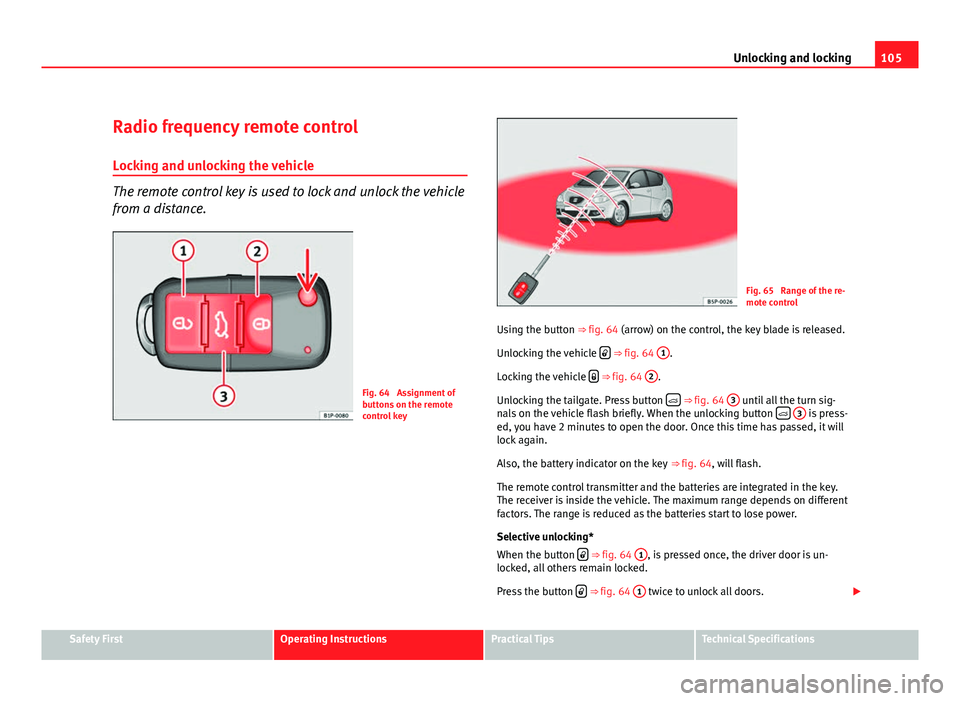
The remote control key is used to lock and unlock the vehicle
from a distance.
Fig. 64 Assignment of
buttons on the remote
control key
Fig. 65 Range of the re-
mote control
Using the button ⇒ fig. 64 (arrow) on the control, the key blade is released. Unlocking the vehicle
⇒ fig. 64
1.
Locking the vehicle
⇒ fig. 64
2.
Unlocking the tailgate. Press button
⇒ fig. 64
3 until all the turn sig-
nals on the vehicle flash briefly. When the unlocking button
3 is press-
ed, you have 2 minutes to open the door. Once this time has passed, it will
lock again.
Also, the battery indicator on the key ⇒ fig. 64, will flash.
The remote control transmitter and the batteries are integrated in the key.
The receiver is inside the vehicle. The maximum range depends on different
factors. The range is reduced as the batteries start to lose power.
Selective unlocking*
When the button
⇒
fig. 64 1, is pressed once, the driver door is un-
locked, all others remain locked.
Press the button
⇒ fig. 64
1 twice to unlock all doors.
Safety FirstOperating InstructionsPractical TipsTechnical Specifications
Page 108 of 313
106Unlocking and locking
WARNING
● An improper use of the key can cause serious injuries.
● Never leave children or disabled persons in the vehicle. In case of
emergency, they may not be able to leave the vehicle or manage on their
own.
● Never forget the keys inside the vehicle. Otherwise, this could result
in serious injuries, accidents or even the theft of your vehicle. Always
take the key with you when you leave the vehicle.
● An uncontrolled use of the key could start the engine or activate any
electric equipment (e.g. electric windows), causing risk of accident. The
vehicle can be locked when using the remote control key. This could com-
plicate the aid in case of emergency.
Note
● The remote control can be programmed by means of pressing the un-
locking button once; as a result, only the driver door will unlock. When the
button is pressed once more, all doors and the tailgate will be unlocked.
● The remote control functions only when you are in range ⇒ fig. 65 (red
area).
● If the vehicle is unlocked using the
1 button, it will lock again auto-
matically if any of the doors or the tailgate are not opened within 30 sec-
onds after unlocking it. This function prevents the vehicle from remaining
unlocked if the unlock button is pressed by mistake.
● If the vehicle cannot be opened and closed using the remote control,
the remote control key will have to be re-synchronised ⇒ page 106.
Changing the battery
If the battery indicator does not flash when the buttons are pushed, the bat-
tery must be replaced.
CAUTION
The use of inappropriate batteries may damage the radio frequency remote
control. For this reason, always replace the dead battery with another of the
same size and power.
For the sake of the environment
Used batteries must be disposed of at an appropriate waste facility or
through an authorised service, given that their components can affect the
environment.
Synchronising the remote control key
If it is not possible to unlock or lock the door with the remote
control, it should be re-synchronised.
– Press the
⇒ fig. 64 button on the remote control.
– Then close the vehicle using the key bit within one minute.
It is possible that the vehicle could no longer be opened and closed with
the remote control if the button
is repeatedly pressed outside of the ef-
fective range of the radio frequency remote control. The remote control key
will have to be resynchronised.
Spare remote control keys are available in your Authorised Service Centres,
where they must be matched to the locking system.
Up to eight remote control keys can be used.
Page 154 of 313

152Seats and storage compartments
Note
● The use of electrical appliances with the engine switched off will cause a
battery discharge.
● Before using any electrical accessories, see the instructions in
⇒ page 221.
Auxiliary audio input (AUX-IN)*
Fig. 119 Auxiliary audio
connection
– Lift the AUX cover ⇒ fig. 119.
– Insert the plug as far as possible (see Radio manual). AUX RSE connection*
Fig. 120 AUX RSE con-
nection
This connector may be used as an audio input (red and white connectors) or
audio and video connector (red, white and yellow connectors). For more de-
tails about the use of this audio and video source, see the RSE manual.
Page 155 of 313
153
Seats and storage compartments
MEDIA-IN* connector
Fig. 121 Connection in
central armrest compart-
ment
For information concerning the use of this equipment, please see the Radio
handbook. First-aid kit, warning triangle, fire
extinguisher
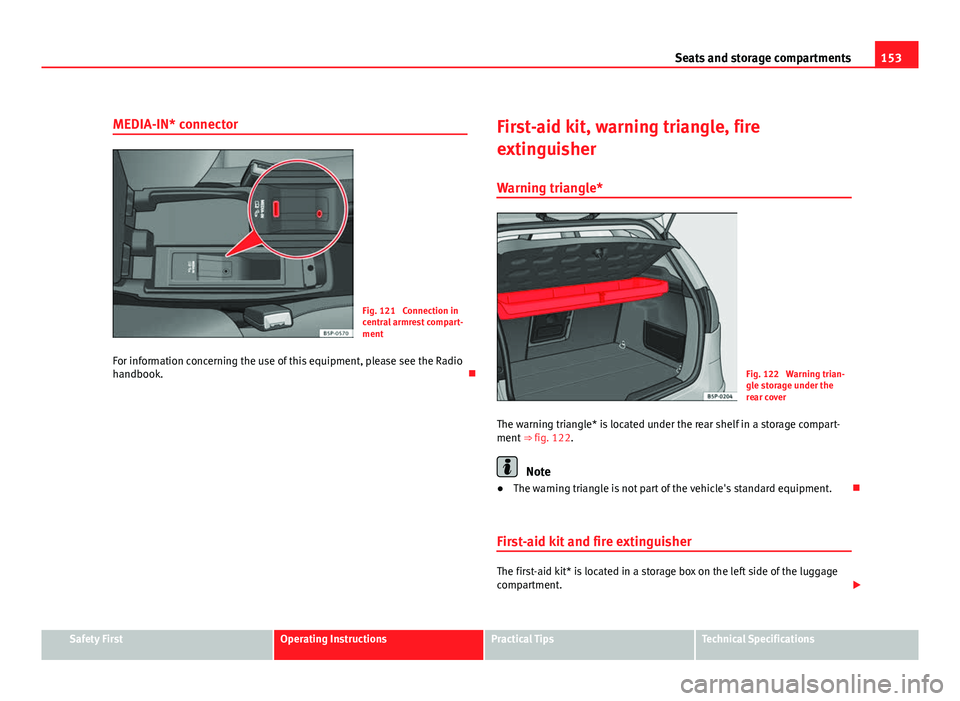
Warning triangle*
Fig. 122 Warning trian-
gle storage under the
rear cover
The warning triangle* is located under the rear shelf in a storage compart-
ment ⇒ fig. 122.
Note
● The warning triangle is not part of the vehicle's standard equipment.
First-aid kit and fire extinguisher
The first-aid kit* is located in a storage box on the left side of the luggage
compartment.
Safety FirstOperating InstructionsPractical TipsTechnical Specifications
Page 165 of 313
163
Air conditioning
2C-Climatronic*
Controls
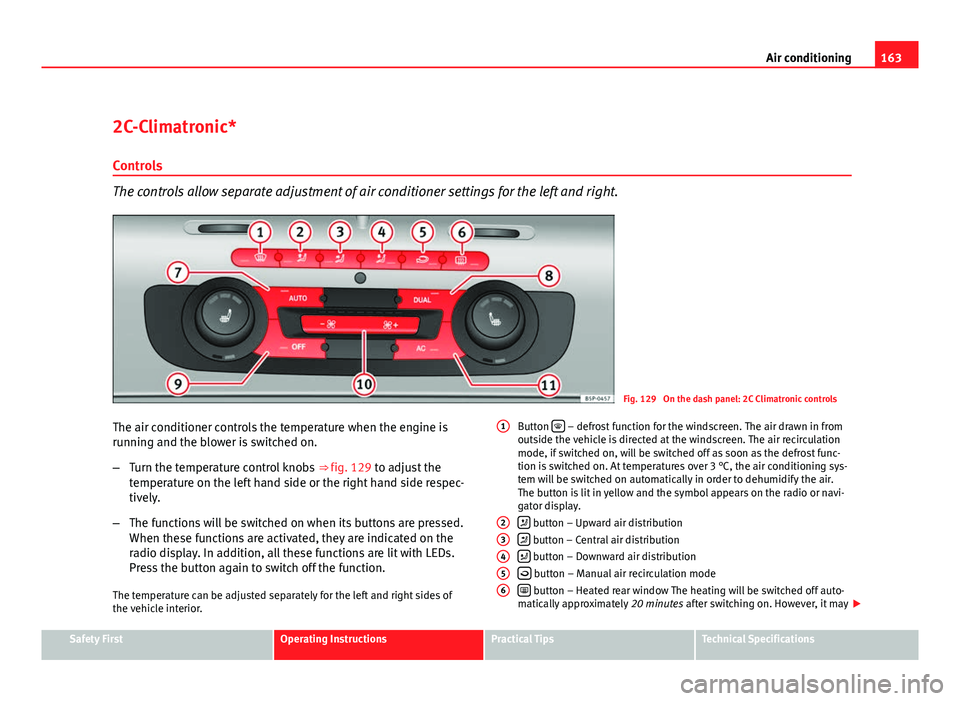
The controls allow separate adjustment of air conditioner settings for the left and right.
Fig. 129 On the dash panel: 2C Climatronic controls
The air conditioner controls the temperature when the engine is
running and the blower is switched on.
– Turn the temperature control knobs ⇒ fig. 129 to adjust the
temperature on the left hand side or the right hand side respec-
tively.
– The functions will be switched on when its buttons are pressed.
When these functions are activated, they are indicated on the
radio display. In addition, all these functions are lit with LEDs.
Press the button again to switch off the function.
The temperature can be adjusted separately for the left and right sides of
the vehicle interior. Button
– defrost function for the windscreen. The air drawn in from
outside the vehicle is directed at the windscreen. The air recirculation
mode, if switched on, will be switched off as soon as the defrost func-
tion is switched on. At temperatures over 3 °C, the air conditioning sys-
tem will be switched on automatically in order to dehumidify the air.
The button is lit in yellow and the symbol appears on the radio or navi-
gator display.
button – Upward air distribution
button – Central air distribution
button – Downward air distribution
button – Manual air recirculation mode
button – Heated rear window The heating will be switched off auto-
matically approximately 20 minutes after switching on. However, it may
1
23456
Safety FirstOperating InstructionsPractical TipsTechnical Specifications
Page 166 of 313
164Air conditioning
be turned off by pushing the button. The button lights up yellow and
the symbol appears in the display.AUTO
button – Automatic temperature, ventilation and air distribution
control ⇒ page 165
DUAL
button - Dual zone synchroniser
OFF button – Switches the 2C-Climatronic on and off ⇒ page 166
Blower control ⇒ page 166
AC
button – Switches heating, ventilation and air-conditioning system
on
WARNING
For road safety all windows must be clear of ice, snow, and condensation.
This is essential to ensure good visibility. Please familiarise yourself with
the correct operation of the heating and ventilation system, including the
anti-fog/defrost functions for the windscreens.
Note
Please observe the general notes ⇒ page 167.
7
891011
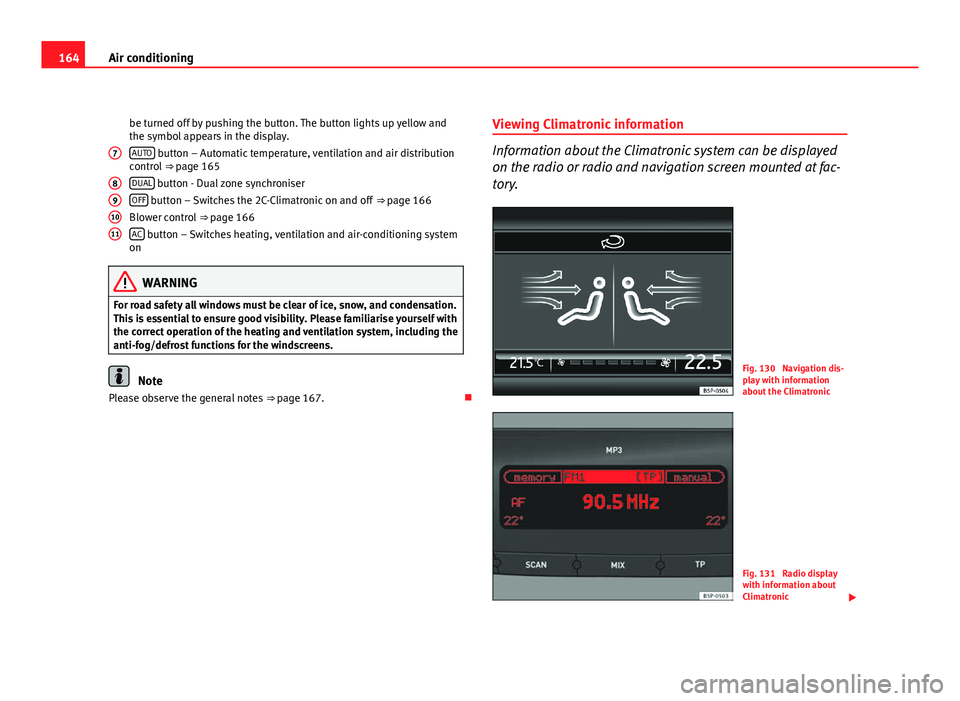
Viewing Climatronic information
Information about the Climatronic system can be displayed
on the radio or radio and navigation screen mounted at fac-
tory.
Fig. 130 Navigation dis-
play with information
about the Climatronic
Fig. 131 Radio display
with information about
Climatronic
Page 167 of 313
165
Air conditioning
The LEDs on the Climatronic controls indicate that the selected function has
been activated.
In addition, the radio or radio and navigation displays mounted at factory
briefly display the current settings of the Climatronic if any are modified.
The symbols used on the radio or radio and navigation displays are the
same as the symbols used for the Climatronic controls.
Automatic mode
In automatic mode air temperature, air flow and distribution
are automatically regulated so that a specified temperature
is attained as quickly as possible and then maintained. The temperature can be adjusted separately for the left and right
sides of the vehicle interior.
Switching on automatic mode
– Press the AUTO
⇒
fig. 129 button. “AUTO High” is shown on the
radio display (high fan speed).
– Press the AUTO
button again ⇒ fig. 129. “AUTO Low” is shown
on the radio display (low fan speed).
Depending upon the version and finish, the vehicle may include: When a temperature of 22 °C (72 °F) is set in automatic mode a comfortable
interior climate is quickly reached. Therefore, we recommend you not to
change this adjustment, except as necessary to suit individual preferences
or particular circumstances. The inside temperature can be set between
+18 °C (64 °F) and +26 °C (80 °F). These are approximate temperatures and
the actual temperature may be slightly higher or lower depending on the
ambient conditions.
Climatronic maintains a constant temperature. The temperature of the air
supplied to the interior, the blower speed and the air distribution are regu-
lated automatically. The system also considers the sunlight radiation, so
there is no need for manual readjustment. Therefore,
automatic mode al-
most always provides the best comfort for the vehicle occupants throughout
the year.
Automatic mode is switched off whenever an adjustment is made using the
buttons for the air distribution, air flow or
or the air recirculation button
. The temperature will continue to be regulated within the parameters
manually selected by the user.
Note
There are two automatic modes:
● Automatic mode LO: This calculates the air flow for two people.
● Automatic mode HI: This calculates the air flow for more than two peo-
ple.
Safety FirstOperating InstructionsPractical TipsTechnical Specifications
Page 168 of 313
166Air conditioning
Manual mode
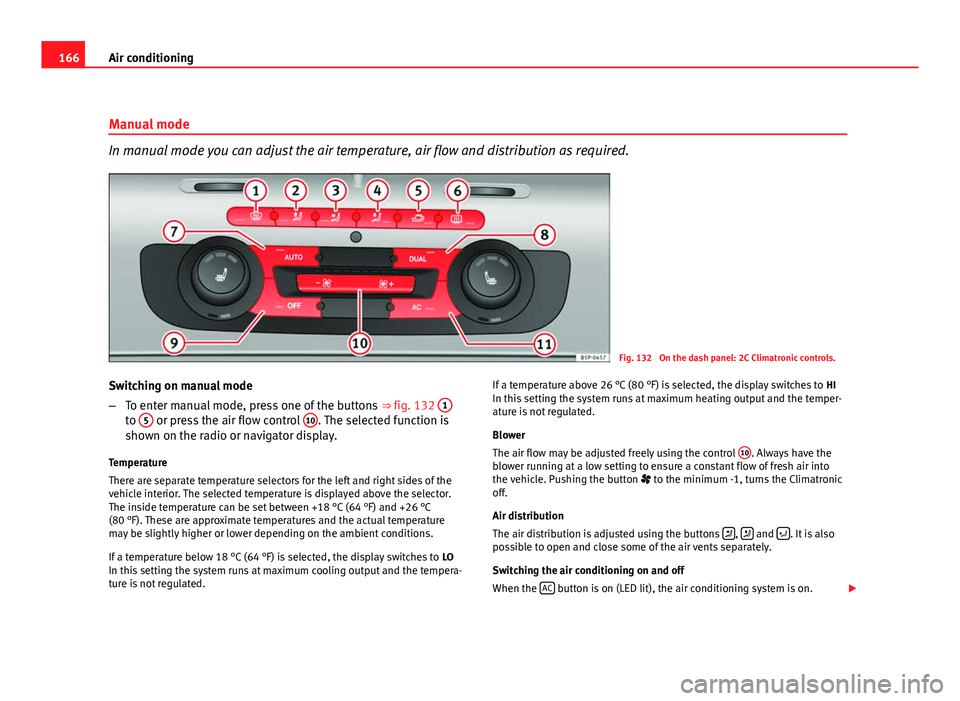
In manual mode you can adjust the air temperature, air flow and distribution as required.
Fig. 132 On the dash panel: 2C Climatronic controls.
Switching on manual mode
– To enter manual mode, press one of the buttons ⇒ fig. 132 1
to 5 or press the air flow control 10. The selected function is
shown on the radio or navigator display.
Temperature
There are separate temperature selectors for the left and right sides of the
vehicle interior. The selected temperature is displayed above the selector.
The inside temperature can be set between +18 °C (64 °F) and +26 °C
(80 °F). These are approximate temperatures and the actual temperature
may be slightly higher or lower depending on the ambient conditions.
If a temperature below 18 °C (64 °F) is selected, the display switches to LO
In this setting the system runs at maximum cooling output and the tempera-
ture is not regulated. If a temperature above 26 °C (80 °F) is selected, the display switches to
HI
In this setting the system runs at maximum heating output and the temper-
ature is not regulated.
Blower
The air flow may be adjusted freely using the control 10
. Always have the
blower running at a low setting to ensure a constant flow of fresh air into
the vehicle. Pushing the button to the minimum -1, turns the Climatronic
off.
Air distribution
The air distribution is adjusted using the buttons
, and . It is also
possible to open and close some of the air vents separately.
Switching the air conditioning on and off
When the AC
button is on (LED lit), the air conditioning system is on.
Page 190 of 313
188Driving
SEAT Parking System Plus*: Description
The parking system plus is an acoustic and optical parking
aid.
Sensors are located in the front and rear bumpers. When the sensors detect
an obstacle, you are alerted by acoustic and optical signals. The measuring
range of the sensors starts at approximately:
FrontSide0.90Centre1.20
RearSide0.60Centre1.60
The acoustic signals sound with increasing frequency as you approach the
obstacle. When the vehicle is less than 0.30 m away from the obstacle, the
warning tone will sound continuously. Stop moving immediately!
The volume of the warning beeps will be gradually reduced after about four
seconds if the vehicle remains at a constant distance from a detected obsta-
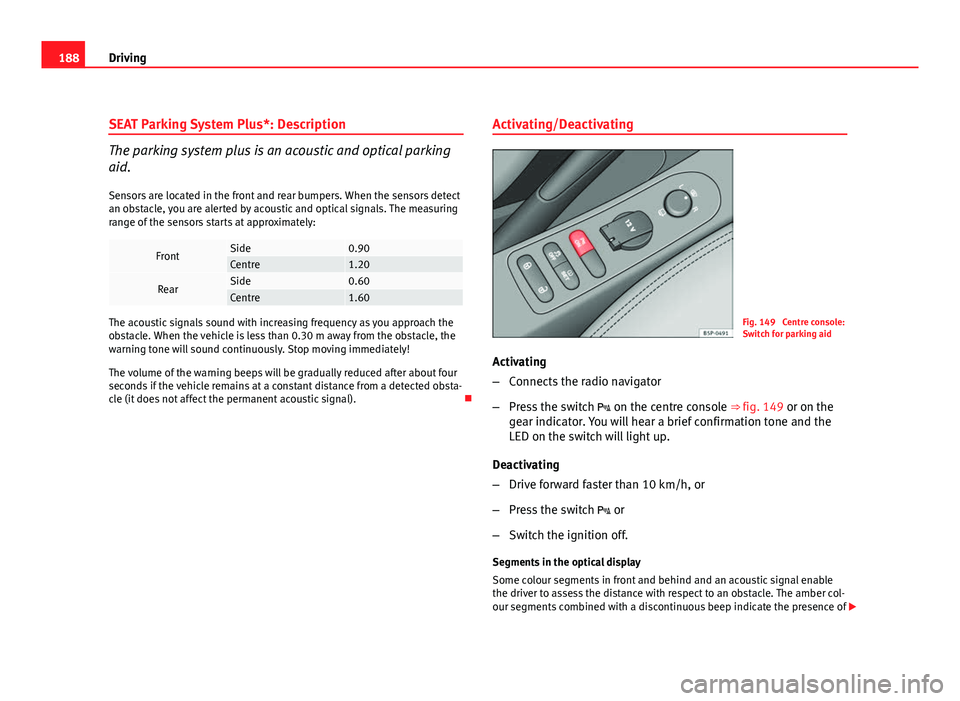
cle (it does not affect the permanent acoustic signal). Activating/DeactivatingFig. 149 Centre console:
Switch for parking aid
Activating
– Connects the radio navigator
– Press the switch on the centre console ⇒ fig. 149 or on the
gear indicator. You will hear a brief confirmation tone and the
LED on the switch will light up.
Deactivating
– Drive forward faster than 10 km/h, or
– Press the switch or
– Switch the ignition off.
Segments in the optical display
Some colour segments in front and behind and an acoustic signal enable
the driver to assess the distance with respect to an obstacle. The amber col-
our segments combined with a discontinuous beep indicate the presence of