stop start Seat Altea 2012 Owner's Manual
[x] Cancel search | Manufacturer: SEAT, Model Year: 2012, Model line: Altea, Model: Seat Altea 2012Pages: 313, PDF Size: 4.47 MB
Page 5 of 313
Table of Contents
Manual structure . . . . . . . . . . . . . . . . . . . . 5
Content . . . . . . . . . . . . . . . . . . . . . . . . . . . . . . . . 6
Safety First . . . . . . . . . . . . . . . . . . . . . . . . . . . . 7
Safe driving . . . . . . . . . . . . . . . . . . . . . . . . . . . . . . . 7
Brief introduction . . . . . . . . . . . . . . . . . . . . . . . . . 7
Proper sitting position for occupants . . . . . . . . . 10
Pedal area . . . . . . . . . . . . . . . . . . . . . . . . . . . . . . . 16
Storing objects . . . . . . . . . . . . . . . . . . . . . . . . . . . 17
Seat belts . . . . . . . . . . . . . . . . . . . . . . . . . . . . . . . . . 19
Brief introduction . . . . . . . . . . . . . . . . . . . . . . . . . 19
Why wear seat belts? . . . . . . . . . . . . . . . . . . . . . . 21
Seat belts . . . . . . . . . . . . . . . . . . . . . . . . . . . . . . . 25
Seat belt tensioners . . . . . . . . . . . . . . . . . . . . . . . 29
Airbag system . . . . . . . . . . . . . . . . . . . . . . . . . . . . . 30
Brief introduction . . . . . . . . . . . . . . . . . . . . . . . . . 30
Front airbags . . . . . . . . . . . . . . . . . . . . . . . . . . . . . 34
Side airbags* . . . . . . . . . . . . . . . . . . . . . . . . . . . . 38
Curtain airbags . . . . . . . . . . . . . . . . . . . . . . . . . . . 41
Deactivating airbags* . . . . . . . . . . . . . . . . . . . . . . 44
Child safety . . . . . . . . . . . . . . . . . . . . . . . . . . . . . . . 46
Brief introduction . . . . . . . . . . . . . . . . . . . . . . . . . 46
Child seats . . . . . . . . . . . . . . . . . . . . . . . . . . . . . . . 48
Securing child seats . . . . . . . . . . . . . . . . . . . . . . . 51 Operating Instructions
. . . . . . . . . . . . . 55
Cockpit . . . . . . . . . . . . . . . . . . . . . . . . . . . . . . . . . . . 55
Overview . . . . . . . . . . . . . . . . . . . . . . . . . . . . . . . . 55
Instruments . . . . . . . . . . . . . . . . . . . . . . . . . . . . . . 57
LPG system* . . . . . . . . . . . . . . . . . . . . . . . . . . . . . 60
Digital instrument panel display . . . . . . . . . . . . . 61
Instrument panel menus* . . . . . . . . . . . . . . . . . . . 68
Warning lamps . . . . . . . . . . . . . . . . . . . . . . . . . . . 77
Steering wheel controls . . . . . . . . . . . . . . . . . . . . 91
General information . . . . . . . . . . . . . . . . . . . . . . . 91
Audio system . . . . . . . . . . . . . . . . . . . . . . . . . . . . . 92
Radio navigation system . . . . . . . . . . . . . . . . . . . 95
Unlocking and locking . . . . . . . . . . . . . . . . . . . . . 97
Central locking . . . . . . . . . . . . . . . . . . . . . . . . . . . 97
Keys . . . . . . . . . . . . . . . . . . . . . . . . . . . . . . . . . . . . 103
Radio frequency remote control . . . . . . . . . . . . . . 105
Anti-theft alarm system* . . . . . . . . . . . . . . . . . . . 107
Tailgate . . . . . . . . . . . . . . . . . . . . . . . . . . . . . . . . . 109
Windows . . . . . . . . . . . . . . . . . . . . . . . . . . . . . . . . 111
Sliding/tilting sunroof* . . . . . . . . . . . . . . . . . . . . 113
Lights and visibility . . . . . . . . . . . . . . . . . . . . . . . . 116
Lights . . . . . . . . . . . . . . . . . . . . . . . . . . . . . . . . . . . 116
Interior lights . . . . . . . . . . . . . . . . . . . . . . . . . . . . . 124
Visibility . . . . . . . . . . . . . . . . . . . . . . . . . . . . . . . . . 127
Windscreen wipers . . . . . . . . . . . . . . . . . . . . . . . . 128
Rear-view mirrors . . . . . . . . . . . . . . . . . . . . . . . . . 132
Seats and storage compartments . . . . . . . . . . 135
The importance of correct seat adjustment . . . . . 135
Head restraints . . . . . . . . . . . . . . . . . . . . . . . . . . . 136
Front seats . . . . . . . . . . . . . . . . . . . . . . . . . . . . . . . 138
Rear seats . . . . . . . . . . . . . . . . . . . . . . . . . . . . . . . 140
Storage compartment . . . . . . . . . . . . . . . . . . . . . . 142
Ashtray*, cigarette lighter* and power points . . 150 First-aid kit, warning triangle, fire extinguisher . 153
Luggage compartment . . . . . . . . . . . . . . . . . . . . . 154
Air conditioning . . . . . . . . . . . . . . . . . . . . . . . . . . . 157
Heating . . . . . . . . . . . . . . . . . . . . . . . . . . . . . . . . . 157
Climatic* . . . . . . . . . . . . . . . . . . . . . . . . . . . . . . . . 159
2C-Climatronic* . . . . . . . . . . . . . . . . . . . . . . . . . . . 163
General notes . . . . . . . . . . . . . . . . . . . . . . . . . . . . 167
Driving . . . . . . . . . . . . . . . . . . . . . . . . . . . . . . . . . . . . 169
Steering . . . . . . . . . . . . . . . . . . . . . . . . . . . . . . . . . 169
Safety . . . . . . . . . . . . . . . . . . . . . . . . . . . . . . . . . . . 170
Ignition lock . . . . . . . . . . . . . . . . . . . . . . . . . . . . . . 171
Starting and stopping the engine . . . . . . . . . . . . 172
Start-Stop function* . . . . . . . . . . . . . . . . . . . . . . . 176
Manual gearbox . . . . . . . . . . . . . . . . . . . . . . . . . . 179
Automatic gearbox/DSG automatic gearbox* . . . 180
Handbrake . . . . . . . . . . . . . . . . . . . . . . . . . . . . . . . 185
Parking aid acoustic system* . . . . . . . . . . . . . . . . 187
Cruise speed* (Cruise control system) . . . . . . . . 190
Practical Tips . . . . . . . . . . . . . . . . . . . . . . . . . 194
Intelligent technology . . . . . . . . . . . . . . . . . . . . . 194
Brakes . . . . . . . . . . . . . . . . . . . . . . . . . . . . . . . . . . 194
Anti-lock brake system and traction control M-
ABS (ABS and ASR (TCS)) . . . . . . . . . . . . . . . . . . . 195
Electronic Stability Control ESC (ESP) * . . . . . . . . 196
Driving and the environment . . . . . . . . . . . . . . . 202
Running-in . . . . . . . . . . . . . . . . . . . . . . . . . . . . . . . 202
Exhaust gas purification system . . . . . . . . . . . . . 203
Economical and environmentally friendly driving 204
Driving abroad . . . . . . . . . . . . . . . . . . . . . . . . . . . . 207
3
Table of Contents
Page 6 of 313
Trailer towing . . . . . . . . . . . . . . . . . . . . . . . . . . . . . . 208
Instructions to follow . . . . . . . . . . . . . . . . . . . . . . 208
Ball coupling of towing bracket* . . . . . . . . . . . . . 209
Driving tips . . . . . . . . . . . . . . . . . . . . . . . . . . . . . . 209
Fitting a towing bracket* . . . . . . . . . . . . . . . . . . . 209
Vehicle maintenance and cleaning . . . . . . . . . 212
General notes . . . . . . . . . . . . . . . . . . . . . . . . . . . . 212
Care of the vehicle exterior . . . . . . . . . . . . . . . . . . 213
Vehicle interior maintenance . . . . . . . . . . . . . . . . 218
Accessories, parts replacement and
modifications . . . . . . . . . . . . . . . . . . . . . . . . . . . . . 221
Accessories and spare parts . . . . . . . . . . . . . . . . 221
Technical modifications . . . . . . . . . . . . . . . . . . . . 221
Roof aerial* . . . . . . . . . . . . . . . . . . . . . . . . . . . . . . 222
Mobile phones and two-way radios . . . . . . . . . . . 222
Checking and refilling levels . . . . . . . . . . . . . . . 223
Refuelling . . . . . . . . . . . . . . . . . . . . . . . . . . . . . . . 223
LPG system* . . . . . . . . . . . . . . . . . . . . . . . . . . . . . 225
Petrol . . . . . . . . . . . . . . . . . . . . . . . . . . . . . . . . . . . 228
Diesel . . . . . . . . . . . . . . . . . . . . . . . . . . . . . . . . . . . 229
Working in the engine compartment . . . . . . . . . . 230
Engine oil . . . . . . . . . . . . . . . . . . . . . . . . . . . . . . . . 233
Coolant . . . . . . . . . . . . . . . . . . . . . . . . . . . . . . . . . 237
Washer fluid and windscreen wiper blades . . . . 239
Brake fluid . . . . . . . . . . . . . . . . . . . . . . . . . . . . . . . 242
Vehicle battery . . . . . . . . . . . . . . . . . . . . . . . . . . . 243
Wheels and tyres . . . . . . . . . . . . . . . . . . . . . . . . . . 247
Wheels . . . . . . . . . . . . . . . . . . . . . . . . . . . . . . . . . . 247
If and when . . . . . . . . . . . . . . . . . . . . . . . . . . . . . . . 255
Tools, tyre repair kit and spare wheel . . . . . . . . . 255
Wheel change . . . . . . . . . . . . . . . . . . . . . . . . . . . . 256
Tyre repair kit (Tyre-Mobility-System)* . . . . . . . . . 262
Fuses . . . . . . . . . . . . . . . . . . . . . . . . . . . . . . . . . . . 264
Bulb change . . . . . . . . . . . . . . . . . . . . . . . . . . . . . 268
Jump-starting . . . . . . . . . . . . . . . . . . . . . . . . . . . . . 277
Towing and tow-starting . . . . . . . . . . . . . . . . . . . . 280 Technical Specifications
. . . . . . . . . . . 283
Description of specifications . . . . . . . . . . . . . . . 283
Important information . . . . . . . . . . . . . . . . . . . . . 283
Information on fuel consumption . . . . . . . . . . . . 285
Towing a trailer . . . . . . . . . . . . . . . . . . . . . . . . . . . 285
Wheels . . . . . . . . . . . . . . . . . . . . . . . . . . . . . . . . . . 286
Technical specifications . . . . . . . . . . . . . . . . . . . . 287
Checking fluid levels . . . . . . . . . . . . . . . . . . . . . . . 287
Petrol engine 1.4 63 kW (85 PS) . . . . . . . . . . . . . 288
Petrol engine 1.6 75 kW (102 PS) . . . . . . . . . . . . 289
Petrol engine 1.2 77 kW (105 PS) . . . . . . . . . . . . 290
Petrol engine 1.4 92 kW (125 PS) . . . . . . . . . . . . 291
Petrol engine 1.8 118 kW (160 PS) . . . . . . . . . . . 292
Diesel engine 1.6 TDI CR 66 kW (90 PS) with/
without DPF . . . . . . . . . . . . . . . . . . . . . . . . . . . . . . 294
Diesel engine 1.6 TDI CR 77 kW (105 PS) with/
without DPF . . . . . . . . . . . . . . . . . . . . . . . . . . . . . . 295
Diesel engine 1.6 TDI CR 77 kW (105 PS) DPF
Start-Stop . . . . . . . . . . . . . . . . . . . . . . . . . . . . . . . . 296
Diesel engine 2.0 TDI CR 103 kW (140 PS) . . . . . 297
Dimensions and capacities . . . . . . . . . . . . . . . . . 299
Index . . . . . . . . . . . . . . . . . . . . . . . . . . . . . . . . . . . 301
4Table of Contents
Page 21 of 313

19
Seat belts
Seat belts
Brief introduction Before driving: remember your seat belt!
Wearing a seat belt properly can save your life!
In this chapter you will learn the importance of wearing seat belts,
how they work and how to properly fasten, adjust and wear them.
– Read and consider all the information as well as the warnings in
this chapter.
WARNING
● If seat belts are worn incorrectly or not at all, the risk of severe inju-
ries increases.
● Properly worn seat belts can reduce severe injuries in case of sudden
braking manoeuvres or accidents. For safety reasons, you and your pas-
sengers must always wear the seat belts properly while the vehicle is
moving.
● Pregnant women or people with physical disabilities must also use
seat belts. Like all other passengers, these people can also sustain se-
vere injuries if they are not wearing their seat belts properly.
Number of seats
Your vehicle has five seats, two in the front and three in the rear. Each seat
is equipped with a three-point seat belt. In some versions, your vehicle is approved
only for four seats. Two front
seats and two rear seats.
WARNING
● More people than available seats must never be transported in your
vehicle.
● Every passenger in the vehicle must properly fasten and wear the
seat belt belonging to his or her seat. Children must be protected with an
appropriate child restraint system.
Seat belt warning lamp*
The warning lamp acts as a reminder to the driver to fasten
the seat belt.
Before starting the vehicle:
– Fasten your seat belt securely.
– Instruct your passengers to fasten their seat belts properly be-
fore driving off.
– Protect children by using a child seat according to the child's
height and weight.
Safety FirstOperating InstructionsPractical TipsTechnical Specifications
Page 23 of 313

21
Seat belts
Why wear seat belts? Physical principles of frontal collisions
In the event of a frontal collision, a large amount of kinetic
energy must be absorbed.
Fig. 7 Vehicle about to
hit a wall: the occupants
are not wearing seat
belts
Fig. 8 The vehicle hits
the wall: the occupants
are not wearing seat
belts
It is easy to explain how the laws of physics work in the case of a head-on
collision: When a vehicle starts moving ⇒ fig. 7, a certain amount of energy
known as kinetic energy is produced in the vehicle and its occupants.
The amount of kinetic energy depends on the speed of the vehicle and the
weight of the vehicle and its passengers. The higher the speed and the
greater the weight, the more energy there is to be released in an accident.
The most significant factor, however, is the speed of the vehicle. If the
speed doubles from 25 km/h to 50 km/h, for example, the kinetic energy is
multiplied by four.
Because the passengers in our example are not restrained by seat belts, in
the case of a head-on collision all of their kinetic energy has to be absorbed
at the point of impact ⇒ fig. 8.
Even at speeds of 30 km/h to 50 km/h, the forces acting on bodies in a col-
lision can easily exceed one tonne (1000 kg). At greater speed these forces
are even higher.
Passengers not wearing seat belts are not “attached” to the vehicle. In a
head-on collision, they will move forward at the same speed their vehicle
Safety FirstOperating InstructionsPractical TipsTechnical Specifications
Page 57 of 313
55
Cockpit
Operating Instructions Cockpit
Overview Overview of the dash panel
This overview will help you to familiarise yourself with the
controls and displays. Door release lever
Light switch . . . . . . . . . . . . . . . . . . . . . . . . . . . . . . . . . . . . . . . . . . . . . . . 116
Lighting control for instrument and control lighting . . . . . . . . .120
Headlight range control . . . . . . . . . . . . . . . . . . . . . . . . . . . . . . . . . . . 120
Air vent
Turn signal and main beam lever and cruise control system* 123, 190
Controls on the steering wheel . . . . . . . . . . . . . . . . . . . . . . . . . . . . . 91
Instrument panel:
– Instruments . . . . . . . . . . . . . . . . . . . . . . . . . . . . . . . . . . . . . . . . . . . . 57
– Display . . . . . . . . . . . . . . . . . . . . . . . . . . . . . . . . . . . . . . . . . . . . . . . . 61
– Indicator lamps . . . . . . . . . . . . . . . . . . . . . . . . . . . . . . . . . . . . . . . . . 77
Horn (works only when the ignition is on)/ Driver front airbag . .30
Windscreen wiper and washer lever and operation of the
multifunction display* . . . . . . . . . . . . . . . . . . . . . . . . . . . . . . . . . . . . . 128, 63
Left seat heating button . . . . . . . . . . . . . . . . . . . . . . . . . . . . . . . . . . . 139
1
2345678
910
11
Controls for
–
Heating* and ventilation . . . . . . . . . . . . . . . . . . . . . . . . . . . . . . . . 157
– Climatic* . . . . . . . . . . . . . . . . . . . . . . . . . . . . . . . . . . . . . . . . . . . . . . . 159
– Climatronic* . . . . . . . . . . . . . . . . . . . . . . . . . . . . . . . . . . . . . . . . . . . . 163
Radio/Navigator*
Right seat heating button . . . . . . . . . . . . . . . . . . . . . . . . . . . . . . . . . . 139
Warning lamp for deactivated front passenger airbag . . . . . . .44
Front passenger airbag . . . . . . . . . . . . . . . . . . . . . . . . . . . . . . . . . . . . 30
Glove compartment lever . . . . . . . . . . . . . . . . . . . . . . . . . . . . . . . . . . 142
Selector lever . . . . . . . . . . . . . . . . . . . . . . . . . . . . . . . . . . . . . . . . . . . . . 180
Cup holder compartment . . . . . . . . . . . . . . . . . . . . . . . . . . . . . . . . . . 146
Controls on the centre console:
– Central locking . . . . . . . . . . . . . . . . . . . . . . . . . . . . . . . . . . . . . . . . . 97
– ESC (ESP) . . . . . . . . . . . . . . . . . . . . . . . . . . . . . . . . . . . . . . . . . . . . . . 196
– Tyre pressure control* . . . . . . . . . . . . . . . . . . . . . . . . . . . . . . . . . . 85
– Park Pilot* . . . . . . . . . . . . . . . . . . . . . . . . . . . . . . . . . . . . . . . . . . . . . 187
– Cigarette lighter / Power socket . . . . . . . . . . . . . . . . . . . . . . . . . 150
– Exterior mirror adjustment . . . . . . . . . . . . . . . . . . . . . . . . . . . . . . 133
– Start-Stop* . . . . . . . . . . . . . . . . . . . . . . . . . . . . . . . . . . . . . . . . . . . . . 176
Handbrake . . . . . . . . . . . . . . . . . . . . . . . . . . . . . . . . . . . . . . . . . . . . . . . . 185
Hazard warning light switch . . . . . . . . . . . . . . . . . . . . . . . . . . . . . . . 121
Pedals
Ignition lock . . . . . . . . . . . . . . . . . . . . . . . . . . . . . . . . . . . . . . . . . . . . . . 171
Steering column control lever* . . . . . . . . . . . . . . . . . . . . . . . . . . . . . 169
12
1314151617181920
2122232425
Safety FirstOperating InstructionsPractical TipsTechnical Specifications
Page 61 of 313
59
Cockpit
Needle in warning zone C
The warning lamp* ⇒ fig. 50 2 will light up if the needle is in the warning
zone. The following warning message appears on the instrument panel dis-
play 1)
. Stop the vehicle and switch off the engine. Check the coolant level
⇒ page 237 ⇒
.
Even if the coolant level is correct do not continue driving. You should ob-
tain technical assistance.
WARNING
When working in the engine compartment, always observe the safety
warnings ⇒ page 230.
CAUTION
Accessories in front of the air inlet reduce the cooling effect of the coolant.
At high outside temperatures and high engine loads, there is a risk of the
engine overheating.
Rev counter
The rev counter displays the engine speed in revolutions per
minute. The start of the red zone ⇒ fig. 34 4
indicates the maximum engine speed
operating at service temperature. However, it is advisable to change up a in-
to a higher gear, move the selector lever to D or lift your foot off the acceler-
ator before the needle reaches the red zone.
CAUTION
The rev counter needle must never enter the red zone on the scale. Risk of
engine damage.
For the sake of the environment
Changing up into higher gears sooner, following the recommended gear in-
dications ⇒ fig. 40 will help you to reduce fuel consumption, emissions and
also engine noise.
Speedometer
The speedometer is equipped with a digital odometer and a trip recorder, in
addition to a service intervals display.
During the running-in period, the instructions shown on ⇒ page 202
should be followed.
Setting the digital clock*
The digital clock is located in the instrument panel display.
– Turn the setting knob ⇒ fig. 34 5
clockwise until the first
“click” to set the hour. The hour will flash. To change the hour,
press the button.
– Turn the setting knob clockwise to the second “click” to set the
minutes. The minutes will flash. To change the minutes, press
the button.
1)
Depending on the version of the model.
Safety FirstOperating InstructionsPractical TipsTechnical Specifications
Page 83 of 313
81
Cockpit
Information messages displayed on the screen*
Message a)Description
SERVICEThe service interval has ended. Take the vehicle to an au-
thorised service.
IMMOBILIS-
ERImmobiliser system active. The vehicle will not start. Take
the vehicle to an authorised service.
ERRORInstrument panel faulty. Take the vehicle to an authorised
service.
CLEAN AIRFILTERWarning: The air filter must be cleaned.
NO KEYWarning: Correct key cannot be found in the vehicle.KEY BATTERYWarning: Key battery low. Change the battery.
CLUTCHWarning: Press the clutch to start. In vehicles with manual
gearbox and Start/Stop system.
--> P/NWarning: Place the selector level in P/N to start. Only in ve-
hicles with automatic gearbox.
--> PWarning: Place the selector lever in position P to stop the
engine.
STARTINGWarning: The engine starts automatically. Start-Stop system
activated.
START MAN- UALLYWarning: The engine must be started manually. Start-Stop
system activated.
ERROR
START STOPWarning: Start-Stop system error.
START STOP
IMPOSSIBLEWarning: Although the Start-Stop system is switched on, the
engine cannot be stopped automatically. Not all the neces-
sary conditions are met
START STOP ACTIVEWarning: Start-Stop system activated. Vehicle in Stop mode.
SWITCH OFFWarning: Start-Stop system activated. Switch off the ignition
when you leave the vehicle.
STOP TRANS-MISSIONTOO HOTWarning: Stop the engine. Gearbox overheated.
BRAKEWarning: To start the engine, press the brake pedal. Only in
vehicles with automatic gearbox.
COASTING FUNCTIONWarning: Coasting mode active. Transmission engaged. On-
ly in vehicles with automatic gearbox.
CHECK SAFE- LOCKNotification of central locking function activated.
a)These messages may vary according the version of the vehicle model.
Fuel level / reserve
This symbol lights up to indicate that the fuel tank is under
the reserve level.
It lights up when only 7 litres of fuel remain in the tank. You will also hear a
warning signal. It reminds you to fuel up the fuel tank as soon as possible
⇒ page 223.
The instrument panel displays the following message 1)
: PLEASE REFUEL! .
1)
Depending on the version of the model.
Safety FirstOperating InstructionsPractical TipsTechnical Specifications
Page 85 of 313
83
Cockpit
Turn signals
The indicator lamp flashes when the turn signals are in op-
eration.
Depending on which turn signal is operating, either the left or right
turn signal lamp flashes. Both indicator lamps will flash at the same time
when the hazard warning lights are switched on.
If any of both turn signals fails, the indicator lamp will start flashing twice
faster than normal.
For further information on the turn signals, please see ⇒ page 123.
Engine management*
This warning lamp monitors the engine management sys-
tem for petrol engines.
The warning lamp (Electronic Power Control) lights up when the ignition
is switched on to show that the lamp is working properly. It should go out
once the engine is started.
If there is a fault in the electronic engine management system while you are
driving, this warning lamp will light up. Stop the vehicle and seek technical
assistance. Glow plug system / engine fault
The warning lamp lights up to show that the glow plugs are
preheating. It flashes if there is an engine fault.
Warning lamp is lit
The warning lamp lights up while the glow plugs are preheating. When
the warning lamp goes off, the engine should be started straight away.
Warning lamp flashes
If a fault develops in the engine management system while you are driving,
the glow plug lamp will flash . Take the vehicle to an Authorised Service
Centre as soon as possible and have the engine checked.
Main beam headlights
This warning lamp lights up when the main beams are on.
The warning lamp is switched on once main beams are on or once the
headlight flasher is operating.
For further information see ⇒ page 123.
Soot accumulation in the diesel engine particulate filter *
If the warning lamp lights up you should help the filter clean itself by
driving in the appropriate manner.
Safety FirstOperating InstructionsPractical TipsTechnical Specifications
Page 87 of 313
85
Cockpit
The following message is shown on the instrument panel display* 1)
: REFILL
WINDSCREEN WASHER FLUID .
Alternator
This warning lamp signals a fault in the alternator.
The warning lamp lights up when the ignition is switched on. It should
go out when the engine has started running.
If the warning lamp lights up while driving, the alternator is no longer
charging the battery. You should immediately drive to the nearest special-
ised workshop.
You should avoid using electrical equipment that is not absolutely necessa-
ry because this will drain the battery.
Worn brake pads
If the symbol lights up, have the front brake pads (and, for safety rea-
sons, the rear pads as well) inspected by a specialised workshop. Tyre pressure
The tyre pressure control system controls the tyre speed and
the frequency spectrum of each tyre.
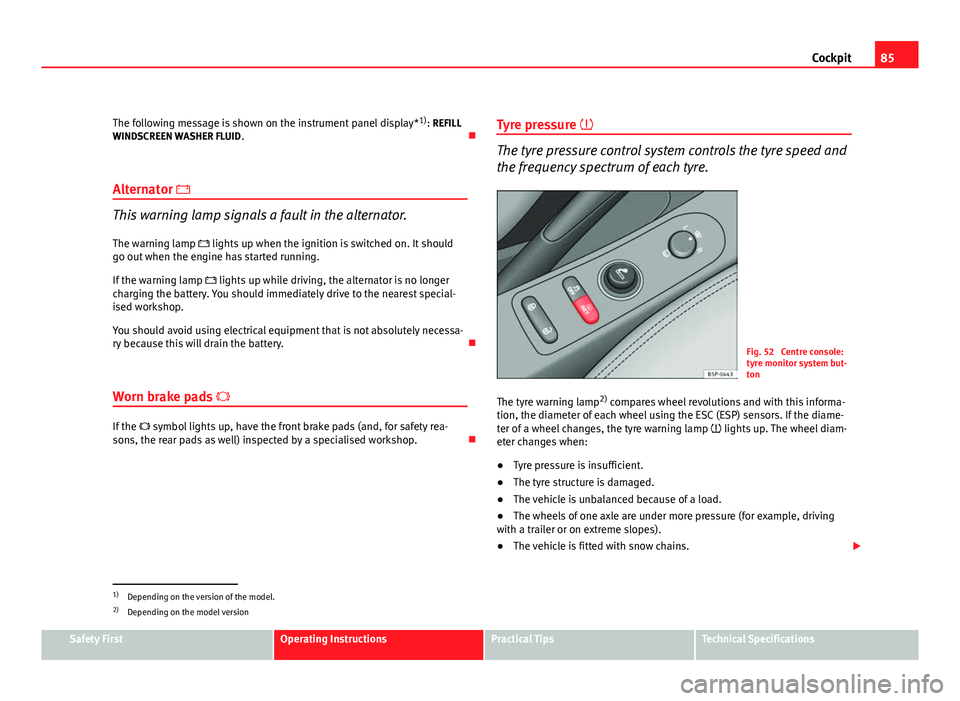
Fig. 52 Centre console:
tyre monitor system but-
ton
The tyre warning lamp 2)
compares wheel revolutions and with this informa-
tion, the diameter of each wheel using the ESC (ESP) sensors. If the diame-
ter of a wheel changes, the tyre warning lamp lights up. The wheel diam-
eter changes when:
● Tyre pressure is insufficient.
● The tyre structure is damaged.
● The vehicle is unbalanced because of a load.
● The wheels of one axle are under more pressure (for example, driving
with a trailer or on extreme slopes).
● The vehicle is fitted with snow chains.
1)
Depending on the version of the model.
2) Depending on the model version
Safety FirstOperating InstructionsPractical TipsTechnical Specifications
Page 89 of 313
87
Cockpit
WARNING
● Before opening the bonnet, read and observe the warnings on
⇒ page 230.
● If the brake warning lamp does not go out, or if it lights up when driv-
ing, the brake fluid level ⇒ page 242, Brake fluid in the reservoir is too
low. Risk of accident. Stop the vehicle and do not drive on. Obtain techni-
cal assistance.
● If the brake warning lamp lights up together with the ABS warning
lamp , the control function of the ABS could be out of action. This could
cause the rear wheels to lock quickly when you brake. This could cause
the rear to break away. Risk of skidding. Stop the vehicle and seek tech-
nical assistance.
Handbrake
This lamp lights up when the handbrake is applied. If you drive faster than 6 km/h with the handbrake on, the following mes-
sage will appear on the instrument panel display 1)
: HANDBRAKE ON. You will
also hear an acoustic warning signal ⇒ page 185.
Bulb defect*
The warning lamp lights up when a bulb in the vehicle's ex-
terior lighting is defective.
The warning lamp lights up when a bulb in the vehicle's exterior lighting
(e.g. left-hand main beam) is defective. The instrument panel displays the following message
1)
: LEFT FULL BEAM
FAULTY.
Engine oil pressure
If this warning lamp is red it indicates that the engine oil
pressure is too low.
If this warning symbol starts to flash, and is accompanied by three audible
warnings, switch off the engine and check the oil level. If necessary, add
more oil ⇒ page 233.
The instrument panel displays the following message 1)
: STOP ENGINE OIL
PRESSURE INSTRUCTION MANUAL .
If the symbol flashes although the oil level is correct, do not drive on. The
engine must not even run at idle speed. Obtain technical assistance.
Checking the oil level
If the warning lamp is yellow the engine oil level should be checked as
soon as possible. Top up the oil ⇒ page 235 at the next opportunity.
Oil level sensor faulty*
If the yellow warning lamp flashes, take the vehicle to a specialised
workshop to have the oil level sensor checked. Until then it is advisable to
check the oil level every time you refuel.
1)
Depending on the version of the model.
Safety FirstOperating InstructionsPractical TipsTechnical Specifications