light Seat Altea 2014 Owner's Manual
[x] Cancel search | Manufacturer: SEAT, Model Year: 2014, Model line: Altea, Model: Seat Altea 2014Pages: 321, PDF Size: 4.52 MB
Page 292 of 321
290If and when
Towing and tow-starting
Tow-starting
The use of jump leads is preferable to tow-starting.
We recommend that you do not tow-start your vehicle. Jump-start-
ing is preferable ⇒ page 287.
However, if your vehicle has to be tow-started:
– Engage the 2nd or the 3rd gear.
– Keep the clutch pressed down.
– Switch the ignition on.
– Once both vehicles are moving, release the clutch.
– As soon as the engine starts, press the clutch and move the
gear lever into neutral. This helps to prevent driving into the
towing vehicle.
WARNING
The risk of accidents is high when tow-starting. The vehicle being towed
can easily collide with the towing vehicle.
CAUTION
When tow-starting, fuel could enter the catalytic converter and damage it. General notes
Please observe the following points if you use a tow rope:
Notes for the driver of the towing vehicle
–
Drive slowly at first until the tow rope is taut. Then accelerate
gradually.
– Begin and change gears cautiously. If you are driving an auto-
matic vehicle, accelerate gently.
– Remember that the brake servo and power steering are not
working in the vehicle you are towing. Brake sooner than nor-
mal and pressing the pedal gently.
Notes for the driver of the towed vehicle
– Ensure that the tow rope remains taut at all times when towing.
Tow rope or tow bar
It is easier and safer to tow a vehicle with a tow bar. You should only use a
tow rope if you do not have a tow bar.
A tow rope should be slightly elastic to reduce the loading on both vehicles.
It is advisable to use a tow rope made of synthetic fibre or similarly elastic
material.
Attach the tow rope or the tow bar only to the towline anchorages provided
or a towing bracket.
Driving style
Towing requires some experience, especially when using a tow rope. Both
drivers should be familiar with the technique required for towing. Inexper-
ienced drivers should not attempt to tow.
Page 293 of 321
291
If and when
Do not pull too hard with the towing vehicle and take care to avoid jerking
the tow rope. When towing on an unpaved road, there is always a risk of
overloading and damaging the anchorage points.
The ignition of the vehicle being towed must be switched on to prevent the
steering wheel from locking and also to allow the use of the turn signals,
horn, windscreen wipers and washers.
As the brake servo does not work if the engine is not running, you must ap-
ply considerably more pressure to the brake pedal than you normally would.
As the power assisted steering does not work if the engine is not running,
you will need more strength to steer than you normally would.
● The vehicle must not be towed faster than 50 km/h (31 mph).
Towing vehicles with an automatic gearbox
● Put the selector lever into position “N”.
● Do not drive faster than 50 km/h (31 mph).
● Do not tow further than 50 km.
● If a breakdown vehicle is used, the vehicle must be towed with the front
wheels raised.
Note
● Observe legal requirements when towing or tow-starting.
● Switch on the hazard warning lights of both vehicles. However, observe
any regulations to the contrary.
● For technical reasons, vehicles with an automatic gearbox must not be
tow-started.
● If damage to your vehicle means that there is no lubricant in the gear-
box, you must raise the driven wheels while the vehicle is being towed.
● If the vehicle has to be towed more than 50 km (30 miles), the front
wheels should be raised during towing, and towing should be carried out by
a qualified person. ●
The steering wheel is locked when the vehicle has no electrical power.
The vehicle must then be towed with the front wheels raised. Towing should
be carried out by a qualified person.
● The towline anchorage should always be kept in the vehicle. Please refer
to the notes on ⇒ page 290, Tow-starting.
Safety FirstOperating instructionsPractical TipsTechnical Specifications
Page 297 of 321
295
Description of specifications
The fuel consumption and CO 2 emissions do not depend only on the per-
formance of the vehicle, they can also differ from the established values de-
pending on other factors such as driving style, road conditions, traffic con-
ditions, environmental conditions, load and number of passengers.
Calculation of fuel consumption
The consumption values have been calculated based on measurements per-
formed or supervised by certified CE laboratories according to the latest ver-
sion of directives 715/2007/EC and 80/1268/CEE (for more information
consult the European Union Publications Office at EUR-Lex: © European Un-
ion, http://eur-lex.europa.eu/en/index.htm) and are valid for the kerb
weight indicated for the vehicle.
Note
In practice, and considering all the factors mentioned here, consumption
values can differ from those calculated in the current European regulations.
Weights
Kerb weight refers to the basic model with a fuel tank filled to 90% capacity
and without optional extras. The figure quoted includes 75 kg to allow for
the weight of the driver.
For special versions and optional equipment fittings or for the addition of
accessories, the weight of the vehicle will increase ⇒
.
WARNING
● Please note that the centre of gravity may shift when transporting
heavy objects; this may affect vehicle handling and lead to an accident.
Always adjust your speed and driving style to suit road conditions and re-
quirements.
● Never exceed the gross axle weight rating or the gross vehicle weight
rating. If the allowed axle load or the allowed total weight is exceeded,
the driving characteristics of the vehicle may change, leading to acci-
dents, injuries and damage to the vehicle.
Towing a trailer Trailer weights
Trailer weight
The trailer weights and drawbar loads approved are selected in intensive tri-
als according to precisely defined criteria. The approved trailer weights are
valid for vehicles in the EU for maximum speeds of 80 km/h (50 mph) (in
certain circumstances up to 100 km/h (62 mph)). The figures may be differ-
ent in other countries. All data in the official vehicle documentation takes
precedence over these data at all times ⇒
.
Drawbar loads
The maximum permitted drawbar load on the ball joint of the towing bracket
must not exceed 75 kg.
In the interest of road safety, we recommend that you always tow approach-
ing the maximum drawbar load. The response of the trailer on the road will
be poor if the drawbar load is too small.
If the maximum permissible drawbar load cannot be met (e.g. with small,
empty and light-weight single axle trailers or tandem axle trailers with a
Safety FirstOperating instructionsPractical TipsTechnical Specifications
Page 298 of 321
296Description of specifications
wheelbase of less than 1 metre), a minimum of 4% of the actual trailer
weight is legally required for the drawbar load.
WARNING
● For safety reasons, you should not drive at speeds above 80 km/h (50
mph) when towing a trailer. This also applies to countries where higher
speeds are permitted.
● Never exceed the maximum trailer weights or the drawbar load. If the
permissible axle load or the permissible total weight is exceeded, the
driving characteristics of the vehicle may change, leading to accidents,
injuries and damage to the vehicle.
Wheels
Tyre pressure, snow chains, wheel bolts
Tyre pressures
The sticker with the tyre pressure values can be found on the inside of the
fuel tank flap. The tyre pressure values given there are for cold tyres. Do not
reduce the slightly raised pressures of warm tyres ⇒
.
Snow chains
Snow chains may be fitted only to the front wheels.
Consult the section “wheels” of this manual.
Wheel bolts
After the wheels have been changed, the tightening torque of the wheel
bolts should be checked as soon as possible with a torque wrench ⇒
.
The tightening torque for steel and alloy wheels is 120 Nm.
WARNING
● Check the tyre pressure at least once per month. Checking the tyre
pressure is very important. If the tyre pressure is too high or too low,
there is an increased danger of accidents, particularly at high speeds.
● If the tightening torque of the wheel bolts is too low, they could loos-
en while the vehicle is in motion. Risk of accident! If the tightening tor-
que is too high, the wheel bolts and threads can be damaged.
Note
We recommend that you ask your Technical Service for information about
appropriate wheel, tyre and snow chain size.
Page 300 of 321
298Technical specifications
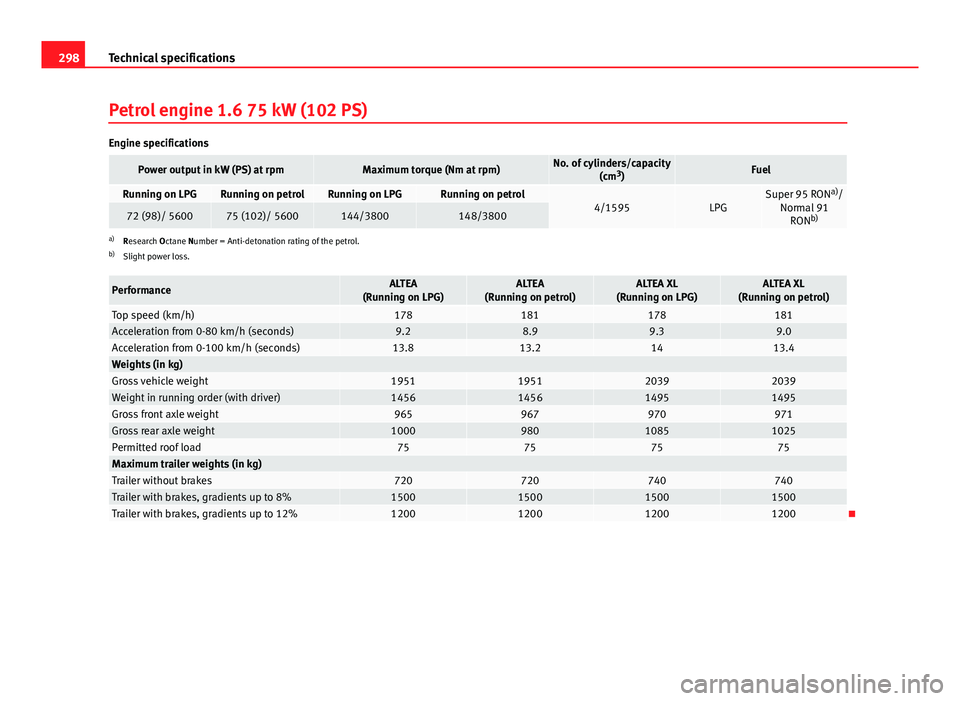
Petrol engine 1.6 75 kW (102 PS)
Engine specifications
Power output in kW (PS) at rpmMaximum torque (Nm at rpm)No. of cylinders/capacity
(cm3
)Fuel
Running on LPGRunning on petrolRunning on LPGRunning on petrol4/1595LPGSuper 95 RON a)
/
Normal 91 RON b)
72 (98)/ 560075 (102)/ 5600144/3800148/3800
a)
Research Octane Number = Anti-detonation rating of the petrol.
b) Slight power loss.
PerformanceALTEA
(Running on LPG)ALTEA
(Running on petrol)ALTEA XL
(Running on LPG)ALTEA XL
(Running on petrol)
Top speed (km/h)178181178181Acceleration from 0-80 km/h (seconds)9.28.99.39.0Acceleration from 0-100 km/h (seconds)13.813.21413.4Weights (in kg)Gross vehicle weight1951195120392039Weight in running order (with driver)1456145614951495Gross front axle weight965967970971Gross rear axle weight100098010851025Permitted roof load75757575Maximum trailer weights (in kg)Trailer without brakes720720740740Trailer with brakes, gradients up to 8%1500150015001500Trailer with brakes, gradients up to 12%1200120012001200
Page 301 of 321
299
Technical specifications
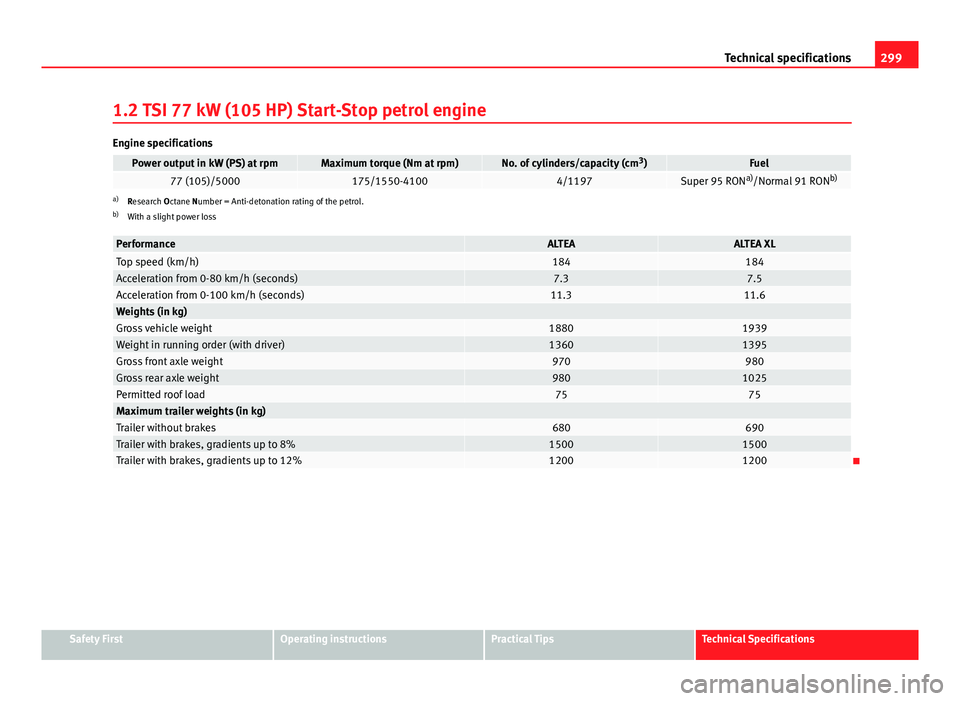
1.2 TSI 77 kW (105 HP) Start-Stop petrol engine
Engine specifications
Power output in kW (PS) at rpmMaximum torque (Nm at rpm)No. of cylinders/capacity (cm 3
)Fuel77 (105)/5000175/1550-41004/1197Super 95 RON a)
/Normal 91 RON b)a)
Research Octane Number = Anti-detonation rating of the petrol.
b) With a slight power loss
PerformanceALTEAALTEA XLTop speed (km/h)184184Acceleration from 0-80 km/h (seconds)7.37.5Acceleration from 0-100 km/h (seconds)11.311.6Weights (in kg)Gross vehicle weight18801939Weight in running order (with driver)13601395Gross front axle weight970980Gross rear axle weight9801025Permitted roof load7575Maximum trailer weights (in kg)Trailer without brakes680690Trailer with brakes, gradients up to 8%15001500Trailer with brakes, gradients up to 12%12001200
Safety FirstOperating instructionsPractical TipsTechnical Specifications
Page 302 of 321
300Technical specifications
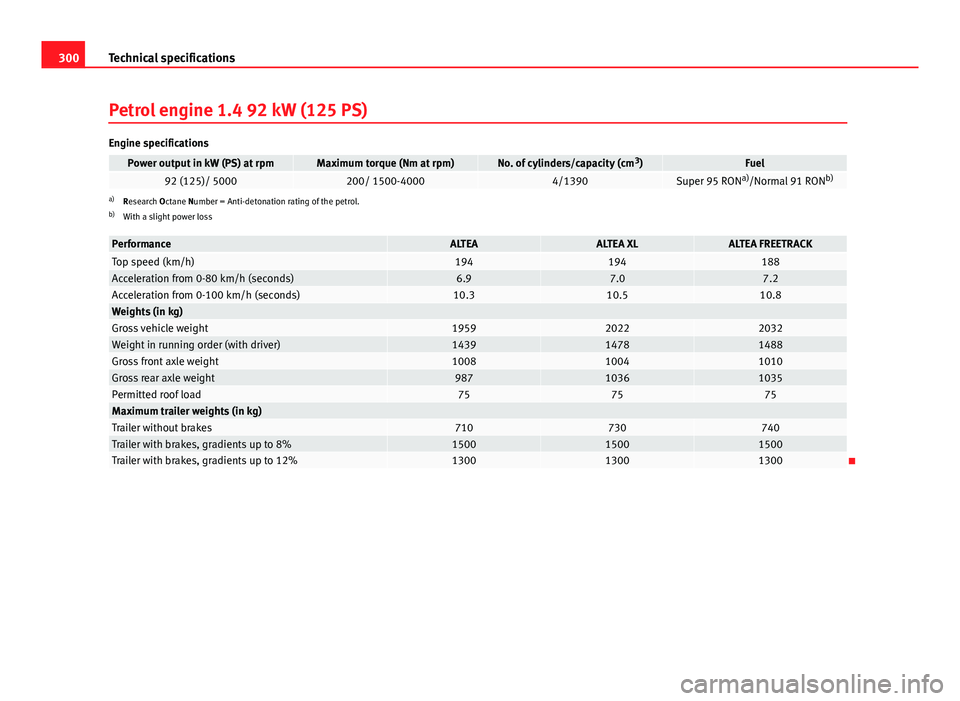
Petrol engine 1.4 92 kW (125 PS)
Engine specifications
Power output in kW (PS) at rpmMaximum torque (Nm at rpm)No. of cylinders/capacity (cm 3
)Fuel92 (125)/ 5000200/ 1500-40004/1390Super 95 RON a)
/Normal 91 RON b)a)
Research Octane Number = Anti-detonation rating of the petrol.
b) With a slight power loss
PerformanceALTEAALTEA XLALTEA FREETRACKTop speed (km/h)194194188Acceleration from 0-80 km/h (seconds)6.97.07.2Acceleration from 0-100 km/h (seconds)10.310.510.8Weights (in kg)Gross vehicle weight195920222032Weight in running order (with driver)143914781488Gross front axle weight100810041010Gross rear axle weight98710361035Permitted roof load757575Maximum trailer weights (in kg)Trailer without brakes710730740Trailer with brakes, gradients up to 8%150015001500Trailer with brakes, gradients up to 12%130013001300
Page 303 of 321
301
Technical specifications
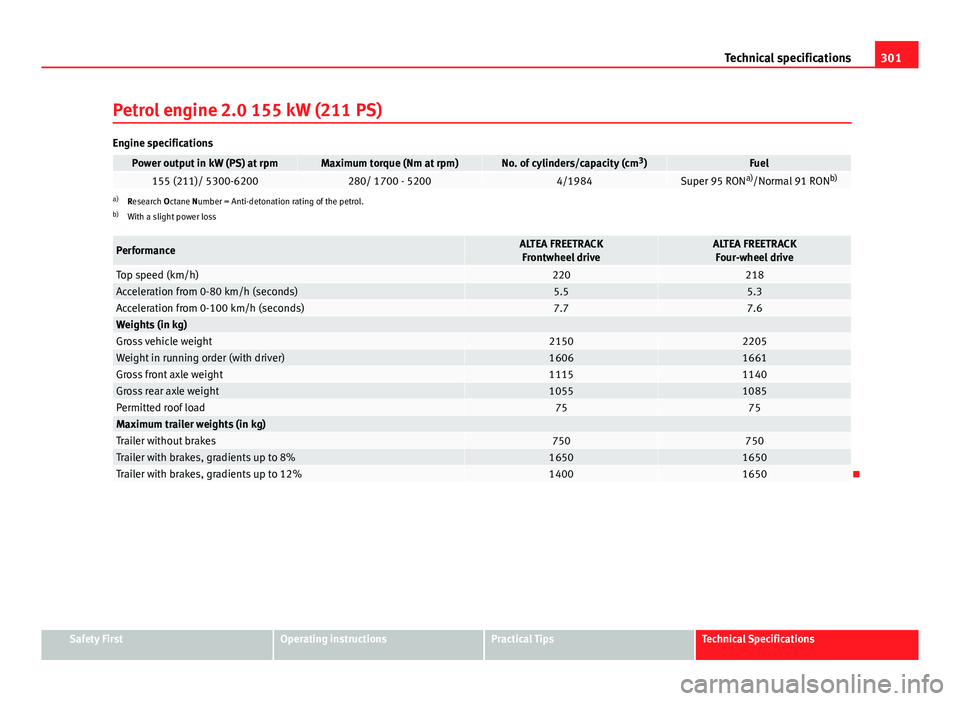
Petrol engine 2.0 155 kW (211 PS)
Engine specifications
Power output in kW (PS) at rpmMaximum torque (Nm at rpm)No. of cylinders/capacity (cm 3
)Fuel155 (211)/ 5300-6200280/ 1700 - 52004/1984Super 95 RON a)
/Normal 91 RON b)a)
Research Octane Number = Anti-detonation rating of the petrol.
b) With a slight power loss
PerformanceALTEA FREETRACK
Frontwheel driveALTEA FREETRACK Four-wheel drive
Top speed (km/h)220218Acceleration from 0-80 km/h (seconds)5.55.3Acceleration from 0-100 km/h (seconds)7.77.6Weights (in kg)Gross vehicle weight21502205Weight in running order (with driver)16061661Gross front axle weight11151140Gross rear axle weight10551085Permitted roof load7575Maximum trailer weights (in kg)Trailer without brakes750750Trailer with brakes, gradients up to 8%16501650Trailer with brakes, gradients up to 12%14001650
Safety FirstOperating instructionsPractical TipsTechnical Specifications
Page 309 of 321
307
Technical specifications
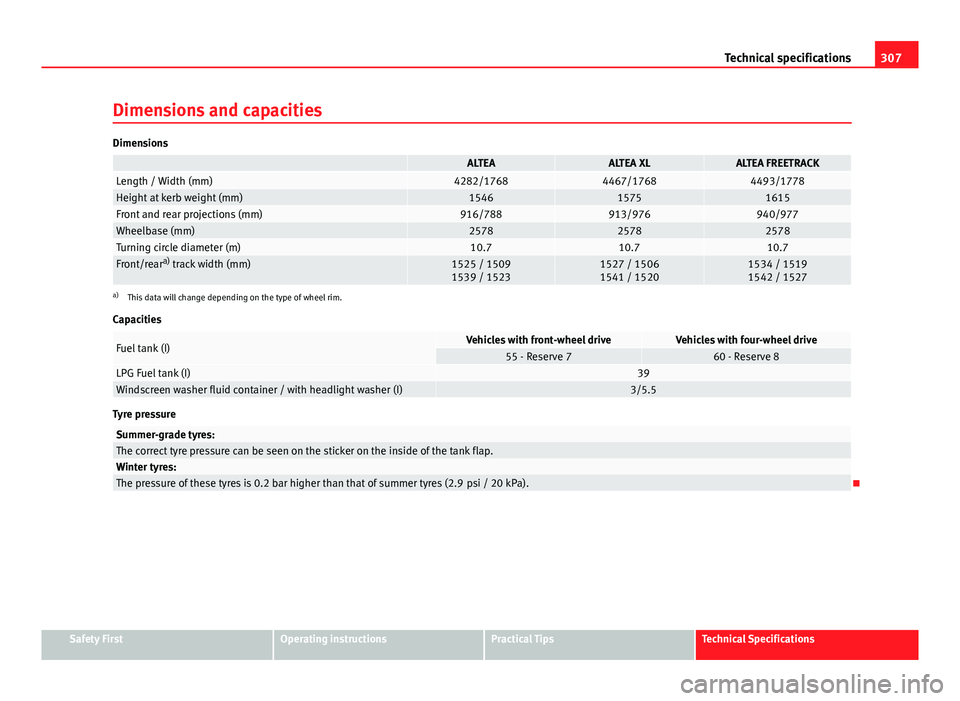
Dimensions and capacities
Dimensions
ALTEAALTEA XLALTEA FREETRACKLength / Width (mm)4282/17684467/17684493/1778Height at kerb weight (mm)154615751615Front and rear projections (mm)916/788913/976940/977Wheelbase (mm)257825782578Turning circle diameter (m)10.710.710.7Front/rear a)
track width (mm)1525 / 1509
1539 / 15231527 / 1506
1541 / 15201534 / 1519
1542 / 1527
a) This data will change depending on the type of wheel rim.
Capacities
Fuel tank (I)Vehicles with front-wheel driveVehicles with four-wheel drive55 - Reserve 760 - Reserve 8LPG Fuel tank (I)39Windscreen washer fluid container / with headlight washer (I)3/5.5
Tyre pressure
Summer-grade tyres:The correct tyre pressure can be seen on the sticker on the inside of the tank flap.Winter tyres:The pressure of these tyres is 0.2 bar higher than that of summer tyres (2.9 psi / 20 kPa).
Safety FirstOperating instructionsPractical TipsTechnical Specifications
Page 311 of 321
Index
A
ABS . . . . . . . . . . . . . . . . . . . . . . . . . . . . . . . . . . 197control lamp . . . . . . . . . . . . . . . . . . . . . . . . . 83
Accessories . . . . . . . . . . . . . . . . . . . . . . . . . . . . 226
Acoustic warning . . . . . . . . . . . . . . . . . . . . . . . 173
Adaptive headlights . . . . . . . . . . . . . . . . . . . . . 119
Adjusting the seat belt height . . . . . . . . . . . . . . 28
AFS (cornering lights) . . . . . . . . . . . . . . . . . . . 120
Airbag covers . . . . . . . . . . . . . . . . . . . . . . . . . . . 36
Airbag system . . . . . . . . . . . . . . . . . . . . . . . . . . . 30 control lamp . . . . . . . . . . . . . . . . . . . . . . . . . 32
Curtain airbags . . . . . . . . . . . . . . . . . . . . . . . 41
Front airbags . . . . . . . . . . . . . . . . . . . . . . . . 34
side airbags . . . . . . . . . . . . . . . . . . . . . . . . . 37
Air conditioner 2C-Climatronic . . . . . . . . . . . . . . . . . . . . . . 164
General notes . . . . . . . . . . . . . . . . . . . . . . . 169
Air conditioner automatic mode 2C-Climatronic . . . . . . . . . . . . . . . . . . . . . . 166
Air conditioning . . . . . . . . . . . . . . . . . . . . . . . . 161
Air recirculation mode 2C-Climatronic . . . . . . . . . . . . . . . . . . . . . . 168
Manual air conditioner . . . . . . . . . . . . . . . . 163
Alarm system Switching off . . . . . . . . . . . . . . . . . . . . . . . . 106
Alcantara . . . . . . . . . . . . . . . . . . . . . . . . . . . . . . 222
All-wheel drive . . . . . . . . . . . . . . . . . . . . . . . . . 200 Alternator
Warning lamp . . . . . . . . . . . . . . . . . . . . . . . . 84
Anti-lock brake system . . . . . . . . . . . . . . . . . . . 197 control lamp . . . . . . . . . . . . . . . . . . . . . . . . . 83
Anti-theft alarm system . . . . . . . . . . . . . . . . . . 106 Switching off . . . . . . . . . . . . . . . . . . . . . . . . 106
Anti-theft wheel bolts . . . . . . . . . . . . . . . . . . . 266
Antifreeze . . . . . . . . . . . . . . . . . . . . . . . . . . . . . 242
Aquaplaning . . . . . . . . . . . . . . . . . . . . . . . . . . . 256
Ashtray . . . . . . . . . . . . . . . . . . . . . . . . . . . . . . . 150
Aspects to note before setting off . . . . . . . . . . . . 8
ASR . . . . . . . . . . . . . . . . . . . . . . . . . . . . . . . . . . 197 Control lamp . . . . . . . . . . . . . . . . . . . . . . . . . 88
Audible warning . . . . . . . . . . . . . . . . . . . . . . . . . 20
Automatic anti-dazzle interior rear vision mirror Activating the anti-dazzle function . . . . . . 131
Deactivating the anti-dazzle function . . . . 131
Automatic car wash tunnel . . . . . . . . . . . . . . . 215
Automatic gearbox Kick-down feature . . . . . . . . . . . . . . . . . . . . 187
Automatic gearbox/DSG automatic gearbox . 183
Automatic lighting . . . . . . . . . . . . . . . . . . . . . . 116
Automatic windscreen wiper/washer . . . . . . . 127
Auxiliary audio input: AUX-IN . . . . . . . . . . . . . 152
B
Ball coupling . . . . . . . . . . . . . . . . . . . . . . . . . . . 211 Battery
Changing . . . . . . . . . . . . . . . . . . . . . . . . . . 252
Charging . . . . . . . . . . . . . . . . . . . . . . . . . . . 252
Winter conditions . . . . . . . . . . . . . . . . . . . . 250
Before setting off . . . . . . . . . . . . . . . . . . . . . . . . . 8
Biodiesel . . . . . . . . . . . . . . . . . . . . . . . . . . . . . . 234
Biodiesel fuel . . . . . . . . . . . . . . . . . . . . . . . . . . 234
Bonnet . . . . . . . . . . . . . . . . . . . . . . . . . . . . . . . 237
Brake fluid . . . . . . . . . . . . . . . . . . . . . . . . . . . . 249 Changing . . . . . . . . . . . . . . . . . . . . . . . . . . 249
control lamp . . . . . . . . . . . . . . . . . . . . . . . . . 66
Brake pads . . . . . . . . . . . . . . . . . . . . . . . . . . . . 204
Brake pedal control lamp . . . . . . . . . . . . . . . . . . . . . . . . . 89
Brakes . . . . . . . . . . . . . . . . . . . . . . . . . . . . . . . . 204 Worn brake pads . . . . . . . . . . . . . . . . . . . . . 84
Brake servo . . . . . . . . . . . . . . . . . . . . . . . . 196, 204
Brake system . . . . . . . . . . . . . . . . . . . . . . . . . . 249 Brakes . . . . . . . . . . . . . . . . . . . . . . . . . . . . . 201
Brake servo . . . . . . . . . . . . . . . . . . . . . . . . . 201
warning lamp . . . . . . . . . . . . . . . . . . . . . . . . 85
Braking distance . . . . . . . . . . . . . . . . . . . . . . . 204
Bulb changes General notes . . . . . . . . . . . . . . . . . . . . . . . 274
Bulb defect Control lamp . . . . . . . . . . . . . . . . . . . . . . . . . 86
Buzzer . . . . . . . . . . . . . . . . . . . . . . . . . . . . 122, 173
309
Index