cooling Seat Altea 2014 User Guide
[x] Cancel search | Manufacturer: SEAT, Model Year: 2014, Model line: Altea, Model: Seat Altea 2014Pages: 321, PDF Size: 4.52 MB
Page 245 of 321
243
Checking and refilling levels
WARNING
If there is not enough anti-freeze in the coolant system, the engine may
fail leading to serious damage.
● Please make sure that the percentage of additive is correct with re-
spect to the lowest expected ambient temperature in the zone in which
the vehicle is to be used.
● When the outside temperature is very low, the coolant could freeze
and the vehicle would be immobilised. In this case, the heating would
not work either and inadequately dressed passengers could die of cold.
CAUTION
The original additives should never be mixed with coolants which are not
approved by SEAT. Otherwise, you run the risk of causing severe damage to
the engine and the engine cooling system.
● If the fluid in the expansion tank is not purple but is, for example,
brown, this indicates that the G 13 additive has been mixed with an inade-
quate coolant. The coolant must be changed as soon as possible if this is
the case! This could result in serious faults and engine damage.
For the sake of the environment
Coolants and additives can contaminate the environment. If any fluids are
spilled, they should be collected and correctly disposed of, with respect to
the environment. Checking the coolant level and topping up
The correct coolant level is important for fault-free function-
ing of the engine cooling system.
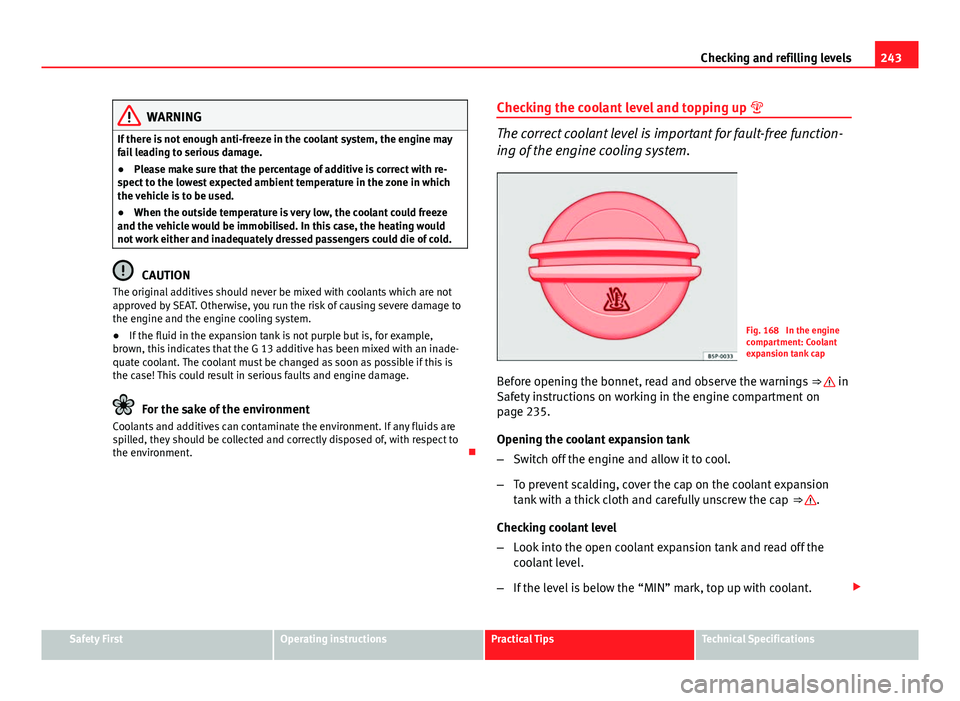
Fig. 168 In the engine
compartment: Coolant
expansion tank cap
Before opening the bonnet, read and observe the warnings ⇒
in
Safety instructions on working in the engine compartment on
page 235.
Opening the coolant expansion tank
– Switch off the engine and allow it to cool.
– To prevent scalding, cover the cap on the coolant expansion
tank with a thick cloth and carefully unscrew the cap ⇒
.
Checking coolant level
– Look into the open coolant expansion tank and read off the
coolant level.
– If the level is below the “MIN” mark, top up with coolant.
Safety FirstOperating instructionsPractical TipsTechnical Specifications
Page 246 of 321
244Checking and refilling levels
Topping up coolant
–Only use new coolant liquid.
– Do not fill above the “MAX” mark.
Closing the coolant expansion tank
– Screw the cap on again tightly.
The position of the coolant expansion reservoir is shown in the correspond-
ing engine compartment illustration ⇒ page 297.
Make sure that the coolant meets the required specifications ⇒ page 242.
Do not use a different type of additive if additive G12+ is not available. In
this case use only water and bring the coolant concentration back up to the
correct level as soon as possible by putting in the specified additive
⇒ page 242.
Always top up with new coolant.
Do not fill above the “MAX” mark. Otherwise the excess coolant will be
forced out of the cooling system when the engine is hot.
The coolant additive G12+ (dyed purple) may be mixed with G12 (dyed red)
and also with G 11.
WARNING
Any work carried out in the engine compartment or on the engine must
be carried out cautiously.
● When working in the engine compartment, always observe the safety
warnings ⇒ page 235.
● When the engine is warm or hot, the cooling system is pressurised!
Do not unscrew the cap on the coolant expansion tank when the engine
is hot. This is a burn injury risk.
CAUTION
● When mixed with other additives the colour of G12 will change to brown.
If this occurs you should have the coolant changed immediately. Failure to
do so will result in engine damage!
● If a lot of coolant fluid has been lost, wait for the engine to cool down
before putting in cold coolant. This avoids damaging the engine. Large cool-
ant losses are an indication of leaks in the cooling system. See a special-
ised workshop immediately and have the cooling system checked. Other-
wise, there is a risk of engine damage.
Washer fluid and windscreen wiper blades Topping up washer fluid
The water for cleaning the windscreen should always be
mixed with washer fluid.
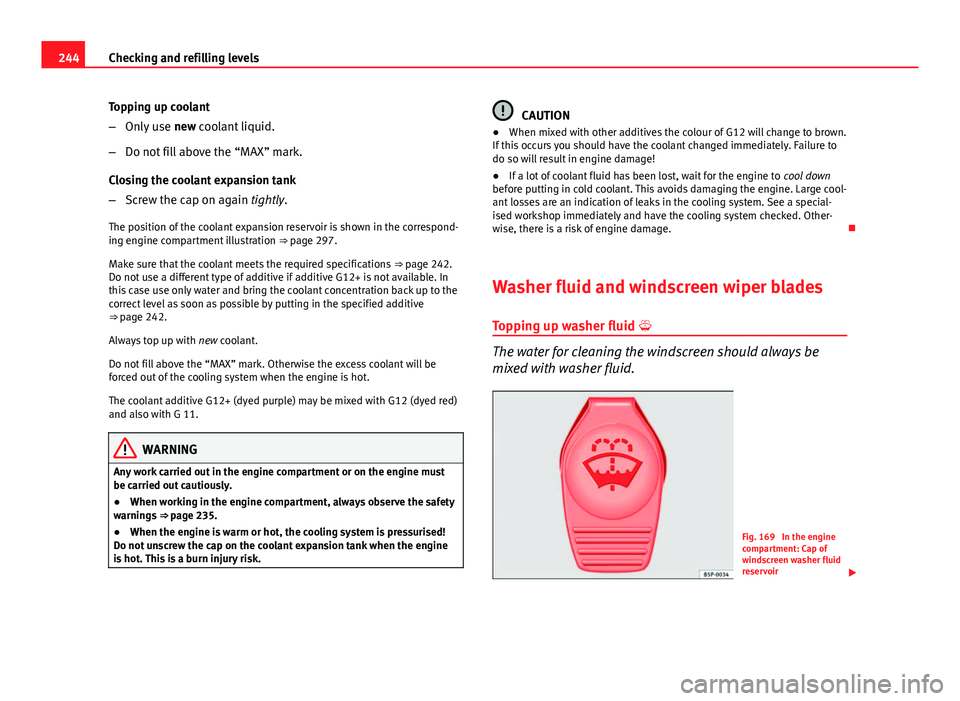
Fig. 169 In the engine
compartment: Cap of
windscreen washer fluid
reservoir