fuel cap Seat Altea 2014 User Guide
[x] Cancel search | Manufacturer: SEAT, Model Year: 2014, Model line: Altea, Model: Seat Altea 2014Pages: 321, PDF Size: 4.52 MB
Page 291 of 321
289
If and when
10.Turn on the heater blower and heated rear window in the vehi- cle with the flat battery. This helps minimise voltage peaks
which are generated when the leads are disconnected.
11.When the engine is running, disconnect the leads in reverse or- der to the details given above.
Connect the battery clamps so they have good metal-to-metal contact with
the battery terminals.
If the engine fails to start, switch off the starter after about 10 seconds and
try again after about half a minute.
WARNING
● Please note the safety warnings referring to working in the engine
compartment ⇒ page 235, Working in the engine compartment.
● The battery providing assistance must have the same voltage as the
flat battery (12V) and approximately the same capacity (see imprint on
battery). Failure to comply could result in an explosion.
● Never use jump leads when one of the batteries is frozen. Danger of
explosion! Even after the battery has thawed, battery acid could leak and
cause chemical burns. If a battery freezes, it should be replaced.
● Keep sparks, flames and lighted cigarettes away from batteries, dan-
ger of explosion. Failure to comply could result in an explosion.
● Observe the instructions provided by the manufacturer of the jump
leads.
● Do not connect the negative cable from the other vehicle directly to
the negative terminal of the flat battery. The gas emitted from the battery
could be ignited by sparks. Danger of explosion.
● Do not attach the negative cable from the other vehicle to parts of the
fuel system or to the brake line.
WARNING (Continued)
● The non-insulated parts of the battery clamps must not be allowed to
touch. The jump lead attached to the positive battery terminal must not
touch metal parts of the vehicle, this can cause a short circuit.
● Position the leads in such a way that they cannot come into contact
with any moving parts in the engine compartment.
● Do not lean on the batteries. This could result in chemical burns.
Note
The vehicles must not touch each other, otherwise electricity could flow as
soon as the positive terminals are connected.
Safety FirstOperating instructionsPractical TipsTechnical Specifications
Page 297 of 321
295
Description of specifications
The fuel consumption and CO 2 emissions do not depend only on the per-
formance of the vehicle, they can also differ from the established values de-
pending on other factors such as driving style, road conditions, traffic con-
ditions, environmental conditions, load and number of passengers.
Calculation of fuel consumption
The consumption values have been calculated based on measurements per-
formed or supervised by certified CE laboratories according to the latest ver-
sion of directives 715/2007/EC and 80/1268/CEE (for more information
consult the European Union Publications Office at EUR-Lex: © European Un-
ion, http://eur-lex.europa.eu/en/index.htm) and are valid for the kerb
weight indicated for the vehicle.
Note
In practice, and considering all the factors mentioned here, consumption
values can differ from those calculated in the current European regulations.
Weights
Kerb weight refers to the basic model with a fuel tank filled to 90% capacity
and without optional extras. The figure quoted includes 75 kg to allow for
the weight of the driver.
For special versions and optional equipment fittings or for the addition of
accessories, the weight of the vehicle will increase ⇒
.
WARNING
● Please note that the centre of gravity may shift when transporting
heavy objects; this may affect vehicle handling and lead to an accident.
Always adjust your speed and driving style to suit road conditions and re-
quirements.
● Never exceed the gross axle weight rating or the gross vehicle weight
rating. If the allowed axle load or the allowed total weight is exceeded,
the driving characteristics of the vehicle may change, leading to acci-
dents, injuries and damage to the vehicle.
Towing a trailer Trailer weights
Trailer weight
The trailer weights and drawbar loads approved are selected in intensive tri-
als according to precisely defined criteria. The approved trailer weights are
valid for vehicles in the EU for maximum speeds of 80 km/h (50 mph) (in
certain circumstances up to 100 km/h (62 mph)). The figures may be differ-
ent in other countries. All data in the official vehicle documentation takes
precedence over these data at all times ⇒
.
Drawbar loads
The maximum permitted drawbar load on the ball joint of the towing bracket
must not exceed 75 kg.
In the interest of road safety, we recommend that you always tow approach-
ing the maximum drawbar load. The response of the trailer on the road will
be poor if the drawbar load is too small.
If the maximum permissible drawbar load cannot be met (e.g. with small,
empty and light-weight single axle trailers or tandem axle trailers with a
Safety FirstOperating instructionsPractical TipsTechnical Specifications
Page 300 of 321
298Technical specifications
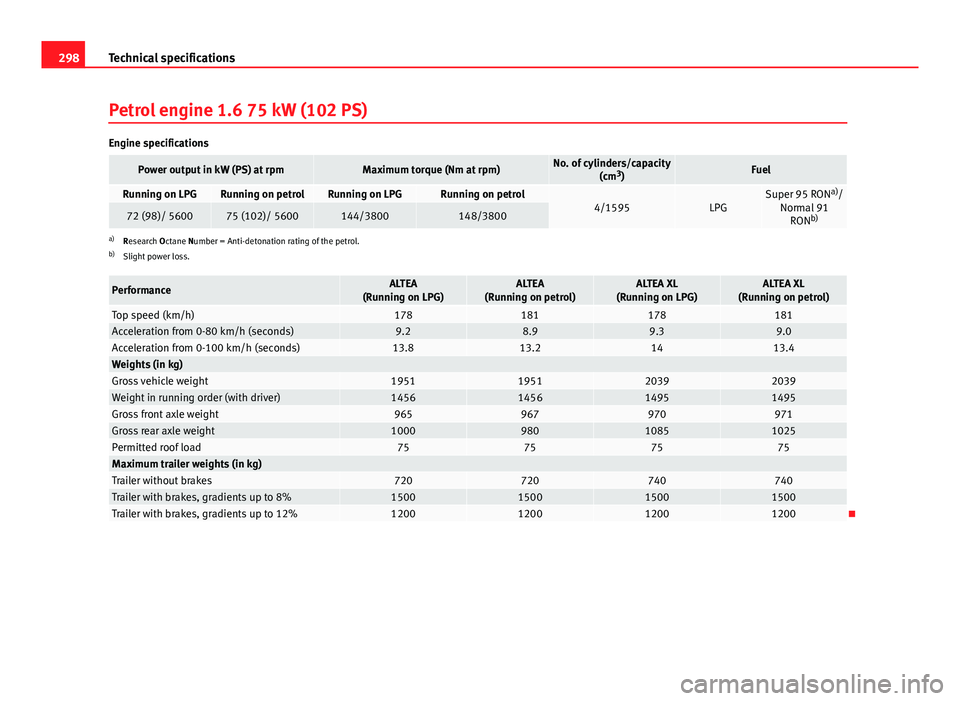
Petrol engine 1.6 75 kW (102 PS)
Engine specifications
Power output in kW (PS) at rpmMaximum torque (Nm at rpm)No. of cylinders/capacity
(cm3
)Fuel
Running on LPGRunning on petrolRunning on LPGRunning on petrol4/1595LPGSuper 95 RON a)
/
Normal 91 RON b)
72 (98)/ 560075 (102)/ 5600144/3800148/3800
a)
Research Octane Number = Anti-detonation rating of the petrol.
b) Slight power loss.
PerformanceALTEA
(Running on LPG)ALTEA
(Running on petrol)ALTEA XL
(Running on LPG)ALTEA XL
(Running on petrol)
Top speed (km/h)178181178181Acceleration from 0-80 km/h (seconds)9.28.99.39.0Acceleration from 0-100 km/h (seconds)13.813.21413.4Weights (in kg)Gross vehicle weight1951195120392039Weight in running order (with driver)1456145614951495Gross front axle weight965967970971Gross rear axle weight100098010851025Permitted roof load75757575Maximum trailer weights (in kg)Trailer without brakes720720740740Trailer with brakes, gradients up to 8%1500150015001500Trailer with brakes, gradients up to 12%1200120012001200
Page 301 of 321
299
Technical specifications
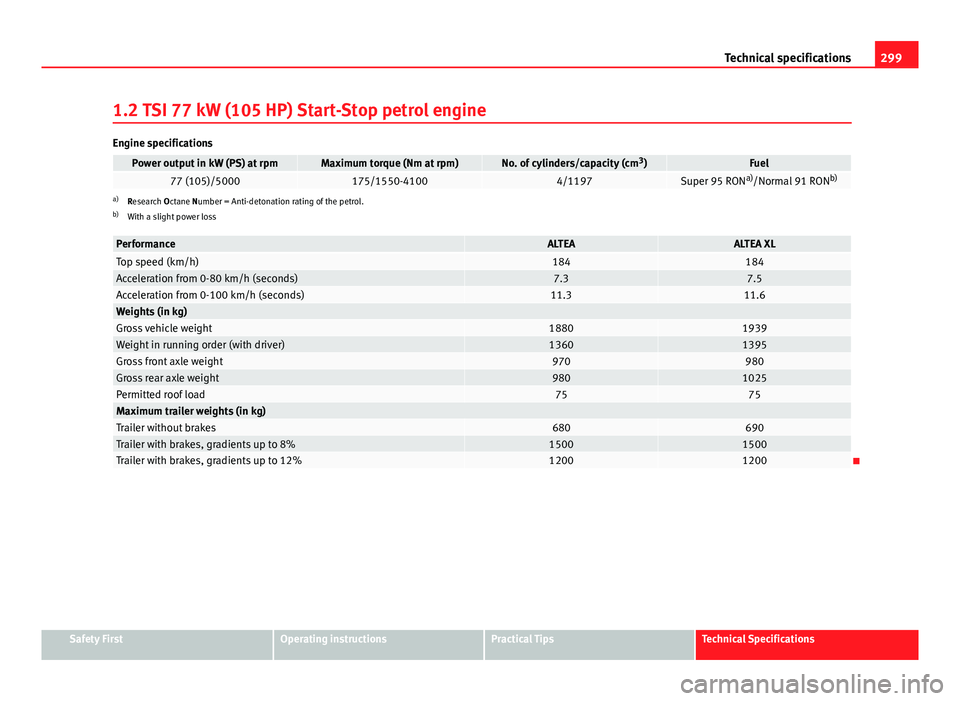
1.2 TSI 77 kW (105 HP) Start-Stop petrol engine
Engine specifications
Power output in kW (PS) at rpmMaximum torque (Nm at rpm)No. of cylinders/capacity (cm 3
)Fuel77 (105)/5000175/1550-41004/1197Super 95 RON a)
/Normal 91 RON b)a)
Research Octane Number = Anti-detonation rating of the petrol.
b) With a slight power loss
PerformanceALTEAALTEA XLTop speed (km/h)184184Acceleration from 0-80 km/h (seconds)7.37.5Acceleration from 0-100 km/h (seconds)11.311.6Weights (in kg)Gross vehicle weight18801939Weight in running order (with driver)13601395Gross front axle weight970980Gross rear axle weight9801025Permitted roof load7575Maximum trailer weights (in kg)Trailer without brakes680690Trailer with brakes, gradients up to 8%15001500Trailer with brakes, gradients up to 12%12001200
Safety FirstOperating instructionsPractical TipsTechnical Specifications
Page 302 of 321
300Technical specifications
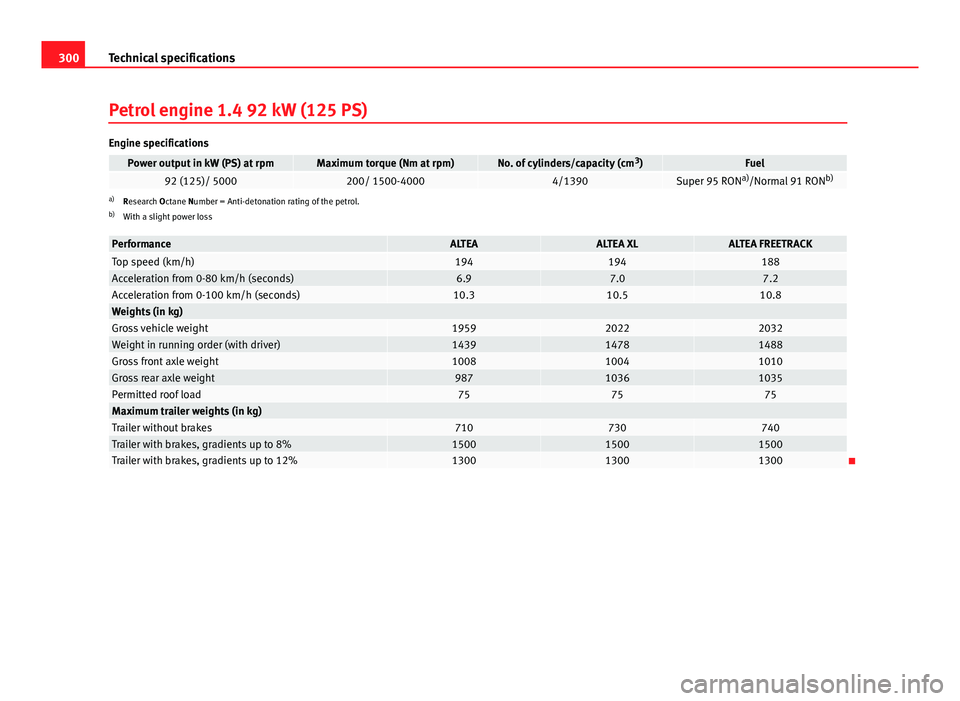
Petrol engine 1.4 92 kW (125 PS)
Engine specifications
Power output in kW (PS) at rpmMaximum torque (Nm at rpm)No. of cylinders/capacity (cm 3
)Fuel92 (125)/ 5000200/ 1500-40004/1390Super 95 RON a)
/Normal 91 RON b)a)
Research Octane Number = Anti-detonation rating of the petrol.
b) With a slight power loss
PerformanceALTEAALTEA XLALTEA FREETRACKTop speed (km/h)194194188Acceleration from 0-80 km/h (seconds)6.97.07.2Acceleration from 0-100 km/h (seconds)10.310.510.8Weights (in kg)Gross vehicle weight195920222032Weight in running order (with driver)143914781488Gross front axle weight100810041010Gross rear axle weight98710361035Permitted roof load757575Maximum trailer weights (in kg)Trailer without brakes710730740Trailer with brakes, gradients up to 8%150015001500Trailer with brakes, gradients up to 12%130013001300
Page 303 of 321
301
Technical specifications
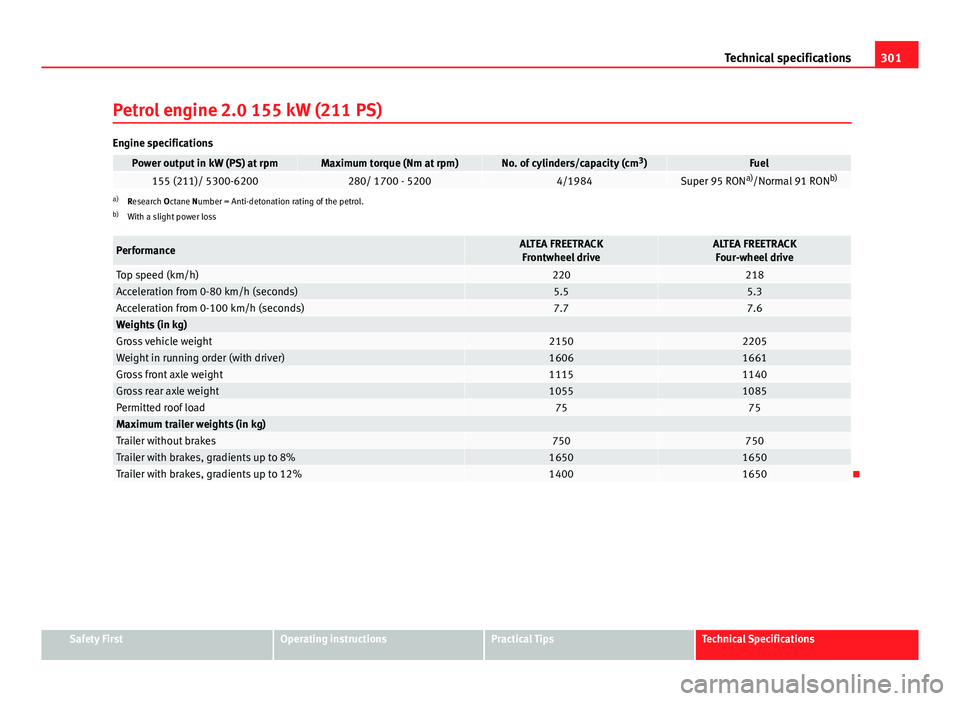
Petrol engine 2.0 155 kW (211 PS)
Engine specifications
Power output in kW (PS) at rpmMaximum torque (Nm at rpm)No. of cylinders/capacity (cm 3
)Fuel155 (211)/ 5300-6200280/ 1700 - 52004/1984Super 95 RON a)
/Normal 91 RON b)a)
Research Octane Number = Anti-detonation rating of the petrol.
b) With a slight power loss
PerformanceALTEA FREETRACK
Frontwheel driveALTEA FREETRACK Four-wheel drive
Top speed (km/h)220218Acceleration from 0-80 km/h (seconds)5.55.3Acceleration from 0-100 km/h (seconds)7.77.6Weights (in kg)Gross vehicle weight21502205Weight in running order (with driver)16061661Gross front axle weight11151140Gross rear axle weight10551085Permitted roof load7575Maximum trailer weights (in kg)Trailer without brakes750750Trailer with brakes, gradients up to 8%16501650Trailer with brakes, gradients up to 12%14001650
Safety FirstOperating instructionsPractical TipsTechnical Specifications
Page 304 of 321
302Technical specifications
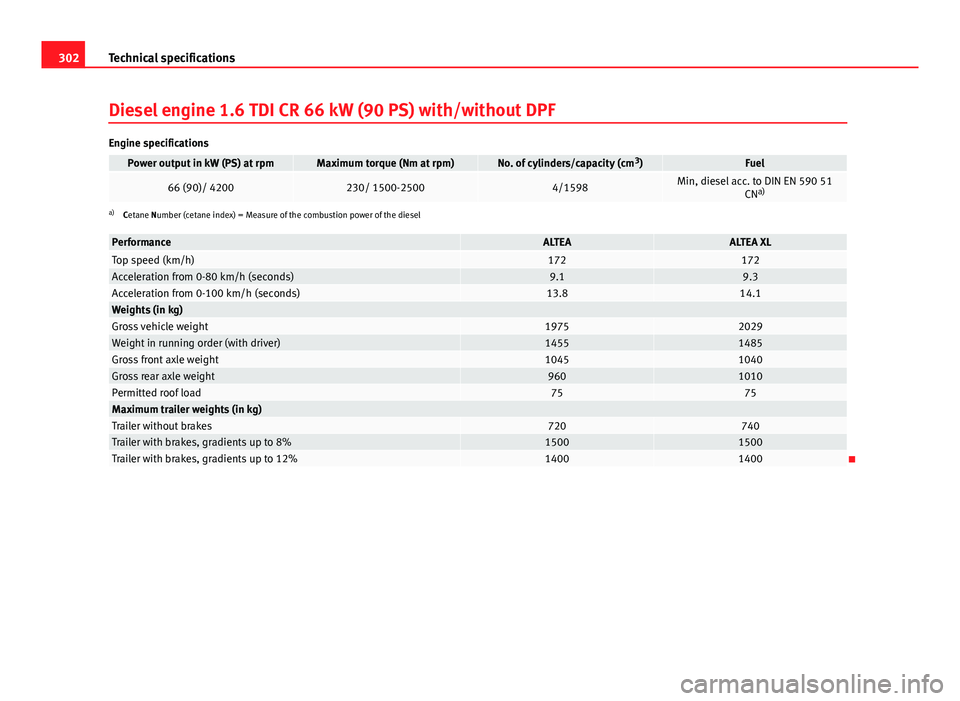
Diesel engine 1.6 TDI CR 66 kW (90 PS) with/without DPF
Engine specifications
Power output in kW (PS) at rpmMaximum torque (Nm at rpm)No. of cylinders/capacity (cm 3
)Fuel
66 (90)/ 4200230/ 1500-25004/1598Min, diesel acc. to DIN EN 590 51
CNa)
a)
Cetane Number (cetane index) = Measure of the combustion power of the diesel
PerformanceALTEAALTEA XLTop speed (km/h)172172Acceleration from 0-80 km/h (seconds)9.19.3Acceleration from 0-100 km/h (seconds)13.814.1Weights (in kg)Gross vehicle weight19752029Weight in running order (with driver)14551485Gross front axle weight10451040Gross rear axle weight9601010Permitted roof load7575Maximum trailer weights (in kg)Trailer without brakes720740Trailer with brakes, gradients up to 8%15001500Trailer with brakes, gradients up to 12%14001400
Page 305 of 321
303
Technical specifications
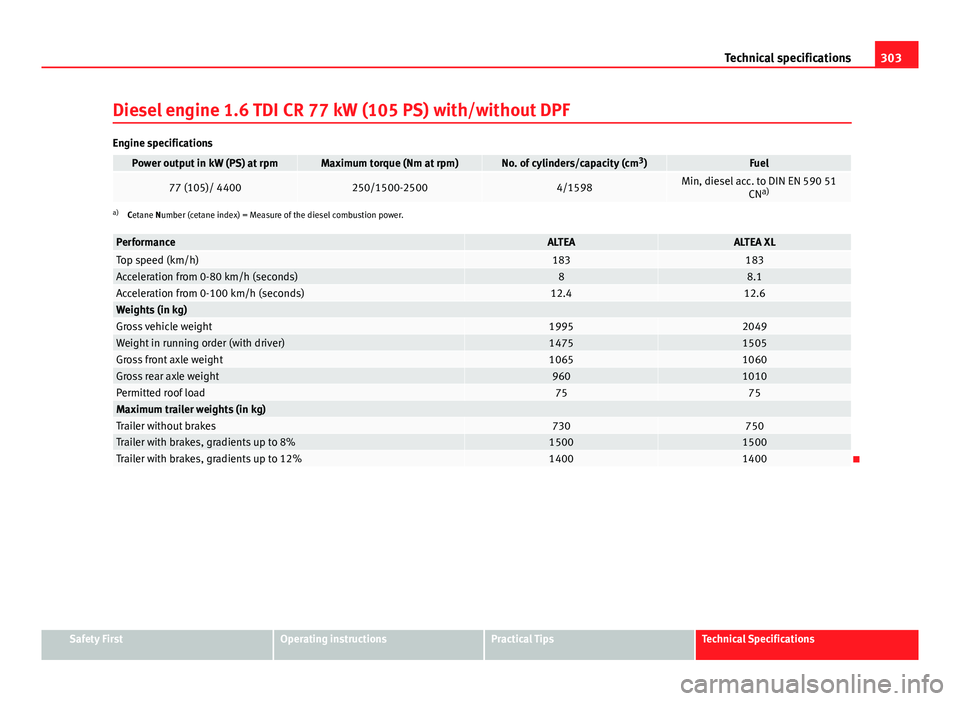
Diesel engine 1.6 TDI CR 77 kW (105 PS) with/without DPF
Engine specifications
Power output in kW (PS) at rpmMaximum torque (Nm at rpm)No. of cylinders/capacity (cm 3
)Fuel
77 (105)/ 4400250/1500-25004/1598Min, diesel acc. to DIN EN 590 51
CNa)
a)
Cetane Number (cetane index) = Measure of the diesel combustion power.
PerformanceALTEAALTEA XLTop speed (km/h)183183Acceleration from 0-80 km/h (seconds)88.1Acceleration from 0-100 km/h (seconds)12.412.6Weights (in kg)Gross vehicle weight19952049Weight in running order (with driver)14751505Gross front axle weight10651060Gross rear axle weight9601010Permitted roof load7575Maximum trailer weights (in kg)Trailer without brakes730750Trailer with brakes, gradients up to 8%15001500Trailer with brakes, gradients up to 12%14001400
Safety FirstOperating instructionsPractical TipsTechnical Specifications
Page 306 of 321
304Technical specifications
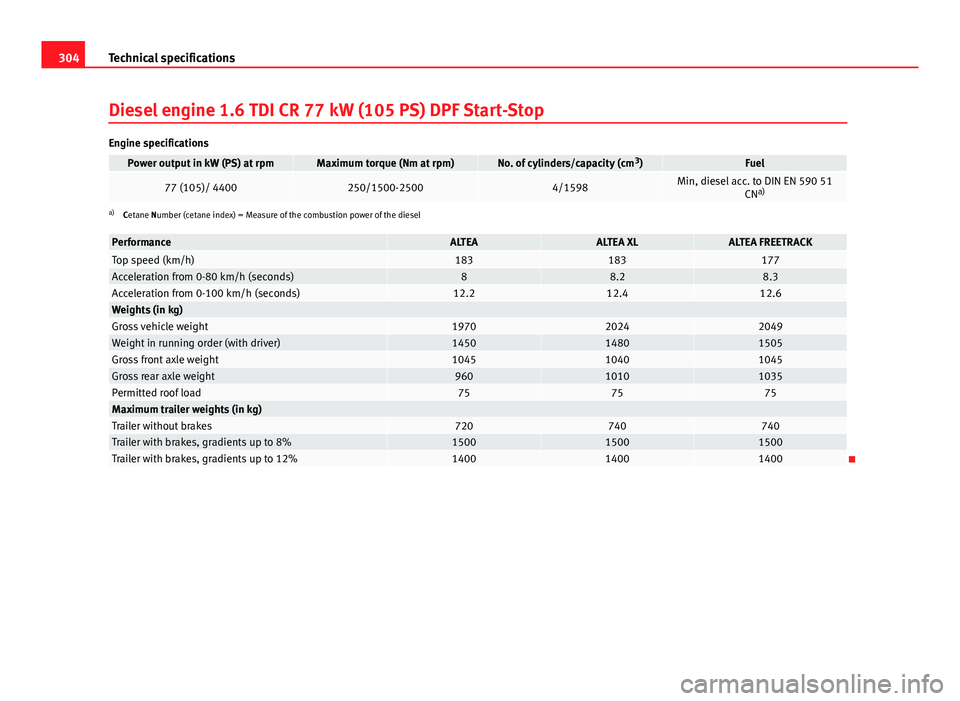
Diesel engine 1.6 TDI CR 77 kW (105 PS) DPF Start-Stop
Engine specifications
Power output in kW (PS) at rpmMaximum torque (Nm at rpm)No. of cylinders/capacity (cm 3
)Fuel
77 (105)/ 4400250/1500-25004/1598Min, diesel acc. to DIN EN 590 51
CNa)
a)
Cetane Number (cetane index) = Measure of the combustion power of the diesel
PerformanceALTEAALTEA XLALTEA FREETRACKTop speed (km/h)183183177Acceleration from 0-80 km/h (seconds)88.28.3Acceleration from 0-100 km/h (seconds)12.212.412.6Weights (in kg)Gross vehicle weight197020242049Weight in running order (with driver)145014801505Gross front axle weight104510401045Gross rear axle weight96010101035Permitted roof load757575Maximum trailer weights (in kg)Trailer without brakes720740740Trailer with brakes, gradients up to 8%150015001500Trailer with brakes, gradients up to 12%140014001400
Page 307 of 321
305
Technical specifications
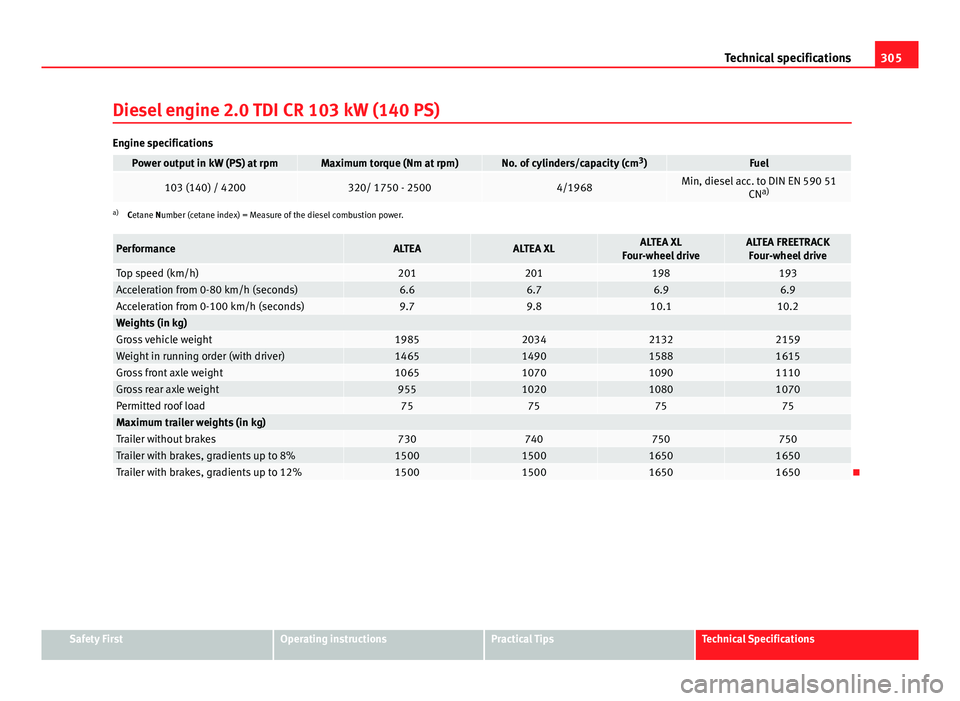
Diesel engine 2.0 TDI CR 103 kW (140 PS)
Engine specifications
Power output in kW (PS) at rpmMaximum torque (Nm at rpm)No. of cylinders/capacity (cm 3
)Fuel
103 (140) / 4200320/ 1750 - 25004/1968Min, diesel acc. to DIN EN 590 51
CNa)
a)
Cetane Number (cetane index) = Measure of the diesel combustion power.
PerformanceALTEAALTEA XLALTEA XL
Four-wheel driveALTEA FREETRACK Four-wheel drive
Top speed (km/h)201201198193Acceleration from 0-80 km/h (seconds)6.66.76.96.9Acceleration from 0-100 km/h (seconds)9.79.810.110.2Weights (in kg)Gross vehicle weight1985203421322159Weight in running order (with driver)1465149015881615Gross front axle weight1065107010901110Gross rear axle weight955102010801070Permitted roof load75757575Maximum trailer weights (in kg)Trailer without brakes730740750750Trailer with brakes, gradients up to 8%1500150016501650Trailer with brakes, gradients up to 12%1500150016501650
Safety FirstOperating instructionsPractical TipsTechnical Specifications