ECU Seat Altea 2014 Owner's Guide
[x] Cancel search | Manufacturer: SEAT, Model Year: 2014, Model line: Altea, Model: Seat Altea 2014Pages: 321, PDF Size: 4.52 MB
Page 139 of 321
137
Seats and storage
Front seats
Adjustment of the front seats
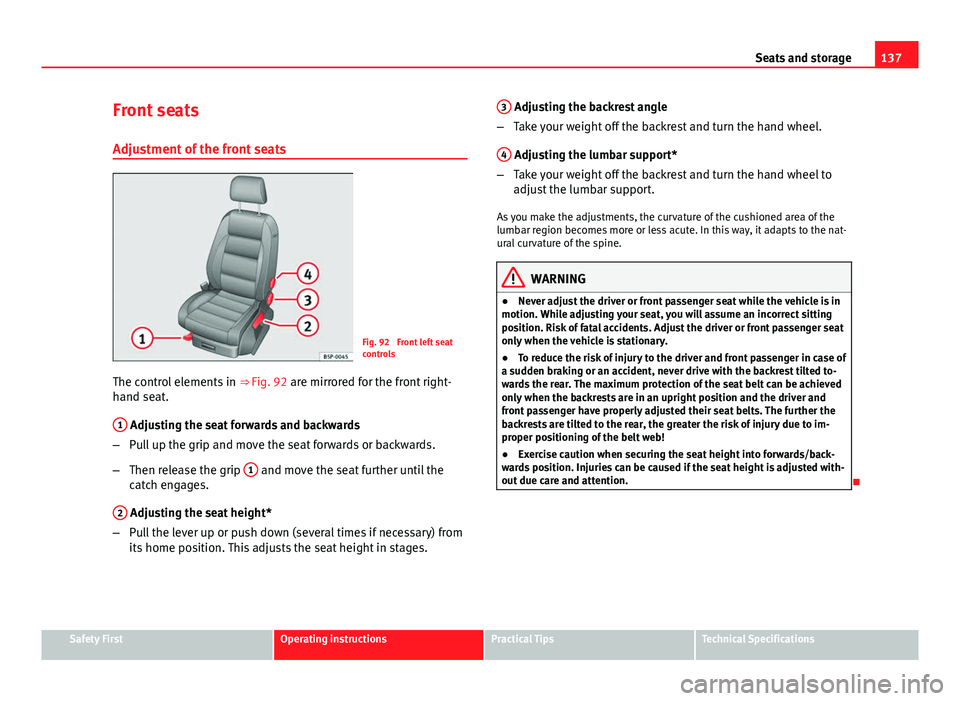
Fig. 92 Front left seat
controls
The control elements in ⇒ Fig. 92 are mirrored for the front right-
hand seat.
1
Adjusting the seat forwards and backwards
– Pull up the grip and move the seat forwards or backwards.
– Then release the grip 1
and move the seat further until the
catch engages.
2
Adjusting the seat height*
– Pull the lever up or push down (several times if necessary) from
its home position. This adjusts the seat height in stages. 3
Adjusting the backrest angle
– Take your weight off the backrest and turn the hand wheel.
4
Adjusting the lumbar support*
– Take your weight off the backrest and turn the hand wheel to
adjust the lumbar support.
As you make the adjustments, the curvature of the cushioned area of the
lumbar region becomes more or less acute. In this way, it adapts to the nat-
ural curvature of the spine.
WARNING
● Never adjust the driver or front passenger seat while the vehicle is in
motion. While adjusting your seat, you will assume an incorrect sitting
position. Risk of fatal accidents. Adjust the driver or front passenger seat
only when the vehicle is stationary.
● To reduce the risk of injury to the driver and front passenger in case of
a sudden braking or an accident, never drive with the backrest tilted to-
wards the rear. The maximum protection of the seat belt can be achieved
only when the backrests are in an upright position and the driver and
front passenger have properly adjusted their seat belts. The further the
backrests are tilted to the rear, the greater the risk of injury due to im-
proper positioning of the belt web!
● Exercise caution when securing the seat height into forwards/back-
wards position. Injuries can be caused if the seat height is adjusted with-
out due care and attention.
Safety FirstOperating instructionsPractical TipsTechnical Specifications
Page 142 of 321
140Seats and storage
Folding the seat backrests down
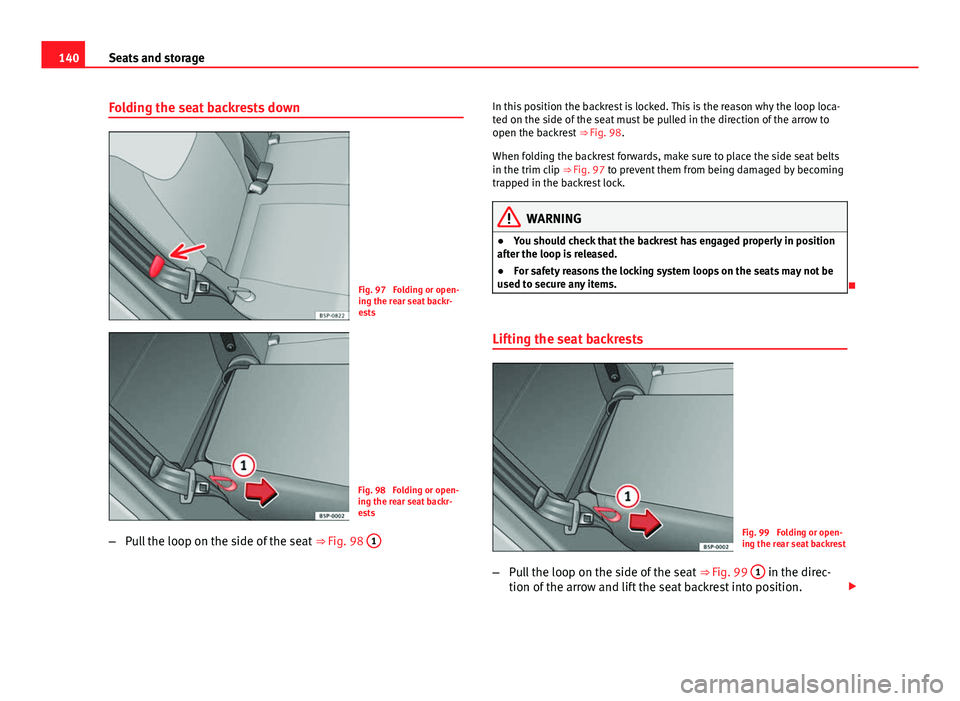
Fig. 97 Folding or open-
ing the rear seat backr-
ests
Fig. 98 Folding or open-
ing the rear seat backr-
ests
– Pull the loop on the side of the seat ⇒ Fig. 98 1
In this position the backrest is locked. This is the reason why the loop loca-
ted on the side of the seat must be pulled in the direction of the arrow to
open the backrest
⇒ Fig. 98.
When folding the backrest forwards, make sure to place the side seat belts
in the trim clip ⇒ Fig. 97 to prevent them from being damaged by becoming
trapped in the backrest lock.
WARNING
● You should check that the backrest has engaged properly in position
after the loop is released.
● For safety reasons the locking system loops on the seats may not be
used to secure any items.
Lifting the seat backrests
Fig. 99 Folding or open-
ing the rear seat backrest
– Pull the loop on the side of the seat ⇒
Fig. 99 1
in the direc-
tion of the arrow and lift the seat backrest into position.
Page 143 of 321
141
Seats and storage
WARNING
● You should check that the backrest has engaged properly in position
after the loop is released.
● For safety reasons the locking system loops on the seats may not be
used to secure any items.
● After locking the seat backrest into position ensure that the seat
belts protrude from the seat.
Storage compartment
Storage compartment on the front passenger side
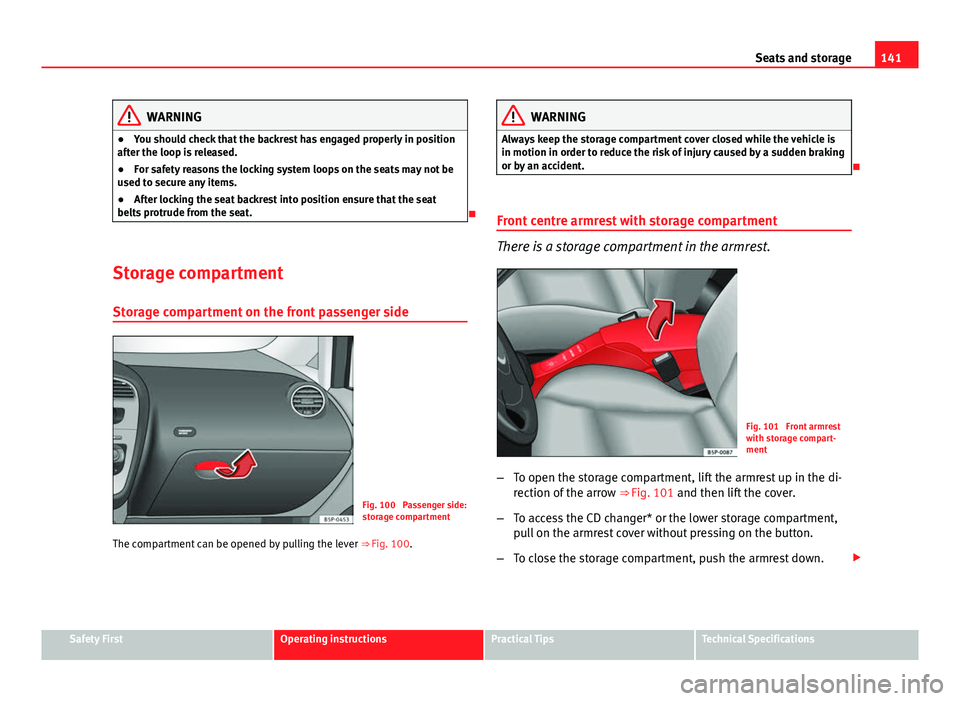
Fig. 100 Passenger side:
storage compartment
The compartment can be opened by pulling the lever ⇒ Fig. 100.
WARNING
Always keep the storage compartment cover closed while the vehicle is
in motion in order to reduce the risk of injury caused by a sudden braking
or by an accident.
Front centre armrest with storage compartment
There is a storage compartment in the armrest.
Fig. 101 Front armrest
with storage compart-
ment
– To open the storage compartment, lift the armrest up in the di-
rection of the arrow ⇒
Fig. 101 and then lift the cover.
– To access the CD changer* or the lower storage compartment,
pull on the armrest cover without pressing on the button.
– To close the storage compartment, push the armrest down.
Safety FirstOperating instructionsPractical TipsTechnical Specifications
Page 145 of 321
143
Seats and storage
WARNING
● The folding trays may not be folded down whilst the vehicle is in mo-
tion and anyone is seated on the second row of seats. There is a risk of
injury during a sudden braking manoeuvre! The tray must therefore be
closed and properly secured whilst the vehicle is in motion.
● Do not put hot drinks in the drink holders. During normal or sudden
driving manoeuvres, sudden braking or an accident, the hot drink could
be spilled. Danger of scalding.
CAUTION
When driving, do not leave open cans in the cup holders. The drink might
be spilt on braking, for example, and could damage the vehicle.
Roof storage compartment*
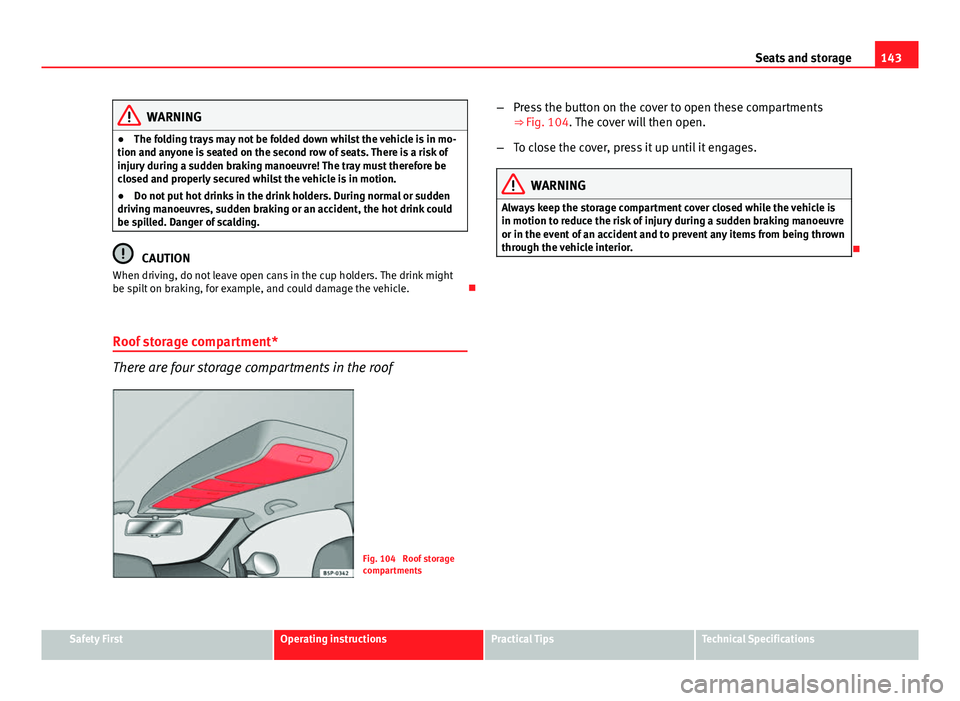
There are four storage compartments in the roof
Fig. 104 Roof storage
compartments –
Press the button on the cover to open these compartments
⇒ Fig. 104. The cover will then open.
– To close the cover, press it up until it engages.
WARNING
Always keep the storage compartment cover closed while the vehicle is
in motion to reduce the risk of injury during a sudden braking manoeuvre
or in the event of an accident and to prevent any items from being thrown
through the vehicle interior.
Safety FirstOperating instructionsPractical TipsTechnical Specifications
Page 146 of 321
144Seats and storage
Storage in the luggage compartment*
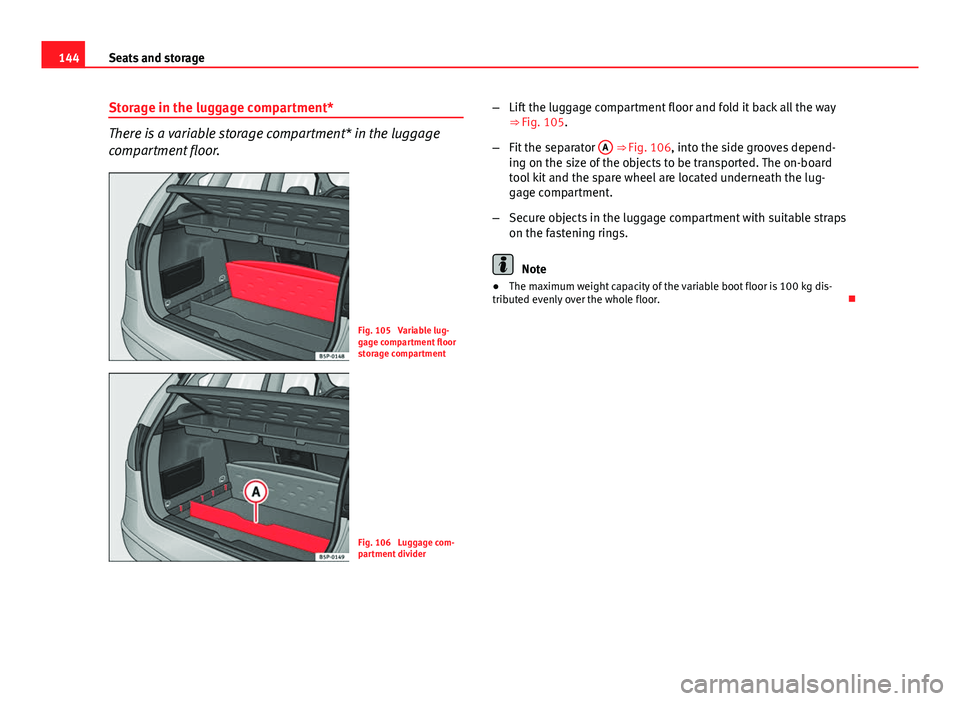
There is a variable storage compartment* in the luggage
compartment floor.
Fig. 105 Variable lug-
gage compartment floor
storage compartment
Fig. 106 Luggage com-
partment divider –
Lift the luggage compartment floor and fold it back all the way
⇒ Fig. 105.
– Fit the separator A
⇒ Fig. 106, into the side grooves depend-
ing on the size of the objects to be transported. The on-board
tool kit and the spare wheel are located underneath the lug-
gage compartment.
– Secure objects in the luggage compartment with suitable straps
on the fastening rings.
Note
● The maximum weight capacity of the variable boot floor is 100 kg dis-
tributed evenly over the whole floor.
Page 147 of 321
145
Seats and storage
Luggage compartment net*
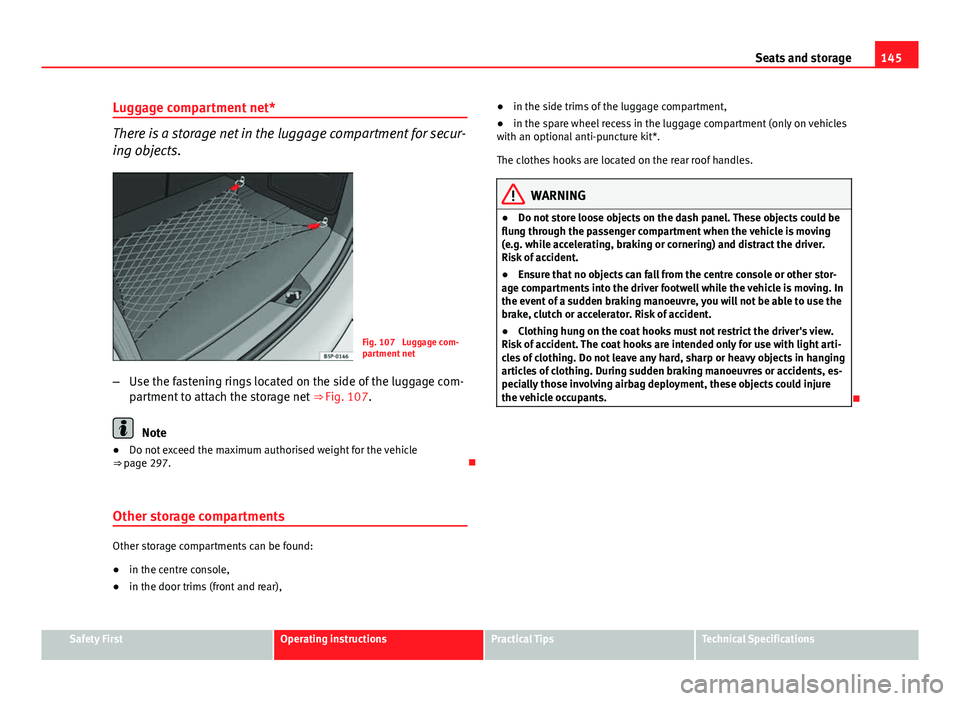
There is a storage net in the luggage compartment for secur-
ing objects.
Fig. 107 Luggage com-
partment net
– Use the fastening rings located on the side of the luggage com-
partment to attach the storage net ⇒ Fig. 107.
Note
● Do not exceed the maximum authorised weight for the vehicle
⇒ page 297.
Other storage compartments
Other storage compartments can be found:
● in the centre console,
● in the door trims (front and rear), ●
in the side trims of the luggage compartment,
● in the spare wheel recess in the luggage compartment (only on vehicles
with an optional anti-puncture kit*.
The clothes hooks are located on the rear roof handles.
WARNING
● Do not store loose objects on the dash panel. These objects could be
flung through the passenger compartment when the vehicle is moving
(e.g. while accelerating, braking or cornering) and distract the driver.
Risk of accident.
● Ensure that no objects can fall from the centre console or other stor-
age compartments into the driver footwell while the vehicle is moving. In
the event of a sudden braking manoeuvre, you will not be able to use the
brake, clutch or accelerator. Risk of accident.
● Clothing hung on the coat hooks must not restrict the driver's view.
Risk of accident. The coat hooks are intended only for use with light arti-
cles of clothing. Do not leave any hard, sharp or heavy objects in hanging
articles of clothing. During sudden braking manoeuvres or accidents, es-
pecially those involving airbag deployment, these objects could injure
the vehicle occupants.
Safety FirstOperating instructionsPractical TipsTechnical Specifications
Page 149 of 321
147
Seats and storage
– To close, lift the Drink holder*/ armrest* in the direction of the
arrow ⇒ Fig. 110 2
.
WARNING
Ensure that the load in the luggage compartment is correctly secured
with the net* when travelling with the armrest down ⇒ page 145.
Safety FirstOperating instructionsPractical TipsTechnical Specifications
Page 156 of 321
154Seats and storage
First-aid kit, warning triangle, fire
extinguisher
Warning triangle* and first-aid kit*
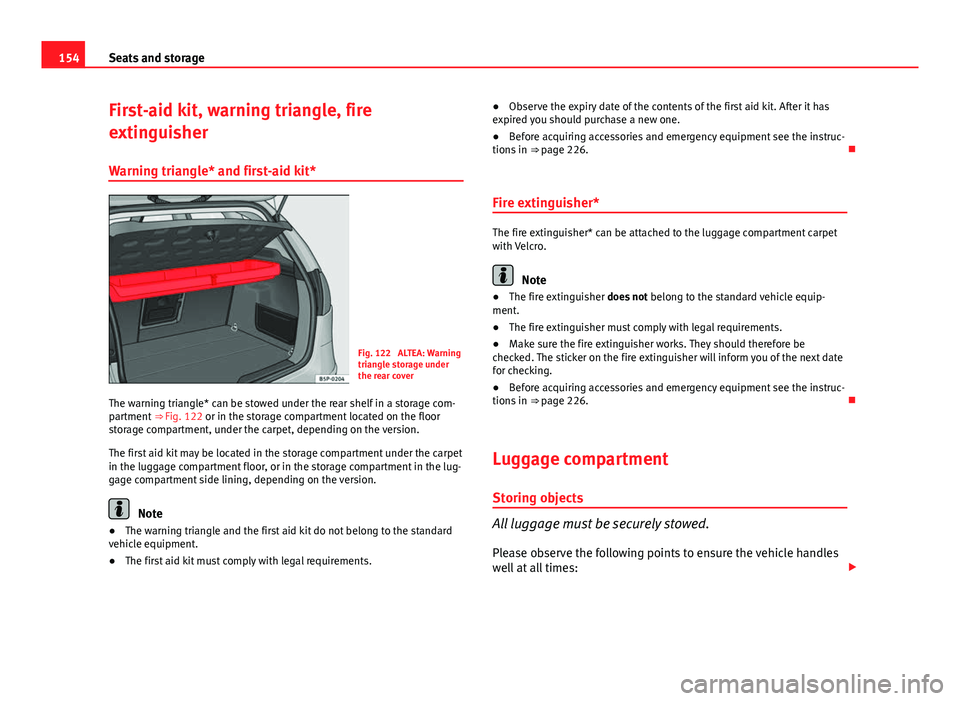
Fig. 122 ALTEA: Warning
triangle storage under
the rear cover
The warning triangle* can be stowed under the rear shelf in a storage com-
partment ⇒ Fig. 122 or in the storage compartment located on the floor
storage compartment, under the carpet, depending on the version.
The first aid kit may be located in the storage compartment under the carpet
in the luggage compartment floor, or in the storage compartment in the lug-
gage compartment side lining, depending on the version.
Note
● The warning triangle and the first aid kit do not belong to the standard
vehicle equipment.
● The first aid kit must comply with legal requirements. ●
Observe the expiry date of the contents of the first aid kit. After it has
expired you should purchase a new one.
● Before acquiring accessories and emergency equipment see the instruc-
tions in ⇒ page 226.
Fire extinguisher*
The fire extinguisher* can be attached to the luggage compartment carpet
with Velcro.
Note
● The fire extinguisher does not belong to the standard vehicle equip-
ment.
● The fire extinguisher must comply with legal requirements.
● Make sure the fire extinguisher works. They should therefore be
checked. The sticker on the fire extinguisher will inform you of the next date
for checking.
● Before acquiring accessories and emergency equipment see the instruc-
tions in ⇒ page 226.
Luggage compartment
Storing objects
All luggage must be securely stowed. Please observe the following points to ensure the vehicle handles
well at all times:
Page 157 of 321
155
Seats and storage
– Distribute the load as evenly as possible.
– Place heavy objects as far forward in the luggage compartment
as possible.
– Secure luggage in the luggage compartment with suitable
straps on the fastening rings.
WARNING
● Loose luggage and other loose items in the vehicle can cause serious
injuries.
● Loose objects in the luggage compartment can suddenly move and
change the way the vehicle handles.
● During sudden manoeuvres or accidents, loose objects in the passen-
ger compartment can be flung forward, injuring vehicle occupants.
● Always store objects in the luggage compartment and secure with
suitable straps. This is especially important for heavy objects.
● When you transport heavy objects, always take in account that a
change in the centre of gravity can also cause changes in vehicle han-
dling.
● Please observe information on safe driving ⇒ page 7, Safe driving.
CAUTION
Hard objects on the shelf could chafe against the wires of the heating ele-
ment in the rear window and cause damage.
Note
The ventilation slots in front of the rear side windows must not be covered
as this would prevent stale air being extracted from the vehicle. Applies to the model: ALTEA
Rear shelf
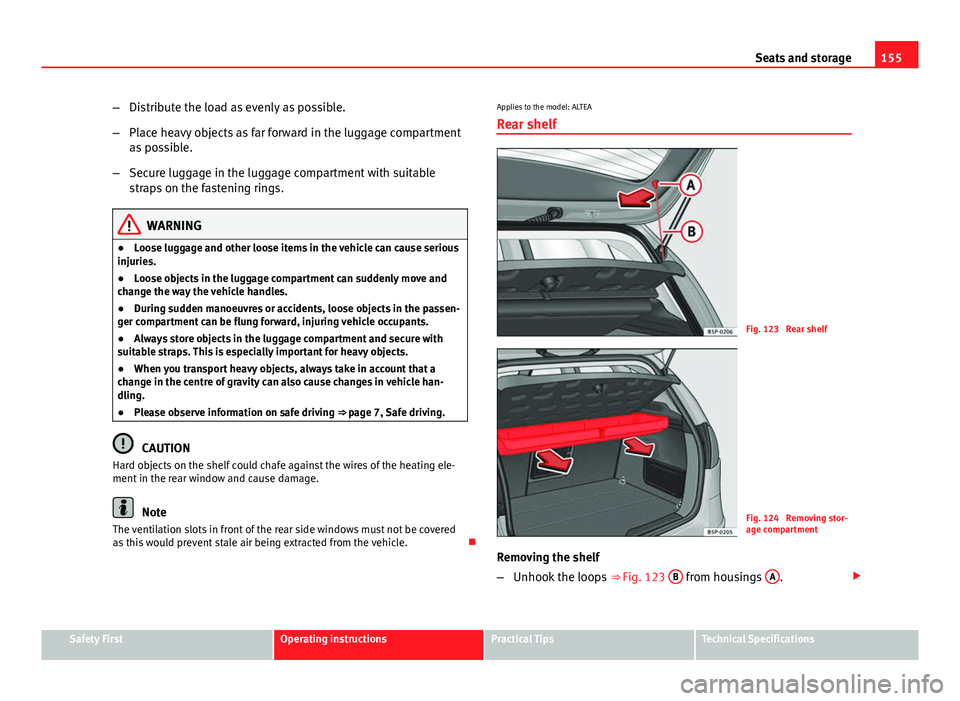
Fig. 123 Rear shelf
Fig. 124 Removing stor-
age compartment
Removing the shelf
– Unhook the loops ⇒ Fig. 123 B
from housings A.
Safety FirstOperating instructionsPractical TipsTechnical Specifications
Page 191 of 321
189
Driving
– Apply the handbrake.
– Select first gear.
– Switch the engine off and remove the key from the ignition. Turn
the steering wheel slightly to engage the steering lock.
– Always take you keys with you when you leave the vehicle ⇒
.
Additional notes on parking the vehicle on gradients:
Turn the steering wheel so that the vehicle rolls against the kerb if it started
to roll.
● If the vehicle is parked facing downhill, turn the front wheels so that
they point towards the kerb .
● If the vehicle is parked facing uphill, turn the front wheels so that they
point away from the kerb .
● Secure the vehicle as normal by applying the handbrake firmly and se-
lecting first gear.
WARNING
● Take measures to reduce the risk of injury when you leave your vehi-
cle unattended.
● Never park where the hot exhaust system could ignite inflammable
materials, such as dry grass, low bushes, spilt fuel etc.
● Never allow vehicle occupants to remain in the vehicle when it is
locked. They would be unable to open the vehicle from the inside, and
could become trapped in the vehicle in an emergency. In the event of an
emergency, locked doors will delay assistance to vehicle occupants.
● Never leave children alone in the vehicle. They could set the vehicle
in motion, for example, by releasing the handbrake or the gearbox lever.
● Depending on weather conditions, it may become extremely hot or
cold inside the vehicle. This can be fatal.
Hill driving assistant*
This function is only included in vehicles with ESC.
The hill driving assistant helps the driver to move off and upwards on a hill
when the vehicle is stationary.
The system maintains brake pressure for approximately two seconds after
the driver takes his foot off the brake pedal to prevent the vehicle from
lurching backwards when it is started. During these two seconds, the driver
has enough time to release the clutch pedal and accelerate without the ve-
hicle moving and without having to use the handbrake, making start-up
easier, more comfortable and safer.
These are the basic operation conditions:
● being on a ramp or hill/slope,
● closed doors,
● vehicle completely stationary,
● engine running and foot on the brake,
● besides having a gear engaged or being in neutral for manual gear
change and with the selector lever at positions S, D or R in vehicles with au-
tomatic gearbox.
This system is also active in reversing uphill.
WARNING
● If you do not start the vehicle immediately after taking your foot off
the brake pedal, the vehicle may start to roll back under certain condi-
tions. Depress the brake pedal or use the hand brake immediately.
● If the engine stalls, depress the brake pedal or use the hand brake
immediately.
● When following a line of traffic uphill, if you want to prevent the vehi-
cle from rolling back accidentally when starting off, hold the brake pedal
down for a few seconds before starting off.
Safety FirstOperating instructionsPractical TipsTechnical Specifications