belt Seat Altea 2014 Service Manual
[x] Cancel search | Manufacturer: SEAT, Model Year: 2014, Model line: Altea, Model: Seat Altea 2014Pages: 321, PDF Size: 4.52 MB
Page 139 of 321
137
Seats and storage
Front seats
Adjustment of the front seats
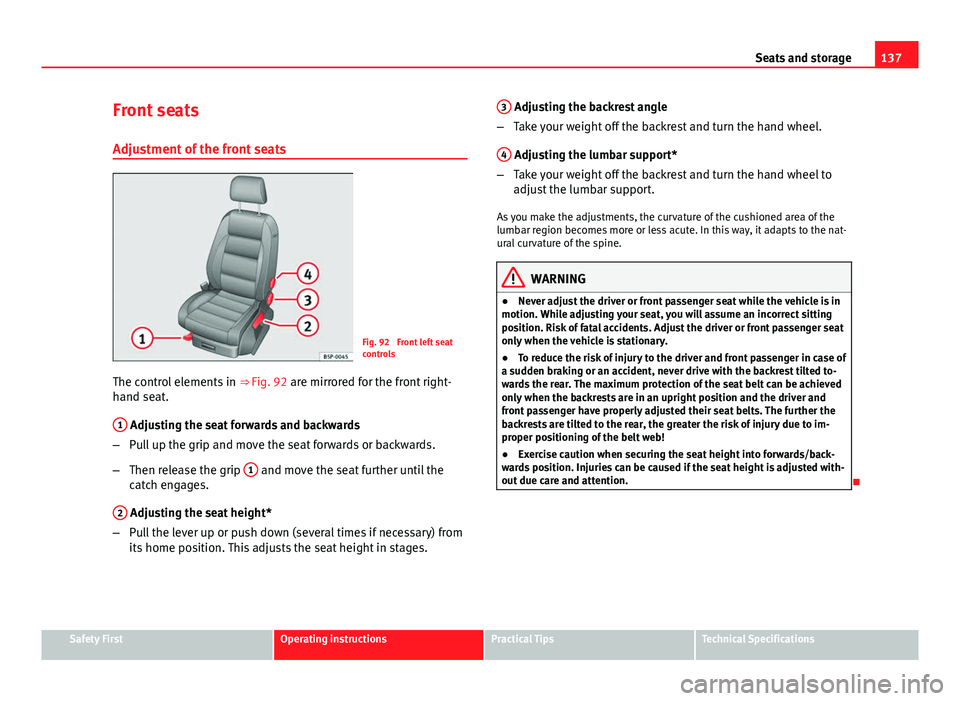
Fig. 92 Front left seat
controls
The control elements in ⇒ Fig. 92 are mirrored for the front right-
hand seat.
1
Adjusting the seat forwards and backwards
– Pull up the grip and move the seat forwards or backwards.
– Then release the grip 1
and move the seat further until the
catch engages.
2
Adjusting the seat height*
– Pull the lever up or push down (several times if necessary) from
its home position. This adjusts the seat height in stages. 3
Adjusting the backrest angle
– Take your weight off the backrest and turn the hand wheel.
4
Adjusting the lumbar support*
– Take your weight off the backrest and turn the hand wheel to
adjust the lumbar support.
As you make the adjustments, the curvature of the cushioned area of the
lumbar region becomes more or less acute. In this way, it adapts to the nat-
ural curvature of the spine.
WARNING
● Never adjust the driver or front passenger seat while the vehicle is in
motion. While adjusting your seat, you will assume an incorrect sitting
position. Risk of fatal accidents. Adjust the driver or front passenger seat
only when the vehicle is stationary.
● To reduce the risk of injury to the driver and front passenger in case of
a sudden braking or an accident, never drive with the backrest tilted to-
wards the rear. The maximum protection of the seat belt can be achieved
only when the backrests are in an upright position and the driver and
front passenger have properly adjusted their seat belts. The further the
backrests are tilted to the rear, the greater the risk of injury due to im-
proper positioning of the belt web!
● Exercise caution when securing the seat height into forwards/back-
wards position. Injuries can be caused if the seat height is adjusted with-
out due care and attention.
Safety FirstOperating instructionsPractical TipsTechnical Specifications
Page 142 of 321
140Seats and storage
Folding the seat backrests down
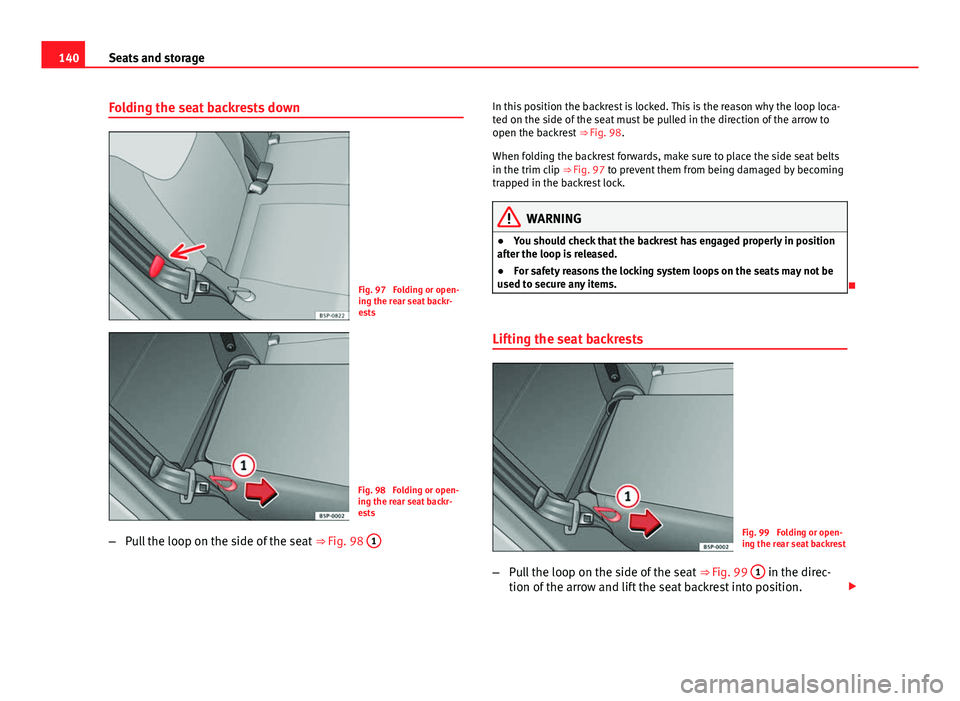
Fig. 97 Folding or open-
ing the rear seat backr-
ests
Fig. 98 Folding or open-
ing the rear seat backr-
ests
– Pull the loop on the side of the seat ⇒ Fig. 98 1
In this position the backrest is locked. This is the reason why the loop loca-
ted on the side of the seat must be pulled in the direction of the arrow to
open the backrest
⇒ Fig. 98.
When folding the backrest forwards, make sure to place the side seat belts
in the trim clip ⇒ Fig. 97 to prevent them from being damaged by becoming
trapped in the backrest lock.
WARNING
● You should check that the backrest has engaged properly in position
after the loop is released.
● For safety reasons the locking system loops on the seats may not be
used to secure any items.
Lifting the seat backrests
Fig. 99 Folding or open-
ing the rear seat backrest
– Pull the loop on the side of the seat ⇒
Fig. 99 1
in the direc-
tion of the arrow and lift the seat backrest into position.
Page 143 of 321
141
Seats and storage
WARNING
● You should check that the backrest has engaged properly in position
after the loop is released.
● For safety reasons the locking system loops on the seats may not be
used to secure any items.
● After locking the seat backrest into position ensure that the seat
belts protrude from the seat.
Storage compartment
Storage compartment on the front passenger side
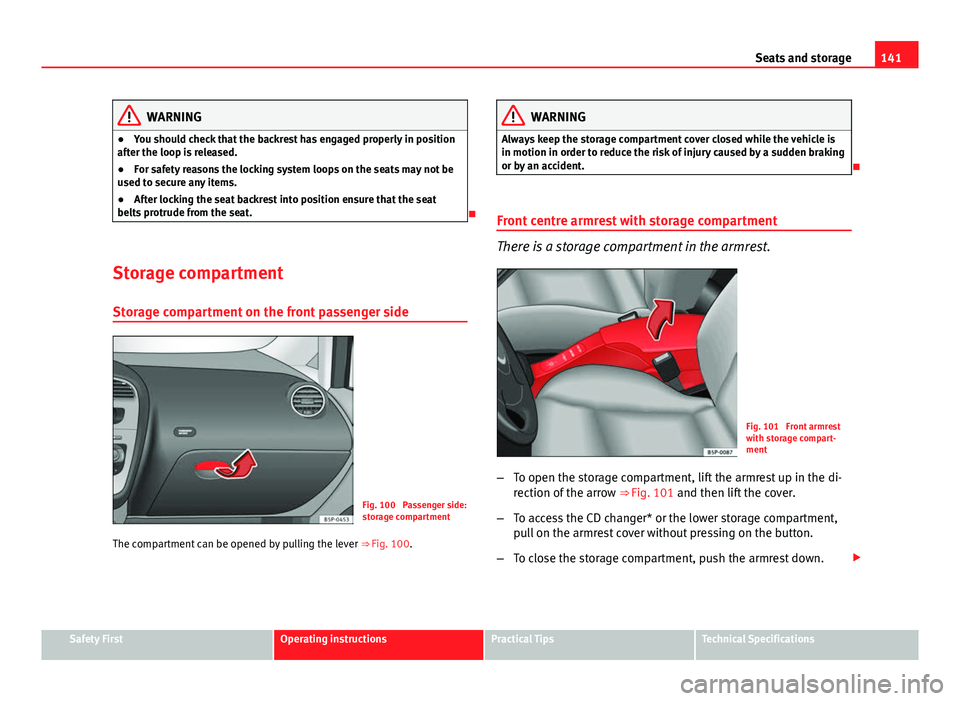
Fig. 100 Passenger side:
storage compartment
The compartment can be opened by pulling the lever ⇒ Fig. 100.
WARNING
Always keep the storage compartment cover closed while the vehicle is
in motion in order to reduce the risk of injury caused by a sudden braking
or by an accident.
Front centre armrest with storage compartment
There is a storage compartment in the armrest.
Fig. 101 Front armrest
with storage compart-
ment
– To open the storage compartment, lift the armrest up in the di-
rection of the arrow ⇒
Fig. 101 and then lift the cover.
– To access the CD changer* or the lower storage compartment,
pull on the armrest cover without pressing on the button.
– To close the storage compartment, push the armrest down.
Safety FirstOperating instructionsPractical TipsTechnical Specifications
Page 150 of 321
148Seats and storage
Multi-purpose mobile storage compartment*
General information
This storage compartment may only be placed in the central
area of the rear seat
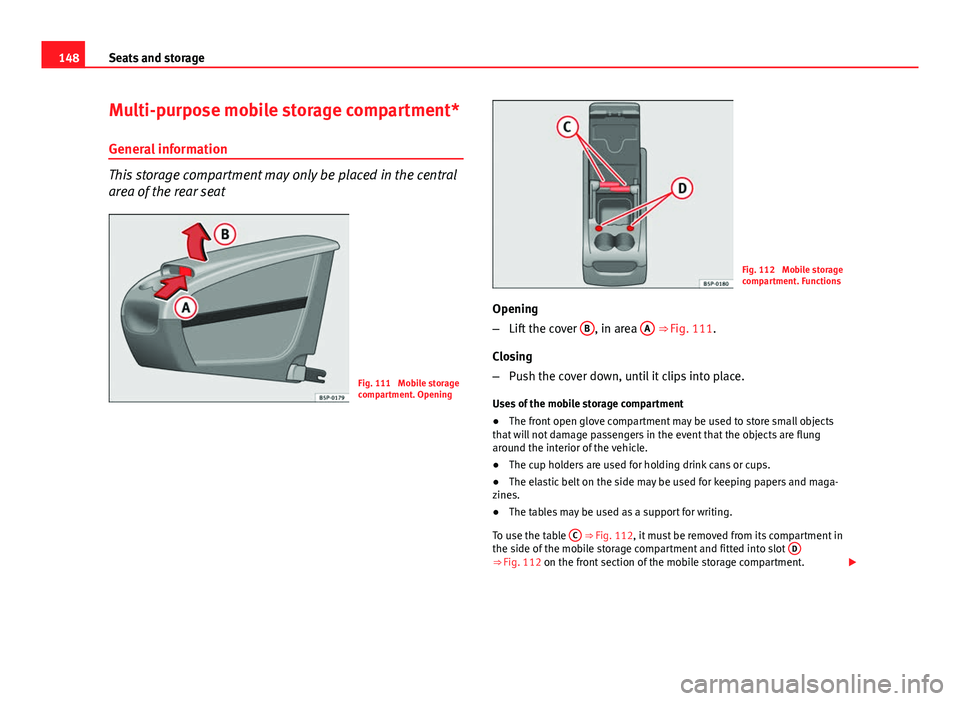
Fig. 111 Mobile storage
compartment. Opening
Fig. 112 Mobile storage
compartment. Functions
Opening
– Lift the cover B
, in area A ⇒ Fig. 111.
Closing
– Push the cover down, until it clips into place.
Uses of the mobile storage compartment
● The front open glove compartment may be used to store small objects
that will not damage passengers in the event that the objects are flung
around the interior of the vehicle.
● The cup holders are used for holding drink cans or cups.
● The elastic belt on the side may be used for keeping papers and maga-
zines.
● The tables may be used as a support for writing.
To use the table C
⇒ Fig. 112, it must be removed from its compartment in
the side of the mobile storage compartment and fitted into slot D
⇒
Fig. 112 on the front section of the mobile storage compartment.
Page 160 of 321
158Seats and storage
–Pull the net from underneath between the backrest and the fold-
ing tray and fit it to the slots in the roof, first the right then the
left ⇒ Fig. 127.
– Hook the belts into the front fastening rings to tense the net
⇒ Fig. 128.
Roof rack*
Please observe the following points if you intend to carry loads on the roof:
● For safety reasons, only luggage racks and accessories supplied by SEAT
Official Services are recommended.
● It is essential that you follow the assembly instructions included with
the bars exactly, being especially careful to position the luggage compart-
ment cover bars on the special housings, you must also respect their posi-
tion according to the direction of travel indicated in the assembly manual.
Not following these instructions may cause marks on the bodywork and the
longitudinal bars.
● Pay special attention to the tightening torque of the attachment bolts
and check them following a short journey. If necessary, retighten the bolts
and check them at regular intervals.
● Distribute the load evenly. A maximum load of 40 kg only is permitted
for each roof rack system support bar, the load must be distributed evenly
along the entire length. However, the maximum load permitted for the en-
tire roof (including the support system) of 75 kg must not be exceeded nor
should the total weight of the vehicle be exceeded. See the Technical Data
section.
● When transporting heavy or large objects on the roof, any change in the
normal vehicle behaviour due to a change in the centre of gravity or an in- creased wind resistance must be taken into account. For this reason, a suit-
able speed and driving style must be used.
●
For those vehicles fitted with a sliding/tilting sunroof*, ensure that it
does not interfere with the load on the roof rack system when opened.
Page 181 of 321
179
Driving
Start-Stop function*
Description and operation
The Start-Stop function stops the engine when the vehicle is stop-
ped and starts it automatically when required.
– When the vehicle is stopped, put it in neutral and release the
clutch pedal. The engine will stop.
– When the clutch pedal is pressed, the engine starts again.
– The instrument panel display shows information about the sta-
tus of the Start-Stop function ⇒ Fig. 143.
Start-Stop function conditions
● The driver seat belt must be buckled.
● The bonnet must be closed.
● The engine must be at operating temperature.
● The steering wheel must not be turned more than 270°.
● The vehicle must not be on a steep gradient.
● The vehicle must not be in reverse.
● A trailer must not be connected.
● The temperature of the passenger compartment must be within the com-
fort limits (button AC
11 ⇒ Fig. 136 should be selected).
● The windscreen de-mist function must be off.
● If not, it requires an increase in airflow 10
⇒ Fig. 136 for more than three
presses.
● The temperature must not be set to HI or LO.
● The driver door must be closed.
● The diesel particulate filter must not be in regeneration mode, for diesel
engines. ●
The battery charge must not be low for the next start.
● The battery temperature must be between -1 °C (+30 °F) and +55 °C
(+131 °F).
● The Parking aid system (Park Assist*) must not be activated.
Start-Stop function interruption
In the following situations, the Start-Stop function will be interrupted and
the engine will automatically start:
● The vehicle starts moving.
● The brake pedal is pressed several times in a row.
● The battery has been discharged excessively.
● The Start-Stop System is manually deactivated.
● The windscreen de-mist function is turned on.
● The temperature of the passenger compartment exceeds the comfort
limits (button AC
11 ⇒ Fig. 136 should be selected).
● If in an increase in airflow 10 ⇒ Fig. 136 is required for more than three
presses.
● Temperature setting HI or LO is selected.
● The engine coolant temperature is insufficient.
● The alternator is faulty, for example the V-belt has ruptured.
● If any of the conditions described in the previous section are not fulfil-
led.
WARNING
Never allow the vehicle to move with the engine off for any reason. You
could lose control of your vehicle. This could cause an accident and seri-
ous injury.
● Power steering does not work when the engine is not running. That is
why it is much more difficult to turn the steering wheel.
● Turn off the Start-Stop system when driving through water (fording
streams, etc.).
Safety FirstOperating instructionsPractical TipsTechnical Specifications
Page 223 of 321
221
Vehicle maintenance and cleaning
The longer stains or dirt remain on the vehicle surfaces, especially the fab-
rics covering the padded upholstery, the more difficult it becomes to clean
and maintain them. If stains and dirt are left for a long time, it may be that
they are impossible to remove.
WARNING
Car-care products may be toxic and hazardous. Using unsuitable car-care
products or, using them in the wrong way, may cause accidents, serious
injury, burns or intoxication.
● Keep your car-care products in their original containers.
● Read the instructions.
● Never keep car-care products in empty food containers, bottles or
other similar containers. Other people may confuse them.
● Keep all car-care products out of the reach of children.
● Some products may give off harmful vapours during use. Therefore,
they should be used outdoors in well-ventilated places.
● Never use fuel, turpentine, engine oil, nail-varnish remover or any
other volatile product for washing, maintenance or cleaning. These are
toxic and highly flammable.
WARNING
Unsuitable maintenance and cleaning of vehicle components may impair
proper operation of safety equipment and cause serious injury.
● Maintain and clean vehicle components according to the manufactur-
er's instructions.
● Only use approved or recommended cleaning products.
CAUTION
● Cleaning products which contain solvents have a corrosive effect and
may damage the material irreparably.
● Stains and dirt containing aggressive substances or solvents attack the
material and may damage it irreparably, even when they are cleaned quick-
ly.
● Dirt and stains should not be allowed to dry and should be cleaned as
quickly as possible.
● In the case of stubborn stains, take the vehicle to a specialised work-
shop to avoid damage.
Treating your upholstery
Checklist
To treat and maintain your seat upholstery, keep the following in mind ⇒
:
Before entering the vehicle, close any Velcro fasteners that might
snag on the upholstery or trim fabric. Any open Velcro fasteners may
damage the trim or upholstery fabrics.
To prevent damage, avoid direct contact between sharp decorative
objects and the upholstery and trim fabrics. Decorative objects in-
clude zips, rivets and rhinestones on clothing and belts.
From time to time, clean the dust that gathers in the perforations,
folds and seams so that the surfaces of the seats are not damaged
by its abrasive effect.
Make sure clothes are colour-fast to avoid them running and staining
the upholstery. This is especially important if the upholstery is light
in colour.
Safety FirstOperating instructionsPractical TipsTechnical Specifications
Page 227 of 321
225
Vehicle maintenance and cleaning
Cleaning the radio and climate controls
To clean the radio and/or climate controls, use a soft damp cloth. For more
resistant dirt, a neutral soap solution may be used.
Seat belt cleaning
A dirty belt may not work properly.
Check all seat belts regularly and keep them clean.
Seat belt cleaning
– Pull the dirty seat belt right out and unroll it.
– Clean dirty seat belts with a gentle soap solution.
– Allow it to dry.
– Do not roll the seat belt up until it is dry.
If large stains form on the belts, it will not retract correctly into the automat-
ic belt retractor.
WARNING
● Do not use chemical cleaning agents on the seat belts, as this can im-
pair the strength of the webbing. Ensure that seat belts do not come into
contact with corrosive fluids.
● Check the condition of the seat belts at regular intervals. If you notice
that the belt webbing, fittings, retractor mechanism or buckle of any of
the belts is damaged, the belt must be replaced by a specialised work-
shop.
● Do not attempt to repair a damaged seat belt yourself. The seat belts
must not be removed or modified in any way.
CAUTION
After cleaning, allow seat belts to dry completely before rolling them up.
Otherwise, the belt retractors could become damaged.
Safety FirstOperating instructionsPractical TipsTechnical Specifications
Page 238 of 321
236Checking and refilling levels
WARNING
All work on the engine or in the engine compartment, e.g. checking and
refilling fluids, involves the danger of injury and scalding as well as the
risk of accident or fire.
● Never open the bonnet if you see steam, smoke or coolant escaping
from the engine compartment. Otherwise, there is a risk of sustaining
burns. Wait until no more steam or coolant is emitted, then allow the en-
gine to cool before carefully opening the bonnet.
● Switch off the engine and remove the key from the ignition.
● Apply the handbrake and move the gear lever to neutral or selector
lever to position P.
● Keep children away from the vehicle.
● Never touch hot engine parts. There is a risk of burns.
● Never spill liquids on a hot engine or on a hot exhaust gas system.
This is a fire hazard.
● Avoid causing short-circuits in the electrical system, particularly at
the points where the jump leads are attached ⇒ page 288. The battery
could explode.
● Never touch the radiator fan. It is temperature controlled and could
start automatically, even when the engine has been switched off and the
key removed from the ignition!
● Do not unscrew the cap on the coolant expansion tank when the en-
gine is hot. If the coolant is hot, the cooling system will be pressurised!
● Protect face, hands and arms by covering the cap with a large, thick
cloth to protect against escaping coolant and steam.
● Always make sure you have not left any objects, such as cleaning
cloths and tools, in the engine compartment.
● If you have to work underneath the vehicle, you must use suitable
stands additionally to support the vehicle, there is a risk of accident!. A
hydraulic jack is insufficient for securing the vehicle and there is a risk of
injury.WARNING (Continued)
● If any work has to be performed when the engine is started or with
the engine running, there is an additional, potentially fatal, safety risk
from the rotating parts, such as the drive belts, alternator, radiator fan,
etc., and from the high-voltage ignition system. You should also observe
the following points:
–Never touch the electrical wiring of the ignition system.
– Ensure that jewellery, loose clothing and long hair do not get trap-
ped in rotating engine parts. Danger of death. Before starting any
work remove jewellery, tie back and cover hair, and wear tight-fitting
clothes.
– Never accelerate with a gear engaged without taking the necessary
precautions. The vehicle could move, even if the handbrake is ap-
plied. Danger of death.
● If work has to be carried out on the fuel system or on electrical com-
ponents, you must observe the following safety notes in addition to the
above warnings:
–Always disconnect the battery from the on-board network. The ve-
hicle must be unlocked when this is done, otherwise the alarm will be
triggered.
– Do not smoke.
– Never work near naked flames.
– Always have a fire extinguisher on hand.
CAUTION
When topping up service fluids, make sure not to mistake them. Using the
wrong fluids could cause serious malfunctions and engine damage!
Page 311 of 321
Index
A
ABS . . . . . . . . . . . . . . . . . . . . . . . . . . . . . . . . . . 197control lamp . . . . . . . . . . . . . . . . . . . . . . . . . 83
Accessories . . . . . . . . . . . . . . . . . . . . . . . . . . . . 226
Acoustic warning . . . . . . . . . . . . . . . . . . . . . . . 173
Adaptive headlights . . . . . . . . . . . . . . . . . . . . . 119
Adjusting the seat belt height . . . . . . . . . . . . . . 28
AFS (cornering lights) . . . . . . . . . . . . . . . . . . . 120
Airbag covers . . . . . . . . . . . . . . . . . . . . . . . . . . . 36
Airbag system . . . . . . . . . . . . . . . . . . . . . . . . . . . 30 control lamp . . . . . . . . . . . . . . . . . . . . . . . . . 32
Curtain airbags . . . . . . . . . . . . . . . . . . . . . . . 41
Front airbags . . . . . . . . . . . . . . . . . . . . . . . . 34
side airbags . . . . . . . . . . . . . . . . . . . . . . . . . 37
Air conditioner 2C-Climatronic . . . . . . . . . . . . . . . . . . . . . . 164
General notes . . . . . . . . . . . . . . . . . . . . . . . 169
Air conditioner automatic mode 2C-Climatronic . . . . . . . . . . . . . . . . . . . . . . 166
Air conditioning . . . . . . . . . . . . . . . . . . . . . . . . 161
Air recirculation mode 2C-Climatronic . . . . . . . . . . . . . . . . . . . . . . 168
Manual air conditioner . . . . . . . . . . . . . . . . 163
Alarm system Switching off . . . . . . . . . . . . . . . . . . . . . . . . 106
Alcantara . . . . . . . . . . . . . . . . . . . . . . . . . . . . . . 222
All-wheel drive . . . . . . . . . . . . . . . . . . . . . . . . . 200 Alternator
Warning lamp . . . . . . . . . . . . . . . . . . . . . . . . 84
Anti-lock brake system . . . . . . . . . . . . . . . . . . . 197 control lamp . . . . . . . . . . . . . . . . . . . . . . . . . 83
Anti-theft alarm system . . . . . . . . . . . . . . . . . . 106 Switching off . . . . . . . . . . . . . . . . . . . . . . . . 106
Anti-theft wheel bolts . . . . . . . . . . . . . . . . . . . 266
Antifreeze . . . . . . . . . . . . . . . . . . . . . . . . . . . . . 242
Aquaplaning . . . . . . . . . . . . . . . . . . . . . . . . . . . 256
Ashtray . . . . . . . . . . . . . . . . . . . . . . . . . . . . . . . 150
Aspects to note before setting off . . . . . . . . . . . . 8
ASR . . . . . . . . . . . . . . . . . . . . . . . . . . . . . . . . . . 197 Control lamp . . . . . . . . . . . . . . . . . . . . . . . . . 88
Audible warning . . . . . . . . . . . . . . . . . . . . . . . . . 20
Automatic anti-dazzle interior rear vision mirror Activating the anti-dazzle function . . . . . . 131
Deactivating the anti-dazzle function . . . . 131
Automatic car wash tunnel . . . . . . . . . . . . . . . 215
Automatic gearbox Kick-down feature . . . . . . . . . . . . . . . . . . . . 187
Automatic gearbox/DSG automatic gearbox . 183
Automatic lighting . . . . . . . . . . . . . . . . . . . . . . 116
Automatic windscreen wiper/washer . . . . . . . 127
Auxiliary audio input: AUX-IN . . . . . . . . . . . . . 152
B
Ball coupling . . . . . . . . . . . . . . . . . . . . . . . . . . . 211 Battery
Changing . . . . . . . . . . . . . . . . . . . . . . . . . . 252
Charging . . . . . . . . . . . . . . . . . . . . . . . . . . . 252
Winter conditions . . . . . . . . . . . . . . . . . . . . 250
Before setting off . . . . . . . . . . . . . . . . . . . . . . . . . 8
Biodiesel . . . . . . . . . . . . . . . . . . . . . . . . . . . . . . 234
Biodiesel fuel . . . . . . . . . . . . . . . . . . . . . . . . . . 234
Bonnet . . . . . . . . . . . . . . . . . . . . . . . . . . . . . . . 237
Brake fluid . . . . . . . . . . . . . . . . . . . . . . . . . . . . 249 Changing . . . . . . . . . . . . . . . . . . . . . . . . . . 249
control lamp . . . . . . . . . . . . . . . . . . . . . . . . . 66
Brake pads . . . . . . . . . . . . . . . . . . . . . . . . . . . . 204
Brake pedal control lamp . . . . . . . . . . . . . . . . . . . . . . . . . 89
Brakes . . . . . . . . . . . . . . . . . . . . . . . . . . . . . . . . 204 Worn brake pads . . . . . . . . . . . . . . . . . . . . . 84
Brake servo . . . . . . . . . . . . . . . . . . . . . . . . 196, 204
Brake system . . . . . . . . . . . . . . . . . . . . . . . . . . 249 Brakes . . . . . . . . . . . . . . . . . . . . . . . . . . . . . 201
Brake servo . . . . . . . . . . . . . . . . . . . . . . . . . 201
warning lamp . . . . . . . . . . . . . . . . . . . . . . . . 85
Braking distance . . . . . . . . . . . . . . . . . . . . . . . 204
Bulb changes General notes . . . . . . . . . . . . . . . . . . . . . . . 274
Bulb defect Control lamp . . . . . . . . . . . . . . . . . . . . . . . . . 86
Buzzer . . . . . . . . . . . . . . . . . . . . . . . . . . . . 122, 173
309
Index