service Seat Altea 2014 Repair Manual
[x] Cancel search | Manufacturer: SEAT, Model Year: 2014, Model line: Altea, Model: Seat Altea 2014Pages: 321, PDF Size: 4.52 MB
Page 272 of 321
270If and when
Notes for the proper use of the air compressor are included in an additional
instruction leaflet.
WARNING
● Do not attempt to repair a puncture with the sealing product if the
tyre has been damaged by driving the vehicle after the tyre has lost its
air.
● Always observe warnings and follow instructions concerning com-
pressor and sealing compound carefully.
● Do not drive faster than 80 km/h (50 mph), avoid heavy acceleration,
hard braking and fast cornering.
● Tyres which have been repaired with sealing compound are only suit-
able for temporary use over a short period. Therefore, please drive care-
fully to the next available specialised workshop.
For the sake of the environment
If you have to dispose of a sealant can, go to a specialised waste service or
to a SEAT Technical Service, where the product can be recycled in an appro-
priate waste container.
Note
● If sealing product should leak out, leave it to dry. This way you can pull it
off like a piece of foil.
● Observe the expiry date stated on the sealing compound can. Have the
sealing compound exchanged by a specialised workshop.
● Seek professional assistance if the repair of a tyre puncture is not possi-
ble with the sealing product. Preparation work
Certain steps must be taken before repairing a tyre.
–
If you have a flat tyre or puncture, park the vehicle as far away
from the flow of traffic as possible.
– Apply the handbrake firmly.
– Engage first gear , or put the selector lever to position P.
– All occupants should leave the vehicle. They should wait in a
safe area (for instance behind the roadside crash barrier).
– Check whether a repair is possible using the Tyre Mobility Sys-
tem “General information and safety notes.”
– Unscrew inflation cap from the affected wheel.
– Take the tyre repair kit out of the luggage compartment.
WARNING
Put the hazard warning lights on and place the warning triangle in posi-
tion. This is for your own safety and also warns other road users.
CAUTION
Take special care if you have to repair a tyre on a slope.
Note
Please observe legal requirements when doing so.
Page 274 of 321
272If and when
Fuses
Introduction
Due to the constant update of vehicles, fuse assignments depending on
equipment and the use of the same fuse for various electrical components,
at the time of printing this manual it is not possible to provide an up-to-date
summary of the electrical components fuse positions. For detailed informa-
tion about the fuse positions, please consult a Technical Service.
In general, a fuse can be assigned to various electrical components. Like-
wise, an electrical component can be protected by several fuses.
Only replace fuses when the cause of the problem has been solved. If a
newly inserted fuse blows after a short time, you must have the electrical
system checked by a specialised workshop as soon as possible.
Additional information and warnings:
● Working in the engine compartment ⇒ page 235
WARNING
The high voltages in the electrical system can give serious electrical
shocks, causing burns and even death!
● Never touch the electrical wiring of the ignition system.
● Take care not to cause short circuits in the electrical system.
WARNING
Using unsuitable fuses, repairing fuses or bridging a current circuit with-
out fuses can cause a fire and serious injury.
● Never use a fuse with a higher value. Only replace fuses with a fuse of
the same amperage (same colour and markings) and size.
● Never repair a fuse.
● Never replace a fuse by a metal strip, staple or similar.
CAUTION
● To avoid damage to the vehicles electric system, before replacing a fuse
turn off the ignition, the lights and all electrical elements and remove the
keys from the ignition.
● If you replace a fuse with higher-rating fuse, you could cause damage to
another part of the electrical system.
● Protect the fuse boxes when open to avoid the entry of dust or humidity.
Dirt and humidity inside fuse boxes can cause damage to the electrical sys-
tem.
Note
One single consumer could have more than one fuse.
Note
Several consumers could run over one single fuse.
Page 277 of 321
275
If and when
- W5W - PY21W
Xenon headlights 1)
/adaptive*
- D1S 2)
- P21W SLL
- W5W - PY21W
Front fog light - H3
Upper tail light (ALTEA) - P21W3)
- R10W
Lower tail light (ALTEA) - P21W- P21W
Fixed tail light (ALTEA XL / ALTEA FREETRACK) - P21W3)
- P21W
Position
Turn signal
Dipped and full beam
Daylight
Position
Turn signals
Front fog light
Stop/Position
Turn signal
Fog light
Reverse light
Stop/Position
Turn signal Mobile tail light (ALTEA XL / ALTEA FREETRACK)
- P21W- P21W
- W5W
Side turn signal - W5W
Number plate light - C5W
Note
● Depending on weather conditions (cold or wet), the headlights, the fog
lights, the tail lights and the turn signals may be temporarily misted. This
has no influence on the useful life of the lighting system. By switching on
the lights, the area through which the beam of light is projected will quickly
be demisted. However, the edges may continue to be misted.
● Please check at regular intervals that all lighting (especially the exterior
lighting) on your vehicle is functioning properly. This is not only in the inter-
est of your own safety, but also that of all other road users.
● Due to the difficulty in accessing some of the bulbs, any replacement
work should be done by a Technical Service. However, the following is a de-
scription of how to change the lamps except for the fog lights* and interior
lamps.
Fog light (driver side)
Reverse (passenger side)
Position
Side turn signal
Number plate light
1)
On this type of headlight, the bulb changes must be made by the Technical Service, given
that complex elements must be removed from the vehicle and a reset must be made on the
automatic control system incorporated.
2) The Xenon bulbs discharge 2.5 times the light flux and have an average lifespan of 5 times
more than that of halogen bulbs, this means that, except due to unusual circumstances,
there is no need to change the bulbs for the whole life of the vehicle.
3) Electronically controlled single filament bulb for Stop/side bulbs. If the bulb blows it will
not work in either position or Stop.
Safety FirstOperating instructionsPractical TipsTechnical Specifications
Page 298 of 321
296Description of specifications
wheelbase of less than 1 metre), a minimum of 4% of the actual trailer
weight is legally required for the drawbar load.
WARNING
● For safety reasons, you should not drive at speeds above 80 km/h (50
mph) when towing a trailer. This also applies to countries where higher
speeds are permitted.
● Never exceed the maximum trailer weights or the drawbar load. If the
permissible axle load or the permissible total weight is exceeded, the
driving characteristics of the vehicle may change, leading to accidents,
injuries and damage to the vehicle.
Wheels
Tyre pressure, snow chains, wheel bolts
Tyre pressures
The sticker with the tyre pressure values can be found on the inside of the
fuel tank flap. The tyre pressure values given there are for cold tyres. Do not
reduce the slightly raised pressures of warm tyres ⇒
.
Snow chains
Snow chains may be fitted only to the front wheels.
Consult the section “wheels” of this manual.
Wheel bolts
After the wheels have been changed, the tightening torque of the wheel
bolts should be checked as soon as possible with a torque wrench ⇒
.
The tightening torque for steel and alloy wheels is 120 Nm.
WARNING
● Check the tyre pressure at least once per month. Checking the tyre
pressure is very important. If the tyre pressure is too high or too low,
there is an increased danger of accidents, particularly at high speeds.
● If the tightening torque of the wheel bolts is too low, they could loos-
en while the vehicle is in motion. Risk of accident! If the tightening tor-
que is too high, the wheel bolts and threads can be damaged.
Note
We recommend that you ask your Technical Service for information about
appropriate wheel, tyre and snow chain size.
Page 299 of 321
297
Technical specifications
Technical specifications
Checking fluid levels
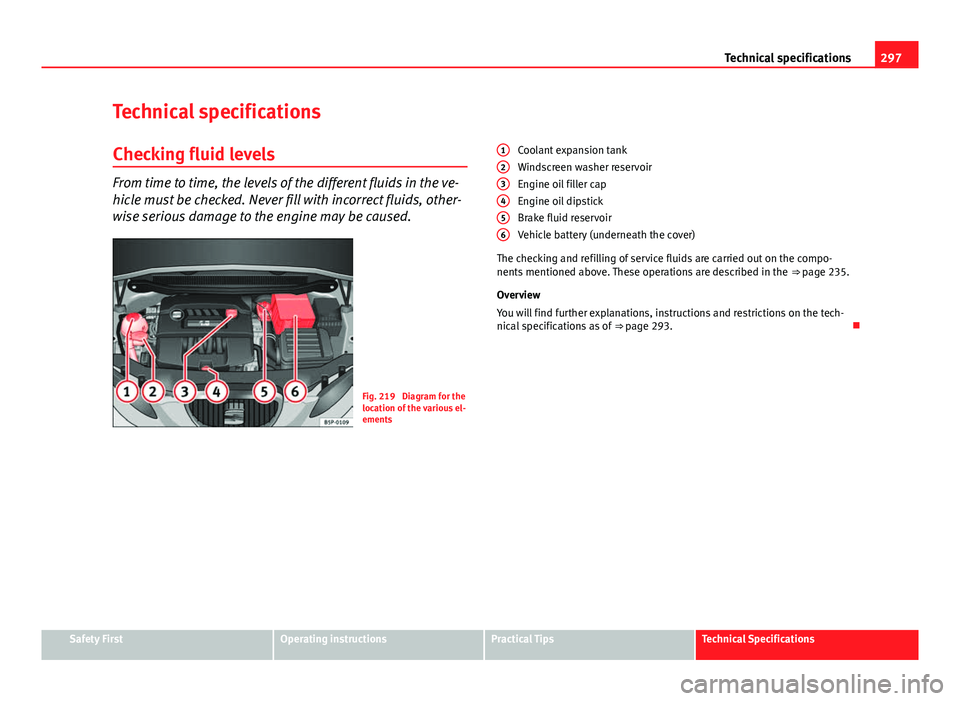
From time to time, the levels of the different fluids in the ve-
hicle must be checked. Never fill with incorrect fluids, other-
wise serious damage to the engine may be caused.
Fig. 219 Diagram for the
location of the various el-
ements Coolant expansion tank
Windscreen washer reservoir
Engine oil filler cap
Engine oil dipstick
Brake fluid reservoir
Vehicle battery (underneath the cover)
The checking and refilling of service fluids are carried out on the compo-
nents mentioned above. These operations are described in the ⇒ page 235.
Overview
You will find further explanations, instructions and restrictions on the tech-
nical specifications as of ⇒ page 293.
1
23456
Safety FirstOperating instructionsPractical TipsTechnical Specifications
Page 314 of 321
EngineRunning in . . . . . . . . . . . . . . . . . . . . . . . . . 204
Engine compartment Working in the engine compartment . . . . 235
Engine coolant . . . . . . . . . . . . . . . . . . . . . . . . . 242 G 12 plus-plus . . . . . . . . . . . . . . . . . . . . . . 242
G 13 . . . . . . . . . . . . . . . . . . . . . . . . . . . . . . . 242
Specifications . . . . . . . . . . . . . . . . . . . . . . . 242
Engine fault Control lamp . . . . . . . . . . . . . . . . . . . . . . . . . 82
Engine management control lamp . . . . . . . . . . . . . . . . . . . . . . . . . 82
Engine oil . . . . . . . . . . . . . . . . . . . . . . . . . . . . . 238 Changing . . . . . . . . . . . . . . . . . . . . . . . . . . 241
Checking engine oil level . . . . . . . . . . . . . . 240
Oil properties . . . . . . . . . . . . . . . . . . . . . . . 239
Specifications . . . . . . . . . . . . . . . . . . . . . . . 238
Topping up . . . . . . . . . . . . . . . . . . . . . . . . . 241
Engine oil dipstick . . . . . . . . . . . . . . . . . . . . . . 240
Engine oil pressure control lamp . . . . . . . . . . . . . . . . . . . . . . 66, 86
Environment . . . . . . . . . . . . . . . . . . . . . . . . . . . 206 Environmental friendliness . . . . . . . . . . . . 208
Environmentally friendly driving . . . . . . . . . . . 206
Environmental tip Avoiding pollution . . . . . . . . . . . . . . . . . . . 229
ESC . . . . . . . . . . . . . . . . . . . . . . . . . . 88, 172, 198 see also Electronic Stability Control . . . . . 172
Example of menu use Program a speed limit warning . . . . . . . . . . 69
To activate and deactivate the speed limitwarning . . . . . . . . . . . . . . . . . . . . . . . . . . . 69 Example of the use of the menus
Open the Configuration menu with the MFIlever . . . . . . . . . . . . . . . . . . . . . . . . . . . . . . 68
Open the Configuration menu with the steering wheel controls . . . . . . . . . . . . . . 69
Examples of menu use Open the main menu . . . . . . . . . . . . . . . . . . 68
Open the winter tyres menu . . . . . . . . . . . . 69
To close the winter tyres menu . . . . . . . . . . 69
Exhaust gas purification system . . . . . . . . . . . 205
Exterior mirrors . . . . . . . . . . . . . . . . . . . . . . . . . 217
F
Fastening rings . . . . . . . . . . . . . . . . . . . . . . . . . . 18
Fire extinguisher . . . . . . . . . . . . . . . . . . . . . . . . 154
First-aid kit . . . . . . . . . . . . . . . . . . . . . . . . . . . . 154
Flexible service interval display . . . . . . . . . . . . 62
Floor mats . . . . . . . . . . . . . . . . . . . . . . . . . . . . . . 16
Fog lights . . . . . . . . . . . . . . . . . . . . . . . . . . . . . 115
Fog lights with cornering function . . . . . . . . . 120
Folding table . . . . . . . . . . . . . . . . . . . . . . . . . . . 142
Folding the seat backrests down . . . . . . . . . . 140
Front airbags . . . . . . . . . . . . . . . . . . . . . . . . . . . 34 Description . . . . . . . . . . . . . . . . . . . . . . . . . . 34
Operation . . . . . . . . . . . . . . . . . . . . . . . . . . . 35
Safety notes . . . . . . . . . . . . . . . . . . . . . . . . . 37
Front drinks holders . . . . . . . . . . . . . . . . . . . . . 146
Front interior light type 1 Switching light off . . . . . . . . . . . . . . . . . . . 123
Switching light on . . . . . . . . . . . . . . . . . . . 123 Front interior light type 2
Switching light off . . . . . . . . . . . . . . . . . . . 124
Switching light on . . . . . . . . . . . . . . . . . . . 124
Front passenger airbag deactivation . . . . . . . . 44
Front reading lights . . . . . . . . . . . . . . . . . . . . . 125
Front seat adjustment Lumbar support . . . . . . . . . . . . . . . . . . . . . 137
Fuel Diesel . . . . . . . . . . . . . . . . . . . . . . . . . . . . . 234
Petrol . . . . . . . . . . . . . . . . . . . . . . . . . . . . . . 233
fuel consumption . . . . . . . . . . . . . . . . . . . . . . . 206
Fuel consumption . . . . . . . . . . . . . . . . . . . . . . . 294
Fuel level Indicator . . . . . . . . . . . . . . . . . . . . . . . . . . . . 58
Fuel reserve . . . . . . . . . . . . . . . . . . . . . . . . . . . . 80 Warning message . . . . . . . . . . . . . . . . . . . . . 67
Fuel tank see Fuel reserve . . . . . . . . . . . . . . . . . . . . . . 80
Fuel Tank Opening the fuel tank flap . . . . . . . . . . . . . 228
Fuel: save . . . . . . . . . . . . . . . . . . . . . . . . . . . . . 206
Fuses . . . . . . . . . . . . . . . . . . . . . . . . . . . . . . . . . 272 Fuse box . . . . . . . . . . . . . . . . . . . . . . . . . . . 273
Identifying blown fuses . . . . . . . . . . . . . . . 274
Identifying by colours . . . . . . . . . . . . . . . . 273
Preparation before replacing . . . . . . . . . . . 274
Replacement . . . . . . . . . . . . . . . . . . . . . . . . 274
G
Gear shift pattern . . . . . . . . . . . . . . . . . . . . . . . 182
General overview of the engine compartment 297
312 Index