warning Seat Altea 2014 Manual PDF
[x] Cancel search | Manufacturer: SEAT, Model Year: 2014, Model line: Altea, Model: Seat Altea 2014Pages: 321, PDF Size: 4.52 MB
Page 99 of 321
97
Opening and closing
Note
● While the driver door is open, the vehicle cannot be locked with the re-
mote control. This avoids the user from forgetting his key inside the vehicle.
● If the driver door is unlocked with the key shaft, only the driver door is
unlocked, the rest of the doors remain locked. When the ignition is switched
on, the door deadlock function is deactivated (although the doors remain
locked) and the central lock button is activated. See ⇒ page 106.
● If the central locking or anti-theft alarm are faulty, the driver door control
lamp remains lit for approx. 30 seconds after locking the vehicle.
● For anti-theft security, only the driver door is fitted with a lock cylinder.
“Safe” Security system*
The deadlock function makes it more difficult to break into
the vehicle because the door release lever and the central
lock button are not active (depending upon country). Activating the deadlock
– Press once the locking button
on the remote control. or
– Turn the key once in the driver door lock to lock. A warning lamp
in the driver door flashes to indicate the deadlock is working.
The warning lamp flashes for approx. two seconds at short in-
tervals and then more slowly.
Deactivating the deadlock when the vehicle is locked
– Press the lock button
on the remote control
twice within two
seconds. The vehicle is locked without activating the deadlock.
The driver door warning lamp flashes for approx. two seconds
and then goes out. After approx. 30 seconds it starts flashing
again. The doors can be unlocked and opened from the inside if the deadlock has
not been activated. You will have to pull the door release lever once. When
the deadlock is off, the anti-theft alarm*
⇒ page 106 remains active. The
vehicle interior monitoring system* and the anti-tow system are deactiva-
ted*.
WARNING
Nobody should remain in the vehicle if the deadlock system mechanism
has been activated. It is not possible to open the doors from the inside.
Locked doors could make it more difficult to assist vehicle occupants in
the event of an accident. People could become trapped inside in an emer-
gency.
Selective unlocking system*
This system allows to unlock either just the driver door or all
the vehicle.
Using the remote control, press the unlock button on the remote
once.
The Safe system for all the vehicle is deactivated, only the driver door is un-
locked and both the alarm and the warning lamp are also turned off.
Unlocking all doors and the luggage compartment
The unlock button on the remote control must be pressed twice
so that
all doors and the luggage compartment can be opened.
Press twice within 2 seconds to deactivate the Safe system for all vehicle, to
unlock all doors and to use the luggage compartment. The warning lamp
and the alarm (only vehicles fitted with one) are turned off.
Safety FirstOperating instructionsPractical TipsTechnical Specifications
Page 100 of 321
98Opening and closing
Automatic speed-dependent locking and unlocking
system*
This is a safety system which prevent the access to the vehi-
cle from the outside when it is running (for example, when
stopped at a traffic light).
Locking
The doors and rear lid will lock automatically if the speed of 15 km/h
(9 mph) is exceeded.
If the vehicle is stopped and one of the doors is opened, when the vehicle
moves off again and exceeds a speed of 15 km/h (9 mph), the unlocked
door(s) will be locked once more.
Unlocking
The driver door automatically unlocks when the key is removed from the ig-
nition.
Each door can be unlocked and opened independently from the inside (for
example, when a passenger gets out of it). To do it, simply operate the lever
inside the door.
WARNING
The door handles must not be operated when the vehicle is running: the
door would open.
Automatic locking system for involuntary unlocking*
It is an anti-theft system and prevents the unintentional un-
locking of the vehicle.
If the vehicle is unlocked and any of the doors (including the rear lid) are
opened within 30 seconds, it gets re-locked automatically. This function
prevents the vehicle from remaining unlocked if the unlock button is press-
ed by mistake.
Emergency unlocking system
If the airbags are triggered during an accident, the vehicle is unlocked, ex-
cept for the luggage compartment. It is possible to lock the vehicle from in-
side with the central locking, after turning the ignition off and back on
again.
If the doors must be locked from the outside, see “Emergency locking of the
doors”.
Page 101 of 321
99
Opening and closing
Central lock button
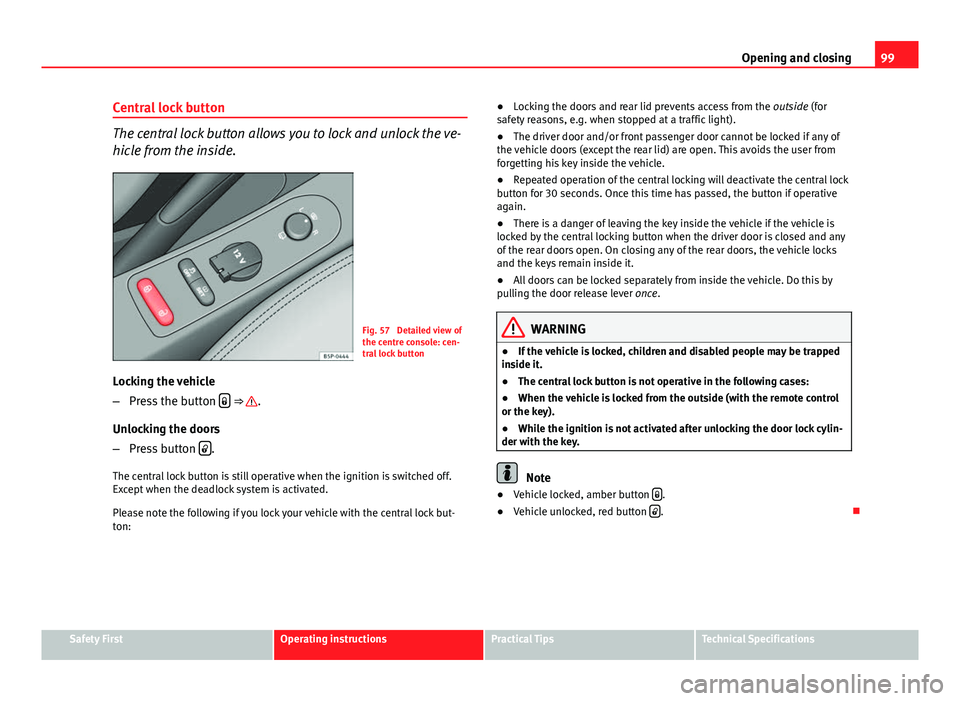
The central lock button allows you to lock and unlock the ve-
hicle from the inside.
Fig. 57 Detailed view of
the centre console: cen-
tral lock button
Locking the vehicle
– Press the button
⇒ .
Unlocking the doors
– Press button
.
The central lock button is still operative when the ignition is switched off.
Except when the deadlock system is activated.
Please note the following if you lock your vehicle with the central lock but-
ton: ●
Locking the doors and rear lid prevents access from the outside (for
safety reasons, e.g. when stopped at a traffic light).
● The driver door and/or front passenger door cannot be locked if any of
the vehicle doors (except the rear lid) are open. This avoids the user from
forgetting his key inside the vehicle.
● Repeated operation of the central locking will deactivate the central lock
button for 30 seconds. Once this time has passed, the button if operative
again.
● There is a danger of leaving the key inside the vehicle if the vehicle is
locked by the central locking button when the driver door is closed and any
of the rear doors open. On closing any of the rear doors, the vehicle locks
and the keys remain inside it.
● All doors can be locked separately from inside the vehicle. Do this by
pulling the door release lever once.
WARNING
● If the vehicle is locked, children and disabled people may be trapped
inside it.
● The central lock button is not operative in the following cases:
● When the vehicle is locked from the outside (with the remote control
or the key).
● While the ignition is not activated after unlocking the door lock cylin-
der with the key.
Note
● Vehicle locked, amber button .
● Vehicle unlocked, red button .
Safety FirstOperating instructionsPractical TipsTechnical Specifications
Page 105 of 321
103
Opening and closing
WARNING
● An incorrect use of the keys can cause serious injuries.
● Never leave children or disabled persons in the vehicle. In case of
emergency, they may not be able to leave the vehicle or manage on their
own.
● An uncontrolled use of the key could start the engine or activate any
electric equipment (e.g. electric windows), causing risk of accident. The
doors can be locked using the remote control key. This could become an
obstacle for assistance in an emergency situation.
● Never forget the keys inside the vehicle. An unauthorised use of your
vehicle could result in injury, damage or theft. Always take the key with
you when you leave the vehicle.
● Never remove the key from the ignition if the vehicle is in motion.
Otherwise, the steering could suddenly block and it would be impossible
to steer the vehicle.
CAUTION
There are electronic components in the remote control key. Avoid wetting
and hitting the keys.
Safety FirstOperating instructionsPractical TipsTechnical Specifications
Page 107 of 321
105
Opening and closing
WARNING
● An improper use of the key can cause serious injuries.
● Never leave children or disabled persons in the vehicle. In case of
emergency, they may not be able to leave the vehicle or manage on their
own.
● Never forget the keys inside the vehicle. Otherwise, this could result
in serious injuries, accidents or even the theft of your vehicle. Always
take the key with you when you leave the vehicle.
● An uncontrolled use of the key could start the engine or activate any
electric equipment (e.g. electric windows), causing risk of accident. The
vehicle can be locked when using the remote control key. This could com-
plicate the aid in case of emergency.
Note
● The radio frequency remote control can be programmed by means of
pressing the unlocking button once; as a result, only the driver door will un-
lock. When the button is pressed once more, all doors and the rear lid will
be unlocked.
● The radio frequency remote control functions only when you are in range
⇒ Fig. 63 (red area).
● If the vehicle is unlocked using the
1 button, it will lock again auto-
matically if any of the doors or the rear lid are not opened within 30 sec-
onds after unlocking it. This function prevents the vehicle from remaining
unlocked if the unlock button is pressed by mistake.
● If the vehicle cannot be opened and closed using the radio frequency re-
mote control, the remote control key will have to be re-synchronised
⇒ page 105. Changing the battery
If the battery indicator does not flash when the buttons are pushed, the bat-
tery must be replaced.
CAUTION
The use of inappropriate batteries may damage the radio frequency remote
control. For this reason, always replace the dead battery with another of the
same size and power.
For the sake of the environment
Used batteries must be disposed of at an appropriate waste facility or
through an authorised service, given that their components can affect the
environment.
Synchronising the remote control key
If it is not possible to unlock or lock the door with the remote
control, it should be re-synchronised.
– Press the
⇒ Fig. 62 button on the remote control.
– Then close the vehicle using the key bit within one minute.
It is possible that the vehicle could no longer be opened and closed with
the remote control if the button
is repeatedly pressed outside of the ef-
fective range of the radio frequency remote control. The remote control key
will have to be resynchronised.
Spare remote control keys are available in your Technical Service, where
they must be matched to the locking system.
Up to four remote control keys can be used.
Safety FirstOperating instructionsPractical TipsTechnical Specifications
Page 108 of 321
106Opening and closing
Anti-theft alarm system*
Description of anti-theft alarm system*
The anti-theft alarm triggers if unauthorised movements are
detected around the vehicle.
The anti-theft alarm makes it more difficult to break into the vehicle or steal
it. Audible and visible alarms are triggered if the vehicle is opened using
the key, or if unauthorised access to the vehicle is forced.
The anti-theft alarm system is automatically switched on when locking the
vehicle. The system is then primed.
When does the system trigger an alarm?
The system triggers an alarm if the following unauthorised actions are car-
ried out when the vehicle is locked:
● Opening the vehicle mechanically using the key and with the ignition off
● Opening a door
● Opening the bonnet
● Opening the rear lid
● Switching on the ignition
● Movements in the vehicle interior
● Undue manipulation of the alarm
● Battery handling
The acoustic signals sound and the turn signals flash for approx. 30 sec-
onds. This may be repeated up to 10 times depending on the country.
Opening the doors mechanically (emergency opening)
If the radio frequency remote control function fails, you will have to use the
key to unlock the vehicle. This is done as follows: ●
Unfold the key by pressing the button shown by the (arrow).
● Use the lock on the driver door to unlock the vehicle. The anti-theft
alarm system remains active, but an alarm is not triggered immediately.
● Switch on the ignition within 15 seconds. When the ignition is switched
on, the electronic immobiliser recognises a valid vehicle key and deacti-
vates the anti-theft alarm system. If you do not switch on the ignition within
15 seconds, the alarm is triggered (in certain markets, such as the Nether-
lands, there is no 15 second waiting time and the alarm is activated imme-
diately after opening the door).
Opening all the doors in manual mode
In vehicles without alarm, when opening the driver door manually all the
doors are opened.
How to switch the alarm off
When the vehicle is unlocked via the unlocking button of the radio frequen-
cy remote control or when the key is inserted in the ignition lock.
Note
● If, after the audible warning goes off, another monitored area is ac-
cessed (e.g. the rear lid is opened after a door has been opened), the alarm
is triggered again.
● Vehicle monitoring remains active even if the battery is disconnected or
not working for any reason.
● The alarm is triggered immediately if one of the battery cables is discon-
nected while the alarm system is active.
Page 109 of 321
107
Opening and closing
Volumetric sensor*
Monitoring or control function incorporated in the anti-theft
alarm* which detects unauthorized vehicle entry by means
of ultrasound.
The system consists of 3 sensors, 2 emitters and a receptor.
Activation
– It is automatically turned on with the anti-theft alarm, when the
vehicle is locked mechanically with the key and when the but-
ton
on the remote control is used.
Deactivation
– Press the button
on the remote control twice. Only the volu-
metric sensor is deactivated. The alarm system remains activa-
ted.
WARNING
● The deadlock system remains deactivated if the volumetric sensor is
deactivated.
● For those vehicles in which a separation screen is fitted, the alarm
will not function correctly due to interference with the sensor.
Note
● If the alarm has been triggered by the volumetric sensor, this will be in-
dicated by a flashing of the warning lamp on the driver door when the vehi-
cle is opened. This flashing will be different to that for an activated alarm.
Safety FirstOperating instructionsPractical TipsTechnical Specifications
Page 110 of 321
108Opening and closing
Rear lid
Unlocking and locking
The rear lid opening system operates electrically. It is activa-
ted by using the handle on the rear lid.
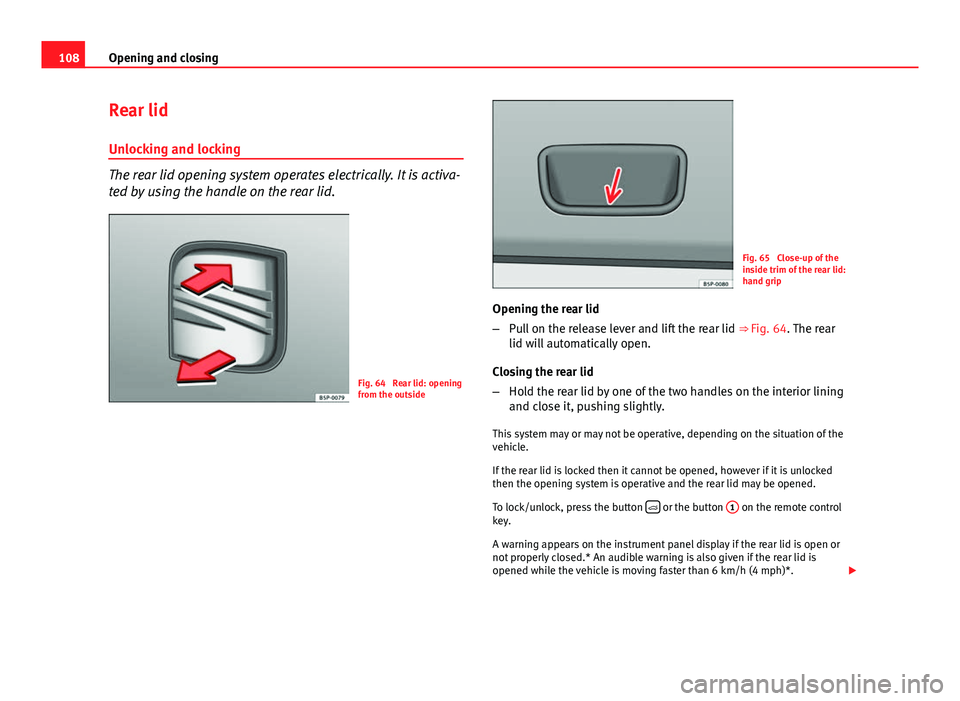
Fig. 64 Rear lid: opening
from the outside
Fig. 65 Close-up of the
inside trim of the rear lid:
hand grip
Opening the rear lid
– Pull on the release lever and lift the rear lid ⇒ Fig. 64. The rear
lid will automatically open.
Closing the rear lid
– Hold the rear lid by one of the two handles on the interior lining
and close it, pushing slightly.
This system may or may not be operative, depending on the situation of the
vehicle.
If the rear lid is locked then it cannot be opened, however if it is unlocked
then the opening system is operative and the rear lid may be opened.
To lock/unlock, press the button
or the button
1 on the remote control
key.
A warning appears on the instrument panel display if the rear lid is open or
not properly closed.* An audible warning is also given if the rear lid is
opened while the vehicle is moving faster than 6 km/h (4 mph)*.
Page 111 of 321
109
Opening and closing
WARNING
● Always close the rear lid properly. Risk of accident or injury.
● Do not close the rear lid by pushing it down with your hand on the
rear window. The glass could smash. Risk of injury!
● Ensure the rear lid is locked after closing it. If not, it may open unex-
pectedly while driving.
● Never allow children to play in or around the vehicle. A locked vehicle
can be subjected to extremely high and low temperatures, depending on
the time of year, thus causing serious injuries/illness. It could even have
fatal consequences. Close and lock both the rear lid and all the other
doors when you are not using the vehicle.
● Closing the rear lid without observing and ensuring it is clear could
cause serious injury to you and to third parties. Make sure that no one is
in the path of the rear lid.
● Never drive with the rear lid open or half-closed, exhaust gases may
penetrate into the interior of the vehicle. Danger of poisoning!
● If you only open the rear lid, do not leave the key inside. The vehicle
will not be opened if the key is left inside.
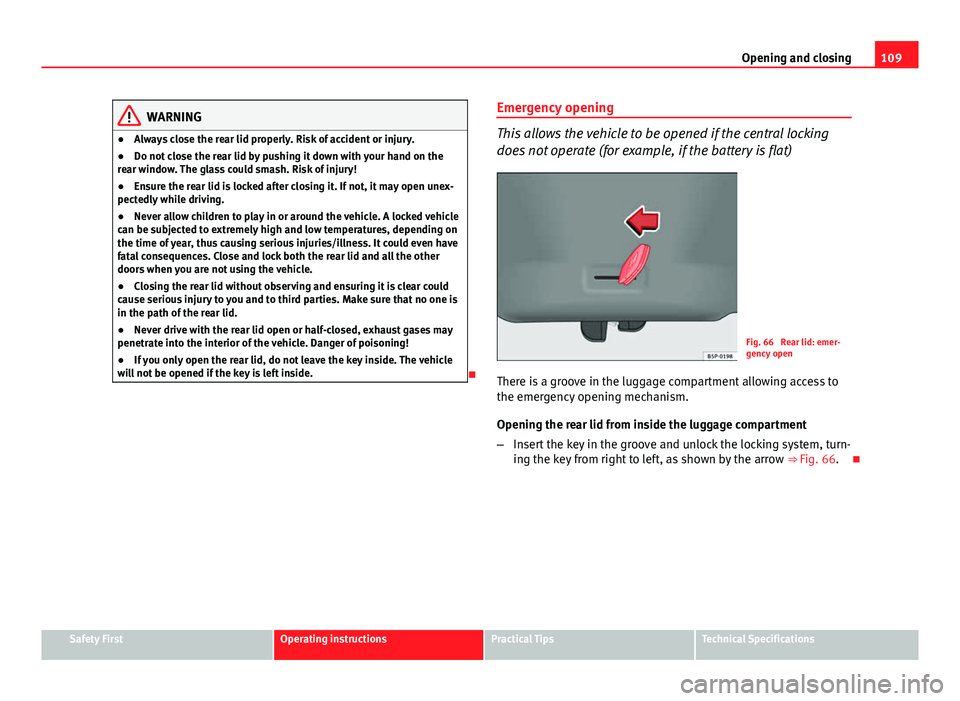
Emergency opening
This allows the vehicle to be opened if the central locking
does not operate (for example, if the battery is flat)
Fig. 66 Rear lid: emer-
gency open
There is a groove in the luggage compartment allowing access to
the emergency opening mechanism.
Opening the rear lid from inside the luggage compartment
– Insert the key in the groove and unlock the locking system, turn-
ing the key from right to left, as shown by the arrow ⇒ Fig. 66.
Safety FirstOperating instructionsPractical TipsTechnical Specifications
Page 112 of 321
110Opening and closing
Windows
Opening or closing the electric windows
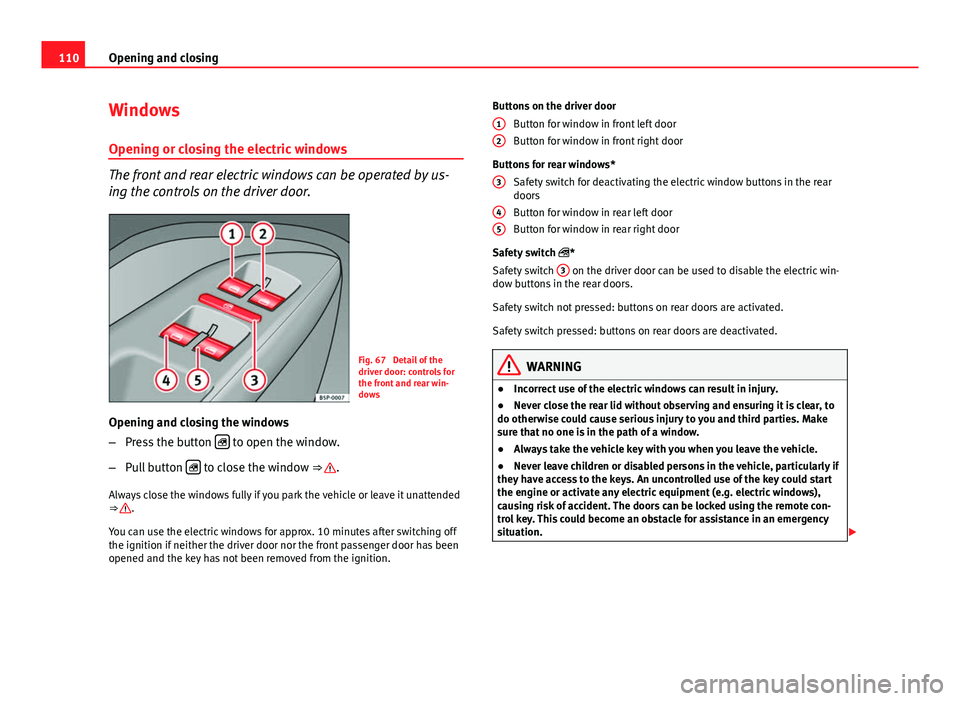
The front and rear electric windows can be operated by us-
ing the controls on the driver door.
Fig. 67 Detail of the
driver door: controls for
the front and rear win-
dows
Opening and closing the windows
– Press the button
to open the window.
– Pull button
to close the window ⇒ .
Always close the windows fully if you park the vehicle or leave it unattended
⇒
.
You can use the electric windows for approx. 10 minutes after switching off
the ignition if neither the driver door nor the front passenger door has been
opened and the key has not been removed from the ignition. Buttons on the driver door
Button for window in front left door
Button for window in front right door
Buttons for rear windows* Safety switch for deactivating the electric window buttons in the rear
doors
Button for window in rear left door
Button for window in rear right door
Safety switch *
Safety switch 3
on the driver door can be used to disable the electric win-
dow buttons in the rear doors.
Safety switch not pressed: buttons on rear doors are activated.
Safety switch pressed: buttons on rear doors are deactivated.
WARNING
● Incorrect use of the electric windows can result in injury.
● Never close the rear lid without observing and ensuring it is clear, to
do otherwise could cause serious injury to you and third parties. Make
sure that no one is in the path of a window.
● Always take the vehicle key with you when you leave the vehicle.
● Never leave children or disabled persons in the vehicle, particularly if
they have access to the keys. An uncontrolled use of the key could start
the engine or activate any electric equipment (e.g. electric windows),
causing risk of accident. The doors can be locked using the remote con-
trol key. This could become an obstacle for assistance in an emergency
situation.
12
3
45