spare wheel Seat Altea 2014 Owner's Manual
[x] Cancel search | Manufacturer: SEAT, Model Year: 2014, Model line: Altea, Model: Seat Altea 2014Pages: 321, PDF Size: 4.52 MB
Page 6 of 321
Trailer towing . . . . . . . . . . . . . . . . . . . . . . . . . . . . . . 210
Instructions to follow . . . . . . . . . . . . . . . . . . . . . . 210
Ball coupling of towing bracket* . . . . . . . . . . . . . 211
Driving tips . . . . . . . . . . . . . . . . . . . . . . . . . . . . . . 211
Fitting a towing bracket* . . . . . . . . . . . . . . . . . . . 212
Vehicle maintenance and cleaning . . . . . . . . . 214
General notes . . . . . . . . . . . . . . . . . . . . . . . . . . . . 214
Care of the vehicle exterior . . . . . . . . . . . . . . . . . . 215
Vehicle interior maintenance . . . . . . . . . . . . . . . . 220
Accessories, replacement of parts and
modifications . . . . . . . . . . . . . . . . . . . . . . . . . . . . . 226
Accessories and spare parts . . . . . . . . . . . . . . . . 226
Technical modifications . . . . . . . . . . . . . . . . . . . . 226
Roof aerial* . . . . . . . . . . . . . . . . . . . . . . . . . . . . . . 227
Mobile phones and two-way radios . . . . . . . . . . . 227
Checking and refilling levels . . . . . . . . . . . . . . . 228
Refuelling . . . . . . . . . . . . . . . . . . . . . . . . . . . . . . . 228
LPG system (Liquefied petroleum gas)* . . . . . . . 230
Petrol . . . . . . . . . . . . . . . . . . . . . . . . . . . . . . . . . . . 233
Diesel . . . . . . . . . . . . . . . . . . . . . . . . . . . . . . . . . . . 234
Working in the engine compartment . . . . . . . . . . 235
Engine oil . . . . . . . . . . . . . . . . . . . . . . . . . . . . . . . . 238
Coolant . . . . . . . . . . . . . . . . . . . . . . . . . . . . . . . . . 242
Washer fluid and windscreen wiper blades . . . . 244
Brake fluid . . . . . . . . . . . . . . . . . . . . . . . . . . . . . . . 249
Vehicle battery . . . . . . . . . . . . . . . . . . . . . . . . . . . 250
Wheels and tyres . . . . . . . . . . . . . . . . . . . . . . . . . . 253
Wheels . . . . . . . . . . . . . . . . . . . . . . . . . . . . . . . . . . 253
If and when . . . . . . . . . . . . . . . . . . . . . . . . . . . . . . . 262
Vehicle tools, tyre repair kit and spare wheel . . . 262
Wheel change . . . . . . . . . . . . . . . . . . . . . . . . . . . . 264
Tyre repair kit (Tyre-Mobility-System)* . . . . . . . . . 269
Fuses . . . . . . . . . . . . . . . . . . . . . . . . . . . . . . . . . . . 272
Bulb change . . . . . . . . . . . . . . . . . . . . . . . . . . . . . 274
Jump-starting . . . . . . . . . . . . . . . . . . . . . . . . . . . . . 287
Towing and tow-starting . . . . . . . . . . . . . . . . . . . . 290 Technical Specifications
. . . . . . . . . . . 293
Description of specifications . . . . . . . . . . . . . . . 293
Important information . . . . . . . . . . . . . . . . . . . . . 293
Information on fuel consumption . . . . . . . . . . . . 294
Towing a trailer . . . . . . . . . . . . . . . . . . . . . . . . . . . 295
Wheels . . . . . . . . . . . . . . . . . . . . . . . . . . . . . . . . . . 296
Technical specifications . . . . . . . . . . . . . . . . . . . . 297
Checking fluid levels . . . . . . . . . . . . . . . . . . . . . . . 297
Petrol engine 1.6 75 kW (102 PS) . . . . . . . . . . . . 298
1.2 TSI 77 kW (105 HP) Start-Stop petrol engine 299
Petrol engine 1.4 92 kW (125 PS) . . . . . . . . . . . . 300
Petrol engine 2.0 155 kW (211 PS) . . . . . . . . . . . 301
Diesel engine 1.6 TDI CR 66 kW (90 PS) with/
without DPF . . . . . . . . . . . . . . . . . . . . . . . . . . . . . . 302
Diesel engine 1.6 TDI CR 77 kW (105 PS) with/
without DPF . . . . . . . . . . . . . . . . . . . . . . . . . . . . . . 303
Diesel engine 1.6 TDI CR 77 kW (105 PS) DPF
Start-Stop . . . . . . . . . . . . . . . . . . . . . . . . . . . . . . . . 304
Diesel engine 2.0 TDI CR 103 kW (140 PS) . . . . . 305
Diesel engine 2.0 TDI CR 125 kW (170 PS) . . . . . 306
Dimensions and capacities . . . . . . . . . . . . . . . . . 307
Index . . . . . . . . . . . . . . . . . . . . . . . . . . . . . . . . . . . 309
4Table of Contents
Page 62 of 321
60Cockpit
LPG system*
Applies to the model: ALTEA / ALTEA XL LPG gauge
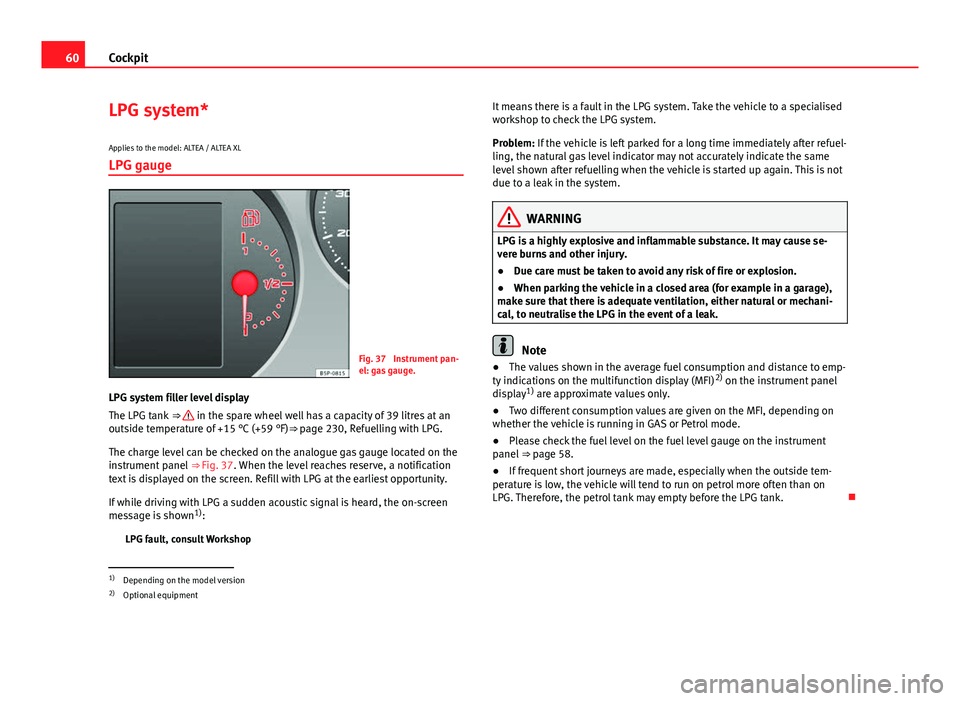
Fig. 37 Instrument pan-
el: gas gauge.
LPG system filler level display
The LPG tank ⇒
in the spare wheel well has a capacity of 39 litres at an
outside temperature of +15 °C (+59 °F)⇒ page 230, Refuelling with LPG.
The charge level can be checked on the analogue gas gauge located on the
instrument panel ⇒ Fig. 37. When the level reaches reserve, a notification
text is displayed on the screen. Refill with LPG at the earliest opportunity.
If while driving with LPG a sudden acoustic signal is heard, the on-screen
message is shown 1)
:
LPG fault, consult Workshop It means there is a fault in the LPG system. Take the vehicle to a specialised
workshop to check the LPG system.
Problem: If the vehicle is left parked for a long time immediately after refuel-
ling, the natural gas level indicator may not accurately indicate the same
level shown after refuelling when the vehicle is started up again. This is not
due to a leak in the system.
WARNING
LPG is a highly explosive and inflammable substance. It may cause se-
vere burns and other injury.
● Due care must be taken to avoid any risk of fire or explosion.
● When parking the vehicle in a closed area (for example in a garage),
make sure that there is adequate ventilation, either natural or mechani-
cal, to neutralise the LPG in the event of a leak.
Note
● The values shown in the average fuel consumption and distance to emp-
ty indications on the multifunction display (MFI) 2)
on the instrument panel
display 1)
are approximate values only.
● Two different consumption values are given on the MFI, depending on
whether the vehicle is running in GAS or Petrol mode.
● Please check the fuel level on the fuel level gauge on the instrument
panel ⇒ page 58.
● If frequent short journeys are made, especially when the outside tem-
perature is low, the vehicle will tend to run on petrol more often than on
LPG. Therefore, the petrol tank may empty before the LPG tank.
1)
Depending on the model version
2) Optional equipment
Page 87 of 321
85
Cockpit
● The temporary spare wheel is fitted.
● The wheel on one axle is changed.
Tyre pressure adjustment
Following the modification to tyre pressure or after changing one or more
wheels, the button ⇒ Fig. 50 must be kept pressed while the ignition is on
until an audible warning is heard and the warning lamp goes out.
If the wheels are under excessive load (for example, driving with a trailer or
heavy load), the tyre pressure must be increased to the recommended value
for a full load (see the sticker on the inside of the fuel flap). If the tyre moni-
tor system button is pressed down, the new tyre pressures are confirmed.
The tyre pressure control lamp lights up
If the tyre pressure of one or more wheels is much lower than the value set
by the driver, the tyre control warning lamp lights up ⇒
.
The tyre pressure control lamp flashes
If the tyre pressure control lamp flashes, this indicates a fault. Go to the
nearest specialised workshop.
WARNING
● When the tyre pressure control lamp lights up, reduce speed immedi-
ately and avoid any sudden manoeuvre or braking. Stop when possible,
and check the tyre pressure and status.
● The driver is responsible for maintaining correct tyre pressures. For
this reason, tyre pressure must be regularly checked.
● Under certain circumstances (for example, when driving in a sports-
like manner, in winter conditions or on a dirt track) the tyre control lamp
may light up or function incorrectly.
Note
If the battery is disconnected, the yellow warning lamp lights up after
turning the ignition on. This should turn off after a brief journey.
Brake system*
This warning lamp lights up if the brake fluid level is too low
or if there is a fault in the system.
This warning lamp lights up if
● the brake fluid level is too low ⇒ page 249.
The instrument panel displays the following message 1)
: STOP BRAKE FLUID
INSTRUCTION MANUAL.
● there is a fault in the brake system.
The instrument panel displays the following message 1)
: BRAKE SYSTEM
FAULT INSTRUCTION MANUAL.
This warning lamp can light up together with the ABS system warning lamp.
1)
Depending on the version of the model.
Safety FirstOperating instructionsPractical TipsTechnical Specifications
Page 146 of 321
144Seats and storage
Storage in the luggage compartment*
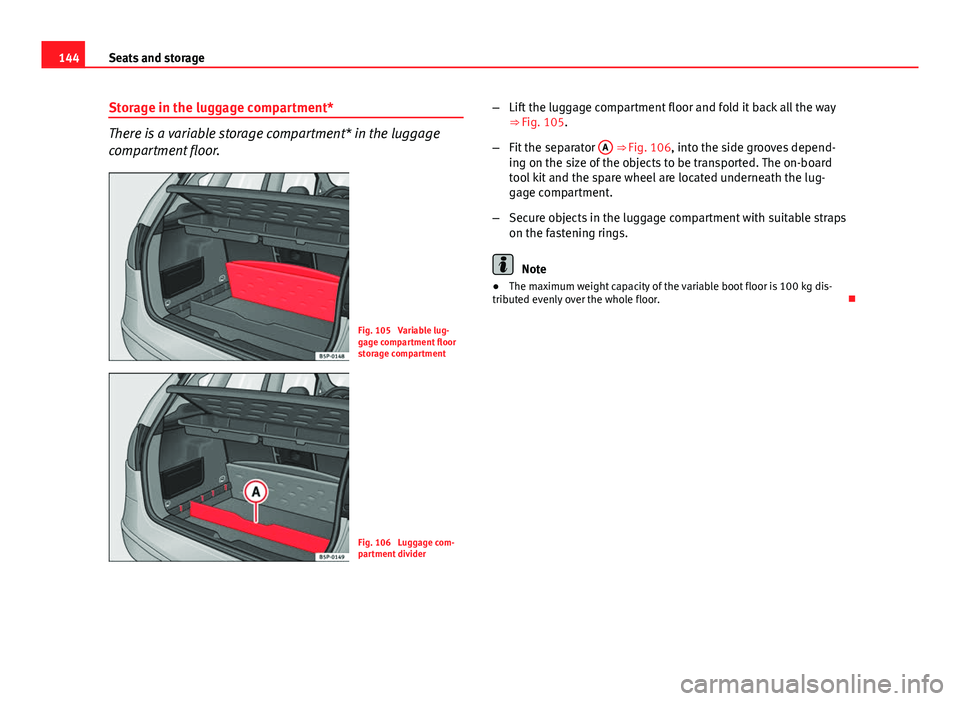
There is a variable storage compartment* in the luggage
compartment floor.
Fig. 105 Variable lug-
gage compartment floor
storage compartment
Fig. 106 Luggage com-
partment divider –
Lift the luggage compartment floor and fold it back all the way
⇒ Fig. 105.
– Fit the separator A
⇒ Fig. 106, into the side grooves depend-
ing on the size of the objects to be transported. The on-board
tool kit and the spare wheel are located underneath the lug-
gage compartment.
– Secure objects in the luggage compartment with suitable straps
on the fastening rings.
Note
● The maximum weight capacity of the variable boot floor is 100 kg dis-
tributed evenly over the whole floor.
Page 147 of 321
145
Seats and storage
Luggage compartment net*
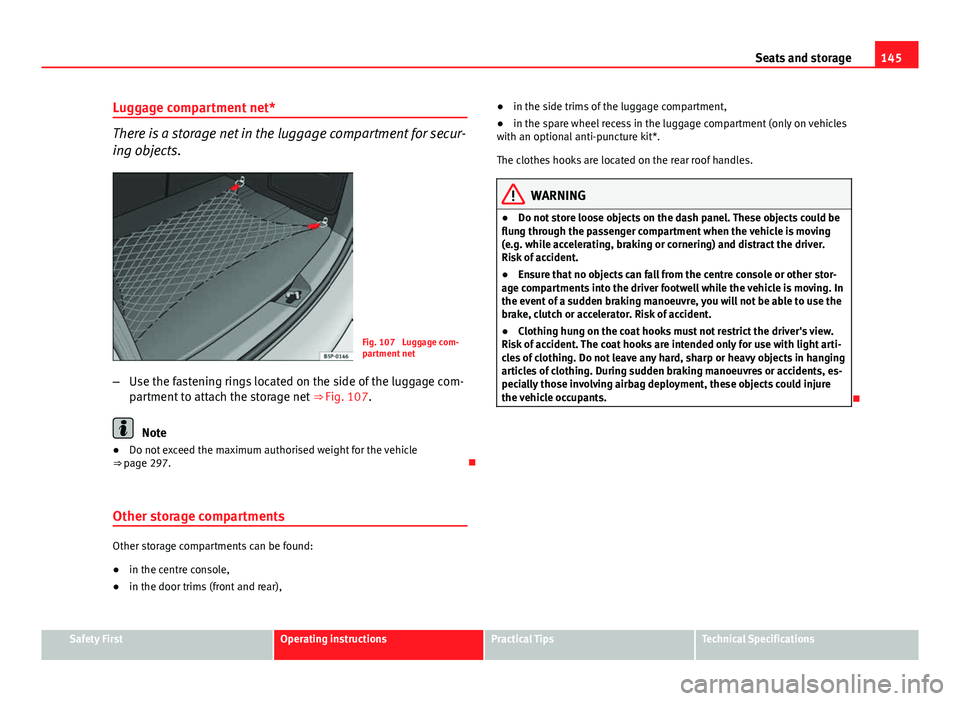
There is a storage net in the luggage compartment for secur-
ing objects.
Fig. 107 Luggage com-
partment net
– Use the fastening rings located on the side of the luggage com-
partment to attach the storage net ⇒ Fig. 107.
Note
● Do not exceed the maximum authorised weight for the vehicle
⇒ page 297.
Other storage compartments
Other storage compartments can be found:
● in the centre console,
● in the door trims (front and rear), ●
in the side trims of the luggage compartment,
● in the spare wheel recess in the luggage compartment (only on vehicles
with an optional anti-puncture kit*.
The clothes hooks are located on the rear roof handles.
WARNING
● Do not store loose objects on the dash panel. These objects could be
flung through the passenger compartment when the vehicle is moving
(e.g. while accelerating, braking or cornering) and distract the driver.
Risk of accident.
● Ensure that no objects can fall from the centre console or other stor-
age compartments into the driver footwell while the vehicle is moving. In
the event of a sudden braking manoeuvre, you will not be able to use the
brake, clutch or accelerator. Risk of accident.
● Clothing hung on the coat hooks must not restrict the driver's view.
Risk of accident. The coat hooks are intended only for use with light arti-
cles of clothing. Do not leave any hard, sharp or heavy objects in hanging
articles of clothing. During sudden braking manoeuvres or accidents, es-
pecially those involving airbag deployment, these objects could injure
the vehicle occupants.
Safety FirstOperating instructionsPractical TipsTechnical Specifications
Page 179 of 321
177
Driving
Applies to the model: ALTEA / ALTEA XL Driving with LPG*
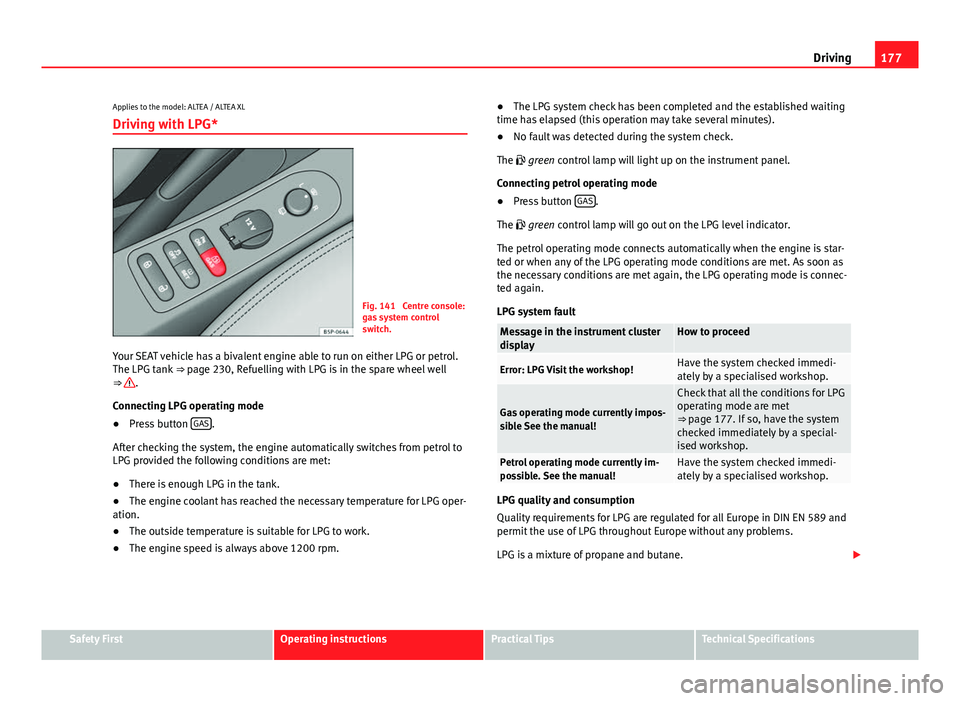
Fig. 141 Centre console:
gas system control
switch.
Your SEAT vehicle has a bivalent engine able to run on either LPG or petrol.
The LPG tank ⇒ page 230, Refuelling with LPG is in the spare wheel well
⇒
.
Connecting LPG operating mode
● Press button GAS
.
After checking the system, the engine automatically switches from petrol to
LPG provided the following conditions are met:
● There is enough LPG in the tank.
● The engine coolant has reached the necessary temperature for LPG oper-
ation.
● The outside temperature is suitable for LPG to work.
● The engine speed is always above 1200 rpm. ●
The LPG system check has been completed and the established waiting
time has elapsed (this operation may take several minutes).
● No fault was detected during the system check.
The green control lamp will light up on the instrument panel.
Connecting petrol operating mode
● Press button GAS
.
The green control lamp will go out on the LPG level indicator.
The petrol operating mode connects automatically when the engine is star-
ted or when any of the LPG operating mode conditions are met. As soon as
the necessary conditions are met again, the LPG operating mode is connec-
ted again.
LPG system fault
Message in the instrument cluster
displayHow to proceed
Error: LPG Visit the workshop!Have the system checked immedi-
ately by a specialised workshop.
Gas operating mode currently impos-
sible See the manual!
Check that all the conditions for LPG
operating mode are met
⇒ page 177. If so, have the system
checked immediately by a special-
ised workshop.
Petrol operating mode currently im-
possible. See the manual!Have the system checked immedi-
ately by a specialised workshop.
LPG quality and consumption
Quality requirements for LPG are regulated for all Europe in DIN EN 589 and
permit the use of LPG throughout Europe without any problems.
LPG is a mixture of propane and butane.
Safety FirstOperating instructionsPractical TipsTechnical Specifications
Page 200 of 321
198Intelligent technology
The ASR automatically switches on when the engine is started. If necessary,
it may be turned on or off by briefly pushing the button on the centre con-
sole.
When the ASR is switched off, the OFF
warning lamp will light up. The ASR
should normally be left on. Only in exceptional circumstances, when the
slipping of the wheels is required, it will be necessary to have it disconnec-
ted, for example.
● With compact temporary spare wheel.
● When using the snow chains.
● When driving in deep snow or on loose surfaces
● When the vehicle is bogged-down, to free it by rocking.
The ASR should be switched on again as soon as possible.
WARNING
● Remember that not even the ASR can defy the laws of physics. This
should be kept in mind, particularly on slippery and wet roads and when
towing a trailer.
● Always adapt your driving style to suit the condition of the roads and
the traffic situation. The greater safety provided by the ASR should not
encourage you to run any risks.
CAUTION
● To ensure that the ASR works correctly, identical tyres should be fitted
on all four wheels. Any differences in the rolling radius of the tyres can
cause the system to reduce engine power when this is not desired.
● Any modifications made to the vehicle (for example, to the engine,
brake system, running gear or to the combination of wheels and tyres) may
affect the operation of the ABS and ASR. XDS*
Driveshaft differential
When taking a bend, the driveshaft differential mechanism allows the outer
wheel to turn at a higher speed than the inner wheel. In this way, the wheel
that is turning faster (outer wheel) receives less drive torque than the inner
wheel. This may mean that in certain situations the torque delivered to the
inner wheel is too high, causing the wheels to spin. On the other hand, the
outer wheel is receiving a lower drive torque than it could transmit. This
causes an overall loss of lateral grip on the front axle, resulting in under-
steer or “lengthening” of the trajectory.
The XDS system can detect and correct this effect via the sensors and sig-
nals of the ESC.
Via the ESC, the XDS will brake the inside wheel and counter the excess
driving torque of that wheel. This means that the driver's desired trajectory
is much more precise,
The XDS system works in combination with the ESC and is always active,
even when the ASR traction control is disconnected.
Electronic Stability Control (ESC)*
General notes
The Electronic Stability Control increases the vehicle's stabil-
ity on the road. The Electronic Stability Control helps reduce the danger of skidding.
The Electronic Stability Control (ESC) includes the ABS, EDL, ASR and Steer-
ing manoeuvre recommendation systems.
Page 232 of 321
230Checking and refilling levels
LPG system (Liquefied petroleum gas)*
Applies to the model: ALTEA / ALTEA XL Refuelling with LPG
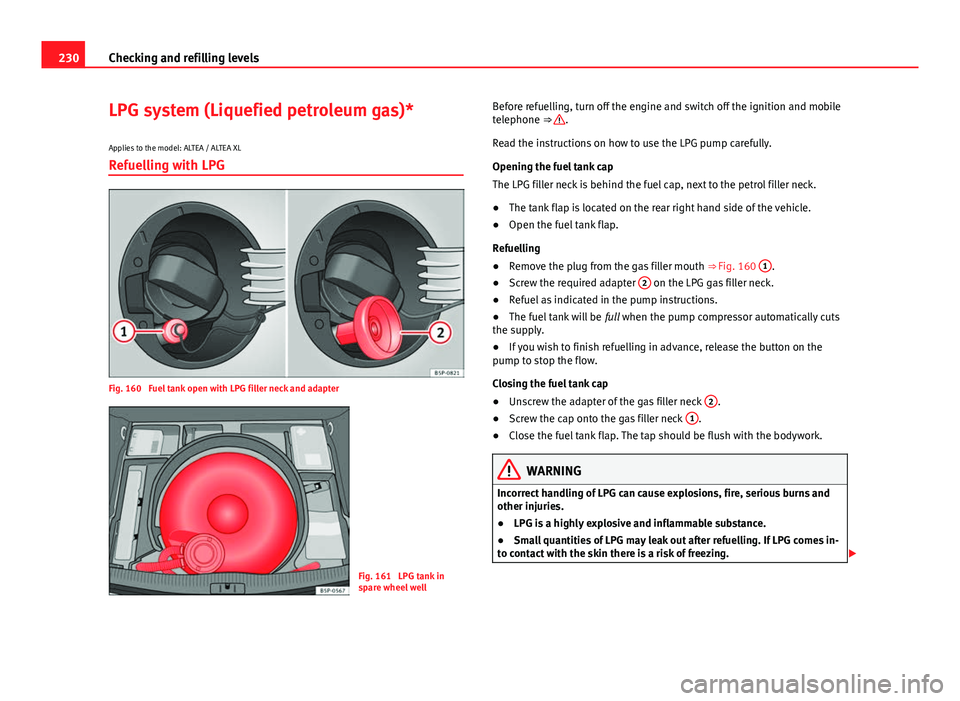
Fig. 160 Fuel tank open with LPG filler neck and adapter
Fig. 161 LPG tank in
spare wheel well Before refuelling, turn off the engine and switch off the ignition and mobile
telephone ⇒
.
Read the instructions on how to use the LPG pump carefully.
Opening the fuel tank cap
The LPG filler neck is behind the fuel cap, next to the petrol filler neck.
● The tank flap is located on the rear right hand side of the vehicle.
● Open the fuel tank flap.
Refuelling
● Remove the plug from the gas filler mouth ⇒ Fig. 160 1
.
● Screw the required adapter 2 on the LPG gas filler neck.
● Refuel as indicated in the pump instructions.
● The fuel tank will be full when the pump compressor automatically cuts
the supply.
● If you wish to finish refuelling in advance, release the button on the
pump to stop the flow.
Closing the fuel tank cap
● Unscrew the adapter of the gas filler neck 2
.
● Screw the cap onto the gas filler neck 1.
● Close the fuel tank flap. The tap should be flush with the bodywork.
WARNING
Incorrect handling of LPG can cause explosions, fire, serious burns and
other injuries.
● LPG is a highly explosive and inflammable substance.
● Small quantities of LPG may leak out after refuelling. If LPG comes in-
to contact with the skin there is a risk of freezing.
Page 260 of 321
258Wheels and tyres
WARNING
When driving in emergency conditions, the driving quality of the vehicle
is considerably impaired.
● The maximum permitted speed of 80 km/h (50 mph) is subject to
road and weather conditions. Please observe legal requirements when
doing so.
● Avoid sharp turns and rapid manoeuvres, and brake earlier than usu-
al.
● Avoid driving over obstacles (for example kerbs) or potholes.
● If one or more tyres are being driven in emergency conditions, the
driving quality of the vehicle is impaired and there is a risk of accident.
Note
● The run-flat tyres do not “deflate” on losing pressure because they are
supported on the reinforced sides. Therefore defects in the tyre cannot be
detected with a visual inspection.
● Snow chains must not be used on front tyres used in emergency condi-
tions.
New tyres and wheels
New tyres and wheels have to be run in.
The tyres and wheel rims are an essential part of the vehicle's design. The
tyres and rims approved by SEAT are specially matched to the characteris-
tics of the vehicle and make a major contribution to good road holding and
safe handling ⇒
.
Tyres should be replaced at least in pairs and not individually (i.e. both front
tyres or both rear tyres together). A knowledge of tyre designations makes it
easier to choose the correct tyres. Radial tyres have the tyre designations
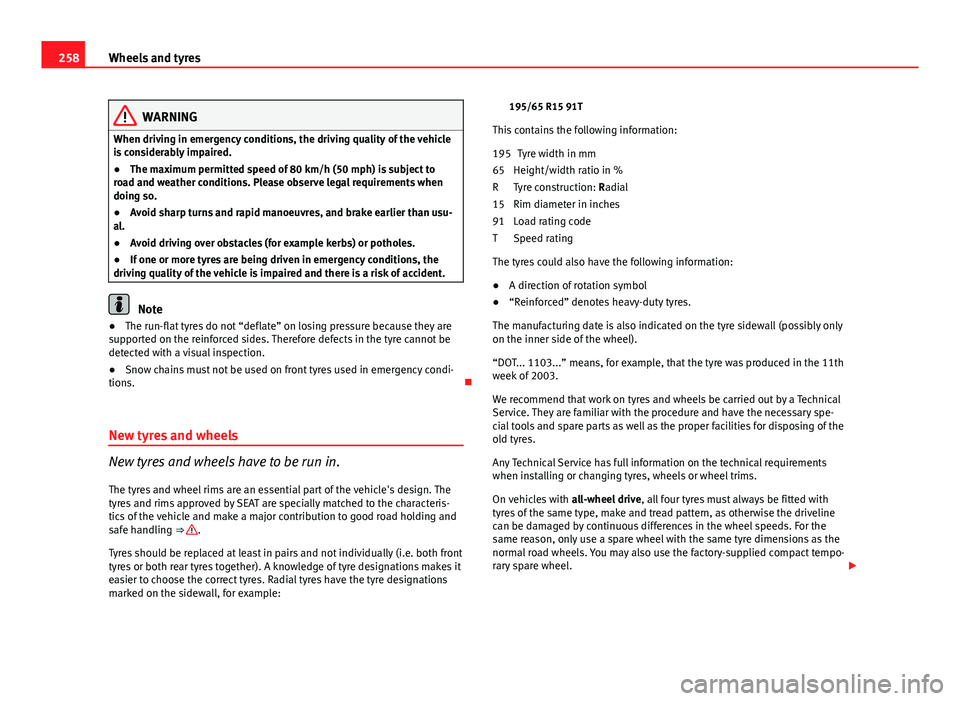
marked on the sidewall, for example: 195/65 R15 91T
This contains the following information: Tyre width in mm
Height/width ratio in %
Tyre construction: Radial
Rim diameter in inches
Load rating code
Speed rating
The tyres could also have the following information:
● A direction of rotation symbol
● “Reinforced” denotes heavy-duty tyres.
The manufacturing date is also indicated on the tyre sidewall (possibly only
on the inner side of the wheel).
“DOT... 1103...” means, for example, that the tyre was produced in the 11th
week of 2003.
We recommend that work on tyres and wheels be carried out by a Technical
Service. They are familiar with the procedure and have the necessary spe-
cial tools and spare parts as well as the proper facilities for disposing of the
old tyres.
Any Technical Service has full information on the technical requirements
when installing or changing tyres, wheels or wheel trims.
On vehicles with all-wheel drive, all four tyres must always be fitted with
tyres of the same type, make and tread pattern, as otherwise the driveline
can be damaged by continuous differences in the wheel speeds. For the
same reason, only use a spare wheel with the same tyre dimensions as the
normal road wheels. You may also use the factory-supplied compact tempo-
rary spare wheel.
195
65
R
15
91
T
Page 261 of 321
259
Wheels and tyres
WARNING
● We recommend that you use only wheels and tyres which have been
approved by SEAT for your model. Failure to do so could impair vehicle
handling. Risk of accident.
● Avoid running the vehicle on tyres that are more than 6 years old. If
you have no alternative, you should drive slowly and with extra care at all
times.
● Never use old tyres or those with an unknown history of use.
● If wheel trims are retrofitted, you must ensure that the flow of air to
the brakes is not restricted. This could cause the brake system to over-
heat.
● All four wheels must be fitted with radial tyres of the same type, size
(rolling circumference) and the same tread pattern.
For the sake of the environment
Old tyres must be disposed of according to the laws in the country con-
cerned.
Note
● For technical reasons, it is not generally possible to use the wheels from
other vehicles. This can also apply to wheels of the same model. The use of
wheels or tyres which have not been approved by SEAT for use with your
model may invalidate the vehicle's type approval for use on public roads.
● If the spare tyre is not the same as the tyres that are mounted on the
vehicle (e.g. winter tyres) you should only use the spare tyre for a short peri-
od of time and drive with extra care. Refit the normal road wheel as soon as
possible. Wheel bolts
Wheel bolts must be tightened to the correct torque.
The design of wheel bolts is matched to the rims. If different wheel rims are
fitted, the correct wheel bolts with the right length and correctly shaped
bolt heads must be used. This ensures that wheels are fitted securely and
that the brake system functions correctly.
In certain circumstances, you should not use wheel bolts from a different
vehicle, even if it is the same model ⇒ page 226.
After the wheels have been changed, the tightening torque of the wheel
bolts should be checked as soon as possible with a torque wrench ⇒
.
The tightening torque for steel and alloy wheels is 120 Nm.
WARNING
If the wheel bolts are not tightened correctly, the wheel could become
loose while driving. Risk of accident.
● The wheel bolts must be clean and turn easily. Never apply grease or
oil to them.
● Use only wheel bolts which belong to the wheel.
● If the tightening torque of the wheel bolts is too low, they could loos-
en whilst the vehicle is in motion. Risk of accident! If the tightening tor-
que is too high, the wheel bolts and threads can be damaged.
CAUTION
The prescribed tightening torque for wheel bolts for steel and alloy wheels
is 120 Nm.
Safety FirstOperating instructionsPractical TipsTechnical Specifications