change wheel Seat Altea 2015 User Guide
[x] Cancel search | Manufacturer: SEAT, Model Year: 2015, Model line: Altea, Model: Seat Altea 2015Pages: 236, PDF Size: 4.23 MB
Page 132 of 236
Operation
– Lightly press the selector lever forward
››› Fig. 128 + to change up to a higher
gear.
– Lightly press the selector lever backward
››› Fig. 128 - to change down to a lower
gear.
Changing gear with the steering wheel
paddle levers* – Press the right paddle lever + towards the
steering wheel to change up ››› Fig. 129 .
– Pr e
ss the left paddle – towards the steer-
ing wheel to change down ››› Fig. 129 .
U s
ing the paddle levers on the steering
wheel, you can access manual driving mode
regardless of the pre-selected driving mode.
General information about driving in
tiptronic mode
When accelerating, the automatic gearbox /
DSG automatic gearbox goes into a higher
gear a little before the engine reaches its
maximum permitted revolutions.
If a lower gear is selected, the automatic
gearbox / DSG automatic gearbox will only
change down when the engine cannot go
over its maximum permitted revolutions.
If “tiptronic” is selected whilst the vehicle is
in motion and the automatic gearbox / DSG
automatic gearbox is in third gear and selec- tor lever position D, “tiptronic” mode will
then also be in third gear.
Changing gears in the normal or sport
programme using the steering wheel paddle
levers
If the paddle levers
››› Fig. 129 are used in
the normal
or sport programme, the system
switches temporarily to “tiptronic” mode. To
exit “Tiptronic” mode again, press the right
paddle shifter +OFF toward the steering
wheel for approximately one second. You will
also leave “Tiptronic” mode if the paddle lev-
ers are not moved for a certain time. Note
● The gearbox controls on the steering wheel
can operate with the selector lever in any po-
sition and with the vehicle in motion. Kick-down feature
This feature allows maximum acceleration.
If you press the accelerator down thoroughly,
the gearbox automatically changes down, de-
pending on speed and engine speed, into a
lower gear to take full advantage of give the
vehicle maximum acceleration.
The gearbox does not change gear until the
engine reaches the maximum determined en-
gine speed for the gear. WARNING
You could lose control of the vehicle if you ac-
celerate on slippery road surfaces. Risk of se-
rious injury.
● Be particularly careful when using the kick-
down features on slippery road surfaces. With
a fast acceleration, the vehicle could lose
traction and skid.
● You should use the kick-down feature only
when traffic and weather conditions allow it
to be used safely. Run-in and economical driving
Running in a new engine The engine needs to be run in over the first
1,500 km.
Up to 1,000 kilometres
– Do not drive at speeds of more than 2/3
the maximum speed.
– Do not accelerate hard.
– Avoid high engine revolutions.
– Do not tow a trailer.
130
Page 133 of 236
Driving
From 1,000 to 1,500 kilometres
– Speeds can be gradually increased to the
maximum road speed or maximum
permissible engine speed (rpm).
During its first few hours of running, the in-
ternal friction in the engine is greater than
later on, when all the moving parts have bed-
ded in. For the sake of the environment
If the engine is run in gently, its life will be in-
creased and its oil consumption reduced. Environmental friendliness
Environmental protection is a top priority in
the design, choice of materials and manufac-
ture of your new SEAT.
Constructive measures to encourage
recycling
● Joints and connections designed for easy
dismantling
● Modular construction to facilitate disman-
tling
● Increased use of single-grade materials.
● Plastic parts and elastomers are marked in
accordance with ISO 1043, ISO 11469 and
ISO 1629. Choice of materials
●
Use of recycled materials.
● Use of compatible plastics in the same part
if its components are not easily separated.
● Use of recycled materials and/or materials
originating from renewable sources.
● Reduction of volatile components, includ-
ing odour, in plastic materials.
● Use of CFC-free coolants.
Ban on heavy metals, with the exceptions
dictated by law (Annex II of ELV Directive
2000/53/EC): cadmium, lead, mercury, hexa-
v al
ent chromium.
Manufacturing methods
● Reduction of the quantity of thinner in the
protective wax for cavities.
● Use of plastic film as protection during ve-
hicle transport.
● Use of solvent-free adhesives.
● Use of CFC-free coolants in cooling sys-
tems.
● Recycling and energy recovery from resi-
dues (RDF).
● Improvement in the quality of waste water.
● Use of systems for the recovery of residual
heat (thermal recovery, enthalpy wheels,
etc.).
● Use of water-soluble paints. Catalytic converter To maintain the useful life of the catalytic
converter
– Use only unleaded petrol with petrol en-
gines, as lead damages the catalytic con-
verter.
– Do not let the fuel get too low in the tank.
– For engine oil changes, do not replenish
with too much engine oil ››› page 168, Top-
ping up engine oil .
– Never tow the vehicle to start it, use jump
leads if necessary ›››
page 189.
If you notice misfiring, uneven running or
loss of power when the vehicle is moving, re-
duce speed immediately and have the vehi-
cle inspected at the nearest specialised
workshop. In general, the exhaust warning
lamp will light up when any of the described
symptoms occur ›››
page 35 . If this happens,
u nb
urnt fuel can enter the exhaust system
and escape into the environment. The cata-
lytic converter can also be damaged by over-
heating. WARNING
The catalytic converter reaches very high
temperatures! Risk of fire!
● Never park where the catalytic converter
could come into contact with dry grass or
flammable materials under the vehicle. » 131
Technical specifications
Advice
Operation
Safety
Page 137 of 236

Driver assistance systems
The ESC system is always active and cannot
be switched off. The ESC switch only switches
the ASR off.
The ASR can be deactivated when wheel spin
is desirable.
For example:
● When driving with snow chains.
● When driving in deep snow or on loose sur-
faces.
● When the vehicle is stuck, to rock it back-
wards and forwards.
Press the button to switch the ASR back on
when you no longer need wheel spin.
Electronic Stability Control (ESC)*
The ESC reduces the risk of skidding by brak-
ing the wheels individually.
The system uses the steering wheel angle
and road speed to calculate the changes of
direction desired by the driver, and constant-
ly compares them with the actual behaviour
of the vehicle. When irregularities occur, for
example, if the vehicle begins to skid, the
ESC brakes the appropriate wheel automati-
cally.
The forces acting on the braked wheel bring
the vehicle back to a stable condition. If the
vehicle tends to oversteer (the rear end
slides out), the system will act on the front
wheel on the outside of the turn. Steering manoeuvre recommendations
This is a complementary safety function in-
cluded in the ESC. This function aids the driv-
er to better stabilize the vehicle in a critical
situation. For example, in case of sudden
braking on a surface with varied adherence,
the vehicle will tend to destabilise its trajec-
tory to the right or to the left. In this case, the
ESC recognises the situation and assists the
driver with a counter steering manoeuvre
from the power steering.
This function simply provides the driver with
a recommended manoeuvre in critical situa-
tions.
The vehicle does not steer itself with this
function, the driver has full control of the ve-
hicle at all times.
WARNING
● Remember that not even the ESC can defy
the laws of physics. This should be kept in
mind, particularly on slippery and wet roads
and when towing a trailer.
● Always adapt your driving style to suit the
condition of the roads and the traffic situa-
tion. The greater safety provided by the ESC
should not encourage you to run any risks. CAUTION
● To ensure that the ESC works correctly, all
four wheels must be fitted with the same
tyres. Any differences in the rolling radius of the tyres can cause the system to reduce en-
gine power when this is not desired.
● Any modifications made to the vehicle (for
example, to the engine, brake system, run-
ning gear or to the combination of wheels
and tyres) may affect the operation of the
ABS, EDL, ESC and ASR. Electronic differential lock (EDL)*
EDL helps the vehicle to start moving, accel-
erate and climb a gradient in slippery condi-
tions where this may otherwise be difficult or
even impossible.
It uses the ABS sensors to monitor the speed
of the driven wheels. In case of an EDL fault,
the warning light for ABS lights up
››› page 41 .
At s
peeds of up to approximately 80 km/h
(50 mph), it is able to balance out differences
in the speed of the driven wheels of approxi-
mately 100 rpm/min caused by a partially
slippery road surface. It does this by braking
the wheel which has lost traction and distrib-
uting more driving force to the other driven
wheel via the differential.
To prevent the disc brake of the braking
wheel from overheating, the EDL cuts out au-
tomatically if subjected to excessive loads.
The vehicle will continue to function normally »
135
Technical specifications
Advice
Operation
Safety
Page 178 of 236

Advice
●
At continuously high speeds, a tyre with in-
sufficient pressure flexes more. In this way it
becomes too hot, and this can cause tread
separation and tyre blow-out. Always observe
the recommended tyre pressures.
● If the tyre pressure is too low or too high,
the tyres will wear prematurely and the vehi-
cle will not handle well. Risk of accident! For the sake of the environment
Under-inflated tyres will increase fuel con-
sumption. Tyre pressure monitoring
The tyre pressure monitoring system con-
stantly checks the pressure of the tyres.
The system uses the speed sensors of the
ABS wheels. It operates by analysing the
speed and frequency spectrum of each
wheel.
For optimum performance, use genuine SEAT
tyres. In addition, check and adjust tyre pres-
sures regularly.
Whenever the tyre pressure is are changed or
one or more tyres are changed, the system
should be reset by pressing the SET button
on the centre console.
The system warns the driver in the event of a
loss of pressure by means of symbols and messages in the instrument panel display.
The system operates via the ESC
››› page 134.
Note that tyre pressure also depends on tyre
temperature. Said pressure increases around
0.1 bar (2.9 psi/10 kPa) for each +10 °C
(+50 °F) in tyre temperature increase. The tyre
heats up while the vehicle is being driven
and the tyre pressure will rise accordingly.
Therefore, you should only adjust the tyre
pressure when they are cold (i.e. approxi-
mately at ambient temperature).
To ensure that the tyre pressure monitoring
system works reliably, you should check and,
if necessary, adjust the tyre pressures at reg-
ular intervals and store the correct pressures
(reference values) in the system.
A tyre pressure information label is attached
to the inside of the fuel tank flap. WARNING
● Never adjust tyre pressure when the tyres
are hot. This may damage or even burst the
tyres. Risk of accident!
● An insufficiently inflated tyre flexes a lot
more at high speeds and causes significant
heating of the tyre. Under these conditions,
the tyre bead may be released or the tyre may
burst. Risk of accident! For the sake of the environment
Under-inflated tyres lead to increased fuel
consumption and tyre wear. Significant tyre pressure loss
The tyre symbol
is displayed and indicates
th at
the tyre pressure of at least one tyre is
insufficient.
– Stop the vehicle.
– Switch the ignition off.
– Check the tyre(s).
– Change the wheel if necessary.
176
Page 179 of 236
Wheels
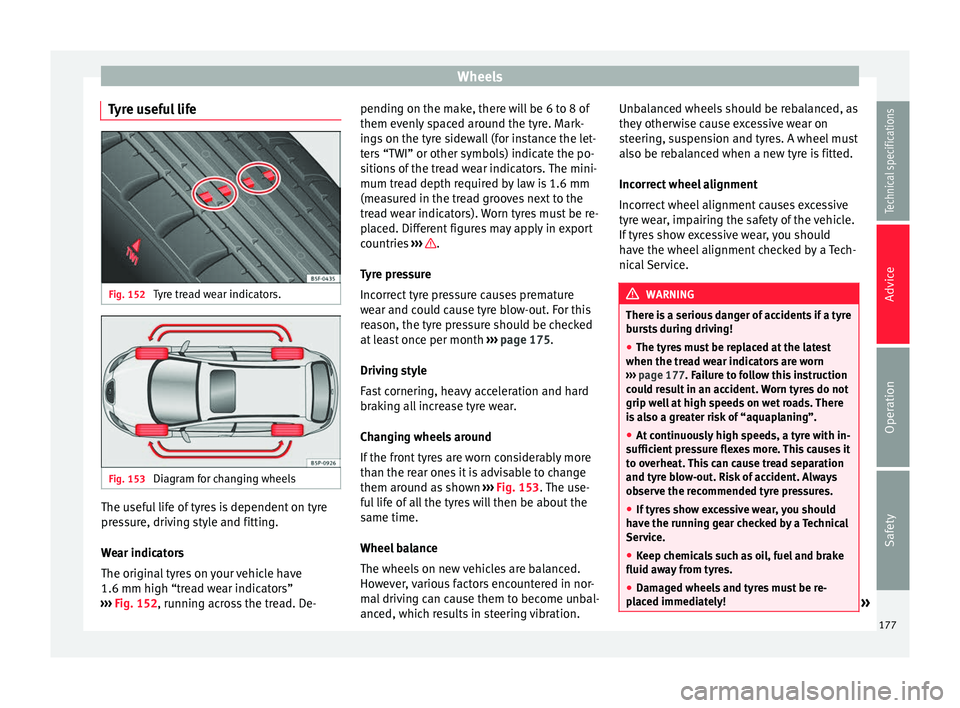
Tyre useful life Fig. 152
Tyre tread wear indicators. Fig. 153
Diagram for changing wheels The useful life of tyres is dependent on tyre
pressure, driving style and fitting.
Wear indicators
The original tyres on your vehicle have
1.6 mm high “tread wear indicators”
››› Fig. 152 , running across the tread. De- pendin
g on the m ake, there will be 6 to 8 of
them evenly spaced around the tyre. Mark-
ings on the tyre sidewall (for instance the let-
ters “TWI” or other symbols) indicate the po-
sitions of the tread wear indicators. The mini-
mum tread depth required by law is 1.6 mm
(measured in the tread grooves next to the
tread wear indicators). Worn tyres must be re-
placed. Different figures may apply in export
countries ››› .
Tyre pressure
Incorrect tyre pressure causes premature
wear and could cause tyre blow-out. For this
reason, the tyre pressure should be checked
at least once per month ››› page 175.
Driving style
Fast cornering, heavy acceleration and hard
braking all increase tyre wear.
Changing wheels around
If the front tyres are worn considerably more
than the rear ones it is advisable to change
them around as shown ››› Fig. 153 . The use-
f u
l life of all the tyres will then be about the
same time.
Wheel balance
The wheels on new vehicles are balanced.
However, various factors encountered in nor-
mal driving can cause them to become unbal-
anced, which results in steering vibration. Unbalanced wheels should be rebalanced, as
they otherwise cause excessive wear on
steering, suspension and tyres. A wheel must
also be rebalanced when a new tyre is fitted.
Incorrect wheel alignment
Incorrect wheel alignment causes excessive
tyre wear, impairing the safety of the vehicle.
If tyres show excessive wear, you should
have the wheel alignment checked by a Tech-
nical Service.
WARNING
There is a serious danger of accidents if a tyre
bursts during driving!
● The tyres must be replaced at the latest
when the tread wear indicators are worn
››› page 177. Failure to follow this instruction
could result in an accident. Worn tyres do not
grip well at high speeds on wet roads. There
is also a greater risk of “aquaplaning”.
● At continuously high speeds, a tyre with in-
sufficient pressure flexes more. This causes it
to overheat. This can cause tread separation
and tyre blow-out. Risk of accident. Always
observe the recommended tyre pressures.
● If tyres show excessive wear, you should
have the running gear checked by a Technical
Service.
● Keep chemicals such as oil, fuel and brake
fluid away from tyres.
● Damaged wheels and tyres must be re-
placed immediately! » 177
Technical specifications
Advice
Operation
Safety
Page 180 of 236
Advice
For the sake of the environment
Under-inflated tyres will increase fuel con-
sumption. Run-flat tyres
Run-flat tyres allow you to continue driving
even with a punctured tyre, in the majority of
cases.
In vehicles that are factory-fitted with run-flat
tyres
1)
the loss of tyre pressure is indicated
on the instrument panel.
Driving with run-flat tyres (emergency
running)
– Leave the ESC/ASR on (Electronic Stability
Control), or switch it on ›››
page 137.
– Continue driving carefully and slowly
(80 km/h [50 mph] maximum).
– Avoid sudden manoeuvres and sharp turns.
– Avoid driving over obstacles (e.g. kerbs) or
potholes.
– Pay attention if the ESC/ASR activates of-
ten, if smoke comes from the tyres or there
is a smell of rubber, the vehicle vibrates or
there are clattering noises. If any of these
occur, stop the vehicle. The run-flat tyres have a tag on the side of
the tyre, with the description: “DSST”, “Eufo-
nia”, “RFT”, “ROF”, “RSC”, “SSR” or “ZP”.
The sides of this type of tyre are reinforced.
When the tyres lose air they are supported on
the sides (emergency driving).
The loss of pressure in the tyre is shown on
the instrument panel. You can then drive a
maximum of 80 km (50 miles) and if the cir-
cumstances are favourable (e.g. low load),
even more.
The damaged tyre should be changed as
soon as possible. The rim should be checked
in a specialised workshop to detect possible
damage and replace it if necessary. We rec-
ommend you contact your technical service.
If more than one tyre is being used under
emergency conditions, this reduces the dis-
tance that can be travelled.
Starting driving in emergency conditions
When loss in tyre pressure is displayed on
the instrument panel, this means that at least
one tyre is being driven in emergency condi-
tions
››› .
End of emergency operation
Do not drive on if:
● smoke is coming from one of the tyres, ●
there is a smell of rubber,
● the vehicle vibrates,
● there is a rattling noise.
When is it no longer possible to continue
driving even using run-flat tyres?
● If one of the tyres has been severely dam-
aged in an accident, etc. If a tyre has been
badly damaged there is a risk that parts of
the tread can be thrown off and cause dam-
age to the fuel lines, brake pipes or fuel filler.
● It is also advisable to stop driving if severe
vibrations occur, or if the wheel starts over-
heating and gives off smoke. WARNING
When driving in emergency conditions, the
driving quality of the vehicle is considerably
impaired.
● The maximum permitted speed of 80 km/h
(50 mph) is subject to road and weather con-
ditions. Please observe related legal require-
ments.
● Avoid sharp turns and rapid manoeuvres,
and brake earlier than usual.
● Avoid driving over obstacles (e.g. kerbs) or
potholes.
● If one or more tyres are being driven in
emergency conditions, the driving quality of 1)
Depending upon version and country.
178
Page 182 of 236
Advice
For the sake of the environment
Old tyres must be disposed of according to
the laws in the country concerned. Note
● For technical reasons, it is not generally
possible to use the wheels from other vehi-
cles. This can also apply to wheels of the
same model. The use of wheels or tyres
which have not been approved by SEAT for
use with your model may invalidate the vehi-
cle's type approval for use on public roads.
● If the spare tyre is not the same as the
tyres that are mounted on the vehicle (e.g.
winter tyres) you should only use the spare
tyre for a short period of time and drive with
extra care. Refit the normal road wheel as
soon as possible. Wheel bolts
The design of wheel bolts is matched to the
rims. If different wheel rims are fitted, the
correct wheel bolts with the right length and
correctly shaped bolt heads must be used.
This ensures that wheels are fitted securely
and that the brake system functions correctly.
In certain circumstances, you should not use
wheel bolts from a different vehicle, even if it
is the same model
›››
page 147. After the wheels have been changed, the
tightening torque of the wheel bolts should
be checked as soon as possible with a torque
wrench
››› . The tightening torque for steel
and alloy wheels is 120 Nm. WARNING
If the wheel bolts are not tightened correctly,
the wheel could become loose while driving.
Risk of accident.
● The wheel bolts must be clean and turn
easily. Never apply grease or oil to them.
● Use only wheel bolts which belong to the
wheel.
● If the tightening torque of the wheel bolts
is too low, they could loosen whilst the vehi-
cle is in motion. Risk of accident! If the tight-
ening torque is too high, the wheel bolts and
threads can be damaged. CAUTION
The prescribed tightening torque for wheel
bolts for steel and alloy wheels is 120 Nm. Winter service
Winter tyres In winter conditions winter tyres will consid-
erably improve the vehicle's handling. Sum-mer tyres (width, rubber compound, tread
pattern) provide less grip on ice and snow.
Winter tyres must be inflated to a
pressure of
0.2 bar (2.9 psi/20 kPa) higher than the pres-
sures specified for summer tyres (see sticker
on fuel tank flap).
Winter tyres must be fitted on all four wheels.
Information on permitted winter tyre sizes
can be found in the vehicle's registration
documentation. Use only radial winter tyres.
All tyre sizes listed in the vehicle documenta-
tion also apply to winter tyres.
Winter tyres lose their effectiveness when the
tread is worn down to a depth of 4 mm.
The speed rating code ››› page 179, New
tyres and wheels determines the following
speed limits for winter tyres:
›
› › max. 160 km/h
max. 180 km/h
max. 190 km/h
max. 210 km/h
In some countries, vehicles which can exceed
the speed rating of the fitted tyre must have
an appropriate sticker in the driver's field of
view. These stickers are available from your
technical service. The legal requirements of
each country must be followed.
Do not have winter tyres fitted for unnecessa-
rily long periods. Vehicles with summer tyres Q
S
T
H
180
Page 184 of 236
Advice
●
Never start the engine when the vehicle is
on the jack. Risk of accident.
● If work is to be carried out underneath the
vehicle, this must be secured by suitable
stands. Otherwise, there is a risk of injury. Note
The jack does not generally require any main-
tenance. If required, it should be greased us-
ing universal-type grease. Compact spare wheel* (temporary
spare wheel)
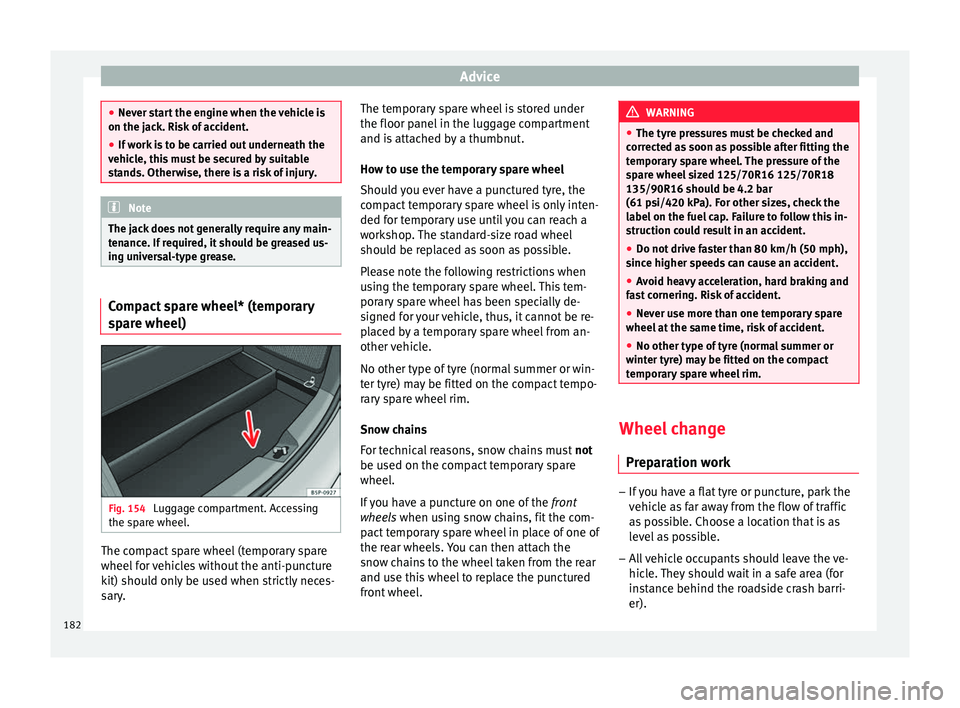
Fig. 154
Luggage compartment. Accessing
the spare wheel. The compact spare wheel (temporary spare
wheel for vehicles without the anti-puncture
kit) should only be used when strictly neces-
sary. The temporary spare wheel is stored under
the floor panel in the luggage compartment
and is attached by a thumbnut.
How to use the temporary spare wheel
Should you ever have a punctured tyre, the
compact temporary spare wheel is only inten-
ded for temporary use until you can reach a
workshop. The standard-size road wheel
should be replaced as soon as possible.
Please note the following restrictions when
using the temporary spare wheel. This tem-
porary spare wheel has been specially de-
signed for your vehicle, thus, it cannot be re-
placed by a temporary spare wheel from an-
other vehicle.
No other type of tyre (normal summer or win-
ter tyre) may be fitted on the compact tempo-
rary spare wheel rim.
Snow chains
For technical reasons, snow chains must
not
be used on the compact temporary spare
wheel.
If you have a puncture on one of the front
wheels when using snow chains, fit the com-
p act
temporary spare wheel in place of one of
the rear wheels. You can then attach the
snow chains to the wheel taken from the rear
and use this wheel to replace the punctured
front wheel. WARNING
● The tyre pressures must be checked and
corrected as soon as possible after fitting the
temporary spare wheel. The pressure of the
spare wheel sized 125/70R16 125/70R18
135/90R16 should be 4.2 bar
(61 psi/420 kPa). For other sizes, check the
label on the fuel cap. Failure to follow this in-
struction could result in an accident.
● Do not drive faster than 80 km/h (50 mph),
since higher speeds can cause an accident.
● Avoid heavy acceleration, hard braking and
fast cornering. Risk of accident.
● Never use more than one temporary spare
wheel at the same time, risk of accident.
● No other type of tyre (normal summer or
winter tyre) may be fitted on the compact
temporary spare wheel rim. Wheel change
Preparation work –
If you have a flat tyre or puncture, park the
vehicle as far away from the flow of traffic
as possible. Choose a location that is as
level as possible.
– All vehicle occupants should leave the ve-
hicle. They should wait in a safe area (for
instance behind the roadside crash barri-
er).
182
Page 185 of 236
Emergencies
– Switch off the engine. Switch on the hazard
warning lights.
– Apply the handbrake firmly.
– En g
age the first gear , or put
the selector
lever to position P for those vehicles with
an automatic gearbox.
– If you are towing a trailer, unhitch it from
your vehicle.
– Take the vehicle tools and the spare wheel
out of
the luggage compartment. WARNING
Put the hazard warning lights on and place
the warning triangle in position. This is for
your own safety and also warns other road
users. CAUTION
If you have to change the tyre on a gradient,
block the wheel opposite the wheel being
changed by placing a stone or similar object
under it to prevent the vehicle from rolling
away. Note
Please observe related legal requirements. Changing a wheel
Change the wheel as described below: –
Remove the wheel cover
. A
l
so refer to
››› Fig. 155.
– Slac
ken the wheel bolts .
– Rai
se the vehicle with the jack at the corre-
spondin
g area.
– Remove the wheel and put
on the spare
one.
– Lower the vehicle.
– Tighten the wheel
bolts firmly with the box
sp
anner.
– Replace the hub cap.
Aft
er changing a wheel –
Put the tools back in their storage location.
– Place the wheel with the defective tyre in
the luggage compartment and secure it.
– Check the tyre pressure of the newly fitted
tyre as soon as possible.
– Have the tightening torque of the wheel
bolts checked as soon as possible with a
torque wrench. The prescribed torque must
be 120 Nm. Note
● If you notice that the wheel bolts are corro-
ded and difficult to turn when changing a wheel, they must be replaced before having
the wheel bolt tightening torque checked.
● For safety reasons, drive at moderate
speeds until the wheel bolt tightening torque
has been checked. Wheel trims
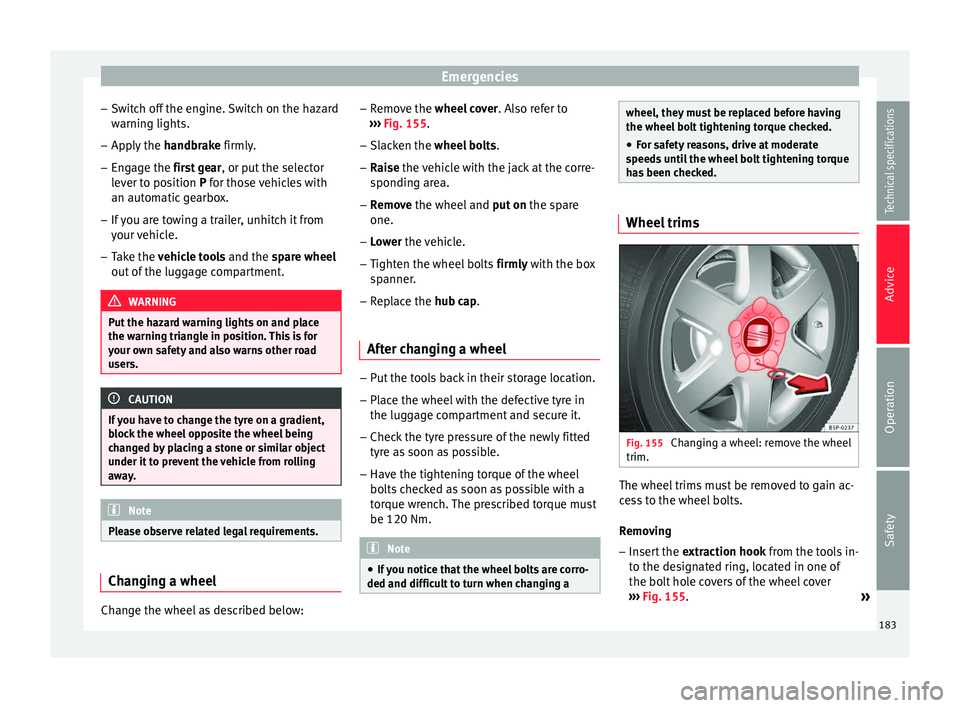
Fig. 155
Changing a wheel: remove the wheel
trim. The wheel trims must be removed to gain ac-
cess to the wheel bolts.
Removing
– Insert the extraction hook from the tools in-
to the designated ring, located in one of
the bolt hole covers of the wheel cover
››› Fig. 155 .
»
183
Technical specifications
Advice
Operation
Safety
Page 188 of 236
Advice
Removing and fitting the wheel Change the wheel as described below after
loosening the wheel bolts and raising the ve-
hicle with the jack.
Removing a wheel
– Unscrew the wheel bolts using the box
spanner and place them on a clean surface.
Fitting a wheel
– Screw on the wheel bolts in position and
tighten them loosely with a box spanner.
The wheel bolts should be clean and easily
screwed. Before fitting the spare wheel, in-
spect the wheel condition and hub mounting
surfaces. These surfaces must be clean be-
fore fitting the wheel.
If tyres with a specific direction of rotation
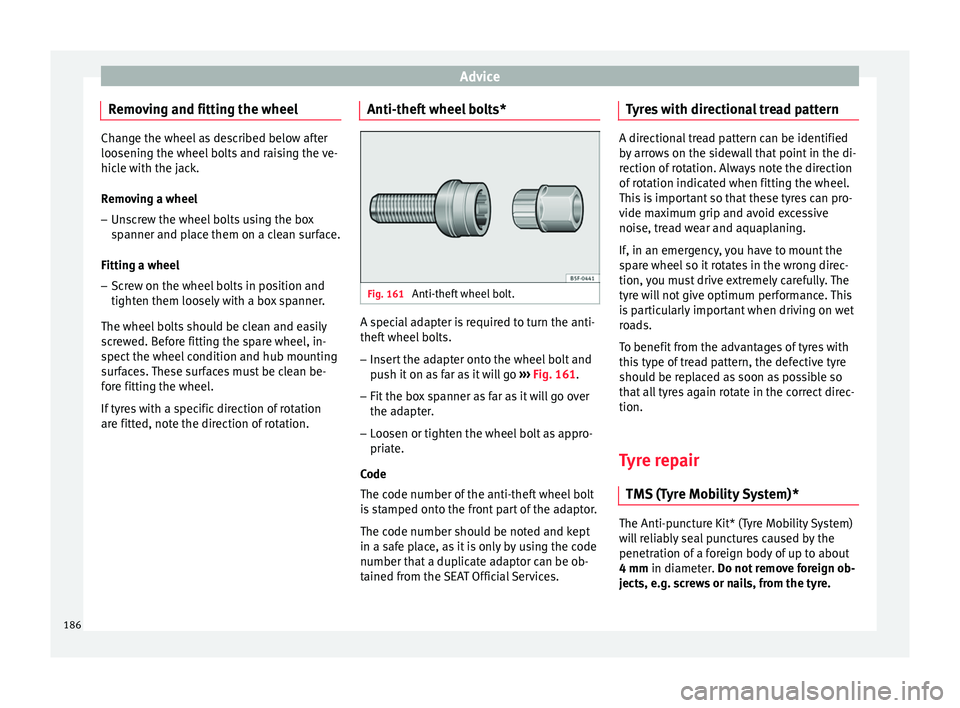
are fitted, note the direction of rotation. Anti-theft wheel bolts* Fig. 161
Anti-theft wheel bolt. A special adapter is required to turn the anti-
theft wheel bolts.
– Insert the adapter onto the wheel bolt and
push it on as far as it will go ››› Fig. 161 .
– Fit the bo
x spanner as far as it will go over
the adapter.
– Loosen or tighten the wheel bolt as appro-
priate.
Code
The code number of the anti-theft wheel bolt
is stamped onto the front part of the adaptor.
The code number should be noted and kept
in a safe place, as it is only by using the code
number that a duplicate adaptor can be ob-
tained from the SEAT Official Services. Tyres with directional tread pattern A directional tread pattern can be identified
by arrows on the sidewall that point in the di-
rection of rotation. Always note the direction
of rotation indicated when fitting the wheel.
This is important so that these tyres can pro-
vide maximum grip and avoid excessive
noise, tread wear and aquaplaning.
If, in an emergency, you have to mount the
spare wheel so it rotates in the wrong direc-
tion, you must drive extremely carefully. The
tyre will not give optimum performance. This
is particularly important when driving on wet
roads.
To benefit from the advantages of tyres with
this type of tread pattern, the defective tyre
should be replaced as soon as possible so
that all tyres again rotate in the correct direc-
tion.
Tyre repair TMS (Tyre Mobility System)* The Anti-puncture Kit* (Tyre Mobility System)
will reliably seal punctures caused by the
penetration of a foreign body of up to about
4 mm
in diameter.
Do not remove foreign ob-
j
ects, e.g. screws or nails, from the tyre.
186